Tag: Dominic West

The Square (2017)

The Square header
Art goes wrong in Ruben Östlund’s scattergun satire The Square

Director: Ruben Östlund

Cast: Claes Bang (Christian), Elizabeth Moss (Anne), Dominic West (Julian), Terry Notary (Oleg Rogozjin), Christopher Læssø (Michael), Lise Stephenson Engström (Daughter), Lilianne Mardon (Daughter), Marina Schiptjenko (Elna), Annica Liljeblad (Sonja), Elijandro Edouard (Boy with Letter)
Christian (Claes Bang) has it all. The respected director of a celebrated Swedish Modern Art Gallery, he’s rich, handsome and highly thought of by all. That all fractures when his phone and wallet are stolen in a confidence trick. Using the phone’s tracker, Christian identifies the working-class apartment building its in. In a burst of late-night energy, he writes a threatening letter to the thieves and posts a copy through every single apartment door demanding it’s return. It is: but Christian’s letter has a negative impact on an innocent young boy (Elijandro Edouard) whose parents now believe he must be a thief. Christian is so preoccupied with this he fails to pay attention to a YouTube video created to promote his new exhibition: the video of a homeless child being blown up outside the museum leads to national condemnation.

And that exhibit? It’s called The Square (you see!). Its main feature is a literal square on the floor, marking a safe space where everyone is equal. The exhibit is themed around trust, mutual respect and altruism. Traits which Östlund’s film reminds us time-and-time again his central characters are all sadly lacking in. It’s part of a broad-ranging satire on the self-importance of the Art World and the self-obsession of the upper classes that, while beautifully filmed, comes across as rather scattergun. Putting it bluntly, most of its targets are so obvious, the entire film might as well be footage of fish being shot in barrels.

A film like this, hinges on Christian’s self-perception being clearly shown to be very different from his reality. In effect, we need to see how Christian believes himself to be a decent, upstanding, noble fellow but also be shown he is in fact prejudiced, self-obsessed and vain. While the film does very well to show how shallow Christian’s “nice-guy” image is – he basks in the adulation of colleagues and museum patrons and carefully prepares his ‘spontaneous’ presentations for maximum effect – we never get quite enough of a sense of how he sees himself. His mystique is punctured so early, that the sense of events forcing an awkward confrontation with his true character is not developed.

This takes nothing away from the exceptional performance of Claes Bang, a charismatic and gifted actor who can pivot on a sixpence from huge charm to bullying menace. He’s completely believable as the red-spectacled, scarf wearing aesthete just as he is the sort of bully who’ll push a troublesome kid over. Matey and jovial with his employees, he’s also hesitant on their names and berates assistant Michael (Christopher Læssø) when he gets cold feet about executing his letter drop plan (on top of which, he naturally assumes as Michael is black, he’ll be better at carrying out the plan than Christian). His life is a careful performance, with every moment scripted by him, that fractures into something much messier the instant he loses control.
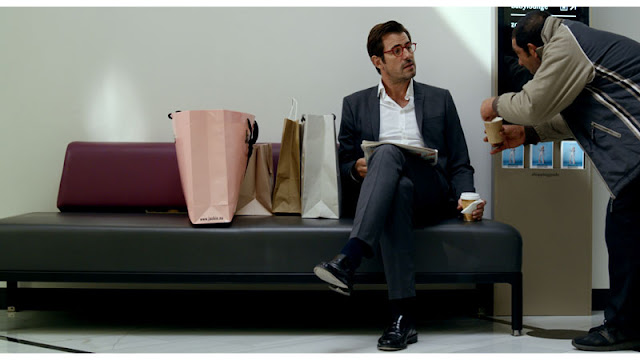
It’s just a shame that Östlund doesn’t delve into the opportunities this presents. He’s more interested in obvious characters like Elizabeth Moss’ Anne, a preening journalist (she inexplicably lives with a Chimp) with whom Christian enjoys a one-night stand, culminating in the two of them bickering over a used condom. (Christian seems worried she’ll pinch his sperm).

Too often Östlund contents himself with simply stating that the upper clases are vain and pre-occupied with their own needs instead of the lives of others. In case we miss this point, the film is littered with shots of beggars. It even opens with the camera focused on a beggar sleeping on the street in broad daylight while, off camera, a passionate student pushes leaflets urging people to do more to help the homeless while passers-by express irritation or disinterest to them. You see! Even the campaigner is more interested in virtue signalling than actually helping people! Interactions with beggars pepper the film: Christian is annoyed by one beggar not being grateful enough when he condescendingly offers to buy them dinner to get out of an awkward conversation with them and then later pays another to guard his shopping when he takes a phone call.

This social satire runs in parallel with a scathing-but-rather-obvious series of jokes at the expense of the preening self-importance of the Art World. The exhibition, The Square, is treated as if it’s the second coming but, other than parroting the Artist’s written vision, no one (not even Christian) seems interested in engaging in it or really has a clue what it is trying to do. The most important part of Christian’s role is in fact attracting money from rich patrons, who ooh and ahh over the art but have nothing whatsoever to say about it. The art itself is a parade of cliches – although there is a very funny recurring joke of an installation that is a series or piles of ash on the floor which the museum cleaners inadvertently slowly reduce each night.

The unwillingness of people to rock the boat in social situations is also parodied. Dominic West cameos as an American artist whose Q&A is constantly disrupted by a man with Tourettes – the discussion collapses but no one knows how to even to begin to manage the situation. This culminates in the film’s showpiece (and best scene). A Russian artist whose ‘art’ is to impersonate a monkey (played by motion-capture guru Terry Notary), performs an installation at a fund raiser dinner. The guests (and Christian) sit in increasingly awkward silence, no one willing to take the first step to intervene, as the artist progresses from humorous monkey noises to increasing acts of intimidation, violence and finally sexual assault.

It’s all interesting stuff, but it all feels a little too obvious. The advertising reps bought into design the video are such cliched social media obsessives they feel like sitcom characters. The juxtaposition of The Square’s idea that “everyone inside the square is equal” with the reality of no one being equal is made time and time and again with reduced impact.

Östlund finds a host of squares (stairways, windows etc) to frame Christian in visually to hammer this home. He makes frequent use of one-sided two shot set ups (meaning we only focus on one character during a conversation or exchange) which helps further drill down into that character’s psyche and stress their distance from whoever they are talking to. But it’s a lot of flash on an otherwise rather obvious and self-satisfied film, which never makes as many new and original points as it thinks.

If it’s a stunning realisation to you that people have a tendency to be self-obsessed, that the Art world is as much about posing and money as it is art and that social awkwardness will stop people intervening in the most disastrous circumstances, this is the film for you. Otherwise, you might find little real insight here.

Chicago (2002)

Catherine Zeta-Jones struts her stuff in Rob Marshall’s fabulous Oscar winner Chicago

Director: Rob Marshall

Cast: Renée Zellweger (Roxie Hart), Catherine Zeta-Jones (Velma Kelly), Richard Gere (Billy Flynn), Queen Latifah (“Mama” Morton), John C. Reilly (Amos Hart), Christine Baranski (Mary Sunshine), Taye Diggs (The Bandleader), Colm Feore (Martin Harrison), Lucy Liu (Kitty Baxter), Dominic West (Fred Casely), Mya (Mona), Susan Misner (Liz), Denise Faye (Annie), Deidre Goodwin (June)

It’s become quite the fashion to knock Chicago. Heck I’ve done it myself. How did this mere musical win Best Picture? It’s not even as if the original production was much more than an entertainment. It’s another of those films diminished by whispers that it doesn’t deserve the title of Best Picture. But, look at the film with an unprejudiced eye, and you’ll see that this is the best stage-to-screen musical theatre adaptation since Cabaret. Chicago is such dynamic, high octane entertainment, you would have to a really cold heart not to enjoy it.

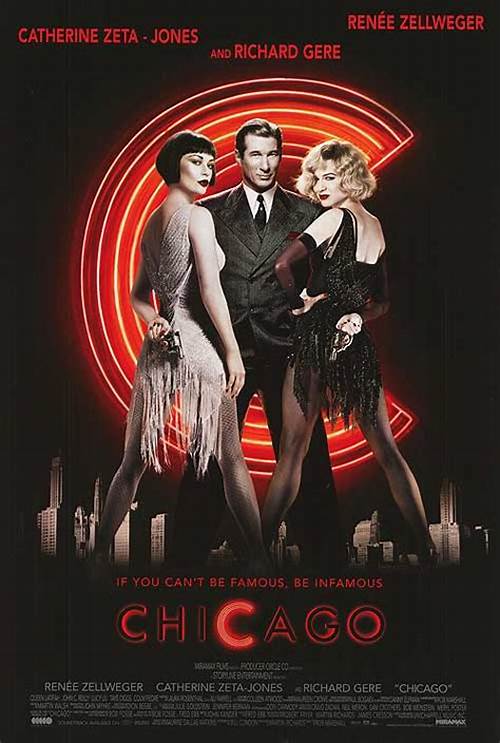
A heart as cold, perhaps, as most of the characters. Its set in a 1920s Chicago where it doesn’t matter what you are famous for, so long as you are famous. Who are the bigger stars? The people on stage of the infamous on death row? Roxie Hart (Renée Zellweger) is a wannabe who guns down her conman lover Fred Casely (Dominic West) when his promises of the stage career she’s dreaming of turns out to be all hot air. Roxie works out that she can turn her infamy into just plain fame – following the inspiration of vaudeville-star-turned-accused-murderer Velma Kelly (Catherine Zeta-Jones), who is now more famous than ever. With amoral lawyer Billy Flynn (Richard Gere) in their corner, can they play all sides against the middle and find freedom and fame?

Chicago’s debt to Bob Fosse is in almost every single frame. Rob Marshall’s brilliant choreography is inspired by Fosse’s own work for the original production. It means the entire film drips with the passionate sexiness of Fosse’s best work. It’s also inspired by Fosse’s Cabaret in its use of the musical numbers. There all the musical numbers were kept within the nightclub, acting as a subtle commentary on the events of the film. Here they occur in Roxie’s imagination, staged in a shadowy empty theatre with a mysterious band leader (a charismatic Taye Diggs) introducing each song. It’s a brilliant concept, that allows them to be staged with the sort of exuberance and theatricality that would look plain odd in a ‘real’ setting.

And what musical numbers they are! These are toe-tappingly, finger-clickingly fun, that will make you want to jump up and join in. Marshall’s choreography and direction is not only faultless, but also covers a range of styles. From the sultry opening of All That Jazz performed by Catherine Zeta-Jones, we get burlesque (When You’re Good to Mama), sensual sexiness (Cell Block Tango), knock-about farce (We Both Reached for the Gun), classic 1930s Astaire and Rogers (Roxie) and surreal madness (Razzle Dazzle). The one thing they all have in common is the high-octane energy they are performed with (no wonder all those dancers are so slim!), with no one leaving anything in the dressing room.

Chicago is possibly one of the best edited musicals ever made. Marshall gets a superb balance between camera movements, cutting and the dance numbers. We can appreciate – and see – every step of the intricate choreography, with clear camera movements and angles. But the film is also edited practically on the beat. Cuts accentuate changes in the tempo and even marry up with the exact movements of the dancers. Not only that, the numbers frequently cut from reality to fantasy and back again – and this parallel montage is superbly done, with perfectly timed transitions. The cutting complements each number so well, it actually makes them more exciting and dynamic. It’s a masterclass in using the language of cinema to accentuate the impact of dancing.

But Marshall manages to make Chicago not just a collection of amazing dances and fabulous tunes. In our celebrity worship age, Chicago feels increasingly more relevant – you can imagine Roxie would love to be on reality TV and would never be off Twitter. It doesn’t matter that she’s got no real talent (in fact it makes the fact that all the musical numbers are fantasies even more witty), she’s just desperate to be known. Shooting her lover is the best thing that’s ever happened to her and she’ll do anything to stay in the newspapers, from a fake pregnancy to playing the timid ingenue.

Everyone in Chicago is just playing the game. Velma is just as desperate to cling to fame – and her growing desperation at losing the limelight to Roxie is almost touching. Mama Morton, the quietly corrupt prison warden, lives vicariously through her inmates (she even dyes her hair to match Roxie’s). The media lap up the details of every killing, turning the trials into huge soap operas. And at the heart you have Billy Flynn, as much a showman as he is a lawyer, playing every angle and knowing its all about telling a good story rather than truth or justice.

Chicago is played with absolute commitment. Renée Zellweger is excellent as the fiercely ambitious, amoral Roxie, her fragile softness perfect for the image Roxie likes to project, just as she is able to twist her face into selfish meanness. Zeta-Jones clearly hadn’t forgotten her years of musical theatre, demonstrating she is a superb singer and dancer, her vampish glamour perfect for Velma’s dark ambition. Richard Gere (in a role turned down by Travolta, as he ‘didn’t get’ the framing device) channels his natural charisma and good natured smirk into a role that could have been made for him. Reilly is surprisingly sweet and effective as Roxie’s put-upon husband and Latifah hugely entertaining as the knowingly manipulative Mama.

Chicago may be “just a musical” – but you’d be hard pressed to find a better entertainment. The song and dance numbers are superb and the film still manages to land some blows on celebrity culture. Hollywood has always loved musicals – can you imagine how the viewers of Broadway Melody would have responded if they had seen this? – and with Chicago we get something we’ve not seen since the golden days of Bob Fosse. There are few Oscar winners as straight forwardly entertaining as this.

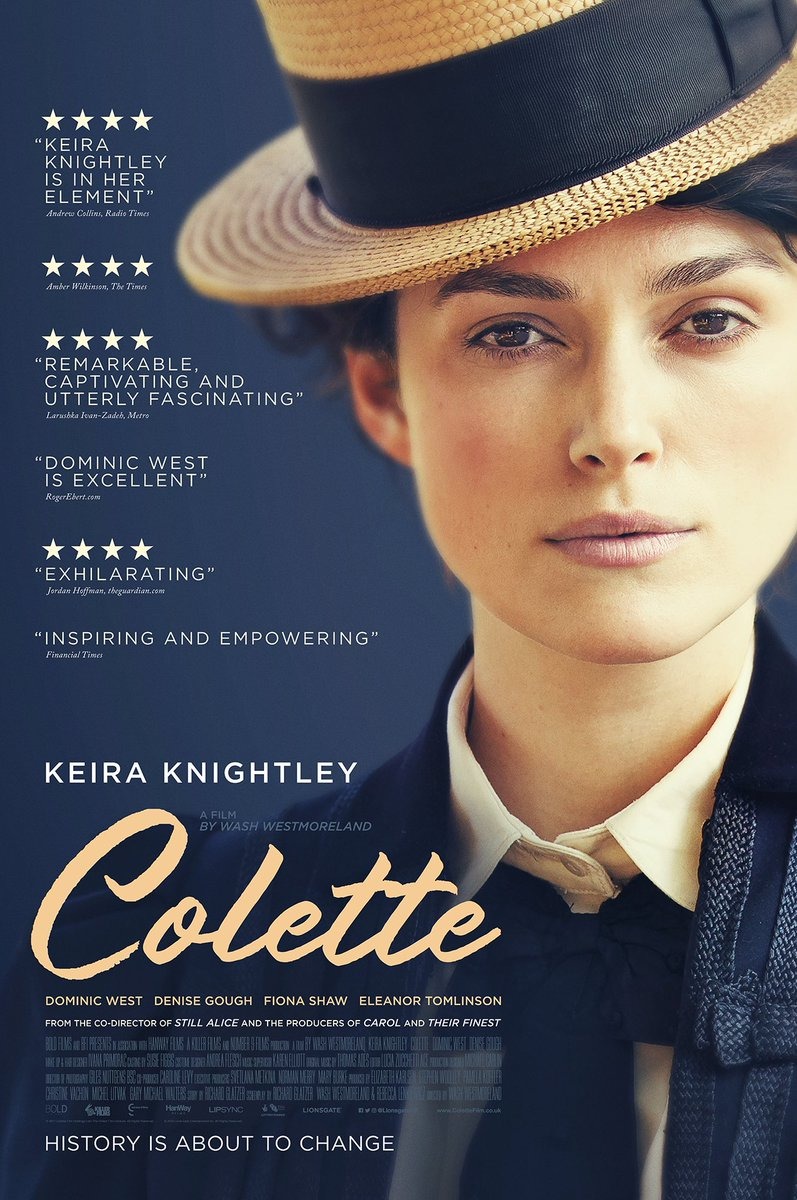
Colette (2018)

Keira Knightley tries her best in this light but safe biography Colette

Director: Wash Westmoreland

Cast: Keira Knightley (Gabrielle Colette), Dominic West (Henry Gauthier-Villars/Willy), Eleanor Tomlinson (Georgie Raoul-Duval), Aiysha Hart (Polaire), Fiona Shaw (Sido), Denise Gough (Missy), Robert Pugh (Jules), Rebecca Root (Rachilde), Julian Wadham (Ollendorff)

In the era of #metoo what could make for a more relevant storyline today than this biography of Gabrielle Colette (Kiera Knightley), a young woman who marries literary playboy Henry Gauthier-Villars (Dominic West) aka Willy. Henry brings her back to Paris, and reveals the secrets of his success – he is the front man for a host of ghostwriters, producing articles and even novels for the public. Colette writes a novel for the “factory”, based on her own childhood – Claudine àl’école – which Willy initially rejects but later publishes under his own name (after he has suggested revisions to improve its plot and general raunchiness). The book is a smash – and Willy is a sensation – as are the sequels, but the growing frustration Colette feels at her lack of recognition, combined with the growing sense of freedom she finds in their open marriage, starts to lead her to question what she wants from her own life.

Colette is a decent, rather middle-of-the-road and middlebrow literary biography, that dabbles with controversy and racy content, but essentially follows a fairly traditional structure of our hero finding her own voice. The most interesting thing about it, despite the obvious surface message of the woman exploited by a man, is to suggest that while Willy certainly profited from Colette’s work, he was also the primary driver in her development as a writer and that the two of them maintained a stable working partnership for years until events led to their collapse. 

Much has been made in particular of a scene where Willy locks Colette into a room to write – and there isn’t a single review that hasn’t mentioned it – but, in the context, it’s Colette who has failed to focus on the writing (which the pair have already been paid for), or wdo the work she has committed to do, much to Willy’s disappointment when he returns to the country home that the advance for the book has paid for. While her objections are at first furious she swiftly settles into writing in the room (and there is no suggestion that this event is any more than a single one-off, a shock tactic from Willy to get Colette creating again). This isn’t to say the film is suggesting that Colette shouldn’t have received all the credit and freedom from the start, but it does raise more interesting questions: yes Willy was taking advantage of her, but yes he also pushed her to achieve things she would never have done herself.

It’s all part of Dominic West’s superb performance as Willy, skilfully balancing a man who (until the final act of the film) is neither flat-out villain or misunderstood hero, but a man of shades of grey: flawed, selfish, lazy, thoughtless but also encouraging of his wife’s exploration of her own sexuality and creativity, supportive and capable of acts of charming sweetness and kindness. Westmoreland makes clear that for much of the marriage their relationship was functional and a good match, for all it was founded on the false sands of Colette being denied the public credit for her own work. Sure he spunks their money up the wall continuously, but he also helps her become an artist. 

For all the film’s workmanlike structure and obvious telling, this does make for a far more interesting version of the story than the straight “ogre-victim” story you might expect, even if it does start to get a bit bogged down in sexual shenanigans. The mostly focus around bisexual American socialite Georgie (Eleanor Tomlinson with a soapy Southern accent), who becomes the lover of both Colette and Willy. It’s part of the sense of Colette questing for an identity, but the idea of what this is and what the journey is never quite solidifies into something really incoherent. Though I suppose you could argue the journey is Colette realising she doesn’t need Willy, and that shorn of him she can survive far better on her own than he can without her.

Part of this is connected to Keira Knightley’s solid, but not quite deep enough, performance as Colette. As is often the way with her best work, Knightley works her socks off here and is clearly completely committed to the role and the film – but she just isn’t quite capable of elevating the depths of her skill to meet the full demands of the film. She doesn’t disgrace herself at all, but it’s a performance that never had enough fire and life to really become compelling.

It means you don’t quite get the powerful feminist message the film is aiming for. Knightley’s performance isn’t quite strong enough to counter-balance West, and the film’s failure to put together a compelling story line around what Colette actually wants – the film eventually settles for a rather ill-thought out phrase about wanting to lead her own life – means it peters out without much impact. There is a powerful story in here around women being denied recognition for their own talents and skills, but it never quite coalesces as it should.

Centurion (2010)

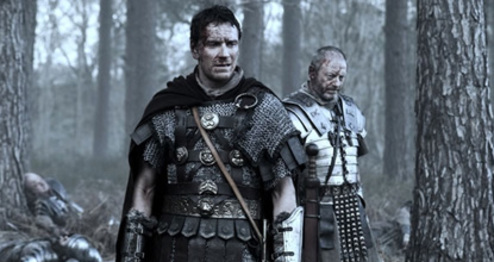
Michael Fassbender surveys the devastation that is Centurion

Director: Neil Marshall

Cast: Michael Fassbender (Quintus Dias), Olga Kurylenko (Etain), Dominic West (General Titus Flavius Virilus), Liam Cunningham (Brick), David Morrissey (Bothos), JJ Feild (Thax), Noel Clarke (Macros), Riz Ahmed (Tarak), Dimitri Leonidas (Leonidas), Ulrich Thomsen (Gorlacon), Imogen Poots (Arianne), Paul Freeman (Gnaeus Julius Agricola), Rachael Stirling (Drusilla), Less Ross (Septus)

It’s an old fable: the “missing” Roman legion, the 9thLegion that allegedly marched to Scotland around 120 AD. We don’t know what happened (if anything) but it usually gets tied into Hadrian’s decision to build his famous wall. Anyway, Neil Marshall’s film tries to plug the gap, with the Legion eradicated on an ill-judged expedition north to settle affairs there once for all. A “ragtag bunch” of survivors (all of whom match expected character tropes) have to run over hostile countryside, led by surviving senior officer Centurion Quintus Dias (Michael Fassbender) to get back to safety and Roman lines.

It’s a Neil Marshall film, so you can expect blood-letting aplenty and high-octane action on a budget. And you more or less get it, mixed with his love for accelerator-hitting chases and against-the-odds action. It’s entertaining enough, but its main problem is that it feels a little too by-the-numbers, as if all the thought about how to make it original and exciting went straight into the look and style of the film – all drained out colours and serious claret – and none at all into storytelling or character.

You sort of end up caring for the characters in a functional way – largely because they are all such familiar types – but their personalities seem to have been designed entirely around the various deaths that have been invented for them. So the enthusiastic meet unjust ends, the likeable fall to cruel chance, the world-weary give their lives for one more stand, the selfish meet justice. At the end, the characters you would basically expect to stumble to the finish line do. It’s a film that lacks any uniqueness.

In fact, what gives the characters life is the professional character actors playing them, all of whom can do what they are doing here standing on their heads and look like they were largely there with an eye on pleasant after-shooting hours in a series of local pubs. It’s hard otherwise to think what attracted them to these cardboard cut-outs and pretty familiar structure.

Not that there is anything wrong with what Marshall does with his film here – it’s a lot of fun when stuff is happening, it’s just that nothing feels like it carries enough weight or originality to survive in the memory. Everything is fine but nothing is really inspired. There is very little sense of Ancient Rome or any other place. The Romans are basically squaddies, an idea that sounds interesting until you remember turning period warriors into versions of modern soldiers is hardly new, while the Brits chasing them are woad-covered psycho stereotypes.

So while it passes the time, Centurion does nothing special with it. It feels like a wasted opportunity – that with a cast this good and a decent premise, plus a nice little historical mystery to pin it onto in order to give it depth, Marshall could have come up with something that was more than the sum of its parts rather than less. Perhaps it needed more time with its ragtag group so they actually became characters rather than plot devices. Perhaps it needed to take more of a rest from its constant chasing to allow quieter moments of reflection and character. Perhaps it’s just a chase film that is never quite compelling enough to make you overlook these things. Either way, Centurion isn’t an all-conquering empire of  film.

Money Monster (2016)


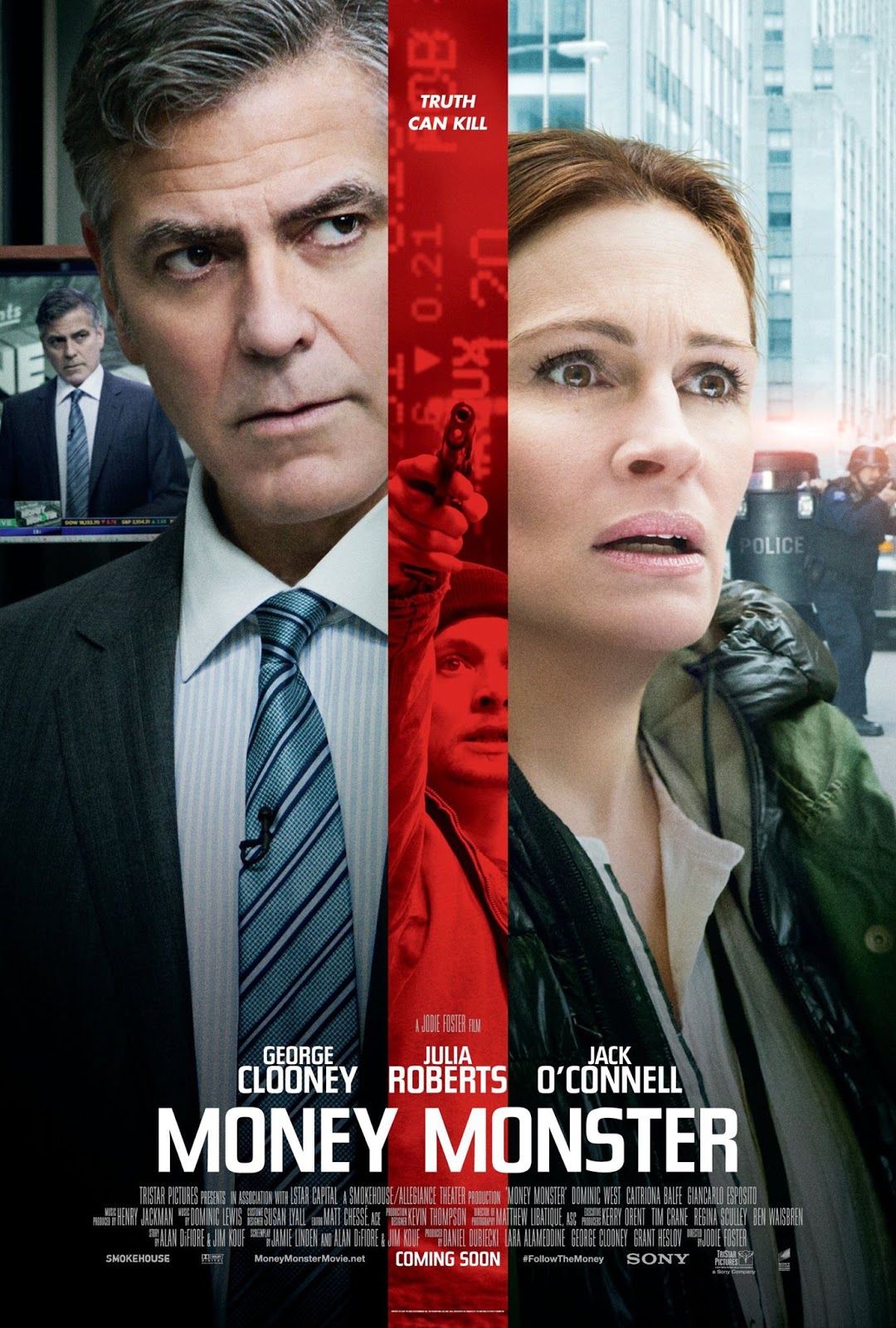
A bad day at the office was ahead for George Clooney

Director: Jodie Foster

Cast: George Clooney (Lee Gates), Julia Roberts (Patty Fenn), Jack O’Connell (Kyle Budwell), Dominic West (Walt Camby), Caitriona Balfe (Diane Lester), Giancarlo Esposito (Captain Marcus Powell)

For as long as there has been TV, then the world of Film has looked down its nose at the mass market medium. “It’s in your homes! It makes you dumber! It stops you caring!” Set a film in a TV studio and it’s a fair bet that, before long, some shallow media types will appear, a dramatic on-air event will take place, a shallow man will rediscover his soul and the camera will cut back to punters at home watching the drama as if they it was just part of the show.

All this is exhibited to its full in Money Monster, a passably entertaining hostage drama set in the studio of a fictional Wall Street themed entertainment and “news” show. Lee Gates (George Clooney) is a shallow, image and money-obsessed TV personality taken hostage after a desperate grief-stricken viewer Kyle Budwell (Jack O’Connell) loses his life savings on one of Gates’ tips. However, with the prodding of his director Patty (Julia Roberts), Gates slowly begins to rediscover his journalistic integrity.

Watching the film when it rather heavy-handedly enters into the world of media satire, it’s pretty hard not to remember better films in the same genre. Network covered much of this ground so well 40 years ago, it’s almost not been necessary to watch another film about the manipulation of the media. The Truman Show so successfully skewered the thoughtless collaboration of the watcher at home, that this film’s attempt feels like a rather mundane repeat.

Saying that, George Clooney does a grand job of portraying the shallow, media man re-discovering his depths – although lord knows he’s played this sort of part often enough to do it standing on his head. But he gets the dark comedy of it, and he is also able to deliver on the growing decency and integrity of the character. Julia Roberts is pretty good as a confident professional who has allowed her principles to slide for too long. In this illustrious company, Jack O’Connell more than holds his own, delivering brilliantly as a desperate and angry man.

The hostage taking sequences are quite well done, and threaded in well with the general satirical air of the film. At two key moments during the crisis, the film successfully pulls the rug out from under the feet of the viewer by delivering a different outcome than we might have expected. It’s probably when the film is most effective. It also does a good job threading many of the themes, locations and characters that will become important by the end of the film into its opening moments – many of them done so gently, you won’t even notice until they become important later.

The dark satire around the uncaring nature of big business and its lack of principles also hits more than a few familiar beats (big business being another thing multi-million film companies love to lay into), but this side of the plot is interesting enough – and I didn’t quite work out how the dodgy dealing had worked out. The final reveal and confrontation around this is well staged. It doesn’t tell you anything new, or present its old points in a unique or intriguing new way, but it does it in an entertaining way.

The film generally deserves some congratulation for its staging – Foster directs with a tightness and the flimsy conception of the film is delivered in a taut 85 minutes (almost in real time) which certainly means it doesn’t outstay its welcome. The acting is decent and the points it makes are well delivered, no matter how familiar they are. The film effectively plays with and changes your views on its characters over the course of its runtime. Honestly there are worse ways you can spend an hour and a half. It’s just not something that is going to stick with you for long.