Tag: Don Siegel

The Shootist (1976)

The Shootist (1976)

Wayne’s final elegiac Western as a dying gunslinger tries to go out on his own terms

Director: Don Siegel

Cast: John Wayne (JB Brooks), Lauren Bacall (Bond Rogers), Ron Howard (Gillom Rogers), James Stewart (Dr Hostetier), Richard Boone (Sweeney), John Carradine (Beckum), Scatman Crothers (Moses), Richard Lenz (Dobkins), Harry Morgan (Marshall Thibido), Sheree North (Serepta), Hugh O’Brian (Pulford)
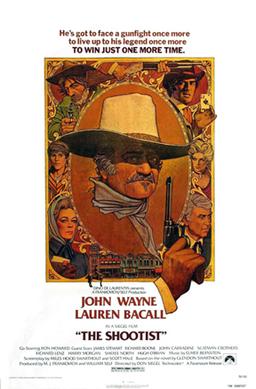
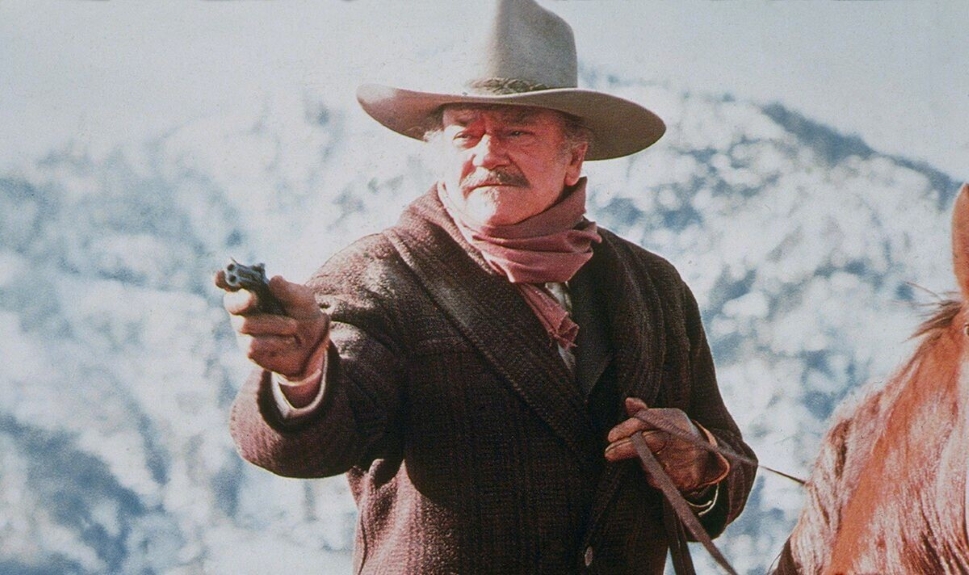
It’s 22nd January 1901 and Queen Victoria has passed. Automobiles are starting to chug down roads, towns filled with electricity, telegraphs and trams, no longer look like the beat-up, dust-bowls the likes of Wyatt Earp policed. It’s a new age and the end of the Wild West. Which also means it’s the end of the gun-toting cowboys, like JB Brooks (John Wayne), who rode freely and grabbed their six-shooters faster than anyone else. Brooks rides into Carson City, his cancer terminal, his life lonely and full of enemies, wanting to live (and die) in his final week on his own terms.

You don’t need to be a psychologist to see more than a few parallels between Brooks and the man playing him, Hollywood legend John Wayne. Wayne himself was struggling with a cancer that claimed his life three years later and you could argue he too had outlived his time. The glory days of the Westerns were gone along with men like John Ford who built it. The Shootist draws huge piles of its elegiac emotion from this – with even more retrospectively added when it turned out to be the star’s swan song.

It’s strange to think Wayne wasn’t even first choice for the role (the producers were worried his health might not last), because he is so perfect for it that the line between Wayne and Brooks seems paper thin. Wayne still has the spark under the weakness of a sickly one who downs laudanum and relies on a cushion to sit comfortably. He’s a vulnerable man, raging quietly against the dying of the light. Lonely, devoid of friends whose entire life’s possessions are wrapped up in a saddle bag. But he’s also dangerous who can still be extraordinarily ruthless. He kills without hesitation when called on and resorts to violent threats (backed with a gun) when he needs to. But he needs to believe there is more to him than this.

Brooks is a man ‘scared of the dark’, quietly terrified about how he will be remembered. He sees himself as a ‘shootist’, a prowling man’s-man who shot when he needed to. What he doesn’t want to be seen as is a ruthless blood-soaked assassin dealing death left-right-and-centre. He humiliates a journalist (the weasily Richard Lenz) who wants a blood-and-guts killer’s story, sending him packing with a gun in his mouth. He turns away a funeral director (John Carradine, a lovely cameo) who offers a free funeral so he can sell tickets to see the dead killer. He’s desperate for some sort of positive legacy.

This overlaps with Wayne who, if he didn’t know this was his final film, surely knew it was probably his final Western. Siegel opens with a montage from Wayne films past (including Red River, Hondo and Rio Bravo) before crashing into a wide-screen, Fordian landscape that sees Wayne swiftly get the better of a would-be robber. Wayne’s performance is, whatever you think of him, undeniably heart-felt. His drawling pain-wracked face, full of fear and frustration, when told his fatal diagnosis by an old friend (an almost equally emotional cameo from that other drawling icon of the Western, James Stewart) is very moving.

You can see Brooks regrets when an old flame (Sheree North) arrives to suggest they marry – and the hurt when it becomes clear she only wants marriage so she can sell his story. The closest thing he has to a friend – Stewart’s doctor – he hasn’t seen for fifteen years (coincidentally the exact length of time since the two actors shot The Man Who Shot Liberty Valance). In fact it becomes clear the people in his life are enemies and rivals. From Richard Boone’s weasily rancher who blames Brooks for his brother’s death to Hugh O’Brian’s suave gambler who wants the chance to take down a legend. Even that’s better than Harry Morgan’s nervous Marshal, who bursts into relieved laughter when he hears cancer is going to take care of Brooks so he doesn’t have to.

In his final week, Brooks finds some sort of connection not based on fear, envy or greed with Lauren Bacall’s (yet another golden-voiced legend) Bond Rogers, a widow with a tearaway son Gillom (Ron Howard), whose initial suspicion of Brooks soften. Bacall is excellent, full of humanity and sharp no-nonsense sincerity that hides a warmth you feel she’s had to crush down over years of holding hearth-and-home together. Brooks and Mrs Rogers form a quiet friendship, based on mutual loneliness, both actors playing beautifully in a series of quiet, sombre but gentle scenes, with Bacall drawing even more humanity from Wayne.

Mrs Rogers’ son, Gillom, becomes the embodiment of Brooks battle for a legacy. Ron Howard makes Gillom a cocky, immature dreamer, exactly the sort of guy who’d lap up the sort of blood-and-guts stories Brooks is worried his life will be turned into. He’s wowed when Brooks – alerted by his pain-ridden body keeping him awake – takes down two would-be assassins. But his mother is terrified that he could lead the wrong sort of life. And, eventually, Brooks himself starts to worry that all he’s doing spending time with him is leading Gillom towards an end like his: lonely and dying in a guest house, surrounded by strangers. It becomes the thematic struggle of the film, which is handled (like the rest) with an unlaboured patience.

It’s all building of course to Brooks deciding to go down on his own terms, clutching a gun not a laudanum bottle. The Shootist ends with a blood-soaked shoot-out that we all suspect its heading to, expertly assembled by Siegel. Siegel’s direction throughout is faultlessly smooth, avoiding all temptation to layer on sentimentality but instead let the sad tiredness of Wayne carry the emotion without loading the deck. It’s a beautifully done, quiet, restrained and perfectly elegiac picture that makes for a perfect final role for John Wayne. A sad, touching film about a strong-willed man fighting a last battle he can’t win, it’s a compelling watch.
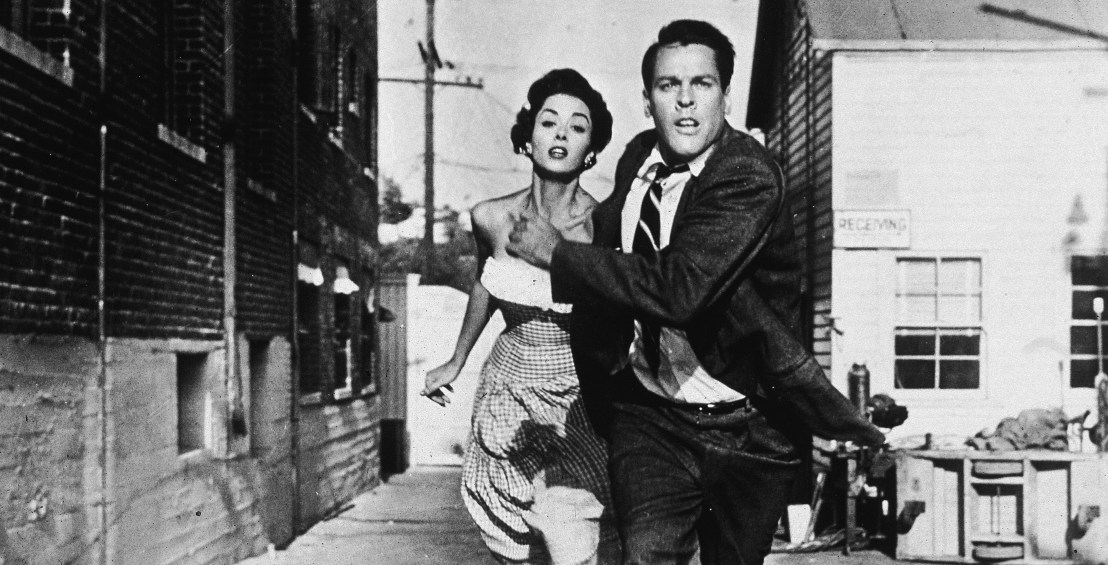
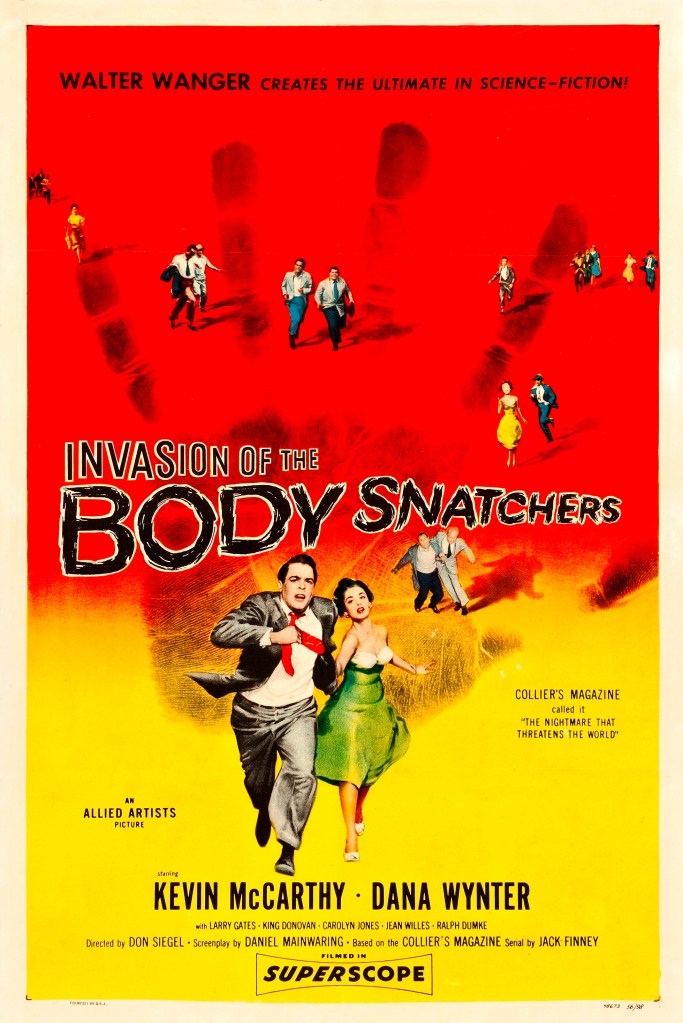
Invasion of the Body Snatchers (1956)

Invasion of the Body Snatchers (1956)

Paranoia in small-town America is superbly executed in Siegel’s creepy sci-fi thriller

Director: Don Siegel

Cast: Kevin McCarthy (Dr Miles Bennell), Dana Wynter (Becky Driscoll), King Donovan (Jack Belicec), Carolyn Jones (Teddy Belicec), Larry Gates (Dr Dan Kauffman), Virginia Christine (Wilma Lentz), Ralph Dumke (Police Chief Nick Grivett), Jean Wiles (Nurse Sally Withers), Bobby Clark (Jimmy Grimaldi)

‘Look, you fools, you’re in danger! Can’t you see?! They’re after you! They’re after all of us! Our wives, our children, everyone! They’re already here! You’re next!’

Those paranoid screams from Dr Miles Bennell (Kevin McCarthy) are part of the iconic conclusion of Don Siegel’s thrilling B-movie sci-fi conspiracy, full of the creeping horror of not trusting your own eyes or ears. It’s set in small-town Santa Mira, a sweet-as-apple-pie slice of Americana, where everyone knows everyone and life never changes. Until, of course, it does. Dr Bennell returns from a conference in Los Angeles to an epidemic of people claiming their loved ones are no longer their loved ones but that something about them is different. Bennell shrugs this off, more focused on his budding romance with fellow divorcee Becky Driscoll (Dana Wynter) – until he finds a clone of his friend Jack Belicec (King Donovan) growing in their home and faces the horrific truth: alien invaders are replacing people in the town with emotionless duplicates bent on world domination.

Siegal always claimed it was just a movie. That he wasn’t interested in political statements. You can believe that if you like, but Invasion of the Body Snatchers’ power stems from the terrible political and social parallels it draws with the real-world. The inversion reeks of 50s McCarthyite paranoia at communist infiltration, those suspicious Pinkos uninterested in individuality, only in protecting the system, where people are just cogs in its wheel. Even today, it still feeds on our fear of ‘the system’ absorbing us, crushing all that individuality we pride ourselves in having.

Even scarier at the time, Invasion doesn’t happen in the big city (where individuals are all getting lost anyway), but in that most American place of all, sacred small-town America, of picket fences and lifelong neighbours. If it can happen there, Invasions suggests, it really could happen anywhere. It’s one of many instances where Siegel makes the low-budget work effectively: in the same way he made a massive city full of people you don’t know the perfect space for a killer in Dirty Harry, he makes an intimate community the worst possible place to see people drained of humanity.

Invasions of the Body Snatchers uses that low-budget and limited locations to excellent effect. The bulk of the action taking place in the character’s homes and offices is actually more chilling. Watching a pod person mow a lawn, while his terrified niece (an effective performance from Virginia Christie) swears up-and-down he’s definitely not really her uncle, or a child running in terror from the home of his preternaturally calm mother is even more scary. That gets even more disturbing when our heroes discover replicas of themselves growing in their basements, or watch their small-town streets suddenly turn into a sea of emotionless duplicates.

There is also a hell of a lot snuck under the censor’s watchful eyes (maybe they only half-watched B-movies?) Its sharp screenplay includes plenty of surprisingly racy talk about between Bennell and Becky about his ‘bedside manner’ (‘that comes later’ he wryly tells her), or the fact that both of these characters talk openly about ‘going to Reno’, a popular euphemism at the time for divorce. For the time this is a surprisingly frank discussion of sex, not to mention the possibility of contented divorce (even Bennell’s nurse teases him about his flirtations with married ladies). What’s interesting is to consider is, if part of the appeal of the film is the horror of the familiar disappearing, perhaps the open acceptance of both divorce and sex suggests the process is already happening in different ways? Perhaps the safe world of picket fences is collapsing anyway, into something more permissive (and, who knows, plenty of people might well prefer that).

The creepy body-horror of the pods the duplicates grow in is also surprisingly disturbing for a 50s sci-fi. Splitting open to reveal the half-formed people inside, covered in foam, or the creepily serene complete copies that emerge, there is something deeply unsettling about it. No wonder Bennell’s instinct is to destroy them if he can with a garden fork, a surprisingly graphic choice. It’s hard to imagine a major Hollywood picture getting away with this sort of nightmare imagery.

It helps to build the terror of the film, which grows more-and-more relentless. Much of the final third of Invasion mixes a cat-and-mouse game with Bennell and Becky’s desperate flight from the town. It culminates in Bennell – in a scene really sold by Kevin McCarthy, who is the picture of (literally) square-jawed determination and reasonableness – disintegrate into just the sort of ranting lunatic (as he would do again in a cameo in the 1978 remake) the pod people decide they can let go, because ‘no one will believe him anyway’. Siegel shoots this sequence of paranoid ranting with a fast-cut mix of close-up and unsettling angles, as Bennell fails utterly to get anyone on the highway to slow down and listen to his warnings, like that nightmare of shouting when no one can hear you.

Perhaps it was too much for the producers, who added their own reassurance, introducing a framing device where Bennell recounts his tale to two reassuring figures of authority. I like to think Siegel – who uses visual metaphors for creeping paranoia and panic effectively throughout the film – deliberately shot these sequences as dully as possible (they remind me above all of the pedestrian final sequence of The Magnificent Ambersons) either so that we forget them (which we do) or perhaps to suggest their mundane nature implies these two-dimensional doctors and FBI agents might just be pod people themselves.

Despite the framing device, Invasion of the Body Snatchers is a tightly paced thriller, that builds in intensity throughout and uses its small-town setting as an excellent metaphor for the terrifying thought of your own family being invaded and subverted by a horrendous outside force. It makes for a compelling B-movie and leaves a deeply unsettling feeling behind: no wonder it has inspired so many remakes and reinventions. The terror of the people you know being the same and yet so completely alien and different, is going to have impact on every generation, no matter the context.

Dirty Harry (1971)

Dirty Harry (1971)

Eastwood enters into cinematic legend in this grippingly entertaining pulpy cop thriller

Director: Don Siegel

Cast: Clint Eastwood (Inspector Harry Callahan), Harry Guardino (Lt Al Bressler), Reni Santoni (Inspector Chich Gonzalez), John Vernon (Mayor), Andy Robinson (Scorpio), John Larch (Police Chief Paul Dacanelli), John Mitchum (Inspector Frank DiGiorgio), Mae Mercer (Mrs Russell)

“Do you feel lucky? Well do ya? Punk” With these words, .44 Magnum in one hand and remains of a hot dog in the other (yes, Harry Callahan was so cool he didn’t even stop having lunch to take on a bunch of armed robbers), Clint Eastwood made a permanent mark on cinematic history. In 1971 Dirty Harry was condemned by some as fascist or reactionary, but really it’s just energetic, punchy, impossibly entertaining pulp. In a year where tough, rule-bending cops were de rigour, Dirty Harry may have more of a B-movie vibe than Friedkin’s Oscar-winning The French Connection but there is no doubt which one is the most viscerally entertaining.

“Dirty” Harry Callahan (Clint Eastwood) – so called because he gets all the jobs no-one else wants – is a tough-as-nails Inspector who values the Rule of Law over the Rules of the Law. Taciturn, not-suffering fools and always on the hunt for criminals (as the prototype gruff cop maverick, of course he works best alone), he prowls the streets of San Francisco and stops at nothing to take down bad guys and protect the innocent. He’s the guy you want on the case when the ruthless Scorpio killer (Andy Robinson) holds the city to ransom, shooting innocent people at random, seizing hostages and sending notes demanding payment to prevent more outrages.

Dirty Harry is lean, mean and a simply perfect piece of pulpy action. Directed with a tautness by Don Siegel, that never let’s go, it riffs on real life events – Scorpio is an obvious stand-in for the Zodiac Killer – and basically shifts a shoot-first-ask-questions-later cowboy into the heart of a modern city. Harry, embodied with sublime suitability by Eastwood (cementing his image) has a waspish sense-of-humour, speaks as he finds, never-ever-stops, has the ruthless determination we all wish we had and carries inside himself (buried deep) a maudlin sadness at his fundamental loneliness.

Dirty Harry doesn’t shirk in showing how a cop who bends the rules to deliver real justice can be an attractive figure. Harry doesn’t quite shoot first – he gives a cursory warning every time – but he always responds with lethal force when people are threatened. He’ll carry out illegal search operations of despicable offenders, he’ll follow a psychopath because he knows he’ll offend again (he’s right, but still) and when Scorpio won’t tell him where a hostage has been hidden, he doesn’t think twice about effectively torturing the guy to get him to talk.

Siegel’s film knows that this makes Harry the sort of guy we liberals tut about but, when push-comes-to-shove we need. Harry clones run through film and television history – what is 24’s Jack Bauer, but Dirty Harry fighting nuclear terrorists? – and it’s rooted in the fact that, although we know we should respect the rights of criminals, secretly we don’t want to. Surely, it’s not an accident that the film was set in San Francisco, the nirvana of liberalism in 1970s America. What makes that possible – cops like Harry.

The film stacks the deck slightly by making most of the besuited bosses Harry rubs up against punch-clock rules followers who place the letter of the law above its spirit. Of course, the DA will release Scorpio back onto the street because the damning evidence Harry has collected needs to be thrown out. Of course, he’ll order Harry to leave the clearly-mad-as-a-bag-of-bats Scorpio in peace. Of course, almost every other law official we see can’t hold a candle to Harry’s ruthless skill. Eastwood is so cool, we need to take a beat to remind ourselves that Harry is a widower who lives in an empty apartment, has no friends and he looks on with a quiet envy when his wounded partner is comforted by his wife.

But Harry is made for other things. Siegel’s character-defining set-piece early on, irrelevant to the plot, introduces everything we need to know about Harry. He effortlessly surmises a robbery is taking place at a bank across the street, calls for back-up and when he realises it will arrive too late, grabs that .44 Magnum and hot dog and strolls across the street into a shoot-up. At the same time, it’s a miracle no one is caught in the crossfire or crashing cars. He then bluffs another robber to stand down with a hard-as-nails bad ass speech, despite his chamber being empty of bullets.

To take on a guy like that, you need a truly inspired villain. Andy Robinson, his performance a master-class of twitch with a high-pitched giggle that acts like nails on a blackboard, provides it. He makes Scorpio a deeply unhinged, unpredictable predator who compensates for his slightness and youth (opposite Eastwood’s chiselled masculinity) by simply being an utterly unpredictable lunatic, with no sense of moral compass. Robinson pitches the performance just right, avoiding obvious histrionics to present a character larger than life but terrifyingly plausible.

The duel between them is shot by Siegel like an extended, grimly tense mix of chase and spy thriller. Opening the film with Scorpio searching the horizon for a new victim through a rifle’s telescopic lens, it throws us into a dark nightmare of San Francisco, with parks and baseball grounds places of unimaginable danger and a closing tense game of cat-and-mouse at an industrial plant. Through it all, Eastwood brings his softly spoken charisma to a man who knows full well there is little too him but the chase, but who puts the rights of the guilty a very, very distant second to the victims.

Dirty Harry plays like a punch to the guts, a superbly (and seductively) entertaining film that gives just enough hints at the dangers of Harry’s methods, while making their effectiveness abundantly clear. Siegel’s direction is pitch-perfect – this is one of the greatest cop thrillers ever made – and Eastwood’s performance is iconic. The French Connection maybe a more complex film – but Dirty Harry is more entertaining and the one you’d choose to put on with some popcorn.

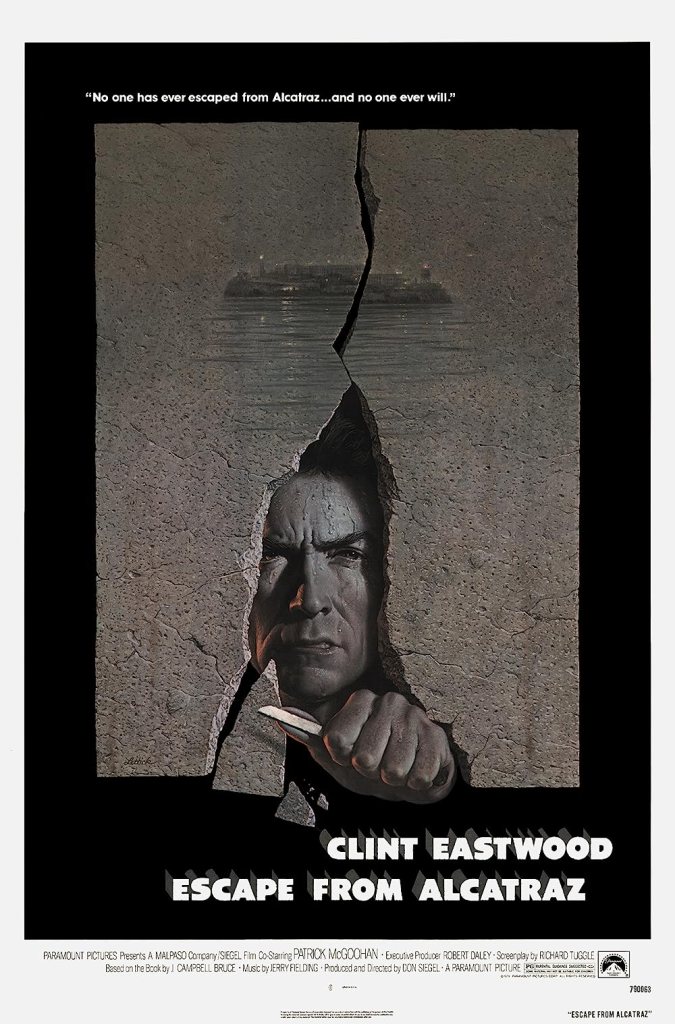
Escape from Alcatraz (1979)

Escape from Alcatraz (1979)

Siegel’s quietly observed prison break drama masters the small details

Director: Don Siegel

Cast: Clint Eastwood (Frank Morris), Patrick McGoohan (The Warden), Fred Ward (John Anglin), Jack Thibeau (Clarence Anglin), Larry Hankin (Charley Butts), Frank Ronzio (Litmus), Roberts Blossom (Chester “Doc” Dalton), Paul Benjamin (English), Bruce M Fischer (Wolf Grace)

In 1962, three men dug their way out of the cells in Alcatraz, climbed into a raft made of raincoats and sailed into San Francisco Bay and mystery. Not a trace was ever seen again of Frank Morris (Clint Eastwood), John Anglin (Fred Ward) or Clarence Anglin (Jack Thibeau), but their story became a cause celebre. Some say they disappeared to South America – many more believe they drowned in the freezing cold water of the Bay. Siegel’s film covers the details of the escape attempt – and leaves more than a hint that they escaped.

Escape from Alcatraz is a quintessential prison movie. It’s got the complete genre checklist: sadistic wardens, bullying in the courtyard, the threat of rape in the showers, solitary confinement, boring routines and jobs, unfair access to privileges, cagey alliances, the little details of a plan coming together, hair’s-breadth escapes from being caught and a “we go now or not at all” climax. It’s all mounted extremely well by Siegel, shot on location with such a searing coldness you can practically feel the chill the prisoners suffered all the time.

Alcatraz is made up of two things: quiet and time. Siegel’s film therefore delves into both of these things. From its opening montage detailing Morris’ arrival at the prison – on the boat, checking-in, cavity searches and tramping naked down to his cell – images and silence tell their own story. For the guards, words are formulaic and repetitive. Eastwood as Morris is barely ever out of shot but doesn’t speak for ten minutes. It’s the same for many other sequences, detailing prison life: quiet conversations in the yard, the pointless moves from place to place, the grinding procedure.

Time stretches without meaning in Alcatraz, so it’s no great sacrifice for Morris to work out that he can scratch away the brickwork around the drain in his cell and create a hole large enough to allow him to get to the unguarded ventilation corridors on the other side. (He works out it connects – eventually – to the outside by observing a cockroach crawl out of his cell.) Morris then reckons he’s got nothing better to do than to scratch away at that wall with a stolen nail pick, a labour that will take him months to extend the hole to something he can climb through.

Siegel also makes a great deal of this through his long-earned knowledge of how best to work with his star. This is one of Eastwood’s finest performances, a slate of determined, dry-witted stillness that communicates great thoughtfulness and ingenuity behind a stoic exterior. Morris maybe a compulsive thief, but he’s no fool – and he doesn’t suffer them either. He’s contemptuous of the self-importance of many of the warden and unrelenting in his determination to use whatever he can lay his hands on to help facilitate his escape attempt.

You’d be desperate to escape from Alcatraz too. Grim, very cold and crowded with bullies like Wolf (Bruce M Fischer), a puffed-up psychopath looking for a new punk (though as Quentin Tarantino said in a recent book, no one alive would look at Clint Eastwood and believe he’d be an easy shower victim). Meals are vile and the punishment of solitary is beyond tough: pitch black cells, only interrupted by the door being flung open so a high-pressure hose can ‘shower’ you with cold water (even Morris is reduced to something close to trembling wreck after a month of this treatment in the hole). It all leads into his determination to use anything he can to get out.

Siegel’s film loves the tiny details of small, inconsequential items converted into the means to escape. Unwanted magazines from the library become papier-mache to craft dummy heads to disguise the gang’s absence from their beds while they make preparations the other side of their wall. An accordion case smuggles goods around the prison. Makeshift candles are assembled. A set of portrait paints are used to paint the dummies and create a cardboard fake wall to place over the newly created hole. We see the painstaking effort to assemble enough coats to create their life-raft, the puzzling out of what is needed to get them from the ventilation roof to the other side.

Escape from Alcatraz presents these Herculean labours with simplicity but a patient eye for detail that makes them become strangely noble and hugely tense. You put aside your knowledge that these are hardened criminals – the film does everything it can to downplay their offences – and instead focus on them as victims of an unjust system, with “the man” crushing any hope from them.

As such, Patrick McGoohan has a huge amount of fun in a lip-smacking role as the prison warden. (It’s fun to see the world’s most famous Prisoner as the man handing out the numbers.) McGoohan’s unnamed warden has everything the men have not – not least words. He’s not starved by silence, but pontificates at pompous length about his theories of incarceration and the inevitable pointlessness of rehabilitation. Just to make sure our sympathy for the prisoners is complete, he’s also a vindictive bully, stripping prisoner “Doc” (Roberts Blossom) of his painting privileges because he doesn’t like a portrait made of him (tipping Doc into depressive self-harm), then provoking old-timer Litmus (Frank Ronzio) into a risky physical altercation. He’s unjust, unfair and mean.

So when he says at the end that he’s certain the prisoners died, of course we don’t want to believe him. Not least since we’ve been with the prisoners every minute of their desperate throw of the dice. In real life, they almost certainly froze to death in the Bay, their raft not being strong enough to help them complete the mile long swim before the icy water paralyzed them. But Escape from Alcatraz makes you want to believe they could have got away.

Charley Varrick (1973)

Walter Matthau schemes a caper in crime thriller Charley Varrick

Director: Don Siegel

Cast: Walter Matthau (Charley Varrick), Joe Don Baker (Molly), Andy Robinson (Harman Sullivan), John Vernon (Maynard Boyle), Sheree North (Jewell Everettt), Felicia Farr (Sybil Fort), Norman Fell (Garfinkle), Woodrow Parfrey (Harold Young), William Schallert (Sheriff Horton), Jacqueline Scott (Nadine), Tom Tully (Tom), Benson Fong (Honest John)

Don Siegel was perhaps the ultimate professional director, who took on any scripts that came his way, producing polished, professional films. In the later part of his career, he finally received some of the freedom to start shooting his quality B-movies on A-movie style budgets. Charley Varrick was the first film he made after his box-office smash Dirty Harry, and Siegel received more time and space to deliver a film that mixed action and drama with an elaborate, almost meditative, mystery.

Charley Varrick (Walter Matthau) is a former stunt pilot, whose small crop-dusting business is a front for carrying out small-scale robberies. A bank robbery in Tres Cruces, New Mexico goes horribly wrong – Varrick’s wife Nadine (Jacqueline Scott) is killed and he and his partner Harman Sullivan (Andy Robinson) find the small job they had anticipated is actually holding a huge amount of mafia money. Varrick knows the mafia won’t rest until they get the money back – and he is right, as bank president Maynard Boyle (John Vernon) has no choice but to call in ruthless hitman Molly (Joe Don Baker) to get the money back and kill those who stole it.

Charley Varrickwas also known by Don Siegel as The Last of the Independents – and that kinda fits its tone. Varrick is a small-scale operator who has chosen crime because he’s been squeezed out of the crop-dusting business by the corporations. He’s operating a crime gang that follows a series of carefully planned robberies, aimed at stealing humble amounts: enough to be a nuisance rather than cause a genuine scandal. He’s a small-time operator, proud of who is, who doesn’t want to hit the big time but to excel as the big fish in the small pond.

The whole film reflects this personality: the film is deliberately set in a quiet American town in the mid-West – the opening credits are played over everyday scenes of small-town life. Every location is slightly run-down and unimpressive. Those wrapped up in the crime are regular Joes – on both sides of the law – and the values and principles are those of mid-west America. Even Molly the hitman – while clearly ruthless and capable of extreme violence and full of disdain of those he meets – has a drawling, cowboy quality to him. 

Part of Siegel’s point is that into all this explodes a story of crime, murder and violence that all spins out of money (doesn’t it always?). The mystery element is the audience wondering how Varrick is going to get out of this with both cash and life intact. What Siegel does really well is effectively make Varrick an unreliable narrator. Despite the fact we follow him around in the film, we are never really told what he is thinking or why he does things. Only at the end of the film are all the threads of the actions he has carried out pulled together – a real lightbulb “ah ha!” moment – and the real purpose of what he has been doing is revealed.

To make a character who plays their cards so close to their chest work, you need an actor who is effortlessly charming. The film gets this in Walter Matthau. Matthau, with his hang-dog Droopy-face is hardly anyone’s first idea of a ruthless bank robber (surely part of the film’s point!) but his winning charm and kindly-Uncle quality, as well as the eye of assured cool that Matthau gives him, really make you root for him. In fact it works so well that you actually forget how ruthless Varrick in this film: from moving on swiftly from his wife’s death, to ruthlessly sacrificing several people in his quest for self-preservation. In other hands, Varrick wouldn’t half come across as a copper-bottomed shit. 

Instead, his plan of misdirection, clues pointing towards the wrong thing, and carefully juggled parallel attempts to escape (his unrevealed real plan, and the clumsy surface plan that the audience knows must be a bluff) really works to keep you engaged and entertained. Siegel is purposefully pulling the wool over your eyes in virtually every scene – and he has Varrick basically tell us he’s doing this – but there are few things that audiences like more than a magic trick. We want Varrick to pull a rabbit out of the hat at the end – to surprise us all with how clever he’s been (and to reward those who have worked out part of what he is doing).

Siegel mixes this with a surprising number of quiet, even soulful moments that mix the thoughtful with some black comedy. From Varrick’s tender kissing of his dead wife – right before he professionally carries on with their plan to burn the get-away car they escaped in (this time with his wife’s body inside it) – to a secret meeting/interrogation/intimidation of timid bank manager Harold Young (a twitchy Woodrow Parfey) by smooth big-city bank manager Boyle (a superbly cold John Vernon, nowhere near as assured and secure as he thinks he is) in a cow-filled field, these scenes are about character as much as they are about plot.

Siegel mixes this with moments of pure action and drama. The opening bank robbery is surprisingly violent, considering the gentle introduction to the film – and our “heroes” are amazingly ruthless towards those that stand in their way. Joe Don Baker’s chillingly amoral Molly hands out beatings as easily as he does slightly goofy Western smirks (a beat down of Harman is particularly brutal). Varrick is quietly ruthless and the film ends with a dynamic chase scene in a scrapyard, quite unlike anything you have ever seen.

Charley Varrick epitomises the sort of 1970s film that studios and Hollywood looked down on at the time, but inspired the filmmakers today far more than some of the Oscar winning gumph that got praised. Parts of it are dated – women in the film are either love interests or whores, and both Molly and Charley (Walter Matthau is no one’s idea of a lothario) bed compliant, impressed women in the film with an off-hand carelessness. But the core and heart of the film is in its cool, calculated confidence mixed with a sense of Western soul. With a terrific performance by Matthau, this is a fine example of independent film-making.