Tag: Donald Sutherland

A Dry White Season (1989)

A Dry White Season (1989)

A passionate, clear-eyed and largely unsentimental denunciation of Apartheid, the best of its kind

Director: Euzhan Palcy

Cast: Donald Sutherland (Ben du Toit), Janet Suzman (Susan du Toit), Zakes Mokae (Stanley), Jürgen Prochnow (Captain Stolz), Susan Sarandon (Melanie Bruwer), Marlon Brando (McKenzie), Winston Ntshona (Gordon), Thoko Ntshinga (Emily), Leonard Maguire (Professor Bruwer), Gerard Thoolen (Colonel Viljoen), Susannah Harker (Suzette de Toit), Andrew Whaley (Chris du Toit), John Kani (Julius), Richard Wilson (Cloete), Michael Gambon (Magistrate), Ronald Pickup (Louw)

The late 1980s saw a small wave of films denouncing the horrors of Apartheid in South Africa, a racist system founded on cruelty and injustice. Many of these films struggled with either being overly earnest or turning their (inevitably) white lead character into a saviour figure. A Dry White Season is perhaps the best of trend, perhaps because it focuses on a fictional story rather than real history (instantly gaining it the sort of dramatic latitude drained out of Cry Freedom) and directed by Euzhan Palcy, the first Black woman (then aged only 32) hired by a major studio, with a cast of the cream of Black South African actors, who knew all too well this world. A Dry White Season is also notable for its critical view of white South Africans who, bar a few exceptions, are presented as tribalist blind-eye-turners, furious at anyone who shakes their world view.

Ben du Toit (Donald Sutherland) is the epitome of smugly complacent Afrikaner (Sutherland even has a plump false belly, to hammer home his cosy self-satisfaction). A former rugby star, teaching white history in a private school, to him the system is always fair and if a Black man is arrested he must have done something wrong. That’s shaken when school gardener Gordon (Winston Ntshona) asks him for help, first after his barely-a-teenager son is beaten by police then again when the same son dies in custody after a protest. Ben’s first reaction is to shrug and say nothing can be done: the scales fall from his eyes when Gordon asks the wrong questions and is in turn murdered in custody by brutal Captain Stolz (Jürgen Prochnow). Working with campaigner Stanley (Zakes Mokae), Ben finds his entire world view falling apart as he is compelled to uncover the truth – to the fury of his wife, daughter, in-laws and colleagues who increasingly see him as a traitorous boat-rocker.

A Dry White Season doesn’t shirk on the violence of Apartheid. It says a lot that an early truncheon-wielding police assault on a township, and the scarred backside of Gordon’s son soon feels everyday. The student protest – many of its attendees literally no more than children – is met with lethal force from white soldiers carrying machine guns, indiscriminately shooting down children at point-blank range. Gordon is waterboarded and brutally tortured. Anyone who crosses the security forces faces violent assassination or fatal beatings. Palcy unflinchingly shows this horror – and frequently cuts away from atrocities to shots of the du Toit’s enjoying their wealthy, contented life of sports and garden parties. The impression is clear: underneath this contented life for the whites is a brutal, violent, repressive system supressing all rights for the many.

Palcy brings the sort of perspective perhaps only a Black film-maker could. There is no attempt in A Dry White Season to shelter the audience. Instead, we are exposed to the worst the system has to offer. Palcy adds impact with her casting of several extraordinary South African actors. Ntshona, Mokes and Kani among others had all experienced this themselves (Kani lost an eye in a police beating). Their performances are superb. Ntshona’s simple, honest bravery is deeply moving while Ntshinga is heart-breaking as his wife. Kani drips moral authority as a solicitor. Best of all Mokae’s activist Stanley is a superb portrait of warm, world-weary wit barely covering a life of fury.

What’s really refreshing is we expect the white characters to feel shame or guilt as the truth edges into their lives. This doesn’t occur: in fact, bar Sutherland’s du Toit and his young son (the same age as Gordon’s child – the film opens with the two of them playing together) all the white characters furiously protect the system. Sides are firmly picked and no blurring of the lines is tolerated. His daughter (Susannah Harker at her most Aryan looking) just wants him to shut up and stop spoiling things. Richard Wilson’s avuncular headmaster can’t hide his anger at du Toit’s ‘treason’. The police’s deference evaporates the second du Toit asks the wrong questions about the wrong people.

Even du Toit’s wife – memorably played with a raw harshness by Janet Suzman – progresses through irritation, horror to outright disgust at du Toit. Suzman – a South African who fled the country and long campaigned against Apartheid – pours all her anger into a show-stoppingly racist speech where she claims Black people are dangerous and don’t deserve any rights, that the Afrikan’s own South Africa and any violence against Black people doesn’t matter so long as the whites continue to live well. She represents a system supporting a boot stamping on Black faces for the rest of time.

It takes time for du Toit to realise there is no justice. Even after Gordon is murdered, he is convinced a trial will reveal the truth. He is of course, fantastically wrong – the trial being rigged from the start to produce a ludicrous suicide verdict. The trial is conducted by human rights lawyer McKenzie, played in a show-stopping cameo by Marlon Brando. Coming out of retirement to support the project (and working at union rate), Brando flexes his muscles one last time to deliver a charismatic, witty turn as a shambling Rumpole-like barrister who knows from the start his only result will be making the powers-that-be faintly embarrassed at their blatant injustice. If Brando’s support didn’t extend to learning his lines – he’s blatantly reading them from off cue cards or having them funnelled to him through a visible ear-piece – he’s still a stand-out in a sequence that makes abundantly clear just how complicit the whole system is in murder.

Sutherland – a fine performance of stunned, sad-eyed bemusement – makes du Toit a well-meaning men who realises he can never go back to his old life after peaking behind the curtain. It’s a nice touch in A Dry White Season that he never becomes a conventional white saviour: most of his actions lead to disaster, he’s reliant on Mokes’ Stanley and (other than his son) he fails to persuade anyone. But what chance does he have? Placy even shows many Black people have given up. At least one of Gordon’s torturers is a Black police officer and Gordon’s son and his friends open the film berating Black workers in a boozer that their apathy only props up the system. After Gordon’s death, a Black priest counsels turning the other cheek. But then the courage needed to protest is immense: Stanley smilingly states he long-ago accepted he was a dead man and it’s that which keeps him going.

A Dry White Season ends with a touch too much melodrama and a slightly too ‘Hollywood’ ending – but then it’s so relentlessly depressing that even a small victory is a relief. But, in the main, while sometimes rough and ready, it actually presents an important message with real dramatic force, stuffed with fine performances and a brutally realistic view of South Africa. It does give us some hope for the future: the only other white persuaded is du Toit’s young son: and it’s the young who are only hope for long-term change.
Don’t Look Now (1973)

Don’t Look Now (1973)

Atmospheric, heart-rendering and beautifully constructed supernatural film, an emotional look at grief

Director: Nicolas Roeg

Cast: Julie Christie (Laura Baxter), Donald Sutherland (John Baxter), Hilary Mason (Heather), Clelia Matania (Wendy), Massimo Serato (Bishop Barbarrigo), Renato Scarpa (Inspector Longhi), Leopoldo Trestini (Hotel manager), Giorgio Trestini (Woekman)

We tend to trust our senses, don’t we? We like to see the world as something solid and factual, that we can process and understand with rational thought. What we don’t have time for is the idea of a sixth sense about the world beyond us. We can’t measure that, so we prefer to ignore those feelings. Don’t Look Now is partially about the terrible consequences of ignoring gut-instincts about the unexplainable, as well as the terrible, all-consuming horror of grief. On top of that it’s a horrifying quasi-ghost story, a moving portrait of marriage and a terrifyingly beautiful image of Venice that’s quite unlike anything else on film.

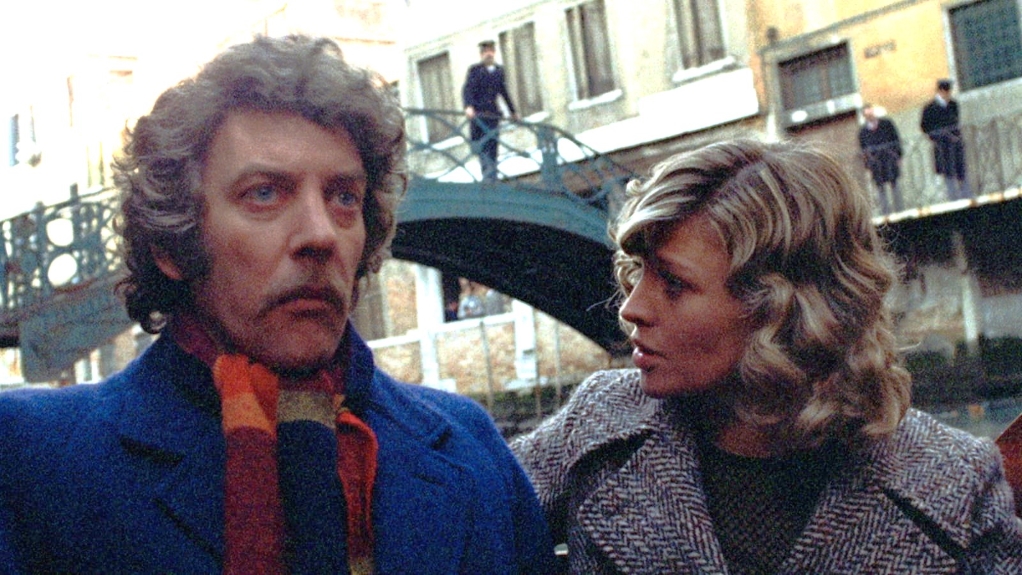
John (Donald Sutherland) and Laura Baxter (Julie Christie) are in Venice, a few months after the death of their daughter in a tragic drowning accident. John is busying himself at work restoring a church, Laura is looking for distraction from grief. Chance leads to a meeting between Laura and two mysterious sisters (Hilary Mason and Clelia Matania), one of whom claims to have second sight and to be able to ‘hear’ messages from the Baxter’s late daughter. Laura is desperate to believe, but John is resolutely unconvinced. But it’s John who starts seeing visions of a child in a red coat – a red coat just like the one their daughter was wearing when she drowned – and becomes increasingly troubled by strange coincidences and feelings.

Roeg’s stunning film is a masterpiece of atmosphere. Shot in vivid colours in a coldly intimidating Venice – which Roeg manages to make feel both beautiful and deeply, disturbingly unknowable and dreadfully intimidating. Don’t Look Now constantly unsettles and disorientates you, a gorgeous city hosting an insidious gothic mystery. It’s a masterfully edited film, that uses our ‘knowledge’ of the language of cinema to disorientate us, forcing us to form associations between images by juxtaposing them together (for instance, Roeg cuts from John casting doubts on the motives of the sisters to them laughing joyfully something that context makes us see as sinister).

The clue in Don’t Look Now is in the title – once we are told to look at something, we’ve got an overwhelming desire to stare straight at it. John’s mind is mind sending a plethora of subconscious warnings: but the more his mind says ‘don’t look’, the longer he stares. He should be picking up on the visual signals from Roeg’s extraordinary design: Don’t Look Now is awash in red. In almost every scene, splashes of striking crimson abound – from coats, to bags, to signs, to everyday objects, to blood – as if the film itself is trying to warn him (at one crucial moment, he even turns away from a street of green fronted shops and cafes, to charge down a street lined with red ones). Don’t Look Now is the tragedy of a man with great powers of intuition who comprehensively ignores them because it’s the rational, sensible thing.

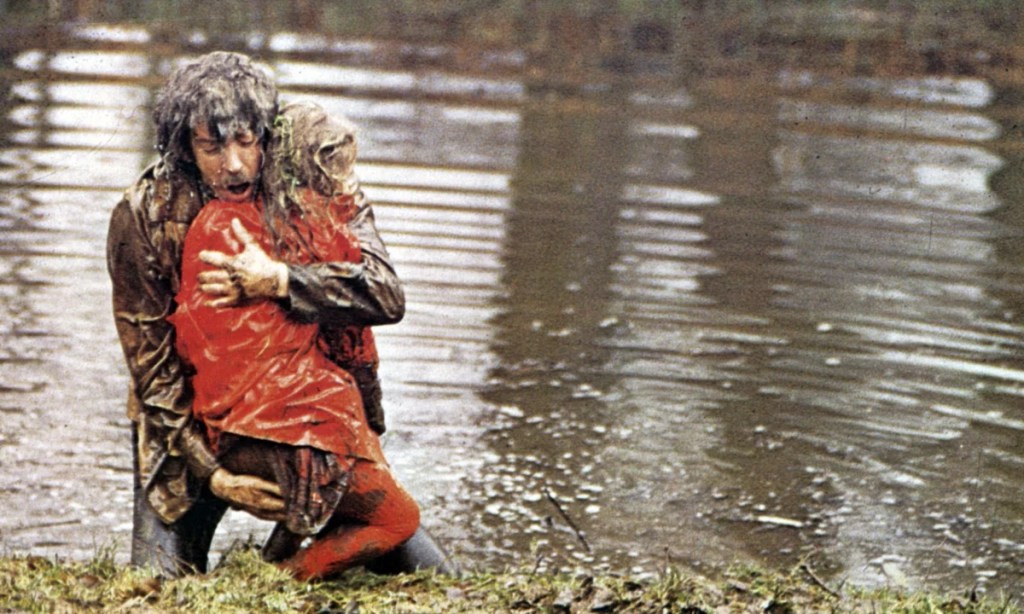
Already he has been warned of the dangers of ignoring his instincts. Roeg opens the film with the drowning of the Baxter’s daughter, while her parents rest indoors after a large Sunday meal. It’s a sequence of ominous, intense anxiety and terrifying, gut-wrenching impact as we cut back and forth between the daughter playing outside (with broken glass and lost balls floating on ponds), to John and Laura continuing casually talking while a slide frame of the Venetian church John is working on soaks in spilled water and the red of a girl’s coat in the image bleeds across the it (as much a prescient warning of John’s danger, as it is of his daughter’s). A distracted John is finally unable to resist the of danger he is feeling – racing instinctively to the pond, but too late to prevent tragedy.

The heart-rendering, raw pain as John fishes his daughter from the pond – the elemental roar from Donald Sutherland being almost unwatchable – caps a deeply affecting sequence in Don’t Look Now’s profound and tender study of grief and the strain it places on a loving relationship. Sutherland and Christie give beautifully judged, profoundly humane and sympathetic performances as shell-shocked people, barely able to process tragedy and looking for anything to distract them from the crushing grief that is hollowing them out. Grief in this wintery city is practically a third wheel in the relationship, an unspoken mix of regrets (and recriminations, Laura at one point blaming John’s lax rules for their daughter’s death) and barely expressed pain.

This doesn’t detract from the deep love they still feel from each other. Don’t Look Now’s (in)famous sex scene carries the erotic charge it does, because it genuinely feels like a long-married couple reconnecting physically, intimately familiar with each other’s bodies. Brilliantly, this sense is actually increased by Roeg intercutting from their love-making to their post-coital dressing, somehow the act of them half-watching each other put their clothes on being as loving as what they did before. Both have a deep desire to protect the other: John is distracting himself from his grief by ‘looking after’ Laura, while she re-focuses on an intense desire to protect her remaining family.

Laura at first feels the more vulnerable of the two: her emotions rawer (she collapses in distress after her first encounter with the sisters), her need for spiritual connection – either lighting candles in the Church, or desperately trying to believe she can communicate with their late daughter – much greater. It’s only when they are separated (after she rushes home to see their son after an injury at school) that the depths of John’s vulnerability and fragility become clear. Without her to distract him, he quickly seems to fall apart: becoming paranoid, increasingly fixated on possible disasters, ever-more obsessed with his glancing images of that girl in the red coat.

Roeg presents much of the world exactly as John sees it, and his masterful framing and editing of key moments and sequences both leave us in as much doubt about what is real as John is, suckering us into making the same mistakes he does. Again, our trust of how visual images are presented works against us, just as John misinterprets and misunderstands premonitions as events literally happening at that moment. It’s what lies behind his obsessive hunt for his ‘kidnapped’ wife, after seeing her on a boat on the canal hours after she flew back to England. Later events will demonstrate how disastrously he has misinterpreted these warnings.

John is drawn into an ever-more Kafkaesque nightmare (there is a lovely touch that, the more distressed John becomes, the more his Italian evaporates – in his element at the church, rebuilding frescoes, he’s fluent – at other times he can barely string a sentence together). A sinister police inspector – Roeg deliberately not correcting Renato Scarpa’s phonetic delivery of his English dialogue, making it unsettingly ‘wrong’ – seems sympathetic, but has John watched. The off-season city empties out (even the Baxter’s hotel closes), becoming a ghost town of echoey, identical streets which John hurtles down. The dark mystery of a serial killer haunting Venice becomes more prominent, concluding in the film’s horrifying reveal of what lies under that red coat, John realising all too late the skills of intuitive understanding that make him a skilled restorer of fragmented mosaics, was the same ignored intuition warning him of the dangers first to his daughter then himself.

Don’t Look Now is not only a masterpiece of atmosphere and superb editing and structure, it’s also Roeg’s most humane and tender work. It’s a deeply affecting portrait of a loving marriage struggling with grief – with extraordinary performances from Christie and Sutherland – and the way our longings combat with our rational mind to confound us. Set in a Venice that is eerily, ghostly and unsettling, it’s a haunting, powerful and superb piece of film-making.

1900 (1976)

1900 (1976)

Bertolucci’s bloated, self-indulgent and simplistic film is a complete mess

Director: Bernardo Bertolucci

Cast: Robert De Niro (Alfredo Berlinghieri), Gerard Depardieu (Olmo Dalco), Dominique Sanda (Ada Fiastri Paulhan), Donald Sutherland (Attila Mellanchini), Laura Betti (Regina), Burt Lancaster (Alfredo Berlinghieri the Elder), Stefania Sandrelli (Anita Foschi), Werner Bruhns (Ottavio Berlinghieri), Stefania Casini (Neve), Sterling Hayden (Leo Dalco), Francesca Bertini (Sister Desolato), Anna Henkel (Anita the Younger), Ellen Schwiers (Amelia), Alida Valli (Signora Pappi)

After The Conformist and Last Tango in Paradise, Bertolucci could do anything he wanted. Unfortunately, he did. Perhaps the saddest thing about 1900 is that you could watch The Conformist twice with a decent break in-between during the time it would take you to watch it– and get a much richer handle on everything 1900 tries to do. Bertolucci went through a struggle to get his 315-minute cut released: perhaps the best thing that could have happened would have been if he had lost. Not only would the film be shorter, but it would be remembered as a lost masterpiece ruined by producers, rather than the interminable, self-indulgent mess we ended up with.

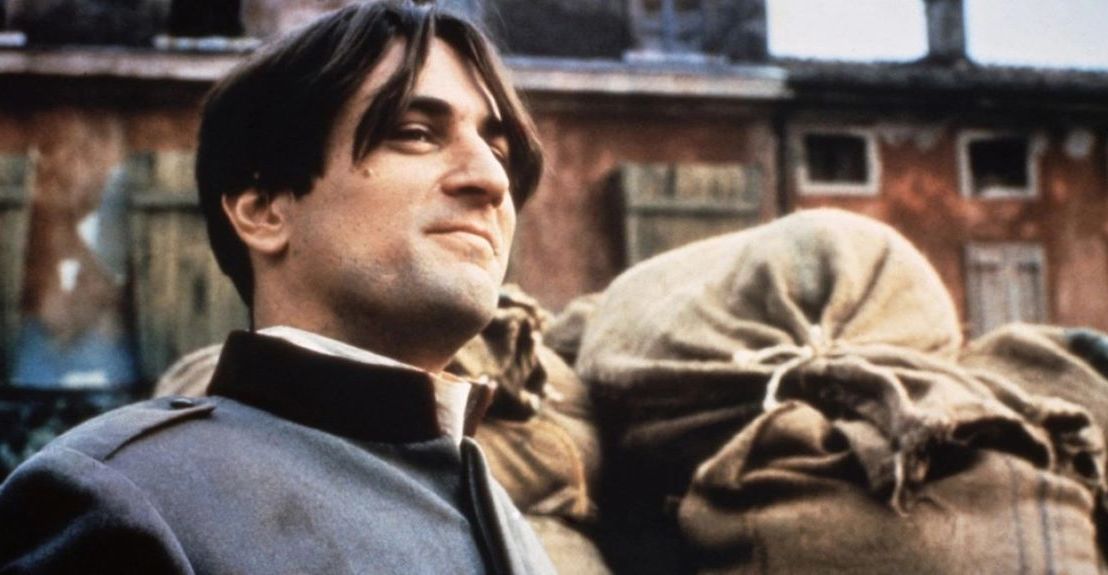
1900 – or Twentieth Century to literally translate its title Novecento – follows the lives of two very different men. Born minutes apart in 1901, Alfredo (Robert De Niro) is the grandson of the lord of the manor (Burt Lancaster), while Olmo (Gerard Depardieu) is the grandson of Leo (Sterling Hayden), scion of a sprawling dynasty of peasants. They grow up as friends, Olmo becomes a socialist and Alfredo an indolent landlord and absent-minded collaborator with the fascists, embodied by his psychopathic land agent Attila (Donald Sutherland). Their small community becomes a symbol of the wider battle between left and right in Italy.

In many ways 1900 is an epic only because it is extremely long and beautifully shot in the Bologna countryside by Vittorio Storaro. In almost every sense it fails. It offers nominal scale in its timeline, but its attempt to become a sweeping metaphor for Italy in the twentieth century falls flat and it focuses on a small community of simple characters, many of whom are ciphers rather than people. All of Bertolocci’s communist sympathies come rushing to the fore in a film striking for its political simplicity. It never convinces in its attempt to capture in microcosm the forces that divided Italy between the two world wars, nor invests any of its characters with an epic sense of universality.

Instead Bertolucci presents a world of obvious questions and easy answers. Every worker is an honest, noble salt-of-the-earth type, working together in perfect harmony to fight for rights. Every single upper-class character is an arrogant, selfish layabout, caring only about their back-pockets and the easy life. Bertolucci suggests fascism only arose in Italy as a means for the rich to control the poor, and never allows for one moment the possibility that any working-class person was ever tempted to take their side. It never rings true. (Bertolucci skips a huge chunk of the fascist 30s and 40s, possibly because this fantasy would be impossible to sustain if he actually focused on the history of that era.)

Bertolucci uses his two protagonists to make painfully on-the-nose comparisons between working class and rich with De Niro’s weak-willed Alfredo always found wanting compared to Depardieu’s Olmo. Even as children, Olmo is braver, stronger and smarter. Olmo has the guts to lie under the moving trains (Alfredo runs), Olmo stands up for what he believes in (Alfredo looks away), Olmo puts others first Alfredo whines about his own needs. Hell, Olmo even has a bigger cock than Alfredo (something they discover comparing penises as children and re-enforced when as young men they share an epileptic prostitute and she ‘tests’ them both).

The upper classes hold all the power but can do nothing without the working class. During the 1910s, a strike by the workers on the Berlinghieri leaves the clueless rich unable to even milk their moaning cows (they buy milk instead). Sterling Hayden’s peasant patriarch is a manly inspiration to all, while Lancaster’s increasingly shambling noble is literally and metaphorically impotent (Lancaster’s role is like a crude commentary on his subtle work in The Leopard). At one point he even pads around barefoot in horseshit to hammer home his corruption. (Incidentally this is the only film where you’ll ever see a horse’s anus being massaged on camera to produce fresh shit to be thrown at a fascist.)

For the rich, fascism is the answer. Continuing to shoot fish in a barrel, Bertolucci scores more easy hits by presenting our prominent fascist as an out-and-out psychopath. Played with a scary relish by Sutherland – in the film’s most compelling performance – no act of degradation is too far for Attila. Along with his demonic partner-in-crime Regina (a terrifyingly loathsome Laura Betti), he routinely carries out acts of violence, horrific murder and child-abuse, even literally headbutting a cat to death while ranting about the evils of socialism.

The poor meanwhile are all good socialists. Olmo, decently played by Depardieu, and his wife Anita (an affecting Stefania Sandrelli) rally the workers to stand against charging cavalry and protect their rights. Bertolucci even has Depardieu flat-out break the fourth wall for a closing speech, spouting simplistic platitudes direct to camera about the inherent wickedness of the landowner. Depardieu at least seems more comfortable than De Niro among this Euro-pudding (every actor comes from a different country and the soundtrack is a mismatch of accents and dubbing, not least Depardieu himself). Rarely has De Niro looked more uncomfortable than as the empty Alfredo, a role he fails to find any interest in, like the rest of the actors never making him feel like more than a device.

Bertolucci, stretching the run-time out, also embraces numerous tiresome excesses. Rarely does more than 20 minutes go by without a sex scene or a sight of someone’s breasts or sexual organs. From children comparing penises, to Depardieu performing oral sex on Sandrelli (just outside a socialist meeting), to De Niro and Depardieu getting hand-jobs from a prostitute, to Sanda dancing naked and high on cocaine or the revolting exploits of Attila and Regina, nothing is left to the imagination. As each goes on and on Bertolucci ends up feeling more like a naughty boy than an artist, so praised for his sexual licence in Last Tango that he feels more is always more. The excess doesn’t stop with sex either: at one point a worker silently cuts his ear off in front of a landowner to make a point about his stoic nobility.

1900 eventually feels like you’ve stumbled into a student debating club, where a privileged student drones on at great length about the evils of the rich, while quaffing another glass of champagne. It has moments of cinematic skill – some of its time jump transitions, in particular a train passing through a tunnel in one time and emerging at another, are masterful – but it’s all crushed under its self-indulgence. From its length to its sexual and violence excess, to its crude and simplistic politics delivered like a tedious lecture, everything is crushed by its never-ending self-importance.

Murder by Decree (1979)

Murder by Decree (1979)

Sherlock Holmes investigates Jack the Ripper in this overlong but enjoyable Doyle pastiche

Director: Bob Clark

Cast: Christopher Plummer (Sherlock Holmes), James Mason (Dr John Watson), David Hemmings (Inspector Foxborough), Susan Clark (Mark Kelly), Frank Finlay (Inspector Lestrade), Anthony Quayle (Sir Charles Warren), Donald Sutherland (Robert Lees), Geneviève Bujold (Annie Crook), John Gielgud (Lord Salisbury)

In the world of Sherlock Holmes pastiches, it’s a popular sub-genre: Sherlock Holmes vs Jack the Ripper. How would Holmes have taken on the murderer who has baffled generations since those brutal Whitechapel killings in 1889? Murder by Decree explores the idea, mixing Conan Doyle with a deep dive into (at the time) the most popular theory in Ripperology, the Royal Killings (Murder by Decree indeed!).

It’s all pulled together into a decent, if over-long, film, shot with sepia-toned stolid earnestness by Bob Clark. With its fog-ridden Whitechapel sets (carefully built but always strangely empty), heavy-duty actors sporting large sideburns, wavy-screen flashbacks and carefully unimaginative framing, there is something very old-fashioned about Murder by Decree. That also extends to its Ripper theory, steeped in a very 70s class-conscious conspiracy. The film pads out its two-hour run time with many a POV shot of the Ripper prowling the streets, which bring to mind Jaws and slasher horror films of the time.

Where Murder by Decree does stand out is in its imaginative characterisation of Holmes and Watson. They are presented as affectionate friends – Mason’s older Watson has a sweet indulgent elder-brother feeling to him, giving Plummer’s sparkly Holmes plenty to tease and bounce off. They split the casework between them – Watson is an equal partner, even if Holmes does the brainwork – and use their strengths to complement each other (notably, Watson frequently distracts people so Holmes can interrogate a witness more closely). They genuinely feel like long-term friends (there is a delightful sequence where Holmes is so distracted by Watson’s attempt to fork a pea, that he squashes it onto the fork – to be met with a forlorn “you’ve squashed my pea” from Watson, who likes the peas intact so they “pop in my mouth”).

They are dropped into the middle of a very much of-its-time Ripper theory. Murder by Decree centres on the theory that the murders were ordered (the film reluctantly suggests tacitly) by the establishment to cover up the secret marriage of Prince Edward, Duke of Clarence to a Whitechapel woman, Annie Crook. This alleged marriage produced a baby, and a royal doctor, sheltered by a Masonic conspiracy, sets about eliminating everyone who knows the truth. Of course, it’s almost certainly bollocks – but with its mix of secret societies, Royals, a lost heir and the rest, it’s an attractive story.

It gains a lot from the performances of the two actors. James Mason flew in the face of then popular perception by presenting a quick-witted, assured Watson, more than capable of looking after himself (he bests a blackmailing pimp in a street fight and is very comfortable with guns – far more than the reticent Holmes). He’s still the classic gentlemen, who loves King and Country, but also shrewd, brave, loyal, able to win people’s trust and look at a situation with clear eyes.

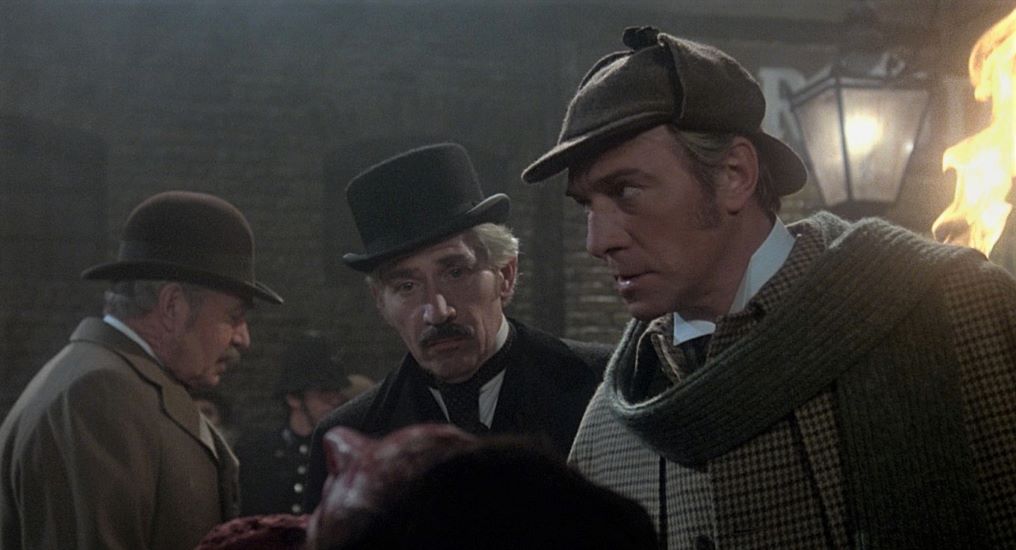
With Christopher Plummer, Murder by Decree has one of the all-time great Sherlock Holmes. Plummer’s Holmes is refreshingly un-sombre, twinkly with a ready wit, who loves teasing Watson (cleaning his pipe with Watson’s hypodermic needles) and delights in his own cleverness. But Plummer takes Holmes to places no other film Holmes goes. The case as a devastating effect on him: he weeps at the fate of Annie Crook (consigned by conspirators to a slow death in an asylum) and furiously attacks her doctor. When the conspiracy is unmasked, he emotionally confronts the Prime Minister and berates himself for his failures. There is a depth and humanity to Plummer’s Holmes unseen in other versions, a living, breathing and surprisingly well-adjusted man, unafraid of emotion.

Sadly, the film takes a little too long to spool its conspiracy out. Rather too much time is given to an extended cameo by Donald Sutherland as a pale-faced psychic who may or may not have stumbled upon the killer. There are a lot of unfocused shots of that killer, all swollen black eyes and panting perversion. It relies a little too much on a Poirot-like speech from Holmes at the end explaining everything we’ve seen. But there are strong moments, best of all Geneviève Bujold’s emotional cameo as the near-catatonic Annie Crook, cradling in her arms a memory of her stolen child.

There are many decent touches. The film is open in its depiction of the filth and squalor of life in Whitechapel – a pub is an absolute dive, and the women pretty much all look haggard and strung out. It has a refreshingly sympathetic eye to the victims, with Holmes denouncing the attitudes of both Government and radicals (looking to make political hay from the killings) who see them as lives without intrinsic worth. Holmes places no blame or judgment on them, or the choices life has forced on them, which in a way puts him (and the film) quite in line with modern scholarship (even if there is the odd slasher-style shot of mangled corpses).

The main issue is the film never quite manages to come to life. It’s a little too uninspired, a bit too careful and solid where it could have been daring and challenging. There are good supporting roles: Finlay is a fine low-key Lestrade (at one point persistently raising his hand to ask his superior permission to speak) while Gielgud sells the imperious Lord Salisbury. There is enough here for you to wish the film just had a bit more of spark to lift it above its B-movie roots. But in Plummer and Mason it has a Holmes and Watson to treasure – and for that alone it’s worth your time.

Klute (1971)

Klute (1971)

Paranoia runs rampant in this fascinating – and chilling – murder thriller that taps into into conspiracy thrillers

Director: Alan J. Pakula

Cast: Jane Fonda (Bree Daniels), Donald Sutherland (John Klute), Charles Cioffi (Peter Cable), Roy Scheider (Frank Ligourin), Dorothy Tristan (Arlyn Page), Rita Gam (Trina), Nathan George (Trask), Vivian Nathan (Psychiatrist), Morris Strassberg (Mr Goldfarb)

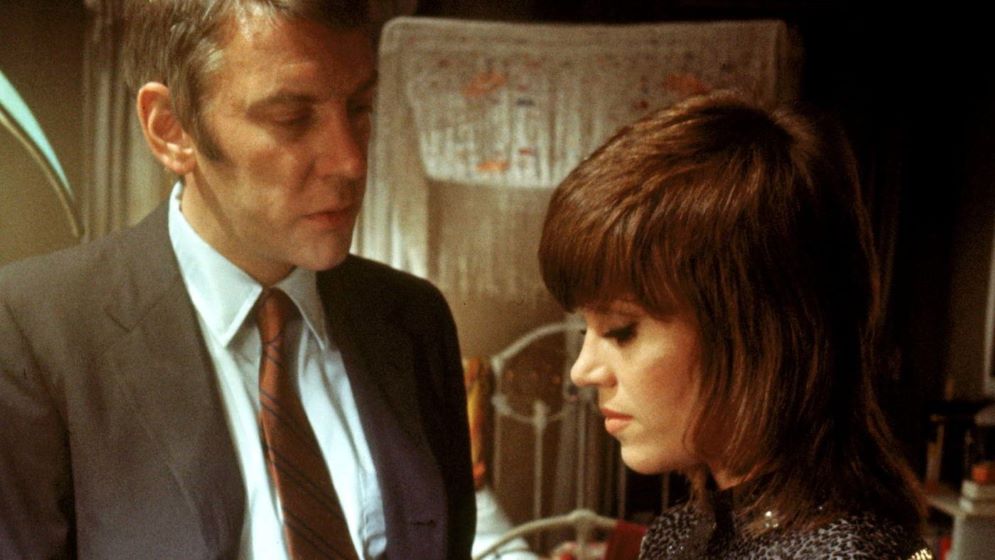
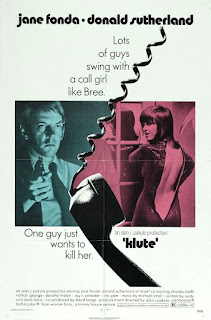
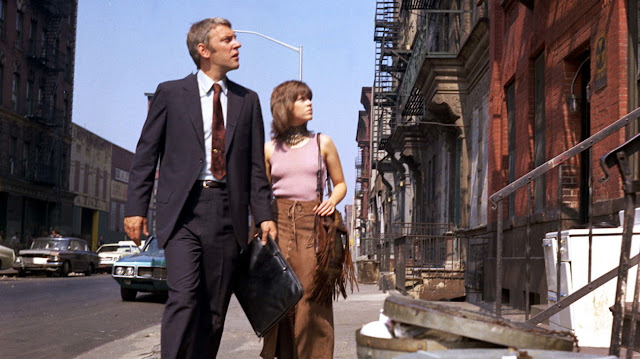
There is one question everyone asks when watching Klute: why the heck is it called Klute? Would calling the film Daniels have been too dull? Would Bree have made it sound like a history of cheese? Klute is dominated by its character study of Jane Fonda’s Bree Daniels, split between her desire to be an actress and the comforting sense of control and avoidance of intimacy her work as call-girl brings. Klute uses the conventions of the male detective movie to conduct a sympathetic, compassionate character examination of its female lead. Match that with Pakula discovering his affinity for creeping 70’s paranoia, and you’ve got one of the most interesting and rewarding films of the decade.

John Klute (Donald Sutherland) is a small-town cop called in as a private investigator after a six month New York police investigation fails to find his friend, businessman Tom Gruneman. The only lead they have is a series of obscene letters found in Gruneman’s office written to New York call girl Bree Daniels (Jane Fonda). Klute discovers Bree has no memory of Gruneman, but Klute believes she may be in serious danger. Together they investigate the crime further, which becomes more and more focused on a mysterious abusive client and even more complicated by the growing relationship between the quiet, reserved Klute and the strong-willed, independent Bree.

Klute uses the conventions of a gumshoe detective movie, spliced with a hard-hitting 70s fascination with grimy, sensationalist crimes (this was the same year as hard-bitten, shades-of-grey cops in Dirty Harry took on a serial killer and The French Connection explored the drugs trade), in this case the assault and murder of prostitutes. But this isn’t a whodunnit, or even really a detective story. The film is barely 45 minutes old before Pakula basically reveals who the killer is (the suspect list has only two people on it in any case). Most of the investigation takes place off screen. Some answers are kept vague. There is no cathartic moment of success.

Instead, the film feels far more like it’s using its Laura-ish set-up (the big difference here being the taciturn detective’s love interest is alive rather than just a painting) as a backdrop to deep dive in Bree’s personality. Bree is played with a stunning (and Oscar-winning) verisimilitude by Jane Fonda. Fonda immersed herself totally in the character, even living in the apartment set during shooting (Pakula had a working toilet installed) and developing a careful psychological background to Bree that is brilliantly introduced through our frequent cuts to her sessions with a coolly professional psychiatrist.

This is a portrait of a female sex worker on screen, where she’s neither a tragic or pathetic figure, or a hooker-with-a-heart-of-gold (the standard tropes). Instead, this is a woman struggling with a crippling fear of intimacy and a compulsion to control, who finds a freedom and release in acting out the fantasies of others. Bree speaks to her psychiatrist of being a call girl not as a curse or source of shame, but something she takes a sort of freedom from. It’s clear that really makes her sweat is not adjusting herself to whatever men want (faking an orgasm while checking her watch with one John, or acting out an elaborate, detailed fantasy for a lonely tailor) but the idea of having to be herself, to display something emotional and true.

And prostitution has the advantage over acting as she sets the terms. We are introduced to Bree as just one in a row of sitting actresses auditioning for an advert, each of them dismissively given a score from A to C. She later auditions for Shaw’s Saint Joan with a detailed, heartfelt reading (she’s clearly a good actress) which is stopped mid-speech by a bored director. With Fonda making clear that control is vital to Bree’s sense of well-being, no wonder she struggles with this dismissive world. Or that she finds a greater freedom in high-end prostitution, where we see she sets the terms with a business-like professionalism and is the centre of the focus and attention of her John’s for the whole of their session. This is a feeling she doesn’t get from anyone else.

What really scares her is the thought of a genuine emotional intimacy with Klute. In their first encounters she assumes she can seduce him with the professional ease she does most men, dropping naturally into her role of seductive dream-girl, offering him sex in return for recordings he has of her from his investigation. Later she will prove a point by coming to him in the night and seducing him with a pretence of vulnerability and fear, as if to prove to him (and herself) that she can work out exactly what mood she needs to control any man.

But it’s buried in genuine fear about emotional attachment. To her psychiatrist she talks about not understanding why Klute seems, with no ulterior motive, to be concerned for her safety and well-being despite the things he’s knows about her or that she’s done and said to him.

There is a marvellous scene where the two of them go shopping for fruit (Klute of course knows exactly how to choose the best fruit, he’s that sort of guy). First, she impulsively steals an apple like a naughty, impulsive child. When Klute responds with a bemused half-shock, she stands behind him, a grin spreading across her face, then she lightly rests her head (almost not touching) on his back – then follows him down the street, holding the end of his coat. It speaks worlds of how something in her emotional growth has been slightly stunted somewhere along the line. And the fact this intimacy is followed in the next scene by a drug-fuelled blow-out, speaks volumes of her fear of it.

It’s a brilliant performance by Fonda, throbbing with empathy and emotional complexity. She’s perfectly abetted by Donald Sutherland, who proves himself once again one of the most generous actors in the game. Klute is in many ways the typical rube in the big city, the one honest cop. But he also has a wet-eyed vulnerability, a tenderness and an urge to protect that as motherly as it masculine. He reveals very little emotionally, not from fear but from a shyness.

He’s also an observer. And Pakula’s film partly draws links between detective and voyeurism. Let’s not forget Klute also bugs Bree’s phone and follows her. The camera frequently shoots the action from distance, through windows and looking down on the action: the idea of being constantly observed lingers over the picture, giving it a rich vein of paranoia. The killer listens to disembodied audio recordings of Bree, and these frequently play over the action not only echoing this paranoia, but re-enforcing how her personality is a fractured one between the independent exterior and the less certain interior.

Pakula’s film pulls all this together into something creepy and unsettling but is also a fascinating character study. That is perhaps its best trick. You come into it expecting a film noir or a detective story. What you get is a compelling analysis of the psyche of one woman, who emerges into the picture and takes complete control of it. Perhaps that’s why it’s called Klute – it’s as much a part of the misdirection as everything else. With its psychological complexity and creeping sense of being watched, this would set the tone for many other films that followed in the 70s.

The Hunger Games: Catching Fire (2013)

Jennifer Lawrence and Josh Hutcherson head back into the area in The Hunger Games: Catching Fire

Director: Francis Lawrence

Cast: Jennifer Lawrence (Katniss Everdeen), Josh Hutcherson (Peeta Mellark), Liam Hemsworth (Gale Hawthorne), Woody Harrelson (Haymitch Abernathy), Elizabeth Banks (Effie Trinket), Lenny Kravitz (Cinna), Philip Seymour Hoffman (Plutarch Heavensbee), Jeffrey Wright (Beetee Latier), Stanley Tucci (Caesar Flickerman), Donald Sutherland (President Coriolanus Snow), Sam Claflin (Finnick Odair), Lynn Cohen (Mags), Jena Malone (Johanna Mason)

It’s a year on from Katniss (Jennifer Lawrence) and Peeta’s (Josh Hutcherson) victory at the 74th Hunger Games. They and the other victors live a life of relative luxury in the dictatorship of PanAm. Problem is Katniss’ humanity and defiance of the ‘rules’ from her victory have started to inspire whispers of discontent into open mutterings. When a “victor’s tour” fails to impact on her lustre, President Snow (Donald Sutherland) follows the suggestion of Games Maker Plutarch (Philip Seymour Hoffman) – let’s celebrate the 75th Anniversary by chucking two victors from each district back into the ring. As the only female victor from District 12, this means Katniss will either wind up dead – or be put into a position where she has to abandon her humanity to become the killer she never wanted to be. But is there another game going on inside the game?

Catching Fire is an entertaining, fast-paced, well made sequel to The Hunger Games that successfully broadens and deepens the franchise. Far from being a difficult middle chapter, it’s well structured to tell a pretty self-contained story that riffs on events from the first film without being enslaved to them. It also very sharply deepens the social and political commentary from the first film, widening our knowledge of PanAm and our understanding of its corrupt, murderous system.

Lawrence’s direction is punchy, pacey and provides plenty of emotional depth and scope. It’s a film that skilfully balances questions of trauma and the horrors of murder-for-entertainment, with poundingly exciting action sequences in the games themselves. In some ways Catching Fire is the only film in the series that ends (more-or-less) with a triumphant bang, and it’s possibly why the film is the most satisfying of the lot, with the cleanest structure. It also has the advantage of widening the outer edges of the world of the film, while still largely operating within the self-contained world of the games arena.

Within that, it also manages to keep us on our toes. Many of the same set-ups – both in the build-up to the games and the action in the arena itself – echoes or reflects what we’ve seen before. The film uses this to throw at us moments the surprise us – as allegiences are revealed – or provide opportunities for dark humour (such as the setpiece Katniss decides to use to showcase her skills this time round, markedly, darkly different from her archery display in the first film).

The film is entertaining and also thought-provoking. Within the confines of its 12A certificate, it doesn’t flinch from the oppressive horror of PanAm in the districts, where sudden executions and brutal beatings are an everyday occurrence. Similarly, it demonstrates even more the heartless opulence of the capital, a world of hedonism where no questions are asked about what props this whole system up.

And at the heart we have Katniss. Wonderful played, with a full-blooded emotional commitment from Jennifer Lawrence, Katniss is slowly become aware of her iconic status, but hasn’t changed dramatically from the at-times judgmental, prickly, abrasive loner she was at the start. She’s a reluctant figure-head for a new movement, but that’s what makes her both so effective and so moving. She’s not pretending or playing a hero – she simply does the right thing, because that’s what she believes she should do. Sure she makes a host of poor character choices, but that’s what genuine people do.

Lawrence’s grounded emotional realism in the lead, helps sets the tone for the whole franchise as something surprisingly gritty, dangerous and at times quite emotionally challenging. Hutcherson does fine work as the true heart of the film series, a decent, kind man who not only sees but also brings out the best in other people. Claflin is very good as a matinee idol victor who keeps us guessing on his motivations. Harrelson and Banks provide skilled depth to characters that could have been flamboyant cartoons. Sutherland enjoyably quietly munches some scenery as the dastardly Snow, while Hoffman coasts showily but effectively.

Catching Fire bursts along with a great deal of flair and lets us really see how despotic regimes like this operate. Katniss is manipulated into situations designed to fit a narrative that will cement the position of the regime. Ordinary people are corrupted by the wickedness around them. Humanity is seen as a dangerous quality. It’s intriguing and way more insightful than you might expect from a YA blockbuster. And its treated with a profound respect by everyone involved.

And it works because it also tells a cracking, entertaining story, revolving around richly drawn characters with fully fleshed out hinterlands and personal story arcs. For all it takes place in a dystopian future, it feels a real and grounded story. And its hard not to relate to a film where the central character, for all her flaws, is fighting for her right to not kill, maim and slaughter those around her for entertainment: who clings to her humanity despite all temptations to the contrary.

Catching Fire is also blessed with being the neatest, most straight-forward and cinematic of the stories (it’s the only film in the series that ends with anything near a triumphant bang rather than a searching question – for all that it’s a compromised triumphant bang). Told with verve, smoothness and pace it’s a very entertaining movie – and surprisingly rewarding.

The Hunger Games (2012)

Jennifer Lawrence takes aim against a corrupt system in The Hunger Games

Director: Gary Ross

Cast: Jennifer Lawrence (Katniss Everdeen), Josh Hutcherson (Peeta Mellark), Liam Hemsworth (Gale Hawthorne), Woody Harrelson (Haymitch Abernathy), Elizabeth Banks (Effie Trinket), Lenny Kravitz (Cinna), Stanley Tucci (Caesar Flickerman), Donald Sutherland (President Coriolanus Snow), Wes Bentley (Seneca Crane), Toby Jones (Claudius Templesmith), Alexander Ludwig (Cato)

“May the odds be ever in your favour”. They certainly were for The Hunger Games, the first adaptation of Suzanne Collins’ dystopian YA trilogy. It was one of many franchises trying to ride the success of the Harry Potter series – and easily the best (it’s vastly superior to, say, Twilight or the woeful Divergent). Shepherded to the screen by a confident Gary Ross, it’s a film that doesn’t shy away from book’s social politics and darkness, while also balancing that with complex and engaging characters. It stands up well to repeated viewings and never lets you forget it’s a film about teenagers involved in a brutal series of murderous blood sports.

In the future, after disasters and wars, the nation of Panem has been built. Twelve colonies are ruled from the capital. As punishment for a past rebellion, each year each district sends two tributes to the capital. These tributes will be feted, celebrated – and then pushed into an area and made to fight to the death in “The Hunger Games”, all of it transmitted on TV across Panem. To the winner, a lifetime of fame and comfort. To the losers – well, death. In the poorest district, District 12, Katniss Everdeen (Jennifer Lawrence) volunteers as tribute after her sister’s name is selected. Stubborn, surly, defiant and an expert archer, Katniss surprisingly finds herself capturing the public imagination – helped by a faked romance with her media-savvy fellow District 12 tribute (Josh Hutcherson’s Peeta). But in the ring will it be everybody for themselves? Or can Katniss keep hold of her soul?

The Hunger Games is rich material. Panem feels more and more like a mix between Gilead and Trumpian pomposity (the capital is a heavily stylised and artificial Rome-inspired centre of excess), in which life and death matters for very little. It’s a film that has astute things to say not only about how totalitarian regimes operate, but also how the oppressed often connive in their own suppression. So wrapped up is the population in the excitement of the Hunger Games, so invested in the results, that they’ve almost forgotten it is a tool of oppression. That the capital can only continue to exist if all the districts co-operate in following its orders and meekly supplying anything it asks – from food and resources, to teenagers for slaughter.

What this world needs is someone like Katniss. An individual who knows her own mind, who won’t play the game and will be herself. The film is brave in not softening the edges of this often prickly personality. Expertly played by Jennifer Lawrence, Katniss is compassionate and caring – but she’s also judgemental, untrusting, holds grudges and in person is often surly, resentful and impatient. But what makes her a hero, is her refusal to collaborate in softening the Hunger Games. She knows she is being manipulated to make a world feel better about itself – and she is repulsed by the idea of taking life needlessly and the slaughter of the weaker and more vulnerable tributes. Indeed, she will go to huge lengths to keep others alive in the games – something that helps to wake a population up to how they’ve been hoodwinked by bright lights to forget their own humanity. Her defiance is less about politics and more about simple human decency and being able to make her own choices – something a whole world has forgotten.

Even the people in the capital have forgotten that the Hunger Games exist to suppress not entertain. The film gets some delightful mileage out of its satire of blanket media coverage. The TV coverage is pure ESPN or Sky Sports, mixed with shallow chat shows. Stanley Tucci has a ball as a flamboyant anchor who lets no moral qualms even cross his mind as he banters with the tributes in interviews with the same excited ease as he will later commentate on their slaughter. Wes Bentley’s would-be Machiavel TV producer has been so drawn into the mechanics of his games, he’s stopped even seeing the combatants as human beings, just another set of ratings-tools he can use to advance his career.

It’s a neat commentary from the film on how we can be so beaten down and crushed by the everyday that we forget – or overlook – how it is both controlling our own lives and forcing us to rethink our own views on life. This is a world where people are being taught that life and death are not valuable, that murder can be entertainment and that everyday burdens are worth dealing with because you have a chance of being allowed to fight to the death for a shot at eternal comfort. It’s a deeply corrupt and savage system, and the film doesn’t flinch away from exploring it.

Alongside that, it’s an entertaining, gripping and involving film (if one that is a little overlong in places). The second half – which focuses on the games – is both exciting and terrifying in its (often implied – after all this is still a film that needs to be shown to kids) savagery. It encourages us to identify closely with Katniss, to experience the same terror she does as well as delight in her ingenuity and inventiveness to escape death and plan strikes against her brutal opponents. By the end of the film we’ve taken her to our hearts – for all we’ve seen how difficult a person she is – as much as the population of Panem have.

Ross’s film is a triumph of adaptation, and you don’t say that about many YA novels. Suzanne Collins’ adaptation of her own book captures its thematic richness, while compressing it effectively. There are a host of interesting actors giving eclectic performances, including Harrelson as Katinss and Peeta’s mentor, Banks and Kravitz as their support team, and Sutherland as the controlling dictator behind it all. The Hunger Games is prime entertainment, with some fascinating design work (the costumes and sets are spot on) and very well made. It’s a franchise to watch.

The Eagle (2011)

eagle header
Jamie Bell and Channing Tatum on a spectacularly un-fun adventure in The Eagle

Director: Kevin Macdonald

Cast: Channing Tatum (Marcus Flavius Aquila), Jamie Bell (Esca), Donald Sutherland (Marcus’ Uncle), Mark Strong (Guern/Lucius Caius Metellus), Tarah Rahim (Prince of the Seal People), Denis O’Hare (Centurion Lutorius), Douglas Henshall (Cradoc), Paul Ritter (Galba), Paul Ritter (Galba), Dakin Matthews (Legate Claudius), Pip Carter (Tribune Placidus), Ned Dennehy (Chieftan)

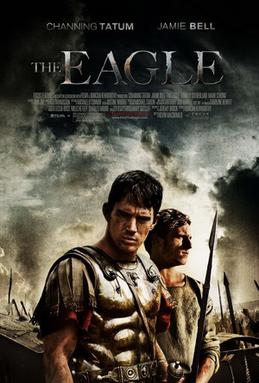
Rosemary Sutcliff’s The Eagle is one of the classic young adult stories of all time. An enjoyable odd-couple-turned-brothers-in-arms series, with plenty of action and adventure it arrives on screen as a dark, gloomy and above all not-really-fun-at-all story that doesn’t seem to know whether it’s aiming for a boys-own yarn or an adult adventure. It basically fails to make either work.

In Roman Britain AD 140, Marcus Flavius Aquila (Channing Tatum) is a young centurion whose father was one of the commanders of the Ninth Legion, which disappeared twenty years before somewhere in the North. Now Marcus is working to save his family honour – but his career as a centurion is cut short after he is injured almost single-handedly saving his garrison from attack. Depressed, he resolves to head north to try and find his father’s legion’s missing eagle standard – accompanied only by his strong-willed slave Esca (Jamie Bell), who hates Rome but owes his life to Marcus who saved him from execution in the gladiatorial ring. Heading North they find the eagle is in the hands of a savage tribe of warriors, who take no quarter.

Kevin Macdonald’s film probably should work like a Bernard Cornwell novel remixed in Roman Britain – or, better yet, like a proto-Simon Scarrow novel. There should be a growing sense of odd-couple bond – or at least chemistry – between Marcus and Esca as unlikely allies who become even more unlikely friends. Sadly, Macdonald misjudges the mood and instead turns the film into a grimly serious, mud spattered and miserable travel saga, which slowly drains any sense of enjoyment out of the story and its mission.

Instead, Esca and Marcus seem to hate each other’s guts for most of then movie until the plot finally absolutely demands that they lay down their lives for each other – at which point, an unearned switch takes part. Rather than an amusing “opposites attract”, men on a mission banter that the film sort of needs, instead everything is morose, angry and very, very serious. By the time the film hits the sort of banter tone it needed at the start, the credits start to roll.

It’s not helped by the choices of the two lead actors. Tatum is at his most “serious” here, with none of the playfulness and lightness that can make him an engaging presence. Instead he’s muscle bound and frowning, dispatching enemies without a second thought and forever gloomily reflecting on his father’s lost honour. Bell gets the tone slightly more on point, but he’s given almost nothing light to work with, instead having to juggle guilt and resentment at the oppression his people face and his part in it. With the dreary photography, all this misery finally starts to wear the viewer down.

Where’s the enjoyment of all this adventure? I get the film wants to make a serious point about the cost of empire and conquest, but did that have to be at the cost of any sense of fun? At least the film does take an interesting decision to make all the Romans American – reflecting the fact that America is “the new Rome” – but it doesn’t really take these revelations anywhere.

Not that you would really want it too as this is supposed to be an adventure story. Instead it’s a gloomy trip of two angry people in extreme cold and mud to grab a metal eagle, punctured by darkly framed fights, dully assembled dialogue scenes and a bubbling dislike between the two lead characters that never flowers into respect until far too late. By making neither of the two lead characters particularly likeable, we never really invest in their journey – and in the end just plain don’t care about what happens to them or if they ever get that eagle at all. For an adventure story, this is one trip you’ll insist you’d rather stay at home and guard the base.

JFK (1991)

Kevin Costner goes on a quest for the truth in Oliver Stone’s crazy but brilliant JFK

Director: Oliver Stone

Cast: Kevin Costner (Jim Garrison), Sissy Spacek (Liz Garrison), Kevin Bacon (Willie O’Keefe), Tommy Lee Jones (Clay Shaw), Jack Lemmon (Jack Martin), Walter Matthau (Senator Russell B Long), Gary Oldman (Lee Harvey Oswald), Joe Pesci (David Ferrie), Donald Sutherland (Colonel X), Laurie Metcalf (Susie Cox), Michael Rooker (Bill Broussard), Jay O. Sanders (Lou Ivan), Edward Asner (Guy Banister), Brian Doyle-Murray (Guy Banister), John Candy (Dean Andrews), Sally Kirkland (Rose Cheramie), Wayne Knight (Numa Bertel), Priutt Taylor Vince (Lee Bowers), Tony Plana (Carlos Bringuier)

When great events happen, it’s hard for us to accept they might take place for random reasons. Rather than freak occurrences or boring individuals, we’d rather see them taking place due to an impenetrable web of shadowy figures. There is something in us that rejects randomness and embraces order. Conspiracy theories are the (ironic) result of these, with their exponents often the most passionate believers in the all-pervading genius of big government. Events like the death of President Kennedy can’t be because some nobody shot him. Instead it must be part of a wider junta of baddies, with every man you see merely a front for a cabal of the wicked. It’s hard not to be swept up by the lure of the conspiracy theories (they invariably have the best stories after all) – and Oliver Stone’s JFK is perhaps the definitive mainstream conspiracy theory essay.

Taking the campaign of Louisiana DA Jim Garrison (Kevin Costner) to find out the “truth” about the murder of President Kennedy, Stone’s film is part a fascinating presentation of half-truths and “might-have-beens” and part a sprawling mess of irresponsible nonsense. Either way it’s assembled with astonishing panache, a level of filmic skill that makes it (literally) almost impossible to tell whether what you are seeing is true and what is invention. Stone’s film superbly interweaves a variety of film stocks and effects to seamlessly splice together newsreel footage, Zapruder film and his own reconstructions so brilliantly it frequently becomes hard to tell which is which.

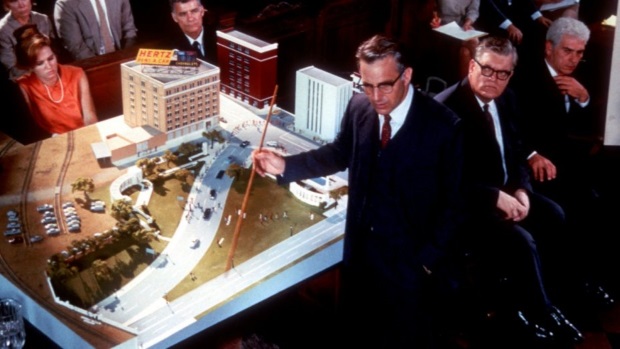
The same logic also applies to the script. JFK is frequently engaging and fascinating. But you have to remember that it is the equivalent of meeting the most literate and articulate street corner “End-of-the-Worlder”. Such is Stone’s skill he could, I am sure, have created an equally compelling film which would have you questioning the Moon Landings or the shape of the Earth. JFK throws an army of questions, objections and theories at the screen. And while it rarely provides much in the way of answers, only points that it wants you to think about, these theories frequently fascinate. Imagine JFK as a sort of video essay, linked together with dramatic scenes, with its points delivered by authoritative and trusted actors like Donald Sutherland, Jack Lemmon and Walter Matthau.

There is absolutely no doubting the technique of Stone here, or his mastery of the language of cinema. The work of Robert Richardson’s photography, with its myriad styles, and of Joe Hutshing and Pietro Scalia’s editing, pulling together a host of images, snapshots and flash cuts into an insidiously convincing whole, is breathtaking. Light in particular is superbly used, casting some characters in shadow, flaring up to (literally) blind others – light frequently plays across Garrison’s glasses, a visual metaphor for his own struggle to see the light. The speeches he writes for his characters are superbly done, and make their points with great skill – Sutherland (superb) has a hugely convincing story of military black ops action (and inaction) before and after the assassination that fills almost 20 minutes of screentime.

There are compelling arguments made about the ability of Oswald to fire the shots, the triangulation of fire, the spurning of an easier shot before the fateful turn, Oswald’s seemingly illogical movements after the shooting etc. etc. There is decent reasoning behind all of this, and the points are marshalled very well. But, like all extremist theories, suddenly it will turn into something just a little batshit (Lyndon B Johnson ordering the hit or some sort of cabal of Cubans, CIA, FBI and Secret Service working together to conduct a coup).

Much of Stone’s passion for finding the truth (the film’s mantra) is rooted in his own romantic view of Kennedy, as some sort of lost “Prince Who Was Promised”. To Stone, Kennedy would have withdrawn us from Vietnam (news I am sure to the President who started and escalated America’s involvement in it), ended the military industrial complex (contrary to his platform when elected of a stronger US military), bought the Cold War to an end (again, running against his sustained opposition to the Soviet Union) and introduced full Civil Rights (a cause he was lukewarm on at best – unlike his brother or his successor Johnson).

But Kennedy was a romantic figure who had the ability to invite people to invest him with whatever qualities they wanted (both good and bad), a magic cemented forever by his untimely murder. In reality there is no indication that JFK would do (or want to do) any of the things JFK argues he was assassinated for. But that’s all part of the magic of the conspiracy. Facts and events can be marshalled into whatever you want them to be. (Tellingly the only member of Garrison’s investigative team who questions these theories is shown to be a creep in the pay of the conspirators.)

So Kennedy can be a saint, and the film can outline (with no evidence at all beyond a series of coincidences and unlikely or random events) a grand vision of master schemers reshaping America over the body of a dead President. Does it really stand up? Well no of course not. But I will say it is compelling viewing – even if it is essential to keep an open mind about it. Stone later wished he had made clearer that much of the work here was pure fiction (and speculative at best). Certainly it’s a point to keep in mind.

Perhaps Stone should also have looked again at some of the other beats in the film. The film’s version of Jim Garrison as a kind of saintly campaigner for justice flies in the face of many (then and later) who believed the Louisiana DA a shameless self-promoter – an argument made easier to believe by the real Garrison’s cheeky cameo in the film as his ‘nemesis’ Earl Warren. No mention is made in the film that the case he brings against Clay Shaw was dismissed by the jury after less than an hour, and the film avoids explicitly showing his lack of evidence. Costner delivers the final speech, with its famous “back and to the left” commentary on what seems like Kennedy’s unnatural movement after being hit by a bullet and breakdown of the “magic bullet” (both theories now largely discredited), with aplomb, but the film puts a halo on Garrison which doesn’t really stand up.

But again at least it’s entertaining. Other parts of the film don’t even manage that: the baseline narrative that links up the various compelling conspiracy lectures is frequently dull, insipid and lamely written. Sissy Spacek has perhaps the most thankless role in film history as Garrison’s wife whose nearly every line is a variation on “Honey please stop reading the Warren Report and come to bed”. Even that though pales against the exploration of the 1960s gay scene in Louisiana (which Clay Shaw and his “fellow conspirators” were leading members of) which has an unpleasant stink of homophobia, playing into a host of deeply unpleasant (and false) stereotypes of gay people as perverted, promiscuous and preying on the straight. One suspects there was more than a little truth in the idea that Garrison’s fury at Shaw was at least partly motivated by homophobia.

These sequences work considerably less well today – and frequently go on far too long – but when the film focuses on its Kennedy theories it is at least compelling, even if it’s all rubbish. The film made it mainstream to believe Kennedy was killed by a conspiracy in which Oswald was, if he was involved at all, only a patsy. How different would the world have been if Oswald had lived and been made to explain why and how he killed Kennedy? But then chances are, being such an average an unremarkable man, people wouldn’t have believed him anyway.

Stone’s film is a triumph of agenda-led fantasy. Stuffed with faults it makes you at least ask questions – even if you wisely use those questions to affirm many of its points are questionable at best. But any film buff will love the skill it’s told with and the beauty of its technical assembly. Costner was perhaps a little too bland to drive the thing along (although the film uses his innate morality very well), but there are several good performances not least from Gary Oldman who is brilliant as put-upon, used but unknowable Oswald. Nuts, crazy and packed with compelling nonsense, it at least always encourages you to find out more about the actual history.

Ad Astra (2019)

Brad Pitt goes out to the stars in Ad Astra

Director: James Gray

Cast: Brad Pitt (Roy McBride), Tommy Lee Jones (H. Clifford McBride), Ruth Negga (Helen Lantos), Liv Tyler (Eve McBride), Donald Sutherland (Colonel Pruitt), John Ortiz (Lt General Rivas

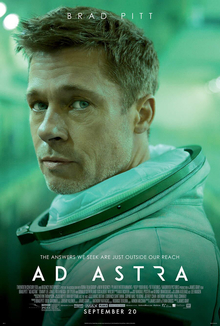
Man has looked up at the stars for as long as we can remember and imagined what lies out there. From Gods to other intelligent life form, every culture has been drawn to imagine beyond the bounds of Earth and dream of finding what is out there. It’s a dream that powers the life of leading US Astronaut H. Clifford McBride (Tommy Lee Jones), who in “the near future” led “The Lima Project” to Neptune to try and find intelligent life beyond the Solar System. Now missing 17 years, Clifford’s son Roy (Brad Pitt) has become a leading astronaut, tasked with leading efforts to find his father after a series of devastating power surges damaging the planet and killing thousands are traced back to the Lima. So Roy embarks on an epic voyage, from Earth to mankind’s bases on the Moon and Mars to Neptune in quest of his father.

James Gray’s artfully made film yearns for a moral and thematic depth that it doesn’t quite manage to achieve. Its structure is heavily inspired by Hearts of Darkness, with Marlow and Kurtz twisted into a Son-Father dynamic and many of the stop offs on the way McBride encounters eerily reminiscent of the adventures of Marlow. Is there a longer trek down the river than crossing the Solar System? 

Within this framework, Gray throws in an earnest meditation on the nature of mankind’s yearnings and how our instincts collide between our dreams for an unattainable unknown and the world around us. All of this accompanied by Pitt’s Conradesque voiceover, as McBride muses over his own internal struggles, doubts, inadequacies, frustrations and sorry all bubbling beneath his calmly controlled exterior.

Its Pitt’s film and Ad Astra is a reminder that he is an actor who looks to push himself to his absolute limits. Here he carries the whole film, for long stretches alone, his eyes conveying the cool professionalism and self-control of McBride, along with his own far-more-fragile-than-appears psyche. Carrying burdens of loss and regret, McBride seems to see crises that he encounters in space as relief from his own internal struggles. Whenever the shit hits the fan, McBride is the coolest man in the room (his commanding officers admiringly state his pulse rate never seems to go above about 80 in even the most life-threatening situations) and from tumbling from the outer atmosphere, evading pirates in a moon buggy in space or manually landing a spacecraft, he never fails at his professional duty. Only when confronted with the emotions of his own life is he left with his composure fractured.

Pitt conveys the isolation and pain of McBride extremely well, with acting and expressions so subtle they carry all the more emotional force. It’s a controlled and perfectly judged performance that powers the entire film, and bears a lot of the thematic weight of Gray’s invention. 

Gray’s direction is powered by clear memories of 2001 and Solaris (although I also felt echoes of Danny Boyle’s space horror Sunshine in its fascination with the dread and danger of the vastness of space not to mention Christopher Nolan’s Interstellar). It looks fantastic with a wonderful score, ambitiously grasping for importance.

Episodic as it moves from location to location, Gray’s film creates a convincing world of the future, where mankind has disputed colonies on the moon (space pirates roam between bases, taking hostages like Somalian pirates), space travel is commercialised (by Virgin of course) and people live and die on a far-flung underground base on Mars. While I did briefly think about the enormous cost of all this space travel with its huge fuel consumption and debris of discarded rocket sections (how on earth is this commercially viable?), not to mention the trouble that would be involved in erecting giant neon cowboys on the Moon, it’s convincing.

Gray’s film wants to delve into the mysteries of humanity, and McBride Snr’s entire life has been dedicated to the quest for finding out that we are part of something larger than ourselves, that we are not alone. Gray wonders perhaps if this shark-like desire we have for moving forward, the ruthlessness we display in leaving the past behind in quest for the future, perhaps mars us as a species, prevents us from finding contentment around us and leads to us damaging this world we have been given in our search to make it larger.

But the more Gray’s film closes its grip, the more themes seem to slip through its fingers. The journey is compelling in its creation of a series of worlds, Brad Pitt’s dedicated performance, and the sense of danger and the array of questions that the film throws up. But while 2001 in many ways manages to feel like it is about everything and nothing, so wonderfully engrained is the magical poetry in its soul, here it feels like the film gets less and less engaging the further the journey goes. The destination sadly cannot match the voyage, however beautifully filmed that voyage is.

Instead when the film arrives, we find it becoming more and more bogged down in father-son issues that feel just cheaper and less interesting than the more spiritual and enigmatic concerns the film has for much of the rest of its running time. Not helped by a disengaged performance from Tommy Lee Jones, the more the film heads into this territory the more it seems to lose the depth it aimed for earlier. Late attempts to restore the enigma, mystery and universality don’t succeed to completely restore the feeling that this is classic science-fiction poetry. It’s a shame as Gray’s film as many wonderful moments, beautiful craft in its making and a wonderful performance by Pitt – but it feels in the end as about much less than it could have been. But for all this, there is a magic unknowingness about it that could have it hailed as a classic in years to come.