
Tag: Ed Begley

Boomerang! (1947)

Boomerang! (1947)

Effective journalistic investigation into a murder case turns into engaging courtroom melodrama

Director: Elia Kazan

Cast: Dana Andrews (State’s Attorney Henry Harvey), Jane Wyatt (Madge Harvey), Lee J Cobb (Chief Harold Robinson), Cara Williams (Irene Nelson), Arthur Kennedy (John Waldron), Sam Levene (Dave Woods), Taylor Holmes (TM Wade), Robert Keith (‘Mac’ McCreery), Ed Begley (Paul Harris), Karl Malden (Lt White)
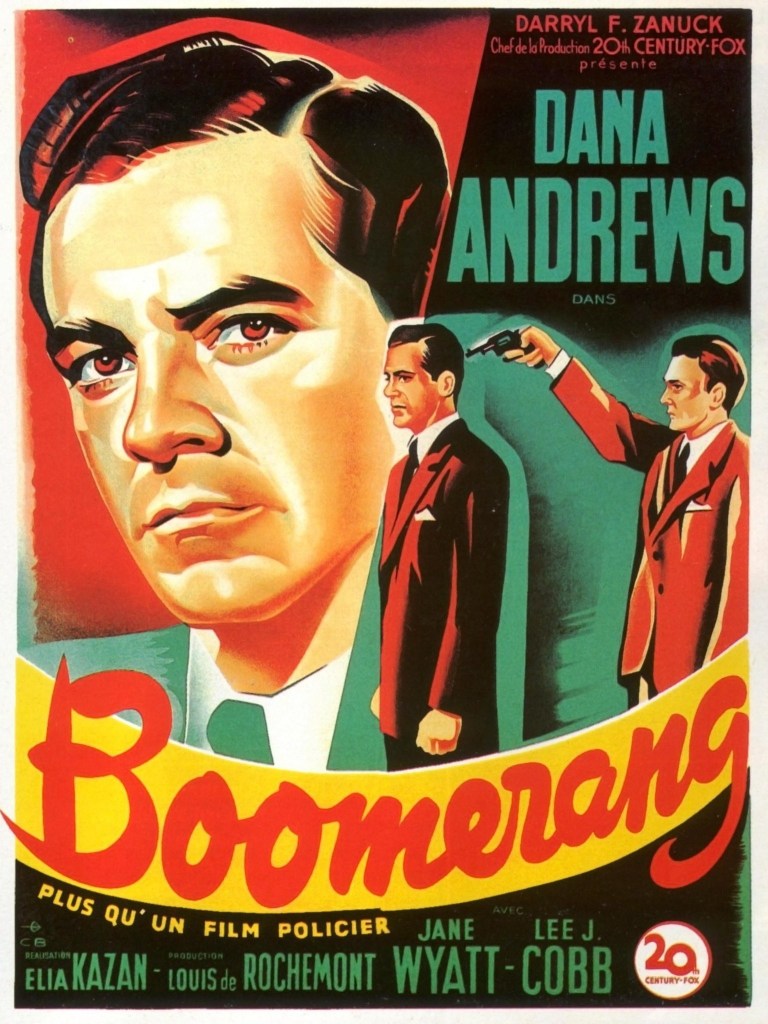
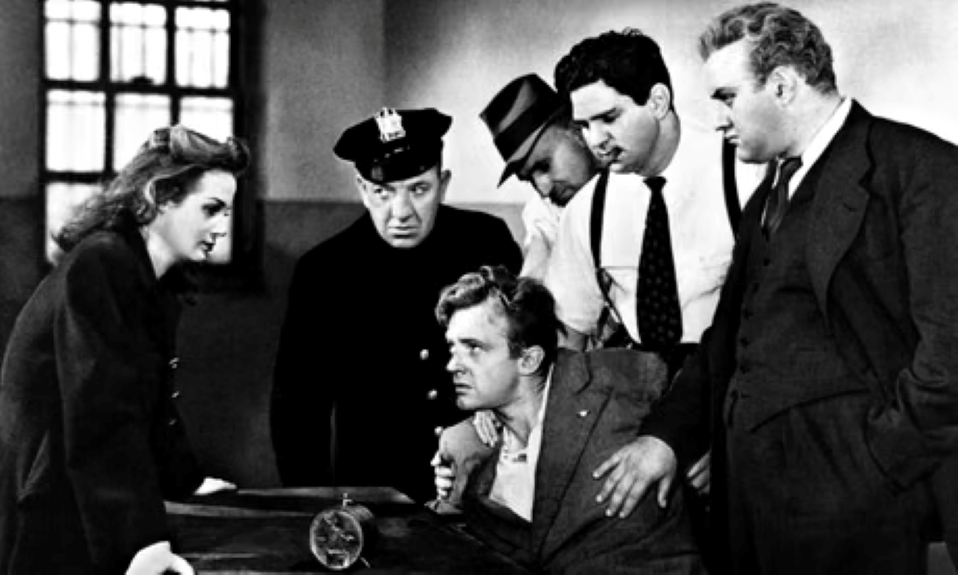
In Bridgeport, Connecticut, a popular priest is gunned down in the street, the killer escaping into the night. The police are baffled. The city turns against the reformist mayor’s administration. Then, after several weeks, there is a lead as twitchy ex-soldier John Waldron (Arthur Kennedy) is dragged in and, after hours-and-hours of interrogation without sleep, signs a confession. But who cares about small details like that, when everyone is sure the police has their man? But State’s Attorney Henry Harvey (Dana Andrews) has doubts – and no pressure from the public or officials will make him build a case against an innocent man.

Based on an actual 1924 murder case, Boomerang! is told with journalistic sharpness by Elia Kazan that smoothly moves from investigative into courtroom drama. Boomerang! was cited by Kazan as when he started to find his voice, establishing a style that would carry him to Oscar-winning success in On the Waterfront and beyond. Shot largely in location (though admittedly in a different Connecticut town than Bridgeport), it’s full of the immediacy of the streets, avoiding sets and forced studio locations. Kazan leans into the journalistic feel, with a voiceover explaining events and an earnest attempt throughout to make it feel like we are watching real events unfold.

It captures people going about their everyday lives: gossiping over laundry, strolling down streets, pounding typewriters in press rooms, gathering in church and shops. This is a film designed to convey a full sense of a real world. That goes as well for reflecting the investigation, which is full of the visceral pounding of pavements and hustling of suspects into police cars as well as the interrogations of the worn-down Waldron, taking place in an inhospitable room where never-ending questions means Waldron’s head has to be literally picked up to continue answering the questions.

The observational strengths of the film’s opening eventually moves into something more straight-forwardly melodramatic, but Kazan’s documentary restraint tries it best to not make this shift too jarring. As Harvey’s doubts grow, he becomes under increasing pressure from officialdom, principally from Ed Begley’s sweaty Paul Harris (who is too noticeably dodgy from the start for his villainy to be anything like a surprise). This is before a series of courtroom dynamics that hue towards the sort of fireworks you find in larger-than-life films than the journalistic reserve Boomerang! starts with.

Which isn’t to say that these courtroom dynamics are not very well-handled, especially by the under-rated Dana Andrews, who brings just the right amount of humanity and dignity to an otherwise stiff-on-paper character of a crusading, too-good-to-be-true attorney. Andrews delivers the courtroom speeches, and the detailed breakdown of the flaws in the police case, with a real quiet passion – just as he brings a nice degree of moral outrage to the bullying attempts to silence him.

Boomerang! provides several opportunities for compelling character actors, many of whom went on to work again for Kazan to great success. Lee J Cobb’s bulldog fierceness is perfect for put-upon police Captain Robinson who lets his determination to prove he can crack the case compromise his judgement. Cobb gives Robinson a powerful sense of authority – there is a wonderful scene where he faces down a would-be lynch mob with little more than growling disapproval. There is also a lovely moment, where he lifts the sleeping Waldron and carries him into his bed with all the care of a loving father. He’s well backed by Karl Malden as an eager-to-please inexperienced cop.

Arthur Kennedy produces one of his expert portraits in weakness as Waldron, an embittered veteran who has found peace offers little more than failure. While never losing track of what makes Waldron suspicious, Kennedy finds a neat line in vulnerability and fear keeps him sympathetic. Opposite him, Cara Williams explodes with righteous fury as a former girlfriend who believes herself wronged, eager to see Waldron condemned. It’s a more interesting role than any other female role in the film, although Jane Wyatt finds some engaging warmth in the dull role of Andrews’ loyal wife.

Boomerang! at heart is a film about the barrel being fine, aside from a few rotten apples. The crime takes place after the old machine politics system has been cast aside by new politicians, not beholden to the system, willing to introduce reforms. And, by and large, they are shown to really mean it – even if, at one point, some express the view that it doesn’t matter if Waldron is guilty or innocent, since winning means the reformists can remain in power. But all the real sins are collected in the hands of Begley’s character: even the police are absolved, despite the fact we watch them essentially brow-beat a man into confessing (a sergeant even suggesting they rough him up a bit to speed things along, which makes you wonder what the system was like for people are not veterans the police captain feels sorry for).

Boomerang! pulls any punches of really exploring systemic flaws, even while it covers an innocent man being bum-rushed into a trial. But then it puts complete faith in the idea that the same system will turn around and do its job by ensuring he is completely absolved – with the only danger from corrupt elected officials, not the blindness of a potential system. It’s a factor Kazan (to be fair) felt the film made too many compromises on – and he’s right. It might tell a scare story, but Boomerang! is fundamentally a reassuring film that is sure everything will turn out right in the end.
Odds Against Tomorrow (1959)

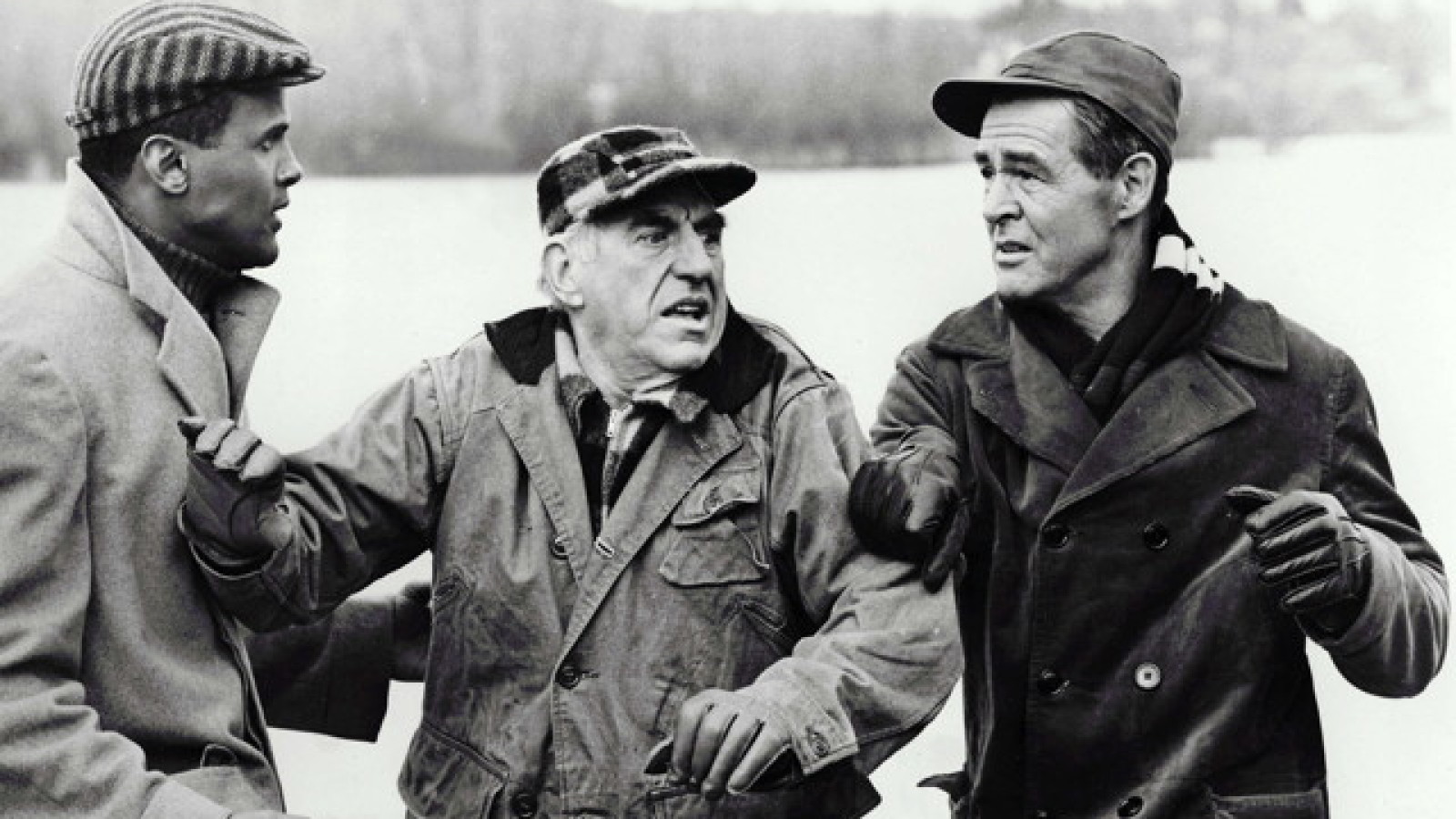
Harry Belafonte, Ed Begley and Robert Ryan are a mismatched crime team in Odds Against Tomorrow

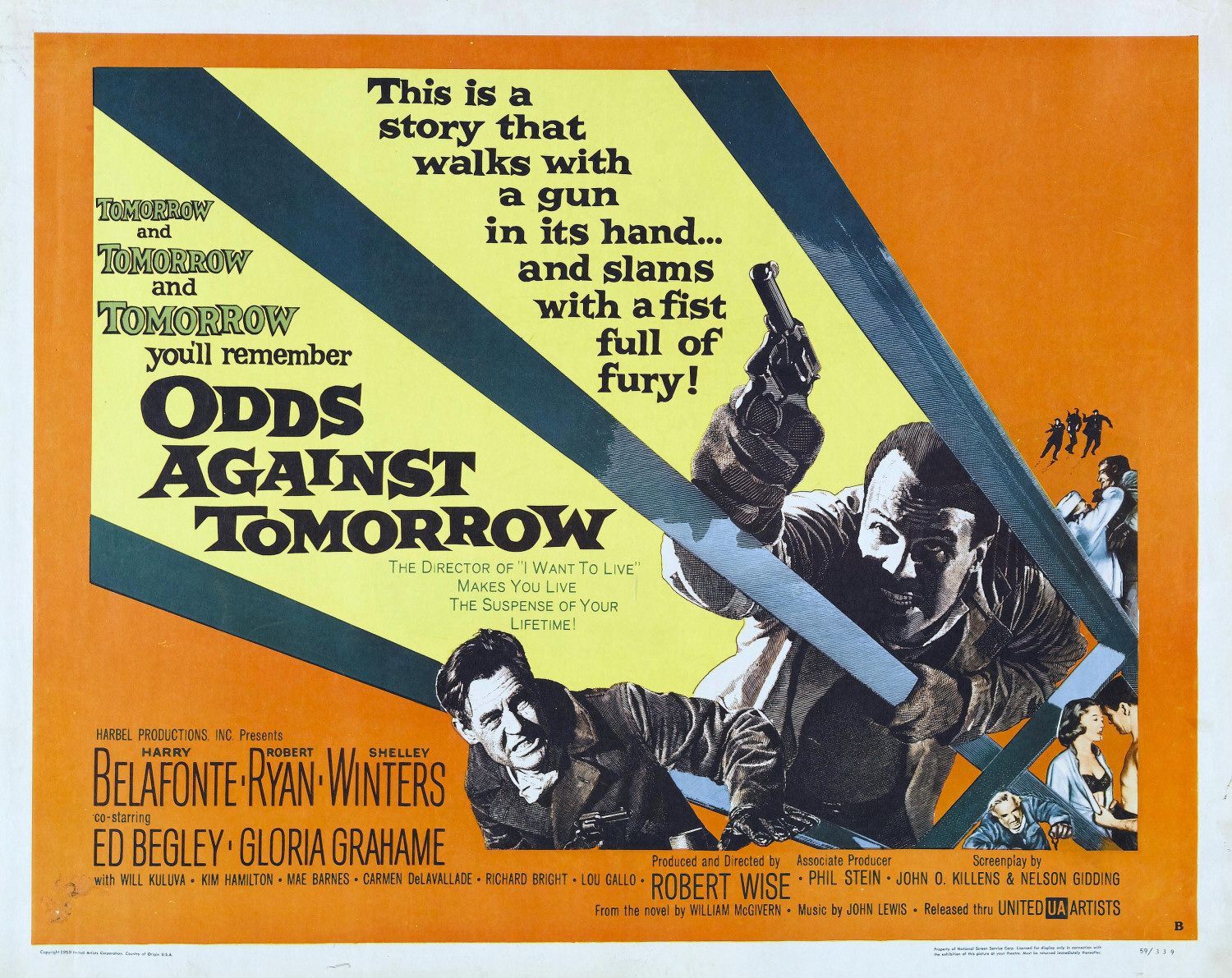
Director: Robert Wise

Cast: Harry Belafonte (Johnny Ingram), Robert Ryan (Earl Slater), Shelley Winters (Lorry), Ed Begley (Dave Burke), Gloria Grahame (Helen), Will Kuluva (Bacco), Kim Hamilton (Ruth Ingram), Mae Barnes (Annie), Richard Bright (Coco), Carmen de Lavallade (Kitty), Lew Gallo (Moriarty)

Johnny Ingram (Harry Belafonte) life is on the skids. His career as a singer isn’t bringing in the money to fuel his gambling addiction or help support his ex-wife. Owing money to gangsters, he’s roped into taking part in a bank heist master-minded by bitter ex-cop Dave Burke (Ed Begley). It should all go smoothly. Unfortunately, Burke has also recruited Earl Slater (Robert Ryan) as muscle – and Slater has channelled all his own insecurities and resentments into virulent racism. Can Johnny and Slater work together to make the heist work?

Wise’s picture – with a script by the black-listed Abraham Polonsky – is on paper a crime drama. But it’s really hardly interested in the heist (which is almost laughably simple) the planning of which doesn’t even start until the film is nearly an hour old. Instead, the focus is on putting together a neat parable for racial divide in America. Because if even criminals are more preoccupied with feuding over the question of the colour of each other’s skin than making a score, why on Earth should we be surprised that such problems arise in every walk of life?

Attitudes are mapped out early in the film, largely thanks to Wise’s crisply efficient story-telling. Ingram playfully tips off a group of mixed-race kids to watch his car; Slater singles out a black child from this same group with a smilingly delivered racial epitaph. In the building, they both have strikingly different conversations with a black elevator attendant. Its clear tensions will abound – not least because Slater won’t work a job with a black man and Ingram is rightly disgusted with him.

Belafonte produced the film and he plays a very different type of black American than most films had seen. Black characters frequently fell into being either noble or deferential. Johnny is neither. He’s angry, bitter, drinks and has no interest in compromise of any sort. Johnny is a deeply troubled man, who seems to be making a mess of his life. Above all he doesn’t rise above racial abuse or shrug it off, but angrily confronts it. Fundamentally he’s a chippy screw-up, but he always retains sympathy because we can see he’s really a decent guy, for all his faults.

He’s just not one who’s willing to play the white man’s game to get ahead. He’s quite clear with his wife (very effectively played by Kim Hamilton) that he’s not willing to simply conform with a structurally unfair world. He’s also quite clear with Slater that he doesn’t want to hear whimsical memories of the South during the ‘good old days’. Belafonte does all this with a great deal of energy, even if you feel he doesn’t quite have the range and power for the role.

It’s interesting though that the film finds plenty of room to explore Slater. Played with a fragile self-loathing by Robert Ryan (one of Hollywood’s great liberals, whose career was made up of characters who persecuted minorities), Slater is deeply unsettled and insecure. He’s struggling to adjust to a more modern world where the man isn’t always the hunter-gatherer, and his wife (a rather sweet Shelley Winters) has the fixed job he can’t get. He doesn’t understand the world anymore.

All this makes Slater vulnerable, confused and even a bit pitiable – all qualities Ryan effortlessly brings out in the film’s finest performance – stumbling into bar fights where he responds with far too much violence. His face constantly seems to crumble into something a little like tears. He engages in a brief fling with a flirtatious neighbour (a blowsy Gloria Grahame) simply, it seems, to try and feel better about himself. The only thing that give him strength, it seems, is turning Johnny and all other black people into an alien “other” which he can lambast and attack.

This of course leads to barely concealed tensions during the robbery planning – where Slater repeatedly states he doesn’t trust Johnny to complete anything – and then during the robbery itself when the fundamental distrust between these two leads to a shoot-out and disaster. Caught in the middle, in a polished performance, is Ed Begley’s Burke, lacking the force of character to make this odd couple work together.

Wise’s film sometimes make some obvious choices – after the final climactic shoot-out, a policeman comments “which is which”, which is about as “under the skin we’re all the same” as you can get. But it’s told with a leanness and pace and by focusing on social issues rather than crime, it presents an intriguing snapshot of American attitudes. The vast majority of characters don’t share Slater’s kneejerk racism – but they also don’t even think of challenging it. No wonder Johnny Ingram’s so annoyed – and no wonder he sees that, for all the smiles, it’s a world run by and for the white man where your only chance of success is conform and shut up. Maybe the odds are against tomorrow.

12 Angry Men (1957)


Henry Fonda must win over 12 good men and true in 12 Angry Men

Director: Sidney Lumet

Cast: Henry Fonda (Juror #8), Lee J Cobb (Juror #3), Ed Begley (Juror #10), E.G. Marshall (Juror #4), Jack Warden (Juror #7), Martin Balsam (Juror #1), Jack Klugman (Juror #5), Joseph Sweeney (Juror #9), John Fiedler (Juror #2), Edward Binns (Juror #6), George Voskovec (Juror #11), Robert Webber (Juror #12)

A young man is on trial for murder. The jury retires to consider. On the first vote, only one man (Henry Fonda) questions his guilt. The other jurors are convinced they are right – can Fonda turn them around?

Who hasn’t done jury service and dreamed of being Henry Fonda? 12 Angry Men is perhaps the most compelling courtroom drama ever, for that very reason: hardly any of us are judges or lawyers, but we’ve all got a decent chance of doing jury service. What would we do in this situation? How thoughtful would we be about the evidence? And, of course, that little stab of ego – could we be charismatic and persuasive enough to sway a room of people? I think this is why this film sticks with people and has become such a persuasive part of our popular culture – we all wanna be Fonda.

12 Angry Men is a film that I feel touches perfection. I thought quite heavily about whether I could identify any flaws in it at all: the closest I got at was the shot Lumet throws in of the suspect (a sweet looking kid). I suspect this shot was required so that the 50s audience could be confident that Fonda was crusading for someone who at least looked innocent (although it always makes me think, since so many of the other jurors make snap decisions, why doesn’t at least one of them look at that cute kid and think “he ain’t no killer…”). Aside from that, I don’t think there is a single mis-step in the filming, acting or writing of the film – and how many times can you say that?

Lumet is a director who doesn’t get a lot of public recognition. He subordinates his skills to the requirements of the story, rather than an auteur who imposes his style. This works perfectly for this compelling slow-burn. Lumet’s expert filming quietly lets the actors and dialogue stand front-and-centre, while cleverly using his camera language and shot choices to amp up the tension.

At first, Lumet uses wider and high angle shots, allowing us to get a sense of the room and the characters. But the real effect of this plays out over the rest of the film, as Lumet slowly moves to tighter angles at POV height, until the final sequences are played out over a series of close-ups cutting from juror to juror, at low angles. What this achieves brilliantly is to make the film feel tighter and more claustrophobic – the room feels like it’s actually shrinking in on the jurors as they argue. You can get a sense of it in the videos below, both early and later in the film.

The film also works so brilliantly because it offers a brilliant insight (and critique even?) of the legal system. The one legal professional we see is a bored judge. All references to the unseen lawyers mention either their showmanship or inadequacy. Even the jury system is subtly called into question: several of the jurors are motived more by prejudice and personal experience than by any analysis of the evidence. Others are flawed in other ways; #12 switches sides indecisively three times while #7 is so impatient and bored with the whole process, he follows the direction of the least resistance. Without #8, a decision would have been made with no discussion at all. Even the very process of taking the vote is shown to root many of the jurors down to “sides” and creates an atmosphere of competition that becomes as important as seeing justice done. And in a system of trial by your peers, only #4 in any way identifies himself as sharing the background of the man on trial. Is this a perfect system?

These ideas, though, are skilfully interwoven in the background of a gripping legal thriller. 12 Angry Men is completely objective. We never see the witnesses whose performance is the cause of such analysis. We never see the scene of the crime. We don’t have any confirmation at all that either side is right. It’s a film about the importance of reasonable doubt – and the need to be absolutely certain before sending someone to the chair. Fonda feels that doubt – and persuades the other jurors of it – but we never know if he was right or not. We never know if any of the suppositions in the jury room are true – the important thing is how high the possibility is that they might be true – and how much that affects our willingness to convict.

The film is one brilliant set-piece after another, as each piece of evidence is interrogated. I honestly can’t decide which one I like the most. What makes it work is the variation of how each case is presented. The film is as comfortable with the drama of #8 flinging a replica of the “unique” murder weapon onto the table, as it is with a careful dialogue-led dissection of the eyesight of a key witness. Who can resist Fonda limping around an approximation of the next-door neighbour’s flat to see if he can cover a certain distance within a certain time. It helps that the dialogue is incredibly rich – it has to convey a lot of information, but also manages to sketch out each of the characters so swiftly and carefully that each of them feels real.

And we’ve come all this way and not even mentioned the performances. Again, each viewing gives me a chance to appreciate a new performance: my eye was caught on this viewing by Robert Webber’s seemingly cool and collected advertising man, who has far less certainty than he projects. Needless to say each actor is brilliant. Fonda (who also produced) is the very image of moral authority – as well as a generous collaborator on the movie. Is this his best performance? It’s got to up there – #8 is a humanitarian, but he’s never smug or self-serving, just a man who feels a strong sense of his own obligation.

If Fonda is the superego, Cobb’s #3 (the primary antagonist, if there is such a thing) is the ego – raging, elemental, decisive, unshaken in his beliefs. Cobb’s performance veers the closestto a little too stagy, but it’s a character that demands it. His bluster and swaggering are vital to the character in order to make his later emotional collapse work as well as it does – and #3’s final emotional disintegration really rings true. It’s a ferociously intense performance.

Each actor gets his chance to shine. Voskovec’s sensitive immigrant has a wonderful speech on the responsibility of passing judgement. The most barnstorming speech is Begley’s racist outburst late in the film. It’s beautifully done as this loud-mouthed bully explodes with frustration, then slowly and even rather sadly collapses as he talks on and on, each sentence making him weaker and weaker, more defensive and vulnerable. But it’s never a scene about just one man – the reactions are as well judged as everything else. And I can’t tell you how much I love #4’s “I have [listened to you]. Now sit down and don’t open your mouth again” one-line response which caps the scene.

In fact just mentioning #4 brings on my love of E.G. Marshall’s performance in this film. #4 should be one of the least engaging characters in the film – coldly analytical, professional, assured and clear minded. But he’s always human, never an antagonist, but a respected citizen – the only one of the jurors who is motivated by judgement rather than prejudice. I love his calmness, his cool lack of regard for #3 and #10’s loud-mouthed berating, his patient, studied explanation of his convictions. I adore his calm puncturing and counterview of each point Fonda puts forward, until he is finally won over – and its his winning over which makes the film work. If this thoughtful, intelligent man has doubts, shouldn’t we all?

But I repeat they are all great. Jack Warden’s #7 is totally convincing as (the film’s real villain?) a man indifferent to right and wrong when compared to his own needs. Balsam’s decent but ineffectual #1 is the perfect mediocrity in above his head. Sweeney’s wry, observant and shrewd #9 is a delight (Sweeney was the only member of the original TV play to be retained). Fiedler’s #2 grows in moral force throughout, belaying his quiet appearance. Klugman’s #5 is quietly defiant and conflicted. Binn’s #6 reveals himself as a mild, humble and honourable man.

I think I could watch 12 Angry Men every week of the year. It’s brilliantly filmed (how could I not mention the oppressive rain soundtrack that accompanies the latter part of the film) and wonderfully directed. The script is simply perfect, Reginald Rose expanding and enriching his original TV adaptation. The acting is nearly flawless from all concerned. It’s, quite simply, a great movie. I simply can’t imagine anyone not reflecting on this movie when heading into jury service. It subtly comments on the legal system, but never gets bogged down in this, telling a gripping and compelling story about things we never see. It’s pretty damn near close to perfection.