Kramer’s film is well-balanced mix of drama and message with two strong performances from the leads
Director: Stanley Kramer
Cast: Sidney Poitier (Noah Cullen), Tony Curtis (John “Joker” Jackson), Theodore Bikel (Sheriff Max Muller), Charles McGraw (Captain Frank Gibbons), Lon Chaney Jnr (Big Sam), King Donovan (Solly), Claude Akins (Mack), Lawrence Dobkin (Editor), Whit Bissell (Lou Gans), Carl Switzer (Angus), Kevin Coughlin (Billy), Cara Williams (Billy’s Mother)
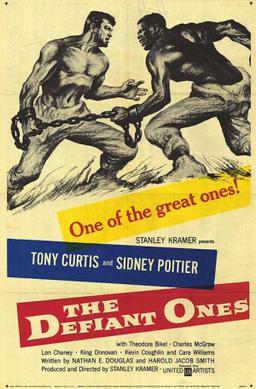
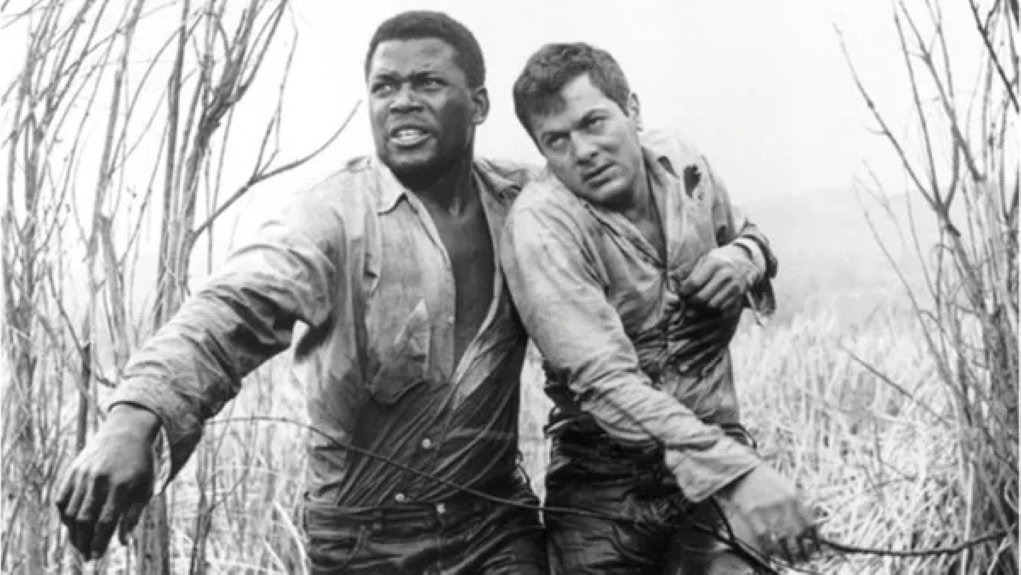
The Defiant Ones is a vintage Stanley Kramer message film, one of his best mixings of serious social issues with entertainment. Two convicts escape from a prison transport, making a run for it while chained together at the wrist. They are thief John “Joker” Jackson (Tony Curtis) and Noah Cullen (Sidney Poitier), imprisoned for standing up to a racist thug. Cullen is Black – and that’s a big issue in the racist world of Southern America. Forced to work together to survive, despite their mutual distrust and outright dislike, slowly the two form a curious bond – all while dodging the dangers of recapture and falling foul to vigilante ‘justice’ from ordinary people.
The message of The Defiant Ones is pretty clear to see, but Kramer’s film manages to avoid laying it on too heavily, mostly letting it be seen in everyday casual prejudice. Starting with Jackson’s constant use of the word “boy” – and his complete failure to understand why Cullen finds this grating. Jackson has already used the n-word the very first time he speaks to Cullen, side-by-side in the prison transport. Most of the police and enthusiastic deputies helping them are itching to release fierce dogs on the escapees (it’s clear why). The hostility Cullen immediately encounters when they are briefly caught by turpentine workers, accelerates with terrifying speed into ropes being flung over lampposts for a lynching (Jackson’s protest, that you can’t lynch a white man, is telling in itself). Even when they encounter a scared child, he jumps to Jackson to protect him from Cullen (he even assumes Jackson must be Cullen’s guard).
The constant repetition of the dangers and assumptions behind racism probably gained added force at the time because they a white man shared some of the chance of being suddenly murdered for looking the wrong way. Part of The Defiant Ones aim is to show through adversity that more connects us than not. This also comes out when the two men talk about their lives. When Jackson bitterly describes his life of working-class drudgery in a hotel, scraping and smiling for tips from the rich, Cullen quickly points out it places him only a mild rung above a Black man who wouldn’t even be allowed in the hotel unless he was holding a mop. Both are firmly wedged on the bottom of the social ladder, part of the film’s suggestion that, prejudice aside, they are natural allies.
Allies is what they become, a relationship that develops smoothly thanks to the skilled playing and excellent chemistry between Poitier and Curtis (both Oscar-nominated). They certainly were put through their paces physically – aside for brief doubles (or dummies) work when they traverse some rapids, pretty much all the difficult stunts (all the more so, since they were chained together) were done by the actors themselves. In particular, an awkward escape from a clay pit was remembered by Curtis as possibly the toughest thing he ever did on a film set. Kramer throws the two stars into a parade of dangerous terrain – wading bogs, fast rivers, climbing awkwardly up and down heights – which adds a narrative energy to his issues-based plot.
Poitier at this time had to carry the burden not only of acting, but also representing a significant share of the American population single-handed. Here, he’s sharper, rougher and more resentful than his reputation suggests. Poitier makes Cullen a no-nonsense fist, someone who refuses to take crap from anyone – least of all Jackson. Frequently he uses singing to express his refusal to knuckle down and be silent, and it’s his strength and resourcefulness that does the most to keep the men moving. If Poitier does have a disadvantage, it’s that Kramer’s film gives him less of a personal journey – it’s the world that must accept Cullen, not vice versa, and rightly-or-wrongly the character is little different from his journey (aside a personal loyalty to Jackson) than he was at the start.
This means, Tony Curtis actually many of the more interesting character beats. If Cullen remains largely unchanged, Jackson progresses from holding thoughtless, knee-jerk assumptions into someone who forms his own opinions and loyalties. It’s very well-drawn by Curtis – who relished the chance to play such a complex character – as he slowly reveals Jackson as a vulnerable, regretful and lonely figure under the bluster. So much so, that his late realisation of where his true loyalties lie – an outburst of anger, expertly delivered by Curtis – feels completely earned, as an expression of all the character depth we’ve watched him develop. Its Curtis’ finest performance.
The Defiant Ones does lose some energy in its later stages. It splits, fairly naturally, into three acts: the convicts alone, the convicts at the turpentine camp and the convicts at the secluded home of a lonely woman (an Oscar-nominated Cara Williams) who takes a shine to Jackson. Each of these acts is, if I’m honest, marginally less compelling than the one before, in a film at its strongest when focused on the relationship between its two stars and their conflict with each other, the elements and the wild terrain. There is something more melodramatically familiar about watching Cullen resentfully face down would-be-lynchers, or Curtis’ flirt with a desperate woman who doesn’t even need to know his name to have the hots for him.
There is good work from the rest of the cast. Cara Williams does manage to make a lot of her quietly siren-like character, with surprising depths of selfishness and cruelty – even if her section is the film’s least narratively intriguing. Lon Chaney Jnr is very good as a work boss, appalled by the racist violence his colleagues are capable with. The police crew following our heroes – oddly soundtracked to a constant barrage of music from their portable radios (the only music in the film) – are little more than narrative tools, but Theodore Bikel (Oscar-nominated) finds a fair bit of humanity in his sheriff.
The Defiant Ones though is strongest with the focus on its two excellent leads, with the constant parade of obstacles and dangers it throws them into powering the film strongly without letting it lapse too much into moralising and preaching. It’s a very good balance of high-brow earnestness, and genuine entertainment, one of Kramer’s most successfully films.