Tag: Sidney Poitier

The Defiant Ones (1958)

The Defiant Ones (1958)

Kramer’s film is well-balanced mix of drama and message with two strong performances from the leads

Director: Stanley Kramer

Cast: Sidney Poitier (Noah Cullen), Tony Curtis (John “Joker” Jackson), Theodore Bikel (Sheriff Max Muller), Charles McGraw (Captain Frank Gibbons), Lon Chaney Jnr (Big Sam), King Donovan (Solly), Claude Akins (Mack), Lawrence Dobkin (Editor), Whit Bissell (Lou Gans), Carl Switzer (Angus), Kevin Coughlin (Billy), Cara Williams (Billy’s Mother)
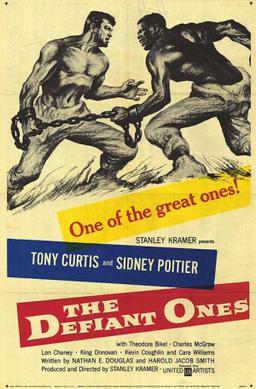
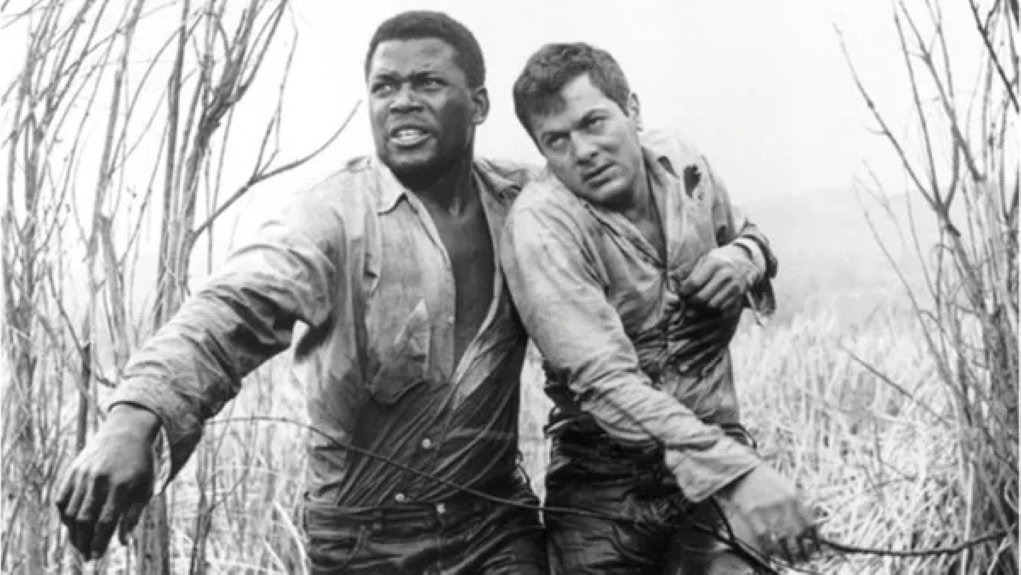
The Defiant Ones is a vintage Stanley Kramer message film, one of his best mixings of serious social issues with entertainment. Two convicts escape from a prison transport, making a run for it while chained together at the wrist. They are thief John “Joker” Jackson (Tony Curtis) and Noah Cullen (Sidney Poitier), imprisoned for standing up to a racist thug. Cullen is Black – and that’s a big issue in the racist world of Southern America. Forced to work together to survive, despite their mutual distrust and outright dislike, slowly the two form a curious bond – all while dodging the dangers of recapture and falling foul to vigilante ‘justice’ from ordinary people.

The message of The Defiant Ones is pretty clear to see, but Kramer’s film manages to avoid laying it on too heavily, mostly letting it be seen in everyday casual prejudice. Starting with Jackson’s constant use of the word “boy” – and his complete failure to understand why Cullen finds this grating. Jackson has already used the n-word the very first time he speaks to Cullen, side-by-side in the prison transport. Most of the police and enthusiastic deputies helping them are itching to release fierce dogs on the escapees (it’s clear why). The hostility Cullen immediately encounters when they are briefly caught by turpentine workers, accelerates with terrifying speed into ropes being flung over lampposts for a lynching (Jackson’s protest, that you can’t lynch a white man, is telling in itself). Even when they encounter a scared child, he jumps to Jackson to protect him from Cullen (he even assumes Jackson must be Cullen’s guard).

The constant repetition of the dangers and assumptions behind racism probably gained added force at the time because they a white man shared some of the chance of being suddenly murdered for looking the wrong way. Part of The Defiant Ones aim is to show through adversity that more connects us than not. This also comes out when the two men talk about their lives. When Jackson bitterly describes his life of working-class drudgery in a hotel, scraping and smiling for tips from the rich, Cullen quickly points out it places him only a mild rung above a Black man who wouldn’t even be allowed in the hotel unless he was holding a mop. Both are firmly wedged on the bottom of the social ladder, part of the film’s suggestion that, prejudice aside, they are natural allies.

Allies is what they become, a relationship that develops smoothly thanks to the skilled playing and excellent chemistry between Poitier and Curtis (both Oscar-nominated). They certainly were put through their paces physically – aside for brief doubles (or dummies) work when they traverse some rapids, pretty much all the difficult stunts (all the more so, since they were chained together) were done by the actors themselves. In particular, an awkward escape from a clay pit was remembered by Curtis as possibly the toughest thing he ever did on a film set. Kramer throws the two stars into a parade of dangerous terrain – wading bogs, fast rivers, climbing awkwardly up and down heights – which adds a narrative energy to his issues-based plot.

Poitier at this time had to carry the burden not only of acting, but also representing a significant share of the American population single-handed. Here, he’s sharper, rougher and more resentful than his reputation suggests. Poitier makes Cullen a no-nonsense fist, someone who refuses to take crap from anyone – least of all Jackson. Frequently he uses singing to express his refusal to knuckle down and be silent, and it’s his strength and resourcefulness that does the most to keep the men moving. If Poitier does have a disadvantage, it’s that Kramer’s film gives him less of a personal journey – it’s the world that must accept Cullen, not vice versa, and rightly-or-wrongly the character is little different from his journey (aside a personal loyalty to Jackson) than he was at the start.

This means, Tony Curtis actually many of the more interesting character beats. If Cullen remains largely unchanged, Jackson progresses from holding thoughtless, knee-jerk assumptions into someone who forms his own opinions and loyalties. It’s very well-drawn by Curtis – who relished the chance to play such a complex character – as he slowly reveals Jackson as a vulnerable, regretful and lonely figure under the bluster. So much so, that his late realisation of where his true loyalties lie – an outburst of anger, expertly delivered by Curtis – feels completely earned, as an expression of all the character depth we’ve watched him develop. Its Curtis’ finest performance.

The Defiant Ones does lose some energy in its later stages. It splits, fairly naturally, into three acts: the convicts alone, the convicts at the turpentine camp and the convicts at the secluded home of a lonely woman (an Oscar-nominated Cara Williams) who takes a shine to Jackson. Each of these acts is, if I’m honest, marginally less compelling than the one before, in a film at its strongest when focused on the relationship between its two stars and their conflict with each other, the elements and the wild terrain. There is something more melodramatically familiar about watching Cullen resentfully face down would-be-lynchers, or Curtis’ flirt with a desperate woman who doesn’t even need to know his name to have the hots for him.

There is good work from the rest of the cast. Cara Williams does manage to make a lot of her quietly siren-like character, with surprising depths of selfishness and cruelty – even if her section is the film’s least narratively intriguing. Lon Chaney Jnr is very good as a work boss, appalled by the racist violence his colleagues are capable with. The police crew following our heroes – oddly soundtracked to a constant barrage of music from their portable radios (the only music in the film) – are little more than narrative tools, but Theodore Bikel (Oscar-nominated) finds a fair bit of humanity in his sheriff.

The Defiant Ones though is strongest with the focus on its two excellent leads, with the constant parade of obstacles and dangers it throws them into powering the film strongly without letting it lapse too much into moralising and preaching. It’s a very good balance of high-brow earnestness, and genuine entertainment, one of Kramer’s most successfully films.

Lilies of the Field (1963)

Lilies of the Field (1963)

Nuns and a drifter find mutual respect (eventually) in this quaint, gentle drama

Director: Ralph Nelson

Cast: Sidney Poitier (Homer Smith), Lilia Skala (Mother Maria), Lisa Mann (Sister Gertrude), Isa Crino (Sister Agnes), Francesca Jarvis (Sister Albertine), Pamela Branch (Sister Elizabeth), Stanley Adams (Juan Acalito), Dan Frazer (Father Murphy), Ralph Nelson (Mr Ashton)

One day Homer Smith (Sidney Poitier) stops at a small Arizona farm to ask for water for his car. The farm is run by refugee Eastern European Nuns. Homer does a few repair jobs, teaches them a little bit of English and stays for dinner, assuming he’ll be paid in the morning. But the fearsome Mother Maria (Lilia Skala) tells Smith (or Schmidt as they call him) his presence is a gift from God and recruits him to build them a chapel, in return for food and lodging (but not money). Smith finds himself accepting – and, as the building work begins, finds a passion for the project building in him. Amen!

A humble “nice” film, based on a successful novel, Liles of the Field was shot in about two weeks by Nelson – who got the financial backing when Poitier agreed to play the lead. It went on to scoop a Best Picture nomination at the Oscars and a Best Actor Award for Sidney Poitier. To be honest there isn’t really anything in Lilies of the Field that you won’t see a hundred times before or since. Shot with an efficient (if Televisual) low-keyness by Ralph Nelson, it’s an inspiring tale about inspiring folks with a few laughs and smiles, set in a world that shows what we could achieve if mutual respect and decency were mankind’s watch-words.

Lilies of the Field is decisively a spiritual, feel-good film but it’s pleasantly told without any over-emphasis or lecturing, which allows it to remain a charming, engaging (if slight) watch. The story of the building of this small chapel in the middle of nowhere is as inspiring as seeing how a passion for the project gives Smith a focus and purpose he perhaps has lacked elsewhere in his life. But it’s also crammed with some charmingly loose scenes, such as Poitier playfully teaching the Nuns basic English phrases (far more useful than the ridiculous – and useless for everyday life – phrases the Nuns are learning from a record) and, later, the fundamentals of Gospel music.

Roughly in the centre is a rather sweet and well-drawn gentle struggle of wills between Homer Smith (an honest guy who expects an honest wage for an honest day’s work) and Mother Maria (a woman who has learned that you don’t get without asking again and again and again). These two feud using bible quotes (rather wittily, Mother Maria uses a massive embossed tone while Homer uses a well-thumbed pocket copy), butt heads on Mother Maria’s refusal to accept anything less than Smith agreeing to do the work gratis and Smith’s frustration at what he sees as her dictatorial stance. But, inevitably, respect grows between them over time (as it does in movies like this).

You could pretty much predict most of the beats in Lilies of the Field. Of course, the whole desert community rallies around to help. Of course, Smith and Nuns reach an understanding of mutual affection. Of course, the building contractor Smith works for part-time to keep himself in dollars (played by the director Ralph Nelson) overcomes his condescension to Smith to chip in. Of course, Smith falls in love with the chapel – and sees it as a chance to live his dream of becoming an architect. None of this should surprise you.

But it works because it’s all quite gentle and charming. A big part of this is down to Poitier’s performance. So many of his roles dripped with nobility and grandeur, that it’s really pleasant to see him cut loose and have some fun. This is surely one of the most relaxed performance Poitier ever gave, his Homer Smith loose-limbed, witty and relaxed, enjoying the comic banter and gracefully breaking into (dubbed) gospel singing. He has a natural and easy chemistry with the other actors – most of all Lilia Skala (also Oscar nominated) who is perfectly dry and starchy as Mother Maria – and keeps the whole enterprise just the right side of light and breezy. It’s Poitier getting a light, personality part very different from the roles he’s more associated with. He became the first black man to win an Oscar – and only the second person of colour after Hattie McDaniel.

The film has a few beats of racial tension: Nelson’s contactor condescendingly calls Smith “Boy” (much to his quiet anger) and there are references to prejudice. But what the film wants to celebrate is people coming together – which is what Smith, the Nuns and the (mostly) Latin American community do to winning effect. It does this with such honesty and simple pleasure that, for all its predictability and lack of narrative invention, it’s rather winning. It’s a simple, almost forgettable, little film – but when watching it you’ll at least feel heart warmed.

In the Heat of the Night (1967)

Sidney Poitier and Rod Steiger confront racism In the Heat of the Night

Director: Norman Jewison

Cast: Sidney Poitier (Virgil Tibbs), Rod Steiger (Chief Bill Gillespie), Warren Oates (Sam Wood), Lee Grant (Mrs Colbert), Larry Gates (Endicott), James Patterson (Purdy), William Schallert (Mayor Schubert), Beah Richards (Mama Caleba), Peter Whitney (Courtney)

A slim, tight thriller with a social message, In the Heat of the Night won Best Picture in 1967, beating out Bonnie and Cyde and The Graduate (both films with a revolutionary impact on films making) as well as another Sidney Poitier starrer, the even-more message heavy Guess Who’s Coming to Dinner. An unflashy, cleanly made, efficient film, In the Heat of the Night is in some ways a surprising winner – but the shocking depiction of racism in the Deep South at the time still hits home today.

In Sparta, Mississippi a wealthy industrialist from Chicago is found murdered in the street. Who committed the crime? Well surely it’s the well-dressed black man with a wallet full of money waiting to get out of town at the train station. The man is hauled in – only for him to reveal he is an expert homicide detective from Philadelphia named Virgil Tibbs (Sidney Poitier). Tibbs is sucked in to assist local police chief Gillespie (Rod Steiger) to investigate the crime, partly on the order of his boss, partly due to his disgust at the police department’s racism and incompetence, and partly at the pleading of the victim’s widow (Lee Grant) who recognises him as the best officer for the case. But will Tibbs’ expertise crack the case in a town where the idea of a black man in a suit, asking questions and taking no shit, is a still a surefire recipe for a lynching?

Nominally In the Heat of the Night is a murder mystery, but you’ll be hard pushed to remember much about the case after you finish the film. The eventual killer emerges from left field and the steps of the investigation are often unclear. While the film is trim, it does mean the tension around the killer’s identity never really builds up and we never get a real sense of the personality of the suspects (apart from the uniform racism).

Where its real strength is, is in the mis-matched “buddy” movie structure of two men forced to work together, the difference being that both casual and violent racism underpins every interaction Tibbs has in the town. Poitier was seen as a calm and graceful figure, but In the Heat of the Night finally gave him the chance to mix dignity with resentment and anger that had never been seen in a black character on screen before. The film works due to Poitier’s inherent toughness, his lack of compromise and anger at injustice. Poitier was never more hard-edged, defiant and determined to get what he deserves. Unlike Poitier’s other racial buddy movie The Defiant Ones, you can’t imagine Tibbs jumping off the train to freedom to try and save Tony Curtis.

Tibbs isn’t just the smartest, toughest policeman on the screen – he demands to be treated like it. The film’s most famous scene – and shocking at the time – is during Tibbs’ questioning of genteel racist Endicott in his orchid greenhouse. Endicott – whose home resembles nothing more than a plantation, loaded with black workers – is well spoken but inherently racist, and slaps Tibbs when his questions go on too long – only to immediately receive a backhand from Tibbs in return. Endicott is as shocked as audiences were – the idea of a black man striking back was on unheard of.

It’s terrifying and sickening to realise however that the American South at the time was genuinely like this. The slap is a proud moment – but it marks Tibbs for retribution. There is a genuine danger Tibbs will get lynched in this film (twice he narrowly escapes murder at the hands of a gang of furious rednecks). In real life, Poitier was very hesitant to film in the South, and for the brief location shooting in Tennessee slept with a gun under his pillow. The film is littered with casually dropped racial slurs, the politest of which is “boy”. It leads to the famous line from Tibbs that back home “they call me Mister Tibbs” – but you forget that it follows from Gillespie asking him what an n-word copper is called in Philadelphia. And even after that Gillespie only calls him Virgil, as if still not quite able to compute the idea of a black man who can be a “mister”.

The relationship between Tibbs and Gillespie is the heart of the film. And the film is brave to not have this turn into “they were opponents but then they became the best of friends”. Instead there is a sort of grudging respect that grows, even though Tibbs clearly thinks Gillespie is an impulsive racist and Gillespie thinks Tibbs is a stiff-backed but brilliant n-word. Rod Steiger won the Oscar for Best Actor, and he does some fine work as the complex Gillespie. Keeping his explosive energy in check (despite the inevitable outbursts), Steiger sketches out a character who is smart enough to know he isn’t smart enough, who can respect Tibbs’ professionalism and understand on some level that racism is beyond all sense but still drop racial words with an instinctive ease.

Steiger’s Gillespie is a tough-talking, stereotypical cop but he’s also got a sad little hinterland – a late dinner at his home with Tibbs has him confess that Tibbs is his only guest for years – and while he arrests no fewer than three innocent people for the crime, there is no doubting his dedication to justice. Steiger doesn’t apologise for Gillespie’s appalling attitudes, but also does enough to suggest that his racism is learned rather than innate. While never completely sympathetic, especially today, the film lays hints of hope that a racist cop from the South could work side-by-side with a black officer – and that was considerable progress at the time.

But it’s Poitier’s movie, and while in many ways he has the simpler part (and Poitier generously ceded his admiration for Steiger’s skill and craft pushing him to a level he felt he not reached before), Tibbs is the centre of the film. Jewison skilfully shoots Poitier as always the outsider, from his looks and Sherlock Holmes style skills, to the way the camera focuses on his hands touching things – from dead bodies to door knobs – to the visible discomfort of the white men watching him. Tibbs may be arrogant but he’s right and Poitier’s refusal to compromise or offer any concessions is a striking thing – Tibbs is who he is and he won’t change a thing to be accepted by the white man. At the end, he may respect the steps Gillespie has taken – but I doubt he’d consider the man a friend and certainly not a professional equal. 

In the Heat of the Night is still shocking for the openly displayed racism and menace of violence that black people faced in the Deep South in sixties America. Jewison’s film is efficiently assembled and tightly edited – not a single minute is wasted in one of the shortest Best Picture winners ever – and while its mystery is little to write home about, its portrait of racism in America is still shocking and stirring and its two lead performances are things to linger in the memory.

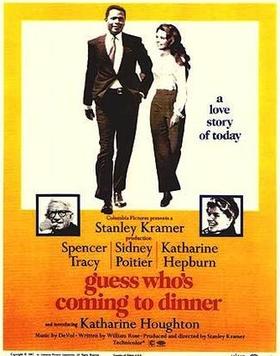
Guess Who's Coming to Dinner (1967)

Hepburn, Tracy, Poitier and one awkward meal: Guess Who’s Coming to Dinner

Director: Stanley Kramer

Cast: Spencer Tracy (Matt Drayton), Sidney Poitier (John Prentice), Katharine Heburn (Christina Drayton), Katharine Houghton (Joey Drayton), Cecil Kellaway (Monsignor Mike Ryan), Beah Richards (Mrs Prentice), Roy E Glenn (Mr Prentice), Isabel Sanford (Tillie)

Stanley Kramer’s films today are quite easy to knock. In fact, to be honest, they were pretty easy to bash back then. Kramer was a man with immense social conscience, and his films carry the same liberal agenda. They were about “Big Themes” and they had a “Message” that they very much wanted the viewer to take home with them. You can see why so many of them were littered with Oscar nominations. Guess Who’s Coming to Dinner is perhaps the most famous of his liberal films, and while we’d love to think the theme it covers today – interracial marriage – isn’t still an issue, I  think many people would say it still was.

Joey Drayton (Katharine Houghton) returns to the home of her liberal parents – Matt (Spencer Tracy) a newspaper editor and Christina (Katharine Hepburn) an art gallery owner – with Dr John Prentice (Sidney Poitier) whom she announces as her new fiancé, after a whirlwind romance in Hawaii over the past two weeks. Her parents, Matt in particular, are hit for six – and their doubts are shared by John’s parents (Beah Richards and Roy E Glenn). Can the older generation overcome their concerns to celebrate the happiness of the younger? 

Guess Who’s Coming to Dinner is a sensitive, very carefully handled film, whose liberal earnestness practically drips off the film. It’s so hand-wringingly liberal in its outlook it’s almost impossible not to mock it a little bit. Not least because John is so ridiculously overqualified – a professor of medicine, one of the world’s leading experts on tropical diseases, a nominee for the Nobel Prize – that you can’t help but wonder what he sees in her not vice versa.

This over-qualification was, by the way, an intentional move by Kramer, who was keen that the onlypossible objections to John could be the haste of the engagement and the colour of his skin. It’s the latter point that becomes the main discussion point, with some hand-wringing concerns around the attitudes of the wider world, and Matt Drayton in particular being moved to question whether he can practise the liberal agenda he preaches. It’s no real surprise to say that eventually all the characters sit down to the eponymous dinner in blissful harmony, but the film is delivering a positive message here.

You could say that it would have been more daring to make John, at the very least, a middle ranking accountant or something at least. But, let’s be honest, at the time this film was made interracial marriages were literally illegal in 17 US states (as the film name checks). Saying that though, the possibility that a BAME male may feel uncomfortably out of place in liberal White America has hardly gone away. It’s one of the reasons why I think the film still works and carries a message today – because if we want to think that these problems have gone away completely today, we are kidding ourselves.

Therefore, however right-on the film may be, it’s still relevant today and it’s still got something to teach us. The world we live in now may well have pushed some of the views and issues expressed in this film underground – we certainly don’t (I hope!) bandy around the word “Negro” as often this film does – but they are still there. So Kramer’s hopeful message of reconciliation and overcoming knee-jerk prejudice is still one that packs a punch. It’s that message that brought such an amazing cast on board, not least Spencer Tracy and Katharine Hepburn as the Drayton parents. Tracy was extremely ill at the time of the film’s production – he died 17 days after filming completed. Tracy was so fragile – as can be clearly seen at several points – that he could only film for three hours in the morning, and only on intermittent days. The film was only made with him because Kramer, Hepburn and Tracy agreed to take no up-front fee, as Tracy could not be insured to finish the film. Hepburn in particular – Tracy’s partner for over 20 years – nursed him through the film, helping with his lines and carefully watching to make sure he was not overcommitted. Not a single shot of Tracy was taken on location due to his ill-health, and a number of scenes were cleverly shot to avoid Tracy having to be on set as often as possible.

Despite all this, Tracy is magnificent. His underlying warmth and humanity work so well for the part that you constantly warm to him, even while you are as frustrated as many of the other characters  with his lukewarm reaction (bordering on hostility) to the wedding. You totally feel empathy for his situation, while at the same time wanting to give him a slap in the face. And man Tracy knows how to react – he is marvellous in a scene with Richards, where all he does is stand, half turned away from the camera and listen. But in this scene you see Drayton think and reassess everything he has considered in the last 24 hours.

But the whole film is building towards the final 10 minutes, which is nearly a complete Tracy monologue – and this is extremely emotional, not least as we are watching a great actor, aware he is dying, knowing that this is his last acting moment, talking emotionally of his love for his fictional wife, while his real life partner of 26 years sits tearfully in shot. It’s that extra level that really creates the emotional force.

Very good as Hepburn in, it’s clear in many scenes that her mind is more on Tracy than her performance – but she still has many wonderful moments, with similar emotional force. She also has one of the film’s funniest moments, where she imperiously dismisses a gallery colleague for barely hiding her racist disgust. Hepburn won the Oscar but stated she had never watched the film, finding the memory of making it far too raw.

The rest of the cast are also good – you can tell their commitment to the film – with Poitier conveying both human decency and firmness of character. Kellaway is very good as the only person in the film who expresses open-minded joy at the union. Richards has a wonderful emotional speech about the value of love, while Glenn conveys all the awkward frustration of a father who cannot understand his son. 

Guess Who’s Coming to Dinner is a very worthy film – and boy it knows it – but it’s got a sort of innocent idealistic purity about it. Its makers clearly believed that they were making a film that would contribute towards changing attitudes in society. And for all its heavy-handed liberalism, you can say it did to a certain extent – but not as much as it would like to. For that reason, there is a sort of additional poignancy to watching it, knowing that an issue the film makers clearly hoped would be gone for good in 30 years would in fact still be with us 50 years on. So for all its flaws, you can’t help but respect and even feel affection for it.