Tag: Edmund Gwenn

Miracle on 34th Street (1947)

Miracle on 34th Street (1947)

Warm Christmas fable will make you want to believe in Santa all over again

Director: George Seaton

Cast: Maureen O’Hara (Doris Walker), John Payne (Fred Gailey), Edmund Gwenn (Kris Kringle), Natalie Wood (Susan Walker), Gene Lockhart (Judge Henry X Harper), Porter Hall (Granville Sawyer), William Frawley (Charlie Halloran), Jerome Cowan (DA Thomas Mara), Philip Tonge (Julian Shellhammer), Henry Antrim (RH Macy), Thelma Ritter (Peter’s mother)
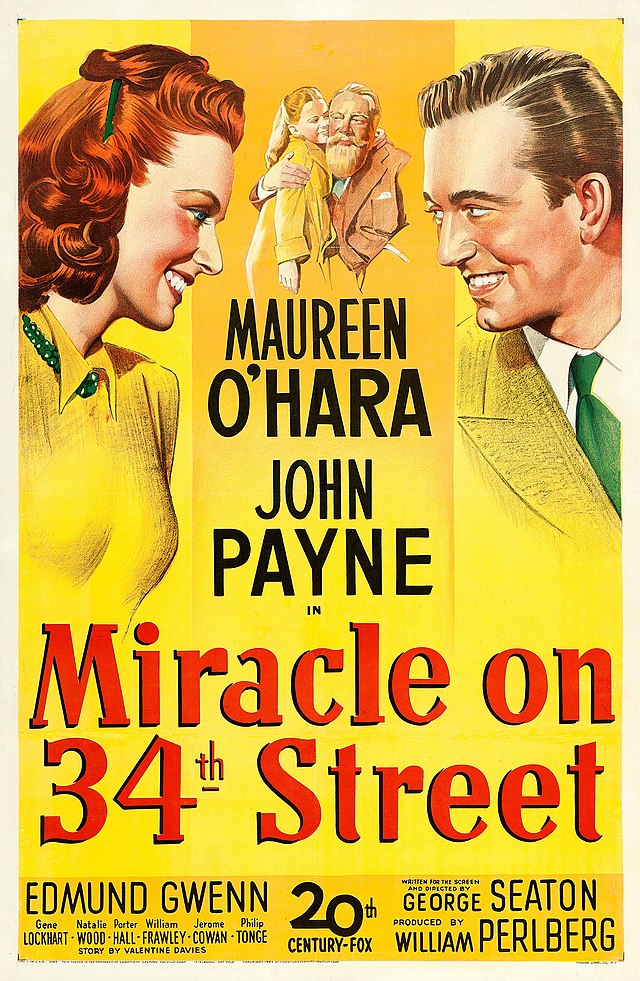
Santa Claus is a sweet little story we were told as kids, all part of buying into the magic of Christmas. How can we have been so silly as to think a jolly fat man with a red coat and flying reindeer delivered our Christmas presents? It’s the sort of fantasy adults are primed to burst like an over-inflated balloon. As a tribute to the earnest joy of believing in childish things, Miracle on 34th Street should also be the sort of thing the adult in us can’t wait to mock. Instead, its warmth and good-natured sweetness carries you along and makes you want to believe.

It’s the build-up to Christmas, and Macy’s in New York is working overtime to bring the magic to its customers (and turn a tidy profit). Macy’s Day Parade director Doris Walker (Maureen O’Hara) is relieved when Kris Kringle (Edmund Gwenn) takes the place of a drunken parade Santa and then occupies Santa’s Grotto in the store. Kringle is exactly the sort of guy you picture when you think of Santa – and, on top of that, claims to be Santa himself, much to the discomfort of Doris who doesn’t believe in all that stuff and certainly doesn’t want her daughter Susan (Natalie Wood) to. But when Kringle finds himself in court, fighting against being committed to an institution, with only Doris’ boyfriend Fred Gailey (John Payne) to defend him, can he prove there is a Santa Claus and it’s him?

Seaton’s film is an adorable delight which is funny and good-natured enough to avoid the trapdoor of sickly sentimentality. It’s a film about adults getting back in touch with the giddy delight of believing childish things. It flags up every cynical objection – and then gently suggests we’d be happier forgetting them. After all, what’s the harm in allowing ourselves in a few harmless flights of fancy – why should everything be measurable? Kris Kringle comes up against the hard-headed: harried mothers, businessmen, judges and lawyers and wins them over with his genuineness and warmth. He makes people want to believe – and doesn’t that, in a way, make him Santa?

It helps a huge amount that Edmund Gwenn is perfectly cast. Piling on the pounds and facial hair, Gwenn looks the part but also is the part. His performance is kind, considerate and bursting with warmth and good cheer. In a performance full of light, unforced playfulness, Gwenn gets the level of sweetness just right. A squeeze or two more and you would choke on the schmaltz of the whole conceit: but Gwenn is so adorable the audience wants to believe in him as much as the characters.

Especially as this Santa melts some of the cold commercialism of our modern Christmas. Miracle on 34th Street has a lot of good-natured fun at how Kris confounds the latent money-making of Christmas. On hire he’s instructed to memorise a list of preferred products to push on children. Instead he points mothers towards competing stores where they can get the exact gift they want or pick up better quality goods than at Macy’s. Of course, the concept proves so popular with customers that RH Macy is confounded by the goodwill it creates in his customers (and the huge sales it will lead to from their loyalty). Even other department stores start doing the same.

It’s one of the recurrent themes of the film: Kris brings out the best in people. Maybe not always for the right reasons: the shop-owners who want money, the judge who wants re-election. But it shows what benefit a little bit of good can have in the world. Kris also shows how little touches of consideration can change lives. There is a truly heart-warming moment where Kringle meets a Dutch orphan who simply wanted to meet Santa – although her adopted mother warned her Santa can’t speak Dutch. Much to her surprise, Kris launches into fluent Dutch, to the delight of the child. Miracle on 34 Street has several moments where the unstudied delight of children is captured to great effect, not least Natalie Wood’s delighted response to discovering the reality of Kringle’s beard (it also, to be fair, has several fairly cloying child actors).

Eventually the forces of darkness – led by Porter Hall’s twitch-laden store “psychologist”, whose bullying self-importance makes him the only person Kringle dislikes – insist we all put away childish things and chuck Kringle in an asylum. Miracle on 34th Street segues into a Capra-esque court-room drama (it’s hard not to detect touches of Mr Deeds Goes to Town) which pits Kringle’s home-spun honesty against legal cold professionalism. The clash becomes a delightful headache, as both the Judge and DA confront outraged children at home who can’t believe they are putting Santa on trial. It’s a great gag: who wants to be the judge who rules categorically Santa does not exist?

Alongside these gently amusing courtroom shenanigans (with John Payne doing an excellent job as Kris’ inventive lawyer) the film balances an endearing domestic plot. There is the inevitable will-they-won’t-they between Payne and O’Hara (if there is a bit of slack you need to cut the film today, it’s in Fred’s pushy wooing of Doris, including corralling Susan). But also, can O’Hara’s all-business professional, who’s raised her daughter with a Gradgrindish obsession with facts, melt her heart and allow both of them to believe a little bit? O’Hara handles this softening with all the consummate skill of a gifted light-comedian, while Gwenn’s delightful interaction with Wood’s precocious Susan, keen to access a world of imagination she’s never really known, is perfectly done.

it becomes a film about the power of believing. In our modern age we become expected to only base decisions on cold hard facts. Doris has taught her daughter to doubt imagination as a weakness to protect her from disappointment in the world (she is after all divorced, quite daring for a 40s family drama). But its also made Susan less likely to invest in faith, to open herself up to hopes and dreams. Its recapturing the ability to believe in something and be enriched by it that becomes one of the film’s richest messages.

It would be incredibly easy to poke fun at the good-natured naivety of Miracle on 34th Street, where businessmen are money-focused-but-decent and lawyers are amiably ready to indulge Kris with a smile. But it’s a film that zeroes in on an in-built nostalgia for simpler times in all of us. We’ve all been little Susan, sitting in a car desperately wanting to believe in the magical. It’s a film that demonstrates the eventual emptiness of cynicism, encouraging the audience to just put all that aside for 90 minutes and remember what it was like to be a child again. Throw in with that Edmund Gwenn as the definitive Santa and it might just be one of the greatest Christmas films ever made.

Foreign Correspondent (1940)

Foreign Correspondent (1940)

Hitchcock’s thriller is a stunning adventure story and a passionate call for action

Director: Alfred Hitchcock

Cast: Joel McCrea (John Jones/Huntley Havestock), Laraine Day (Carol Fisher), Herbert Marshall (Stephen Fisher), George Sanders (Scott ffolliott), Albert Basserman (Van Meer), Robert Benchley (Stebbins), Edmund Gwenn (Rowley), Eduardo Cianelli (Mr King), Harry Davenport (Mr Powers), Edward Conrad (Latvian)

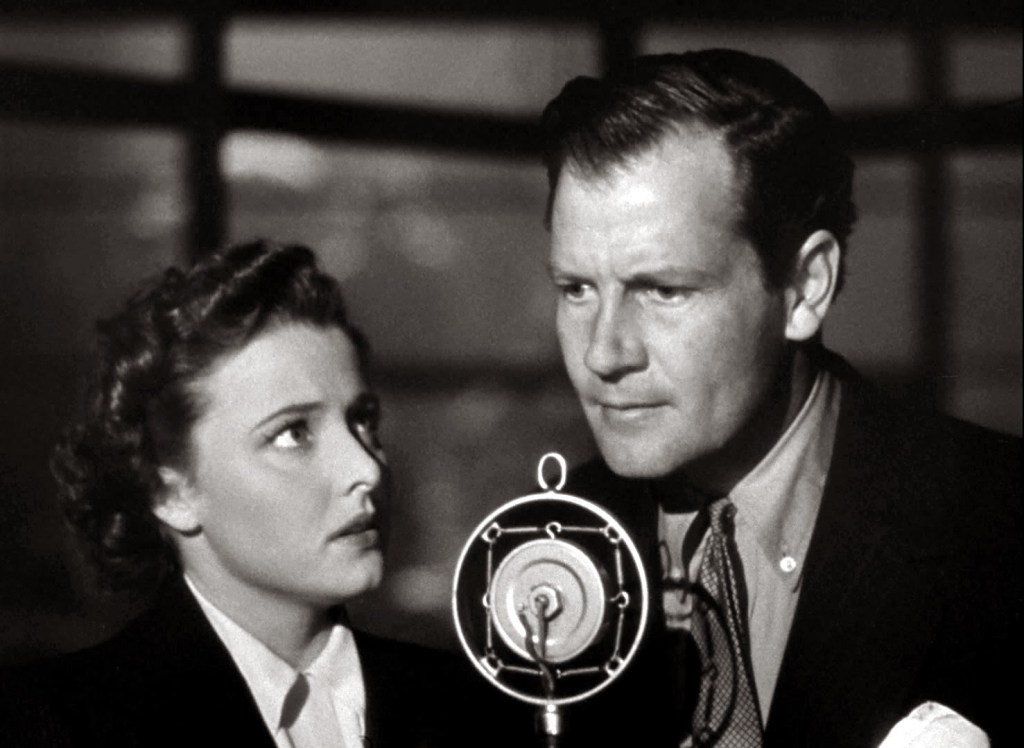
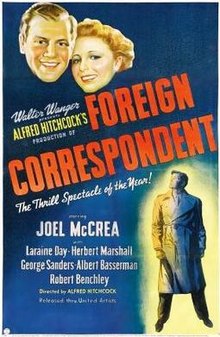
In 1940, Hitchcock was new in America, after a parade of successes in Britain. 1940 was a red-letter year for the master, directing not one but two of the films up for Best Picture. The Oscar was carried home for his masterful gothic adaptation of Du Maurier’s Rebecca, but equally memorable was Foreign Correspondent, a stirring, heartfelt thriller about the build-up to war in Britain, a passionate cry for American intervention and brilliant propaganda contribution to the British war effort (even Joseph Goebbels tipped his hat to it).

John Jones (Joel McCrea) is the new foreign correspondent in Europe for the New York Morning Globe. Given the pseudonym “Huntley Havestock” (because it sounds better), Jones is picked out because he’s a hard-boiled crime journalist, practised at winkling out a story, rather than the cozy posh boys usually sent out to Europe. In Amsterdam, Jones attends a peace conference hosted by leader of the British peace party Stephen Fisher (Herbert Marshall), where eminent Dutch diplomat and architect of the fragile European peace Van Meer (Albert Basserman) is due to speak. While Jones falls in love with Fisher’s daughter Carol (Laraine Day), Van Meer mysteriously falls to show at the dinner – and arrives at the conference the next day only to fail to recognise Jones and immediately get assassinated. Suddenly Jones finds himself in the middle of a dangerous game of spies with only British journalist Scott ffolliott (George Sanders) and Carol to help him.

Hitchcock’s Foreign Correspondent is a masterful spy caper, in the style of many of his early successful works such as The Thirty-Nine Steps, superbly assembled by a genius at the top of his game, with access to funding and techniques beyond what he had in Britain. Hitchcock went through several versions of the script – there were no fewer than nine writers who worked on this film, four of whom are credited – but it matters not a jot when the script they finally came up with matched such superb, zingy, screw-ball style dialogue with such brilliant set-pieces.

The film also had a serious purpose as well. From the start, this is a cry of one of Britain’s most prominent ex-pats to his newly adopted nation to join the effort to preserve Western civilisation against the onslaught of Nazi oppression. Joel McCrea’s Jones – a part written for Gary Cooper, who forever regretted turning the role down – is the quintessential American, disinterested in the world, sure of America’s place in it, who has his eyes opened and passion ignited by seeing up-close and personal the dangers from the agents of totalitarianism. The agents of the enemy nation – probably Germany, a country that is referenced in passing, but the film deliberately keeps it shady in an attempt to appear even-handed – are ruthless, brutal and unscrupulous. Their plans are fiendish and they are bent on world domination. But all this is worn very lightly within a caper framework that has as much interest in Jones falling in love with Carol as it does with foiling the baddies.

It also plays neatly on Jones’ very old-school American obsession with fair-play, and bringing down the baddies no matter what. Witnessing Van Meer assassinated before his very eyes, Jones is determined to go to any lengths to ensure both that justice is done and he is the man who gets the story. At the same time, Jones also has an honest and homely sense of romanticism about him. The film gets a tonne of comic and romantic mileage out of the cracking dialogue between McCrea and Loraine Day as Carol, with the sort of intelligent, witty banter that wouldn’t seem out of place in a screwball comedy, with Jones’ blunt “I say what I mean” attitude crashing beautifully against Carol’s more English rectitude. 

Hitchcock shows himself a brilliantly adept director of comedy – something he doesn’t get enough credit for – in these sequences between the two of them sparring over the course of the movie. And it’s not just them, but also his work with George Sanders – cast against type as a cool, noble British agent – brilliantly hilarious as the curiously named “ffiolliott” (the sequence, mid car chase, where he calmly explains to the befuddled Jones while bullets fly why his name has no capital letter is hilarious). Comedy is a rich vein in Foreign Correspondent and it works so well here because it lightens both the drama of the thriller elements and the political message of “pro-intervention”.

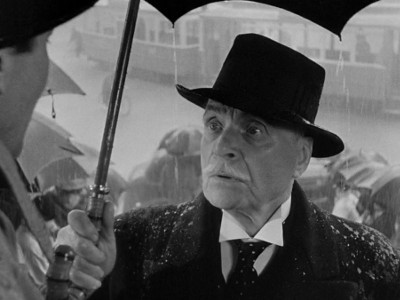
The thriller sequences are just as superb. The assassination sequence is a stand-out, a shooting on a rain soaked series of steps outside a conference, with the assassin making his retreat through a crowd of on-lookers carrying umbrellas under hot-pursuit from Jones. Hitchcock takes his camera above the crowd, meaning we only follow its progress through the disruption of the umbrellas, before the two men emerge (bullets flying) and move straight into a breathless car chase through the Dutch countryside. It’s a masterful sequence.

And it’s far from the last. The film has a superb series of tension-filled sequences, from Jones playing an elaborate game of cat-and-mouse in a Dutch windmill, trying to avoid being seen by the German agents occupying it while finding out as much as he can about their plans, to Jones reporting what he has found to a man we already know is a double agent. Edmund Gwenn, cast well-against type as a jovial, remorseless assassin, gets a brilliant sequence of attempts to kill Jones without putting him on guard, culminating in a vertigo inducing sequence at the top of Westminster Tower. It’s the second such sequence, Jones already having to climb over the roof of a hotel in Amsterdam to escape assassins (along the way brilliantly hitting the neon sign of the Hotel Europe so that it reads “Hot Europe”). Hitchcock tops it all with a brilliant plane-crash sequence shot with chutzpah and daring and is a technical marvel considering the resources available in 1940.

All this excitement and adventure helps to deliver the message of the film as strongly pro-interventionist to encourage the Americans to enter the war on the side of the Allies. Van Meer (a fabulous performance from Albert Bassermann of old-school nobility, made even more astonishing by the fact he didn’t speak a word of English and learned it all phonetically) has a brilliant, impassioned speech – all the more affecting for its  lack of histrionics – that condemns the brutality and violence of the dictatorships. The film is capped with Jones’ Ed Murrow-style broadcast from Blitz-besieged London. Both sequences raise genuine lumps to the throat – McCrea’s delivery is perfect – and the final sequence is all the more astonishing when you realise it was conceived and shot before the Blitz even started.

Not that the film is completely obvious in its allegiances. The turn-coat Brit in the film is a complex, even sympathetic figure who is merely serving his actual home country in the best way possible. He’s largely presented as reluctant to commit crimes, but believing that they must be done and is even allowed a heroic death. His identity perhaps is fairly guessable (he even has a Germanic dog!) but it still works very well in the film.

Hitchcock draws superb performances from the cast – helped by that script of zingers. McCrea is just about perfect, Day very sweet, Sanders is brilliant, Herbert Marshall’s Stephen Fisher a brilliant portrait of arrogance and tortured duty, Robert Benchley very funny (and writing his own scenes) as Jones’ colleague who’s struggling to stay on the wagon, Harry Davenport superb as Jones’ His Girl Fridayish editor. Basserman was Oscar nominated – and deserves it for his big speech – but it could have been any of the cast who got that nod, such is the quality here. Foreign Correspondent is often overlooked among the master’s many, many triumphs. But any pro-interventionist, anti-German film that has even Joseph Goebbels singing its praises must have a fair bit going for it.

Pride and Prejudice (1940)

Laurence Olivier and Greer Garson in a just-plain-not-right version of Pride and Prejudice

Director: Robert Z Leonard

Cast: Greer Garson (Elizabeth Bennet), Laurence Olivier (Fitzwilliam Darcy), Mary Boland (Mrs Bennet), Edna May Oliver (Lady Catherine de Burgh), Maureen O’Sullivan (Jane Bennet), Ann Rutherford (Lydia Bennet), Frieda Inescot (Caroline Bingley), Edmund Gwenn (Mr Bennett), Karen Morley (Charlotte Lucas), Melville Cooper (Mr Collins), Edward Ashley Cooper (George Wickham), Bruce Lester (Mr Bingley)
 

There is an expectation that old-school adaptations of literary classics from the Golden Age of Hollywood somehow set the standards of adaptation, that all others will be judged against. That may well be the case with the 1939 Wuthering Heights, among others, but it really isn’t the case with Pride and Prejudice, which is essentially a bastardisation of Austen’s original, as if the book has been humped by Gone with the Wind and we are now watching its offspring.

Do I need to tell you the plot? Well I probably should tell you this movie’s version of it. The Bennet sisters are sassy young things always on the prowl for husbands. Lizzy Bennet (Greer Garson) flirts with the proud Mr Darcy (Laurence Olivier), while her sister Jane (Maureen O’Sullivan) wins the attentions of Mr Bingley (Bruce Lester). But how will pride and prejudice affect the course of true love? Find out in this Aldous Huxley (!) scripted version of Austen’s classic, adapted via a second-rate stage version.

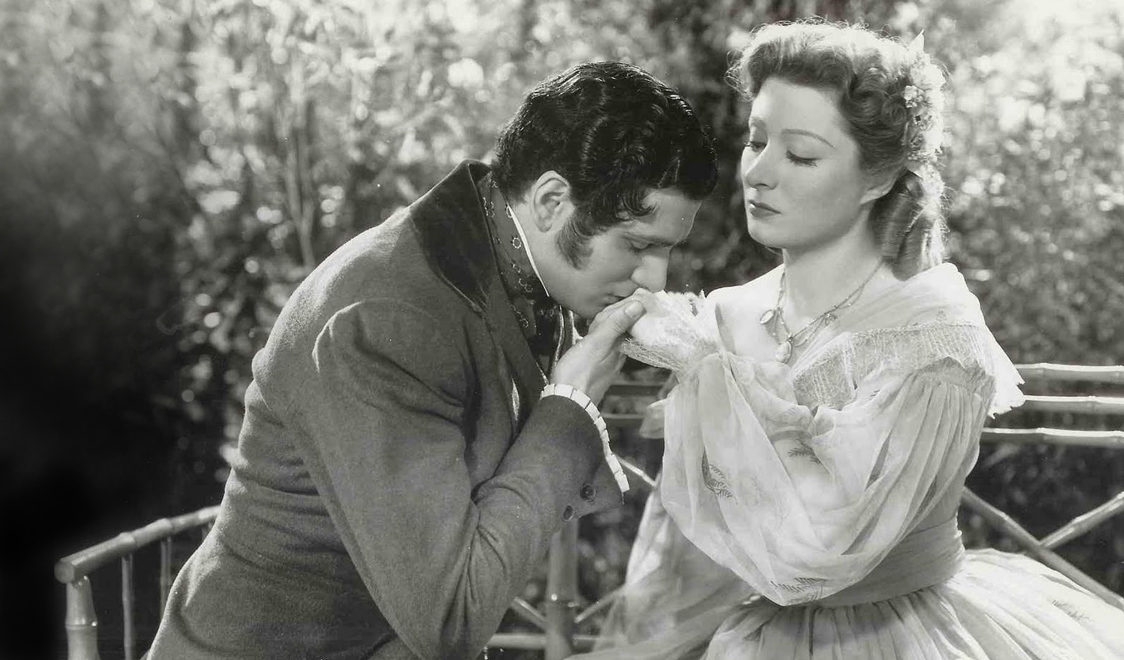
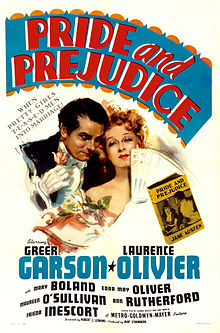
What’s bizarre about this film is how wrong so much of it feels. Now I’m no Austen expert, but even I could see that all the costumes for this production are completely incorrect for the period. Turns out of course that the producers just had a lot of mid-19th century clothing and thought it looked better. Other things feel like low-brow farce: the Bennet sisters and their mother race Caroline Lucas and her mother in carriages in order to be the first to greet Mr Bingley. That’s right, it’s Pride and Prejudice with a horse-drawn drag-race. Who thought that was a good idea? But what can you expect of a film with the tag-line “When Pretty Girls T-E-A-S-E-D Men into Marriage!”? It even takes good lines from the novel and inexplicably rewrites them to make them worse – Darcy’s snobbish and personally hurtful dismissal of Lizzy at the Merryton assembly “I am in no humour to give consequence to young ladies slighted by other men” here becomes “I am in no humour to give consequence to the middle classes”. Why?

I ask you – do these costumes look right?

That’s before you get into the casting. While some of it is pretty good (Edmund Gwenn is very good as an ineffective Mr Bennet, while Mary Boland has a neat line in shrieking as Mrs Bennet) others are downright bad – Bruce Lester is stiff as Mr Bingley, Edward Ashley Cooper is forgettably dull as Wickham, and Melville Cooper hideously overplays as a Collins who seems to have stepped in from a Marx brothers film.

Other parts just feel a bit wrong. Greer Garson and Laurence Olivier as the leads are marvellous actors, but neither of them produces a version of these iconic characters that feels remotely true – or even recognisable. Garson not only looks too old, but she doesn’t have the sense of playful intelligence and spark that Lizzy Bennet needs: she’s more of a slightly aloof tease. Laurence Olivier is reasonably good as Darcy, but the character is re-invented as much softer and more playful from the start, and his willingness to be teased by Lizzy early in the film makes her rejection of him make very little sense.

Their relationship has a flirtatious element throughout, fitting the film’s reimagining of the novel as a sort of romantic comedy in period costume, with elements of Hollywood screwball – but bearing no resemblance at all to the actual relationship Lizzy and Darcy ought to have. At Bingley’s garden party they engage in a playful archery competition (he assumes she’s a novice, she of course is an expert marksman). In itself the scene is good fun, but Darcy’s polite apology and willingness to look a little foolish, means it doesn’t hold together when she condemns him for arrogance. In fact, you’d be pretty hard pressed to identify much pride or prejudice going on at all. The main obstacle to their relationship is shown as Wickham’s denunciation of Darcy – but since Lizzy hasn’t actually seen Darcy do anything particularly bad, it seems particularly forced.

Furthermore, the film makes Lizzy seem like a ditzy schoolgirl, since literally one scene later she has spun on a sixpence and is devoted to Darcy. This is also a flaw of the film’s telescoping of events – within five minutes it feels Wickham elopes with Lydia, then Wickham comes into money, then Darcy reveals his true character, then Wickham and Lydia return. The film rushes through these events, in order to fly towards its artificial happy ending (all the Bennet sisters are given appropriate suitors in a clumsy final shot) without any real sense of Austen, or any real eye for the sort of subtle social satire she had carefully worked into her novels.

The film’s individualist take on Pride and Prejudice does at least distinguish it from other productions I suppose, but it’s terrified of the depths to the story or its characters, and seems to do everything it can to neuter its “bad” characters – Caroline Bingley barely appears, and it’s hard to believe that any reader of the book could picture Lady Catherine as she’s reimagined here: a sort of playful wingman to Darcy’s courtship of Lizzy.

But then this never feels like Austen – it’s got more of an early Gone with the Wind vibe to it, but played as romantic comedy. Lizzy here is an aloof, determined, slightly foolish, but strong-minded Scarlett-O’Hara-lite, while Darcy is a neutered Rhett Butler charmer. The production does everything it can to look like Gone with the Wind in its setting and design. Austen’s social commentary is phased out and replaced with low comedy and bantering lover style dialogue. I suppose as a film in itself, it’s perfectly fine, but as an adaptation of one of the greatest novels of all time, it’s sadly lacking.