
Tag: Edward Ellis

The Thin Man (1934)

The Thin Man (1934)

Complex mysteries take a backseat to witty wordplay in this charming, funny comedy

Director: W.S. Van Dyke

Cast: William Powell (Nick Charles), Myrna Loy (Nora Charles), Maureen O’Sullivan (Dorothy Wynant), Nat Pendleton (Lt John Guild), Minna Gombell (Mimi Wynant Jorgenson), Porter Hall (Herbert MacCauley), Henry Wadsworth (Tommy), William Henry (Gilbert Wynant), Harold Huber (Arthur Nunheim), Cesar Romero (Chris Jorgensen), Natalie Moorhead (Julia Woolf), Edward Ellis (Clyde Wynant)

Wealthy businessmen Wynant (Edward Ellis) is missing and his daughter Dorothy (Maureen O’Sullivan) needs someone to find him: particularly as the police suspect Wynant is a killer after his mistress Julia (Natalie Moorhead) is found dead, under suspicion of stealing $25k from him. Can she persuade debonair, playboy detective Nick Charles (William Powell) to put the martinis aside and take a break from his never-ending banter with wife Nora (Myrna Loy) to help unpick this mystery?

But of course she can, in this hugely enjoyable murder mystery. Inspired by a Dashiell Hammett novel (but you feel only loosely). In fact, Albert Hackett and Frances Goodrich’s script (with the encouragement of WS Van Dyke) focused a lot less on the mystery and a lot more on the sparky interplay between Nick and Nora. The Thin Man is really a crackerjack, joke-a-minute screwball comedy with a murder loosely attached. If anything, it feels more like a comedic Agatha Christie Tommy-and-Tuppence yarn – it even has a final scene where Nick gathers the suspects together over dinner to explain exactly what happened.

Not that Nicks’ actor, William Powell, particularly followed the complex plot details. But then I’m not sure anyone making The Thin Man expected anyone else to either. For starters, most viewers came away with the impression that the debonair Powell was the title’s thin man, rather than Wynant (the original crime relied on the victim being thin) – and the producers eagerly embraced that misconception, with a host of sequels following, each titled with a twist on the thin man.

Besides, the viewers were here for the banter not the crime drama. The Thin Man was shot at a lightening pace by Van Dyke (earning his nickname “one-take Woody”) over no more than twelve days. The reason being that was the length of time Myrna Loy was available for, and her chemistry with Powell was second-to-none. And you can tell it in the film, which has a loose, improvisational quality between the two leads who are often essentially fooling around on camera with each other, pulling faces and telling off-the-cuff jokes far more than spending time actually cracking the case.

And that’s where the joy of the picture really is. It’s huge fun to see the two of them playfully mock hit each other before reverting to affectionate hugs when Lt Guild turns to look at them. Or slapstick business around an icebag to the head for a hung-over Nora. The sort of film where we spent several minutes watching Nick playfully shoot balloons off a Christmas tree with an air rifle from ridiculous positions (until he finally hits a window). Both actors capture perfectly the mood of jaunty, cocktail fuelled, archly witty fun that really powers the film, like Noel Coward goes investigating.

Both actors are at the top of their game. Powell’s casual air of permanent intoxication doesn’t dim his razor-sharp cleverness. Somehow, he manages to remain smooth and stylish, even as he pulls a parade of silly faces. It’s a hugely entertaining, charismatic performance that bounces brilliantly off Myrna Loy’s equally fine performance of arch comic skill. Like Powell, Loy matches playful silliness with sexy sensuality and a winning way with a comic line. Van Dyke encourages both of them to carry out as much natural kidding around as possible (there’s even a moment when Powell drops slightly out of frame, the camera not keeping up with his off-the-cuff japery).

The two of them are a perfect fit for a pair constantly in a state of inebriation. Nora even orders six martinis (all to be lined up) alongside Nick’s one when she finds out he’s that many drinks ahead of her. Nick’s first reaction to be woken up in the middle of the night is reaching for a drink. Despite this, the two of them are sublimely cool under fire (literally) as only Golden-era Hollywood types can be. In fact, being held at gun point in the middle of the night feels like only an inconvenience in the way of a nightcap.

In fact, what’s really striking about The Thin Man is how it shows a real marriage of equals. They may bicker at points – and Nick may joke he married Nora for her money – but they work as a fully unified team. If one has a sharp line, the other an equally sharper comeback and if they make decisions they make it as a team. And, of course, they still have the hots for each other (the film ends with a classic cutaway to them climbing into the same bunk, hammering it home with their dog Asta covering her eyes and a cut to a train steaming away on the track). No wonder audiences absolutely soaked up the energy: just years after the end of prohibition, here was a fun-loving couple all about enjoying every inch of the pleasure’s life had to offer.

The whole tone of The Thin Man is about coating murder mystery in fun. From party guests who tip into the comically ridiculous (my favourite being a melancholic businessman who keeps weeping at the Charles’ Christmas Bash because he feels he needs to call his Momma) to an over-enthusiastic dog (Asta, played by celebrity mutt Skippy) whose whims constantly butt into the Charles’ never-ending drinking, flirting and banter. I love William Henry’s Gilbert, who never moves without a large reference book and uses a parade of out-of-context terms he clearly doesn’t understand from Oedipal to thinking sexagenarian is a sex addict to mispronouncing sadist as sad-est.

With all this background colour, no wonder most people didn’t really give a damn who did the thin man in (or even who the hell the thin man was). We were here for the fun, for Powell and Loy and for the jokes and banter. With Van Dyke encouraging a freeform style from start to finish (Powell’s first scene was his first practice, unknowingly filmed, his relaxed comedy so perfect Van Dyke printed it straight away), The Thin Man is wild, entertaining and funny ride which continues to entertain as viewers try to stop giggling to work out its elaborately obscure mystery.

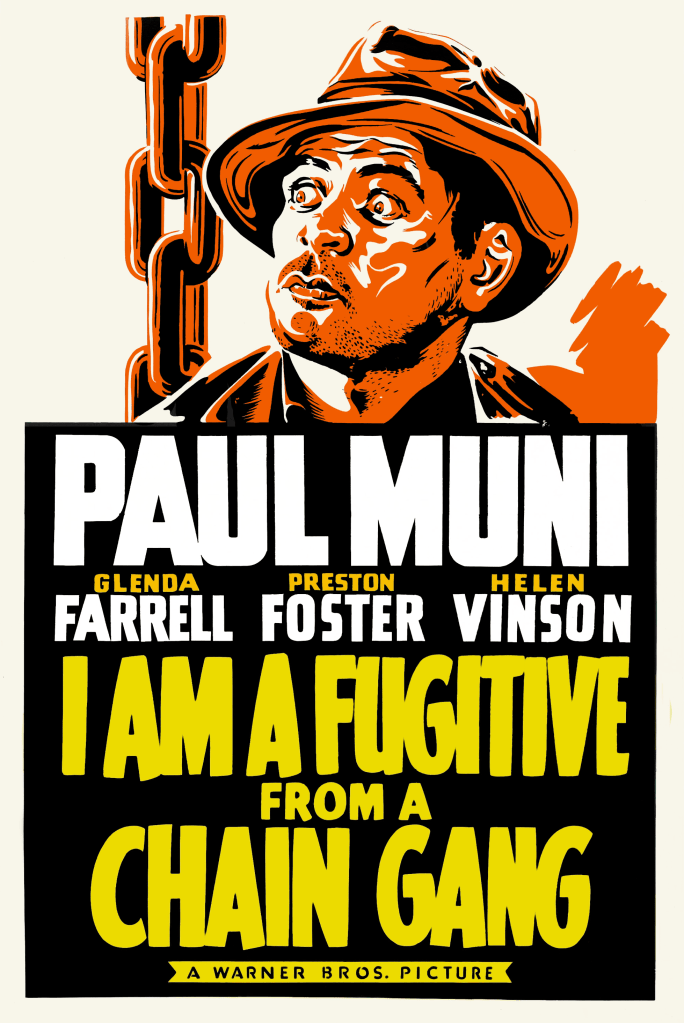
I Am a Fugitive From a Chain Gang (1932)

I Am a Fugitive From a Chain Gang (1932)

Pioneering social issues film remains an impressively mounted film, made with real passion

Director: Mervyn LeRoy

Cast: Paul Muni (James Allen), Glenda Farrell (Marie), Helen Vinson (Helen), Noel Francis (Linda), Preston Foster (Pete), Allen Jenkins (Barney Sykes), Berton Churchill (Judge), Edward Ellis (Bomber Wells), David Landau (Warden), Hale Hamilton (Reverend Allen), Sally Blane (Alice), Louise Carter (Mrs Allen)

What are prisons for? Just punishment or should they encourage reform and change? To many in the South, its clear prisons were solely about the former and had nothing to do about the latter. That, in fact, you couldn’t reform a criminal – after a prison sentence he would always inevitably come back for more. I Am a Fugitive from a Chain Gang, based on a true story, is all about exploring a dehumanising system designed to turn men into working animals, beaten for looking the wrong way. No chance of a pardon, just chain men to each other, shove a pickaxe in their hand and give them a thrashing if they stop swinging it against a rock for more than second.

Based on a memoir by Robert Burns, James Allen (Paul Muni) returns from fighting in World War One with dreams of becoming an architect. Instead, he finds the American workplace is not a welcoming place for a flood of returning soldiers, drifting from state to state for work. Until, in an unnamed Southern State, he accidentally ends up in the middle of a $5 theft and is sentenced to ten years on a chain gang. The prison is a hotbed of inhumanity, with prisoners frequently beaten, dehumanised and all but worked to death. After a year he escapes and finds his way to Chicago where he reinvents himself as a successful surveyor – only, years later, for a bitter wife to expose his secret. Can he trust the Southern State that his sentence will be commuted if he agrees to return and give himself up?

I Am a Fugitive from a Chain Gang was one of the first – and probably one of the best – 1930s social issues films. It’s a surprisingly hard-hitting look at a cruel system, which (although keen to make our hero an unwitting participant in a minor crime, rather than clearly guilty like Burns) passes a sympathetic eye on criminals, asking us to question whether, whatever their crimes, they deserve this system. A system where prisoners can be randomly thrashed near to death by a thick leather belt, where pausing at work will lead to an instant beating. Where a prisoner tied to a post by his neck is such an everyday occurrence, the film is happy to throw it away in a passing shot. It makes a strong case that how we treat prisoners says as much about us as I does them – and that, sadistic wardens quickly become little better than the men they guard.

LeRoy’s film also makes a strong argument that we talk-the-talk but rarely walk-the-walk when it comes to supporting servicemen. James Allen returns a decorated hero – but his family, former employer and patronising reverend brother assume he will happily return to grunt work on the production line. War has expanded his horizons and ambitions, given him the skills to better himself. No one wants to hear it. He’s not alone: many drifters are ex-servicemen and when he tries to pawn his medals a pawnbroker sadly shows him a bucket full of worthless service decorations. It’s an indication that everyone has an assigned role and place and they shouldn’t for one minute expect to step outside this.

It’s no wonder that the prison sentence treats men like animals – a point LeRoy makes by cutting between donkeys and men both being chained up ready for a day’s work. IAAFFACG makes clear in this system all men are equal in their inequality, cutting back and forth from Black to white prisoners as they are prepare for the days work. (The film does make clear there is a higher number of Black prisoners than white). Allen protests at first, but learns to shrug his shoulders and turn away like the rest do. A freed prisoner showcases this indifferent acceptance of suffering, leaving at the same time as a deceased one, hitching a ride on the cart sitting merrily on a fellow worker’s coffin, striking a match for his cigarette on it. LeRoy shoots the prison beds where the men sleep chained together with a forbidding moodiness and the wide-open spaces where they slave in the beating sun with a scale and sense of heat bearing down on us.

Allen won’t be beaten though. His escape is a beautifully filmed and edited sequence, show-casing the film’s triumphant use of sound. LeRoy’s camera tracks both Allen and pursuers as they flee through the undergrowth, adding pace and intensity to the sequence, soundtracked to the bark of the hounds following him. It’s a sound you really notice disappear when Allen hurls himself into a river, using a reed as an air pipe, hiding feet away from his pursuers, in a series of underwater shots that have a haunting power. It’s superbly done, full of tension and fear.

Escaped, first thing James does is buy a suit and have a shave. Instantly he is above suspicion – even while he is perfectly described be a flatfoot cop sitting next to him in the barbers, not a trace of suspicion is placed on to him (thanks for the ‘close shave’ Allen drily says). Now looking like a respectable middle-class sort, James Allen – under his new name of Allen James – suddenly finds opportunities heading his way, moving quickly up the chain at his new job in Chicago. In this world, outward appearances make the man: and a guy in a new suit is always going to get the sort of attention a down-and-out can only dream of.

So much is Allen now an ideal prospect, he is blackmailed into marriage by Glenda Farrell’s hard-faced Marie, a decision that will bite him hard when he makes eyes years later at the sweet Helen (Helen Visnor). He’s pulled back into the world he thought he had left behind, only to find its not changed at all: to the ‘justice’ system his new professional achievements count for not a jot. To them he’s still the same subhuman scum he was before, an even harsher regime swiftly initiated to drive any vestige of humanity from him, even in the face of a national campaign.

At the centre of this film is a superb performance by Paul Muni. Sure, you can see touches of Muni’s love for melodrama, the odd overdone reaction. But this is an emotionally raw, deeply touching performance. Muni gives Allen a superabundance of energy, enthusiasm and hope at the film’s start all of which slowly drains away. The horror builds behind his eyes: it’s no surprise that, re-sentenced to the chain gang, Muni’s face crumbles into genuinely affecting tears of fear and hopelessness. Slowly, despite himself, Allen becomes the toughened, cynical, damaged man the system assumes he was at the start, strangling the hope and optimism that characterised him at the start. It’s a sensitive, deeply humane performance, of humanity being chiselled away.

It results, of course, in the film’s striking (and famous) closing shot, the now fugitive Allen whispering from the shadows, all chance of making an honest life gone. IAAFFACG has already symbolically shown how this system has twisted Allen: having dreamed his whole life of being a bridge builder, one of his final acts in the film is to destroy a bridge as part of a desperate escape. IAAFFACG doesn’t overegg its social commentary, but leaves a strong and lasting impression of how treating men like animals becomes a self-fulfilling prophecy. Leave them no choice and a man must turn to crime: it’s as true for abandoned veterans as it is for chain-gang criminals. In making an appeal for a fairer, kinder world, IAAFFACG doesn’t miss that we are a long way from it right now.