Tag: Edward Fox

The Dresser (1983)

The Dresser (1983)

One of the best films about the magic and trauma of theatre, with two powerhouse lead performances

Director: Peter Yates

Cast: Albert Finney (Sir), Tom Courtenay (Norman), Edward Fox (Oxenby), Zena Walker (Her Ladyship), Eileen Atkins (Madge), Michael Gough (Frank Carrington), Lockwood West (Geoffrey Thornton), Cathryn Harrison (Irene), Betty Marsden (Violet Manning), Shelia Reid (Lydia Gibson), Donald Eccles (Godstone), Llewellyn Rees (Brown)

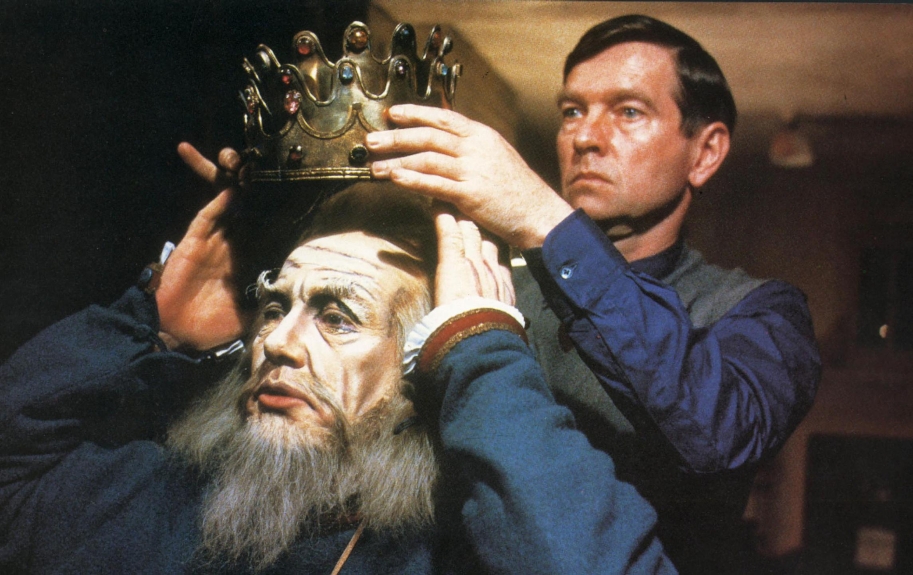
For centuries British theatre was run by Actor-Managers. Stars with complete control of their companies, where they (and their wives) played the best roles – sometimes years past the point where it was still suitable – until the next generation emerged to build their own companies. The Dresser shows this world’s dying days, at the height of the war, when Sir (Albert Finney) a legendary actor is shepherding an aged company around the provinces to perform, while his health and mental sharpness teeter, Lear-like, on the edge of the abyss.

If Sir is Lear, his Fool is Norman (Tom Courtenay) his dresser. A waspishly camp man whose entire life revolves around every inch of Sir’s whims, shepherding, coaxing and bullying the man onto the stage, somewhere between a valet, son and nursemaid. Sir remains a force-of-nature, toweringly bombastic egotist and man of magnetic charisma, with an all-consuming, obsessive love for the theatre. The Dresser takes place in January 1942 in Bradford, largely during a performance of King Lear which Sir’s declining health has placed on a knife-edge. Can Norman hold Sir together to give life to Shakespeare’s greatest tragedy for the 227th time?

The Dresser is based on Ronald Harwood’s play, which was semi-based on Harwood’s experiences as dresser then business manager to Donald Wolfit, one of the final breed of the old-school actor-managers Sir represents. (Harwood hastened to add, neither he nor Wolfit were portraits of Norman or Sir). While it’s a sometimes acidic look at the backstage politics and egos of touring theatre, it also richly celebrates the power of theatre and the momentary (and the film is unsentimental enough to show it is momentary) sense of family that can develop in theatre, that can end with that final curtain. In other words, The Dresser understands the brief, bright flame of theatre can be – and what a transformative feeling and dizzy drug it can be.

Both Sir and Norman are addicted to the grease-paint, their whole lives revolving around theatre and that elusive search for perfection. Even if Sir’s health is failing and sanity is crumbling – pre-show, Norman finds him raging in the streets of Bradford like Lear in the storm, only barely aware of who he is – ‘Dr Greasepaint’ can still briefly restore him to the man he was, spouting Shakespeare, bemoaning and relishing the huge weight of bringing art to life night-after-night. Norman is equally consumed by theatre: he can barely speak to others (such as train manager or a baker) without his conversation being littered with impenetrable theatre-speak. He’s as well-versed in Shakespeare as Sir is and flings himself into his backstage tasks with the same gusto Sir tackles a soliloquy.
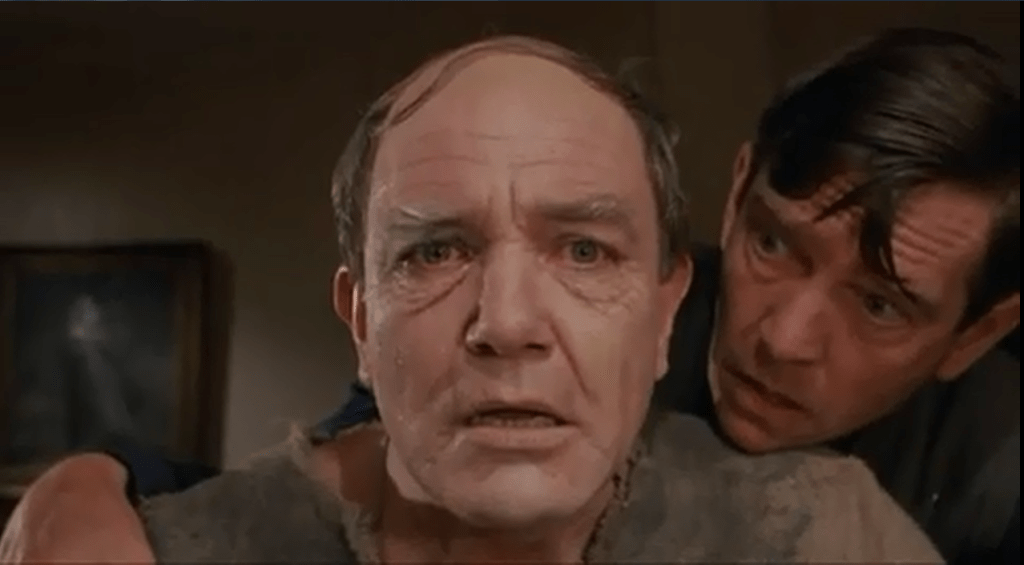
These two have a symbiotic relationship: Sir for the support and dedication Norman exerts to get him on stage, Norman for the glorious world (and purpose) Sir gives him access to. Yates uses mirrors, framing and shared reflections to frequently frame these characters together, visually linking them in a Bergmanesque way as elements of the same personality. But, the relationship is never as straightforward as that, complicated by underlying feelings on both sides. Norman’s homosexuality – over-looked in a world where such feelings are a crime (another member of the company has recently been fired for what sounds like cottaging) – complicates his obsession with Sir, while Sir’s affection for Norman always has the hint of a Lord’s affection for his valet: a man he will confide in, but would never imagine inviting to dinner.

This complex interplay of both characters urgently needing the other, but with an underlying imbalance in their level of true emotional engagement is a subtle dance brilliantly handled throughout Yates’ and Harwood’s film: so much so, it is a surprise to many audiences that Sir utterly fails to mention Norman at all in his draft autobiography even though it’s about as likely as Churchill name-checking his butler in his. Sir and Norman may be partners in the same task – creating theatre – but Norman’s mistake is to see himself as an equal, something Sir never truly believes he is.

There is, however, no doubt about the partnership between the two actors. Tom Courtenay, who had played Norman on stage, is extraordinary. With his flamboyant hands and a voice divided between camp, whiny and ingratiating, constantly reaching for the bottle to power through the stress, Norman is as loyal, dutiful and comforting and he can be waspish, bitter, selfish, possessive and cruel. Courtenay can switch from coaxing Sir like a recalcitrant child, to throwing a potential rival for Sir’s attention to the wall and threatening all manner of damnation. It’s an astonishingly multi-layered performance, with Courtenay shrewd and brave enough to avoid making Norman a fully sympathetic figure but someone so soaking in desperation that even at his most self-pitying you feel for his desolation and emptiness.

Alongside him, Albert Finney is imperiously brilliant as Sir (playing a role almost 25 years older than him). Finney’s Sir is magnetic (they may grumble about him, but in person the company treat him with awe) and charismatic (his booming voice carries such power, it can even stop a departing train). But he’s also selfish, cruel, childish and intensely vulnerable. He’s got all the egotism of the actor (“The footlights are mine and mine alone. You must find what light you can.”), the productions revolve around him (he even continues to direct mid-performance, muttering instructions from Othello’s death bed). But he’s teetering, his mind crumbling, constantly looking to Norman for assurance, Finney living Sir’s fear at the approaching undiscovered country.

Both actors are extraordinary in a play that understands the addictive power of theatre. The Dresser avoids the trap of making Sir an Old Ham: in fact, the production we see (for all its old fashioned air) contains a performance of real power from Sir, rousing himself to touch something transcendent. Of all his 227 Lear’s this might be finest. Cynical technicians and wounded pilots weep openly. Thornton (Lockwood West), an ageing second-rate actor hastily promoted to Fool, talks of how the part has made him hungry for more. Oxenby (a marvellously louche Edward Fox), the youngest company member, clearly is ready for the new era (he carries a script full of bad language he longs to stage) but even he (after an initial point-blank refusal) throws himself into the backstage effort to create the storm. For all the rivalries, when the play is on, everyone briefly feels part of the same team working towards the same goal.

It’s a film with a melancholic feeling of an era coming to a close. It’s also one that punctures the character’s illusions. Sir is a star, but there are greater stars (with real knighthoods) in London; Norman may feel like his relationship with Sir is special, but Sir’s relationship with Madge (a brilliant Eileen Atkins, unflappably loyal and deeply pained under her professionalism) predates his and is more genuine. But it’s also one that understands the transformative power of live theatre. With stunning performances by Finney and Courtenay, backed by a marvellous, faultless cast it’s one of the finest films about theatre ever made.

The Bounty (1984)

The Bounty (1984)

Hopkins and Gibson present a more historically-accurate Bounty movie that’s serious but solid

Director: Roger Donaldson

Cast: Mel Gibson (Fletcher Christian), Anthony Hopkins (Lt William Bligh), Laurence Olivier (Admiral Hood), Edward Fox (Captain Greetham), Daniel Day-Lewis (John Fryer), Bernard Hill (William Cole), Phil Davis (Edward Young), Liam Neeson (Charles Churchill), Wi Kuku Kaa (King Tynah), Tevaite Vernette (Mauatua), Philip Martin Brown (John Adams), Simon Chandler (David Nelson)

The story of the mutiny on The Bounty has intrigued for centuries. It’s been made into plays, novels and no fewer than three films. Most versions have been inspired by a 1932 novel that painted Bligh as an ogre and Christian as a matinee idol. That image was cemented by the classic Best Picture winning Laughton/Gable version. The real story is far more intriguing – and operates much more in shades of grey – and this 1984 film tries to find a middle ground, with mixed success.

In real life, Bligh was a prickly, difficult but fundamentally decent man, who had worked his way up the naval ranks through merit. He was a superb sailor – as seen by his feat of navigating a small open boat of loyalists over hundreds of miles back to a British port. Cleared of any guilt for the mutiny, he had a successful career and retired as Vice Admiral. Fletcher Christian, on the other hand, was an entitled young man who owed everything to his rich family, rather than merit. The truth has been lost in fictionalised versions who were devil and saint. The truth was far more complex.

This film was a long-standing dream of David Lean, who planned the film for many years, before pulling out at the last moment. The script was written by long-time collaborator Robert Bolt (although ill health meant it was finished by an uncredited Melvyn Bragg). Producer Dino de Laurentis – not wanting to write off the money invested – bought in Australian Roger Donaldson to direct. The final product is a competent, if uninspired, middle-brow history film with a slight air of stodge, and a haunting – if incredibly 80s – electronic score from Vangelis. Where the film really lucked out is the superb cast of actors assembled, with Gibson on the cusp of mega stardom and the cast stuffed with future Oscar winners and nominees.

Anthony Hopkins had been attached to the film for almost seven years, and his carefully researched performance as Bligh is what really gives makes the film work. He gets closer to the personality of the real Bligh than anyone else ever has. Awkward, shy, uneasy with men under his command, insecure at his poor background and the West Country burr to his accent, Hopkins’ Bligh is a world away from a bad man. But he is a demanding and rigid leader, who inspires fear but not respect. He’s far from cruel, but he’s short-tempered, inflexible and has trouble empathising. All too often, he relies on his position alone to ensure obedience, rather than building respect. You sympathise with him, at the same time becoming deeply frustrated at his intransigence. You can understand why many would find him an extremely difficult man to work with (let alone work for).

Fletcher Christian is young, naïve and impetuous, a man whose experiences in Tahiti lead him to become surly and impatient with the confines of a naval life. Gibson later said he felt the film didn’t go far enough to depict Christian as selfish and motivated by a desire for the ‘good life’, and the film does try to show him standing up for the crew against Bligh’s demands for perfection. But Gibson is willing to embrace Christian’s darkness. He hurls himself into the (historically attested) near mental collapse, consumed with violent and unpredictable emotion, that Christian demonstrated during the mutiny, losing all control of himself in an explosion of self-pity and frustration.

The film’s highpoints revolve invariably around these actors. Hopkins’ demanding Bligh sets the tone on the ship. The roots of the mutiny can be seen in Bligh’s public bawling out (and demotion) of his first officer Mr Fryer (a disdainful Daniel Day-Lewis) in front of the entire ship, setting a precedent for disrespect. Every action he intends to build spirit and health in the crew has the exact opposite effect (from pushing them to excel, to enforced dancing sessions for exercise). Hopkins is perfect as man believing he is acting for the best but constantly getting the tone wrong, either too distant and reserved to inspire affection, or too enraged to inspire loyalty. Similarly Gibson, in the less intriguing part, really sells the growing self-absorption of Christian, especially his feckless weakness, easily manipulated into actions that go a step beyond his desires (Phil Davis is very good as a darkly Iago-ish Ned Young, using Christian’s popularity to his own ends).

However, the film itself is a little too traditional. Using Bligh’s trial (all captains who lost their ship were placed on trial to judge their responsibility) as a framing device brings us slightly too many interjections of the “and then you did this” variety – even if it allows actors as impressive as Olivier and Edward Fox to narrate us through the film. This stodgy structure carries us into a narrative that is professionally handled but lacks inspiration, ticking off events but not giving them a force outside of the performances of the actors. The film is competently but not inspiringly made, and never quite captures the sense of the epic that the location and scale should bring.

Perhaps this is because a true-to-life version of the mutiny is a little less traditionally dramatic. Despite some truly impressive performances from the leads (and the rest of the superbly chosen cast), it never quite shakes off the feeling of being a history lesson.

Gandhi (1982)

Ben Kingsley excels as Gandhi in Richard Attenborough’s Oscar winning epic

Director: Richard Attenborough

Cast: Ben Kingsley (Mahatma Gandhi), Rohini Hattaggadi (Kasturba Gandhi), Roshan Seth (Jawaharlal Nehru), Pradeep Kumar (VK Krishna Menon), Saeed Jaffrey (Vallabhbhai Patel), Alyque Padamsee (Muhammad Ali Jinnah), Virendra Razdan (Maulana Azad), Candice Bergen (Margaret Bourke-White), Edward Fox (Brigadier General Reginald Dyer), John Gielgud (Lord Irwin), Trevor Howard (Judge Broomfield), John Mills (Lord Chelmsford), Martin Sheen (Vince Walker), Ian Charleson (Reverend Charles Andrews), Arthul Fugard (General Jan Smuts), Geraldine James (Mirabehn), Amrish Puri (Khan), Ian Bannan (Senior Officer Fields), Richard Griffiths (Collins), Nigel Hawthorne (Kinnoch), Michael Hordern (Sir George Hodge), Om Puri (Nahari)

In 1962, Richard Attenborough was approached by Motilal Kothari, an Indian civil servant, who believed Attenborough was the man to bring the life of Mahatma Gandhi to film. All this despite Attenborough having never directed a film. But the life of one of history’s greatest men, and passionate advocate of peace and non-violence, spoke deeply to the socially-engaged Attenborough who dedicated 20 years of his life to bringing the film to the screen, immersing himself in Indian culture along the way and winning the support of Nehru (until his death delayed the project again) and Gandhi’s family. The eventual film was a huge success, cementing the public perception of Gandhi and beautifully capturing both the importance of the story, and its emotional heart.

Opening with Gandhi’s assassination in 1948, the film covers in flashback his life from combatting anti-Indian prejudice in South Africa as a young, British-trained, lawyer to his return to India and long involvement in the campaign to win India its independence from the British Empire, stressing non-co-operation, his eventual success but also his failure to hold the Hindu and Muslim parts of the country together and his attempt as “father of the nation” to put an end to religious violence, a failure that will eventually lead to his assassination. 

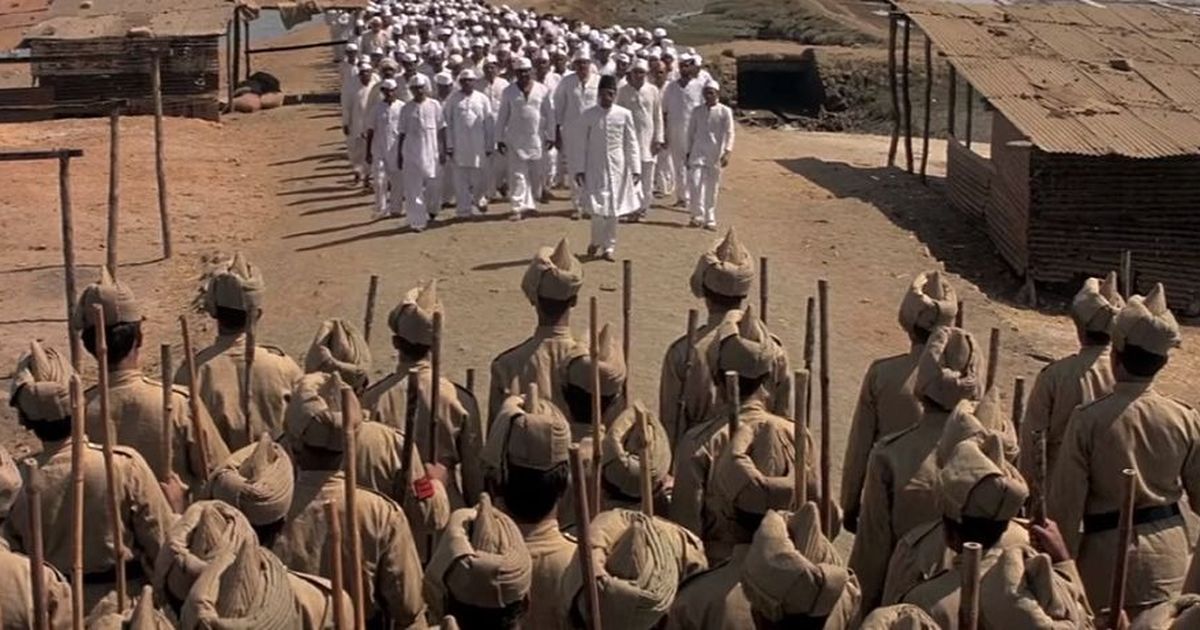
Attenborough’s grand, epic film marshals thousands of extras to bring to life pages of history. At times events fly by with speed, but Attenborough never loses sight of the emotional heart of the story – both Gandhi and the status of Indians as not being masters in their own home. Attenborough directs scenes of real power, most strikingly a heart-rending peaceful march on a salt works (the tax on salt use being a major burden on many poor Indians) that culminates in line after line of peaceful Indian protestors walking calmly forward to be beaten down by soldiers. Despite being the grandest and largest of films, it allows questions of pure morality and decency to lie at its heart and, supported by a parade of British acting greats, keeps the Indians at the heart of their own story and the masters of their own destinies.

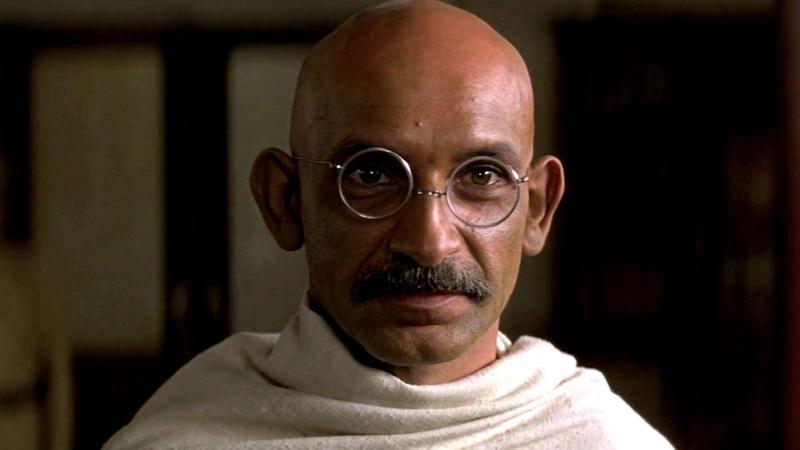
The film’s impact though may be directly connected to the gloriously transcendent performance of Ben Kingsley in the title role. For years it was believed the film could only work with a British actor in the title role – imagine how it would be received today if Gandhi had been played by (as it nearly was) a browned-up Anthony Hopkins or John Hurt (who famously told Attenborough he looked absurd). Instead half-Indian unknown RSC actor Ben Kingsley took the role. Kingsley so completely and utterly immersed himself in Gandhi – everything, the physicality, the morality, the voice, the intellectualism – that not only has he become so completely associated with the role but it’s hard to imagine anyone else playing it.

Ageing almost 50 years over the course of the film, Kingsley’s Gandhi is above-all moral, softly-spoken, observant and considerate – the very spirit of the original man seems to be up on the screen. Far from the sort of histrionics you might expect from a subject of an epic movie, Kingsley is not afraid to be quiet, gentle even underplayed. He completely understands that the charisma and power in Gandhi laid in his moral authority, not his speech-making, but his careful example-setting of even-handedness, patience and desire for peace. 

But Kingsley is also willing to show Gandhi as shrewd and stubborn, even while mixing it with both a deep pain at the loss of life. Kingsley is superbly good at the smaller quieter moments – he wrings heart-rending force from the loss of his wife (a similarly impressive and quietly authoritative performance from Rohini Hattaggadi), which partly works because the film quietly centres the truth and faith in their marriage. This is extraordinary work from Ben Kingsley, that seems to carry not just the entire film but the sense of a nation.

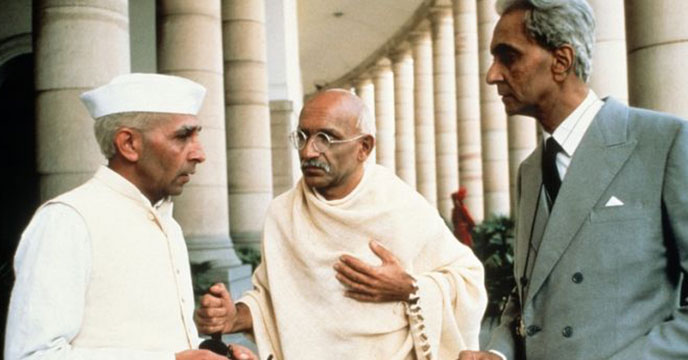
Attenborough though was a director who was at his best when working with actors, and his ability to coax truthful and heartfelt moments from quiet scenes are what gives the other sequences the emotional force to make them work. Attenborough seemingly called in every favour to assemble the supporting cast that backs up Kingsley, many of them juggling only a few scenes. Among the stand-outs we have a martially certain Edward Fox as General Dyer, an archly arrogant John Gielgud and a frustrated John Mills as viceroys, Trevor Howard representing decent British rule as an honest Judge and Martin Sheen as a reformist minded journalist. That’s to overlook dozens of others in small roles, all of them clearly committed to the intention of the project.

The film though allows the Indians themselves to take centre stage, even if it is easy to criticise some of the simplifications of many of the issues that would eventually culminate in partition. The film has a clear hostility towards the idea of religion, seeing it as the root of much of the violence that erupted in India in the last years of Gandhi’s life. While Roshan Seth is excellent as Nehru, the character is portrayed more as the faithful follower of Gandhi than the shrewd politician in his own right (it’s a role most of the other leading members of congress are also placed in). Alyque Padamsee carries a high level of charisma as Jinnah, founder of Pakistan – but the film can’t quite resist painting him into the corner as a semi-villain, ignoring Gandhi’s desperation to get Jinnah to invest in a united India.

It’s part of what has been seen since as the film’s more hagiographic stance towards Gandhi. Certainly later historiography has outlined a few shades of grey in Gandhi – although I would argue that seeing him as a man and not a saint only heightens (similar to Mandela) the awe at what he went on to achieve. The film’s whistle stop tour of Indian history – taking in every major event and personality, some in a matter of moments – looks particularly old-fashioned now with our current trend being biographical films that focus only on crucial moments, not the whole life. It adds a slight air of schoolboy history to the project, an unfortunate side-effect of the passionate earnestness with which the story is told.

But then even in 1982 – when it lifted 8 Oscars including Best Picture, Director and Actor and most of the technicals – it was seen as slightly old-fashioned. Attenborough has generously repeatedly said that he believed Steven Spielberg was more deserving of Best Director for ET. And it’s true that Attenborough was in many ways a producer at heart with these epics than an inspired director like Lean. His marshalling of crowds, finances and simply forcing the will together to make the picture – and to allow it to focus on Indians rather than Westerners – is a tribute to his organisational skills. His strengths as a director were more in performances, and as with many of his epic films the most memorable moments are smaller, intimate ones. The larger moments are shot with an assured professionalism rather than inspiration, but Attenborough understands how to wring emotion from moments and how to let character drive action.

Gandhi works above all because even today you can see it is a passionate labour of love, that everyone involved in clearly believed in passionately. It may well be that at times it is workmanlike or simplistic – and covers the sweep of history with an earnest completeness, even while it is unafraid to be critical certainly of the British – but it still invests it crucial moments with humanity, life and deep emotion. You can’t help but be moved by it – and you are instantly stunned by the sheer brilliance of Kingsley as Gandhi, one of those performances like George C Scott as Patton which seems more like the man than the real thing. Gandhi may be old fashioned, but that’s not a crime when the quality is still there.

The Go-Between (1971)

Julie Christie enlists young Dominic Guard to pass notes in classic adaptation The Go Between

Director: Joseph Losey

Cast: Julie Christie (Marian Maudsley), Alan Bates (Ted Burgess), Dominic Guard (Leo Colston), Margaret Leighton (Mrs Maudsley), Michael Redgrave (Older Leo Colston), Edward Fox (Hugh, Viscount Trimingham), Michael Gough (Mr Maudsley), Richard Gibson (Marcus Maudsley), Roger Lloyd-Pack (Charles)

“The past is a foreign country. They do things differently there.”

It’s a classic line from JP Hartley’s masterpiece novel of youthful disillusionment and trauma, The Go-Between. This film version perfectly captures the novel’s wistful reflections on a past that seems bright and glowing to the young boy caught up in the centre, while carefully and subtly suggesting the darker currents and temptations that lie under the surface. 

In 1900, 12-year-old Leo Colston (Dominic Guard), a middle class boy, spends the summer at the country house of his wealthy school friend. There he finds himself increasingly drawn to the glamour and kindness of the family, who do their best to make Leo feel at home – particularly Marian (Julie Christie), the daughter of the house. Leo also befriends local farmer Ted Burgess (Alan Bates) and finds himself recruited to carry letters between Marian and Ted, little understanding what the messages and arrangements between the two may mean, and what it might mean for her engagement with the decent Viscount Trimingham (Edward Fox). 

The Go-Between is a perfect Chekovian tragedy, which brilliantly captures the hypocrisy and dangers of the final days of the Victorian era. Of course it bubbles down to sex – and there is tonnes of it beneath the surface in the quietly built passion between Marian and Ted. But it’s also class as well – the primary reason why Marian’s affair with Ted remains so illicit is because the farmer (as the younger family members make abundantly clear) is socially unacceptable.

Class weaves itself into every part of the film. The Maudsley family work over time to make Leo feel as comfortable as possible in the house as they are all aware of the social gap between them. The Maudsley family treat Leo as almost a sort of social obligation, quietly buying him new clothes (as he ‘must have forgotten to pack’ the correct clothing for the scorching summer heat) and making much of him at the local cricket game. But Leo can never really forget that he falls somewhere in the middle between the Maudsleys and Tony, and finds himself out of place with both. This awkwardness is perfectly captured in Dominic Guard’s bashful performance.

Class is also lies under Marian’s affair with Burgess – and she seems to know it can never last. Indeed, she has every intention it seems of marrying Trimingham. Trimingam and her father, it’s implied, are even aware of the affair and expect it to burn out. It’s Mrs Maudsley who seems most threatened by the social possibilities of the affair – while the men expect the normal order to reassert itself, Mrs Maudsley (Margaret Leighton, who brilliantly simmers at the edge of the whole film before dominating its closing scenes) seems far more aware of the dangers that love and attraction have.

But it’s a story where the real victims turn out to be those outside the family. Ted Burgess (expertly played by Alan Bates, who made a living of playing son of the soil types like this) winds up feeling like an innocent, a bashful teenager who barely seems to know where to look when Marian accompanies him on the piano while he sings at the celebration after the village cricket match (Mrs Maudsley is appalled at this point). And Ted (constantly described as a lady-killer by Maudsley and Trimingham, despite all evidence to the contrary in his manner – further signposting their awareness of the affair) constantly feels like the weaker partner in the relationship, besotted with the lady of the manor.

As that lady, Julie Christie gives an intriguing performance (even if she is slightly too old for the part). Christie’s Marian is strangely distant, despite her many acts of kindness towards Leo. To what extent is she merely using the boy, winning him over with affection to manipulate him later to deliver her messages? How much does she care for the boy? She understands her relationship with Ted can never be – and is more than prepared to marry Trimingham – but how much is that a defence mechanism against her true feelings? We get only a half suggestion, as Leo does, of how she may really feel. It’s subtly left open for most of the film. 

The film uses a neat device of intercutting moments of the story with the far older Leo (Michael Redgrave, whose voice is perfect for the moments of narration) revisiting the locations of the story again. Everything is in contrast to the bright, luxurious summer of 1900 as the older Leo heads around windswept and rainy locations. Unlike the past, the present day finds the soundtrack drained out by sound effects and ambient noise. It’s a quiet reminder of the foreboding doom that lies over the story – and the film makes good business from the suggestion of trauma that has affected Leo resulting from the events of 1900, and how it has shattered and reshaped his life.

Losey’s direction is a perfect capturing of the languid heat of that 1900 summer, and he perfectly frames events and action for maximum impact. It’s a film made of small looks, quiet asides and suggestions to the audience played from the perspective of a child, where we need to interpret the things we see to get a full understanding of what’s really happening and its implications. Harold Pinter’s script is equally strong, perfectly capturing the mood and feel of Hartley’s novel.

The Go-Between is an excellent film, stuffed with good performances (in addition to those mentioned, Edward Fox and Michael Gough are both excellent), and beautifully shot and filmed. It’s an intelligent and very faithful adaptation of the book that still manages to make the book more cinematic, with the intercutting between past and present giving us a sense of Greek tragedy, and the interrelations between the characters staged with subtly and intrigue. A wonderful adaptation of a great novel.

A Bridge Too Far (1977)


Dirk Bogarde, Sean Connery, Ryan O’Neal and Gene Hackman are among the Generals aiming to go A Bridge Too Far

Director: Richard Attenborough

Cast: Dirk Bogarde (Lt-Gen Frederick “Boy” Browning), James Caan (Staff Sgt Eddie Dohun), Michael Caine (Lt-Col J.O.E. Vandeleur), Sean Connery (Maj Gen Roy Urguhart), Edward Fox (Lt Gen Brian Horrocks), Elliot Gould (Col Robert Stout), Gene Hackman (Maj Gen Stanislaw Sosabowski), Anthony Hopkins (Lt Col John Frost), Hardy Krüger (SS Maj Gen Karl Ludwig), Laurence Olivier (Dr. Jan Spaander), Ryan O’Neal (Brig Gen James Gavin), Robert Redford (Major Julian Cook), Maximilian Schell (SS Gen Wilhelm Bittrich), Liv Ullman (Kate ter Horst), Michael Byrne (Lt Col Giles Vandeleur), Denholm Elliott (RAF Officer), Jeremy Kemp (Briefing Officer), Wolfgang Preiss (Feldmarchall Gerd von Rundstedt), Stephen Moore (Maj Robert Steele)

You’ve got to love a good war film. In fact, there are few things more cinematic than the old-school, star laden Hollywood war film. A Bridge Too Far is for me one of the finest examples of this genre, and it’s a film I come back to time and time again. Is it perfect? No of course it isn’t – in fact I probably love this film more than some of the people actually in it do. But it’s a damn fine piece of big-screen, big-budget film-making, and it’s got a cast of stars. And more than perhaps any other film of this genre, it’s a film about how overwhelmingly awful and gut-wrenching war is. This is a film about a defeat – and not the sort of triumphant defeat that Dunkirk feels like. It’s just a gut-punch. The Allies threw the dice big time, and they lost.

The Battle of Arnhem was one of those “end the war by Christmas” plans. The brainchild of British war-hero Field Marshall Montgomery (noticeably absent from the film), Operation Market Garden was a lightning strike into the heart of the Ruhr to capture Germany’s industrial capability. This involved a series of paratrooper drops into towns in the Netherlands, culminating in Arnhem, to cross the Rhine. While the paratroopers seized key bridges, British Tank Division XXX Corp would power through, cross the bridges and into Germany. It was bold, daring and radical. It was a disaster. Arnhem, far from being undefended, was being used as a rest place for a Waffen-SS Panzer division. The British paratroopers found themselves not seizing a lightly defended bridge, but fighting a tank division with machine guns and limited supplies. Meanwhile XXX Corp’s progress became bogged down in traffic jams and higher than expected German resistance. 

It’s quite something to make a war film about possibly the biggest military disaster on the Western Front during the Second World War. The entire plan is a misconceived tactical blunder, and the film never shies away from this, demonstrating time and again the numerous errors that led to it: from Generals ignoring reconnaissance that suggests this won’t be a cake walk, to paratroopers failing to seize bridges quickly, to tanks crawling down crowded roads, fighting every step of the way. Alongside all this, the film never loses track of the horrifying impact of war on both soldiers and civilians caught in the crossfire. It’s a huge budget, all-action, anti-war film.

Richard Attenborough is the perfect marshal for this film. He has the experience and understanding of scope to handle the action scenes. At the time, this film was possibly the most expensive film ever made. Not only that, it was independently funded – producer Joseph E. Levine thought the film was so important he pumped millions of pounds of his own money into it. The attention to detail is extraordinary – the film consulted nearly every single surviving commander from the battle on the script – and all the stops were pulled out creating the military features of the film. 

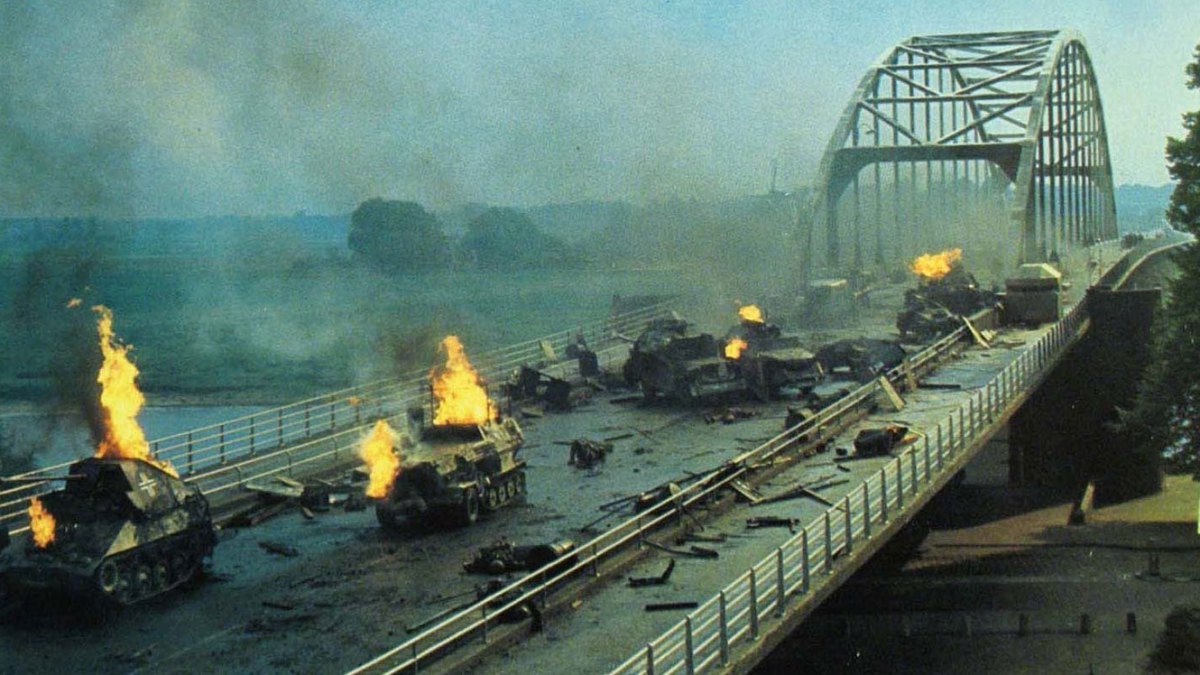
This is of course particularly striking now as we know everything in the film is real – no special effects in those days. If you see it in the film, then you know that it was really there. In the sequence showing the planes taking off to deliver the paratroopers to their destinations, there were so many planes in the air that Attenborough could literally claim to command the world’s seventh largest air force. Every military blow of the battle is carefully reconstructed. The tactics are carefully explained and followed. Attenborough can shoot compelling action.

But what makes the film so good (for me anyway) is the way the heart-breaking horror of war never gets lost. In all this action, we are always shown the cost. Attenborough will frequently cut back to the after-effects – several times we hear wounded soldiers whimpering on smoke-filled, body-littered battlefields. Many acts of courage (on both sides) by individual soldiers result only in pointless, gut-wrenching deaths. Arnhem isn’t just damaged by the battle, it’s flattened. The impact on the civilian population is terrible – in a powerful sequence, we see characters we were introduced to earlier mercilessly caught in the crossfire of the German tanks. We return continually to locations increasingly shredded by weapons fire. More and more soldiers are wounded – some horrifically.  Near the end, the remaining British paratroopers, encircled and surrendering, sing a deeply moving quiet rendition of Abide With Me. No one could come out of this wanting to go to war.

Attenborough’s humanity is key to the film’s success. It helps as well that he is a brilliant actor’s director. Want to dispel any doubt on the horrors of Arnhem –then train the camera on the Laurence Olivier’s tear-stained face as he drives through the destroyed streets. Want to understand the sacrifices and the courage? Well just let Anthony Hopkins – simply excellent as the commander of the only forces to reach the bridge at Arnhem – with calm, restrained Britishness request support and supplies late in the film as his men are butchered around him. It’s a film full of brilliant moments of acting like that, where Attenborough points the camera at them and lets them act. 

The sequences around Arnhem and the British paratroopers there are the heart of the film. Sean Connery is terrific as Major General Roy Urquhart, commander of the British paratroopers. His growing frustration as events spiral far out of his control is a great contrast with his initial professional confidence. Gene Hackman, as commander of the Polish forces (slightly odd casting but good once you tune up to it), gets the role of the “one man talking sense” who can smell disaster early on, but works harder than anyone to get the plan to work. A number of the regular soldiers in Arnhem are faces the film returns to again and again – giving us people to relate to as their numbers are increasingly decimated by the savage, desperate combat. John Addison’s score also helps a huge amount with building the emotion in these scenes.

The Arnhem sequences are so good that the other sequences around the American paratroopers feel like they come from a slightly different movie. It doesn’t help that the likes of Elliot Gould are playing slightly clichéd “Brooklyn Yankee” types, chomping cigars and ribbing the stiff-upper-lip Brits. Ryan O’Neal as General Gavin is slightly dull. The XXX Corp material is a little dry (essentially driving up a road or waiting), although Edward Fox is superb (and BAFTA-winning) as their charismatic commander Lt Gen Brian Horrocks. Attenborough puts together at least one terrific set-piece tank battle on the road – but it’s not quite enough.

The two biggest American stars are also given the feel-good, up-beat material. James Caan gets the best part in what is effectively a stand-alone story of a Staff Sergeant going to impossible lengths to save the life of his Captain (Caan had his choice of part and chose well). Robert Redford is a little too starry (bizarrely in a film full of stars!) as a Major tasked to seize the vital bridge at Nijmagen via a daylight river-crossing. This sequence feels like it’s been put in the film to (a) give us something to cheer and (b) to allow an American victory for the box office. Of course, we need the biggest star in the world at the time to play the most straight-forward heroic part!

The film does have a tendency to shuffle its characters into “good” and “bad”. So after Redford seizes the bridge, the character sent to tell him that XXX Corp won’t be rushing across to Arnhem after all isn’t Caine’s Vandeleur, but a nameless Colonel played by Polanski’s villainous Ross from Macbeth himself, John Stride. The most sympathetic generals and commanders are all (coincidentally) the people who served as military advisors on the film.

On the other hand, the film ends up laying most of the “blame” on Dirk Bogarde’s Lt Gen Browning. Browning’s widow, Daphne du Maurier, threatened to sue the film-makers for the portrayal of Browning here (she got an apology). Browning is portrayed as the ultimate “non-boat rocker” – over-confident and arrogant, he disregards intelligence suggesting the Arnhem plan is dangerous, seems shocked and clueless once the scale of the disaster is revealed, and by the end of the film seems to be most interested in positioning himself as always opposed to the plan in the first place. Bogarde (the only actor in the film who actually served in Market Garden) was similarly angry when he saw the film – and he has a point. It’s grossly unfair.

It’s a problem with this film and it does annoy me. The parts not set in Arnhem are not as memorable or compelling as the rest. But huge chunks of the film are brilliant, and never fail to move or (sometimes) excite me. Its anti-war stance is striking. The acting from the cast is very good across the board – say what you like, cast every part with a star and you never get confused about who is who. Attenborough also draws great performances from the non-stars – Stephen Moore is a particular stand-out as a signals man unwilling to voice his doubts about the equipment (and who pays a heavy price). 

I can watch A Bridge Too Far at any time. I always love it. It’s a film of great moments and performances. It carries real emotional weight. Attenborough is a very good director of actors, but also a skilled commander of scale. It’s a film that gets emotion in there. It’s a film that isn’t afraid to present a military disaster. It doesn’t demonise the Germans. Sure it plays goodies and baddies with the Allies, and parts of it to drag on a bit too much or deal with cliché. But at its best is the core of a great film. I love it. It’s a favourite. And always will be.

The Day of the Jackal (1973)


Edward Fox takes aim as suave assassin The Jackal

Director: Fred Zinnemann

Cast: Edward Fox (The Jackal), Michel Lonsdale (Deputy Commissioner Claude Lebel), Terence Alexander (Lloyd), Michael Auclair (Colonel Rolland), Alan Badel (The Minister), Tony Britton (Inspector Thomas), Denis Carey (Casson), Cyril Cusack (Gunsmith), Maurice Denham (General Colbert), Olga Georges-Picot (Denise), Barrie Ingham (St. Clair), Derek Jacobi (Caron), Jean Martin (Wolenski), Ronald Pickup (Forger), Anton Rodgers (Bernard), Delphine Seyrig (Colette de Montpellier), Donald Sinden (Mallinson), Timothy West (Commissioner Berthier)

The definition of lazy criticism is to say a story doesn’t work because we know the outcome. If that was the case, no production of Hamlet would ever work, and no adaptation of a best-selling book would ever find favour with an audience. We’d be bored by films based on history and we’d be even more indifferent to the hundreds of films made every year that follow accepted narrative structures. What makes a film compelling is often not the destination, but the journey. How do we get there? What do we learn? How does it make us feel? All of these things are keenly observed throughout Fred Zinnemann’s masterful adaptation of The Day of the Jackal.

The year is 1962 and the French President Charles de Gaulle is blamed by many for weakening France by granting independence to Algeria. The Organisation Armée Secrète (OAS) hire an English professional assassin known only as The Jackal (Edward Fox) to assassinate De Gaulle. When word of the target leaks to the panicked French Government, Commissioner Claude Lebel (Michael Lonsdale) is given an impossible task – identify a man of whom the government knows nothing and stop him from carrying out a plan only he knows the details of. Meanwhile, the Jackal relentlessly goes about his meticulous planning.

So anyone with passing familiarity with history will know that de Gaulle was not assassinated in the early 60s. Watching The Day of the Jackal, you know that the Jackal will fail. But that’s not the point of the film. Instead it’s a masterful, streamlined thriller that completely understands how much we can invest in watching someone go about a job with calm, cool professionalism. It’s the ingenuity and meticulousness that makes the film compelling, the way each angle of the Jackal’s plan is carefully considered and information slowly delivered to the audience. In some areas we are a couple of steps ahead of Lebel’s search. In others we are as far behind as he is: we may know the weapon and the Jackal’s secret identities, but we know as little about his final plan as Lebel does – it’s only when it’s revealed that all the pieces we’ve seen make perfect sense.

It’s a film that has been assembled with all the grace and skill of a master clockmaker. Zinnemann’s direction and Kenneth Ross’ taut screenplay make every second count. There isn’t a single piece of flab on the bones of this movie, every scene carries a piece of vital information that contributes to the overall picture. Zinnemann sprinkles the film with careful passing shots of calendars and clocks, making the sense of a countdown towards the Jackal’s strike hang intimidatingly over the whole film. The film is gripping, right from its opening reconstruction of the almost-successful OAS assassination attempt on De Gaulle in 1962. Everything feels perfectly interlinked and connected, each scene brilliantly builds on top of the ones before.

This is quite simply an unshakeably brilliant engine of a film, a relentless ride with tension and excitement dripping from every frame. It’s not afraid to be cruel or dangerous – and some of the victims are truly blameless – and it’s not afraid to show that violence and cruelty are weapons as much for the authorities as the Jackal (the cruellest act, after all, is committed by the French Army on poor loyal Wawlinski).

A large part of the success of the film rests on Edward Fox’s performance in the lead. Fox gives the Jackal an unshakeable, public-school, confidence, an attractive resolve that sees him meet every obstacle with a cool elán, resolutely unperplexed by anything that he encounters. Fox’s superb performance succeeds in making you engage with (and even root for) a man who is a cold-blooded professional killer, who commits murder (when provoked) without hesitation. How does this happen? Again it’s his efficiency, his expertise. The film totally understands how engrossing watching talented people go about their work can be.

The film makes the minutia of setting up an operation immensely compelling. In careful detail, we see exactly how the Jackal goes about getting a false passport from the authorities. How he scopes out a potential place to conduct the assassination. His careful preparation of disguises and fake identities. In one gloriously done scene, we see him practise using his specially constructed rifle on a melon at a huge range. Carefully he takes a series of shots at the melon, adjusting the sight each time to make the weapon as accurate as possible. The scene is a showcase for the Jackal’s meticulous professionalism (you can see why the producers were outraged when the scene was cut from a TV screening in the 1980s – it’s practically a highlight of the movie).

Similar investment, however, is made in the detailed footwork involved in tracing and detecting the Jackal by the French and English police. Michael Lonsdale is a perfect foil for Fox’s urbane cool, with his dour, grey, crumpled Label, a man selected somewhat unwillingly for a mission but who slowly reveals the cool head and nerves of steel that made him perfect for the job. The police-work used to try and close the net on the Jackal is as intricate as the hitman’s own work – careful plodding through files and methodical calculation and educated guesswork. It’s as far from the rush and tumble of Hollywood as you can imagine – but somehow, because it feels so real, every discovery against the odds by the authorities becomes hard-won and exciting. The sense of a net being skilfully built also serves to make the Jackal’s skilful evasion of each trap all the more compelling.

And the tense race against time lasts for the whole of the film. The film brilliantly keeps this cat-and-mouse game alive, with the police and the Jackal constantly leap-frogging each other to stay one step ahead. Each move and counter-move has all the intricacy of a chess game. There are enough twists and turns to keep every audience member gripped. The eventual assassination attempt itself is built up to beautifully – a wordless, tense but brilliantly assembled montage of liberation day celebrations keeps both the police and the audience on their toes as to where the Jackal will strike from. The finale of the film turns on a twist of fate that is simply a brilliant coup de theatre. There is even a droll little coda that deepens the mystery of the Jackal even further.

Zinnemann’s direction throughout is flawless – calm, measured and methodical, and never allowing flash or bombast to drown out events. It’s helped as well by the wonderful cast of actors – a real who’s-who of British and French character actor talent, with Alan Badel’s smooth Interior Minister, Eric Porter’s cool but fanatic OAS leader, Cyril Cusack’s quiet gunsmith and Derek Jacobi’s eager young detective particular standouts. I also have a lot of time for Olga Georges-Picot’s quietly moving performance of a woman pushed to extreme actions by grief.

The Day of the Jackal is another of those near perfect movies. Everything it sets out to do it does perfectly, and it rewards constant viewing. It’s got some terrific unflashy performances and is a perfect demonstration of why professionalism and expertise can be so engrossing. It wraps this up into a deliciously tense confection, where every scene bubbles with undercurrents of drama and danger. There is not an off-beat – instead it’s a brilliant piece of pulp cinema that transcends itself into being something truly adept and dramatic. You can’t take your eyes off it for a second. I don’t hesitate for a second in saying it’s one my favourite thrillers.