Tag: Elijah Wood

Eternal Sunshine of the Spotless Mind (2004)

Eternal Sunshine of the Spotless Mind (2004)

An impulsive decision leads to a wild tour through mind and memory in this mind-bending, desperately romantic classic

Director: Michel Gondry

Cast: Jim Carrey (Joel Barish), Kate Winslet (Clementine Kruczynski), Kirsten Dunst (Mary Svevo), Mark Ruffalo (Stan Fink), Elijah Wood (Patrick Wertz), Tom Wilkinson (Dr Howard Mierzwiak), Jane Adams (Carrie Eakin), David Cross (Rob Eakin), Dierdre O’Connell (Hollis Mierzwiak)
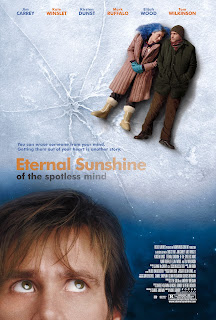
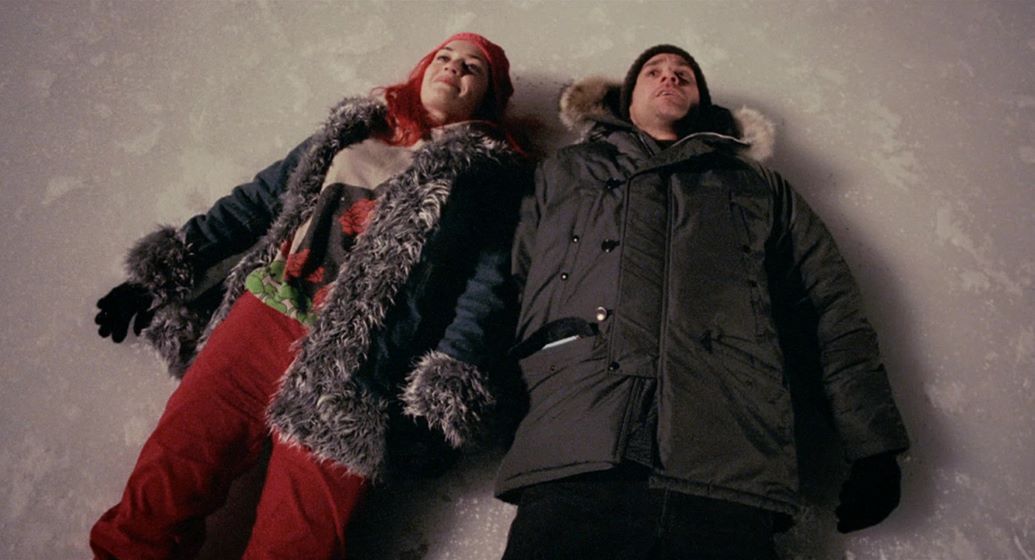
What makes us who we are? If it’s anything, it might just be the sum total of our experiences. The events of our lives, and the emotions they cause in us, shape and define us. If we cut some of them away, what would we be? Is losing painful memories worth it, if we also cut away memories we cling to as treasured possessions? What makes us love someone: instinct or the sum total of our memories with them? Ideas around this and how love works are at the centre of Michel Gondry and Charlie Kaufman’s extraordinarily inventive, imaginative but also romantic and heartfelt Eternal Sunshine of the Spotless Mind, a truly original film crammed with rewarding moments.

Joel Barish (Jim Carrey) wants to make-up with his electric but troubled girlfriend Clementine Kruczynski (Kate Winslet). Imagine his pain when he goes to see her and she seems not to recognise him – and how much worse that might be when he discovers Clementine has erased him from her memory. An experimental surgery, Lacuna, run by Dr Howard Mierzwiak (Tom Wilkinson), offers its clients an unmatchable service: they will erase a person from your memory. Struggling to get over the loss of a partner, wife, friend, child or even dog? No problem, they’ll be gone from your mind and you never need worry about their memory causing you pain again.

Hurt and angry, Joel decides to undergo the same surgery to forget Clementine. While the procedure takes place over night – supervised by techs Stan (Mark Ruffalo) and Patrick (Elijah Wood) and Stan’s girlfriend (and Dr Mierzwiak hero-worshipper) Mary (Kirsten Dunst) – Joel comes to realise in his sub-conscious that he doesn’t want his memory stripped of Clementine. The cost of losing so many good memories isn’t worth it. In his sub conscious he tries to protect his memories – while in the real world the team battle to complete their contract and erase them.

Not many films like that are there? Gondry’s film could have been a slave to its concept. Instead though, it manages to juggle its deeper meanings with a truly heartfelt, winning and very sweet human story about two people who, for all their faults, become people you completely invest in. Kaufman’s script, as you would expect, triumphs as a complex and inventive magic tour but it’s also a wonderfully placed romance and heartfelt relationship story. Effectively the film manages to have something for everyone to invest in, from sci-fi nerds to lovers of romcoms to philosophy students.

It’s also a triumph of style. Set largely in Joel’s mind, the film reflects the fractured nature of the surgery as his memories are assaulted, deconstructed and destroyed. Lights fade, buildings disassemble and disappear, faces melt away from bodies and memories start to crash into each other. In his mind Joel walks through a door in a library to find himself on a beach, or rounds a corner to find himself back in his childhood memories. All of this is filmed with a series of stunning in-camera effects that make characters disappear, duplicate or seem to be in several places at once, all shot in a series of one-take effects that sees buildings disappear in front of us or fascinating memory loops. Visually the film is a feast, a tribute to Gondry’s playful imagination.

But it sticks with people because of the heart at the centre of it. Joel and Clementine become people we care about. We root for Joel to defy the odds and preserve some of his memory. Because, the film makes clear, being consciously aware of his memories being deleted is basically like going through the pain of losing her a second time – only this time knowing you won’t even be left with the parts you want to hold onto. In fact – re-enforced by the distress we see in Clementine when we see her undergoing the panic of being subconsciously aware of memory loss in the real world – Joel’s horror of what he has asked for is likely what all the other patients of Lacuna’s ‘brain damage for your own good’ surgery have gone through.
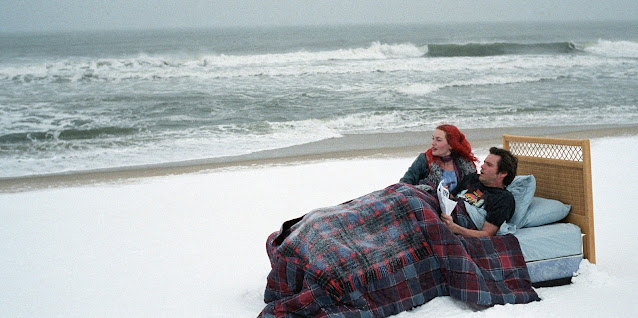
Superbly played by Jim Carrey and Kate Winslet in cast-well-against-type performances, Joel and Clementine might at times be selfish, frustrating, even irritating people – but it’s clear their love for each other is real. Jim Carrey, dialling down his gonzo mania to an unprecedented degree, is perfect as the shy and gentle Joel, bewitched by this explosive presence in his life. Winslet is electric – cranky, brittle, damaged but also caring and playful. Kaufman’s film shows they hurt and snap at each other, but also that they bring each other happiness they can’t get anywhere else.

So, it comes back to that question: do we accept that part of the price of loving and living is pain? That the people who we love the most, are the ones that may also hurt us the most. The film is also clear that love can’t be forced or replicated. In the ‘real world’ Clementine is being wooed by Elijah Wood’s creepily needy techie, using his records of her romantic memories of Joel to replicate their special moments. The falseness of this isn’t a remote match for the true emotion of the real event: and it’s a testament to the film’s commitment that you can’t forge or force love, and that eventually it might just find a way.

Because, even without our memories, will we still be drawn towards the same people? Can love in fact survive, even if you don’t know who the person who love is anymore? It’s another fascinating thread in this film. Romantic couples throughout find themselves drawn to each other continually, a subconscious emotion surviving the purging of actual memories. It adds even more to the horrific trauma of seeing what’s happening to Joel here. His obvious distress as he realises the implications of what he rashly asked for – and there is plenty of suggestion Clementine feels the same – gets worse and worse as he realises he has signed away his own rights to decide who he loves.

Those ethical questions – is it even possible to make an informed decision here about lobotomizing your memory – mix with those philosophical questions of what makes us what we are. Will Joel and Clementine be the same people or not after this operation? How will they adjust to losing such a hugely important part of their histories? Especially as they won’t even know that they have. Kaufman’s script explores this all carefully, but never once losing track of the emotional story driving it.

So Eternal Sunshine becomes a touching love story, about two people going to huge ends against impossible odds to stay together. That, I think, is what lies behind its appeal. What makes it one of the most lasting films of the 00s is the invention and flair the story is told with – Gondry’s direction and its non-linear structure all only add to the fabulous script from Kaufman and Gondry – and the way it very lightly tackles a whole host of fascinating ideas while never losing track of its nature as an entertainment. It’s a brilliant film.
The Lord of the Rings: The Return of the King (2003)

The Fellowship face one final battle in the conclusion of Jackson’s stunning trilogy

Director: Peter Jackson

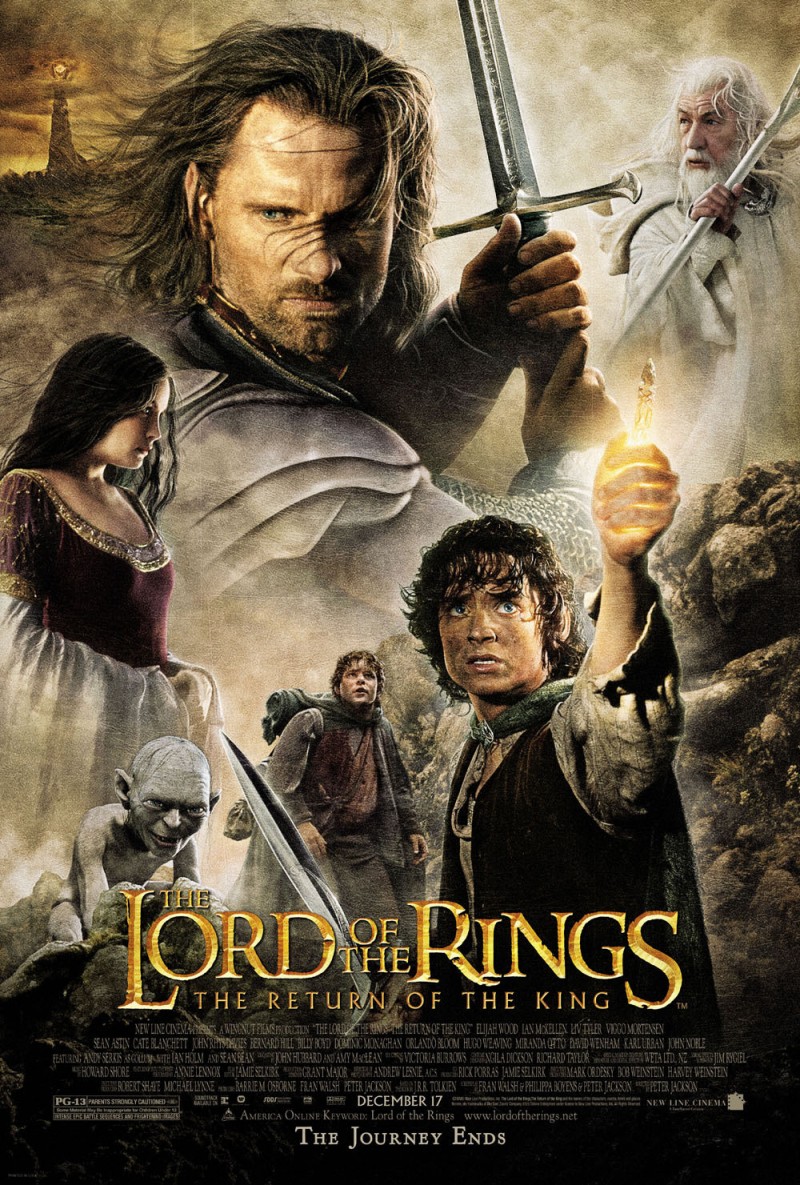
Cast: Elijah Wood (Frodo Baggins), Ian McKellen (Gandalf), Viggo Mortensen (Aragorn), Sean Astin (Samwise Gamgee), Andy Serkis (Gollum), Billy Boyd (Peregrin Took), Dominic Monaghan (Meriadoc Brandybuck), John Rhys-Davies (Gimli), Orlando Bloom (Legolas), Bernard Hill (Theoden), Miranda Otto (Eowyn), David Wenham (Faramir), Karl Urban (Eomer), Hugo Weaving (Elrond), Liv Tyler (Arwen), Cate Blanchett (Galadriel), John Noble (Denethor), Ian Holm (Bilbo), Christopher Lee (Saruman), Brad Dourif (Grima Wormtongue), Sean Bean (Boromir)

By the time the third film in Jackson’s Lord of the Rings trilogy came out, we all knew this was something very special. Readers of Empiremagazine voted it the 9th Best Film Ever Made the month it was released. It was showered with awards, winning every Oscar it was nominated for (11, including three for Jackson) and grossed over a billion dollars worldwide. The Return of the King is a landmark – and it’s a stunning sign-off for a triumphant trilogy.

Frodo (Elijah Wood) and Sam (Sean Astin) are even closer now to Mount Doom, guided by the treacherous former ring-bearer Gollum (Andy Serkis). While they must negotiate the dangers of Mordor, Sauron has sent his forces out to conquer Middle Earth. The city of Minas Tirith is his target. Facing an army of thousands of orcs, the city’s only hope is if Gandalf (Ian McKellen) can defend it long enough to allow Aragorn (Viggo Mortensen) – the man destined to become king of Gondor – to lead a relief force. Will Frodo resist temptation and destroy the ring? And will Aragorn be able to defend the city and become its king?

I think it’s fair to say, with books as widely loved as this, no one is going to agree with every single decision Jackson and fellow writers Fran Walsh and Phillipa Boyens made. Here again, changes have been made – famously the scouring of the Shire that closes the novel has been cut (with Saruman dispatched in the opening scenes of the extended edition). What the screenplay seeks to do is increase the pace and tension – it’s probably why Denethor, leader of Gondor, is reinvented as an antagonist (of which more later) and events charge ahead with a relentless forward motion. There is no stopping to catch breath here: there is always a new crisis to solve.

Where changes have been made, they largely have a positive impact. For example, the film takes the decision to introduce conflict between Frodo and Sam – as well as increasing further the scheming malice of Gollum – by having the disturbed ring-addict manipulate the two hobbits into a falling out. This allows Frodo to enter the lair of the giant spider Shelob (a disgustingly visceral creation) alone. Not only does this make Frodo more vulnerable, it also increases the bravery and nobility of Sam, by having him return to save the day (and allow for a classic Hollywood nick-of-time entrance).

The change also adds to the devious brilliance of Gollum, once again superbly played by Andy Serkis. After spending much of The Two Towers bringing out the depth and sadness in this fragile character, The Return of the King carefully shows how this doesn’t excuse his fundamental ruthlessness. The film opens with a flashback showing Smeagol finding the ring, serving as a neat reminder of the Ring’s fundamental wickedness: within seconds its pushes Smeagol to murder his best friend. The sequence following Smeagol’s moral and physical collapse neatly reminds us of its danger and also how close Frodo is to all this happening to him.

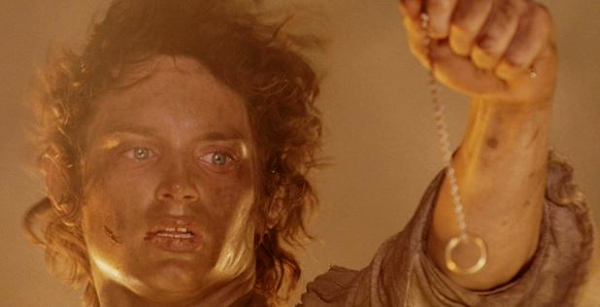
Frodo’s suffering and painful growing maturity is more central here. Wood brilliantly charts Frodo’s continuing moral and emotional decline under the Ring’s influence. Increasingly a physical wreck, Jackson carefully lets the suspicion grow that Frodo’s not going to be capable of chucking the ring away. Balancing this, Astin’s Sam Gamgee (the most heartfelt and affecting performance) becomes the moral centre, self-sacrificing, optimistic and fundamentally decent – a beacon of light in the grimness of Mordor.

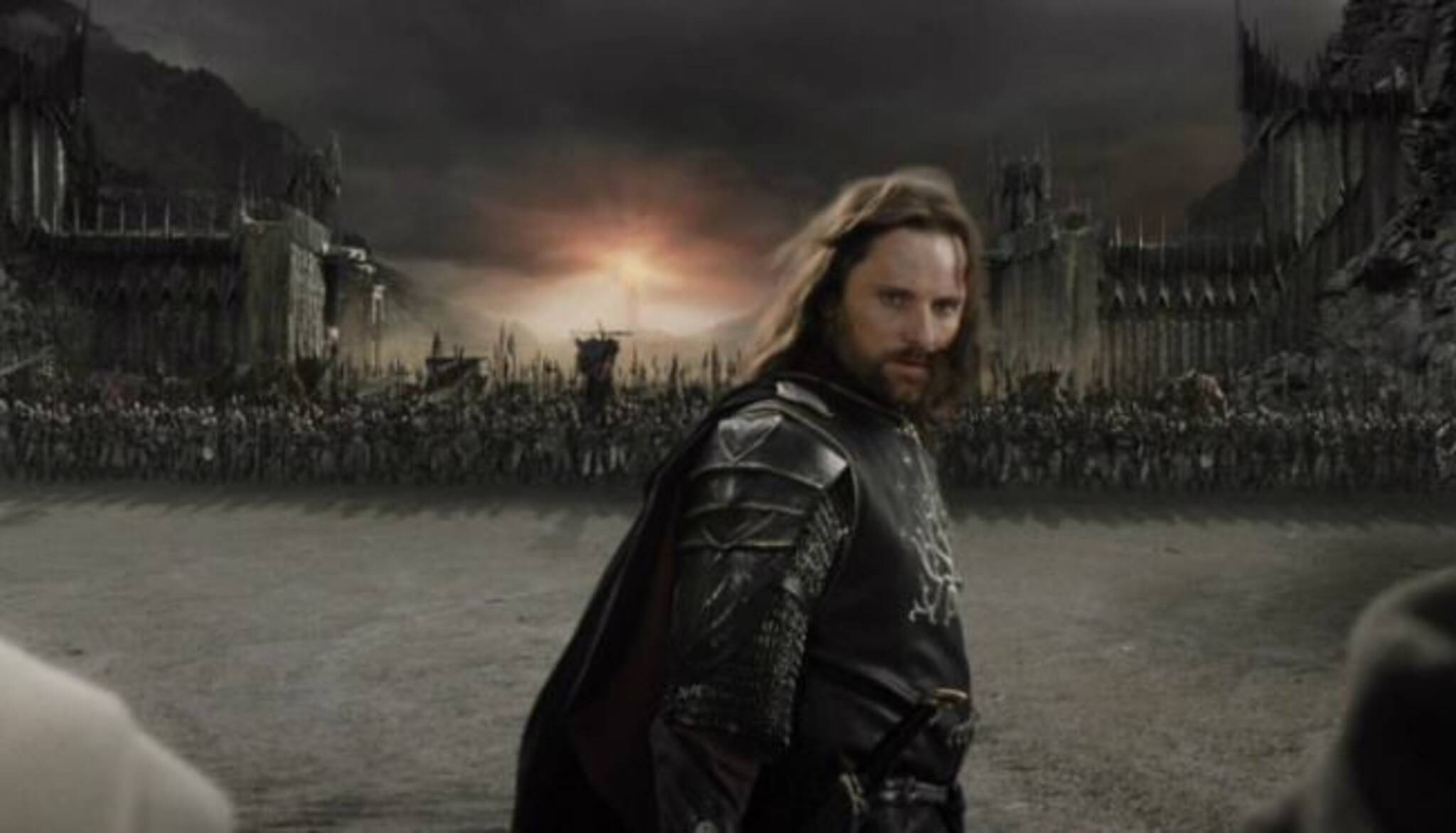
Again, Jackson ups the stakes, with TROK taking place on the grandest scale you could imagine. The battle sequences are breath-taking in their depth and ambition. But, as with the other films, Jackson knows the scale counts for nothing if you didn’t care about the characters at its heart. So, while the events are epically earth-shattering, the film always brings us back to simple emotion. Even in the siege of Gondor, it finds time for a quiet moment of humanity between Gandalf and Pippin.

But those battle scenes are still stunning. The orc armies are terrifyingly vast, while the strafing run of the airborne Nazgul (soldiers snatched from towers are thrown hundreds of feet to their deaths) adds to the sense that victory is hopeless. Soldiers fight desperately for their, and others, lives. The film even tops the Two Towers’ charge of the Rohirrim with a stunningly rousing charge involving thousands of horses into the massed ranks of Orc (and tops that minutes later with a second change accompanied by a sweeping camera movement and swelling musical cue that is just about perfect).

Jackson brilliantly communicates how much the stakes are against our heroes. We really feel their bravery and desperation as they take on impossible odds – and it’s that which really gives the scenes their power, not the scale or the special effects. No moment is lost without bringing us back to moments of bravery and vulnerability from our leads. There are powerful moments of warmth, kindness, loyalty and generosity throughout. It’s finally what makes the film so effective – it’s a tribute to the power of friendship.

It’s all powered with a beautifully operatic score by Howard Shore. Shore’s music captures perfectly the world of Tolkien. A few years after this, an ill-fated musical version of LOTR was launched – and flopped. Because, essentially, Shore has already turned these novels into a sort of opera-slash-concerto, with perfect themes for everything from martial orcs to whimsical hobbits. Some of the musical cues are so luscious and stirring, they make you want to stand and applaud. The music accompanying Gandalf’s rescue of the retreat from Osgiliath is a wonderful highlight, the triumphant and tense music for the Rohirrim charge is stunning, the score for our heroes leaving for the Undying Lands beautiful. LOTR is so beautifully scored, Shore’s work so gorgeous, LOTRis a film you could certainly watch with just the music playing and still understand it perfectly.

Of course, there are things you can criticise. Denethor – in the novel a portrait of corrupted nobility, his intelligence and pride turned to despair – is repositioned here as a sort of heartless WW1 General, gobbling food while his soldiers die and embracing a nihilistic death wish (although this change does allow for the absolutely beautiful Gandalf/Pippin beacon lighting sequence, in defiance of Denethor). It’s not helped by Noble’s lip-smacking performance, stripping the character of nuance. It’s gives Gandalf more to struggle against, but it’s a crude approach for a character who would have worked better as a mis-guided elitist rather than a crass, hissable villain.

Lots of people have had a pop at the multiple endings as well. Jackson certainly teases us a little too much with fades to black. But I’d argue the lack of a definitive full stop adds greater depth to the story. Tolkien was partly inspired by his experiences in WW1. In that war, the hell of the trenches came to an end, but people’s lives didn’t end with a triumphant parade. Instead, they needed to return home and adjust back into civilian life. I think it’s powerfully affecting that the hobbits return to an unscoured Shire, which hasn’t changed at all while they (and us) have seen Middle Earth torn apart. And it adds real force to why Frodo, in particular, can’t return to “life as normal”.

It gives a powerfully moving, bitter-sweet ending and, I think, brings out a rich, emotional message from Tolkien’s story often missed: Frodo and his friends are fighting to protect their home, but find that they have changed so much they can never settle back into that home in the same way again. It’s something soldiers serving in WW1 experienced, and it feels fitting echoed in Jackson’s LOTR.

Jackson’s LOTR will always spark conversations around faithfulness and otherwise to the source material. Not everyone will agree with every choice. But surely no one can argue with the majesty, scale and wonder of these films, the sublimely perfect casting choices, or the loving detail in every touch of the design. When I first saw Return of the King in the cinema, the audience got to their feet and applauded. You can’t blame them: watch this and you are watching something very special, a true landmark in cinema.

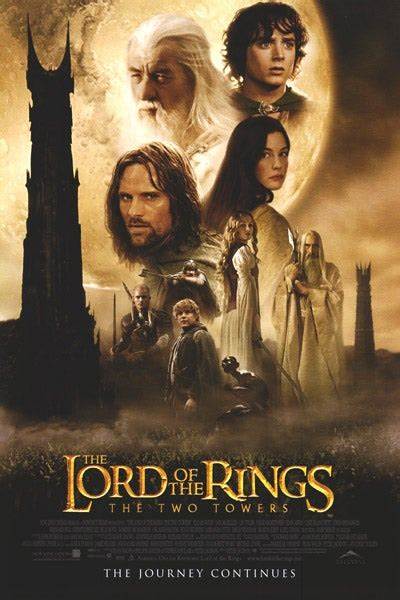
The Lord of the Rings: The Two Towers (2002)

Peter Jackson’s second film in the Lord of the Rings trilogy is another triumph

Director: Peter Jackson

Cast: Elijah Wood (Frodo Baggins), Ian McKellen (Gandalf), Viggo Mortensen (Aragorn), Sean Astin (Samwise Gamgee), Liv Tyler (Arwen), Andy Serkis (Gollum), Billy Boyd (Peregrin Took), Dominic Monaghan (Meriadoc Brandybuck), John Rhys-Davies (Gimli/Treebeard), Orlando Bloom (Legolas), Cate Blanchett (Galadriel), Bernard Hill (King Theoden), Christopher Lee (Saruman), Hugo Weaving (Elrond), Miranda Otto (Eowyn), David Wenham (Faramir), Brad Dourif (Grima Wormtongue), Karl Urban (Eomer), Sean Bean (Boromir), Craig Parker (Haldir)

After Fellowship of the Ring we knew we were in safe hands. So, the real question was would The Two Towers continue to win over long-term fans and new-comers to Middle Earth? Would Jackson pull off the difficult middle chapter, resolving some things, but leaving us with enough tantalising hooks? He succeeded: for many The Two Towers is their favourite film in the series.

The fellowship is broken. Boromir (Sean Bean) and Gandalf (Ian McKellen) are dead. Frodo (Elijah Wood) and Sam (Sean Astin) are making their own way to Mordor – now guided by the former ring-bearer, the dangerously untrustworthy and unbalanced Gollum (Andy Serkis). Aragorn (Viggo Mortensen), Legolas (Orlando Bloom) and Gimli (John Rhys-Davies) are tearing across the land of the kingdom of Rohan following the orcs who kidnapped Merry (Dominic Monaghan) and Pippin (Billy Boyd). Meanwhile, the dark forces of Saruman (Christopher Lee) are moving against Rohan and its sickly king Theoden (Bernard Hill), determined to destroy it. War has truly come to Middle Earth – but can the return of an old friend help to turn the tide? And will Frodo and Sam find safety or danger when they meet Boromir’s brother Faramir (David Wenham)?

Hard to believe considering the scale of the first film, but Jackson’s second Tolkien adventure ramps up the scale even further. It continues the immersive capturing of the look and feel of the novels, while reconceptualising it into something closer to a stirring, gripping action epic. The Two Towersis awe-inspring in its scale and world-creation, building towards one of the all-time great cinematic battles as the few of Rohan hold out against the massed forces of Saruman at Helm’s Deep.

Just as in Fellowship the pace and tension is heightened. With the heroes split into three groups, there are a number of balls to juggle. But Jackson and co-screenwriters Fran Walsh and Phillipa Boyens superbly intercut the more linear book chapters – feeling free to shift orders, motivations and inventing their own narrative flourishes to link events together. The film adapts around 13 of the novel’s twenty chapters (the rest being assigned to the other films), but is so perfectly paced it never feels overstretched or disjointed. They even add more material involving Saruman, making this arch-manipulator a larger presence in the film than in the novel.

The Two Towers radically changes many of the events of the novel – but in most cases (except one) this is done with such respect for Tolkien that even most fans overlooked them. So, it hardly matters Theoden’s motivations for making a stand at Helm’s Deep have radically changed or that the films add warg action or has Aragorn presumed dead at the halfway point. Elves turning up to fight at Helm’s Deep is such a “Hurrah” moment, only the most extreme Tolkien purist could object (they would have objected a lot more to the original plan to have Arwen fight there). Merry and Pippin’s interaction with the Ents (living trees) are re-purposed to give them greater agency.

In fact, the changes to Faramir were the only ones anyone objected. In the novel Faramir is pure-of-heart and untempted by the Ring. With much of the novel’s Frodo material transferred to The Return of the King, Jackson, Walsh and Boyens needed to make Faramir “an obstacle”. Cinematically, the idea of Faramir trying to take the Ring to Gondor – motivated by the urge to win the affection of his distant father – made perfect sense (and Wenham delivers the character very well).

But for many book fans, this was a travesty of a beloved character (for all that Faramir eventually proves his quality). I’ve never met a book fan who wasn’t displeased by “movie Faramir”. For those familiar with the films, there won’t be a problem – but I can see the point. The character is clearly, in a subtle way, different from the more whimsical and unsullied man the book presents.

If there is one element of Tolkien Jackson, Walsh and Boyens are not interested in, it’s Tolkien’s whimsy and idea of characters as paragons (or parAragorns). For the film, the conflicted Boromir is more interesting and sympathetic than goodie-two-shoes Faramir. By contrast, to Tolkien Faramir was an ideal and Boromir a shadow of the martial blowhards who led millions to death in the trenches. Tolkien wanted heroes who were more certain and perfect. The films are about the struggles people face with doing their duty, questioning their purpose. The films are not about questions of spiritualty and moral purity. Tolkien gives over long chapters to the spirituality of the Ents and one short one to Helm’s Deep – that balance is completely flipped here.

But the advantage is that the idea of true heroism being conquering your own doubts pays off hugely in the adaptation. Aragorn – a superb and hugely charismatic Viggo Mortensen, literally sweating heroism and poetic sensibility – has his character arc improved by the film. In the book, he has not doubt at all. The film establishes his reluctance to lead and unwillingness to acknowledge he is of men. From seeing only the weakness of men, he slowly identifies with them. It’s a conscious decision for him to fight at Helm’s Deep and the battle sees him finally accepting leadership. It’s a richness not found in the novel.

Of course, battles are more compelling on screen than the page. Helm’s Deep is perhaps the greatest battle on screen, a Kurosawa-inspired, rain-splatted masterpiece, perfectly mixing character beats and action. It never forgets that we care about people not action, so rarely more than thirty seconds go by without one of our heroes front-and-centre. Shots of refugees establish the stakes, the costs of war are laid shockingly bare and the battle is crammed full of awe-inspiring shots of mayhem and martial prowess. You can’t not be excited by this superbly choreographed epic, with just the right level of Jackson’s pulpish-gore background laid on.

But this is not just a film about a battle. As always, every beat is perfectly worked – even if the Ents material suffers from the reduced interest from the creative team. The opening sequence expanding the battle between Gandalf and the Balrog is jaw-dropping. The world of Rohan is created beautifully. Bernard Hill’s Theoden is plagued with self-doubt. Miranda Otto is very good as a woman who wants to prove her place in a man’s world (even if the hinted romantic sub plot between her and Aragorn feels a little forced).

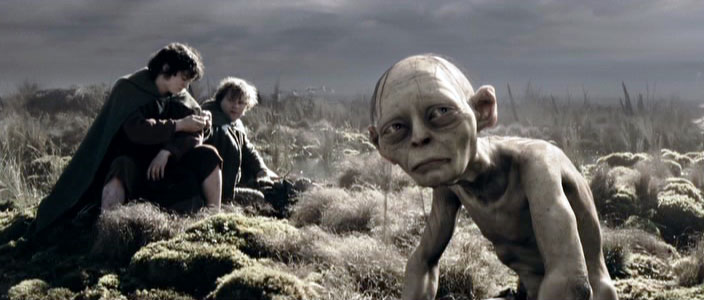
But the biggest magic in the film, and its most special effect, might just be Gollum. While the computer wizardry to create the character is astounding, it works because the acting behind it is sublime. Serkis invented a whole school of acting in motion capture. The screenwriters expand the novel’s conflicted psyche and explores even more the character’s split personality – Gollum (the Ring dominated side) and Smeagol (the timid but dangerous side), both made distinctive by Serkis. Jackson’s most bravura scene might be one of his most simple, a two-shot argument between the two sides, that sees Serkis switch personality with each cut. It’s a superb combination of cinematic language and acting skill.

The Two Towers is superb film-making, with music, photography, editing and design all faultless. The acting is again brilliant – Wood, McKellen, Astin, Tyler as well as those mentioned above. But it’s also a brilliant adaptation of a novel, making changes to increase tension and drama and carefully selecting the elements that will work most effectively on screen. It’s closing battle is one for the ages, but the entire film is a perfectly paced epic, with a growing sense of danger and doom that ends on a beat of quiet hope. This series is a thing of beauty.

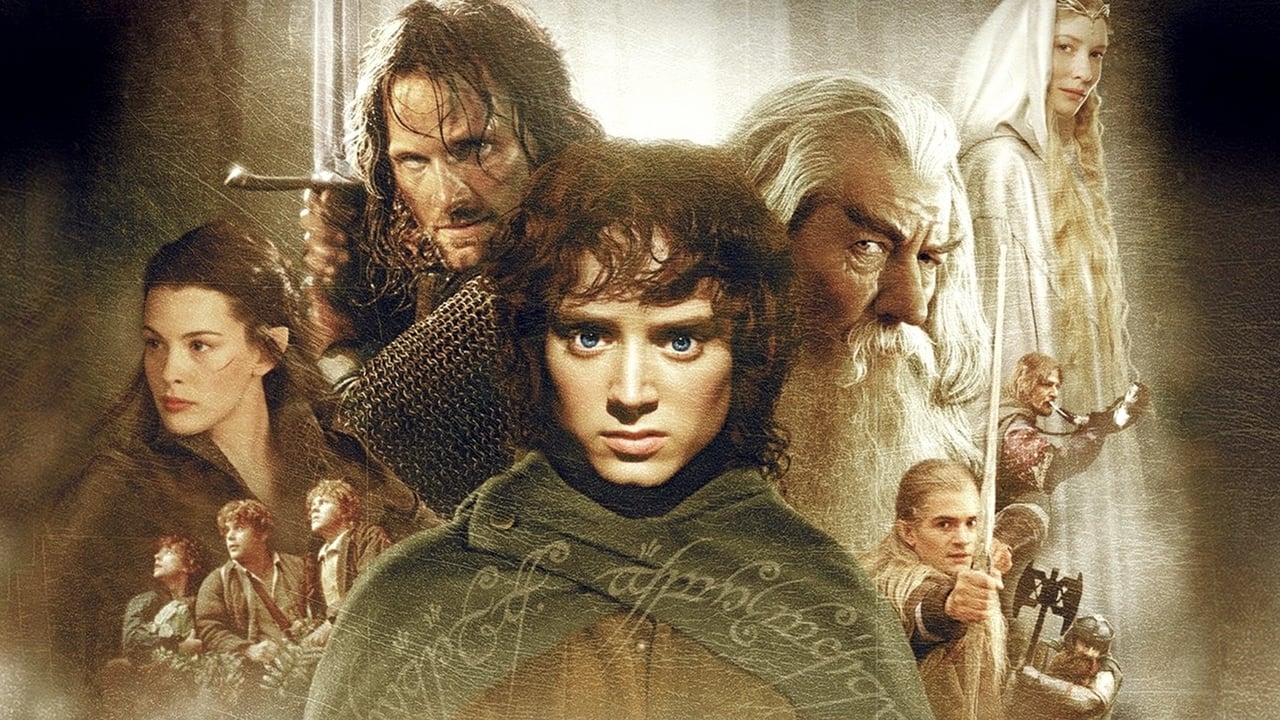
The Lord of the Rings: The Fellowship of the Ring (2001)

Peter Jackson’s near-perfect opening chapter of his Tolkien adaptation

Director: Peter Jackson

Cast: Elijah Wood (Frodo Baggins), Ian McKellen (Gandalf), Viggo Mortensen (Aragorn), Sean Astin (Samwise Gamgee), Liv Tyler (Arwen), Sean Bean (Boromir), Billy Boyd (Pippin Took), Dominic Monaghan (Merry Brandybuck), John Rhys-Davies (Gimli), Orlando Bloom (Legolas), Ian Holm (Bilbo Baggins), Cate Blanchett (Galadriel), Christopher Lee (Saruman), Hugo Weaving (Elrond)

When it was released, people wondered if there was a market for three mega-length adaptations of Tolkien. By the time it finished, Hollywood was casting eyes at The Hobbit and working out how many films that could stretch to. Peter Jackson’s The Fellowship of the Ring is a film so completely perfect it pulled off the near-impossible: embraced all, from the novel’s passionate fanbase, to lovers of blockbusters and connoisseurs of cinema. Jackson turned a landmark novel into a landmark film, the sort of work that decades of other films (and TV shows) would be inevitably compared to. By any benchmark, The Fellowship of the Ring is a cultural and cinematic turning point.

Frodo Baggins (Elijah Wood) is a young hobbit who inherits his home from his Uncle Bilbo (Ian Holm) – along with a mysterious ring which gives its wearer the power of invisibility. But more than that, this ring is the very same ring crafted by the Dark Lord Sauron: the source of his power and possibly the most evil item in the world. Warned of its danger by his uncle’s old friend, the wizard Gandalf (Ian McKellen), Frodo agrees to carry it first to the elves at Rivendell – and then from there to the fires of Mount Doom, the only place it can be destroyed. Joining him on this perilous quest is a ‘fellowship’: Gandalf, fellow hobbits Sam (Sean Astin), Pippin (Billy Boy) and Merry (Dominic Monaghan), elf Legolas (Orlando Bloom), dwarf Gimli (John Rhys-Davies), human Boromir (Sean Bean) and the mysterious ranger Aragorn (Viggo Mortensen), who may be the heir to the kingdom of men.

Jackson’s film faced a huge problem from the start: cater to the fans too much, make it too drenched in the high-fantasy of the novel, and you risk alienating an audience sceptical about stories of magic and elves; push the film too far the other way and it becomes something denounced by the fanbase. Fortunately, Jackson (and fellow scriptwriters Fran Walsh and Phillipa Boyens) transform the book into a masterfully-paced, emotionally-invested epic saga with moments of comedy and tragedy and an overwhelming sense that colossal stakes are being played for. By focusing on what makes The Lord of the Rings such a great story they helped nail making it accessible to the sort of people who wouldn’t dream of picking up a fantasy book.

The novel is carefully, subtly altered throughout to increase pace and build up the emotional depth of the characters. Its timeline is telescoped (Gandalf’s 19 year research into the ring becomes a few months), stand-alone sections removed (good bye Tom Bombadil) and personal conflicts and emotions are subtly made more prominent (most notably Gandalf’s grandfatherly affection for Frodo and the conflicted admiration and resentments between Boromir and Aragorn). What this succeeds in doing is creating a film that actually alters a lot of the original book (reassigning multiple actions and shifting many motivations) but ends up carrying so much of the emotional and narrative truth that it feels completely faithful. The tone is perfectly captured but also becomes a gripping, cinematic drama, populated by characters who feel real, for all their hairy feet or wizard’s hats.

The script is a perfect mixture of the greatest lines and quotes from the book, expanded with a real understanding of character motivation. Its all complemented by faultless direction with a sweeping visual panache from Jackson. This is a passionate director, working at the top of his game. The film is, of course, breathtakingly beautiful – New Zealand, the perfect location for Middle Earth, still dines out on the tourist trade to this day – but Jackson brilliantly mixes the epic with touches of his own Grindhouse roots. So, he can shoot stunning chase scenes with Nazgul or dreamy ascents of mountains with the same flair as he can the grimy, body horror of an Uruk-Hai’s birth. I can’t stress too much the level of Jackson’s achievement here: the film shifts between genre and tone from scene-to-scene: the Moria sequence goes through mystery, whimsy, regret, tragedy, action, awe-inspiring scope then crushing loss. Another director could have made that feel like a wildly veering train – Jackson makes it feel all of a piece. Not a single scene is untouched by directorial genius.

Jackson’s passion for the project was communicated to the entire team. In every single technical department, no effort has been spared to create Tolkien’s world (and crucially it always feels like Tolkien’s world). Stills of this film could be slotted into editions of the book and not look out of place. From the detail of the costume, design of the sets, to the writing of elvish – not a single prop, set or costume doesn’t look like it belongs. Everything feels grown out of the imagination of the reader. It’s helped hugely by the effort to recruit famed Tolkien illustrators Alan Lee and John Howe: their iconic visualisations of the novel inspired every inch of the design.

It’s also a film that feels real (even though so much of it was of course made in a computer). The film used practical locations and shooting tricks wherever possible. Obviously, the New Zealand landscape was used to sumptuous effect, but also wherever possible models and miniatures were used. Even the height differences between hobbits and other characters were largely achieved in camera. It’s an approach which not only subconsciously communicates an intimacy, it also helps make the story feel even more grounded: a sense of dramatic events happening to real people.

The film also brilliantly establishes the sinister darkness of the ring. One of the trickiest things in adapting Tolkien is dealing with the fact that your villains are a suspended glowing eye and a gold ring. TFOR expertly establishes the dark malevolence of the Ring, as a sinister, manipulative, wicked presence that corrupts those around it – it’s even given its own darkly seductive voice. Never for a moment does anyone watching this film doubt that it is bad news, its absolute is evil totally accepted. Think about that for a second and that is a stunning achievement.

Then there’s the score. If you ever wanted to prove to someone how important music is to the experience of watching a film, show them this one. Howard Shore’s orchestral compositions not only deepen and enrich every frame they accompany, they are also perfect in capturing the tone of novel. From the piping hobbit music, to the demonic choirs of the Nazguls, to the soaring but mournful themes of Gondor, this film could almost be a musical. Watch it without dialogue and you still follow it perfectly.

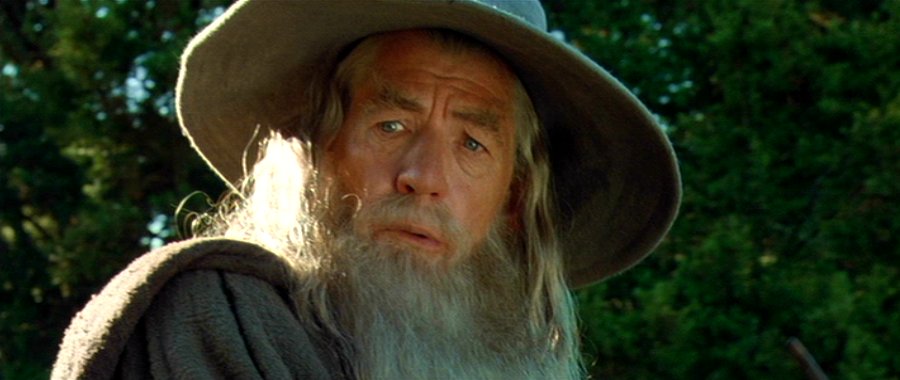
Jackson also nailed the cast. Ian McKellen quite simply becomes Gandalf, on the surface a twinkling grandfatherly presence, but below a frighteningly powerful man carrying centuries of wisdom. It’s a brilliantly iconic performance. Elijah Wood brings a wonderful innocence that slowly strips away as Frodo. Ian Holm’s Bilbo is a delightful charmer with flashes of corruption. Viggo Mortensen is all charisma and conflict as Aragorn. Christopher Lee was born to play Saruman. Liv Tyler was a revelation as Arwen. Sean Bean’s masculine Boromir hides deep-rooted personal doubt, insecurity and fear of failure. The cast is perfect.

And there isn’t a duff scene in the film. It’s opening montage is a masterclass in narrative introduction and awe-inspiring action. The Hobbiton sections have just the right tone of whimsy. The chase through Moria turns descending a staircase into a nail-biter. The final breaking of the fellowship gives us breath-taking battles and heart-rending tragedy, along with an iconic death scene.

No one else could have possibly delivered the novel to the screen better than this. Jackson’s fingerprints are on every inch of the film. It’s a masterclass in adaptation, a beautiful thing to watch and listen to, exquisitely acted and utterly compelling. Both true to the novel and totally engaging for newcomers, it might be the best of the series – and when it was released, felt like the film Tolkien fans had been waiting for their whole lives.

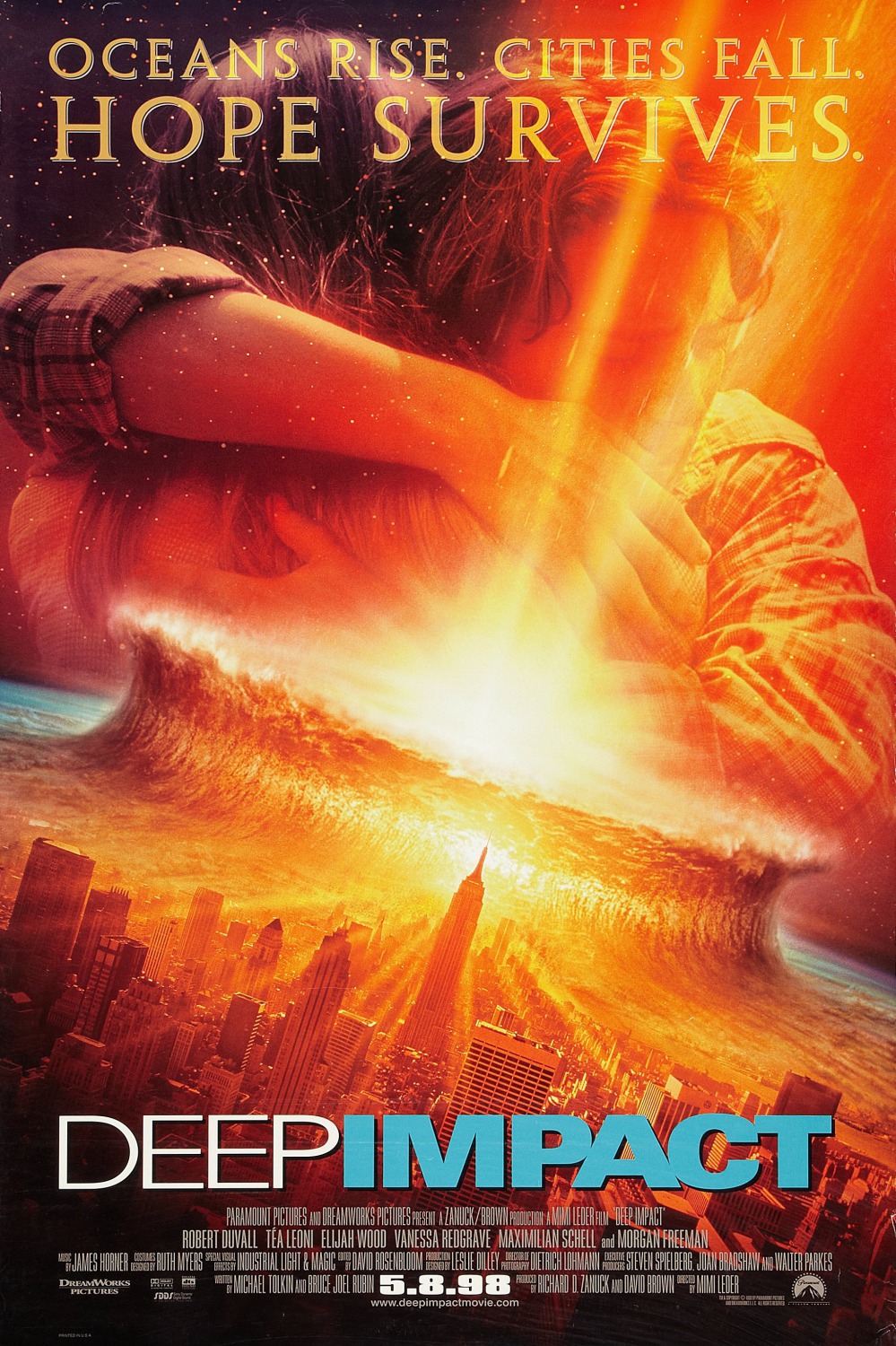
Deep Impact (1998)

It’s the end of the world in Deep Impact

Director: Mimi Leder

Cast: Robert Duvall (Captain Spurgeon “Fish” Tanner), Téa Leoni (Jenny Lerner), Morgan Freeman (President Tom Beck), Elijah Wood (Leo Biederman), Vanessa Redgrave (Robin Lerner), Maximilian Schell (Jason Lerner), James Cromwell (Alan Rittenhouse), Ron Eldard (Commander Oren Monash), Jon Favreau (Dr Gus Partenza), Laura Innes (Beth Stanley), Mary McCormack (Andy Baker), Bruce Weitz (Stuart Caley), Richard Schiff (Don Biederman), Betsy Brantley (Ellen Biederman), Leelee Sobieski (Sarah Hochtner), Blair Underwood (Mark Simon), Dougray Scott (Eric Vennekor)

Sometimes two Hollywood studies have the same ideas at the same time. When this happened in 1974 they clubbed together and turned two scripts about burning skyscrapers into one movie – The Towering Inferno. But it’s more likely they’ll do what happened with volcano movies in 1997, White House invasion movies in 2013 and asteroids movies in 1998: both make a film and rush to be the first one out. Usually that’s the winner (ask Dante’s Peak or Olympus Has Fallen). The exception was Deep Impact which made plenty of moolah – but was trumped by Michael Bay’s thundering Armageddon, with its far more straight-forward feel-good action.

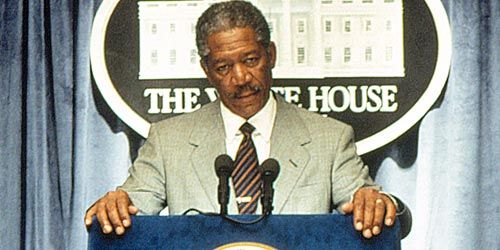
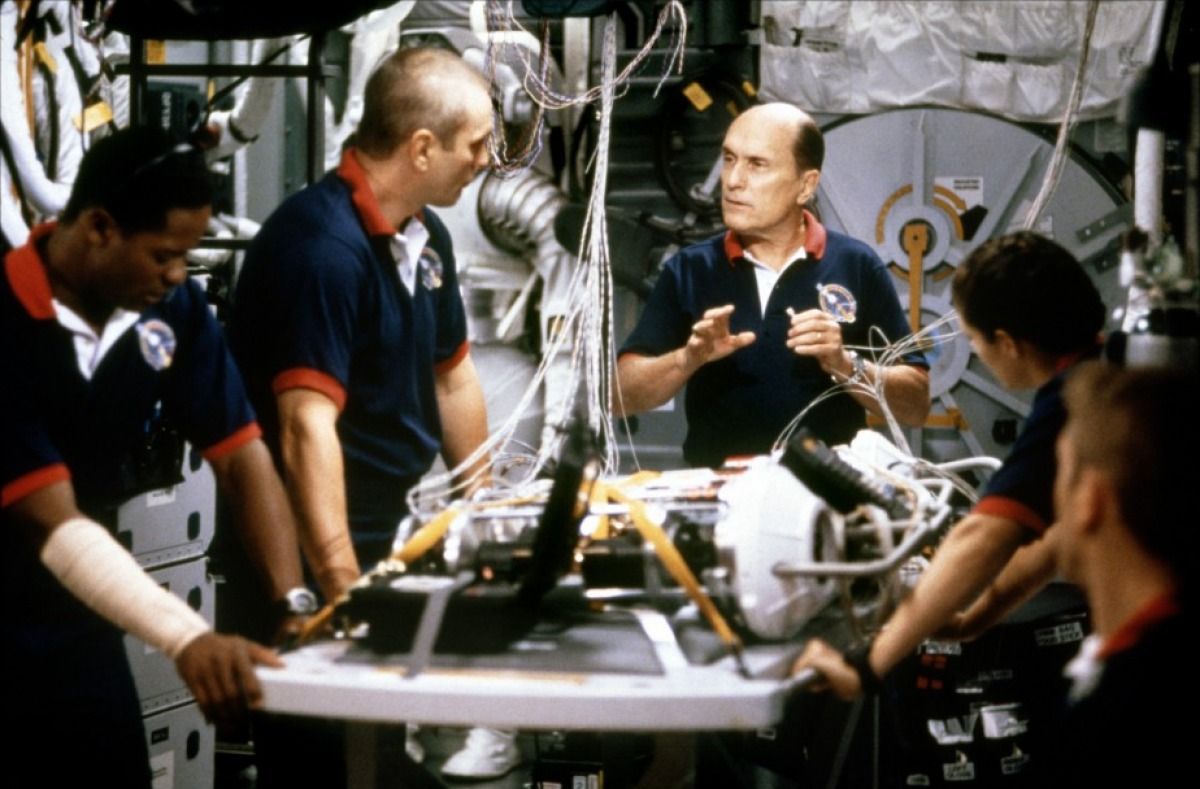
A meteor is heading towards the Earth – and it’s an Extinction Level Event (ELE) that will wipe out all life on Earth. World governments keep it hushed up, wanting to avoid mass panic, and start planning to preserve mankind. Underground “arks” will be built in major countries to protect a small number of population. And a manned space mission, crewed by a team of young bucks and veteran astronaut Spurgeon “Fish” Tanner (Robert Duvall), will head out to the asteroid to try and use a nuclear bomb to blow it up. However news leaks when intrepid young MSNBC reporter Jenny Lerner (Téa Leoni) stumbles on news of a cabinet resignation, over a mysterious “Ellie”, leading to her accidentally uncovering the meteor. President Tom Beck (Morgan Freeman) announces all to the world – and mankind prepares, in hope, for the disaster.

Deep Impact is a well-mounted and surprisingly thoughtful adventure story, that tries to deal with its Earth-ending themes with a seriousness and humanity that’s a world away from the flag-waving crash-bangs of Armageddon. Well directed by Mimi Leder, who juggles effectively huge special effects and low-key personal stories (even if these have the air of movie-of-the-week to them), it’s an ensemble piece with a surprisingly downer ending (no surprise from the poster) that still leaves more than a touch of hope that mankind will persevere.

It’s poe-faced seriousness about reflecting on the end of the world may be dwarfed now by superior TV shows – it’s hardly The Leftovers – but felt quite daring for a 90s blockbuster, at least trying to be some sort of meditation on the end of the world. While the film does do this by focusing on the most mundane of soapy dramas – will Jenny Lind (Téa Leoni in a truly thankless role) manage to reconcile with her estranged father (Maximilian Schell, a bizarre choice but who manages to rein in most of the ham) who walked out on her and her mother (Vanessa Redgrave, if possible an even more surreal choice) before the world ends – at least it’s sort of trying.

Soap also soaks through the storyline about young Leo Biedermann (Elijah Wood), the geeky wünderkid who discovers the asteroid. The drama around a national lottery to select the chosen (very) few who will join the 200,000 essential scientists, artists and politicians in the bunker is boiled down to whether Leo will be able to sneak his girlfriend (Leelee Sobieski) and her family on the list. Needless to say, this plotline boils down into a desperate chase, some heroic sacrifices and a great deal of tears. This sort of stuff doesn’t re-invent the wheel, but it makes for familiar cinema tropes among the general “end-of-the-world” seriousness.

There isn’t much in the way of humour in Deep Impact, perhaps because those making it were worried cracking a joke might undermine the drama. There’s nothing wrong with this, but you start to notice more the film’s “not just another blockbuster” mindset being warn very firmly on its sleeve. The film’s third major plotline, around the mission to blow up the asteroid, is as much about whether grizzled, wise vet Robert Duvall will win the respect of the dismissive young bucks he’s crewed with (spoilers he does) as it is whether they will destroy the meteor. Anyone who can’t see sacrifices coming here btw, hasn’t seen enough films – but these moments when they come carry a fair emotional wallop, partly because the film never puts its tongue in its cheek.

It’s a film proud of its scientific realism, which makes it slightly easy to snigger at the sillier moments – especially when it takes itself so seriously. An astronomer (played by The Untouchables luckless Charles Martin Smith) drives to his death racing to warn the authorities (why not just call them from his office eh?). The astronauts, for all their vaulted training, hit the meteor surface with all the blasé casualness of high-school jocks. Jenny’s journalistic investigation is so clumsy and inept, it’s hilarious watching the President and others assume she’s way more clued up than she is (this also comes from a time when Jenny could key in “E.L.E.” into the Internet and get one result – I just tried it and got 619 million. Simpler times).

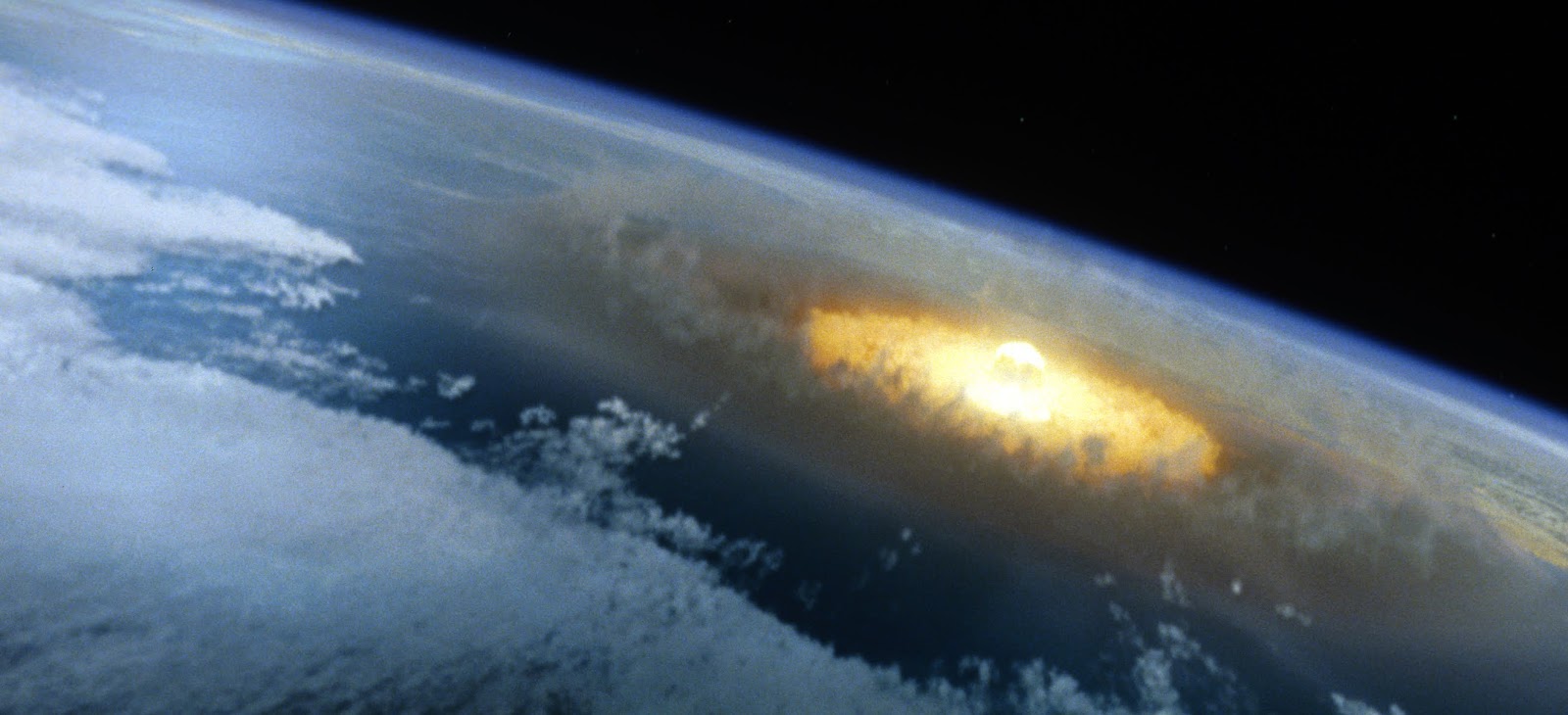
I’ve been hard on this film, but honestly it’s still a very easy film to like. Sure it’s really silly and soapy but it takes itself seriously and it wants to tell a story about people and human relationship problems, rather than effects, which is praiseworthy in itself. The best moments go to the experienced old pros, with Duvall rather good as Tanner and Morgan Freeman wonderfully authoritative as the President (it was considered daring at the time to have a Black President). The special effects when the meteor arrives (spoiled on the poster and the trailer) are impressive and while it’s easy to tease, you’ll still welcome it every time it arrives on your TV screen.