
Tag: François Périer

Z (1969)

Z (1969)

Costa-Gravas thrilling conspiracy thriller is possibly one of the finest political films ever made

Director: Costa-Gravas

Cast: Jean-Louis Trintignant (Examining Magistrate), Yves Montand (Deputy), Irene Papas (Helene, the Deputy’s wife), Pierre Dux (General), Jacques Perrin (Photojournalist), Charles Denner (Manuel), François Périer (Public Prosecutor), Georges Géret (Nick), Bernard Fresson (Matt), Marcel Bozzuffi (Vago), Julian Guiomar (The Colonel), Gérard Darrieu (Barone), Jean Bouise (Georges Pirou), Jean-Pierre Miquel (Pierre)
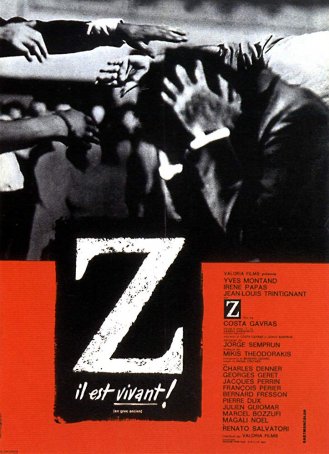
Costa-Gravas Z is an explosive political thriller, ripping a lightly fictionalised story from the Greek headlines (the opening credits playfully state ‘any resemblance to real people is ‘purely intentional!’) and turning it into a compellingly angry, cold-eyed look at political repression. It was based on the state-backed murder of Greek politician Grigoris Lambrakis in 1963 and the investigation by magistrate Christos Sartzetakis which briefly looked like it might expose repressive military forces but actually kick-started a 1967 military junta counter coup in Greece. Z takes this as inspiration for a truly universal story that continues to feel like ‘it could happen here’.

Lambrakis becomes The Deputy, played with great charm and determined charisma by Yves Montand. After death threats, he is murdered after a political rally by two thugs in a hit-and-run, in a public square, surrounded by police officers and a legion of witnesses. The police, represented by the virulent anti-communist General (Pierre Dux) declare it a tragic accident. They firmly expect our Sartzetakis-figure (Jean-Louis Trintignant, putting his enigmatic unreadability to extraordinarily good-use), son of a war hero, to back-up their bullshit. But he didn’t get the memo, conducting a genuine investigation which reveals the extensive links between the military and police and far-right organisations, how they planned the hit and did everything to ensure its success. But will this investigation lead to real change?

Costa-Gravas’ film is a hard-boiled conspiracy thriller with echoes of The Battle of Algiers’ primal urgency and immediacy. It’s committed to throwing you into the middle of the turmoil, with fast-cutting, hand-held camerawork, tracking shots through crowds and shots which zero in on the faces of victims and perpetrators alike. The film’s influence on directors like Oliver Stone is palpable. But, unlike Stone’s work, Z wears its moral outrage carefully: it presents events with a journalistic matter-of-factness, trusting us to recognise the corrupt horror of over-mighty governments. The resolute professionalism of Trintignant’s magistrate helps enormously here – heroism in this world is being honest and doing your job.

What Costa-Gravas film reveals is that these authorities believe they can act with utter impunity, convinced they will never be questioned by anyone, other than their liberal targets. Z opens with a darkly comic scene that outlines this thinking: during a lecture, the pompous General outlines (to a military audience shown impassively watching in a series of quick reaction cuts) his theory of ‘ideological mildew’ attacking the ‘tree of liberty’, using a tortured pesticide metaphor to suggest it is their duty to kill the mildew (liberals and socialists). This tyrannical view is parroted by people who are neither lip-smacking villains or fiendishly clever – they just have absolute, fixed certainty.

Z makes clear that such men, placed in position of authority, will attempt to shape events with a breath-taking arrogance. The assassination plot is shockingly clumsy and obvious and cover-up so full of transparent bare-faced lies, you’d need to be impossibly arrogant to even consider you could get away with it. Copious evidence shows meetings between senior officers and members of the right-wing CROC group. It’s claimed the Deputy’s fatal head-wound came from hitting the pavement, even though this is ruled impossible by both an autopsy and hundreds of witnesses. The General claims not to know the driver who ‘rushed’ the wounded Deputy to hospital (stopping at every opportunity), even though the man is his personal chauffeur. Everyone repeats the same tortured, unusual phrases – from the head of police to the thugs themselves.

It doesn’t stop there. Once it becomes clear Trintignant’s magistrate is genuinely investigating – that he has his own mind and opinions – the clumsy cover up turns aggressive. Blame is put on the Deputies own supporters (the word ‘false-flag operation’ didn’t exist then, but the idea is seized on); his lawyer is almost killed in a park hit-and-run in front of dozens of witnesses; a witness who can testify to the plans of the hitmen is pressured, told he has epilepsy, framed as a radical (he’s clearly not) and then nearly assassinated by one of the hit-men (put up in the same military hospital with a pretend broken leg), who flees the scene and in front of his doctors, while giggling at his cheek.

Some of this is in fact blackly funny. It perhaps almost would be, if it wasn’t for Z’s moral indignation. Even without murder, this is a repressive, corrupt regime: the Deputy’s team have innumerable petty obstacles placed in their way for their rally, their supporters are openly attacked by bused in protestors mixed with baton-wielding under-cover officers. Costa-Gravas doesn’t show the Deputy as a saint – flashbacks reveal he is an adulterer – but it does make clear his bravery (confronting and cowing crowds of anti-liberal rioters, utterly unrestrained by the police), leadership and the fear he overcomes. It also shows, especially in Irene Papas’ emotionally underplayed but quietly devastating performance, the raw grief of those who love him. His closest colleagues weep at news of his death, the post-death slandering of him all-the-more disgusting.

Z presents its evidence with an increasingly overwhelming force. The magistrate corrects (for a long time) any use of the word murder for ‘accident’ – by the time he himself says ‘murder’ it’s almost easy for us to miss it, so natural has the conclusion become. Pressure is, of course, applied to him: senior officers bluster about metaphorical eggs and omelettes; his bosses suggest he charge only the hit-men and (for good measure) charge the Deputy’s people for disrupting the peace by holding the rally in the first place. Plenty of ordinary people know exactly what’s going on, but don’t want to take risks: a newspaper editor reports what he’s told to, the Deputy’s doctor regrets not joining his lonely ‘march for peace’ but, well, you know how it is…
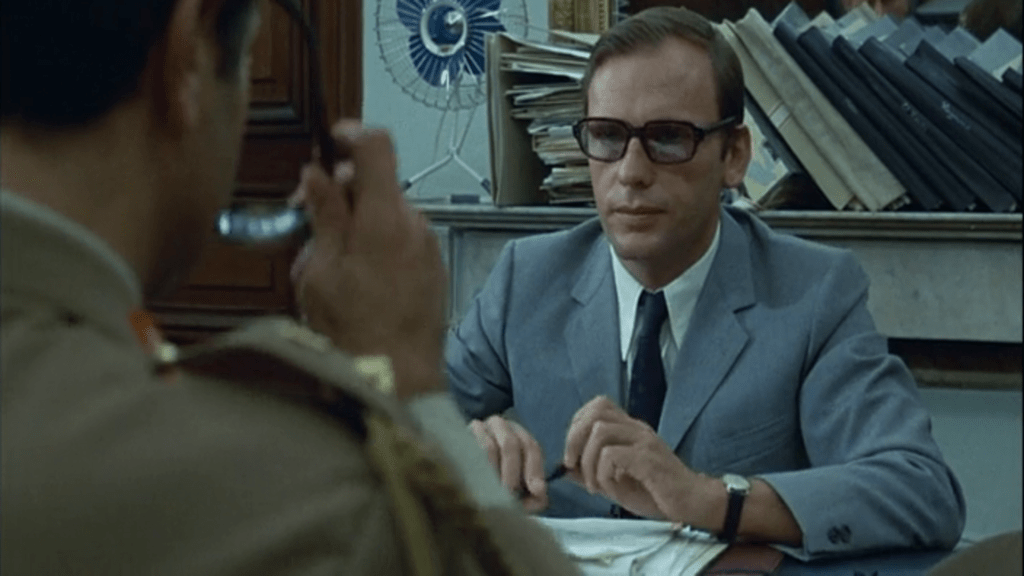
Given the blatant criminality of the police and the army – and the sadistic arrogance of hit-man Vago (an uncomfortable beat in Z is the whiff of homophobia in the depiction of Vago as a predatory homosexual and pederast) – it’s truly triumphant to see them bought to book. Despite their bombast (each officer states he will have no choice but to take his life to avoid the shame, something of course none of them do), each flees the building railing at the press. (The General, an antisemite among everything else, even roars ‘Dreyfus was guilty!’ when a journalist compares the affair to that).

But it’s short-lived. Perhaps Irene Papas’ Helene knows it will be when she responds to news of the arrest with a quiet middle-distance stare. Z closes with a dark coda that could almost be funny if it wasn’t horrifying. A photojournalist (played by producer Jacques Perrin) who we have followed uncovering the plot, reports the aftermath: initial resignations followed by slap-on-the-wrist sentences for the hit-men, charges dropped for the officers and a coup d’etat (at this point a cut removes Perrin) which sees the arrest or ‘accidental’ death of all the Deputy’s supporters, a junta government and bans of everything from authors, mini-skirts, modern mathematics and, above all, the letter Z, as zi has been taken by protestors as the badge ‘He Lives’.

It would be funny. It almost is funny. If it wasn’t part of a system that crushes freedom with violence and murder. Costa-Gravas’ brilliant, engrossing and perfectly judged film shows how terrifyingly swiftly it can happen, how freedoms and justice can be strangled before our very eyes. Watching it today, you can’t imagine a time when it won’t be coldly, chillingly, terrifyingly relevant.
Le Samouraï (1967)

Le Samouraï (1967)

Melville’s iconic and enigmatic hitman film is the epitome of stripped-back cool

Director: Jean-Pierre Melville

Cast: Alain Delon (Jef Costello), François Périer (Superintendent), Nathalie Delon (Jane Lagrange), Cathy Rosier (Valérie), Jacques Leroy (Man in the passageway), Michel Boisrand (Bartender), Jean-Pierre Posier (Olivier Rey), Catherine Jourdain (Hatcheck girl), André Salgues (Mechanic)

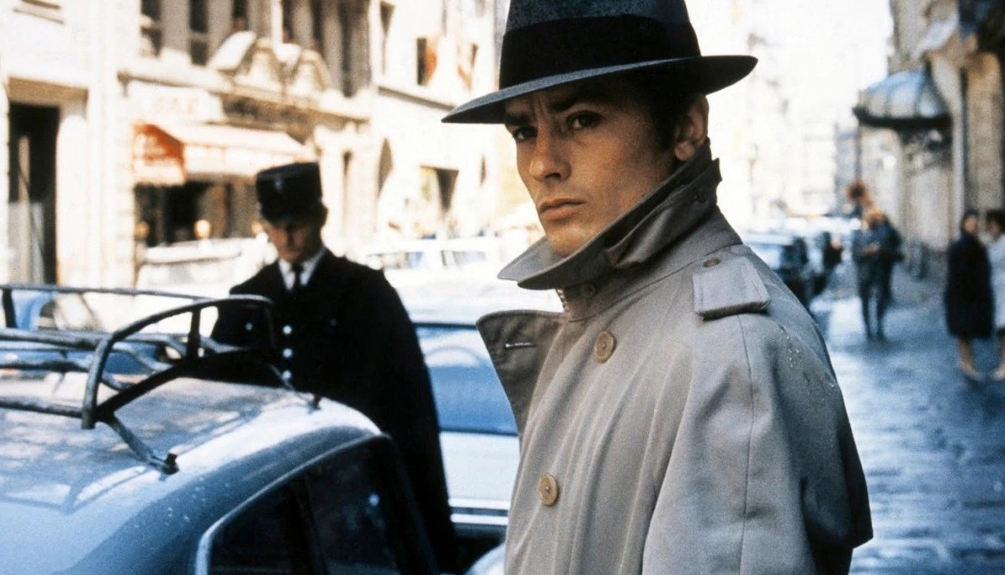
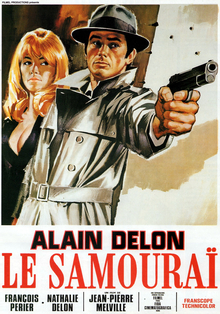
Every professional has his own code, his way of going about business. Why should a hired killer be any different? Jef Costello (Alain Delon) kills for money, but follows his own samurai-inspired code, going about his assignments with methodical preparation and ritualistic regularity, with his hands always covered with white gloves and his fedora at just the right angle. Le Samouraï is partly about how far Costello will go to follow his self-appointed rules. What about when a nightclub hit goes wrong, the piano-playing witness Valérie (Cathy Rosier) may or may not be protecting him, the investigating Superintendent (François Périer) is sure it’s him and the man who hired Jef decides he’s a loose end that needs tying up?

All this comes together in Melville’s stripped back, effortlessly cool mix of Hollywood noir and French New-Wave existentialism shot in a series of chilled greys that makes the film feel like a slice of monochrome 40s throwback. It’s Melville’s mix of the observational, forensic cinema of the likes of Bresson, told with the poetry of Cocteau and with more than a splash of Hawks. It makes for a film quite unlike many others, which sometimes has the logic of a dream, where the hero dresses like he’s stumbled in from Raymond Chandler and lives by a code encapsulated by an opening Bushido quote that Melville made up. It also cemented the filmic idea of the hitman as a mix of sociopath and poet, a consummate professional endlessly attractive in his unflappability sticking loyally to his personal code that shaped everything from Forsyth’s Day of the Jackal right up to John Wick.

Melville’s direction is pin-point perfect, every moment perfectly framed to bring just the right measure of cool and chill. It could almost be a silent – there is no dialogue for the first ten minutes and the dénouement returns to silence as we attempt to fathom Jef’s final cryptic motives – and Melville shoots the careful, forensic detail of Jef’s life with hypnotic mastery. Watching Jef go about, with (mostly) unflappable calm, the preparatory steps for a killing is gripping: stealing a car with a huge ring of possible ignition keys, buying weapons, dressing to perfection, scouting out the territory. It’s a film that’s endlessly fascinated with procedure: it gives almost the same time to the police’s less successful attempts to bug Jef’s apartment, in what becomes a game of move and counter-move.

It’s also a film that builds suspense through the gradual accumulation of facts and events. Jef’s hit in the club sees is no wham-bam affair, but filmed like a prowling tiger in its terrain, with Jef move from room-to-room mapping out his escape route. Two confrontations with a rival hitman, sent by his employers, masterfully feature slow build-ups to sudden bursts of action. An attempt by the police to trail Jef on the Metro cuts superbly back and forth from the police control room, the policemen following Jef to Jef himself, small moments shifting the advantage in the chase here and there.

In a superb performance of unreadable motives and feelings, Alain Delon creates a character who would leave a profound influence on every film hitman to follow. Jef is a man as distant, featureless and anonymous as his apartment (which is grey, contains only the most basic furniture and no possessions at all beyond his caged bird which is as much as an early warning system as pet). He buries himself in his role, keeps all other people distant (his girlfriend, played by Delon’s then wife Nathalie seems to mean little to him other than as an unshakable alibi source via her jealous fiancée) and seems devoid of emotion. It’s hard to imagine him expressing attachment for anyone or anything else (does he really feed that bird?). He’s cool though, because very few characters are as seemingly certain of who or what they are than Jef.

Which is going to be shaken when employers, witnesses and others start to break the expectations of his code. How far does Jef’s personal code of honour, loyalty to contracts and refusal to create collateral damage stretch? His killings are conducted in person – with paid targets greeted with an almost polite apology. But when his employers break the deal, targeting him – it seems nothing will shake him from extracting retribution. The only person who attracts anything approaching his anger is his mysterious employer – witnesses of his crime, other hitmen, the police are all just doing their job like him: but for the boss who broke his word, no threat or bribe will stop Jef. Sticking to the letter of his word is behind the film’s enigmatic ending and you could see the film’s conclusion as the perverse logical end of a philosophy of absolute honour.

Melville’s film drips in classic Americana cool, alongside it’s very Parisian locations. Jef can chew hard-bitten dialogue like a gumshoe and treat his girlfriend with a high-handed dismissiveness that fit him into a host of noirs. Really of course, Jef would be easily caught: despite the struggles of witnesses to identity him, could he look more distinctive in his fedora and Bogart raincoat? Not to mention those attention drawing gloves, that he whips off on completion of the killing to leave fingerprints everywhere? That sort of logic doesn’t matter in a film where it feels like the world is moving forward with the grim, inescapable inevitability of a dream.

There is, among the detailed realism a real sense of the unreal about Le Samouraï right from the start with Melville’s distinctive sharp zoom-in-then-out on Jef’s bed as he sits blowing cigarette smoke in the air. The witness, Valérie, has an unreal, ethereal quality about her, unshaken by seeing Jef at work and drawing him deeper into a situation full of traps and danger like some sort of angel of death. (There is a fair bit of Orphée in Le Samouraï, with an enigmatic hero drawn tighter and tighter into a world of strange rules and hard to predict outcomes). Melville’s film casts such a hypnotic magic that you even forget no real adherent to a Samurai code would ever kill for money.

It comes together in a super-cool, cut-back film of strikingly beautiful noirish images in a world seemingly with no colour at all. But also, a film that is surprisingly complex, considering its enigmatic hero, whose actions and decisions remain open to interpretation and discussion. It’s a film of fascinating contradictions, shot with observational realism but with the logic and unreality of a dream, mixing pulpy thrills with existential pondering. Its absorbing, magisterial and quite unlike almost anything else you could name.

Orphée (1950)

Jean Marais is in love with Death in Cocteau’s poetic Orphée

Director:  Jean Cocteau

Cast: Jean Marais (Orphée), François Périer (Heurtebise), María Casares (The Princess), Marie Déa (Eurydice), Henri Crémieux (L’éditeur), Juliette Gréco (Aglaonice), Roger Blin (The Poet), Édouard Dermit (Cégeste), René Worms (Judge)

Cocteau is perhaps the only major poet who became a filmmaker. His films introduced, naturally, a poetic beauty into the French New Wave – something that has led many to overlook their embracing of the techniques of modern cinema. Orphée is his most successful work, a beautiful re-imagining of the Orpheus myth, set in a smashed up post-war France, with the afterlife a bombed-out industrial wasteland. It’s a beautifully made, inventive and hugely impressive film, not without flaws, that allows you to see the potential magic and inventive sleight-of-hand in cinema. It’s a treat.

Orphée (Jean Marais, Cocteau’s real life-partner) is a poet who attracts the attention of a mysterious Princess (María Casares) during a poets’ café brawl that leaves her current protegee Cégeste (Édouard Dermit) wounded after he is hit by speeding motorcycle riders.  He helps her “transport him to the hospital” only to find that Cégeste is dead and that the Princess is some sort of manifestation of Death, transporting artists to the afterlife. The mysterious motorcycle riders are her assistants, while her driver Heurtebise (François Périer) also has some sort of role in carrying souls to the afterlife. Orphée wakes the next morning obsessed with Princess and the cryptic messages he heard on her car radio, that echo the seemingly meaningless messages of the Free France radio. His obsession distracts him from his wife Eurydice (Marie Déa), but when the Princess’ assistants claim her life, Orphée with the help of Heurtebise (who has fallen in love with Eurydice) feels compelled to journey to the afterlife to rescue her.

Cocteau’s film captures the poetic beauty of a dream, many of the events happening with a strange logic in a world that feels a few degrees askew from ours. It’s a film in love with the personal interpretation of great poetry, presenting a series of events we are invited to form our own impressions of. Cocteau’s film also suggests the ever-present link between the dead and the living – the dead still yearn, in their way, for life (some wander the afterlife unaware that they are even dead) while the poet Orphée falls in love with the mystical immortality of death, the all-encompassing love-affair our soul can have with the afterlife. The Princess is herself drawn towards poets, whose grace and beauty she can help promote to their own immortality.

To present this strange and unsettling world, Cocteau uses a host of inventive cinematic tricks that constantly surprise and delight. The Princess’ helpers feel like they invented the cosplay aesthetic with their burly short-sleeve shirts, helmets, dark glasses and machine guns. The afterlife is a blasted, burnt-out factory with ruined homes and houses around it and vital meetings and trials taking apart in worn-out rooms with cracked and decaying walls. The characters move through this afterlife depending on their status – Orphée crawls through it like treacle, battling against his own brain struggling to understand where he is, while Heurtebise glides through it seemingly without moving his feet. 

The afterlife is accessed by moving through mirrors. Cocteau uses reflections intriguingly throughout the film – after all mirrors show us only a version of our world, not the real thing. Mirrors are moved through either as if they are not there, or melt into liquid that souls can pass through. Cocteau uses film in reverse to show mirrors smashing and then reforming themselves, a brilliant effect that looks disconcertingly wrong. He uses the same technique to show dead souls rising under the Princess’ influence, standing with a bizarre disjointedness (the actors were filmed falling and the film reversed). The rubber gloves that must be used to move through mirrors are also shown being put on using reverse photography – the actors were filmed taking them off and the film is reversed making the gloves seem like they fly onto the hands. It’s a simple effect but brilliantly done.

Cocteau continues this inventiveness in the afterlife. Some sets are built on an angle, meaning Orphée at one point crawls along one wall before sliding impossibly down the next wall. Back projection is brilliantly used to show Heurtebise manipulating the afterlife around him. It’s a feast of inventive and imaginative angles, ideas and concepts brilliantly shot. And mirrors are always the key, the doorway to death and a world like ours but not.

And behind that door, Cocteau presents a fascinating afterlife. Is the Princess Death? Or just one of many functionaries? Heurtebise too seems to have some sort of role as Death – and the functionaries of the afterlife operate under a series of rules that suggest they barely understand the world of the living any more. Orphée is allowed to take Eurydice home – on condition he never looks at her, a condition nearly impossible to meet in the real world, despite Heurtebise’s best efforts. Meanwhile Orphée is fixated on Death, chasing the Princess through cloisters and a marketplace in the real world, drawn towards the ghostly messages on the radio (their echoing of French Resistance messages indicating their link to a deathly past of destruction). 

The film throws in a love triangle with Death as the third wheel. Orphée is moved by the desire for the immortality death can bring, while the Princess herself perhaps causes Eurydice’s death out of envy and bends the rules anyway she can to bring herself closer to Orphée. Orphée’s quest for inspiration and immortality distract him from the everyday love of his wife – and her pregnancy. Only Heurtebise still seems to yearn for the quiet normality of everyday life.

The film’s main flaw is that it often fails to invest the relationship of Orphée and Eurydice with any real emotional depth. Part of this is the fault of Jean Marais, who delivers a performance that is aiming for brooding but instead generally comes across as sour and sulky, making him hard to warm to or invest in, while Marie Déa is given very little to do. The real interest is in the figures from the afterlife, and María Casares is superb as a cold, almost dominatrix like Death who slowly finds in herself great longing (perhaps in part for her previous life on earth). François Périer is similarly superb as Heurtebise, desperate to feel again as he did when alive.

Despite the film’s lack of real heart and warmth among (of all things!) it’s living characters, there is so much depth, inventiveness and bizarre longing in the afterlife that you can more than forget this. Cocteau’s film is a wonderful dream, an immersive, brilliantly created feast for the imagination that marries art and cinematic techniques in a way few others have managed before or since.