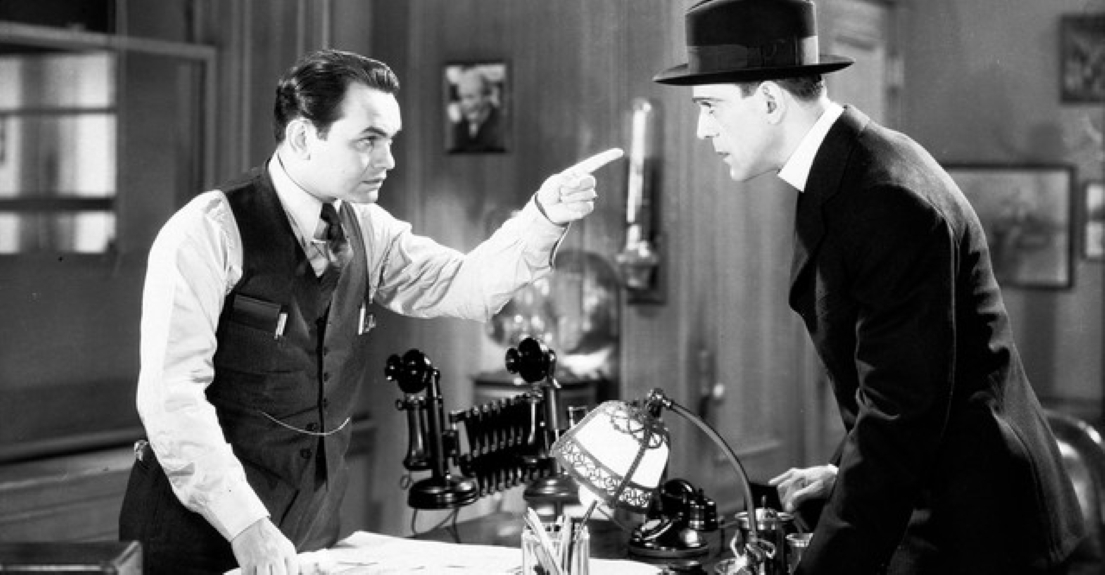
Tag: George E. Stone

The Front Page (1931)

The Front Page (1931)

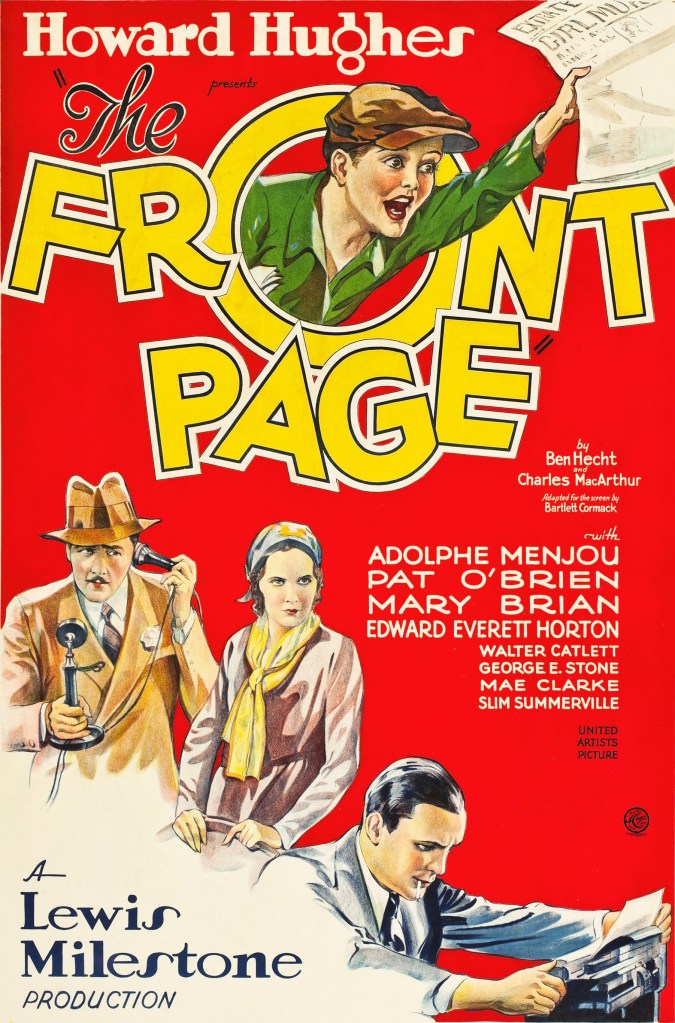
Original and (perhaps) best version of the pioneering cynical journalism story

Director: Lewis Milestone

Cast: Adolphe Menjou (Walter Burns), Pat O’Brien (Hildy Johnson), Mary Brian (Peggy Grant), Edward Everett Horton (Roy Bensinger), Walter Catlett (Jimmy Murphy), George E. Stone (Earl Williams), Mae Clarke (Molly Malloy), Slim Summerville (Irving Pincus), Matt Moore (Ernie Kruger), Frank McHugh (McCue), Clarence Wilson (Sheriff Pinky Hartman), Fred Howard (Schwartz)

Unscrupulous newspaper men fling fast-paced banter at each other, caring less about the truth and far more about how the copy sells. In many ways the deeply cynical The Front Page hasn’t really aged at all. Probably why it keeps coming back round again-and-again, in different forms for different eras (most famously of course, spiced up with a gender-swopped Hildy as the screwball romance His Girl Friday). I’ll make a confession – not a surprise for those who know my heretical views on His Girl Friday – it’s never been my favourite play and I’ve never found it as funny as others. But, despite my doubts, it’s hard to deny the flair and energy of Milestone’s early talkie.

Star-reported “Hildy” Johnson (Pat O’Brien) has decided the time is right to give up the newsprint game and find happiness with sweetheart Peggy Grant (Mary Brian). But his ruthless editor Walter Burns (Adolphe Menjou) doesn’t want to hear it from his star reporter. Burns is determined to drag Hildy back into the game, and the press-stopping story of an anarchist who escapes hours before his scheduled execution is just the thing to tempt Hildy away from those wedding bells.

And so we get the ultimate cynical press story, adapted from a play that practically invented the image of the newspaper man as a heartless adrenalin junkie more interested in the scoop than the truth. The Front Page is all about the process of collecting the news, and how easily and casually this can be spun into what an audience wants. If the truth does out eventually, it barely happens as a result of the journalists. In fact, our heroes largely end up pushing it because it will get them out of a tight spot and shift a hell of a lot of copies tomorrow morning.

Milestone’s film for years existed as only a bastardised version of the international print: made up of Milestone’s third choice takes and angles with re-edited lines. Restored into his original vision, it’s striking how dynamic and cinematic The Front Page is. While His Girl Friday has it beat on pace (giving us the same story and almost the same amount of dialogue in twelve fewer minutes), arguably Milestone’s film has the edge on cinematic technique. Milestone uses dynamic camera angles and set-ups to inject pace, from the long tracking shot of Burns prowling his newsprint rooms to the rotating camera that roves around the film’s primary location, the courthouse press-room.

It uses fast-cuts and zooms to great effect: the opening shot of a sack of flour, crash zooms out to reveal it’s being used to test a gallows; the ‘yo-yo’ effect as the camera bounces rapidly up-and-down to take us from one reporter’s face to another during a harried reporting scene. Milestone makes large chunks of otherwise single-location farce, come to life through witty angles and blocking, knowing when and when-not to include an actor in the frame to make a joke work. It’s fast-cutting gives it an early screwball style that further accelerates its sense of momentum. It’s a very astutely, very skilfully directed movie that feels several years ahead of its time, and certainly a whole other level above some of the stilted play adaptations Hollywood was churning out.

Even though the script has never been my favourite, it also picks up a lot of screwball dynamism (and healthy dose of pre-Wilder cynicism) in its bones. It’s chorus of newspapermen, all corrupted to various degrees, are finely delineated, each with their own clear characteristics. From Frank McHugh’s shallow cough to Fred Howard’s banjo, via Edward Everett Horton’s prissy germaphobia and half-hearted attempts at woeful poetry, they each have complementary personalities that helps the comedy spark even more. That’s even without their utter disinterest in the personal lives and tragedies of those they are reporting on, or their shameless gilding of the facts of every story (a lovely audio montage sees them all reporting wildly different versions of an arrest).

The Front Page has a strong performance from Adolphe Menjou as the debonair Burns, here embodied by Menjou as a heartlessly ambitious Mephistopheles-type, constantly throwing titbits of temptation in the way of Hildy. Milestone even films him with a Devilish-Murnau strength, popping up seemingly everywhere he needs to be at any moment in time. Add in Menjou’s suave delight in some ruthlessly amoral lines and you have a genuinely spot-on piece of casting. This is less of the case for Pat O’Brien, the sort of actor more familiar as the best friend to a real star, here showing he doesn’t quite have the charisma to carry a dynamic part like Hildy (in fact, O’Brien would have been perfect casting for the male-version of Peggy: dependable, sturdy, dull).

Nevertheless, he and Menjou bounce off each other well in a film that has more than a little homoerotic energy in it (surely the idea for the gender reverse spun from this!) Even Peggy points out Hildy seems as least as excited as the thought of inconveniencing Burns as he does in marrying her (“you’re going to marry me to spite Mr Burns?”). Hildy isn’t just a man fighting against his urge to report on any events happening around him (a potential fire sees him bemoaning he doesn’t have a camera to hand). There is a life and energy to him when riffing ideas with Burns, that he just doesn’t have with anyone else. The two of them burst into life like naughty kids in each other’s company, in a way they just don’t with anyone else.

Hildy may end the film heading into the sunset, but you suspect Burns’ scheme to bring him back (a witty typewriter ping covers a sensor banned piece of naughty language as Burns calls Hildy an SOB on the phone to an underling) is going to succeed with very little hinderance. Because these guys are made for each other and, just like the rest of the cast, they need the buzz of being in the room where it happens far more than the dull dependency of a job in advertising for Peggy’s Dad’s firm.

That The Front Page does very well and while I’m still not an admirer of a play I found overly cynical and glib, Milestone’s dynamically staged version of it may (ironically) be the best of many committed to the screen.

42nd Street (1933)

42nd Street (1933)

Less a musical, more about a musical – but a delightful love letter to the joy of theatre

Director: Lloyd Bacon

Cast: Warner Baxter (Julian Marsh), Bebe Daniels (Dorothy Brock), George Brent (Pat Denning), Ruby Keeler (Peggy Sawyer), Guy Kibbee (Abner Dillon), Dick Powell (Billy Lawler), Una Merkel (Lorraine Fleming), Ginger Rogers (Anytime Annie), George E Stone (Andy Lee), Ned Sparks (Barry), Robert McWade (Jones), Allen Jenkins (MacElroy)

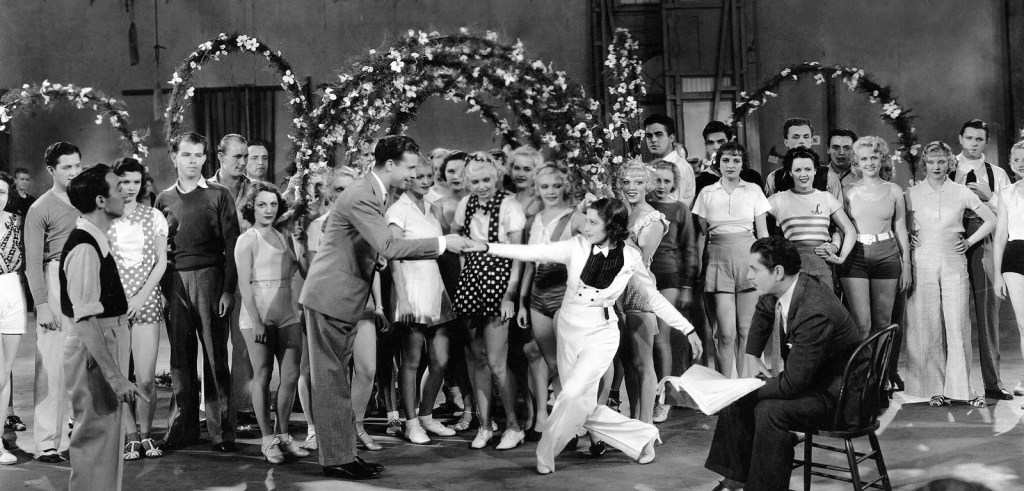
Jones and Barry are putting on a show! The cry lights up Broadway (in an impressively staged series of quick-cuts, cross fades and super-impositions of the excited souls). And 42nd Street is all about the creation of that show, from the signing of the contracts to the opening night and the spontaneous making of a star. If it feels, watching 42nd Street that it’s made up of nothing but theatrical cliches… then it’s because most of them became cliches from excessive re-use after 42nd Street showed they worked so well – and made such a hugely entertaining film along the way.

The show is Pretty Lady, to be directed by Julian Marsh (Warner Baxter), the finest director (and friendliest tyrant) on Broadway who needs the money after losing a packet in the Crash. He’s not the only one struggling in Depression-era America: the competition to land a job as chorus girl is fierce. So, it’s a lucky chance that debutante Peggy Sawyer (Ruby Keeler) lands a gig. The star is Dorothy Brock (Bebe Daniels), a vaudeville veteran trying to make it as a serious Broadway actor and currently the squeeze of the shows’ wealthy financier Abner Dillon (Guy Kibbee) – although she is still seeing her old partner Pat Denning (George Brent). But will Dorothy make it through the drama to opening night – or will Peggy need to step up to save the day?

It’s not a surprise that of course she does, but then Julian’s final words to her (“You’re going out a youngster, but you’ve got to come back a star!”) is the film’s most famous moment. As well as launching a thousand backstage dramas, 42nd Street is remembered as a musical. But there is actually precious little music in it. We have to wait almost 45 minutes before the first song (Dorothy’s rendition of ‘You’re Getting to Be a Habit with Me’) and the final fifteen until we see the bulk of Busby Berkeley’s choreography. Other than that, this is very entertaining soapy, backstage drama with romantic entanglements. It’s a more film about the stressful theatrical alchemy involved in making a musical, rather than a musical itself – there is no ‘putting my feelings into song’ here.

And it’s taking place in Depression-era desperation. Everyone needs a job – that’s why they are so excited about hearing there is a show in town. That plays into the family atmosphere behind the scenes. After all everyone needs the show to be a success, and if that means roping in a few gangsters to get a wayward star back into line so be it. Much like, in fact, 42nd Street itself, coming to the screen after a glut of musical flops (perhaps that’s why there is so little actual musical content in it). The film zeroes in refreshingly and lovingly on the hard work, dedication and family atmosphere that can grow up in theatre, where everyone is working towards a common goal – and why I, a veteran of more than my share of putting a show on, felt a real soft spot for it growing.

And there is support, for all the bitchy moaning behind the scenes. Julian Marsh may tyrannically insist on absolute perfection – rehearsing through the night, waking the piano player when needed – but, it’s all to service a common goal. When emergency hits, the company flocks around and support each other. When one of their number triumphs there will be more congratulations than there are jealousies: even Dorothy will lay aside any personal feelings to support the new star. 42nd Street really captures the sense that behind the curtain in the theatre a little world of its own is created, one which can be very loving in its own unique way.

It’s also a world, with more than a few sexual escapades, something hard to overlook in a film as full of chorus girl’s legs as this (the chorus girls are largely hired on the basis of how good those legs look). Dorothy is effectively trading her favours for a career leg-up from the clueless Dillner, while sticking with true love Denning. Denning, jealous, conducts his own speculative flirtation with Peggy (in a fun sequence, her landlady throws her out for daring to bring Pat home for a coffee – while behind her another chorus girl smuggles out her lover with an illicit kiss). Anytime Annie didn’t get her nickname for her dancing, Lorraine is happy to leverage her relationship with dance director Andy Lee and Lee himself (it’s implied) is the willing subject of Julian’s attentions.

In the midst of this, poor Peggy feels rather naïve. Sure, she may be bouncing between unlooked for attentions from a young member of the company and leading young man Dick Powell, but a passing possibility of romance with George Brent’s cuckolded partner (in every sense) to Bebe Daniel’s star leaves her flustered. Brent’s intentions may well be noble, but left alone with him in his apartment, Peggy is sweetly nervous and locks her door after she is chivalrously conveyed to the spare bedroom by Brent, as if scared she may give into temptation. Hilariously they are only in his apartment, after his calling on her is mistaken for a dalliance by her landlady, who throws them both out while boasting she never misses a trick – all while, in the back of the shot, another tenant quietly ushes her beau out of the door.

All of this gives some lovely opportunity to its actors, and there are several delightful turns in 42nd Street. Not least in the chorus, where Una Merkel has a wonderfully playful flirtatiousness and Ginger Rogers gives her monocle-clad Anytime Annie a rogueish sexiness. Guy Kibbee’s moronically uncultivated sugar daddy gets several good laughs at his boorish cluelessness. If Ruby Keeler at times seem a bit unnuanced as the lead (there has long been some rather mixed feelings about her slightly heavy-footed dancing) and Dick Powell is eminently forgettable as her love interest, there is more than enough class from Baxter’s stressed out director, George Brent is very fine and Bebe Daniels invests Dorothy Brock with just enough vulnerability under the diva exterior to always leave you rooting for her (she is, after all, just as desperate for work as the meanest chorus girl).

It’s a film put together with flair – the early montage is pacily and flashily assembled – and a great deal of wit (producer Darryl F Zanuck and Berkely often gain the lion’s share of the credit for its pace, wit and zip although I feel some credit must go to experienced director-for-hire Lloyd Bacon). The final dance numbers are expertly done and very well filmed by Berkely, including a point where the camera glides under a parade of leg arches. But above all, it’s a heart-warming and witty tale that pulls back the romantic curtain of theatre to reveal – well an equally romantic view of the camaraderie and magic that brings a show to the stage. But it would be a hard heart that could not find something to smile at here.

The Racket (1928)

The Racket (1928)

Silent crime drama has some real moments of interest, before it gets bogged down in stagy framing

Director: Lewis Milestone

Cast: Thomas Meighan (Captain James McQuigg), Louis Wolheim (Nick Scarsi), Lucien Proval (Chick), Marie Prevost (Helen Hayes), G. Pat Collins (Patrolman Johnson), Henry Sedley (Spike Corcoran), George E. Stone (Joe Scarsi), Sam De Grasse (DA Welch), John Darrow (Dave Ames)

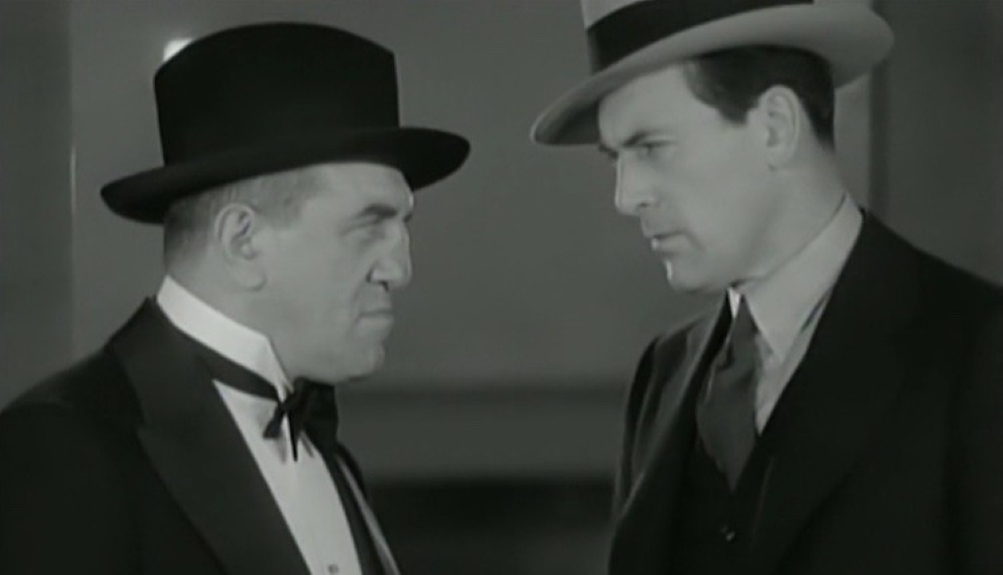
In an unnamed city that-could-be-anywhere (but is definitely Chicago), the corrupt political machine is under the thumb of “The Big Man”. And he’s in cahoots with Caponeish gangster Nick Scarsi (Louis Wolheim), a kingpin pedalling Prohibition-breaking booze and knocking off opponents when and where he pleases. In this bent city, the only straight shooter is police Captain James McQuigg (Thomas Meighan) – and he’ll do everything within the law’s power (but no further) to bring down Scarsi. Banished to the sticks of the 28th Precinct, he gets his chance when Scarsi’s feckless kid brother Joe (George E. Stone) is arrested for a hit-and-run but leaves his girlfriend Helen Hayes (Marie Prevost) to take the rap. Can she help McQuigg bust the case?

Interestingly, The Racket only survives today because a copy was among the films in Howard Hughes’ personal collection. Hughes produced this late silent film – and also a talkie remake in 1951 starring Roberts Mitchum and Ryan. The Racket was adapted from a work-a-day Broadway play that gave Edward G. Robinson a big break as the snarling Scarsi and was one of the first Oscar nominees for Best Picture. Directed by Lewis Milestone it’s a strange mixture of the inventive and the mundane, surprisingly daring in its subtle cynicism about government, with intriguing opening half giving way to a final hour that feels trapped by its stage roots.

It starts with a (silent) bang – literally. Milestone’s camera tracks two assassins overlooking a deserted street, watching a target late at night. As thee unwitting figure walks along, they take their shot and miss, their target ducking for cover into a doorway – where he meets Scarsi and we discover this was (literally) a warning shot. We have to wait for the next scene to discover the target isn’t a gangster (as we assume), but a Police Captain called McQuigg. It’s a tense and intriguing opening, well shot and edited, that sets up a personal struggle between two men that the film doesn’t always deliver on (a Cagney-era film would have made these two childhood friends, turned rivals on different sides of the law).

The first act of The Racket follows in this vein, with a series of fast-paced, tense sequences which will culminate in Scarsi’s defiant murder of a rival in front of a roomful of witnesses and McQuigg’s being despatched to the sticks for rocking the boat far too much for “The Old Man’s” taste. Milestone throws in a large-scale street battle between Scarsi and a rival gang, with bullets (and bodies) flying, cars crashing and an army of McQuigg’s cops charging into settle the peace. A retaliatory hit attempt at Scarsi’s club may see Milestone fail to find the sort of sultry tone Sternberg found for nightclub scenes during Marie Prevost’s singing, but his quick cutting from Scarsi’s face to the various hitmen gathering at tables builds tension well and he introduces a truly imaginative shot, from under a table, focused in close-up, on Scarsi’s gun and his target in long-shot. The invention continues at the resultant funeral, where rows of gangsters face each other, a cross fade revealing their black hats all hide pistols.

It’s a shame the invention dies out as we arrive at McQuigg’s 28th Precinct over one-long-night, and the film hues extremely close to the one-location ins-and-outs of its Broadway roots. Exclusively taking place in the Precinct reception and McQuigg’s next-door office, the film turns becomes much less visually interesting, more stationary and theatrical as characters enter and exit and the world of the film shrinks with only the odd montage of newspaper headlines reminding us of the bigger picture. Considering the expansive world earlier, it also introduces logic gaps – McQuigg doesn’t recognise Scarsi’s brother despite having clearly seen him earlier and (even more baffling) half his cops don’t even recognise Scarsi himself. With just this second act, it’s hard to imagine The Racket would have stood out from the crowd at all, as the action becomes increasingly stunted and theatrical.

What helps is the performance of Louis Wolheim as the thuggish Scarsi. Wolheim had an excellent line in smug brutality – his looks really helped here, his broken nose (he was contractually banned from repairing it) giving him a thuggish look. Wolheim is full of simmering potential violence, something he exploits well when during a striking bit of business he fans his coat while talking with one of McQuigg’s cops (leading us to expect a gun) only to produce a wodge of cash for a bribe attempt. It’s a striking performance of menace and potential violence, far more interesting than Meighan’s strait-laced, formal playing as McQuigg.

Scarsi is also at the heart of the one of the film’s more interesting subtexts. He’s fixated on McQuigg (who he seems obsessed with as a worthy rival) and constantly talking about how women are ‘poison’ to him. With his closest confidante Chick (Lucien Proval) a fey figure, it’s hard not to read a homoerotic context into the macho Scarsi. I doubt any of that is intended, but it makes for interest today.

Just as its interesting to see The Racket be so subtly negative about elected officials. The authorities running the big city are utterly corrupt, everything managed for the benefit of the unseen “Old Man”. The DA lacks any scruples, elections are openly fixed (Scarsi owns half the precincts), and anyone inconvenient can be judicially murdered. The film concludes with a brief paean to the government by professional that on paper reads as praise, but after what we’ve seen is almost certainly intended as a subtle dig at how utterly corrupt all these professionals are.

It’s an interesting, surprisingly bitter and cynical ending – our hero even spends the last few moments mostly with his head in his hands – that restores interest in The Racket right at the final beat. Too much of the second act feels trapped by its stage roots, but Milestone creates several touches of visual and cinematic interest, Wolheim is great and it’s opening acts of gang violence may be dwarfed by the sort of action we’d see only a few years later in The Public Enemy but still provides excitement today.