Tag: George Brent

Jezebel (1938)

Jezebel (1938)

A star turn helps to lift this bonkers melodrama into the realm of delicious entertainment

Director: William Wyler

Cast: Bette Davis (Julie Marsden), Henry Fonda (Preston Dillard), George Brent (Buck Cantrell), Donald Crisp (Dr Livingstone), Fay Bainter (Aunt Belle Massey), Margaret Lindsay (Amy Bradford Dillard), Richard Cromwell (Ted Dillard), Henry O’Neil (General Theophilius Bogardus), Spring Byrington (Mrs Kendrick), John Litel (Jean la Cour)
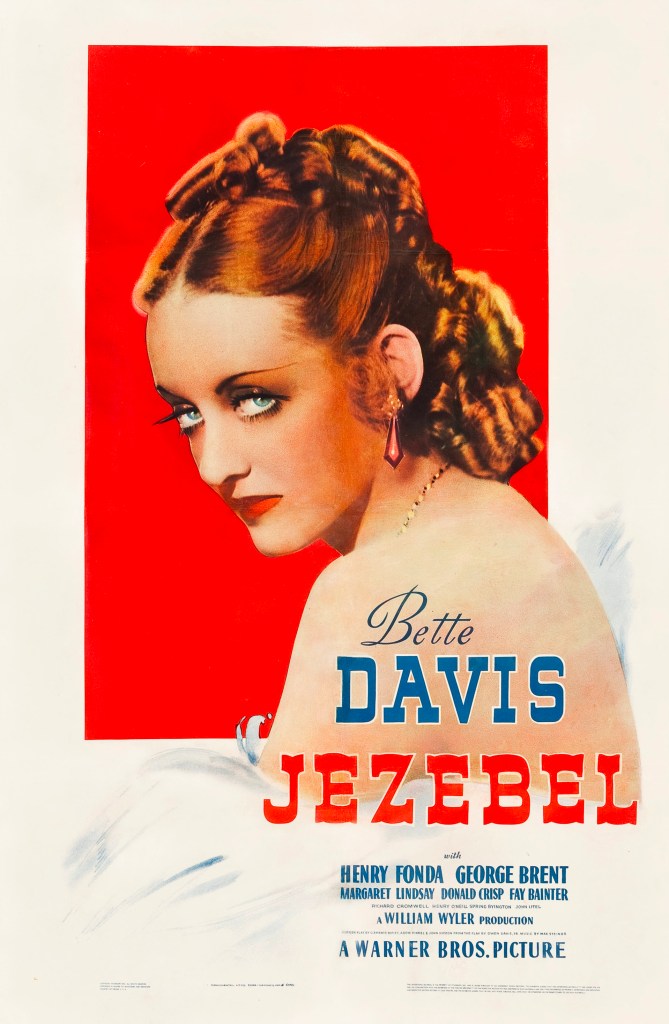
It’s pretty much the first line in any review about Jezebel so let’s start with it: rumour claims it largely exists as a consolation prize for Bette Davis after missing out on Scarlett O’Hara. It makes sense: Julie Marsden is a Southern Belle so similar to Scarlett they could almost be sisters. And Bette Davis is so wonderfully, passionately, brilliant playing her that, if it wasn’t for Vivien Leigh’s landmark performance, Jezebel could make you deeply regret Davis never got that role. But there is more to Jezebel than that, a handsomely filmed adaptation of a hit play by Owen Davis Snr, which predated Margaret Mitchell putting pen to paper. This is delicious, old-school, scandal-tinged Hollywood melodrama, with a star actor in a custom-made star role.

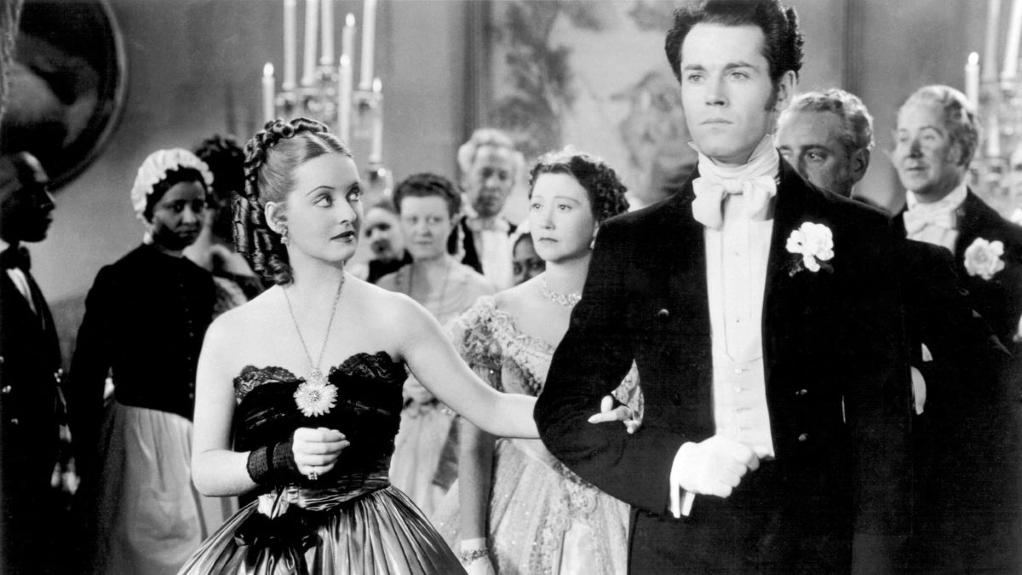
Julie Marsden is a fiery, independent-minded woman in 1850s New Orleans, convinced she can bend the world around her (and the wills of men) to her own whims. She’s engaged to strait-laced Pres Dillard (Henry Fonda), but flirts with playboy Buck Cantrell (George Brent) and won’t play by societies rules. So much so, she plans to attend the high-society Olympus Ball in a dress not of virgin white but Jezebel red. This goes down like a lead balloon; Pres effectively drops her in disgust at her wilful selfishness and a year later returns married to someone else. At which point Julie, a woman spurned, plans revenge even as yellow fever rips through the city.

Jezebel is a great big, melodramatic soap with a celluloid-burning turn by Davis (who won her second Oscar) at its heart. Davis dominates the film, a boundless force of charisma from the moment she sashays (late!) into her own party, whipping her dress up behind with a riding crop to when she departs the film, eyes full of genuine remorse, nursing a fever cart. She plays the role full of sinful flirtatiousness and playful certainty. No one will tell her what to do and where to go – from charging through a bank (captured in a beautiful tracking shot from Wyler) to drag Pres out for the day, to headstrongly ignoring all pleas to not wear her dress of choice, to holding court a year later in her own home planning revenge with burning, destructive glee.

It’s a portrait of bull-headed, feminine, self-destructive foolishness and pride that Davis would make her own, a marvellous star-turn that helps lift this otherwise rather silly melodrama with an inevitable message (this bull-headed floozy will learn the error of her head-strong ways) into something quite magic. That and the superlative richness of Wyler’s direction (and Gregg Toland’s sumptuous camera work), full of dynamic images, as well as a series of top-drawer performances from a strong cast.

Obviously, it’s hard not to spot that Jezebel lacks the scale and colour of Gone with the Wind (has any black-and-white film ever so openly revolved around colour as a source of drama?). But it has a lot of its dramatic energy, despite the fact you can sense its theatrical roots (it splits rather neatly into four acts, each set in a distinct location). Jezebel juggles its balls remarkably well, balancing a focus on Julie’s desire for attention and control with a fine portrait of two different men. George Brent, with a sly, self-satisfied grin as a Don Juan and Henry Fonda, prissy and stuffed-of-shirt (mouthing, at points, an awkward Southern accent) successfully making Pres profoundly wise, surprisingly weak despite his certainty, rigid and unpersuasive.

The pivotal ball-room sequence, and its build-up, works particularly marvellously. Despite Julie’s determination, its clear everyone around her feels it to be a terrible idea. Pres concedes to it with a grudging irritation and, once it becomes clear even to Julie it’s an appalling idea, forces Julie to be swallowed up in her public humiliation. After watching a parade of genteel ladies and gentlemen scurry away from her, as if in fear of catching her loose morals, Pres drags her to the dance floor (despite her pleas). Tracking back, Wyler shows the dance floor clear in moments, leaving just these two dancing alone (Pres even insists the band continues playing), cementing her humiliation. He’s made his point and, even though she slaps him later, even she knows he was right. Not that this will help either of them in the long run.

It’s part of the moral of the story, that sometimes women need a firm hand. (Sometimes literally so, as Donald Crisp’s grouchy Dr Livingston tells Pres). There has to be a punishment for Julie’s willingness to scheme, her constant placing of her own whims above everyone else and her inability to even consider that there might be dangerous consequences to her actions. It doesn’t wear us down though, because Davis is such a dynamic and forceful presence it’s hard not to rather like her. And then, of course, you sort of sympathise with her (even though she is awful and selfish) as a conga-like of damage and guilt leave her reeling before converting her into an ideal self-sacrificing woman.

Of course you watch Jezebel today and can hardly fail to notice that the greatest wickedness all these Southern gents and dames can possibly imagine is turning up at a ball in the wrong dress. Certainly not the slavery all around them. There is a parade of “yasum” slaves in Jezebel, all of them (like old retainer Cato) perfectly content in their lives of servitude. Pres may get a few loose critiques off about the South, but even those are focused on its economic and political short-sightedness: like everyone he’s paternally fond of his naïve property but wouldn’t imagine giving any of them freedom.

It’s another echo perhaps of Gone with the Wind and not a welcome one. Jezebel settles down for another genteel, Birth of a Nation myth of a sublime South doomed for being too noble. Not even the terror of yellow fever – and, at one point, the shooting of an infected man for fleeing his island ghetto – can get in the way of that feeling, that this way of life is not the problem, even if it does allow the odd bad apple like Julie to pop up.

That’s a more awkward political point, but it’s hard to imagine it crossing the mind of many at the time. And it doesn’t stop an enjoyment of Jezebel as a masterfully executed soap. Wyler’s direction is excellent, the filming wonderful and the actors firing on all cylinders. (Fay Bainter also won an Oscar for her fine performance as Julie’s horrified Aunt). Davis of course reigns supreme in the cinematic equivalent of an airport novel, a big, steamy, sex-fuelled melodrama with a handwringing ending of moral enlightenment delivered with such earnest, underplayed sensitivity by Davis and Wyler that it convinces. A big, brash, hugely enjoyable entertainment.

42nd Street (1933)

42nd Street (1933)

Less a musical, more about a musical – but a delightful love letter to the joy of theatre

Director: Lloyd Bacon

Cast: Warner Baxter (Julian Marsh), Bebe Daniels (Dorothy Brock), George Brent (Pat Denning), Ruby Keeler (Peggy Sawyer), Guy Kibbee (Abner Dillon), Dick Powell (Billy Lawler), Una Merkel (Lorraine Fleming), Ginger Rogers (Anytime Annie), George E Stone (Andy Lee), Ned Sparks (Barry), Robert McWade (Jones), Allen Jenkins (MacElroy)

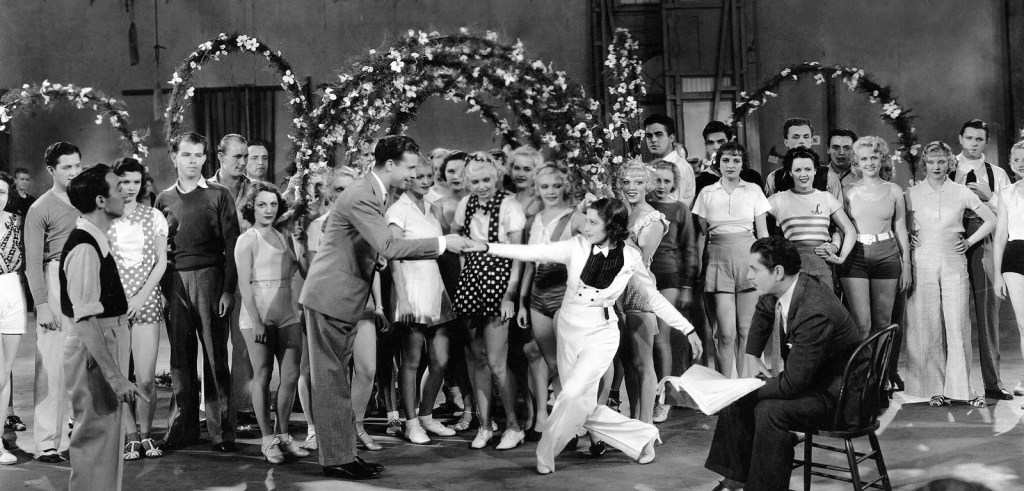
Jones and Barry are putting on a show! The cry lights up Broadway (in an impressively staged series of quick-cuts, cross fades and super-impositions of the excited souls). And 42nd Street is all about the creation of that show, from the signing of the contracts to the opening night and the spontaneous making of a star. If it feels, watching 42nd Street that it’s made up of nothing but theatrical cliches… then it’s because most of them became cliches from excessive re-use after 42nd Street showed they worked so well – and made such a hugely entertaining film along the way.

The show is Pretty Lady, to be directed by Julian Marsh (Warner Baxter), the finest director (and friendliest tyrant) on Broadway who needs the money after losing a packet in the Crash. He’s not the only one struggling in Depression-era America: the competition to land a job as chorus girl is fierce. So, it’s a lucky chance that debutante Peggy Sawyer (Ruby Keeler) lands a gig. The star is Dorothy Brock (Bebe Daniels), a vaudeville veteran trying to make it as a serious Broadway actor and currently the squeeze of the shows’ wealthy financier Abner Dillon (Guy Kibbee) – although she is still seeing her old partner Pat Denning (George Brent). But will Dorothy make it through the drama to opening night – or will Peggy need to step up to save the day?

It’s not a surprise that of course she does, but then Julian’s final words to her (“You’re going out a youngster, but you’ve got to come back a star!”) is the film’s most famous moment. As well as launching a thousand backstage dramas, 42nd Street is remembered as a musical. But there is actually precious little music in it. We have to wait almost 45 minutes before the first song (Dorothy’s rendition of ‘You’re Getting to Be a Habit with Me’) and the final fifteen until we see the bulk of Busby Berkeley’s choreography. Other than that, this is very entertaining soapy, backstage drama with romantic entanglements. It’s a more film about the stressful theatrical alchemy involved in making a musical, rather than a musical itself – there is no ‘putting my feelings into song’ here.

And it’s taking place in Depression-era desperation. Everyone needs a job – that’s why they are so excited about hearing there is a show in town. That plays into the family atmosphere behind the scenes. After all everyone needs the show to be a success, and if that means roping in a few gangsters to get a wayward star back into line so be it. Much like, in fact, 42nd Street itself, coming to the screen after a glut of musical flops (perhaps that’s why there is so little actual musical content in it). The film zeroes in refreshingly and lovingly on the hard work, dedication and family atmosphere that can grow up in theatre, where everyone is working towards a common goal – and why I, a veteran of more than my share of putting a show on, felt a real soft spot for it growing.

And there is support, for all the bitchy moaning behind the scenes. Julian Marsh may tyrannically insist on absolute perfection – rehearsing through the night, waking the piano player when needed – but, it’s all to service a common goal. When emergency hits, the company flocks around and support each other. When one of their number triumphs there will be more congratulations than there are jealousies: even Dorothy will lay aside any personal feelings to support the new star. 42nd Street really captures the sense that behind the curtain in the theatre a little world of its own is created, one which can be very loving in its own unique way.

It’s also a world, with more than a few sexual escapades, something hard to overlook in a film as full of chorus girl’s legs as this (the chorus girls are largely hired on the basis of how good those legs look). Dorothy is effectively trading her favours for a career leg-up from the clueless Dillner, while sticking with true love Denning. Denning, jealous, conducts his own speculative flirtation with Peggy (in a fun sequence, her landlady throws her out for daring to bring Pat home for a coffee – while behind her another chorus girl smuggles out her lover with an illicit kiss). Anytime Annie didn’t get her nickname for her dancing, Lorraine is happy to leverage her relationship with dance director Andy Lee and Lee himself (it’s implied) is the willing subject of Julian’s attentions.

In the midst of this, poor Peggy feels rather naïve. Sure, she may be bouncing between unlooked for attentions from a young member of the company and leading young man Dick Powell, but a passing possibility of romance with George Brent’s cuckolded partner (in every sense) to Bebe Daniel’s star leaves her flustered. Brent’s intentions may well be noble, but left alone with him in his apartment, Peggy is sweetly nervous and locks her door after she is chivalrously conveyed to the spare bedroom by Brent, as if scared she may give into temptation. Hilariously they are only in his apartment, after his calling on her is mistaken for a dalliance by her landlady, who throws them both out while boasting she never misses a trick – all while, in the back of the shot, another tenant quietly ushes her beau out of the door.

All of this gives some lovely opportunity to its actors, and there are several delightful turns in 42nd Street. Not least in the chorus, where Una Merkel has a wonderfully playful flirtatiousness and Ginger Rogers gives her monocle-clad Anytime Annie a rogueish sexiness. Guy Kibbee’s moronically uncultivated sugar daddy gets several good laughs at his boorish cluelessness. If Ruby Keeler at times seem a bit unnuanced as the lead (there has long been some rather mixed feelings about her slightly heavy-footed dancing) and Dick Powell is eminently forgettable as her love interest, there is more than enough class from Baxter’s stressed out director, George Brent is very fine and Bebe Daniels invests Dorothy Brock with just enough vulnerability under the diva exterior to always leave you rooting for her (she is, after all, just as desperate for work as the meanest chorus girl).

It’s a film put together with flair – the early montage is pacily and flashily assembled – and a great deal of wit (producer Darryl F Zanuck and Berkely often gain the lion’s share of the credit for its pace, wit and zip although I feel some credit must go to experienced director-for-hire Lloyd Bacon). The final dance numbers are expertly done and very well filmed by Berkely, including a point where the camera glides under a parade of leg arches. But above all, it’s a heart-warming and witty tale that pulls back the romantic curtain of theatre to reveal – well an equally romantic view of the camaraderie and magic that brings a show to the stage. But it would be a hard heart that could not find something to smile at here.

Dark Victory (1939)

Dark Victory (1939)

Bette Davis almost single-handedly lifts another tear-jerker into something grander

Director: Edmund Goulding

Cast: Bette Davis (Judith Traherne), George Brent (Dr Frederick Steele), Humphrey Bogart (Michael O’Leary), Geraldine Fitzgerald (Ann King), Ronald Reagan (Alec Hamm), Henry Travers (Dr Parsons), Cora Witherspoon (Carrie Spottswood), Dorothy Peterson (Miss Wainwright)

Judith Traherne (Bette Davis) is vivacious and fun-loving. From her grand Long Island home, her days are taken up with racehorses and fast cars, her nights with parties and booze. No wonder she keeps having headaches and making those small falls, right? Pushed to check it out at the insistence of her best friend Ann (Geraldine Fitzgerald), it doesn’t take long for brain specialist Dr Frederick Steele (George Brent) to diagnose a brain tumour. An operation is a short-term success, but Judith’s condition is terminal. At best, she has a year to live. Steele and Ann decide to keep the news from Judith – but when she discovers the truth she decides to live life to the full with Frederick, the man she has grown to love.

Watching Dark Victory is a reminder of the sometimes-limited opportunities for women in Hollywood at the time. If an actor as radiantly talented as Bette Davis were a man, she would have been playing earth-shattering roles in stirring dramas. This was when Tracy, Muni and March were playing explorers, scientists, world leaders and campaigners. Davis, like other women, saw the vast majority of strong roles for women centred on screwball comedies or as loving wives and mothers. As such she made a career propping up effective, sentimental twaddle like Dark Victory.

Which is to be a little harsh, I will admit, on a fine if unambitious tear-jerker. Dark Victory had been a Broadway play – and a flop. The stage had exposed a little too clearly the blatant emotional manipulation of the story of a woman who falls in love in the final year of her life then facing death with self-sacrificing fortitude. On film though, it could be made to work, not least through the full-throated commitment and intelligence of Bette Davis’ acting.

Davis is too often button-holed into the “camp icon” bucket, but Dark Victory – much like Now Voyager – sees her real strong suit, turning ordinary women, tinged with sadness, into portraits of deep tragedy and emotional self-sacrifice. Davis evolves Judith from a shallow, fun-loving playgirl into someone thoughtful, caring and empathetic. Davis avoids almost completely the obvious histrionics you could resort to playing a woman dying of a terminal brain tumour.

Instead, she meets her diagnosis with a carefully studied casualness that hides her fear, confronts the realisation that she has been deceived with a betrayed disappointment rather than carpet-chewing fury, and faces death with an unselfish concern for others (a physical tour-de-force as Davis acts blind – the final stage of her condition – but hides this from her husband so as not to cause him to abandon a medical research conference he has postponed frequently for her sake).

It’s all, of course, very standard material for a tear-jerking “woman’s picture” of the 1930s. A flighty woman finds love, happiness and inevitable tragedy. Davis fizzes around much of the film’s first 30 minutes with a Hepburnesque energy and wit, jodhpurs and champagne glasses abounding. A great deal of sweet charm brilliantly adds to the poignancy as, in her first consultation with Steele, she fails to identify blindfolded the same object being placed in both hands (a dice, a pencil and a piece of silk, all instantly identified in her left are met with confused incomprehension in her right). This is highly skilled, emotionally committed acting that pays off in spades as the gentle, thoughtful, caring woman underneath is revealed.

It helps that Davis has a trusted director in Edmund Goulding. Never the finest visual stylist or most compelling technician, Goulding’s great strength was his finesse with actors. He worked especially well with Davis, his careful focus on performance over technical flair giving her an excellent showpiece for her skills. Davis paired again with George Brent, a solid but generous actor (with whom Davis started a long-running affair) never better than when breathing humanity and life into an on-paper stiff roll as a noble surgeon who falls in love with his patient.

Brent and Davis’ chemistry and comfort with each other squeeze out all other potential romantic sub-plots, despite the actors in the roles. Lord knows what the Irish Republican Brent made of Bogart’s bizarre Irish accent as Judith’s roguish horse trainer. Bogart looks hilariously uncomfortable, his accent coming and going and he lacks affinity for the role or the film. He still comes off better than the rather wet Ronald Reagan as Judith’s playboy friend. Instead, the film’s finest supporting performer is the wonderful Geraldine Fitzgerald, sparky, firm-jawed and endlessly loyal while torn up with grief for her friend.

Dark Victory, though, rises and falls on the success of Davis’ performance. It certainly makes no secret of the fact that we are heading towards a tragic ending. A parade of doctors emerge to confirm to Steele that, yes, the disease is terminal. When Judith uncovers her case notes, she flips through an army of letters from eminent surgeons repeating the phrase “Prognosis: negative” – she even then asks Steele’s secretary to explain the wording. We are building up constantly towards a show-stopping, three-hankie, climax of Judith’s inevitable decease.

And yet the film still manages to get you. Again, it’s the low-key but honest performance of Davis that makes this. The moment of tragic realisation that death is arriving, then the studied determination to carry on regardless and to spare her loved ones as much pain as possible. It’s the self-sacrificing decency and honour of the very best of the “women’s pictures”. Davis delivers on it so utterly successfully, it does make you wonder what triumphs she might have had if she could have played the sort of roles males stars played, as well as breathing such conviction-filled life into gentle weepies like this.