Tag: Ghost stories

Séance on a Wet Afternoon (1964)

Kim Stanley and Richard Attenborough are superb in unsettling drama Seance on a Wet Afternoon

Director: Bryan Forbes

Cast: Kim Stanley (Myra Savage), Richard Attenborough (Billy Savage), Nanette Newman (Mrs Clayton), Mark Eden (Charles Clayton), Patrick Magee (Superintendent Walsh), Gerald Sim (Sergeant Beedle), Judith Donner (Amanda Clayton), Ronald Hines (Constable)

Myra (Kim Stanley) and Billy (Richard Attenborough) Savage are a middle-aged couple held together by shared grief for a lost child. Myra works as a medium with the spirit of their son, Arthur, as a spirit guide. But grief has had a damaging impact on them both – and Myra believes her work can bring some life back to their lost son. Keen to gain more recognition – and therefore for their son – she urges Billy to kidnap the daughter of a rich couple, so that she can “discover” the child through her spirit guide. However, events soon spiral increasingly out of control.

Bryan Forbes writes and directs (and produces, with Attenborough) this unsettling and often tense film, which shares DNA with ghost stories (but contains no terrors) and psychological dramas. It’s also a superbly acted chamber-piece, an acute psychological study of two deeply traumatised individuals who have responded very differently to personal tragedy and found themselves locked into cycles of behaviour that are becoming increasingly destructive.

Forbes shoots the film with a fly-on-the-wall intensity, giving the exterior scenes a cinéma verité style, concealed cameras capturing unwitting crowds walking blithely through a kidnap drama. There is a kitchen-sink realism here, and elements of psychological hammer horror, with the viewer never quite sure how far this couple will be willing to go. The eerie score by John Barry, mixes in with hauntingly dominant sound designs (especially of dripping water in the film’s opening moments) to create an oppressive, claustrophobic atmosphere that leaves you not in the least surprised that the psyche of its two lead characters have been so badly damaged.

That sense of disturbance fits perfectly with the lack of planning around the couple’s entire operation. Despite sparks of ingenuity (many of them dependent on Billy’s bland forget-ability and bank-managerish blending into the crowd), once the child has been kidnapped, they have no idea of the next step or how (or even, it seems, if they want to) exploit the situation. It becomes increasingly clear that the plan is not a grand design, but a final desperate attempt to find meaning in their own lives and (certainly in Myra’s case) to provide some sort of connection to their lost son.

That lost son hangs over the whole film, his pointedly not-real ghostly presence having contributed hugely to Myra’s mental disintegration – and also having crushed the life out of Billy. Myra has clearly never recovered from the shock and grief – more facts of which are revealed as the film plays out, culminating in a scintillating scene of emotional confrontation between the two – and Billy, in a desperate attempt to comfort his wife, has instead become the chief enabler of her fantasies.

It makes for an elegant two-hander of stirring emotion – and requires two actors at the peak of their game. As Myra, the little-known Kim Stanley is a sensation. A Broadway star (the “female Brando”) but with only one film credit prior to this (and only three more after this), Stanley brings a brilliant method technique but also a freshness and theatricality matching perfectly the film’s theatrical roots and heightened sense of reality. Stanley delivers an immersive performance that walks a fine tight-rope between calculation, delusion and psychological collapse. It’s a show-piece role, but Stanley largely avoids overplaying, instead exploring the deep emotional scars in the character with a sensitivity that makes Myra someone to pity as recoil from.

Opposite her, Attenborough delivers one of his finest performances as the complex, conflicted Billy. Seeming at first just a brow-beaten husband, it becomes clear Billy has in fact taken on a great emotional responsibility for protecting and comforting Myra, a dedication that has (step-by-step) led to him catering to her every misguided demand. It’s a generous, very subtle performance, of a fundamentally good man who performs misdeeds because he believes it is for the greater good, confusing love for his wife with refusing to make her confront reality.

These two excellent performers perform a complex dance where our perception of the power dynamics in the relationship constantly shift. At first Myra appears to hold all the aces, brow-beating the meek Billy and lecturing him on everything from the spirit world to classical music. However, it slowly becomes clear – as does Myra’s lack of grasp of reality – that Billy is the quieter but stronger character, whose dedication and strength has kept the couple going.

Séance on a Wet Afternoon is at its best when exploring the relationship between these two and provides two fine actors magnificent opportunities which their seize with relish. Its pace flags a bit over the two hours – a tighter 90 minute run time would probably have helped it – and while it’s lack of drive in the plot does reflect the confused ambling scheme at its heart, it does mean the film can drift. But this is a fine psychological study, well-made and superbly performed.
The Little Stranger (2018)

Little stranger header
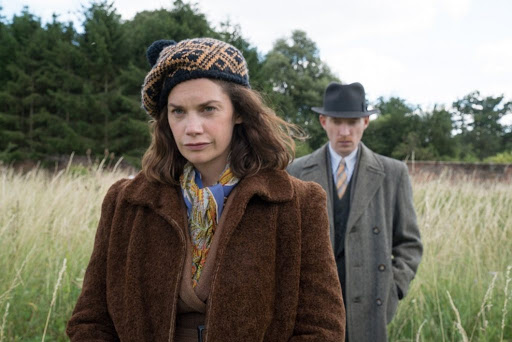
Domhnall Gleeson doesn’t believe in ghosts in The Little Stranger

Director: Lenny Abrahamson

Cast: Domhnall Gleeson (Dr Faraday), Ruth Wilson (Caroline Ayres), Will Poulter (Roderick Ayres), Liv Hill (Betty), Charlotte Rampling (Mrs Ayres), Harry Hadden-Paton (Dr David Granger), Anna Madeley (Anne Granger), Richard McCabe (Dr Seeley)

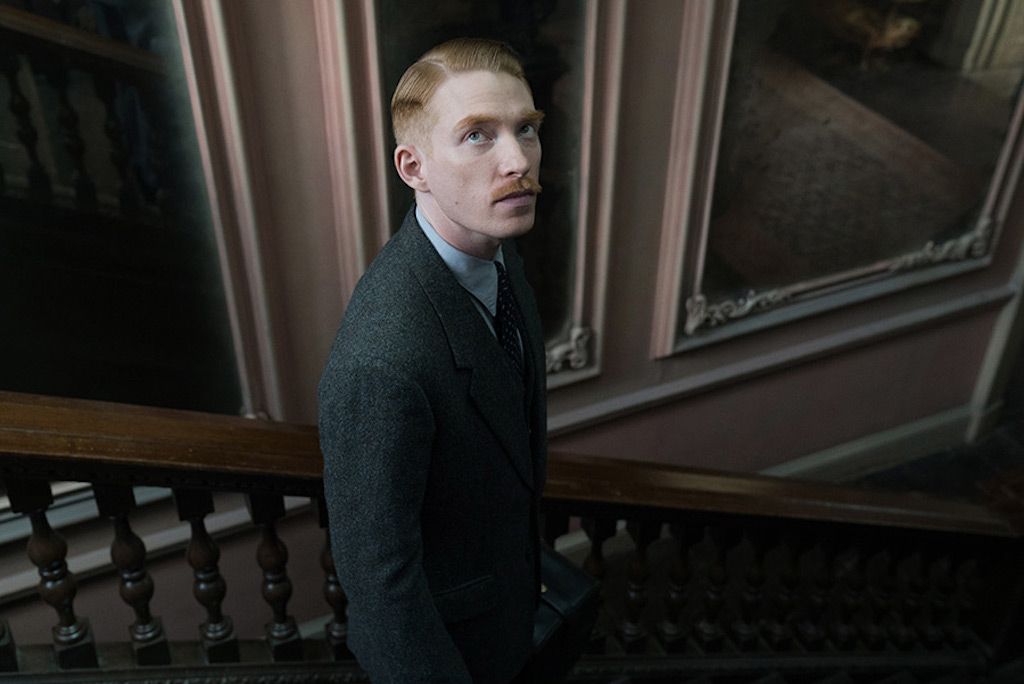
Can an adaptation of a novel work when the key to its success was the way it was told rather than the story itself? With its unreliable narrator and distinctively interior style, Sarah Waters’ book was a tough ask. But, making it even harder for the big screen, The Little Stranger is a ghost story narrated by a fervent non-believer, who witnesses none of the supernatural elements and spends his time finding detailed, logical reasons for why the people living in the haunted house are as unsettled as they are. It makes for a challenge which, for all the style Lenny Abrahamson brings, the film doesn’t quite manage to meet.

Our sceptic is Dr Faraday (Domhnall Gleeson), a young village GP in the years immediately after the Second World War. Faraday grew up in the shadow of the Ayres house, a grand country seat now being lived in by the last remnants of the Ayres family who have fallen on hard times. Son Roderick (Will Poulter) has been left with debilitating injuries after his RAF service, Caroline (Ruth Wilson) seems destined to become a spinster, and their mother (Charlotte Rampling) struggles to hold together what’s left of the house’s prestige, among leaking roofs and bills that can’t be paid. Dr Faraday becomes an intimate of the household. But are the family’s problems partly linked to a malign presence in the house, perhaps the unsettled ghost of a third, long-dead Ayres sibling? Or is it all just bad luck, frozen pipes, branches on the window and creaking floorboards?

Well of course it isn’t. The film’s main problem is that it takes a book where the narrator spends the entire time stubbornly refusing to accept he is in a ghost story, and repackages it as a more conventional tale of creeps and psychological horror. While moments like this are undoubtedly unsettling, it rather flies in the face of what made the book unique in the first place.

In the book you find yourself – despite knowing deep down he’s wrong, because that’s not how stories work – thinking that maybe all this is just a series of terrible coincidences impacting a psychologically fragile family. In the film, you are never in any doubt that the ghosts are real. Not least, because we are frequently witness to supernatural events. When Charlotte Rampling’s character is terrified in the nursery by the ghost of her lost child, we share the terror with her. A truer adaptation of the book would have only shown us the aftermath – a trembling woman on the ground surrounded with broken glass – and asked us if we shared Faraday’s diagnosis of suicidal depression.

The change in perspective from the book has a particularly bad impact on the Faraday character. Faraday, deep down, is a sort of chippy Charles Ryder, as much in love with the house – and the prospect of one day owning it – as he is with the family itself. This mix of longing, envy and class jealousy bubbles under the surface of the character in the book, qualities that we have to read between the lines to detect. In the film however, these qualities are bought firmly to the surface.

This means that, for all Domhnall Gleeson has just the right rigidity and lack of imagination for the born sceptic, it means the character’s sinister possessiveness towards the Ayres house comes more to the fore. In the film it’s hard to escape the sense Faraday is as much a creep as the ghost (something the film even perhaps vaguely suggests in its open-ended conclusion). He’s cold and undeniably bitter, quietly but resentfully recording each moment where he is treated like a retainer.

The film also loses some of the context of the book as well. Part of the reason this house is falling apart is the declining wealth of the family in a world of post-war depression and higher death duties. Today the Ayres house would have been long since flogged to the National Trust. The crumbling house – compared to the grand vision in Faraday’s memories – is itself a metaphor for a particular class in Britain. However, this gets a bit lost in the film. Instead it’s easy to see the Ayres as just personally unlucky rather than symptomatic of a general collapse of the landed class.

But the film does do lots of good things. The ghost stuff is undeniably creepy – even if, as I say, it leaves the viewer in no doubt that Faraday is wrong and the Ayres are right. Will Poulter is very good in a small role as the bitter and scarred son, while Wilson captures a sense of premature middle-aged drift in Caroline, a woman unhappy in her life but unsure what she wants. Rampling is similarly very strong as a crumbling matriarch.

The film also looks lovely – perhaps too lovely, with its idealised view of a 1950s that surely was dirtier than this – and is well assembled. It just fails to bring a narrative drive to the film to replace the uncertainty and scepticism of the narrative voice that made the book so strong. There Faraday’s dismissals and self-denial about his class envy were what made the story compelling: here they are both removed – and what’s left isn’t quite interesting or unique enough to fill the gap.

Here Comes Mr Jordan (1941)

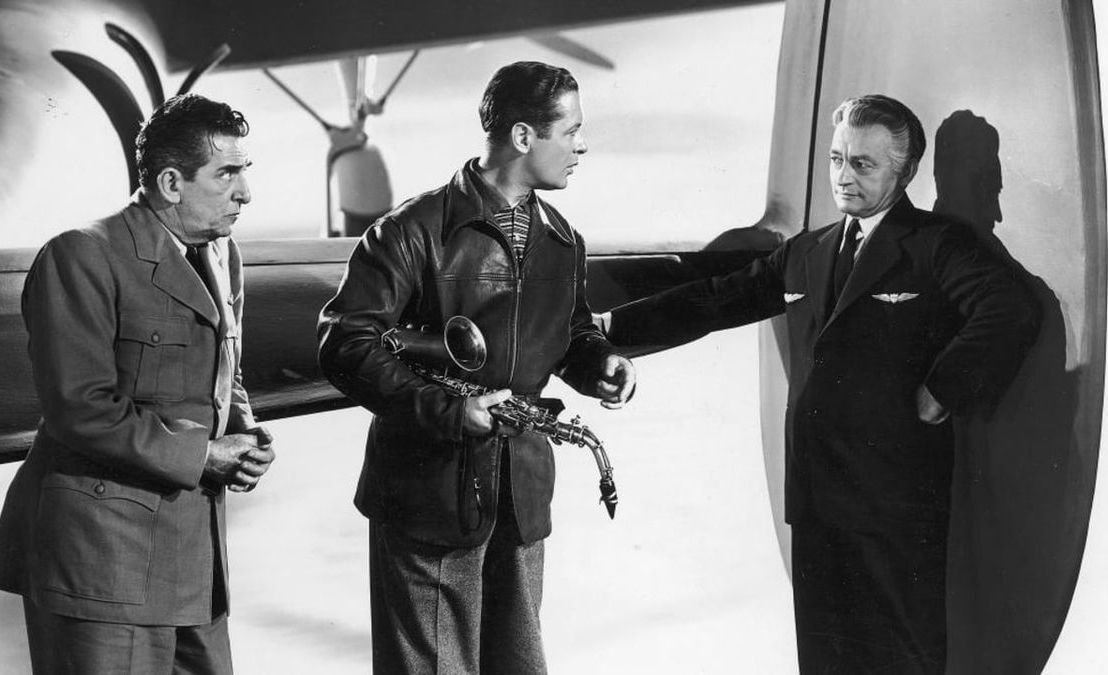
Edward Everett Horton, Robert Montgomery and Claude Rains deal with death, admin and body swops in Here Comes Mr. Jordan

Director: Alexander Hall

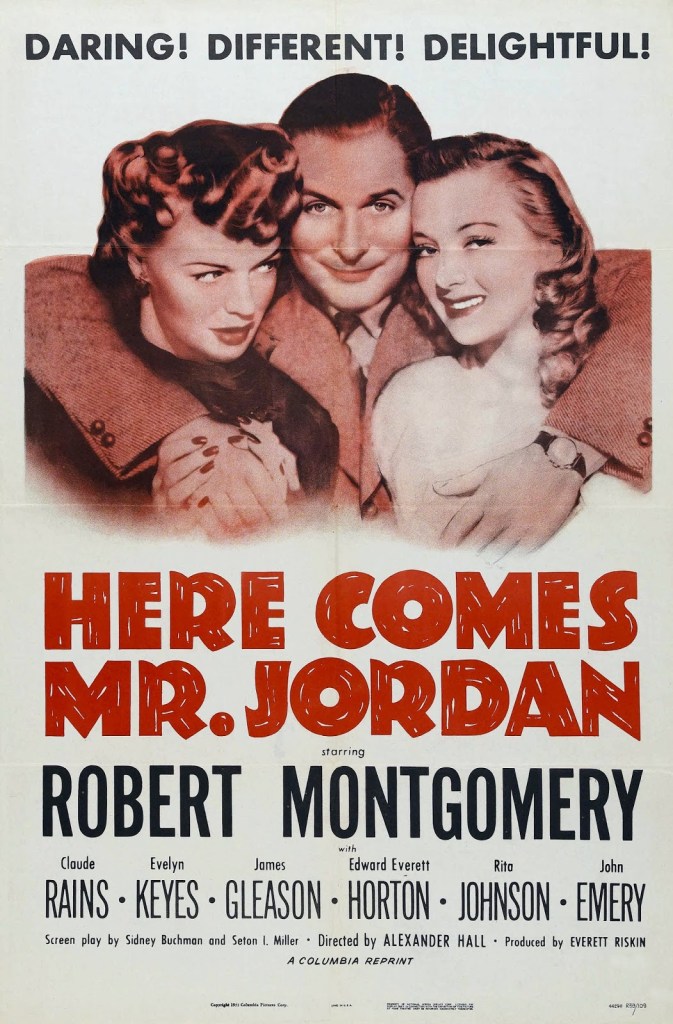
Cast: Robert Montgomery (Joe Pendleton), Evelyn Keyes (Bette Logan), Claude Rains (Mr Jordan), Rita Johnson (Julia Farnsworth), Edward Everett Horton (Messenger 7013), James Gleason (Max “Pop” Corkle), John Emery (Tony Abbott), Donald MacBride (Inspector Williams), Don Costello (Lefty), Halliwell Hobbes (Sisk)

One of the best things about the Hollywood Studio system is that created an environment where middle-brow talents could suddenly lift themselves up to create something very special. That’s certainly the case with Here Comes Mr Jordan, the career high spot for its director and its main stars. It’s the sort of product of Classic Hollywood where everything comes together perfectly and delightfully.

Joe Pendleton (Robert Montgomery) is a boxer with a shot at the title. An amateur pilot, Joe flies his own one-man flight to New York for the match. On the way, his plane crashes. An officious Angel, Messenger 7013 (Edward Everett Horton), collects his soul – only to find on arrival in heaven that Joe was meant to survive the crash and live for another 50 years. Unfortunately, by the time the mistake is found out, Joe’s body has been cremated. Head Angel Mr Jordan (Claude Rains) has no choice other than to find Joe another body on Earth. So Joe winds up in the body of millionaire Bruce Farnsworth, recently murdered by his wife Julia (Rita Johnson) and secretary Tony Abbott (John Emery). In his new body, Joe decides to correct Farnsworth’s wrongs, returning his embezzled money to investors and helping to free the father of Bette Logan (Evelyn Keyes), who took the blame. Joe also wants to retrain for a boxer – recruiting, much to his confusion, his old coach Max Corkle (James Gleason) – and he and Bette begin to fall in love. But Joe’s destiny, it turns out, is to be the champ – and he can’t do that in Farnsworth’s body. How will Mr Jordan clean this mess up?

Here Comes Mr Jordan is a delight, a hilarious musing on reincarnation and afterlife, in which the next world is as weighted down by bureaucracy and red tape as much as this one. With neat, unobtrusive direction from Alexander Hall (who never hit the jackpot like this again), the film keeps its comic balls up in the air beautifully, while throwing in some neat observations around life, death and fate. The script bubbles with lovely bits of invention, from the Afterlife to a bureaucratic organisation to Joe’s inhabiting of Farnsworth’s body (after trying a few other bodies on first), while still appearing to himself (and we the viewers – a neat idea that the film invites us not to think about too much as Joe’s mannerisms and physicality must be completely different from Farnsworth) unchanged from his original body.

Around this the film gets some neat pot shots at big business corruption. In some ways this is a little like A Matter of Life and Death mixed with Capra. As in Capra, the humble, kind-but-not-super-smart regular Joe is the one who takes a long-hard look at the corruption and greed of Big Business and Corporate America and decides “there has to be a better way”. The kind of guy who solves major business problems simply by doing the right thing and listening to his heart. Counterbalancing that is Joe’s ongoing obsession with continuing his boxing career, from his determination to get a body that’s “in the pink” (a phrase that drives Mr Jordan up the wall) to roping in his ageing butler into a series of vigorous workouts.

A large part of the charm of Joe Pendleton lies in the brilliantly dry, witty, sweet but still a little selfish qualities that Robert Montgomery (Oscar nominated) brings to the part. Playing the part with a homespun Brooklyn honesty and simplicity, Montgomery also has a childish delight in finding he can pass unobserved as this new man (particularly funny after his initial terror that he will be “found out” any second), while his boxing obsession has an endearing genuineness to it. Montgomery, as well as getting the light comedic tone spot on (no surprise that Cary Grant was the first choice for the role – although he could never have played the working class Joe as well as Montgomery does he) he also builds a very sweet and charming romance with Evelyn Keyes (also in a career best role), who is ill-treated but defiantly assured of the importance of doing the right thing as Bette.

The whole cast is quite superbly assembled, seasoned pros, doing their thing with aplomb. James Gleason was Oscar-nominated as Joe’s befuddled manager, trying to wrap his head around incarnation. Gleason also gets some of the finest gags, as Corkle tries to interact with Mr Jordan, who remains invisible to the living – but also brings a genuine warmth and tenderness to his feelings for Joe, who he clearly sees as a son. As Mr Jordan, Claude Rains is smoothness personified, playing the entire film with a relaxed grin on his face, gleefully mixing in an obsession with ensuring the “rules” are followed, while offering a dry reaction to events such as murder. As his underling Edward Everett Horton brings his patented A-game of flustered middle-man.

Mr Jordan grins so much through the film it’s easy to forget that he’s basically the Angel of Death. Reasonable and supportive, Jordan is also blithely unaffected by death and murder. The film, among the jokes and the general air of a fairy tale, has a little vein of darkness. In his introduction Jordan is overseeing the collection of souls from some of the battlefields of World War II. Later he calmly informs Joe of Farnsworth’s murder taking place even as they speak. The film doesn’t hesitate to shy away from the details of Farnsworth’s killing – or from two further murders. It’s a little nugget of darkness in amongst the charm, and a reminder that this comedy on death and the afterlife took place while the world was tearing itself apart. No wonder death can sometimes not be as big as a deal to everyone as it is today (especially to the Angel of Death).

Because the film has a more Capraesque belief that what matters is not who we are but what’s inside. Joe will appear as Farnsworth to everyone, but eventually what people will respond to (he is told by Jordan) is the person inside not the outward appearance. The potential that Joe may have to move to a new body to fulfil his destiny of becoming the champ, doesn’t meant that he and Bette need to necessarily be apart if his heart remains the same. While the film does suggest (I feel darkly!) at one point that Joe may forget who he was originally the longer he is in a new body, the more it stresses the point that the basic qualities of his decency won’t be lost.

Its ideas like this – combined with expert telling and superb Classic Hollywood grace and skill in its shooting, directing and acting – that give Here Comes Mr Jordan a little bite, along with its comic impact. Nominated for seven Oscars it won two – and it stands to be remembered in what was a glory year for Hollywood. You might expect something rather slight – but this delightful comedy is as thought provoking as it is playful.

The Falling (2014)

Florence Pugh and Maisie Williams deal with tedious coming-of-age antics in The Falling

Director: Carol Morley

Cast: Maisie Williams (Lydia Lamont), Maxine Peake (Eileen Lamb), Monica Dolan (Miss Alvaro), Greta Scacchi (Miss Mantel), Mathew Baynton (Mr Hopkins), Florence Pugh (Abigail Mortimer), Joe Cole (Kenneth Lamont), Lauren McCrostie (Gwen)

Any film set in an all-girls school that succumbs to hysteria, with ominous goings-on that might be supernatural or might all be allegories for coming of age and emerging sexuality, is inevitably going to get compared with Picnic at Hanging Rock. But few films seem to be so desperate to be that film as The Falling does. 

Set in an all-girls school in 1969, at the cusp of the sexual revolution that will soon engulf the whole country, Lydia Lamont (Maisie Williams) and her elder brother Kenneth (Joe Cole) are both obsessed with Lydia’s charismatic classmate Abigail Mortimer (Florence Pugh) – feelings of emotional and sexual dependency that Abigail knowingly encourages and flirts with. After Abigail’s sudden death connected to her pregnancy, Lydia becomes increasingly disruptive at the school and finally becomes “patient zero” in an epidemic of fainting that afflicts the school.

Based on a true story, you can tell that this film is keen to conjure up some sort of deep-rooted mystery at the heart of the girls’ actions, questioning whether they were truly in control of their own actions at this time or under the influence of something else. Is this linked directly to the tragic fate of Abigail – is she in some way possessing the girls, driving them towards this fainting? Or is the fainting just a sort of acting out, as Lydia tries to get over her grief at the loss of her friend?

Frankly, who really cares? It’s pretty hard to get invested in a film that is working so hard to be meaningful that it overshoots the mark and just becomes tiresome. Yeah I get it, teenage relationships can have this unhealthy intensity to them. They can spin out into self-destructive elements. And maybe, if the film had focused more on that rather than trying to suggest some unsettling mystery it might have got further. But with every shot of the British countryside around the school, or the lingering shots on the girls writhing on the floor, or the unsettled terror of the teachers, you feel the film’s attempt to invest these events with meaning.

What you actually end up feeling, throughout this overlong and puffed up film, is impatience at the indulgence of these children. Far from a mystery, the fainting appears to be a tiresome, attention-seeking effort from young girls unable to express and process emotionally the things that have happened to them. There isn’t a single element of the film that makes you seriously consider some ghostly or psychical explanation for the events – they seem, clearly and throughout, to be manufactured by the girls involved. It’s hard to watch it without unsympathetically suspecting that if the adults around them stopped indulging all this nonsense, they’d miraculously recover soon enough. It’s possible to speculate over whether the girls are doing it deliberately or if this is the work of their overwrought subconscious – but while that could form a good premise for a film interested in group psychology, this film seems more interested in pretentious shots of trees. 

As if realising halfway through that it’s not come up with anything compelling yet, the film hastily throws in a poorly developed incest plotline, which is unsettling, illogical, and springs from nowhere. Not content with that, it then shoe-horns a rape into the backstory of a character late on, in a way that is clearly meant to be a dark reveal, but is in fact a really clumsy “obviously this caused all the problems” solution to the questions of the film. The character’s mental health problems and inability to bond with her closest family could have made for a complex and challenging character (and she’s certainly played by an actor who could’ve handled that material). Instead, rape is casually chucked in as a glib explanation for “oh and this is why she’s troubled – ta-da”. It’s cheap and lazy. But then that is on a par with all the sexual awakening content of the film, which is clumsy, clunky and often misguided. It wants to suggest an unsettling fascination with sex, and tie that in with dangerous, subversive ideas. Instead, it just ends up looking like standard teenage experimentation, filmed with a certain amount of style.

This is not to say the film is badly made as such. It looks good and it’s put together well. It’s just trying way too hard. The acting is very good. Maisie Williams is never anything less than watchable as Lydia, and creates a well-drawn character as a girl who goes from easily-led hero worshipper to the troubled centre point of disruption at the school. Florence Pugh is also a revelation as Abigail – a charismatic presence that you instantly believe would be obsessed over by everyone who knows her. Joe Cole is also very good as the creepy, sexually exploitative brother. There are some good performances from the adults, not least Maxine Peake as Lydia’s nervous, agoraphobic mother. 

But none of this cancels out the laboured pretension of the rest of the film, which always wants to let you know how clever it is, and how much it wants you to question the impact of all that dark sexual awakening. Instead, for all the sturm und drang,it ends up looking rather like a collection of silly girls who are acting out. The idea that obsession with Abigail draws rebellious and transgressive feelings from Lydia seems painfully obvious and unoriginal, and the flirtation with incest, rather than invested with meaning, instead feels like a film straining to shock.

The Falling wants to be a great cult classic. Neither of those words can be applied. It’s a well-made but empty spectacle, living in the shadow of other much better films. For all the skill of Maisie Williams and Florence Pugh, it misses the greater depth it is aiming for and settles for being a rather shrill would-be ghost story and a plodding attempt at social commentary.

Picnic at Hanging Rock (1975)

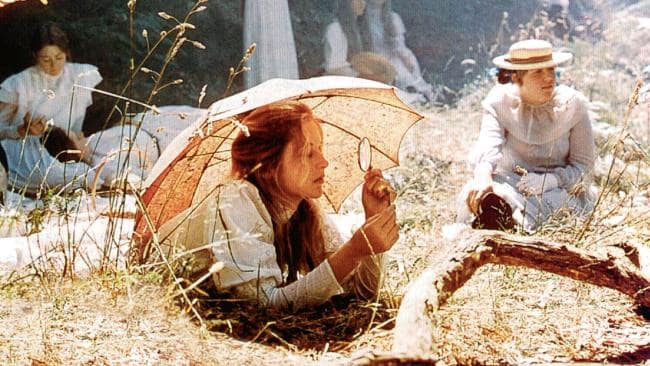
Three girls go up a rock and are never seen again in Peter Weir’s masterpiece Picnic at Hanging Rock

Director: Peter Weir

Cast: Rachel Roberts (Mrs Appleyard), Anne-Louise Lambert (Miranda St Clair), Dominic Guard (Michael Fitzhubert), Helen Morse (Mlle de Poitiers), Margaret Nelson (Sara Waybourne), John Jarratt (Albert Crundall), Wyn Roberts (Sgt Bumpher), Karen Robson (Irma Leopold), Christine Schuler (Edith Horton), Jane Vallis (Marion Quade), Vivean Gray (Miss McGraw), Martin Vaughan (Ben Hussey), Kirsty Child (Miss Lumley), Jacki Weaver (Minnie)

Is there any film as haunting and elliptical as Picnic at Hanging Rock? An impenetrable puzzle shrouded in mystery and wrapped in an enigma, it’s the ultimate “mood” film, where everything you understand in the film has be teased out from its sidelines and the unspoken motivations. It’s not going to be for everyone: Peter Weir tells a story on the feature-length Blu-ray documentary (longer than the film) of the response of one US distributor when he saw the film: “[He] threw his coffee cup at the screen at the end of it because he had wasted two hours of his life – a mystery without a goddamn solution!” That’s a fair comment – but accept that this mesmeric film is somewhere between mystery, hynoptic trick and ghost story and you’ll find treasure in it.

Based on Joan Livesey’s novel (which many believed to be true – a fate that also faced the film when it was released), on St Valentine’s Day 1900, a group of girls from a finishing school head to the Hanging Rock in Victoria for a picnic. Three of them (and one of their teachers) walk up to the rock and simply seem to disappear. The subsequent search by the authorities is baffling – and the impact on those left behind is brutal. 

There is barely any real plot in Picnic at Hanging Rock but it’s not a film about that. It’s all about the mood, the creeping sense of menace, and the general uneasy dream nature of the story. Everything follows a woozy dream-like logic – and the atmosphere is built upon by the use of panpipe music and skilful use of classical music. Weir’s film is a masterpiece of ghostly, unsettling spookiness with the rock itself as some unknown mystical source at its centre – the first shot of the film shows it slowly appearing in the mist, as if it has somehow been transported there from some fantasia land outside of the normal.

Weir’s film became the most influential film of Australian cinema, and its tone set many of the key thematic points followed by later films of what became known as the “Australian New Wave”. It explores uneasy balances in Australia between the wildness of the country – and indigenous people’s beliefs and culture – and the social structures from the British residents who had claimed the land. Picnic also explores the beginnings of a split between long-standing Australian residents and those clinging to the upper class Brit lifestyle of the motherland. Weir’s film – with its brilliant photography – lingers on the nature surrounding the rock. Not only the rock itself, with its odd formations and strange structure, but also the animals and the environment about it. There is something unknowable, wild and untamed about these surroundings – something mankind can’t control or understand.

Weir shoots the film with a lush impressionism – everything has a hazy unreality about it – and the dreamy nature of the film is built on with the dark hints of sexual feeling bubbling under the surface. The girls are all on the cusp of discovering their own sexuality – and there are plenty of open suggestions of same-sex crushes, of growing awareness of their sexual natures among the girls. It doesn’t stop with them either – the adults are equally drawn towards unspoken desires (left very much open to interpretation). Weir gets some perfect visual representations of the stonking repression forced on top of all these feelings, not least a wonderful shot which shows several of the girls standing in a line tightly doing up each other’s corsets.

And that perhaps, it’s hinted, is what happens on the rock when the girls disappear. Trance-like, they walk towards a gap in the rock and seem to disappear. What drew them there? Lead girl Marian (a perfect performance of ethereal other-worldliness from Anne-Louise Lambert) even seems dimly aware in the opening scenes that she is bring drawn towards something. The only girl who isn’t drawn towards the mystic is more repressed, dumpy Edith – whatever the force is that calls the other girls, it leaves her panicking and screaming. What’s going on? Something dark, sinister – and you can’t help but think sexual.

And what does that mean for those left behind? A mess. Rachel Roberts (a late casting replacement for Vivien Merchant, and famously awkward around the girls on set) is very good as the distant, draconian headmistress of Appleyard Academy (basically a sort of finishing school for posh girls). The regime she runs at the school is a mixture of oppressive and discriminate, with punishments handed out according to Mrs Appleyard’s personal feelings about the students rather than any reflection of their own behaviour. Part of the film’s story is the fracturing of her own personality that happens as response to the disappearance – her collapse slowly into a sort of paranoid insanity, powered by drink. What dark secrets is she hiding? (The film hints that she has more knowledge than she should have of at least some of the darker events of the story, but never reveals how much or indeed why.) 

But then the whole cast are dealing with problems they scarcely seem to understand. There is a curious – perhaps homosexual bond – between Dominic Guard’s repressed English teen and John Jarrott’s earthy, ultra-Aussie outbacker (a very good performance from Jarrott in a character that could easily have fallen into stereotype). Perhaps that’s why Guard’s character is drawn constantly back to the rock – and also why he too seems to have such an overwhelmed reaction to it.

The sole character in the film who feels most capable of expressing their emotions is the school’s French teacher Mlle de Poitiers. Played exquisitely by Helen Morse – she gives the warmest, most engaging performance in the film – she is the only character who seems able to get in touch with her emotions, unfiltered by too much repression. Perhaps it is no coincidence that as a “double foreigner” (French among the Brits in Australia) she is less affected by the rules around her. Either way, she becomes a perfect audience surrogate, as slowly horrified and confused by the actions she sees around her in the college as the viewer is. Morse is fabulous in these scenes, from a burst of emotion when reunited with a character she thought lost, to quietly watching Mrs Appleyard’s disintegration late in the film.

But the real star is Weir’s masterful direction of the mood of this film. Like that distributor said, there isn’t any plot as such – vital events happen off screen, and there is the distinct feeling that you are only being told half the story – but despite that, the film is compelling. So much is conveyed in the mood, the tensions, the style of the film that you are invited to bring your own interpretation to events. That makes it a continually rewarding piece of cinema – it invites you to make your own answers. 

This juggling of atmosphere to make something so enigmatic is so crucial to the film’s success that the recent mini-series remake effectively continued the trick (with a few extra insights into Mrs Appleyard), and contained arguably even fewer answers over its 5 hours than this did in 2. But Weir’s brilliantly made, beautifully shot, eerily unforgettable film rightly takes its place as (perhaps) the greatest Australian film ever made: it’s a film that is about Australia, and about the tensions, confusions and mysteries of that country. Brilliant.