

Pioneering social issues film remains an impressively mounted film, made with real passion
Director: Mervyn LeRoy
Cast: Paul Muni (James Allen), Glenda Farrell (Marie), Helen Vinson (Helen), Noel Francis (Linda), Preston Foster (Pete), Allen Jenkins (Barney Sykes), Berton Churchill (Judge), Edward Ellis (Bomber Wells), David Landau (Warden), Hale Hamilton (Reverend Allen), Sally Blane (Alice), Louise Carter (Mrs Allen)
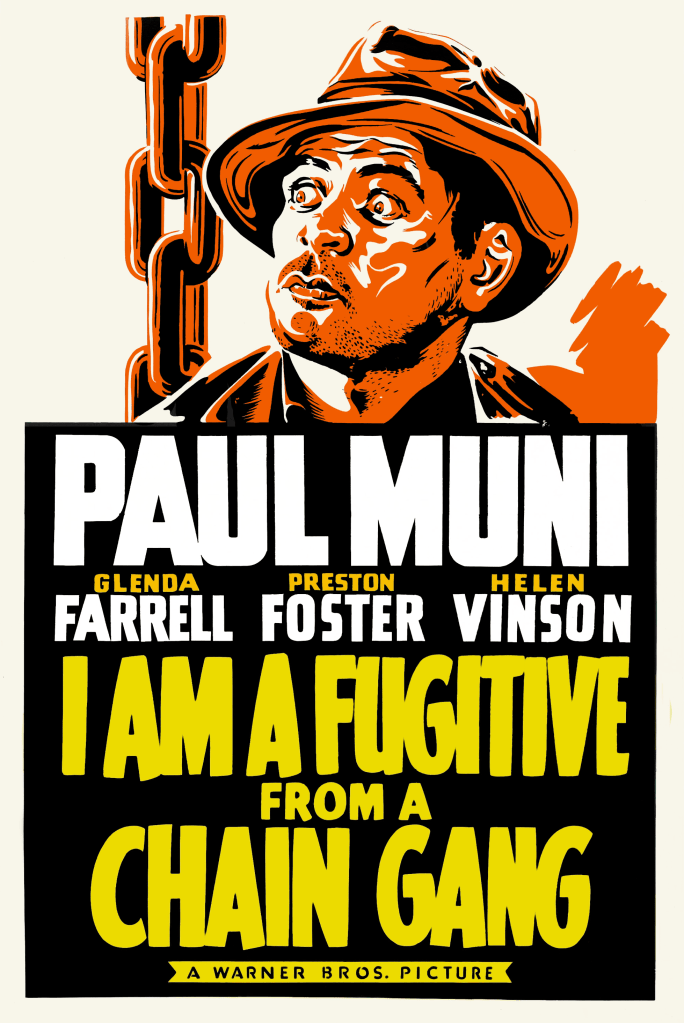
What are prisons for? Just punishment or should they encourage reform and change? To many in the South, its clear prisons were solely about the former and had nothing to do about the latter. That, in fact, you couldn’t reform a criminal – after a prison sentence he would always inevitably come back for more. I Am a Fugitive from a Chain Gang, based on a true story, is all about exploring a dehumanising system designed to turn men into working animals, beaten for looking the wrong way. No chance of a pardon, just chain men to each other, shove a pickaxe in their hand and give them a thrashing if they stop swinging it against a rock for more than second.
Based on a memoir by Robert Burns, James Allen (Paul Muni) returns from fighting in World War One with dreams of becoming an architect. Instead, he finds the American workplace is not a welcoming place for a flood of returning soldiers, drifting from state to state for work. Until, in an unnamed Southern State, he accidentally ends up in the middle of a $5 theft and is sentenced to ten years on a chain gang. The prison is a hotbed of inhumanity, with prisoners frequently beaten, dehumanised and all but worked to death. After a year he escapes and finds his way to Chicago where he reinvents himself as a successful surveyor – only, years later, for a bitter wife to expose his secret. Can he trust the Southern State that his sentence will be commuted if he agrees to return and give himself up?
I Am a Fugitive from a Chain Gang was one of the first – and probably one of the best – 1930s social issues films. It’s a surprisingly hard-hitting look at a cruel system, which (although keen to make our hero an unwitting participant in a minor crime, rather than clearly guilty like Burns) passes a sympathetic eye on criminals, asking us to question whether, whatever their crimes, they deserve this system. A system where prisoners can be randomly thrashed near to death by a thick leather belt, where pausing at work will lead to an instant beating. Where a prisoner tied to a post by his neck is such an everyday occurrence, the film is happy to throw it away in a passing shot. It makes a strong case that how we treat prisoners says as much about us as I does them – and that, sadistic wardens quickly become little better than the men they guard.
LeRoy’s film also makes a strong argument that we talk-the-talk but rarely walk-the-walk when it comes to supporting servicemen. James Allen returns a decorated hero – but his family, former employer and patronising reverend brother assume he will happily return to grunt work on the production line. War has expanded his horizons and ambitions, given him the skills to better himself. No one wants to hear it. He’s not alone: many drifters are ex-servicemen and when he tries to pawn his medals a pawnbroker sadly shows him a bucket full of worthless service decorations. It’s an indication that everyone has an assigned role and place and they shouldn’t for one minute expect to step outside this.
It’s no wonder that the prison sentence treats men like animals – a point LeRoy makes by cutting between donkeys and men both being chained up ready for a day’s work. IAAFFACG makes clear in this system all men are equal in their inequality, cutting back and forth from Black to white prisoners as they are prepare for the days work. (The film does make clear there is a higher number of Black prisoners than white). Allen protests at first, but learns to shrug his shoulders and turn away like the rest do. A freed prisoner showcases this indifferent acceptance of suffering, leaving at the same time as a deceased one, hitching a ride on the cart sitting merrily on a fellow worker’s coffin, striking a match for his cigarette on it. LeRoy shoots the prison beds where the men sleep chained together with a forbidding moodiness and the wide-open spaces where they slave in the beating sun with a scale and sense of heat bearing down on us.
Allen won’t be beaten though. His escape is a beautifully filmed and edited sequence, show-casing the film’s triumphant use of sound. LeRoy’s camera tracks both Allen and pursuers as they flee through the undergrowth, adding pace and intensity to the sequence, soundtracked to the bark of the hounds following him. It’s a sound you really notice disappear when Allen hurls himself into a river, using a reed as an air pipe, hiding feet away from his pursuers, in a series of underwater shots that have a haunting power. It’s superbly done, full of tension and fear.

Escaped, first thing James does is buy a suit and have a shave. Instantly he is above suspicion – even while he is perfectly described be a flatfoot cop sitting next to him in the barbers, not a trace of suspicion is placed on to him (thanks for the ‘close shave’ Allen drily says). Now looking like a respectable middle-class sort, James Allen – under his new name of Allen James – suddenly finds opportunities heading his way, moving quickly up the chain at his new job in Chicago. In this world, outward appearances make the man: and a guy in a new suit is always going to get the sort of attention a down-and-out can only dream of.
So much is Allen now an ideal prospect, he is blackmailed into marriage by Glenda Farrell’s hard-faced Marie, a decision that will bite him hard when he makes eyes years later at the sweet Helen (Helen Visnor). He’s pulled back into the world he thought he had left behind, only to find its not changed at all: to the ‘justice’ system his new professional achievements count for not a jot. To them he’s still the same subhuman scum he was before, an even harsher regime swiftly initiated to drive any vestige of humanity from him, even in the face of a national campaign.
At the centre of this film is a superb performance by Paul Muni. Sure, you can see touches of Muni’s love for melodrama, the odd overdone reaction. But this is an emotionally raw, deeply touching performance. Muni gives Allen a superabundance of energy, enthusiasm and hope at the film’s start all of which slowly drains away. The horror builds behind his eyes: it’s no surprise that, re-sentenced to the chain gang, Muni’s face crumbles into genuinely affecting tears of fear and hopelessness. Slowly, despite himself, Allen becomes the toughened, cynical, damaged man the system assumes he was at the start, strangling the hope and optimism that characterised him at the start. It’s a sensitive, deeply humane performance, of humanity being chiselled away.
It results, of course, in the film’s striking (and famous) closing shot, the now fugitive Allen whispering from the shadows, all chance of making an honest life gone. IAAFFACG has already symbolically shown how this system has twisted Allen: having dreamed his whole life of being a bridge builder, one of his final acts in the film is to destroy a bridge as part of a desperate escape. IAAFFACG doesn’t overegg its social commentary, but leaves a strong and lasting impression of how treating men like animals becomes a self-fulfilling prophecy. Leave them no choice and a man must turn to crime: it’s as true for abandoned veterans as it is for chain-gang criminals. In making an appeal for a fairer, kinder world, IAAFFACG doesn’t miss that we are a long way from it right now.


 Movie Musings