Tag: Guillermo del Toro

Frankenstein (2025)

Frankenstein (2025)

Del Toro’s dream project makes it to the screen in a lavish gothic spectacular

Director: Guillermo del Toro

Cast: Oscar Isaac (Baron Victor Frankenstein), Jacob Elordi (The Creature), Mia Goth (Elizabeth Harlander), Felix Kammerer (William Frankenstein), Lars Mikkelsen (Captain Anderson), Christoph Waltz (Henrich Harlander), David Bradley (Blind Man), Charles Dance (Baron Leopold Frankenstein), Ralph Ineson (Professor Krempe)

When he was a kid del Toro fell in love with James Whale’s Frankenstein. It was his dream project to create his own version of Mary Shelley’s classic. Year of dreaming pay off in this visually gorgeous, and emotionally engaging film – even if it’s also a little overlong and overindulgent. Del Toro throws everything into Frankenstein, creating a grand Gothic epic whose sympathies firmly lie with the abused Creature.

You must be familiar with the plot: in eighteenth century Germany, Frankenstein (Oscar Isaac), driven by never-really-resolved anger over his mother’s death, dreams of conquering death. With the funding of arms dealer Harlander (Christoph Waltz), who is also uncle to the woman he loves: Elizabeth (Mia Goth) who happens to be fiancée to his younger brother William (Felix Kammerer). On a stormy night, he gives life to the Creature (Jacob Elordi) but quickly rejects him. The Creature tries to find a place in the world, only to discover the world is full of prejudice and violence towards him and the Creature’s resentment against his thoughtless creator grows.

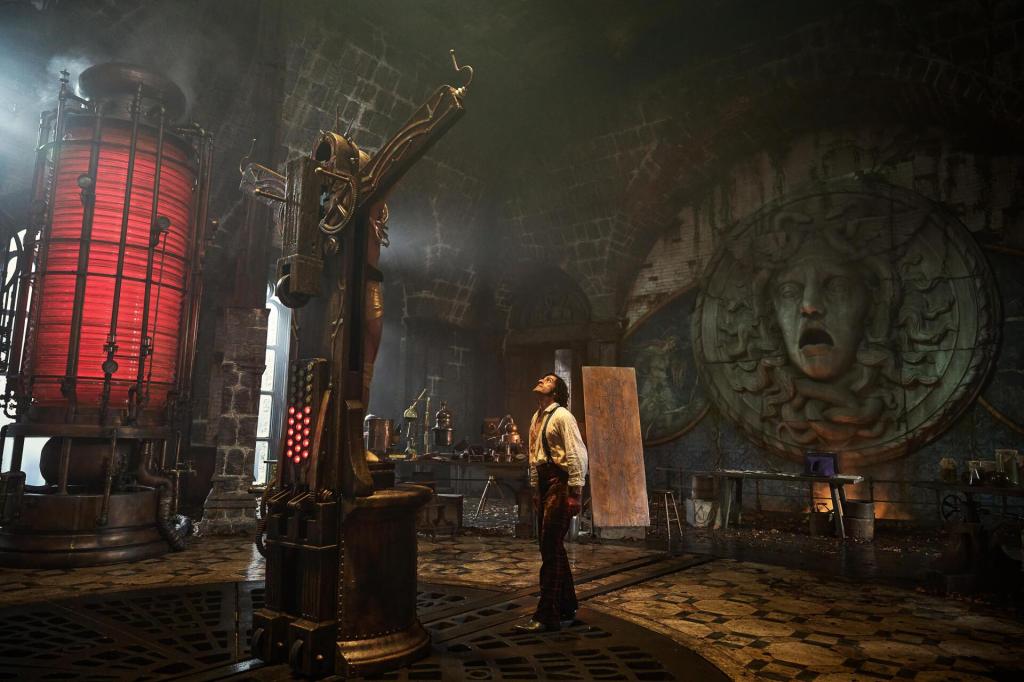
Del Toro’s film looks absolutely stunning, a sumptuously designed Gothic melodrama with extraordinary sets, grand costumes and beautiful cinematography (the Polar-set framing device is particularly striking, covered in lusciously contrasting blues and greens). There are striking echoes of the visual intensity of Pan’s Labyrinth, with Frankenstein’s lab turned into a mix of laboratory and classic temple, including a giant Medusa sculpture. The birthing sequence is a grandiose, operatically Gothic thing of beauty, a version of Whale’s film dialled gloriously up to eleven.

Del Toro’s film goes back to the novel in some ways (in themes and its Polar framing device), but in many ways it’s more of a complex, emotional reimagining of Whale’s film. Isaac’s Frankenstein, an egotist in need of an audience feels very similar to Colin Clive. Whale’s key motif, the Creature’s romantic yearning for the sun, becomes thematically central here. As there, Frankenstein conducts his experiments in a colossal Gothic tower, keeps the Creature chained and makes vague attempts to rear it and takes no responsibility for his actions or the deaths connected to it (in fact Isaacs’s Frankenstein lies and lies in a weasily attempt to protect his reputation). Waltz’s arms dealer funder of Frankenstein’s insanity feels like a version of Pretorious from Bride of Frankenstein, while del Toro goes even further than that film in deepening the bond between the Creature and the Blind Man.

Del Toro also doubles down on Whale’s implicit sympathy for the Creature. Here re-imagined as possessing near super-human strength and durability (his violent responses to being attacked being partially a result of his own strength being uncontrollably great), his child-like vulnerability is as dialled up as his actual physical invulnerability. The Creature feels, first and foremost, like a thought experiment by Frankenstein – and the fact this experiment has effectively rendered the Creature immortal and capable of a Wolverine-like cellular regeneration, condemned to walk the Earth forever alone only heightens the creator’s myopic selfishness.
One of del Toro’s key themes is terrible parenting. Much as he loathed his domineering, brutal father (Charles Dance, in a role perfectly crafted for his austere distance) who caned his face (his hands are too precious) when he flunked remembering anatomy facts, Frankenstein ends up echoing his father’s approach. When the creature constantly fails to say anything other than ‘Victor’, he too reaches for a cane to beat learning into him. Like his father, he resents the creature for being a bad reflection on him. He is, effectively, a dead-beat Dad, casually fathering a child which he has no idea how to treat, who falls back on cruelty.

There can be few Frankenstein’s on film less sympathetic than the version played here by an impressively egotistical Oscar Isaac. He’s full of preening self-importance and self-justification, obsessed with his task but giving no thought to its consequences. Twice he reanimates corpses then callously switches them off without a second thought. Giving birth to Frankenstein – just like in Whale’s film – after an initial interest (that is really self-congratulatory pride) his reaction is to chain him up in the basement and lose patience at him. With his constant milk-drinking there is a sense he’s a little boy who never grew up, and to him love is founded on possession: first of his mother, then his brother, then Elizabeth, all of whom at various points he wants to keep to himself – while his anger at the Creature is rooted in his failing to meet Victor’s expectations.

Frankenstein is at heart an angry mother’s boy, resenting his father for ‘taking’ his mother away from him (del Toro even has him wrapped in his mother’s distinctive red when he wakes to discover the Creature lives). There is more than an echo in that in his love for Elizabeth, the fiancée of his younger brother (who he also subconsciously resents for both ‘killing’ his mother in childbirth and for having the sort of relationship with his father Victor never had). These Freudian feelings are subtly enforced by Mia Goth playing both roles (it’s so subtly done I missed it first time round). Victor’s love for Elizabeth is just as possessive and selfish as that for his mother – and in the same ways his contempt for the Creature is for ‘failing’ him.

By contrast with this monster, the Creature is presented overwhelmingly sympathetically. Played with an outstanding physical and emotional commitment by Jacobi Elordi, he’s framed as a child stumbling towards a painful adolescence. Freshly born, he waddles like a toddler, stares in fascination at leaves floating on a stream and painfully forms the word ‘Victor’. Of course, it never occurs to his creator that this is the equivalent of “mama”. Only Elizabeth, who feels an immediate affinity with the sensitive soul, understands this. Only she tries to speak to him – or asks what his name is.

The poor Creature escapes into a world he quickly full of senseless, prejudiced violence. He bonds with a stag – only for the creature to be shot in front of him by hunters (who instantly turn their guns onto him). In conversation, Elordi presents a man who is sensitive, kind and gentle but capable of anger and fury. Del Toro crafts a tender relationship between the Creature and David Bradley’s Blind Man (the only person, other than Elizabeth, to look past his appearance). The film’s second act, focusing on the Creature’s emotionally painful interaction with the world is its strongest – not least because you feel throughout del Toro’s deep bond with him.

After all this, it’s surprising that Frankenstein ends on a note of hope. Del Toro’s film isn’t always quite nimble enough for this: some of its more optimistic moments can feel as if they have emerged a little thin air (or from the optimistic wishes of the director). In particular, Elizabeth’s bond with the Creature feels so swiftly sketched out it failed to completely convince (more time on this and less time on Waltz’ creepy arms dealer would have been welcome). But this feels like a passionate, committed and perhaps above all beautiful to-look-at piece of work with a real emotional heart. This easily lifts it into the upper echelons of Frankenstein adaptations.

Pan’s Labyrinth (2006)

Pan’s Labyrinth (2006)

Superb fantasy film, full of heart, visual imagination and beautiful story-telling, truly one from the heart

Director: Guillermo del Toro

Cast: Ivana Baquero (Ofelia), Sergi López (Captain Vidal), Maribel Verdú (Mercedes), Doug Jones (The Faun/The Pale Man), Ariadna Gil (Carmen), Álex Angulo (Doctor Ferreiro), Manolo Solo (Garcés), César Vea (Serrano), Roger Casamajor (Pedro), Pablo Adán (Narrator/Voice of the Faun)

What do you do when your world is terrible? Sometimes the only way to survive is to embrace your own world, even if that world has its own darkness and terrors. Guillermo del Toro’s masterful Gothic fairy tale mixes the terrors of Francoist Spain with one of untrustworthy magic and monstrous spirits and compellingly balances bleak horrors with the chance of hope. Visually stunning, thematically rich and heartbreakingly emotional, Pan’s Labyrinth is a Grimm’s fairy tale bought shockingly up-to-date, a uniquely heartfelt film from a distinctive director.

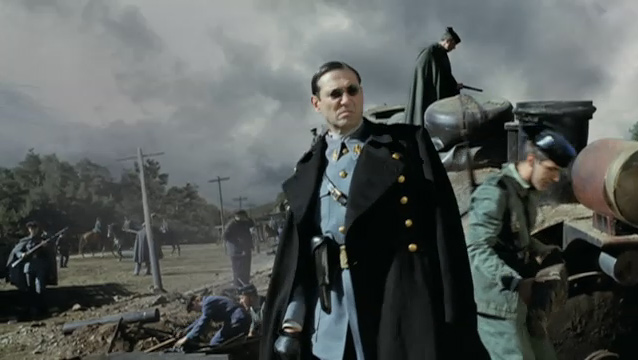
It’s 1944 in the woods of Spain and the Reds are still fighting their lonely crusade against Franco’s fascists. Captain Vidal (Sergi López) is here to stamp out these rebels and has summoned his heavily pregnant wife Carmen (Ariadna Gil) and twelve-year old step-daughter Ofelia (Ivana Baquero) to his distant command post so that he can be present at the imminent birth of his son. Ofelia hates the punctilious and coldly obsessive Vidal (rightly so – he’s capable of coldy indifferent but shocking acts of violence) and escapes more-and-more into her fairytale books. One night, she wanders into an old maze and encounters a Faun (Doug Jones), who tells her she is the long-lost princess of the fairy kingdom and must perform three tasks to return home. Ofelia now exists in two worlds: an increasingly Gothic fairy one of and a real one of violence, ruled by her monstrous father-in-law.

Pan’s Labyrinth is a beautifully balanced film of multiple interpretations. It’s never clearly stated whether Ofelia’s fairytale world is ‘real’ of a product of her imagination. It’s clearly a way a scared girl could process real world traumas – the death of her father, the appalling Vidal, the horrors of war around her – with many elements of the fairy world reflecting things happening around her. But on the other hand, the mandrake root the Faun gives her to help heal her sick mother by placing it under her bed has an immediate impact and Ofelia’s magic chalk and the labyrinth itself offer secret doorways that allow her to escape Vidal in the film’s final act (or perhaps a by then disoriented and drugged Vidal is just mistaken). Essentially, you are left to embrace the idea you prefer – much as it is implied Ofelia herself chooses the version of her life she wishes to embrace.

Choosing for yourself and not blindly following orders is one of the key lessons of Pan’s Labyrinth. The ‘real’ world of Franco’s Spain is full of regimented orders to be blindly obeyed without question. In this it has the collaboration of the Church – at Vidal’s dinner-party, a subservient priest self-satisfyingly fills his plate with food while shrugging off concerns of the starving poor – and Fascism echoes Church mantras (one of Vidal’s lieutenants repeats the same propaganda ‘prayer’ to Franco over-and-over again while he hands out the bread ration to the cowed villagers). Franco’s Spain is one of order and regimen, where individuality and choice is stamped out.

And there are echoes of this in Ofelia’s fantasy world. Played with a gentleness, vulnerability and strikingly earnest decency by Ivana Baquero, Ofelia refuses to accept the world must be the way it is (unlike her mother who has sadly accepted it must). But her fairy world, the Faun – expertly portrayed by Doug Jones’ lithe physicality – is a far from gentle guide. Creaking from the wood he is formed from, he’s sinister, mixes vague statements with subtly presented orders and constantly holds information back while presenting Ofelia with tight rules for her tasks. Just as Fascism takes choice away real world, the Faun presents Ofelia with a book that reveals the future (but only one page at a time) and her tasks increasingly demand complete obedience, under the threat of punishment.

This is not a comforting world. Ofelia – who at one-point wears costumes reminiscent of those other famous children in dark, surreal and dangerous fantasy-worlds Alice and Dorothy – confronts a vile toad and, most chillingly, an albino child-eater with eyes in his stigmata hands who lives in a room decorated with nightmare reflections of the real horrors of the 40s (most strikingly a Holocaust-reminiscent pile of children’s shoes). For all its fantastical, it’s also very much a nightmare version of a real-world that could have been dreamed up by a child processing horrors.

Pan’s Labyrinth celebrates individuality and choosing for yourself. Ofelia’s story is one of increasingly taking her own choices: from refusing to accept her mother’s new husband, to escaping into her fantasy world (twisted as it is), to finally outright refusing the increasingly dark instructions of the Faun. It’s in doing this that she can eventually prove herself a true hero, someone who does not accept the established order but can make her own decisions.

This makes her a contrast to Vidal. Truly he is one of cinema’s most loathsome monsters. In a superbly controlled performance by Sergi López, Vidal isn’t repulsive because he is a larger-than-life, sadistic monster but because he is a small, inadequate bully who has controls his small world in order to make himself feel important. Vidal is obsessed with order and detail – introduced tutting at the 15-minute-late arrival of his wife, his office is filled with the gears of the mill and he fetishistically cleans his pristine uniform, shaves himself and repairs his father’s watch. This watch – the only memoir he has of his hero father, who died when he was a baby – is the root of his obsessions, Vidal desperate to become his father and pass on his own toxic legacy of ancestor worship to his son. It’s striking that, as Vidal’s world collapses around him, his clothing and body becomes more and more scarred, bloody and disordered – his external appearance resembling the monster within.

In Vidal’s world everything fits neatly into place, governed by his Fascist ideology. Carmen – a fragile Ariadna Gil, struggling to accommodate to a world of harsh choices – is of interest to him only because of the baby she carries. He operates the mill as a tightly organised regime, in which the rebels are unwanted ghosts in the machine. He uses violence ruthlessly but as a tool, not with sadistic relish. He brutally beats a suspected rebel to death with a bottle with robotic indifference and tortures suspects with a practised patter. To him, everything is justified if it is obeying an order. So much so, that he literally cannot understand the refusal of Dr Ferreiro (in one of the film’s most moving moments) to blindly follow orders, no matter the consequences.

Dr Ferreiro (a beautifully judged performance by Álex Angulo) is one of two figures whose independent thought Vidal is unable to recognise, even when they are under his nose. His maid Mercedes (Maribel Verdú, one of the passionate hearts of the film) is fiercely independent, the sister of the rebel leader and working subtly against Vidal. She forms a bond with the gentle Ofelia while showing that refusing to be part of a blind system is a crucial part of humanity. She also provides possibly one of the most satisfying moments in cinema during a confrontation with Vidal.

Del Toro’s film beautifully balances these fascinating ideas of choice and independence within its brilliantly evocative design. It’s a beautifully shot film, in a gorgeous array of Velazquez-inspired tones, its moody darks and blues gorgeously captured by Guillermo Navarro while its design work is extraordinary in its texture and detail. But it’s a classic because del Toro’s superb creativity and quietly emotional direction. Pan’s Labyrinth makes us really care for this child just as it makes us despise the cruelty of her step-father. Combined with gorgeous design, del Toro’s film truly comes from the heart, a loving, very personal tribute to the power of stories and individual choices. The film is so powerful, you even forget that it opens as it ends, and that we know in our heart-of-hearts how this journey will finish. Nevertheless, Pan’s Labyrinth ends on a note of joy and acceptance so pure, it could only be from the fantasy world not the real one.

Nightmare Alley (2021)

Nightmare Alley (2021)

A mysterious drifter gets more than he bargained for in del Toro’ flashy but unsatisfying film

Director: Guillermo del Toro

Cast: Bradley Cooper (Stanton Carlisle), Cate Blanchett (Lilith Ritter), Rooney Mara (Molly Cahill), Toni Collette (Zeena Krumbein), Willem Dafoe (Clem Hoatley), Richard Jenkins (Ezra Grindle), Ron Perlman (Bruno), David Strathairn (Pete Krumbein), Mark Povinelli (Major Mosquito), Mary Steenburgen (Felicia Kimball), Peter MacNeill (Judge Kimball), Paul Anderson (Geek), Clifton Collins Jnr (Funhouse Jack), Jim Beaver (Sheriff Jedediah Judd), Tim Blake Nelson (Carny Boss)

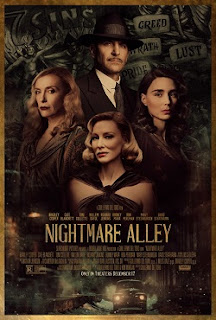
There isn’t any magic left in the world, it’s all show and tricks and no wonder. Nightmare Alley is del Toro’s follow-up to his Oscar-winning The Shape of Water and you can’t not admit it’s a triumph of style. It’s a glorious fusion of film noir and plush, gothic-tinged horror. There is something to admire in almost every frame. But it’s also all tricks and no wonder. There’s no heart to it, just a huge show that in the end makes nowhere near the impact you could expect.

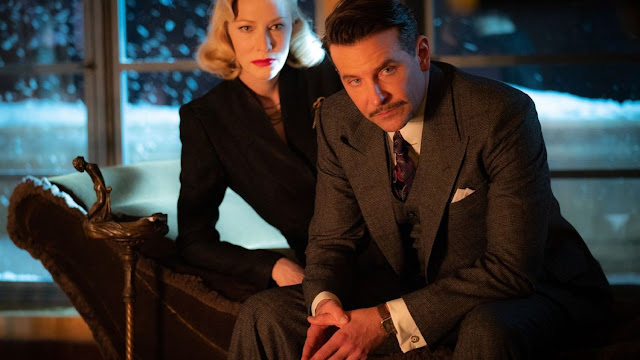
In the late 1930s Stanton Carlisle (Bradley Cooper) is a drifter with a dark past, who is recruited as a labourer in a travelling carnival. Learning the ropes from freak show owner Clem (Willem Dafoe), he’s taken under the wing (in every sense) by mesmerist mind reader Zeena (Toni Collette) and taught the tricks of the art (observation and careful word codes using an assistant to guess names, objects and other facts) by Pete (David Strathairn). Eventually Stanton and his love, circus performer Molly (Rooney Mara), head to the big city where, after two years, Stanton reinvents himself as celebrity mind-reader and medium. There Stanton gets involved with psychiatrist Lilith Ritter (Cate Blanchett) in a long con where he will use the recordings of her sessions with patients to act as a medium to put them in touch with their lost ones. But is there a danger Stanton isn’t ready for in one of his clients, powerful businessman Ezra Grindle (Richard Jenkins)?

Nightmare Alley looks fabulous. But it’s hellishly overlong and curiously uninvolving. It’s like Del Toro fell in love with the whole project and forgot to search for the reason why somebody else would love it. It’s a strangely unshaped film, alternating between long, loving scenes glorying in the dark mood, baroque performances and design but then makes drastic, swift jumps in character psychology that constantly leaves you grasping at engaging with or understanding the personalities of its characters.

Its design is faultless though – it’s no surprise that its only Oscar nominations outside the Best Picture nod were all in technical categories. Dan Lautsen’s cinematography is inky black, with splashes of all-consuming colour. It’s a marvellous updating of film noir, with deep shadows spliced with angles reminiscent of Hammer-style horror. The production design is a labour of love, the carnival sets a hellish nightmare of unsettling shapes, forms and structure contrasting with the art deco grandness of the big city. The design is pretty much faultless, a real labour of love.

But the same effort didn’t go into pacing and story. This is a slow-moving, self-indulgent film, that frequently seems to be holding itself at arm’s length to make it all the easier for it to admire itself. It looks extraordinary, but it’s a frequently empty experience, more interested in mood and striking imagery than character and emotion.

Bradley Cooper gives a fine performance as Stanton. He has an air of cocksure charm, and Cooper skilfully shows this is largely a front of a man who, when push comes to shove, is capable of sudden and unflinching acts of violence. We get an early hint of this when he reacts to being struck by an escaping circus freak with unhesitating brutality. It recurs again and again in the film, and Stanton proudly states his avoidance of alcohol with all the assurance of a man who knows the bottle could unleash dark forces that he could never control. Cooper is vulnerable but selfish and above all becomes more and more arrogantly convinced of his own genius and bulletproof invulnerability, so much so that he drives himself further and further on into self-destruction.

There is some rich material here, so it’s a shame that for all that we never really seem to be given a moment to really understand who he is. Much has to be inferred from Cooper’s performance, since the film seems content to state motivational factors – troubled parental relationships, greed, ambition, a desire to make something of himself – without ever crafting them into a whole. Stanton remains someone defined by what he does.

And Stanton is the only character who gets any real oxygen to breathe, with the others largely ciphers or over-played caricatures. Rooney Mara as his gentle love interest is under-developed and disappears from the film for long stretches. Cate Blanchett gives a distractingly arch performance, somewhere between femme fatale and Hannibal Lector and is so blatantly untrustworthy it’s never clear why Stanton (an expert reader of people!) trusts her completely. Richard Jenkins is miscast as a ruthless businessman, lacking the sense of danger and capacity of violence the part demands.

Most of the rest of the cast are swallowed by the long carnival prologue, that consumes almost a third of the film but boils down to little more than mood-setting and a repeated hammering home of a series of statements that will lead into a final scene twist (and I will admit that is a good payoff). The carnival seems like a self-indulgent exploration of style, and several actors (Perlman, Povinelli and even Collette) play roles that add very little to the film other than ballooning its runtime.

The earlier section would have perhaps been better if it was tighter and more focused on Stanton and his mentor, well played by David Straithairn. I appreciate that would have been more conventional – but it would also have been less self-indulgent and helped the opening third be less of a stylish but empty and rather superfluous experience (since the film’s real plot doesn’t start until it finishes). Drive My Car demonstrated how a long prologue can deepen a whole film – Nightmare Alley just takes a long, handsome route to giving us some plot essential facts, without really telling us anything engaging about its lead character.

It makes for an unsatisfying whole, a cold and distant film packed with arch performances – although Cooper is good – and events that frequently jump with a dreamlike logic. It’s a marvel of design but way too much of a good thing, and constantly seems to stop to admire itself in the mirror and wonder at its own beauty. It becomes a cold and arch study of a film not a narrative that you can embrace. And you can’t the same about many of Del Toro’s other films – from Pan’s Labyrinth to Pacific Rim they’ve got heart. Nightmare Alley doesn’t really have that.

Hellboy II: The Golden Army (2008)

Ron Perlman faces larger problems than ever in Hellboy II: The Golden Army

Director: Guillermo del Toro

Cast: Ron Perlman (Hellboy), Selma Blair (Liz Sherman), Doug Jones (Abe Sapien/Angel of Death/Chamberlain), Seth MacFarlane (Johann Krauss), Luke Goss (Prince Nuada), Anna Walton (Princess Nuala), Jeffrey Tambor (Tom Manning), John Hurt (Professor Trevor Bruttenholm), Roy Dotrice (King Balor)

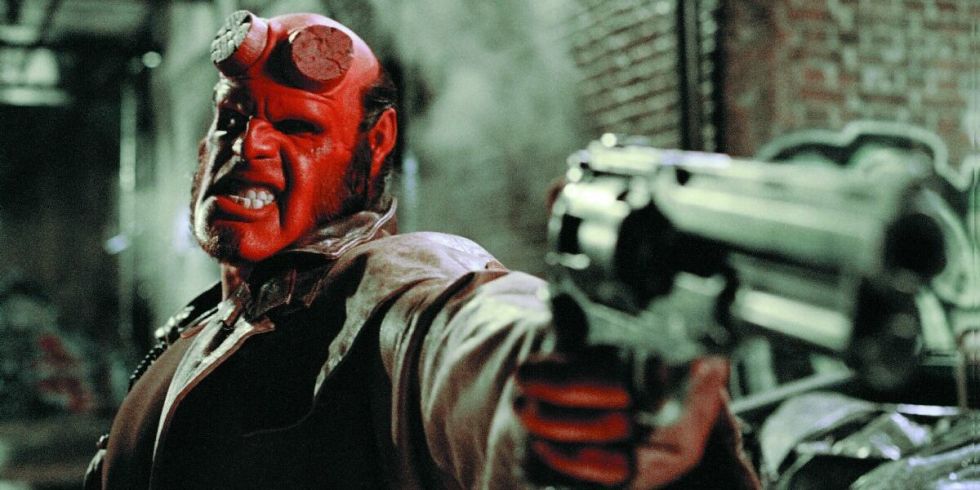
There is something quite sweet about the Guillermo del Toro taking all the chips won for directing Pan’s Labyrinth and cashed them in for this comic book sequel. There you have the distillation of the man’s career right there: one for the artist and then one for the teenage boy he used to be. But Hellboy II is a marvellous creation, a gorgeous to look at, magical, rather funny comic book film crammed with amazing images, ingenious creatures and sparkling moments of action and adventure.

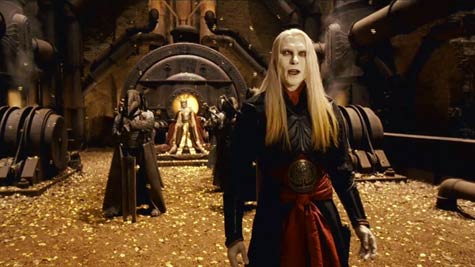
Thousands of years ago, the magical creatures of the world, led by the elves, fought a war against mankind. To win a desperate victory, goblins created the dreaded Golden Army, an indestructible mechanical army. Horrified at the slaughter, Elven King Balor (Roy Dotrice) offered a truce. His son Prince Nuala (Luke Goss) disagreed. In the present day, Nuala goes about to collect the three pieces of the crown needed to control the Golden Army – and only Hellboy (Ron Perlman) and his friends from the BPRD can stop him. 

Hellboy II is immensely imaginative and wonderful to look at. Perhaps inspired by Pan’s Labyrinth, the film plays like a cross between the most brain-twisting magic depths of that film and a traditional comic book. So we get dozens of creatures, each pulled from the pages of some sort of acid tripped Tolkien novel: with extended hands, distorted heads and steam-punkish extremities, the creatures on show are masterpieces of design and character. The juxtaposition between this ethereal, magical world of elves and goblins and mankind’s expansion brings home the danger this world is in: the Elven King’s palace in the modern day is in a sort of converted sewer, while Nuala’s base is an abandoned underground line. With some performers (often del Toro’s muse Doug Jones) under layers of make-up and prosthetics, it’s extraordinary the amount of personality each of these creatures gets. When the film takes a turn down a Diagon Alley-style market, you regret Del Toro never got to make a Harry Potter film.

Hellboy looks both part of this world and also like a muscular bull in a china shop. Ron Perlman continues to be perfect in the part, and captures the wry, cynical, slightly teenagerish humour of the part. Del Toro does a wonderful job of showing the sense of family between Hellboy, his lover pyrokinetic Liz (a decent performance by Selma Blair, although she is too often relegated to the “woman” role), and his surrogate brother, amphibious empath Abe (Doug Jones getting to provide the voice as well this time, and getting a fine display of growing emotional expression). The quiet character moments between the action really ring true – a very funny sequence sees Hellboy and Abe bemoan their romantic entanglements by getting drunk while singing Can’t Smile Without You.

It’s scenes like that which add the heart alongside the throbbing action and colourful character weirdness of del Toro’s vision. It’s also part of the distinctiveness of the whole vision of the film. Everything is seen with as fresh an eye as possible, and makes for some really striking images and scenes. The steam-punk aesthetic of the Golden Army seems to fit together perfectly with the more organic world of the Elves. There’s a sense at all times that the design and pacing of the film have been carefully thought through so everything fits logically together. Starting the film with a wonderfully animated Golden Army backstory (voiced by a briefly returning John Hurt for maximum impact) is just another reflection of the artistry at work here.

There is a nice vein of humour running through the film – there are some funny sight gags as characters walk nonchalantly through bizarre goings-on in BDRP HQ – and the more gory moments of the action are shot with a certain black comedy. The film also gets a decent few points in about how humanity rejects things that are different, which are not surprising but still hit home.

Hellboy II does start to become a bit more generic as it heads towards its final denouement. Most of the events of the final few scenes are pretty predictable from the outset, and offer little in the way of surprises. For all the chemistry she has with Perlman, Blair is more or less relegated to the sidelines for large chunks of the film (usually the action). But for most of the run time, it’s inventive, imaginative fun with a director bringing a distinctive vision to the genre while also kicking back his heels and having fun. And fun is what it wants the viewer to have as well – don’t try too hard, sit back, relax and enjoy yourself.

Hellboy (2004)

Ron Perlman fights the darkness in curio del Toro comic book flick Hellboy

Director: Guillermo del Toro

Cast: Ron Perlman (Hellboy), Selma Blair (Liz Sherman), Rupert Evans (John Thaddeus), John Hurt (Dr Trevor Bruttenholm), Karel Roden (Rasputin), Jeffrey Tambor (Tom Manning), Doug Jones (Abe Sapien), Brian Steele (Sammael), Ladislav Beran (Karl Ruprecht Kroenen), Bridget Hodson (Ilsa Haupstein), Corey Johnson (Agent Clay)

As little as 10 years ago, outside a few core characters like Batman, the X-Men or Spiderman, comic book movies were an odd curio hard to place in the mass market. Today of course, you can virtually get any character who has appeared in a cartoon strip up on the screen with a budget of millions. But back in 2004, Guillermo del Toro had to squeeze this project out on a smaller budget in order to get the studio to agree to make the film.

Hellboy has a particularly demented story. In 1945, the Nazis, working in partnership with Rasputin (Karel Roden) – yes thatRasputin, don’t even ask – attempt to open a portal to hell to, well I’m not quite sure what they want to do, but it probably involves the destruction of the world. Anyway, some humble GIs stop them and the only thing that comes through the portal is a little demon with an enormous stone fist. Raised by paranormal expert Dr Trevor Bruttenholm (John Hurt), this creature grows up into cigar-chomping secret-agent-for-the-FBI Hellboy (Ron Perlman), working on paranormal investigations. But when Rasputin returns from the dead it looks like all hell (literally) is about to break out.

Okay it should be pretty clear to you from that that Hellboy is an odd film. It’s very much from del Toro’s B-movie heart, and he invests this nonsense material with a great deal of directorial style and heart – a real “geek-boy-artist” job. Del Toro has a great deal of imagination and is able to strike a happy balance between enjoying the material and not taking it all too seriously. So he lets the film barrel along, throwing plenty of nonsense at the screen without worrying about trying to make it make real-world sense. In fact Del Toro is clearly so fond of the material that he basically shoots the whole thing like a comic book come to life. 

So the film is crammed with bright primary colours mixed with murky blacks, and Del Toro frames many key moments like comic book panels. It’s a film packed with striking images and scenes built around stuff that feels like it should teeter over into ridiculous camp all the time but never quite does. Its steam-punky styling instead manages to feel somehow both strikingly original visually and also strangely packed with integrity – like Del Toro made a very personal big-budget movie for his childhood, the sort of bizarro cult film that’s actually-quite-good and it’s going to win a huge following once people can find it for themselves (which is indeed what happened).

Del Toro’s other great principled stand was to ensure that Ron Perlman played the lead. Hellboy is a bizarre character – over six feet, red, horns, a tail – but what Perlman and Del Toro do so well is to make him some sort of Brooklynish chippy blue-collar worker with a kitchen-sink earthy wit. Perlman is clearly having a whale of a time playing this temperamental demon like some sort of longshoreman Han Solo, a brattish teenager and rebel with a world-weary cynicism. He’s crammed with contradictions (the demon who fights for good!) that Del Toro is keen to explore – and makes consistently interesting.

Because he’s such a different character, he energises a fairly traditional story and his character’s pretty standard personal-struggle-plotline (will he do the right or the wrong thing?). Perlman juggles all this really well, and gives a performance that is both dry and funny but also has moments of real heart and emotion. He even manages to sell his rather possessive love for Selma Blair’s (also pretty good) fellow orphan with pyrotechnical abilities as something heartfelt and caring, despite the fact that at one point he basically stalks her. It’s a rather wonderful performance.

The rest of the cast are a bit more of a mixed bag. Rupert Evans is saddled with the audience surrogate role – asking the questions we can’t ask – while Karel Roden’s lipsmacking performance as Rasputin never quite engages as a villain. Stronger roles come from Jeffrey Tambor as an officious FBI director and especially from John Hurt as Hellboy’s father-figure, the kind of quintessential ageing mentor that you can imagine his wards adoring. 

The rather silly plot doesn’t really matter. The importance here is the gothic chill of Del Toro’s style, mixed with his crazy “larger-than-life” dark comic book tone. And it works really well: the film is fun and witty, and if the storyline never really feels like it earns the “end of the world” threat (and builds towards an uninvolving duking out with a giant CGI monster), there are enough enjoyments along the way to make you want to make the journey.

The Shape of Water (2017)


Sally Hawkins and Octavia Spencer work together to save a misunderstood creature in The Shape of Water

Director: Guillermo del Toro

Cast: Sally Hawkins (Elisa Esposito), Michael Shannon (Colonel Richard Strickland), Richard Jenkins (Giles), Doug Jones (The Creature), Michael Stuhlbarg (Dr Robert Hoffstetler), Octavia Spencer (Zelda Delilah Fuller), Nick Searcy (General Frank Hoyt), David Hewlett (Fleming), Lauren Lee Smith (Elaine Strickland)

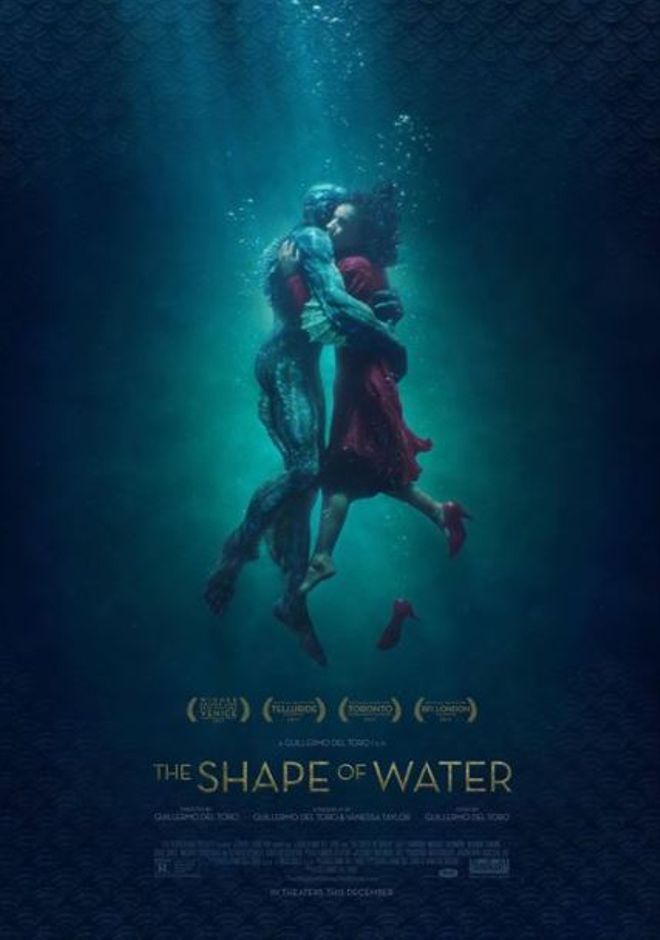
Guillermo del Toro: part arthouse director, part thumping action director, who else could have made both Pan’s Labyrinth and Pacific Rim? The Shape of Water falls firmly into the former category, and continues the director’s long-standing interest in fairy-tales and fables, creating adult bedtime stories filled with romance and wonder, but laced with violence and human horror (and it’s always the humans who are the monsters). The Shape of Water has been garlanded with huge praise – but yet I’m not quite sure about it. Just not quite sure.

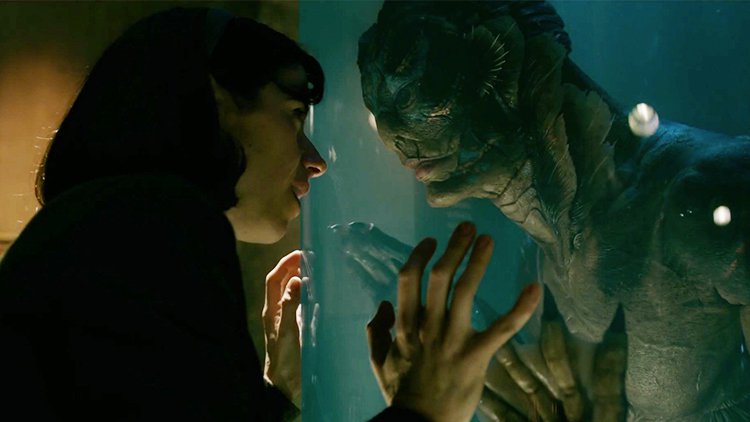
In 1962 in Baltimore, Elisa Esposito (Sally Hawkins) is a mute cleaner working in a government facility with her colleague, friend and effective translator Zelda (Octavia Spencer). Her only other friend is her neighbour, a gay out-of-work advert artist Giles (Richard Jenkins). The research facility takes delivery of a strange amphibious creature (Doug Jones), captured in the wild by sinister CIA man Richard Strickland (Michael Shannon). While Strickland and lead scientist Dr Hoffstetler (Michael Stuhlbarg) conduct tests on the creature, Elisa befriends it – the two of them drawn together by their isolation and inability to communicate verbally. When the decision comes from above to dissect the creature, Elisa decides to help it escape. 

The Shape of Wateris an adult fairy-tale that uses the structure, rules and heightened reality of the bedtime story. So we have Elisa as “the Princess without a voice”, the government facility as the evil castle, the creature as a mixture of damsel in distress and knight errant, and Michael Shannon’s vile government spook as a sort of perverted evil Queen. While the film is set in 1962, it’s aiming for a fantasy world feeling: Elisa and Giles even live above an old-school movie cinema, while the facility itself is a dank, subterranean concrete prison, part medieval dungeon, part industrial complex, dressed in a retro-1950s style. There’s no denying the film looks fantastically impressive.

The plot hinges on the growing bond between Elisa and the creature, which flourishes first into a mutual friendship, then semi-romance and finally into a full-blown relationship. If there is one part of the movie which I felt didn’t quite work, it was the build between friendship and love. While del Toro does some excellent work showing these two bonding over a common lack of language – she teaches him some basic sign language, they both share a love of music – I felt the jump between friendship and sexual attraction seemed a little big.

Del Toro films it all beautifully – and his empathy for both characters is very moving. But the film wants us to feel this deep connection for (and between) the two characters – and I’m just not sure I did. I’m not sure the film gives the time it needs for this development. Great as Michael Stuhlbarg’s (and excellent as his conflicted performance is) character is, could the film have removed his sub-plot and invested more time in the relationship? Yes it could – and I think this could have made a stronger movie. This is of course a personal reaction – I’m sure plenty of people will be bowled over by the romance of the film – but I didn’t quite buy it. For all the soulfulness of the film, I just didn’t find myself investing in this relationship as it built as much as I should.

This is despite Sally Hawkins’ expressive acting as Elisa. I find Hawkins a bit of an acquired taste: she is a little too twee, something about her eyes and vulnerable smile is a little too head-girlish. Of course that sprightly gentleness works perfectly here, but the character is more interesting when del Toro explores her depths, her desire and well-concealed resentfulness under a cheery exterior (practically the first thing we see her do is masturbate in the bath – a daily ritual timed to the second via egg timer, functionally getting these feelings out of the way before the day ahead). Hawkins mixes this gentle exterior and passionate interior extremely well throughout the film.

The principal supports are also excellent. It’s no coincidence that del Toro makes our heroes all outsiders: a mute, a black servant and an ageing gay man. As well as showing why these characters might be drawn together, it’s also a neat parallel commentary on attitudes of the time – Octavia Spencer in particular makes a huge amount out of a character that is effectively a voice for Elisa half the time, investing the part with a huge sisterly warmth.

Richard Jenkins is both very funny and rather sweet as a man scared of being alone and frightened about doing the right thing. Most of the film’s laughs come from him – but so does a large degree of its heart. Jenkins gets some fantastic material – from hints that he has been fired for social and sexual misdemeanors from his Mad Men-ish former job, to his growing realisation that his hand-drawn art is being left behind in a world embracing photography (“I think it’s my best work” has never sounded like a sadder mantra), and above all his hopelessly sad infatuation with the friendly barman at a local diner (the sort of hopeless crush you feel he must realise isn’t going to go anywhere good – but still manages to be endearing before it gets there).

Del Toro’s dreamy fable has plenty of potential monsters and obstacles in it – from government suits to Russian heavies – but the main antagonist is Shannon’s Strickland. Great as Shannon is in this role as a menacing heavy with a hinterland of insecurities and self-doubt, it’s a character that feels a little obvious. He’s the monster, you see! It’s a heavy-handedness the film sometimes uses – not least in its occasional references to the race politics of the era – that weights the deck, and tries to do a little too much of the work for the audience. Again, a film with one fewer sub-plot might have allowed this character greater depth. As it is, his vileness is established from the first second, which means the metaphor of his hand with its increasingly rotten, gangrenous fingers seems a little to on-the-nose.

But The Shape of Water is a labour of love, and a testament to love – and del Toro reminds us all what a luscious and romantic filmmaker he can be. The later romantic moments between Elisa and the Creature have a beauty to them – not least the moments when they immerse themselves together in water. Other moments are too obvious: an imagined song-and-dance routine is so signposted in advance that it carries little emotional impact. In fact, the film’s main fault may be it is too predictable: most of its plot developments I worked out within the first few minutes – but it sort of still works. After all, fairy-tales are predictable aren’t they?

Del Toro has made one from the heart here. It’s not a perfect film – it’s not a masterpiece, and I think it’s a less complex and affecting work than the brilliant Pan’s Labyrinth – but it’s made with a lot of love and a lot of lyrical romanticism. It looks absolutely astounding. It’s actually surprisingly funny and wonderfully acted: Richard Jenkins probably stands out, and my respect for Octavia Spencer continues to grow. Del Toro is gifted filmmaker, and he is working overtime here to make a romantic, sweeping, monster movie cum adult fairy-tale. All the ingredients are there: but somehow I didn’t fall in love. Did I miss it? Maybe I did. And I can’t think of much higher praise than I’m more than willing to go back and look again and see if I get more of a bond with it next time. But, for all its moments of genius, I found the delight was on the margins rather than the centre.

Pacific Rim (2013)


Idris Elba, Charlie Hunnam and Rinko Kikuchi are cancelling the Apocalypse in Pacific Rim

Director: Guillermo del Toro

Cast: Charlie Hunnam (Raleigh Becket), Idris Elba (General Stacker Pentecost), Rinko Kikuchi (Mako Mori), Charlie Day (Dr Newt Geiszler), Max Martini (Hercules Hansen), Robert Kazinsky (Chuck Hansen), Ron Perlman (Hannibal Chau), Clifton Collins Jnr (Tendo Choi), Burn Gorman (Dr Gottleib), Diego Klattenhoff (Yancy Beckett)

Film can be a beautiful and thought-provoking art-form. But sometimes, gosh darn it, you just want to leave the works of the great artists behind and watch a big, loud film in which giant robots hit giant monsters. Over and over again. In lurid, glorious, high colour detail. That’s pretty much the life and career of Guillermo del Toro. Make something like Pan’s Labyrinth. Then follow it up with something so wildly, tonally different you won’t believe it’s from the same guy: Pacific Rim.

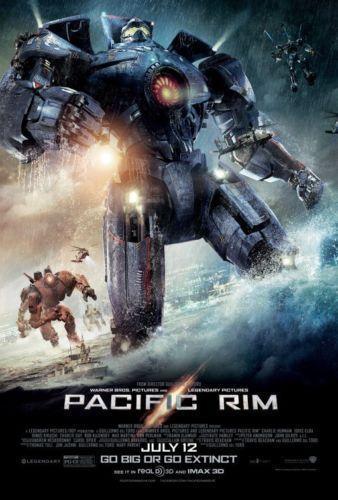
In 2013, huge monsters (Kaiju) emerge from an interdimensional portal at the bottom of the Pacific Ocean. As they destroy cities left, right and centre, mankind is pushed to the limit. Eventually they develop Jaegers – giant robots controlled by two pilots, whose minds are linked together and used to drive the Jaeger’s movements. In 2020, Raleigh Becket (Charlie Hunnam) leaves the Jaeger force, commanded by General Stacker Pentecost (Idris Elba), after his brother and co-pilot is killed by a Kaiju. By 2025, the world governments decide to cut the funding of the Jaeger programme – forcing Pentecost to call Becket out of retirement and team him with his adopted daughter Mako Mori (Rinko Kikuchi) to launch a final, desperate, assault on the portal with the few remaining Jaegers, in an attempt to stop the ever-increasing number of Kaijus for good.

Pacific Rim is loud. It is silly. Its plot is a collection of clichés and offcuts from other movies. Some of the acting in it is ludicrously bad, over-the-top, poorly accented or all three. It looks and sounds like a direct-to-DVD movie made on a massive budget. Yet, despite all this, it’s really, really good fun. The ultimate guilty pleasure. Deafeningly dumb, but somehow it sort of knows this, and it knows you know it, so it just gives you what you wanted when you sat down – bangs, bashes and silly dialogue. Maybe this all works because Del Toro is actually a real director: he can shoot this nonsense with a sense of flair and scale, and is confident enough as a storyteller to just accept he’s making a dumb film and doesn’t need to try and pile some spurious depth on it, but just run with the emptiness.

Pacific Rim gives you this: some truly sublime robot vs. monsters battling in a variety of beautifully shot locations, in particular downtown Hong Kong. I mean, who wouldn’t love seeing this smashy super-action? The robots basically look really cool, the monsters are really imaginative, it’s tonnes of fun. Of course the battles are silly, there is always “one more weapon” to use that is bigger and better than anything they’ve used before (so why not do that from the start?). Del Toro also shoots the fights with a surprisingly calm camera, that makes the action the frantic lead, rather than the normal thing you see in these films, with the camera flying around all over the place. They’re edited really well. The score is great. The battles don’t overstay their welcome, and the characters at the centre of the Jaegers are always kept front-and-centre. Who wouldn’t love them?

The plotline of the film has a B-movie directness, which del Toro manages to fill with some depth. It’s a film about co-operation and learning to work together. This should be pretty wearingly obvious – okay it is – but somehow it strangely moving in the film. The Jaegers literally need two people to work together so closely they share a mind to operate it. The whole Jaeger programme only works from intimate co-operation. Characters feud and argue – but the film is about them learning to overcome these differences and work together. The film hammers home the fatality rate of this war with kaijus so well, that you end up really caring for sacrifices and risks these people are running. When Jaeger pilots start dying, I find it actually rather moving in its brutal suddenness. 

At lot of this comes from the wonderful, hero-worshipping, film style del Toro uses. Look at shots such as when (in flashback) Idris Elba’s Penthouse climbs out of a Jaeger, framed by the sun behind him – he looks like some sort of ultimate hero. The Jaeger pilots all have their own distinctive themes, and are framed and shot with idealism and adoration. Sure their personal issues are the most rampant form of clichéd melodrama – but it’s sold with complete conviction, and told with such unabashed simplicity, that you end up caring for it. 

This is despite the fact that most of the acting is pretty below par. Idris Elba is the one major exception – the only one with the charisma to sell such basic plots as “dying of brain tumour” and to make chuckle worthy lines like “we are cancelling the apocalypse” sound like rallying cries, rather than seriously awful crap. Charlie Hunnam, by comparison, has nowhere near that level of charisma and Raleigh Becket is probably the most forgettable lead character you’re going to see in a movie like this. Robert Kazinsky is pretty awful as his rival Jaeger pilot (his accent is dreadful). Charlie Day and Burn Gorman are hit-and-miss as the comic sidekick scientists. Rinko Kikuchi is however pretty good – and with her “drift” memory loss she has probably the film’s most affecting sequence.

But this isn’t a film of subtle character work or sharp scripting. It’s got a B-Movie aesthetic, but it delivers it totally honestly. Basically, Guillermo del Toro is a good enough director to be comfortable with making a really, really good bad movie, Pacific Rim is deeply silly and stupid, but it is a lot of fun and its characters (despite their pretty forgettable or clichéd nature) are still people you really invest in. Del Toro pulls off a neat trick filming this, perhaps because the film is so sweetly honest, and unabashed, about what they are doing here. It’s got a heart-warming message about co-operation. It never feels exploitative. It’s got a childish sweetness about it, a real family robot basher. It’s the best bad movie you’ll ever see.