Tag: Haley Bennett

Cyrano (2021)

Cyrano (2021)

Slight but enjoyable musical, with the flaws of the original but some virtues of its own

Director: Joe Wright

Cast: Peter Dinklage (Cyrano de Bergerac), Haley Bennett (Roxanne), Kelvin Harrison Jr. (Christian de Neuvillette), Ben Mendelsohn (De Guiche), Monica Dolan (Marie), Bashir Salahuddin (Le Bret), Joshua James (Valvert), Anjana Vasan (Sister Claire), Ruth Sheen (Mother Marthe), Mark Benton (Montfleury), Richard McCabe (Priest), Peter Wight (Ragueneau)

Edmond Rostand’s play has been reinvented time-and-time again. After all, who can’t relate to a man convinced he’s unlovable and uses his poetic heart to write the words to help his rival woo the woman they both love. Erica Schmidt’s stage musical with songs by Aaron and Bryce Dessner from The National, pretty much keeps everything but kicks out the famous oversize nose in favour of making Cyrano a man with dwarfism. Bringing him to life – both here and on stage – is Schmidt’s husband Peter Dinklage, with his stage and screen love Roxanne portrayed by Haley Bennett, wife of Cyrano’s director Joe Wright.

It all helps create an easy-going feeling to Cyrano, a decent, at times impressive musical, that never quite turns into something really lasting but presents several fine songs in its middle act. It’s unfortunate that it’s opening section – and largely forgettable initial number – set the scene less than compellingly, dutifully repeating Rostand via a show-boating Cyrano easily besting a preening actor in a battle of wits, all while casting faintly longing looks at impressed Roxanne. What it doesn’t really do is seize the attention. In fact, what it does is really remind you what a slight story Cyrano de Bergerac really is: and that it only really starts with the Act Two introduction of Christian.

It’s certainly, it feels, where Wright’s interest begins. The romantic triangle between the three – Cyrano and Christian both in love with Roxanne, Roxanne in love with Christian and (perhaps) sub-consciously with Cyrano – introduces drama and stakes into a film that until then largely lacks either. Contrasts are drawn between Cyrano and Christian who share honour and decency, but are polar opposites in terms of confidence. Christian is physically and socially assured but crippled with inarticulate shyness when asked to speak; Cyrano can turn his feelings into poetry, but is convinced he is an unlovable imp, his confidence forever crushed by his appearance.

The concept of exchanging oversize nose for Dinklage’s dwarfism works rather well, when every single camera angle constantly reminds us of Cyrano’s otherness. It also gives a wonderful showpiece for the excellent Dinklage, who brings an intense, grungy charisma to the role. He can do the Cyrano’s performative showmanship, but also expertly demonstrates this is a front to protect his true self from being seen and potentially rejected. It becomes clear Cyrano partly embraces his titanic ghost-writing (hundreds and hundreds of pages), without Christian’s knowledge, because he genuinely feels it is the closest he can come to experiencing a relationship, just as he believes should he ever speak his true feelings they would inevitably be rejected. Dinklage does a wonderful job of balancing inner vulnerability with a mask of cocksure, arrogant confidence.

Cyrano certainly misses the subtle indicators, from the start, that Haley Bennett’s Roxanne might well have feelings for him. Aware that Cyrano de Bergerac often presents not the most flattering picture of Roxanne’s intelligence (she is a woman, after all, fooled for years into believing all those romantic words came from her husband not her lifelong friend). Bennett however let’s a – again perhaps subconscious – suspicion play just around the corner of her eyes, not to mention that her feelings for Cyrano feel a lot closer to romantic from the start. Is she as scared of rejection as Cyrano, put off by his independent front? After all she values honest feelings – and Christian, even if his words come from someone else, is clear about the way he feels in a way Cyrano never is. Kelvin Harrison Jr. is rather charming as this sweet, kind, strangely shy young man, tongue-tied and bemused by long words but with a strong sense of right and wrong.

The film – and the musical – is at its strongest when these three are interacting. Wright’s filmmaking also comes to life, with his more staid and traditional visual set-ups for the theatre-set prologue giving way (via a dynamic one-shot full of ducking and diving camerawork as Cyrano takes out ten assassins single-handed) to a series of balletic scenes. Large-scale musical numbers are accompanied by people going about every-day tasks with a wonderfully choreographed grace: be that bakers rhythmically kneading dough and stocking ovens, to a mass of soldiers fencing in perfect harmony. The songs also pick up considerably in both power and humability, culminating in the affecting Wherever I Fall, an eve-before-battle group number that sees Cyrano’s regiment preparing themselves for what could-be their final night, beautifully shot with a mist-filled coolness.

Cyrano’s slight story remains its weakness and the film can’t quite decide how to expand organically the deception plot at its heart. It’s almost a shame it bravely closes the door on the film’s most obvious protagonist, with Ben Mendelsohn’s De Guiche getting a scowling ‘villainy’ number but proving himself a man of honour. Fundamentally the long introduction to the set-up and the five-year-later coda the film wraps up with end-up feeling unsatisfying. It’s actually too faithful to Rostand, carrying across the original’s flaws. Cyrano embraces the mix of romance, comedy and sadness in its wooing-by-proxy and the odd-couple friendship between Cyrano and Christian, but feels more perfunctory as soon as it has to move beyond this section of the film.

It’s a shame as that central section is actually rather effective with Wright bringing the musical numbers in particular to life with a real delicate beauty. There are some very good performances, especially the heart-felt work from Dinklage, but it eventually strains towards an epic scale its story isn’t quite strong or engaging enough to support.

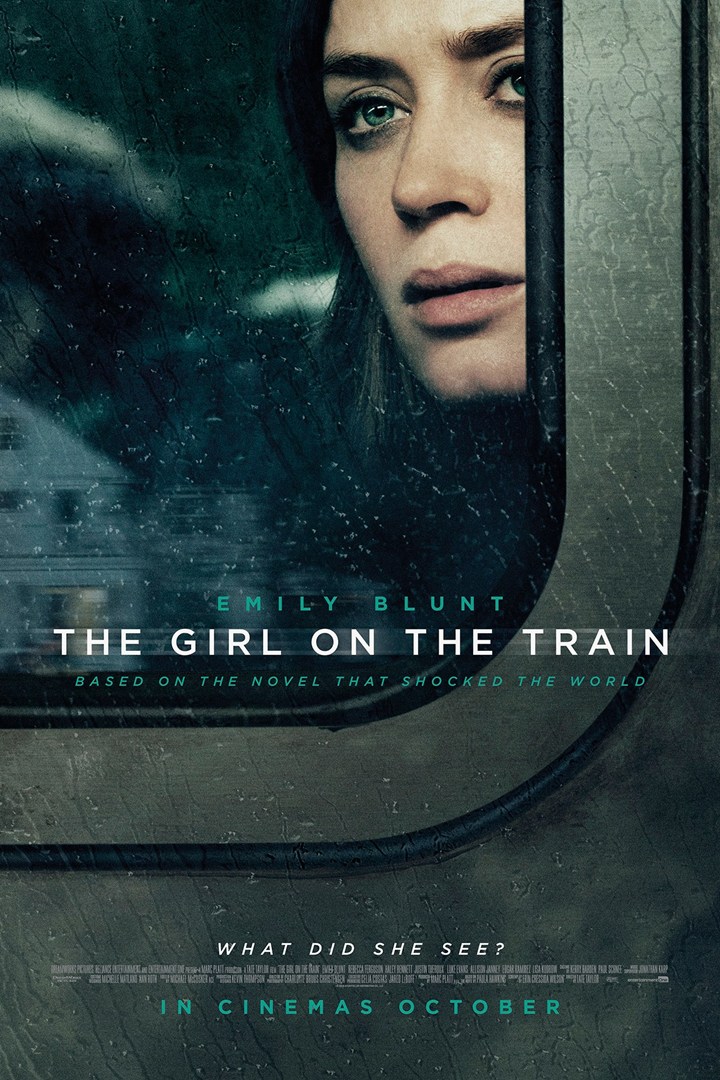
The Girl on the Train (2016)


Emily Blunt on a commute into danger in the underwhelming Girl on the Train

Director: Tate Taylor

Cast: Emily Blunt (Rachel Watson), Rebecca Ferguson (Ann Watson), Haley Bennett (Megan Hipwell), Justin Theroux (Tom Watson), Luke Evans (Scott Hipwell), Allison Janney (DS Riley), Edgar Ramirez (Dr Kamal Abdic), Lisa Kudrow (Martha), Laura Prepon (Cathy)

Rachel Watson (Emily Blunt) is a lonely, divorced alcoholic who takes the train into New York every day to spy on her husband (Justin Theroux) and his new wife (Rebecca Ferguson), whose house the train passes. However, she also becomes obsessed with the seemingly happy marriage of her ex’s neighbours (Luke Evans and Haley Bennett), who live an apparently Instagram-perfect life of coffee on the balcony and candlelit sex in their perfect living room (with the curtains conveniently left open – everyone leaves their curtains open in this film, no matter what they are doing). When the picture-perfect wife goes missing, she inveigles her way into their lives to try and help.

This is not a good film. It’s not a terrible film, but it’s a flat and lifeless one – a plot-boiler that simmers along without ever really getting exciting.  The story feels like it’s been pulled together from crumbs swept from the table of Gillian Flynn. It’s a hotchpotch mess, tangled, unclear and not that interesting. I can’t be the only person un-intrigued by the mystery of who shags who among the middle classes. Even a murder doesn’t spice it up. The small cast makes many mysteries obvious – when one character is found to be pregnant, but two of the three male characters we’ve been introduced to have been ruled out, you don’t need to be Poirot to work out who the father might be. Even the title is a call back to better thrillers, with its Girl with the Dragon Tattoo styled title.

The story drifts on and on, never really getting anyway or explaining anything properly. It doesn’t help that it’s mediocrely filmed. Look at the lean, compelling and sharp film David Fincher made of (the much better) Gone Girl. Then look at the murky, plodding, dull execution here. Particularly damningly it’s a shock to find out this is less than 2 hours, because it feels a hell of a lot longer.

The story has been switched from the book’s original London to somewhere outside Manhattan, which doesn’t help either. There is something quite small scale and domestic about the story that the sweeping vistas and huge houses of wealthy American suburbia don’t match up with. The very concept of the film – seeing into houses from commuter trains paused at signals – doesn’t even work removed from London’s architecture (the train in this film stops regularly on a huge expanse of track due to rail works that go on for ever and ever). Edgar Ramirez’s psychiatrist keeps the name Kamal Abdic (with its suggestion of middle Eastern roots) but now seems to be Mexican. Everyone in the film looks like a fashion model. Lots of other small moments just don’t make sense in the way they would have done in the original setting.

Emily Blunt is pretty good in the lead role, much better than the film deserves. Okay the drop-dead gorgeous Blunt doesn’t even remotely look like the overweight, sweaty alcoholic described in the book. But she nails her drunk acting, and carries the emotional heft of the film rather well, with an engaging vulnerability. She is, perhaps, even a little too engaging – the book’s original version of her character is apparently pretty unlikeable. The script trims away her needy obsessiveness, and creepy stalker tendencies. But Blunt is a little too likeable, and a little too sophisticated (despite prosthetic eyebags), to really convince as the pathetic Rachel. The switch to America doesn’t help here either – basically Brits make better losers than Americans tend to.

The rest of the cast are okay, but there is hardly a stand out among them. I have to admit I found Haley Bennett and Rebecca Ferguson (with their identikit blond hair dyes) hard to tell apart at times (this may be due to staying up all night watching the 2017 British election the night before).

By the end, when the killer is revealed (with a graphically suggestive flashback) you’ll find it hard to really care. In fact the final reveal is so clumsily put together all the implications aren’t clear at all. It’s a load of fuss about nothing. Taylor is trying to turn a pulpy novel into an arty thriller – but he doesn’t have the cinematic know-how to do it. He’s far too bland and middlebrow. Maybe that makes him a suitable match – a derivative director for a derivative book – but it hardly helps make this a good film. If he’d gone for a more B-movie approach, playing up the dark satire you could find in the story, then we could have had something interesting here. But he didn’t and we don’t.

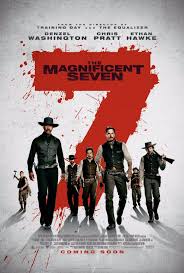
The Magnificent Seven (2016)


Denzel Washington leads his gang of seven wildly different souls to do battle for the little guy

Director: Antoine Fuqua

Cast: Denzel Washington (Sam Chisolm), Chris Pratt (Joshua Faraday), Ethan Hawke (Goodnight Robicheaux), Vincent D’Onofrio (Jack Horne), Byung-hun Lee (Billy Rocks), Manuel Garcia-Rulfo (Vasquez), Martin Sensmeier (Red Harvest), Haley Bennett (Emma Cullen), Peter Sarsgaard (Bartholomew Bogue), Luke Grimes (Teddy Q)

The Magnificent Seven is a much loved staple of BBC bank holiday weekend screenings. The original wasn’t a brilliant piece of film-making art, but it was a brilliant piece of film-making entertainment, and it had simple, wry, heartfelt (if sometimes on-the-nose) observations to make about the sacrifices the life of a gunslinger calls for. How does the remake measure up?

In 1879, the village of Rose Creek is besieged by would-be industrialist Bartholomew Brogue (Peter Sarsgaard), who orders the villagers to leave as he plans to expand the local mine. Newly widowed Emma Cullen (Haley Bennett) sets out to recruit gunslingers to help protect the town. Warrant Officer Sam Chisolm (Denzel Washington) is her first recruit, and he helps her to gather six others from drunken cardsharp Joshua Faraday (Chris Pratt) to legendary sharpshooter Goodnight Robicheaux (Ethan Hawke). But the battle to protect the village will lead to many good men six feet under before our heroes can have the chance to prevail…

One thing’s for sure. In 60 years’ time they won’t be playing this film every bank holiday weekend. That doesn’t mean this is a bad film, it’s just quite an average one. It’s decently done, has several good scenes and even one or two witty lines in among a fairly routine script, but there is very little imagination or inspiration behind this. It’s got a decent cast of actors, but you always feel they are lifting average material rather than working with the good stuff. While the original film combined a sense of boyhood heroics and some iconic performances with some exploration of the emptiness of the life of a gunslinger and the attraction of a normal life, this film manages to deliver much less on all these counts.

So first the good parts. Much of the gun-toting action is very well done. The first shootout as our heroes arrive in the town is terrific (see link below), full of thrilling beats and rewindable moments. To be honest, it’s the best moment of the film, and as close as it comes to capturing the excitement of old-school gunslinging action. The final battle scene is decent, but offers generally more of the same with additional (no spoilers to say) sacrifice. Even without the inspirations of the original film, many of the character beats will be familiar to the watching audience. I successfully predicted which of the cowboys would survive early in the film, and only one death is near to a surprise. It’s well done, but it’s not got the filmmaking expertise of Kevin Costner’s Open Range, with its final small-band-against-an-army structure, nor that film’s intelligent and low-key analysis of the cost of violence.

It’s that lack of human insight that I think is one of the film’s principal weaknesses. The original had more to say about the damage a life of violence can inflict on people, and the longing even the most hardened man of the world can find for  the simple life – as well as the lengths they will go to in order to protect it. This film offers none of that. The motivations for the seven in joining are incredibly thin, almost after-thoughts. At least two members of the team simply turn-up, as if dropped from the sky. Team leader Chris has a “very personal” motivation, signposted from the very start, that serves to undermine much of the depths we seem to learn about his character during the film – as well as making him just another “man looking for revenge” architype.

On top of that, a serious trick is missed when setting this film near the end of the Western era. Already the time of these lawless gunslingers is coming to an end, and they have no place in the modern world. The villain is a sort of corporate bully, launching a hostile take-over of the village for his mining company. There is plenty of thematic material to mine here of these men taking a stand not only against the strong persecuting the weak, but also against the onrush of time that is leaving them behind. Now I’m not expecting the film to be a serious socio-economic discussion, but I’d like to watch a film that at least tips the hat to ideas like this (or any ideas at all) rather than just push through a well-filmed but-by-the-numbers remake.

Saying all this, it is pretty entertaining in an unchallenging way. It does make you want to go back and re-watch the original version (which was itself, to be fair, little more than a crowd pleaser). But that’s kind of all it is – and it doesn’t have any ambition to be more. But it’s a good watch and some of the updating ideas work very well. The multiracial composition of the seven works very well, and Haley Bennett as the “Eighth” member of the team, is a strongly written role that feels like a character rather than an accessory. Washington can do this role standing on his head, but brings his customary authority. Chris Pratt is at his Harrison Fordish charming best, particularly on the edge of bursting out into a childish grin, in gleeful excitement at being paid to play cowboys. Hawke is saddled with the thematic content as a gunslinger with PTSD, but makes a good fist of it. Much of the rest of the gang are a collection of moments rather than characters, but do their jobs well.

The Magnificent Seven, it seems too easy to say, isn’t magnificent. It’s an unambitious film without any real thinking or imagination in its conception. It seems scared of introducing anything too conceptual or thought-provoking in its setting or plot. It’s just about entertaining enough to survive while you are watching it, but its life is going to be little longer than the two hours you watch it, not the 60 years of its predecessor.