
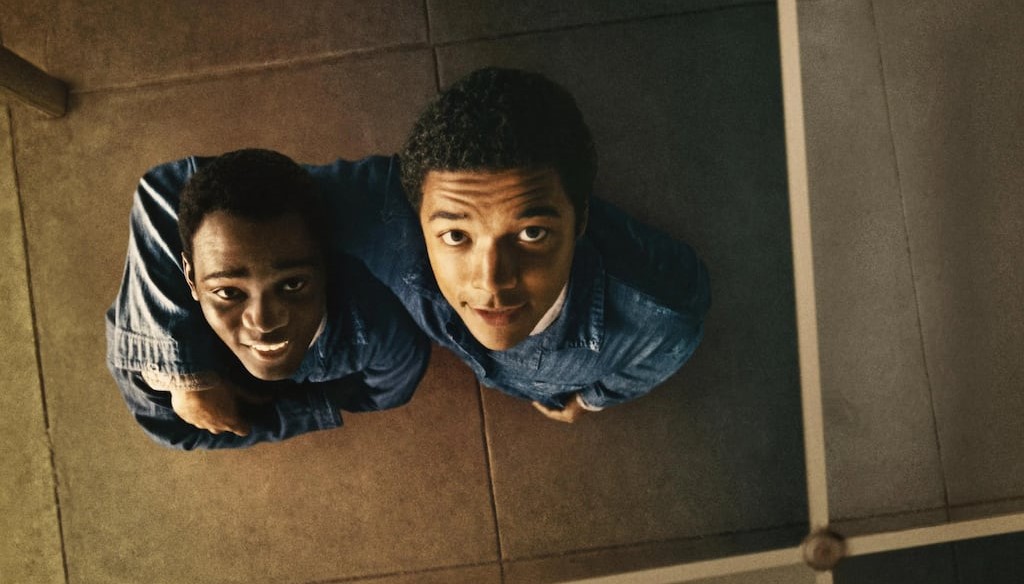
Beautiful and emotional film, with a unique filming style, at times too overtly arty but truly striking
Director: RaMell Ross
Cast: Ethan Herisse (Elwood), Brandon Wilson (Turner), Aunjanue Ellis-Taylor (Hattie), Hamish Linklater (Spencer), Fred Hechinger (Harper), Jimmie Fails (Mr Hill), Daveed Diggs (Adult Eldwood)

In the Deep South of America in the 1960s, a Black American couldn’t afford a wrong-place-wrong-time situation. That’s what happens though to teenager Elwood (Ethan Herisse). A star student, who firmly believes in civil rights and the power of moral action, he accepts a lift to college in what turns out to be a stolen car and is sentenced to an indefinite time in a Louisiana reform school, the Nickel Academy. Despite its lofty claims, the school is a bastion of racism where the black ‘students’ are housed in shabby huts and subjected to beatings, violence and exploitation as slave labour with almost no chance of leaving. The desperate efforts of his grandmother (Aunjanue Ellis-Taylor) to get his release are doomed to failure and his only friend is cynical Turner (Brandon Wilson). Decades later, an adult Elwood (Daveed Diggs) reacts as shocking news reports of unmarked mass graves of Black inmates are found at the site of old Nickel Academy.
Nickel Boys is adapted by RaMell Ross (making his fiction debut) from a Pulitzer Prize winning novel by Colson Whitehead, itself a fictionalisation of a real-life scandal. Dealing with challenging, difficult subject matter, its remarkable what a poetic, sensitive and subtle film Ross has created. Nickel Boys is a sad, lyrical, deeply tragic film which immerses us in the POV of its lead characters, making us feel the same hopelessness and powerlessness they do in a system designed to make them suffer.
Ross shoots Nickel Boys almost exclusively in POV, initially solely from Elwood’s perspective then switching back-and-forth between him and Turner. The older Elwood is shot as if the camera is strapped to his back (like the weight of the world). Ross commits to an extraordinary degree to this unique look-and-feel, with the camera focusing with the same roaming as a head turn, sometimes frustrating us by looking at the ‘wrong’ thing. What it does, above all, is forces us into the shoes of these boys: we see the sights exactly as we see them, their abusers stare into our eyes, we are made to feel as trapped in this small world as they are.
Ross opens Nickel Boys with its most extraordinary and beautiful sequence – one so perfectly constructed, it’s worth the price of admission alone – as we watch through Elwood’s eyes his growing up through a series of vividly remembered memories, our only glance of him brief reflections. This is a parade of truly striking images: a sidesways horizon with an arm stretched out (Elwood lying on his side); tinsel sprinkling down at us from the tree his grandmother is decorating; hazy soft-focus as a half-asleep Elwood witnesses his parents last-night in town; segregated bus journeys; his first encounters with civil rights; the aggressive searching of himself and another boy by a police officer; and his unjust arrest and imprisonment. It’s a breath-taking sequence, a virtuoso and deeply moving exploration of childhood impressions and contrasting memories.
The rest of Nickel Boys doesn’t quite match this glorious opening, but Ross uses the POV to take a surprisingly brave side-swipe in what we see and don’t see. The film becomes a tour-de-force of half looking, with the horrors of the Nickel Academy largely off-screen and ripe for our interpretation. In that, Nickel Boys would make an astonishing companion piece to The Zone of Interest which similarly took an unusual perspective on atrocity, as something on the edge of our visual and aural perception. When Elwood is beaten, the camera pulls away and cuts to extreme close-ups of black-and-white photos of Nickel Academy students to a cacophony of disjointed sound from Elwood’s thrashing.
Ross turns Nickel Boys into a sensory experience, one of acutely captured sounds and gorgeous imagery. The world of our two protagonists drifts interminably on, from eeking out their labour for the family and friends of the Academy’s staff – and Ross’ film makes clear this is unpaid convict labour – to seeing their ‘education’ ignored. The Black boys are kept at the margins of the grounds, never touching the privileges of the white boys with their football games – the only sport available to them is boxing, and there the school’s Black champ is ordered to take a dive to fix the betting ring among the staff (and ‘disappears’ when he, possibly mistakenly, fails to do so).
In this world Elwood is clinging to the hope that he can make a difference: by keeping a detailed log of the abuses and crimes, he might be able to escape. Elwood is a firm believer in civil rights – in one of the film’s most striking moments he runs across a busy street because he (and us – the visual deception is uncanny) mistakes a cardboard cut-out of his hero Martin Luther King as the real thing. His hope is only dented by the growing despair of his grandmother (a deeply heartfelt performance by Ellis-Taylor) and their swindling by their crooked lawyer.
By contrast, Turner is coldly cynical, convinced they have no chance of escaping the Nick alive. Turner’s bitterness – at one point he holds back Elwood’s precious letters for reasons he barely understands, but linked perhaps to his jealousy at never having any himself – is a sharp counterpoint to Elwood’s optimism, the two finding their contrasting viewpoints draws them closer together.
The legacy of events continues to be felt years later, with Elwood still haunted by his memories, struggling to adjust with his survivor’s guilt. A beautifully judged scene in a bar sees the adult Elwood encounter a fellow survivor (an extremely striking performance by Craig Tate) which not only sees Elwood deeply uncomfortable at this vivid reminder of his past – Tate’s Chicken Pete is fragile, alcoholic and not-all-there – but deeply disconcerted to find Pete has almost no memory of foundational events in Elwood’s life. It’s an affecting reminder that we are seeing one experience, and that the memories of each survivor would be radically different.
Nickel Boys has its flaws. At nearly two hours and twenty minutes, its running time dilutes its impact. Despite fine performances by Ethan Herisse and Brandon Wilson, the POV shooting at times makes it harder to personally engage with their characters, so focused is the film on sharing their experience at the cost of their reactions (which, naturally, we rarely see). Ross is a little too in love of documentary-style montages, which slow the pace rather than enrich the experience and can dilute the impact. A tighter, less at-times wilfully artistic film might have actually carried more force.
But it’s also a film full of deep sensory impact, that builds towards a shocking and deeply affecting climax that causes us to re-interpret much of what we have seen. And for large chunks, the film’s unique filming style creates a movie full of poetic wonder that places us firmly into the experience of living in a racist, unjust system like this one. For that alone, Nickel Boys deserves to be commended as a thought-provoking, striking film, one that leaves a real impact on the viewer.
 Movie Musings