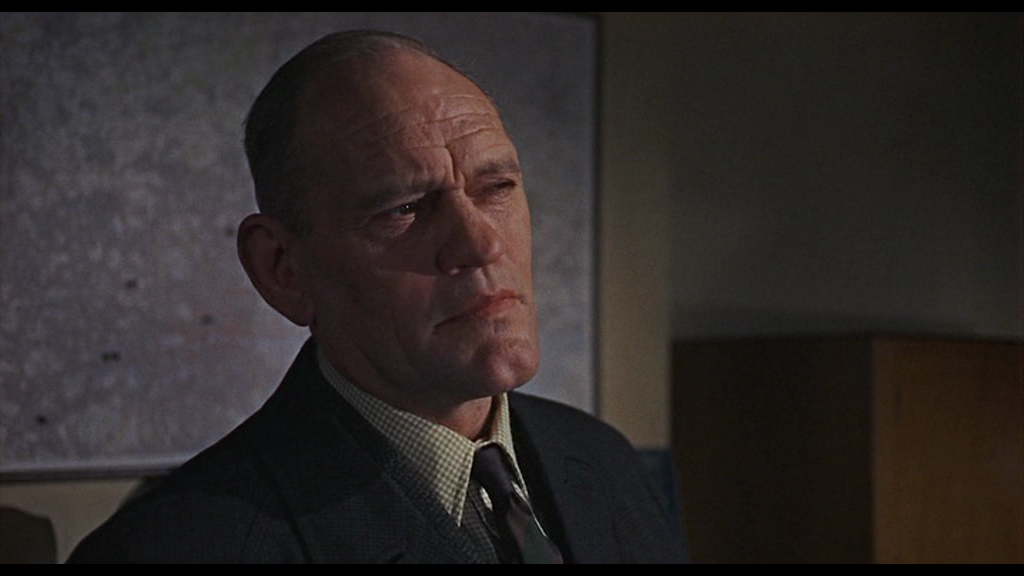
Tag: Harriet Andersson

Fanny and Alexander (1982)

Fanny and Alexander (1982)

Bergman’s gorgeous final film, a sublime family saga, that leaves you thinking for days

Director: Ingmar Bergman

Cast: Bertil Guve (Alexander Ekdahl), Pernilla Allwin (Fanny Ekdahl), Ewa Fröling (Emilie Ekdahl), Jan Malmsjö (Bishop Edvard Vergérus), Gunn Wållgren (Helena Ekdahl), Erland Josephson (Isak Jacobi), Jarl Kulle (Gustav Adolf Ekdahl), Allan Edwall (Oscar Ekdahl), Pernilla August (Maj), Mona Malm (Alma Ekdahl), Börje Ahlstedt (Carl Ekdahl), Christina Schollin (Lydia Ekdahl), Harriet Andersson (Justina), Stina Ekblad (Ismael Retzinsky), Mats Bergman (Aron Retzinsky), Gunnar Björnstrand (Filip Landahl)

After many years (and masterpieces) Bergman wanted to move on from film: but before he went, there was time for one more magnum opus, a sprawling family saga that would throw a host of his interests (death, family, sexual openness, God, theatre, infidelity, the unknowable) onto one grand, sprawling canvas. Fanny and Alexander would be a truly personal film, featuring a young protagonist with more than a passing resemblance to Bergman himself. Despite this it’s an irony Bergman might like that the finest version of this film we have is actually a five-hour recut for television (the limits of run-time from distributors being one of many things Bergman was tired of). That version is a beautiful, life-affirming, gorgeous piece of film-making, an extraordinarily humane story tinged with the supernatural told on a luscious, Visconti-like scale. It’s a fitting sign-off from a master.

In 1907, the wealthy Ekdahl family live in a luxurious apartment block, their rooms filled with the rich detail of their love of art and culture. Ten-year-old Alexander’s (Bertil Guve) father Oscar (Allan Edwall) and mother Emilie (Ewa Fröling) run the Ekhdal theatre, where his wealthy grandmother Helena (Gunn Wållgren) once performed. After a fabulous Christmas celebration, Oscar dies after a stroke while rehearsing the role of the Ghost in Hamlet. After a period of mourning, Emilie remarries to the older Bishop Edvard Vergérus (Jan Malmsjö), who turns out to be a domestic tyrant, obsessed with the letter of religious and family law. Will Alexander, his younger sister Fanny (Pernilla Allwin) and their mother escape from Vergérus’ controlling clutches?

What really strikes you first and foremost about Fanny and Alexander is its gorgeous warmth – hardly the first quality you traditionally associate with Bergman. It opens with a prolonged (over an hour) Christmas celebration, with the family and their servants eating, laughing, telling stories and dancing through their gorgeously furnished apartment. It should feel indulgent (and I suppose it is), but this warm reconstruction of an at-times-flawed, but fundamentally loving and vibrant family is actually deeply moving and heart-warming.

The Ekdahls have a bohemian freedom, with their love of theatre and art (only Uncle Carl, a manic depressive businessman, feels slightly out-of-place and even he takes the children to one-side during the festivities to entertain them by blowing out candles with his farts). Their house is charmingly egalitarian, with the servants treated as part of the family, loyalty they return. The theatre troupe (led by Bergman regular Gunnar Björnstrand in his final, small, role) – are equally part of this extended family, the theatre a second magical home where the children take small roles in various productions and delight in the stagecraft and costumes behind-the-scenes.

Fitting a Bergman family (and the Ekdahl’s share some elements with parts of Bergman’s family) they are extremely forward-looking in their morality. Uncle Gustav Adolf (played with bombastic, gentle charm by Jarl Kulle) is a notorious ladies man, but goes about it with such innocence and near-childish openness his patient wife Alma (Mona Malm) indulges him because in all other respects he’s a loving husband and father, and his overall fidelity to her is never in doubt. Alma restricts herself to a single slap of his new lover, maid Maj, but otherwise treats her like a sister. Pernilla August is hugely endearing as this caring young woman, swiftly absorbed into the wider Ekdahl family who value her care for others. The Ekdahl’s have no time for conventional morality, led from the front by matriarch Helena (Gunn Wållgren is fantastic as this wordly-wise, ideal grandmother figure) who has lived a life of sexual openness with her husband and values people not societal conventions.

Oscar, their father (wonderfully played by Allan Edwall as a bashfully mediocre actor and a quietly shy but warm man) takes his role as the leader of this company very seriously, but with a light touch (modestly bemoaning his lack of statue compared to his father). Bergman uses a myriad of small moments to make this father an ideal parent, not least a late-night fantastical story he improvises for the children, spun around their nursery room chair, one of the most tender moments of parent-child bonding in the movies. (This despite hints that Oscar, who has allowed the younger, more sensual Emilie to conduct her own affairs, might not be their true father).

The stunning production and costume design (which won Oscars for Anna Asp and Marik Vos-Lundh) are essential for creating this immersive, rich and vibrant life: one which will be exploded in Dickensian tragedy by the death of Oscar and the arrival of the Murdstone-like Edvard Vergérus (played with chilling, smug hypocrisy by Jan Malmsjö under a fake smile) who is everything the Ekdahls are not. Where they are warm and egalitarian, he is cool and elitist, he is a prude with no regard for art and his home is in bleached-out puritan stone, devoid of personal touches – it literally looks like a different world to that we’ve spent the first few hours in, full of untrustworthy people (like Vergérus’ maid played by a wonderfully two-faced Harriet Andersson).

Vergérus is all about control, something we suspect from the start with his aggressively tender manhandling of Alexander, his hand slamming into the back of his neck. He worms his way into the affections of Emilie – a woman who, with her earth-shattering wails over the body of Oscar, is clearly vulnerable in her raw grief (Ewa Fröling is extraordinary as this gentle figure, prone to appalling judgement and unexpected strength of character) – and then sets out their marriage terms with controlling agendas, not least that in arriving in his house, she and her children must shed every inch of their previous life, from personal connections to the knick-knacks they have grown to love. He’s a poor advert for a God Alexander is already cursing for taking his father (his attic, filled with crumbling religious symbols, feels of a part of Bergman’s world where God is at best a passive observer, at worst a near malicious presence).

Bergman makes clear Vergérus is a man who genuinely believes he is doing the best for his family and that the moral lessons he hands out, at the end of a cane, to Alexander are essential. A weak man who mistakes bullying for strength. In many ways the fact he is not vindictive just weak and convinced of his own moral certainty (re-enforced by his fawning family, who treat him like a sort of prophet). Sure, he’s capable of anger, anti-Semitic slurs and little acts of cruelty, but Malmsjö shows him as a man who is trying, in his own wrong-headed way, to win the love of his adopted wife and children and can’t understand why he is not met with gratitude and love.
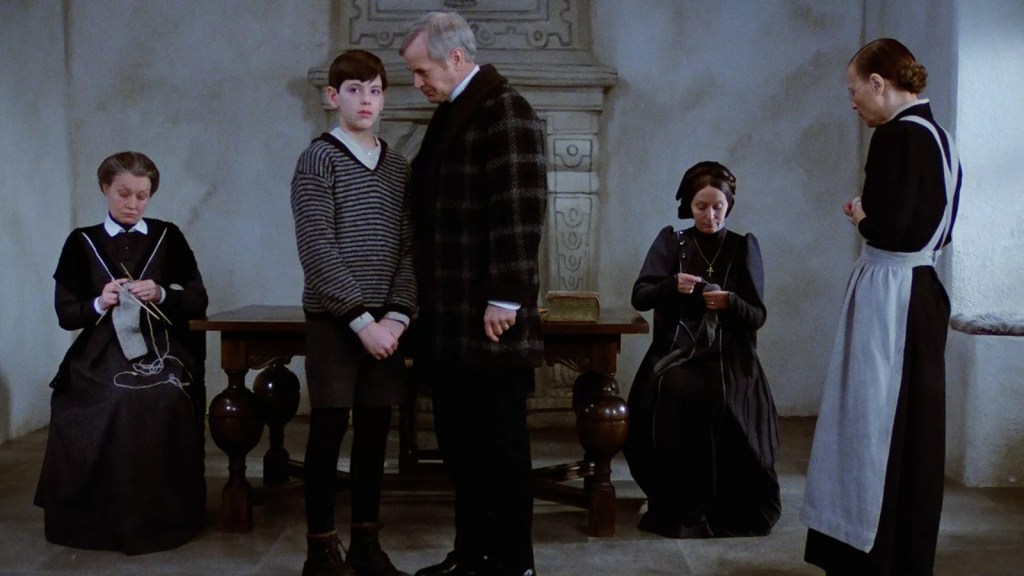
Perhaps it’s this sudden dropping into a cold world (one not dissimilar from Bergman’s own troubled relationship with his priest father – in fact you leave Fanny and Alexander wondering if Bergman hated his own father as much as Alexander who literally prays for his death) that so sparks Alexander’s own links to a mystic world around him. There is a rich vein of something other throughout Fanny and Alexander, from the statues Alexander watches move in the opening sequence (not to mention the haunting spectre of Death he witnesses in the same moment), to Oscar constantly appearing to Alexander like Hamlet’s Ghost. Is this haunting Alexander’s guilt at this failure to face his dying father on his deathbed, or a link to a world beyond our understanding?

After all Oscar’s Ghost greets Helena at one point, the two entering into a loving conversation. And he’s not the only supernatural touch around Fanny and Alexander. Family friend (and Helena’s lover) the Jew Isak (a rich performance by Bergman regular Erland Josephson) lives in a house full of mystic puppets that might be able to breath and walk. Isak perhaps uses magic to help smuggle the children out of Vergérus’ house (making them appear in two places at once), while his androgenous son Ismael (played by a woman, Stina Ekbad) is implied to having the spiritual power to channel Alexander’s hatred of Vergérus into actual supernatural revenge in the real world (another classic literary touch, that plays on spirituality and the Mad Woman in the Attic in Jane Eyre).

Fanny and Alexander is an extraordinary film, I feel I have only begun to scratch its surface here. It’s both a Dickensian family fable and a semi-benevolent Ghost story. It’s a family saga and a careful look at a particular time and place. It’s funny and moving. It really feels like one final mighty effort from a master.
Cries and Whispers (1972)

Cries and Whispers (1972)

Bergman’s heart-rendering, challenging and compelling family drama: a slice of raw pain

Director: Ingmar Bergman

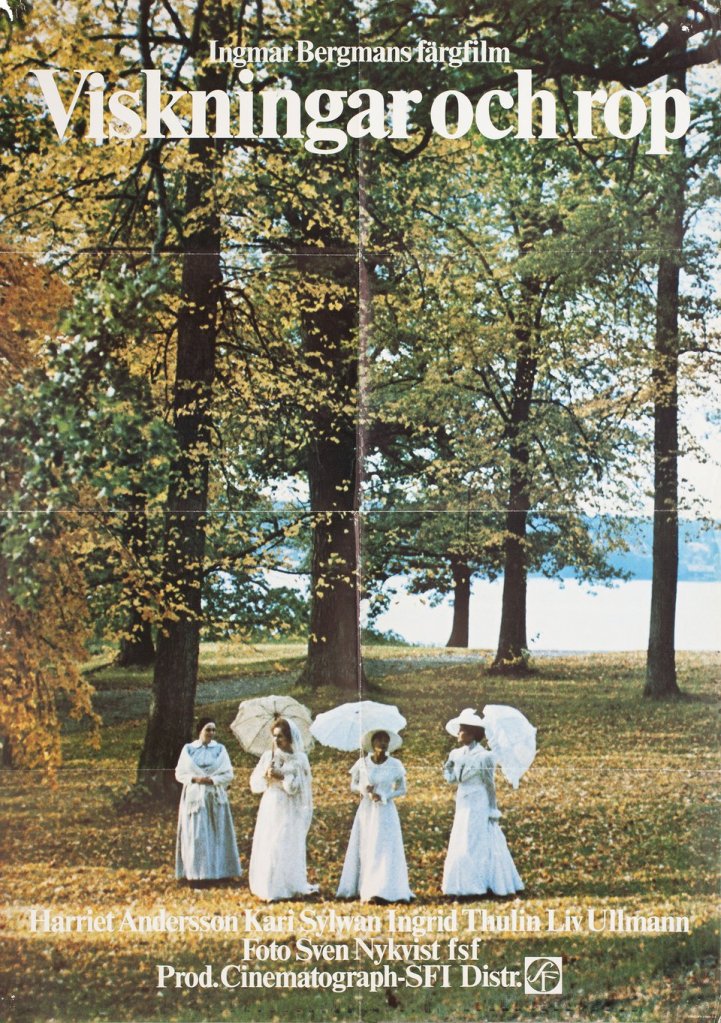
Cast: Harriet Andersson (Agnes), Ingrid Thulin (Karin), Liv Ullmann (Maria), Kari Sylwan (Anna), Anders Ek (Isak, the priest), Inga Gill (Aunt Olga), Erland Josephson (David), Henning Moritzen (Joakim), Georg Årlin (Fredrik)

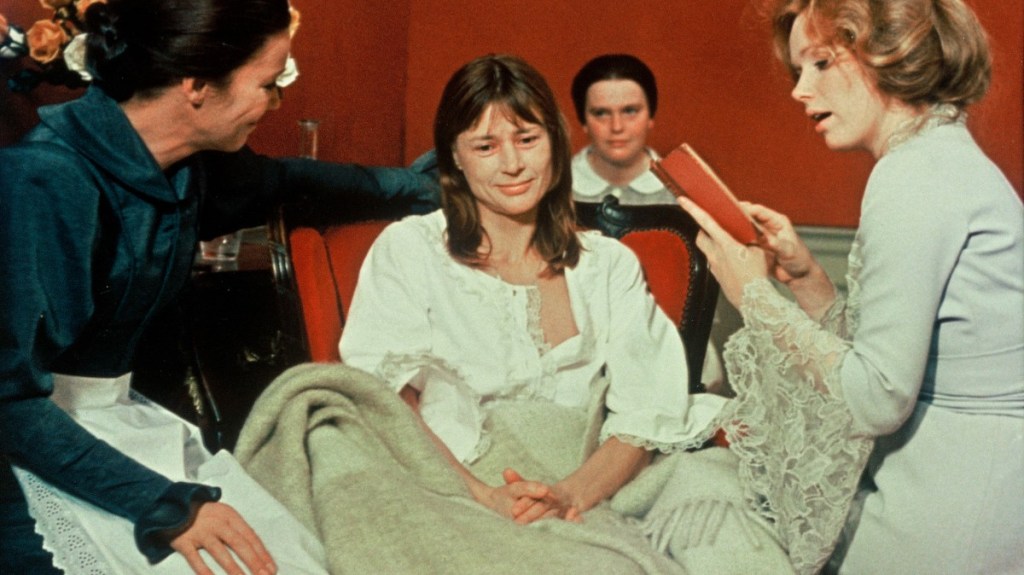
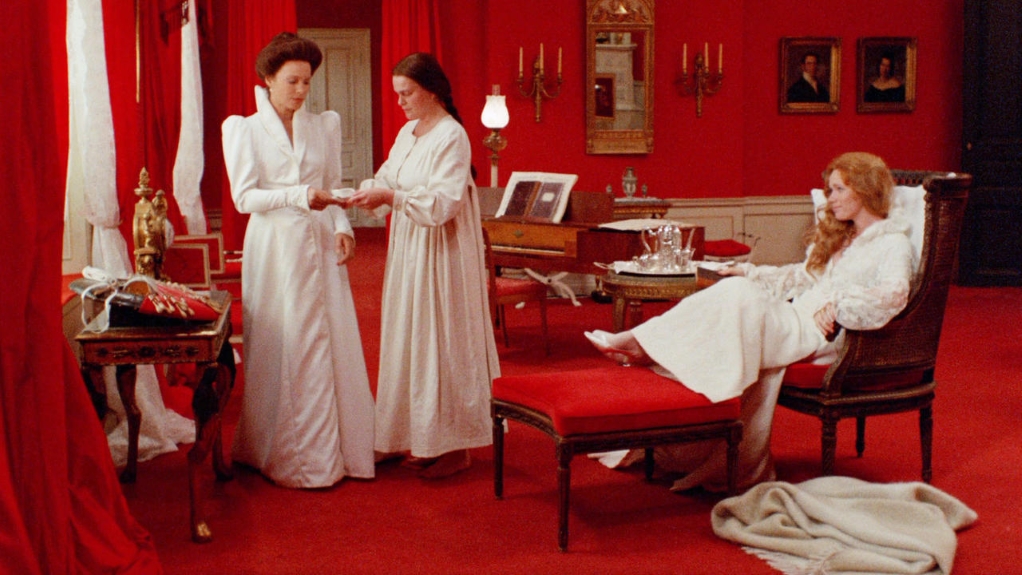
It came to Bergman in a dream: a red-lined room, where four women dressed in white whisper intimate secrets to each other. It became one of his most elliptical, horrifying and haunting films, a cryptic puzzle about life and death, faith and despair, love and hate, sex and violence and almost every human experience in between, all filmed within an imposing (and beautifully shot) red-walled house that turns more-and-more into a nightmareish Satre-style trap. Cries and Whispers sits alongside Persona as one of Bergman’s most successful reaches for the sublimely unknown and if it doesn’t quite touch Persona’s astonishing mastery, it’s remarkable by every measure.

Two sisters gather to nurse a third as she goes through the final days of a long, painful illness. Karin (Ingrid Thulin), the oldest, is professional, distant and repressed; Maria (Liv Ullman) the youngest is sensual, flighty and slightly selfish. The dying Agnes (Harriet Andersson) yearns for love and affection, but is a natural outsider. Agnes is most devotedly cared for by the maid Anna (Kari Sylwan), a young woman who lost a child a few years ago. As Agnes’ final days approach, all four mull on life, their decisions and choices, each trying to grasp some understanding about the great mystery of life.

Cries and Whispers feels like a savage slash of raw pain. Perhaps no other film in Bergman hits like such a punch to the gut. In this red-lined house, everyone is silently screaming behind the whispers (literally so in Agnes’ case, the film opening with Harriet Andersson writhing in wordless agony on her bed for an almost unbearable shot held for almost four minutes). All four of these characters are carrying mountains of disappointment, despair and disillusionments on their shoulders, none of them able to see a way out of the constant grind of simply struggling through existence. You could argue that Agnes has the easiest path in death.

The overbearing red walls – not to mention the fades to ‘red-out’ that seem to drown out the faces of the four women as each stares into the camera before their own memory or dream is staged by Bergman – begins to feel increasingly like a trap. The lack of natural light adds even more to the sense that this is taking place in some sort of prison or oppressive womb, cooking up traumas. There doesn’t seem to be any escape from this pressure-cooker atmosphere (rather like the claustrophobic trappings of The Silence and Persona), with reality starting to fracture and dissolve.

It becomes clear there are decades of unspoken tensions between the three sisters. Karin and Maria seem to be tending for their system more out of duty than love: Maria sleeps through her watch, while Karin feels like a dutiful professional rather than a loving sister. There is precious little sense of intimacy between them. So much so, that both sisters will utterly reject (in a late dream sequence that topples into a nightmare) even the hint of tenderness or contact with the deceased Agnes (Maria will run, screaming, at the very idea). It’s the same between Maria and Karin, who seemingly have nothing except blood in common.

But then they could hardly be two more contrasting women. Liv Ullman is superbly multi-layered as a woman who feels at first flirtatious and light-hearted but emerges as manipulative and selfish with a rich vein of self-loathing, compensated by a malicious pleasure in hurting other people. Her sexual fascination with Erland Josephson’s aloof doctor is based less on his qualities and more on his frank deconstruction of her physical flaws, accentuated by the deep pain and distress the affair causes her husband. Similarly with Karin, she alternates between reaching out to in shared sisterly closeness, then denying she ever felt or said such things a day later.

Like other Bergman films there is dark implication of incest in the relationship between Maria and Karin. In their moments of reconciliation, their physicality (all stroking and kissing) stinks of sexuality, their unheard whispers incredibly suggestive. Is this a foul secret what that has made Karin so deeply disgusted by physical intimacy? This is after all a woman who (in a flourish where I feel Bergman goes too far) cuts her vagina with a piece of glass and defiantly smears the blood over her face in front of her husband to prevent him from claiming his conjugal rights.

Ingrid Thulin is extraordinary as Karin, a deeply repressed woman utterly bereft in the world, who secretly yearns for closeness and contact. She seems though to have a very little idea how to build emotional bridges with people, her manner reserved and cold, unable to even treat the dying Agnes as anything other than a duty. If Maria quietly delights in making people feel bad and is disturbed by feelings of warmth, Karin is unable to even begin to arouse feelings of any sort from other people. She lives in an isolation that has left her deeply unhappy.

Strangely, Agnes herself might even be the happiest – and she’s dying. Agnes is the only person Bergman allows to narrate her own flashbacks (the other three are all introduced in voiceover by Bergman himself). Beautifully played by Harriet Anderson as a woman full of hope, despite the appalling pain of her illness, she is a strange beacon of contentment. The priest at her wake (a beautifully delivered monologue from Anders Ek) even confesses he cannot help but question the strength of his own faith compared to the spirituality of Agnes. What sign is there of God in this world when he punishes with such excruciating pain the purest person in the film?

Harriet Andersson’s performance is not only almost unbearably in its raw physical commitment to pain, but also a quietly moving in its emotion. Agnes is a woman longing to be closer to her sisters – envying Maria’s closeness to their mother as a child (the mother is also played by Liv Ullman) – feeling closer to her mother only when observing her in solitary moments of pain. Her happiest memory is of the three sisters as adults, contently laughing together on a swing. This willingness to embrace love – always a matter of key importance to Bergman – singles her out from the two-faced Maria or the repressed Karin.

It also explains the link to Anna, played with a quiet observance by Kari Sylwan. Frequently silently, moving through the frame or performing duties, Anna is the only person in the house who categorically loves and respects Agnes. It’s she who cares for her, who tends her, nurses her through her pain and most readily responds to her desire for closeness. There is, in fact, a hint of sexual familiarity between the two – it’s very possible to imagine them as lovers. Do Agnes’ family recognise – and envy – that breach of distance, that leads them to offer only the smallest reward for her service and a curt dismissal after Agnes’ death?

Or are Anna’s motives as clear cut and noble as they appear? Grieving the (clearly relatively recent) death of a child, perhaps Anna uses Agnes to fill emotional holes in her own life. Her dream-like fantasy of Agnes’ after death rotates around Anna taking almost complete possession of her deceased mistress, dismissing the sisters and cradling the dying Anna in a pieta like grasp that resembles a mother and child rather than lovers. Is Anna desperately using this moment of death, just as Karin and Maria do, to fulfil longings in herself?

All these ideas are superbly explored in Bergman’s beautifully paced and powerful work, like the best of his films a hauntingly intriguing and challenging work that lingers long in the mind after it finishes. With four very different, but extraordinary performances, at its heart it may at times be a little too intellectual and Bergman may at times go a little too far, but for its extraordinary exploration of raw, vicious pain it can be hard to beat. A challenging but extremely necessary film.

Through a Glass Darkly (1961)

Through a Glass Darkly (1961)

Faith, family and femininity are put to the test in Bergman’s bleak meditation on religion and love

Director: Ingmar Bergman

Cast: Harriet Andersson (Karin), Gunnar Björnstrand (David), Max von Sydow (Martin), Lars Passgård (Minus)

Bergman’s Through a Glass Darkly marks a new era in the Master’s filmography. It was the first of three thematically connected films about faith and religion (although you could argue The Virgin Spring really makes this a quartet). It saw Bergman make a firm commitment to seemingly theatrical chamber pieces, with small, focused casts of trusted collaborators handling complex (joke-free) and searching themes. It was also first of his films set on Fårö, a place that would become so associated with him it would effectively be rechristened Bergman Island.

Through a Glass Darkly (Bergman’s second consecutive Oscar winner for Best Foreign Language Picture) is a brooding, intense chamber piece set entirely in a house and beachside jetty on Fårö. It’s a family reunion. Author David (Gunnar Björnstrand) returns to Sweden from Switzerland to see his children. They are 17-year old son and aspiring writer Minus (Lars Passgård) and Karin (Harriet Andersson), now married to respected older doctor Martin (Max von Sydow). The real purpose of the gathering is to monitor the recovery of Karin, a schizophrenic whose condition has (without her knowledge) been declared inoperable. Karin is drawn to obey the commands of voices only she hears which she believes emanate from an abandoned bedroom, covered in cracked wallpaper. There she believes God calls for her to join him on the other side of the wall.

There is much to admire about Through a Glass Darkly, not least the striking, haunting, cinematography of Sven Nykvist. In a film that takes place on an almost silent island – there is no music, other than a few bars of Bach on the soundtrack, and barely any natural sound, so much so that a late arrival of a helicopter seems (deliberately) like an almost demonic visitor – light becomes the main force. It beats down from the sun, wraps across rooms, seems to transform spaces in front of an eye (there is a beautiful stationary shot of it flooding an abandoned boat where Minus and Karin sit in shocked horror). It picks out every feature of the scarred wallpaper in Karin’s room and casts searching shadows and stark, interrogative beams across the character’s faces.

It greatly expands both the intensity and claustrophobia of a challenging chamber piece, exquisitely directed by Bergman. The acting of the four leads – three trusted collaborators and a newcomer – is faultless. Andersson, in particular, tackles an almost impossibly difficult character who we first meet as a carefree young woman and leave as a huddled, shattered figure hiding from the light behind sunglasses. Andersson’s raw and searching performance avoids all overblown histrionics, becoming a detailed and compassionate study of a woman losing control over her actions. Bergman holds the camera on her for long takes, while Andersson lets a multitude of emotions play across her face.

Björnstrand is equally impressive as a (disparaging) Bergman stand-in, an artist neglecting his children in a quest for perfection, coldly distant to others, guilty at his selfishness (at one point he excuses himself to privately weep at his inadequacy as a father, then returns unchanged) but quite happy to take what he can from his family to use in novels. von Sydow takes a quietly restrained role as a sombre, somewhat dour man, hopelessly in love with his wife but clearly little more to her (and he accepts this) than a surrogate father. Passgård more than matches them as a depressed teenager, yearning for approval and frustrated at learning how difficult life is.

Bergman’s family follows this complex and challenging family, which becomes a filter for understanding if love is where God is in our world. The family is distant and uncommunicative with each other – the opening scene sees them laughingly return from a swim, but the second any of them split into pairs for conversations, resentments about the others come bubbling out. Is any love here real or performative? And if it’s performative, where is love and therefore where is God?

In this world, has Karin’s schizophrenia may have emerged as an attempt to insert an acceptable love that is otherwise missing from her life. Her father is a cold-fish, who immediately announces at their reunion dinner he will soon leave for Yugoslavia, then produces a series of gifts “from Switzerland” all too obviously purchased at an airport and unsuitable for the recipient (such as gloves that don’t fit Karin). Her husband overflows with desire for her, but she can hardly raise a flicker of interest in him sexually and behaves him with more like an affectionate daughter.

The most affection filled relationship she has is also the most inappropriate. She and Minus have a relationship of physical intimacy, and she kisses and strokes him with an affection that from the start feels uncomfortably close. They confide in each other emotionally in a way they never would do with others, and Minus is the first witness of one of her schizophrenic breaks, invited by her to view the room she believes is a passageway to God. This unhealthy intensity builds, through confidences and whispered confessions into a terrible encounter in a ruined boat, where Karin is commanded by her voices to seduce Minus into crossing a terrible line.

Perhaps this is a search for love and meaning “to see but through a glass darkly” as St Paul wrote. Karin is searching endlessly for love – and therefore God – but her search seems fruitless. Her family only slowly adjust, she shatters her closest relationship and eventually even her visions in her wallpapered room tip into nightmares. Bergman never lets us see the visions Karin witnesses or hear the voices she does (this places more pressure on Andersson whose controlled and measured performance is more than capable of delivering on) but we see all the traumatic impact on her as they prove as incapable of delivering confirmation of love in her world as anything else.

It’s surprising, for a film which starts as a family drama and becomes a quietly nihilistic drama, that Bergman ends on a moment of hope as David and Minus share a moment of closeness. Bergman later said he regretted this, and the moment does feel forced at the end of a downbeat drama. It may be a reflection of the fact that Through a Glass Darkly, intriguing as it is, is perhaps a little too serious and leans a little too heavily into artistic intensity. It lacks the touches of warmth, hope and humanity that makes Wild Strawberries a masterpiece and at times hits its notes of intense brooding a little too hard (its more or less from here that the Gloomy Swede label stuck).

It’s frequently an artistic triumph, but in some ways I find it less complete than other Bergmans. It’s exploration of its themes of faith and love don’t always coalesce quite as sharply as I would wish. It strains a little too much for profound importance at the cost of some of its humanity and the characters – brilliantly performed as they are – feel a little too much like puppets in the hands of God-like Bergman, going as and when according to his needs. But then, a Bergman film that doesn’t quite make it, would be the crowning achievement of other directors – and Through a Glass Darkly haunts the mind, turning over and over again in your thoughts, for days after you’ve seen it.

Summer with Monika (1953)

Summer with Monika (1953)

Bergman’s early kitchen-sink drama, as idealism turns sour after a seemingly blissful Summer

Director: Ingmar Bergman

Cast: Harriet Andersson (Monika), Lars Ekborg (Harry), John Harrysone (Lelle), Georg Skarstedt (Harry’s father), Dagmar Ebbesen (Harry’s aunt), Åke Fridell (Monika’s father), Naemi Briese (Monika’s mother), Åke Grönberg (Harry’s friend)

Summer with Monika is, in many ways, the story of two shots. The first follows Monika (Harriet Andersson) as she strips down and runs across the rocks to the sea during her summer escape from the dullness of life with Harry (Lars Ekborg). It’s the shot that excited a generation of sweaty-palmed gentlemen watching the bizarre exploitation-cut of the film released in the US. The second made auteurs the world over swoon: returned from that summer and trapped in the cramped apartment, childcare life of her parents, Monika goes for an illicit drink with her lover, accepts a cigarette and then turns to stare straight down the camera at us, the shot held for a long minute as all light fades around her, as if challenging us to object to what she is obviously about to do.

Summer with Monika (largely thanks to the first shot) remains Bergman’s most watched film in America. In Stockholm, the children of two working-class families meet in a café and go on a date. Harry works joyless shifts, bullied by bosses and the other staff, in a glass shop. Monika sleeps in the living space of her tiny apartment, where her parents are frequently drunk and indifferent. The two of them chuck it all in to run away to the countryside in Harry’s father’s boat. At first its idyllic, but they can never quite escape the burdens of modern life. When they return, Monika’s pregnancy, a rushed marriage and a tiny apartment sees any dreams they had of youthful freedom drain away.

Bergman’s film feels like the advance guard of the British Kitchen Sink drama. Our two young heroes are full of dreams for a perfect, bohemian life totally different from their parents that neither of them really have the initiative to deliver on. Harry is, at heart, a timid individual – to timid to even smash a glass when he quits his job, instead pushing it as near as he dares to the edge of a shelf and glancing round in fear when it falls. Monika is full of desire for something but even she seems unsure what this is, other than knowing it’s not this.

Together they head into what they want to think – and desperately tell each other – is a perfect summer of utter freedom going where the water takes them in a boat. And at points it is perfect. They drift, relax in the sun, make love. Monika strips down and runs towards the water. The two have a sharp sexual longing for each other. It’s all wildly different from sitting in Harry’s house and hurriedly buttoning their clothes up when they hear his father arrive home early. They have no responsibilities, no requirements, nothing.

From their first meeting together, there is the feeling that they are trying too hard. Both of them wants to see the other as an escape from their own lives. On an early date they watch a classic Hollywood romance at the cinema, but while Monika stares rapt at the screen, Harry seems less engaged – she dreams of a romantic future, he’s basically happy with one where he has Monika. While she wants to plan no further than the next hour, Harry won’t let his mind move on from his long-term dream of becoming an engineer (and the years of study it will require).

They rush together in an impulsive summer, as if trying to hide the fact from themselves that deep down they are unsuited and incompatible. Monika wants to be a free spirit, Harry might enjoy a holiday but always sees himself as taking a place in the world at large. But for a few moments they can enjoy the freedom. Together they flee from a crowded pier to dance alone on a romantic abandoned one. Monika sunbathes on the small boat while Harry steers it. They vow to be together forever, but this romantic moment feels like what it is: a fantasy.

Bergman won’t let us wallow in this romantic fantasy. The drift along the coastline takes place in a tiny boat, with only two suitcases worth of possessions. A fellow tourist attacks their boat, forcing them to defend it (the aftermath is their last moment of passion – before this they were arguing over Harry’s bad dancing). They have very little money for food: they start running out, leading to arguments, scavenging and eventually Monika stealing a roast from a farmhouse after she is caught rifling through the outhouses. She eats this like a savage, tearing flesh from the joint with her teeth and berating Harry for failing to help her (he was off gathering wild fruit – a clear reminder that he is a dutiful but far from exciting hunter-gatherer).

When they return though, it is not to a freedom Monika imagined but the world of her parents. Oppressive, full of responsibility, lacking in joy, every hour spent responsible for a child. Harry starts his training and is rarely seen outside of a suit. Monika is ill-suited to domesticity and bemoans the fact it’s forced upon her. She’s young and she wants the freedom she thought she had been promised – and having her sleep disturbed by a baby in a one-room apartment ain’t it.

And so, we get that defiant stare down the camera. Harriet Andersson is quite extraordinary in this role. It’s arguably the challenging glare that really fired the sexual pistons of the American distributors who re-cut the film into a 60-minute exploitation film (with added insert boob shots of someone else). It’s the stare of a woman who is determined to get what she wants from life and challenges us to judge her. Andersson makes Monika both passionate and challenging, but also vulnerable. She wants tenderness and love, but not at the cost of being trapped in a world where decisions are forced upon her. She’s young and selfish, but also honest and strangely gentle.

Bergman’s work here explodes the simplicity of romantic narratives. Instead, it fits wonderfully with that Kitchen Sink realism, where hopes are worn down by the realities of life and people cling to moments of freedom hoping they will last forever and translate into eternal realities. As Harry (Lard Egbork is very good as this young man constantly trying his best) and Monika increasingly argue, they become more-and-more identical to her parents. Youth eventually gets crushed by the truth of life and dream-like cruises on small boats become long years of childcare and professional training. Heartfelt, challenging and very sad it’s a key early Bergman work.

Smiles of a Summer Night (1955)

Smiles of a Summer Night (1955)

Sexual and romantic comeuppances abound in Bergman’s landmark comedy of manners

Director: Ingmar Bergman

Cast: Eva Dahlbeck (Desirée Armfeldt), Gunnar Björnstrand (Fredrik Egerman), Ulla Jacobsson (Anne Egerman), Björn Bjelfvenstam (Henrik Egerman), Harriet Andersson (Petra), Margit Carlqvist (Countess Charlotte Malcolm), Jarl Kulle (Count Carl-Magnus Malcolm), Åke Fridell (Frid), Naima Wifstrand (Mrs. Armfeldt), Jullan Kindahl (Beata), Gull Natorp (Malla), Gunnar Nielsen (Niklas), Birgitta Valberg (Actress), Bibi Andersson (Actress)

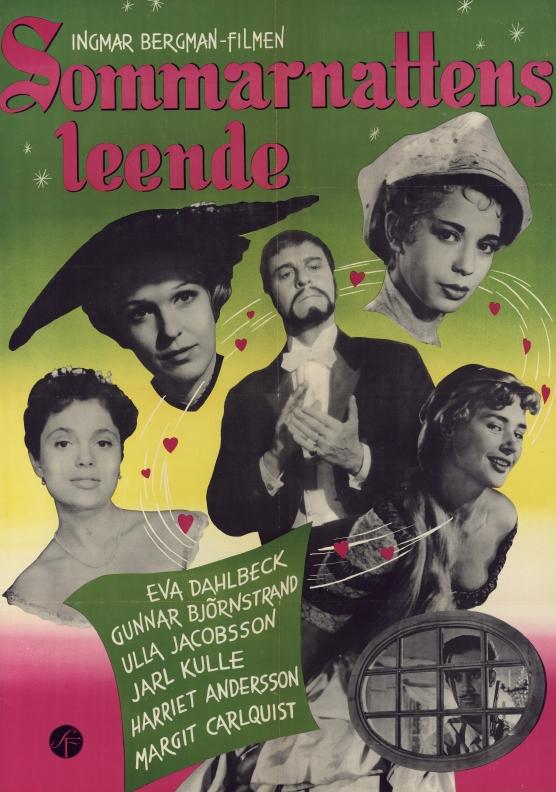
An Ingmar Bergman comedy? Surely a contradiction in terms, right? Like Da Vinci spraypainting graffiti or Austen writing a jingle. The Swedish master is near synonymous with glacial, Scandi-misery, not material that will be transformed into a Sondheim musical. But yet: Smiles of a Summer Night was the big smash-hit that guaranteed Bergman lifetime artistic independence (he followed it with the one-two punch of The Seventh Seal and Wild Strawberries that made him untouchable as Sweden’s premiere Artist). A Bergman comedy was never going to be a Ray Cooney farce, and while there are pratfalls and farce here, this film is an exploration of manners with more than hint of Shaw and Wilde, mixed with echoes of filmic greats like Ophüls and Renoir.

Set in turn-of-the-last-century Sweden, the film follows the romantic and sexual entanglements of a series of would-be couples. Fredrik Egerman (Gunnar Björnstrand) is a respected middle-aged solicitor, who hasn’t consummated his two-year marriage with 19-year old Anne (Ulla Jacobssen). This is partly due to her anxiety about sex. But really both of them are in love with someone else. Fredrik with his old mistress, celebrated actress Desirée Armfeldt (Eva Dahlbeck). Anne with Fredrik’s young son Henrik (Björn Bjelfvenstam) who is also in love with her. Henrik is flirting with house maid Petra (Harriet Andersson), who doesn’t seem averse to a relationship with any member of the Egerman family. Desirée is having an affair with Count Malcolm (Jarl Kulle), whose wife Charlotte (Margit Carlqvist) is considering infidelities of her own just to get his attention.

All of these potential couples merge, swop and work out their feelings overnight at the country house of Desirée’s mother (Naima Wifstrand) during one of the longest days of the year, where the sun hardly sets and people traditionally stay up until dawn. There is more than a touch of the theatrical about all of this – particularly with Bergman’s arch, intelligent dialogue – with the country house as a setting beautifully formal and strangely other-wordly. You can sense the theatrical influences here – Bergman had just directed a production of The Merry Widow – with the characters riffing with Wildean wit and insight, in typically Shavian set-ups.

What we get is a high comedy of manners, that’s also coated in a rich, insightful poetry that gives it a great deal of meaning. There is farce here – including a room with a switch that drags a bed from a neighbouring room (with occupant!) into it. There are several funny lines – many from Jarl Kulle’s hilarious heartless count, who doesn’t care who flirts with his wife until someone actually takes him at his word. There are pratfalls – Henrik has a superbly bleak bit of pure farce near the end that tips into erotic joy (“If the world is full of sin, then I want to sin”). The pompous Fredrik is constantly humiliated, from falling in a puddle to being thrown out of Desirée’s apartment in nothing but a borrowed nightshirt and a pair of slippers. There is no end of sexual suggestiveness, from Harriet Andersson’s gorgeously flirtatious maid (“Hurrah for vice!”) to hints about Mrs Armfeldt’s past (“I was given this estate for promising not to write my memoirs”).

Being Bergman though, this is the sort of romantic comedy that ends with a duelling game of Russian roulette and where we learn as much about human nature as we enjoy the scripted bon mots. Namely, that people – especially men – never seem to know what they want. Fredrik spends a huge chunk of the film persuading himself he is deeply in lust with Anne – although its pretty clear that he’s barely interested. Marriage and relationships in this case are gilded cages that lock people into things they barely want. They don’t even lend themselves to communication – the Malcolm’s marriage doesn’t seem to be based on any communication at all.

So, no wonder it needs a bit of Midsummer Night’s Dream style madness to try and sort it all out. Before that short night, the characters all down a particularly intoxicating wine that they are warned will bring down all their restraining impulses (whether that’s true or not, it certainly does). It’s part of a plot by Desirée – a superb Eva Dahlbeck, serene and glamourous, but also a battle-axe force-of-nature who knows exactly what she wants and how to get it – to resolve all complications for the (her) best, carried out in partnership with Caroline, a woman she’s far to savvy to let something petty like sleeping with her husband get in the way of useful friendship.

Contrasted with all these slightly restrained middle-class people who struggle to understand or express their real feelings, or (like the Egermans) seem to feel a slight guilt at sex anyway, we have the more earthy and free Petra, radiantly played by Harriet Andersson. Andersson gives Petra a flirtatiousness that sees her go from unbuttoning her top to attempt to seduce Henrik, to rolling in a bed with Anna. While the upper classes engage in a formal dance, she seizes life and opportunities – and ends up well-matched with the equally down-to-earth chauffeur Frid (an exuberant Åke Fridell), who like her doesn’t muck around when there is a chance to grab a bit of joy.

Not like the Egermans. Fredrik – a beautifully reserved Gunnar Björnstrand – should want Anna, but all the starring at her photos in the world won’t stop him muttering Desirée’s name while he sleeps. Not that it will allow him to try and rekindle his past relationship with her. Anna (a luminous Ulla Jacobsson), nervous about sex or rather nervous about her feelings with Hendrik, channels her feelings into jealous criticisms of his clothing after catching him naively succumbing to Petra’s flirting. Henrik (Björn Bjelfvenstam, very funny in his bemused wetness) is so inept in his romance of either woman, he barely seems to know what he wants.

Perhaps Desirée recognises all this is a bit of prime, Theatrical nonsense and tries to solve it all accordingly. After all her whole life is the theatre – from treading the boards, to singing and dancing while walking late at night with Fredrik. And it was for Bergman – that and film, which is why perhaps the film has echoes of Jean Renoir’s Le Regle de Jue with its country house romantic intrigues and Max Ophüls partner swopping La Ronde. And Smiles of a Summer Night is a beautifully mounted film, shot with a luscious, poetic beauty by Gunnar Fischer.

The whole film is a complex dance – you can see why it was ripe for Sondheim – that also explores profoundly the romantic and gender clashes between men and women. Men who are in a position to take what they want, but have no idea what that is. Women who know far more, but must be smart about how to achieve their goal – or like Petra willing to embrace a wild abandon to live in the moment. It may be a theatrical, drawing-room, sex comedy of sorts: but it’s also a film about humanity and people’s fates, all under the eyes the suggestively supernatural power of a smiling summer night. Perhaps its not such a contradiction of Bergman terms after all.

The Deadly Affair (1966)


James Mason deals with marital and professional deception and betrayal in spy thriller The Deadly Affair (in every meaning of the word!)

Director: Sidney Lumet

Cast: James Mason (Charles Dobbs), Maximilian Schell (Dieter Frey), Harriet Andersson (Ann Dobbs), Harry Andrews (Inspector Mendel), Simeone Signoret (Elsa Fennan), Kenneth Haigh (Bill Appleby), Roy Kinnear (Adam Scarr), Max Adrian (Adviser), Lynn Redgrave (Virgin), Robert Flemyng (Samuel Fennan), Corin Redgrave (David)

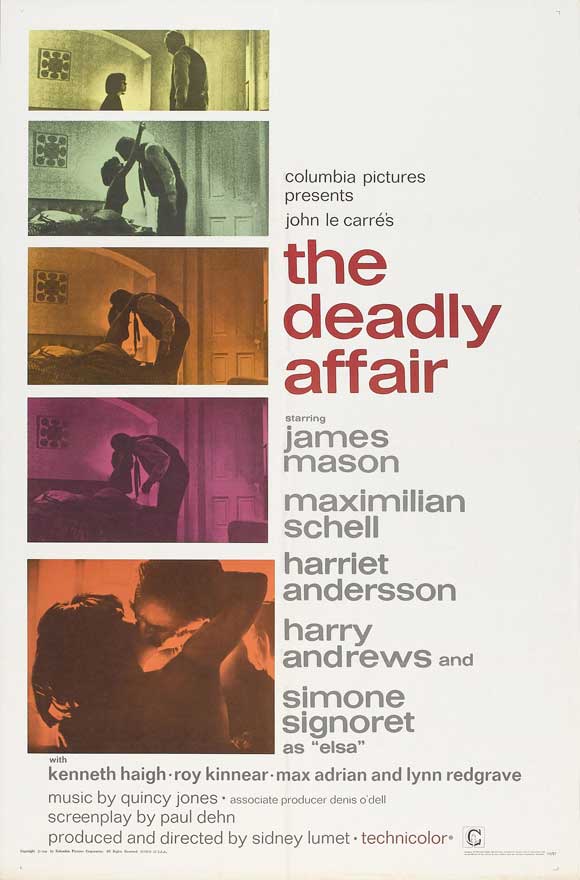
The Deadly Affair is a faithful adaptation of John Le Carré’s first novel, Call for the Dead, that first introduced to both Le Carré’s distinctive vision of espionage (a world where spying is a dirty, depressing business, miles away from Bond), and also his principal recurring hero George Smiley – although Smiley here is renamed Charles Dobbs (Paramount held the rights to several recurring Le Carré characters as it was making The Spy Who Came in From the Cold). The Deadly Affair often gets forgotten in the list of Le Carré films, which is unfair – this is a fine, gripping, character-led thriller.

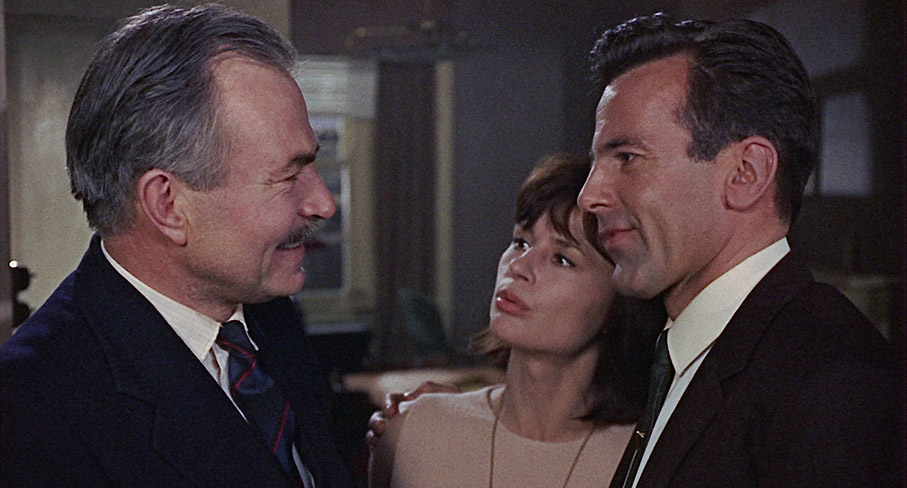
Charles Dobbs (James Mason), a senior case officer in British intelligence, meets with Samuel Fennan (Robert Flemyng): a civil servant in the Ministry of Defence, who has been anonymously accused of being a Russian agent. Dobbs all but agrees to clear Fennan in a friendly meeting – only for Fennan to go home and commit suicide. Dobbs investigates, but quickly finds that the facts – and the story of Fennan’s wife Elsa (Simone Signoret) – don’t seem to tie up. Working with retired police inspector Mendel (Harry Andrews), Dobbs investigates further – against the wishes of his superiors. This also helps to distract Dobbs from his disastrous home life with his serially unfaithful wife Ann (Harriet Andersson) and her growing closeness to his old war friend Dieter Frey (Maximilian Schell).

The Deadly Affairhas an old-school, unflashy, Hollywood professionalism to it, very smoothly directed by Sidney Lumet. Lumet and photographer Frederick A. Young slightly exposed each shot of the film to give the colours a drained, murky quality, which works extraordinarily well for the grimy Le Carré feeling. Lumet uses a series of careful POV and shot-reverse-shots to involve the audience neatly in the action – we are nearly always seeing events from someone’s perspective, and this helps us empathise with the characters and action. He also uses London locations expertly – everywhere is carefully chosen and shot for maximum impact, creating a world of dingy backstreets that perfectly matches the feeling of the story.

It also helps that Lumet changes very little from what was already an excellent source novel. It’s an intricate “whodunnit” puzzle, twisty and challenging enough to keep the audience guessing. What the film does really well is introduce Dobbs’ wife Ann as a central character in the storyline, and to make marital betrayal and deception a complementary subplot, alongside Dobbs’ involvement in the world of professional bluff and counter-bluff: during the day he practises the very same deception that pains him so much at home. (Le Carré would effectively lift some of the ideas of this film adaptation and reproduce them in later books, most especially Tinker, Tailor, Solider, Spy.)

This marital disharmony becomes a key theme in the movie – two people who are totally reliant on each other but can’t seem to stop hurting each other. Ann is in many ways the hellish wife – serially unfaithful and largely unrepentant – but Dobbs is equally difficult, unnervingly patient and silently (but never vocally or perhaps even consciously) judgemental. They have a complex arrangement, but also a clear understanding of each other, and their conversations sound like careful, familiar routines. Like a scab, Dobbs keeps picking at this wound of his wife’s infidelity – early in the film he returns home after a late call out to find his wife naked in bed. She rises to greet him provocatively, and they kiss, but Dobbs seemingly can’t let go of his own sense of impotence. Later Ann demands Dobbs expresses some rage and jealousy – as if looking for him to show some sort of feeling.

It’s a neat sub-plot for a film that focuses on a series of major personal and professional betrayals – I counted no fewer than five over the course of the film but there are probably more depending on how you define it – and which shows how spying can become wrapped up in personal affairs. Despite Dobbs’ apparent pride at treating his work with a determined coolness, everything is so very personal in this film. Characters react often with emotions rather than cool rational thinking – with the exception of one character who uses the emotions of others very rationally to manipulate them. Even the final confrontation of the film has a sad loss of emotional control at the centre of it – and leads to actions bitterly regretted by the survivors.


James Mason is very good as Dobbs, buttoned-up but slightly run-down, a man who presents a face of calm control and wisdom to the world, but at home is an insecure, deeply pained, impotent mess. Determined and principled in the world of espionage, he is hopelessly in love with his wife, to the extent of practically allowing her free rein to do as she wishes. Despite being in nearly every scene, it’s also a very generous performance, quiet and unshowy, that often cedes the scene to his partners. Harriet Andersson (though clearly dubbed) manages to make Ann someone who feels sympathetic and understandable – even though she is a colossal pain.

Lumet also gets some wonderful performances from the rest of the cast, not least from Harry Andrews who I think steals the movie as a narcoleptic Inspector Mendel, obsessed with facts and possessed of a dry professionalism. The film also gives a gift of a role to Simeone Signoret, a woman with a troubled past and indeterminate motives, bubbling with guilt and resentment. She is given no less than three tour-de-force scenes (one played almost in complete silence) and plays each brilliantly. There are neat cameos as well from Max Adrian (as a campy popinjay running Dobbs’ department) and Lynn Redgrave as an eager stagehand for an amateur theatre company with some vital evidence. 

The film’s conclusion revolves around two masterfully done sequences: one during a performance of Edward II (by the real Royal Shakespeare Company – spot several familiar actors on stage), the second an emotional confrontation at a dock that erupts into violence. It’s a wonderful dwelling on betrayal and its impacts. It also works an absolute treat as a low-key counterpart to Bond at his Swinging Sixties height, while still packing a jazzy score from Quincy Jones (which at first seems completely incongruous but actually helps to establish the mood really well). Directed with professional assurance with a host of fine performances – it’s a little bit of an overlooked gem.