Tag: Harry Melling

The Lost City of Z (2016)

The Lost City of Z (2016)

An obsessive explorer plunges into the Amazon in search of a lost city in this imaginative epic

Director: James Gray

Cast: Charlie Hunnam (Percy Fawcett), Robert Pattinson (Henry Costin), Tom Holland (Jack Fawcett), Sienna Miller (Nina Fawcett), Edward Ashley (Arthur Manley), Angus MacFadyen (James Murray), Clive Francis (Sir John Scott Keltie), Ian McDiarmid (Sir George Goldie), Franco Nero (Baron de Gondoriz), Harry Melling (William Barclay)
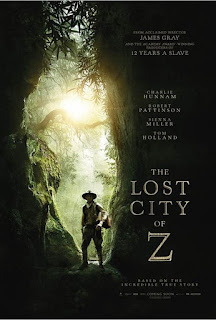
For as long as parts of a map so unknown, that all we write on them is “Here Be Dragons”, there have been explorers yearning to uncover their secrets. Exploring in the nineteenth and early twentieth century was a dangerous, sometimes fatal, call, as explored with a near-mystical thoughtfulness in James Gray’s ambitious film The Lost City of Z. Percy Fawcett (Charlie Hunnam) was the courageous soldier, whose whole life was a campaign to prove he had nothing in common with his disgraced father. Fawcett became obsessed with discovering the secrets of the Amazon, principally the existence of a lost civilisation built by the indigenous people of Brazil, which he called The Lost City of Z. It was to become a quest that would dominate his life.

Based on a true story, Gray’s film taps deeply into a Herzog-by-way-of-Lean view of the Jungles of South America, a place of great awe and danger which creeps inside the soul of Fawcett until, as one tribesperson says, he seems to be of both the West and the Jungle. Shot on location, the Jungle becomes a place of great beauty, but also unknowable mystery and menace. As Fawcett and his companions hack their way through it, on what could be a fool’s errand, their growing respect for it and the indigenous people, is matched only by their increased awareness of its dangers.

The Golden Age of Exploration is a difficult subject to tackle today, with many seeing (in some cases correctly) it as underpinned by a Westernised Imperialism, that earnestly believed the best thing that could happen to these lands (and the ‘savages’ who populated them) was that they should gratefully concede their land and culture to Western ‘civilisation’. Gray’s film is careful to show that Fawcett acknowledged he didn’t always understand the world he was in and learned some hard lessons. But the key difference is that acknowledgment and, as presented here, the humility and respect he recognised the rights and skills of the indigenous people. It marks him out from several of his contemporaries who see them only as contemptable savages and simpletons.

Indeed, Gray’s film positions Fawcett as an admirable egalitarian. His belief that the people of Brazil were not only capable of building in the Jungle, but that they could create an advanced society of pottery and irrigation ahead of those in the West is laughed out of court by many of his fellow members of the Royal Geographical Society (as we see in an involving debate sequence). While staying with a tribe in the Amazon, he marvels at their ability to cultivate and farm the land – something he had been assured was impossible. Encountering a tribe whose custom is to eat parts of their dead (so as to preserve their spirit in themselves), he reacts not with kneejerk disgust but understanding and respect.

The respect he shows for the environment and those he finds there is contrasted with the reaction of famed explorer James Murray, who joins him for his second expedition. Played with a puffed-up self-satisfaction and rigid believe in his own righteousness by Angus MacFadyen, Murray (a noted polar explorer) proves a serious handicap on the expedition. Unfit, unprepared for the tropical environment and treating all he encounters with hauteur, Murray slowly alienates the rest of the party by displaying the imperialist confidence Fawcett and his companions avoid. Stealing supplies, nearly overtipping a raft and ruining some of their stores, Gray uses Murray as the picture of the arrogant classic explorer and a great contrast with Fawcett, who swears thereafter to never again judge a man on his standing and reputation rather than on his character.

Gray’s film has rather a good ear for the pressures and hypocrisies of post-Edwardian Britain. The film opens with Fawcett successfully shooting a leading stag during a state visit by Archduke Franz Ferdinand. It’s a feat that wins him praise – but not any form of meeting with the Archduke since Fawcett is, as a Lord puts it, “unwise in his choice of ancestors”. It’s a stigma Fawcett has to deal with at almost every turn, from being pooh-poohed for his advocation of the Amazonian tribes to dealing with the criticism of the entitled establishment figures.

Gray marshals this all rather effectively, bringing the film into a neat balance of acknowledging modern issues with exploration while still giving an excellent idea of why motivated these men. It all plays out within a dream like aesthetic that leaves a haunting impression. During his first expedition, Fawcett emerges from the bushes into a make-shift opera house built in the jungle (how Fitzcarraldo is that?), on a plantation ruled by a Portuguese landowner dripping with the greed of his class (Franco Nero in a delicious cameo). During his time at home – and at the front during the First World War – elements of the jungle creep into frame, reflecting Fawcett’s longing to return to this mysterious exotic land which makes him feel alive in ways the stifling life at home never does.

Gray’s sense of atmosphere is so well done in the film – its mesmeric shots and sense of unreality will linger – that it’s a shame Charlie Hunnam isn’t quite the right actor to play the role (he took over from Benedict Cumberbatch, who would have been perfect for the obsession, decisiveness and desire to prove himself). Hunnam gives a solid performance, and he really understands the egalitarian humanity of Fawcett, who treats all men and women as equals. But there is a deeper unknowability and mystical longing in Fawcett that is beyond his grasp.

Interestingly, Robert Pattinson – here grimy, eccentric and almost unrecognisable as Fawcett’s best friend Henry Costin – would have been a better call. This is an intensity and soulfulness in Pattison that Hunnam can’t quite bring to Fawcett. Tom Holland gives a heartfelt performance as Fawcett’s hero-worshipping son and Sienna Miller a sensitive and intelligent one as his devoted wife. Clive Francis and Ian McDiarmid play with aplomb sympathetic senior RGS men.

There are many more virtues than faults in The Lost City of Z. The photography by Darius Khondji is wonderful – no one has filmed the jungle better since The Mission. Gray’s intelligent and thoughtful film addresses questions of colonialism and prejudice, while also not shying away from the danger and aggression of some of these tribes. The portrayal of Fawcett’s final expedition is wonderfully done, culminating literally in a dream like sequence where reality, hope and fate merge. It’s a fascinating film.
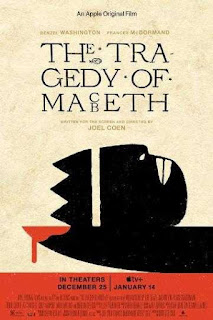
The Tragedy of Macbeth (2021)

The Tragedy of Macbeth header

Denzel Washington and Frances McDormand are the Macbeths in this brilliant, noirish, superb Shakespeare film

Cast: Joel Coen

Director: Denzel Washington (Lord Macbeth), Frances McDormand (Lady Macbeth), Corey Hawkins (Macduff), Brendan Gleeson (King Duncan), Harry Melling (Malcolm), Bertie Carvel (Banquo), Alex Hassell (Ross), Kathryn Hunter (The Witches), Moses Ingram (Lady Macduff), Ralph Ineson (Captain), Stephen Root (Porter), Miles Anderson (Lennox), Jefferson Mays (Doctor)

Shakespeare on screen is difficult to pull off. Focus too much on the language and you end up with something more theatrical than cinematic. Zero in on the visuals and you lose what makes Shakespeare great in the first place. That’s not even to mention that films – with their huge audiences – tend to focus on simple, more traditional interpretations of a play that add little to interpreting it afresh. These are all problems avoided by Joel Coen’s The Tragedy of Macbeth which is bloody, bold and resolute and jumps straight into the upper tier of great Shakespeare films. Inventive, dynamic, gripping and excellently acted it succeeds in being both a creative production of the play and something truly cinematic.

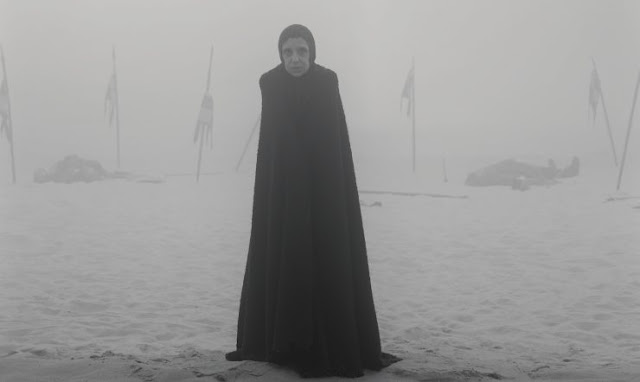
Shot in a crisply clean black-and-white, the 4:3 frame frequently filled with rolling mist and stark white light (it’s superbly shot by Bruno Delbonnel), this is a Macbeth set in a Jan Kott inspired Samuel-Beckett-tinged wasteland, with Scotland a bleak, blasted country, its characters leading lives full of sound and fury that signify nothing. The Macbeth’s castle is an Esher like construction of perfectly formed empty rooms, towering walls and arches casting grim shadows and open ceilinged rooms allowing onlookers to observe everything. There are brilliant images: not least the handle to Duncan’s door which is strikingly lit to resemble a knife. Characters frequently emerge from the mist or the darkness to walk towards us and confess their darkest thoughts.

No Shakespeare film has better used set and location since Orson Welles’ Othello – a film this is sharply reminiscent of, with its brilliant use of angles and shade that constantly disconcerts the viewer (even leaving us confused at points on whether we are looking down or up). Coen also seems to have been inspired by Peter Brook’s grimly nihilistic King Lear film, with this Scotland being trapped firmly in a circle of destruction powered by the witches. All three are played by Kathryn Hunter, whose contortionist twisting and ability to switch her vocals on a sixpence from sing-song to a Gollumesque growl make them truly feel of the earth and yet not. Hunter is inspired casting – sometimes representing all three witches in a single schizophrenic body, at others playing all three at once. A brilliant image at one point shows her double reflection in a watery pool, turning her body immediately into a trinity.

Hunter’s movement is birdlike and agile – fitting since it’s suggested the witches can transform themselves into carrion crows, flying over Scotland picking bones clean of fresh. The first image is the three birds circling the Captain as he walks slowly across a beach to report to Duncan. Later Hunter perches on a crossbeam in another opened-ceiling room, subtly poking Macbeth on to greater monstrosities. There is a cycle of destruction here – and the film’s ending implies all this chaos is bound to start again.

Crucial to this is Ross. Following Polanski’s Macbeth – and again heavily inspired by Jan Kott – Alex Hassell’s unctuous Ross, ingratiates himself with all while happily engaging in acts of brutality. He personally executes Cawdor (by beheading), joins Banquo’s murderers, shows the way to the sacking of Macduff house and hands Malcolm both the crown and Macbeth’s severed head. But Coen takes it further again: rather than a cruel opportunist, this Ross seems to be an agent of the witches – or maybe even a witch himself. Hassell’s costume, with its curiously feminine robe and wing-like arms, echoes the witches and Ross moves smoothly from side-to-side even in the final acts, planting seeds of further destruction (including further implied murders) and collaborating directly with the witches to restart the cycle at the end.

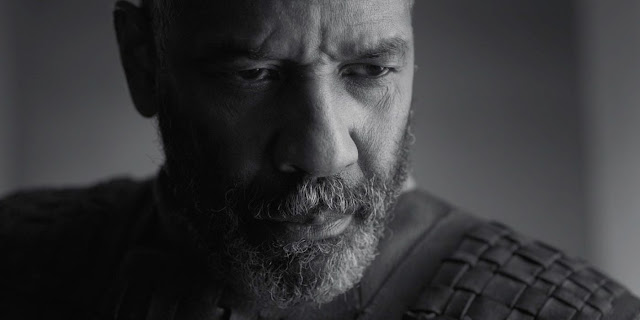
All this makes Macbeth and Lady Macbeth at times feel like rather tragic puppets at the heart of a terrible cycle of events they cannot control. It certainly fits with Denzel Washington’s balanced and intelligent performance in the lead. While Washington doesn’t mine as much weight and meaning from the text as the great stage Macbeths, he gives his line readings an unstudied naturalism and a dynamic and thoughtful rhythm (even if he is prone a little too much to the “soft-slow/fast” approach). His Macbeth is a weak, indecisive man, happy only when he is in action. Clearly ambitious from the start, he binds himself in knots thinking but, once a decision has been made, has no hesitation. Violence is an instinctive tool – he kills several people with no hesitation and a lightening aggression – but he’s lost without direction. He clings to the crown as if it will somehow give the things he has done meaning.

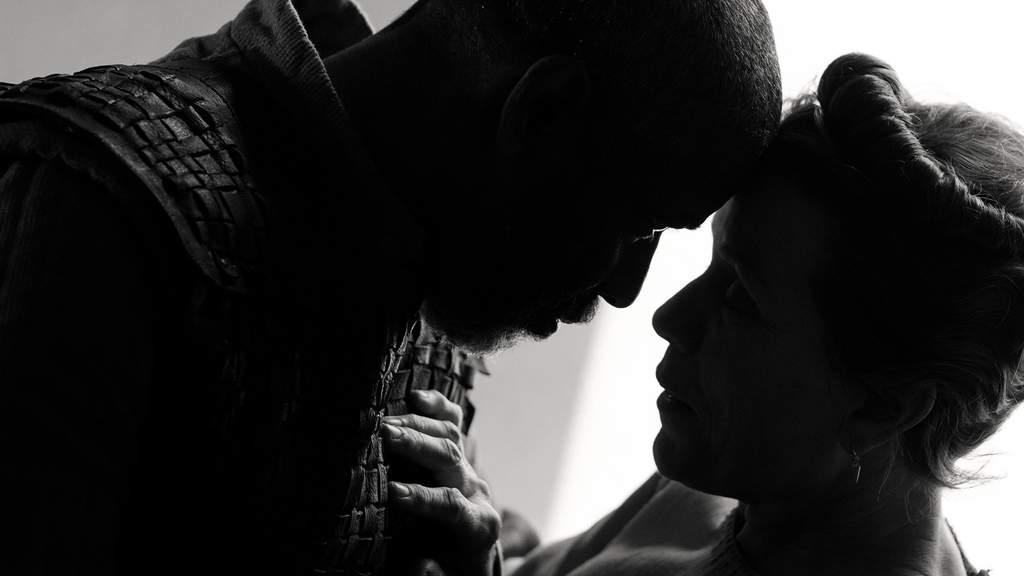
Washington’s performance shifts gears once Macbeth has decided to fully commit himself to those scorpions that fill his mind, becoming an unbalanced mixture of fatalistic and recklessly impulsive. No wonder he has less need for his wife. Frances McDormand is perhaps even better as a Lady Macbeth who sees the crown as her last chance for legacy in a world that has left her behind. McDormand really understands the way to mine nuance from the language. Frequently inpatient with her husband, she is decisive where he is not, but squeamish around violence in a way he isn’t. Both Washington and McDormand manage to suggest a great deal of unfulfilled sadness in the Macbeths, two people in the twilight of their years who pounce on a chance for a last hurrah but find themselves psychologically unsuited for the consequences.

The two leads are at the head of a uniformly strong cast. Hunter and Hassell are both superb. Bertie Carvel is a brooding but honest Banquo. Corey Hawkins a forceful but thoughtful Macduff, played with guilt and wise from the start on Macbeth’s villainy. Moses Ingram brings a lot of warmth to a striking scene as Lady MacDuff. Ralph Ineson’s delivery of the Captain’s speech is spot on. Harry Melling is an immature, stubborn Malcolm.

But the real star here might just be Coen’s direction. The brooding, overbearing beauty of the film is all part of its atmosphere of creeping intimidation and danger. There are some truly striking, haunting images: the flame lit murder of Banquo, a deranged Macbeth fighting a spectral hallucination of Banquo, water pouring down into the flagstones after Macbeth’s final visions of the future, the smoke and mist filled murder of Macduff’s children (a shot of Wellesian brilliance), Lady Macbeth standing before a sheer drop, the imaginative arrival of Birnam wood, Macduff and Macbeth’s final duel in a narrow battlements. This is a punchy, brilliant, beautiful, intelligent and unique reimagining of the play that mixes Shakespeare, visual and has something clear and unique to say about staging the play. Comfortably one of the greatest Shakespeare films ever made.