Tag: Harry Morgan

Inherit the Wind (1960)

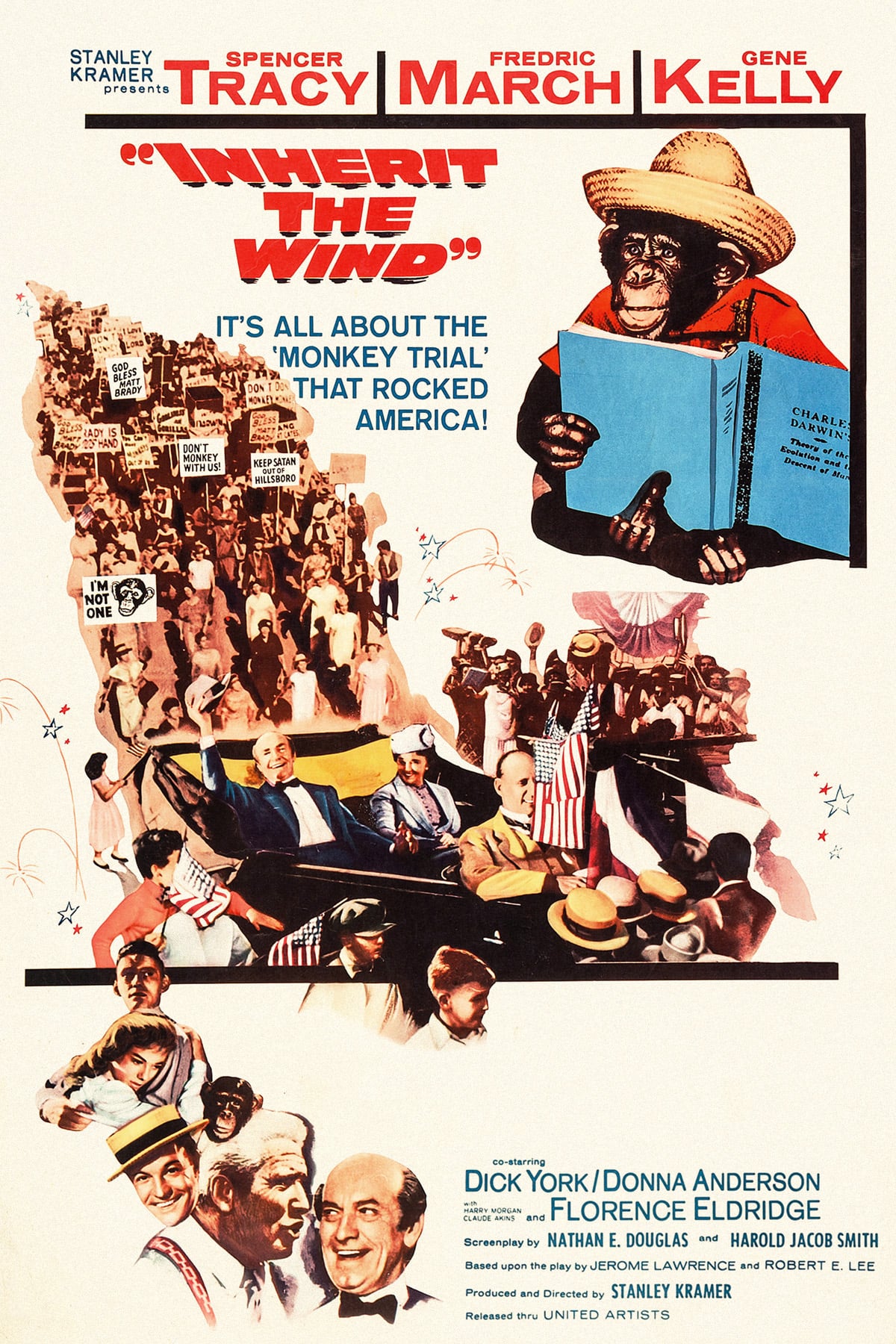
Spencer Tracy and Fredric March go toe-to-toe in Stanley Kramer’s liberalism-on-trial movie Inherit the Wind

Director: Stanley Kramer

Cast: Spencer Tracy (Henry Drummond), Fredric March (Matthew Harrison Brady), Gene Kelly (EK Hornbeck), Florence Eldridge (Sara Brady), Dick York (Bertram T Cates), Donna Anderson (Rachel Brown), Harry Morgan (Judge Merle Coffey), Claude Atkins (Reverend Jeremiah Brown), Elliott Reid (Prosecutor Tom Davenport), Paul Hartman (Deputy Horace Meeker)

In 1960, Inherit the Wind was a parable. The teaching of Darwinism being illegal in a small town that defined itself by its faith couldn’t really happen today could it? So, the film used the concept as an angle to criticise the restrictions placed on free speech during the McCarthy years. The wheel has come full circle now: it’s no longer unlikely at all to imagine something like this happening. Indeed, versions of it have already taken place in America this century. This change does actually help the film look increasingly more prescient as time goes by.

A fictionalised version of the famous Scopes monkey trial (with most of the names changed, but many of the court room events fundamentally the same) a local schoolteacher, Bertram Cates (Dick Young), in a small Southern town is placed on trial for teaching Darwinism in his school. Staunch Christian and former Presidential candidate Matthew Harrison Brady (Fredric March) volunteers to put the case for the prosecution. Cates’ defence will be handled by the renowned liberal lawyer Henry Drummond (Spencer Tracy). Sparks fly in a courtroom and around the town, where many people are instinctively opposed to anything that can be seen to draw doubt on intelligent design.

Kramer’s films are often both praised and criticised for their rather heavy-handed liberalism. Inherit the Wind is no different. You’d be hard pressed to miss the message here about the dangers of intrusive laws designed to govern what we think and believe. Kramer’s film edges away from making criticism of fundamentalism too overt. Sure, the local preacher (a lip-smacking Claude Atkins) is a tongue-frothing “burn ‘em all!” maniac, only happy when stirring up an outraged mob. But on the other hand, Drummond is revealed to be a man of (liberal) faith – and, in an agonisingly heavy-handed final note, the film ends with him literally weighing The Bible and On the Origin of the Species in his hands then clasping them both together. You see – science and faith can work together!

While it’s easy to smile at Inherit the Wind’s striving for inoffensive liberalism, it means well and actually produces some effective court-room set-pieces. While its overlong – the sections outside of the court could do with trimming down and a rather shoe-horned plot with Cates dating the local preacher’s daughter (not helped by the blandness of both actors) promises much but delivers very little. What the film really works at is a chance for two seasoned performers to go at each other hammer and tongs in the court. Chances they both seize.

Spencer Tracy sets a template of sensible, liberal reasonableness mixed with a well-defined sense of right and wrong that would serve him well in a further three collaborations with Kramer. He brings Drummond a rumbled worldliness, a shrewd intelligence and a patient forbearance but never once lets us forget his righteous fury that this case is even happening in the first place. His courtroom performance hinge on a winning reasonableness that can turn on a sixpence into ingenious traps for witnesses. He’s a rock of decency in a shifting world and Tracy effectively underplays several scenes, making Drummond seem even more humane.

It also means that Tracy makes a lovely performing contrast with Fredric March’s firey passion as Brady. Sweating in the heat of the court, March’s Brady is overflowing with moral certainty and fury. March’s performance is big, but the character himself has a court-personae that depends on him appearing like an embodiment of God’s fury. It works because March gives Brady a quiet air of sadness. This is a man raging against the dying of the light – this case is his last hurrah. Brady is becoming yesterday’s news, but can’t seem to consciously accept this. In quieter moments, he is clearly a man of reflection and reasonableness – but (in a surprisingly modern touch) is all to aware that a raging public personae is what “sells”.

Kramer’s film is at its strongest when it lets these two actors go toe-to-toe. These moments aren’t just in the fireworks for court. Private scenes between the two show a great deal of mutual respect and even admiration. The two men are old friends. Drummond is very fond of Brady’s wife Sara (played excellently by Fredric March’s real life wife Florence Eldridge), who also regards him as a man of decency. They can sit on a bench at night and reflect on the good times. Brady may be a type of demagogue but he’s not a rabble rouser like the Reverend Brown (who he publicly denounces) even while he enjoys the attention of crowds. Drummond isn’t adverse to whipping up a bit of popular support – or enjoying the attention. It’s a fine contrast of two men who both similar and very different.

Aside from this, Kramer sometimes trips too often into rather obvious and heavy-handed social commentary. Gene Kelly is on good form in an over-written part as a cynical journalist – he sort of cares about justice, but only if its a good story and has only scorn for anyone else who believes anything. The film closes with a rather heavy-handed denunciation of his lack in belief in anything, compared to Brady’s faith. The script is at times a little too weak – Tracy and March sell the hell out of a vital confrontation near the end, playing “gotcha” moments that the script largely fails to deliver – but there is still lots of meat in there. Some of the staging and performances – including the extended pro-religion protests that pad out the run time – are a little too obvious.

But at heart, there is a very true and increasingly more-and-more relevant message in this film – and when its acted as well as this, it’s hard not to enjoy it.

High Noon (1952)

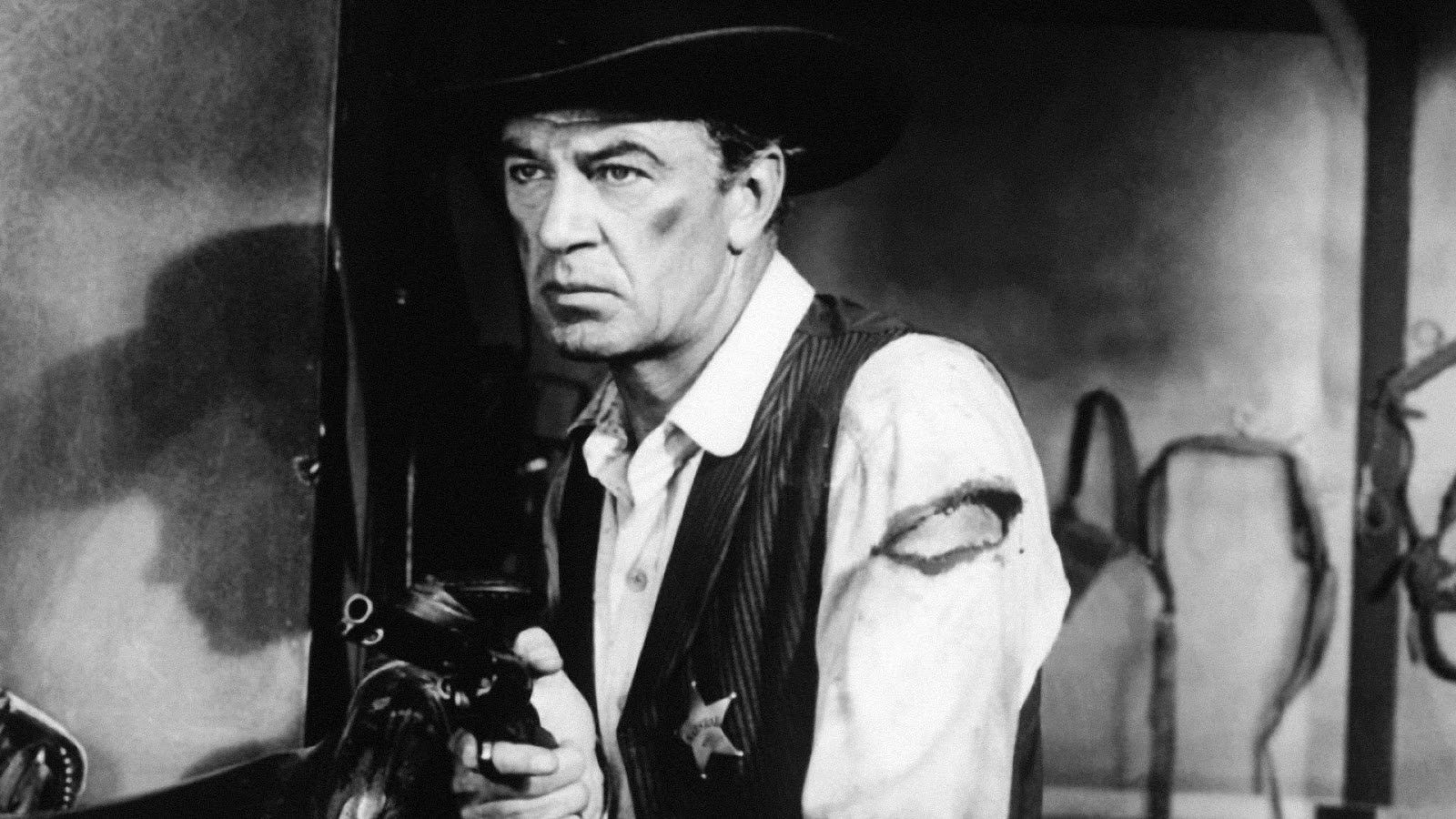
Gary Cooper stands alone in High Noon

Director: Fred Zinnemann

Cast: Gary Cooper (Marshal Will Kane), Grace Kelly (Amy Fowler Kane), Thomas Mitchell (Mayor Jonas Henderson), Lloyd Bridges (Deputy Marshal Harvey Pell), Katy Jurado (Helen Ramirez), Otto Kruger (Judge Percy Mettrick), Lon Chaney Jny (Marshal Martin Howe), Eve McVeagh (Mildred Fuller), Harry Morgan (Sam Fuller), Morgan Farley (Minister Mahin), Ian MacDonald (Frank Miller), Lee Van Cleef (Jack Colby)

It’s 10:35 am on the day of the wedding of retiring Marshal Will Kane (Gary Cooper) to Quaker Amy Fowler (Grace Kelly). It should be the happiest day of his life – but events are interrupted by news that Frank Miller (Ian MacDonald), a killer Kane put away, has been released and will arrive on the midday train with his gang to kill Kane. Kane’s first instinct – and the town’s – is for Kane to flee the town: but Kane doesn’t want to spend his life looking over his shoulder, and besides his friends and colleagues in the town will stand with him right? He decides to make his stand – to the outrage of his pacifist wife – only to find one-by-one the citizens of the town excuse themselves from helping Kane. After all, who wants to die?

Playing out like a Western 24, Kane has got a little under 90 minutes to put together a posse to give himself a fighting chance against these hardened killers. Zinnemann’s film is full of carefully placed shots of clocks that hammer home the ominous approach of Kane’s seemingly inevitable death. In a brilliant use of contrasts, Kane walks with growing desperation in virtually every shot through the increasingly abandoned town, mixed with clever cut-backs to the Miller gang waiting patiently at the train station (with deep focus shots of the train lines stretching on forever) for Miller to arrive and kick off the killing. Using a wonderful combination of low-angles, tracking shots and one superb crane shot that pulls out and away to show Kane stranded alone in the abandoned town, Zinnemann’s film stresses Kane’s isolation, anxiety and growing desperation.

Because Kane is scared. And why shouldn’t he be? He’s past-his-best and over-the-hill, a long-serving hero on his last day in the job, outmatched by his opponent. Why on earth wouldn’t he be desperate for help? John Wayne and Howard Hawks hated the film, loathed its perceived anti-American-spirit and, most of all, couldn’t stand the idea of a Western hero being scared and desperate for help. They even made a twist on the film, Rio Bravo, where Wayne played a marshal turning down any and all help in order to do what a man needs to do alone. For them that was a Western hero, and this self-doubting, anxious pussy Kane – the man even cries at one point! – was an abomination.

Cooper seemed to be no-one’s choice for the film – Heston, Brando, Fonda, Douglas, Clift and Lancaster all turned it down – but scooped the Oscar as Kane. Then 51, his obvious age and vulnerability – at one point Lloyd Bridges almost beats the crap out of him – make him feel even more at risk from this threat. In a performance devoid of vanity – other than perhaps Kane landing the radiant (and thirty years younger) Grace Kelly as his wife – Cooper is sweaty, nervous, twitchy and a mix of All-American duty and genuine nerves, resentment and terror at what feels almost certain to be his end. Kane knows why he must do it, but to Wayne’s disgust, he still doesn’t like it.

Carl Foreman, the screenwriter, was to be pulled before the House of Un-American Activities for his communist sympathies. And the entire film is pretty clearly a commentary on the McCarthyite era, specifically the abandonment of those pulled before the house by those who seemed to be their friends. Like the blacklisted Hollywood writers and actors, Kane opens the film with admirers and friends all of whom eulogise his greatness and decency: and all of them turn their back on him as the chips go crumbling down.

Most of the film is given over to Kane desperately going from ally to ally, only to find that he is offered only platitudes, excuses and outright cowardice. His deputy demands a recommendation for Kane’s job, and chucks in his star when Kane refuses. Old friends hide in their houses and refuse to come out when Kane comes calling. Lon Chaney Jnr’s retired marshal pleads illness. The judge rides straight out of town and suggests Kane does the same. At a town meeting in the church, the voices calling to help Kane are few and far between, and Mayor Thomas Mitchell praises Kane to the skies, before concluding the town would be better off if he could ride away and not come back. The one man who volunteers backs down when he finds out no one else has volunteered, and the only person eager to fight is a 14 year old boy. 

So much for loyalty and the American way. When the chips are down, words mean nothing and it’s the actions that show the man. Customers in the saloon talk about how life wasn’t that bad when the Millers ruled the town (to show how wrong this is, literally their first action when riding into town is to steal something from a milliners). Others moan that all this law enforcement from Kane has actually made business a bit worse for the town. Why do the hard thing, why make the stand, when it’s so much easier to just look down, keep quiet and let the just suffer while your life ticks on.

Cooper’s Kane is masterfully low-key, subtle, using only the slightest gestures to show deep-rooted, only barely hidden resentment and bitterness, covering fear. What he’s doing he’d give anything not to do, but he sees no choice. There is no other Western where the hero writes a will, and quietly weeps with his head on his hands on his desk. There is no other Western where the hero spends so long trying to make a manly task easier to do. There is no other Western where the self-serving cowardice and hypocrisy of the townsfolk are more blatant. No wonder Cooper – in the final insult for Wayne – drops his tin star in the dirt at the film’s end, as the townsfolk rush out to congratulate him on winning the duel. This is a film that looks at America as it really is – and many people didn’t like that one little bit.

Zinnemann’s direction is spot on, a perfect blend of tension build and technical mastery, mixed with superb dialogue from Carl Foreman. Not a word or shot is wasted, and every single character and event is carefully sketched in, established and build up with no effort at all. Cooper is superb, Grace Kelly just as good in a thankless role as the humourless Quaker wife who struggles with her life-long principles against her love for her husband. Beautifully filmed, with a wonderful score with Dimitri Tiomkin, High Noon is a classic for a reason, a masterpiece of slow-build and enlightened social commentary.

The Ox Bow Incident (1943)

Henry Fonda tries to change the fate of a lynching, in gripping social-issue drama The Ox Bow Incident

Director: William A Wellman

Cast: Henry Fonda (Gil Carter), Dana Andrews (Donald Martin), Harry Morgan (Art Croft), Frank Conroy (Major Tetley), Harry Davenport (Davies), Anthony Quinn (Juan Martinez), Francis Ford (Alva Hardwicke), William Eythe (Gerald Tetley), Mary Beth Hughes (Rose Swanson), Jane Darwell (Ma Grier), Marc Lawrence (Jeff Farnley), Paul Hurst (Monty Smith)

Spoilers: Can’t quite believe I am saying this about a film that is over 60 years old – but I’m going to give away the whole plot here. Because you can’t really talk about the film without it. It’s a film that’s well worth watching not knowing what is going to happen, so you are warned!

We all like to believe that, when push comes to shove, we live in a civilised world. That when the chips are down, we would behave nobly and stand for what was right. The Ox Bow Incident is a challenging western, because it defiantly says the opposite. The world is a cruel and judgemental place – and sometimes good people are ineffective, regular people panic and lash out and decent people pay the price.

Gil Carter (Henry Fonda) and Art Croft (Harry Morgan) ride into town. Cattle rustlers are plaguing the town and a popular rancher has been gunned down outside his home. With the sheriff absent and the judge ineffective, the townspeople take justice into their own hands. Led by a faux-Civil War major Tetley (Frank Conroy) and aggrieved friend of the dead rancher Jeff Farnley (Marc Lawrence), they form a posse and ride out to lynch the three suspects (Dana Andrews, Anthony Quinn and Francis Ford). Carter and Croft follow, reluctant, but worried that if they protest too much suspicion will fall on them.

The Ox Bow Incident is a film you keep expecting to make a veering turn towards positivity – you keep expecting it to suddenly draw breath and for everything to turn out okay. Instead, it’s a grim insight into how mob mentality can drive people into sudden and cruel actions. It’s equally a testimony to how ineffective protest and principles can be in the face of anger and revenge. It’s a Western that feels years ahead of its time – there is no romanticism here, just grim everyday life.

In many ways it’s a po-faced and serious morality tale, and revolves around one long scene where the lynch victims are tried by mob justice, plead for their lives, are given a brief respite to say their prayers, protests from a few men are swept aside, and then they are strung up. Every time the viewer starts to think righteousness will slow things down, the certainty of the mob stops decency from taking hold. It’s a slippery slope towards the deaths of men we find out almost immediately afterwards were completely innocent.

The Ox Bow Incident is a film that preaches – and it feels very stagy, a feeling increased by the obviousness of its sets and the intense chamber feeling of the limited locations and scenes. But it works, because it’s so brilliantly put together and so grippingly involving. Wellman’s film is trimmed to the bone, the writing is very strong with Lamar Trotti’s script bristling with moral outrage at humanity’s weakness and fear. It’s a story of injustice and mob rage – and it works because it manages to tell a compelling story while also dealing with universal themes.

Henry Fonda listed this as one of his few early performances he felt was good. Fonda is often remembered as the archetype of American justice, so it’s fascinating here to see how ineffective and compromised Carter is. Carter knows what they are doing is wrong – but he lacks the decisiveness, strength of will or character to persuade people. In fact, his main contributions are quiet comments, or sniping from the wings of the action. 

It’s an inversion almost of Twelve Angry Men’s juror #7 – Carter can’t lead us to justice, because he’s a bit too afraid, a bit too weak, a bit too compromised. At the end, as he reads Martin’s final heartfelt and forgiving letter (beautifully filmed by Wellman with Croft’s hat obscuring Carter’s eyes while he reads, a shot that has multiple symbolic meanings), he projects not moral force but the shame and guilt of a man who, when it came down to it, didn’t have the determination to do what was right. It’s a perfect comment on what a writer may have felt was happening all over in 1943.

The real advocate of justice is Harry Davenport’s humane shop-keeper – but he can’t persuade anyone (Davenport is excellent). Instead, all the big personalities are leading the lynch mob, from Frank Conroy’s bullying Major, who just wants to see the action and stamp his domination on others, to Jan Darwell’s vile honking old woman excited by the killing, to Marc Lawrence’s just plain angry Farnley. Everyone who knows what they are doing is wrong – like Tetley’s weak-willed son (well played by William Eythe) – are just too weak, scared or uncharismatic to do much more than vainly protest. Their regular joe victims (all three actors are excellent as in turn, decent, old and confused and suspiciously alien) don’t stand a chance.

The Ox Bow Incident is a perfect little morality tale, crammed with brilliant performances and moments. It even has the guts (for the time) to reference that most lynchings didn’t have white victims, and introduces a sympathetic black honorary padre who is equally powerless. It’s a film that really feels like it came from an era when the world was going to hell in a handbasket, but it speaks to all ages. Because our fear and readiness to attack – and punish – those people we see as different hasn’t gone away. It’s chilling to think that the world hasn’t changed and this story could just as easily be transposed – with no changes – to half a dozen locations around our world today.