Tag: Hong Chau

Asteroid City (2023)

Asteroid City (2023)

Anderson’s quirk filled film is a triumph of his own style but lacks the depth of his best work

Director: Wes Anderson

Cast: Jason Schwartzman (Augie Steenbeck/Jones Hall), Scarlett Johansson (Midge Campbell/Mercedes Ford), Tom Hanks (Stanley Zak), Jeffrey Wright (General Gibson), Tilda Swinton (Dr. Hickenlooper), Bryan Cranston (Host), Edward Norton (Conrad Earp), Adrien Brody (Schubert Green), Liev Schreiber (J.J. Kellogg), Hope Davis (Sandy Borden), Stephen Park (Roger Cho), Rupert Friend (Montana), Maya Hawke (June Douglas), Steve Carell (Motel manager), Matt Dillon (Mechanic), Hong Chau (Polly), Willem Dafoe (Saltzburg Keitel), Jake Ryan (Woodrow), Grace Edwards (Dinah), Aristou Meehan (Clifford), Sophia Lillis (Shelly), Ethan Josh Lee (Ricky)

Every time I go and see a Wes Anderson film, I hope I might fall in love again. Eventually, I’ll find something in Anderson’s overly distinctive, quirky style that I love as much as The Grand Budapest Hotel. Maybe the romantic in me is dying, because I think its never going to happen. Certainly it doesn’t with Asteroid City a film I sat watching thinking “I know some people will love this more than life itself, but for me sitting here it feels like waiting for the rapture”.

Asteroid City is another of Anderson’s films that’s an intricate puzzle box where the pieces shift like the brightly coloured squares on a Rubrik’s cube. It’s filtered through several layers of remove: we watch a 50s TV announcer (Bryan Cranston) introduce a stage performance of a playwright’s (Edward Norton) long-running play that is itself an entrée to a wide-screen, technicolour production of a host of eccentrics, including a recently widowed photographer (Jason Schwartzman), his grouchy father-in-law (Tom Hanks), a glamourous Hollywood star (Scarlett Johansson) and several others accompanying their kids to a remote town in the desert for a young stargazing and science competition co-sponsored by an army general (Jeffrey Wright), when the whole town is thrown into quarantine after a stop-motion alien drops in, looks around and flies off.

Somewhere in Asteroid City there is an interesting, slightly sad, meditation on grief, loss and ennui struggling to get out. The alien arrival makes everyone question the nature of the universe and their place in it. It’s easy to see the influence of Covid on a town flung into quarantine, and the resulting state of uncertainty throwing everyone off kilter. We are following a man who has recently lost his wife, being played in this film-within-a-play-within-a-TV-show by an actor who was (we discover) recently lost his own partner. At one point this actor asks the director if he is ‘doing it right’, if he is getting the emotion or the author’s intention: “just tell the story” the director (Adrien Brody) responds. I think that’s part of a message about just live and let the big questions take care of themselves, of trusting that we can do our loved ones proud. That’s an interesting, rewarding point.

But it’s lost in Anderson’s pitiless device, his never-ending quirk and the deliberately distancing, artificial nature of his world and the monotonous, arch delivery his script, camera work and editing imposes on a series of actors. What this film desperately misses is a leading player with the strength and independence of a Ralph Fiennes or a Gene Hackman: someone who can bring depth and a sense of reality to the stylised Anderson world, while still delivering something perfectly in keeping with his tone. To put it bluntly, Schwartzman is, to put it bluntly, not a sufficiently engaging or interesting actor to communicate his character’s inner turmoil under the surface which the film’s inner meaning requires. He too naturally, and trustingly, settles into the Anderson rhythm.

In this crucial role, he’s a misfire. With our leading player too much of an artificial character, someone we never believe is anything other than a construct of the film’s author, inhabited by a collaborator who doesn’t bring the independence or new vision the director needs, the more the deeper emotional layers of the film are drowned. Instead, the film becomes a crushing onslaught of style and trickery, devoid of any sense of reality at any point.

It eventually makes the film feel overly smug, too pleased with-itself, too taken with its intricate, tricksy construction. It is of course a triumph of art design and the photography is gorgeous, from the black-and-white of the TV studio and theatre, to the 60s tinged, artificial world of Asteroid City, crammed with its obviously fake skylines and vistas and technicolour inspired feel. That at least its impossible not to admire. But it’s also a mighty artificial trap that enfolds the entire film – and eventually the audience – in a world of weightless, arch, eyebrow-cocked commentary that promises a lot but winds up saying almost nothing of any interest.

There are performances to admire. Scarlett Johansson is very droll and finds some depths as an star actress struggling with a concealed depression. Tom Hanks looks most like the actor who feels like he can break out of the Anderson mould and discover some genuine emotion. Jeffrey Wright demonstrates few actors can do Anderson dialogue better than him, Bryan Cranston very droll and perfectly observed as Ed Murrow style TV man and Adrien Brody is loose, fun and inventive as the play’s director. But yet its everything inside this framework that feels somehow empty.

What I want from Anderson is someone to come in and shake him up, to point out that he is not betraying his aesthetics or style by injecting a small dose of reality and humanity into it. When he has done that in the past – moments in Rushmore, The Royal Tenenbaums and, above all, The Grand Budapest Hotel – he has delivered movies that are inventive, fun and playful but also carry real, lasting emotional impact. When he delivers in-jokes like Asteroid City, it feels like a party you have been invited to where everyone speaks in some made-up language they’ve not told you about in advance. And after not very long, all you want to do is to get up and leave.

The Whale (2022)

The Whale (2022)

Manipulative and sentimental, Aronofsky’s tear-jerker is dishonest and disingenuous

Director: Darren Aronofsky

Cast: Brendan Fraser (Charlie), Sadie Sink (Ellie Sarsfield), Hong Chau (Liz), Ty Simpkins (Thomas), Samantha Morton (Mary), Sathya Sridharan (Dan)

The Whale is the sort of film that is either going to bring you out in tears or hives. Me? Let’s just say I felt incredibly itchy as I sat through this naïve, sentimental and manipulative film. I hated its dishonesty and its disingenuousness. The only thing I felt move was my stomach.

Charlie (Brendan Fraser) is a morbidly obese, reclusive English professor who teaches online courses with the camera turned off. Nursed by Liz (Hong Chau), the sister of his deceased partner, Charlie has never processed his depression and guilt at his partner’s suicide. Now, facing death from congestive heart failure, his last wish is to finally bond with his daughter Ellie (Sadie Sink) whom he has not seen in the eight years since he left her and her mother (Samantha Morton). Ellie is now an angry, high-school drop-out teenager. But Charlie is sure he can see the good in her.

So much has been made about the morbid obesity of the film’s lead. The prosthetics coating Fraser in layers of fat are impressive. An opening montage shows Charlie struggling to move around the house. Picking something up off the floor is impossible and he has to lever himself out of the bed or into the shower. But the film is hugely pleased with itself that it dares to see a fat person as “one of us”. Aronofsky initially films him like a freak show monster – already patting himself on the back about how “humanising” it will be when we learn that obese people are just as capable of being at the heart of maudlin, self-pitying films as thin ones.

The Whale is adapted from a stage play. Not only does it really feel like it (it’s all set within Charlie’s apartment, with characters announcing their arrival in a neat four-act structure), it also sounds like it. The dialogue is forced, artificial and clumsy, making on-the-nose emotional points. Characters feel like narrative constructs. Sadie Sink’s Ellie is the sort of precocious-but-angry tear-away genius brat you never find in real life. Ty Simpkins’ hipster-turned-missionary is more a collection of quirks than a person. The script leans heavily on clumsy metaphors – a walk on the beach, bible quotes, Ellie’s childhood essay on Moby Dick – milked for all they are worth.

Worst of all, a film that prides itself on being about the power of honesty feels like a big, walloping lie. It lies about its characters and it lies about the real issues that drive them. Firstly, it never once touches on issues of mental health and addiction that have led Charlie to this state. Sure, we get a scene of him compulsively eating. But Liz, his “caring” nurse, brings him medicine and huge piles of food (a massive bucket of fried chicken, enormous sub sandwiches…). It’s like caring for an alcoholic by bringing him chicken soup and a huge bottle of whisky. How is this helping someone recognise and deal with an addiction? Which is what this level of over-eating is.

Worst of all the film treats this as a “charming friendship between two eccentrics”. It eventually touches on the fact they are both hurting from the suicide of Charlie’s partner Alan. But never once is the film brave enough to link their behaviour now to this act. Charlie failed to get Alan help, keeping him away from the world and others, believing that the isolated love of a single person would solve his depression. Liz repeats the same mistakes. She isolates Charlie, encourages him to eat, never challenges him to seek help or process his grief, and creates a safe environment for him to destroy himself. If he was a drug addict, what would we say about a carer who draws the curtains and encourages him to shoot up? We’d be calling her the villain of the piece.

That’s before we even dive into the film’s lack of honesty about Charlie. It’s sad to think of a character being so depressed he’s eaten himself to death. That’s awful – even if the film never wants to reflect on the emotional and psychological reasons for this (because that would be depressing in a film as desperate to be upbeat as this one). But by showing us Charlie at the end, full of regret and self-pity, the film white-washes his mistakes and selfishness. There are clear flaws in Charlie that contributed to this state – however much the film wants to present it as a terrible accident.

Charlie abandoned his family and made no contact with his daughter for years (he complains it was too difficult and tries to blame her mother), leaving her traumatised. The film loves its sentimental device of Charlie reading to himself Ellie’s childhood essay (which he knows by heart). But this is, basically, a selfish fantasy: an idea for Charlie to cling to that he was a good Dad and Ellie a kid with a future, radically different from the actual reality. Just like he never addresses why guilt and depression drove him to destroy himself, so he refuses to deal with the issues Ellie is facing now by simply not acknowledging that she has changed from his idealised version of her as the sweet, sensitive girl who knew Moby Dick was really about Melville’s unhappiness.

Instead, the film suggests her mother is the one who really failed. Charlie – who has spent about an hour in her company in eight years – would have donebetter. Just like Liz passing him chicken buckets, Charlie’s solution to solving his daughter’s problems is to smother her with love rather than get her to ask herself why she does and says the cruel things she does. How can the film not see he is repeating the same ghastly cycle again, encouraging a depressed, vulnerable person to stick her head in the sand and hope for the best? Well, he’s wrong. And the fact that the film doesn’t see this means it’s lying to itself as much as he is.

By the end you’ll be stuffed by sentiment, greased by the insistent score. Every single frame is like being walloped over the head while Aronofsky shouts “cry damn you”. The dreadful script is well acted, even if no-one ever makes these device-like characters feel like real people (except maybe Morton). Fraser is committed, a lovely chap and I’m very pleased he’s having “a moment”. But this is a simplistic character, that requires little of him other than to wear a fat suit and cry. He never once really delves into any complexity. It’s also true of Hong Chau, a collection of quirk and tears.

The Whale is a dreadful film, manipulative, artificial and full of naïve and dishonest emotions that avoids dealing with any complex or meaningful issues. Instead, it thinks it’s achieved something by making you see a fat person as a real person. There is almost nothing I can recommend about it.

The Menu (2022)

The Menu (2022)

Dark satire is mixed with intelligent character work and a challenge to our assumptions in this intriguing film

Director: Mark Mylod

Cast: Ralph Fiennes (Julian Slowik), Anya Taylor-Joy (Margot Mills), Nicholas Hoult (Tyler Ledford), Hong Chau (Elsa), Janet McTeer (Lilian Bloom), John Leguizamo (Famous Actor), Reed Birney (Richard Liebbrandt), Judith Light (Anne Leibbrandt), Paul Adelstein (Ted), Aimee Carrero (Felicity), Arturo Castro (Soren), Rob Yang (Bryce), Mark St Cyr (Dave)

A dash of Succession. A soupcon of Hannibal Lector. Lashings of The Most Dangerous Game. All these ingredients are mixed to delightfully dark comic effect in The Menu, a sharp and tangy assault on class and modern society which leaves an unusual but satisfying taste in the mouth.

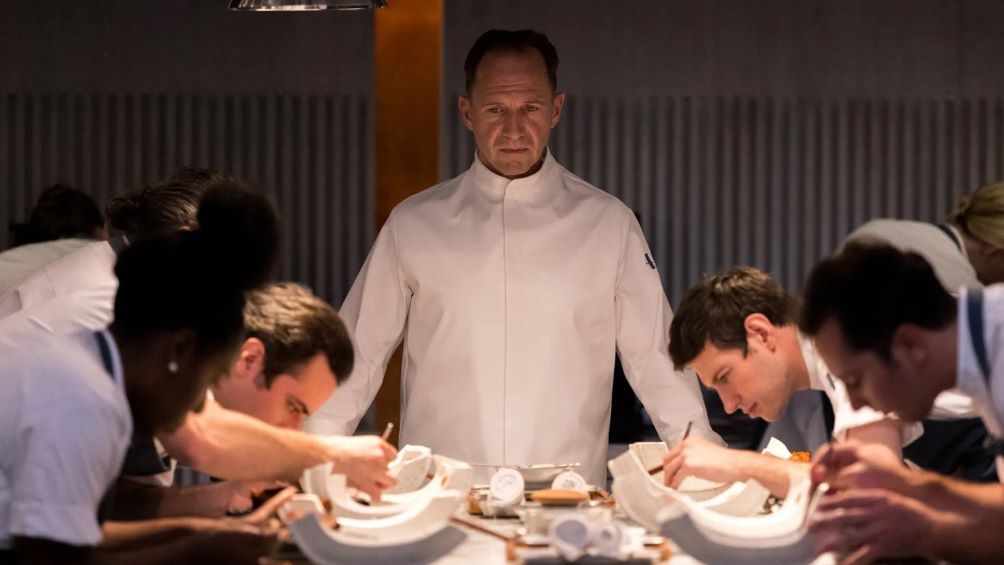
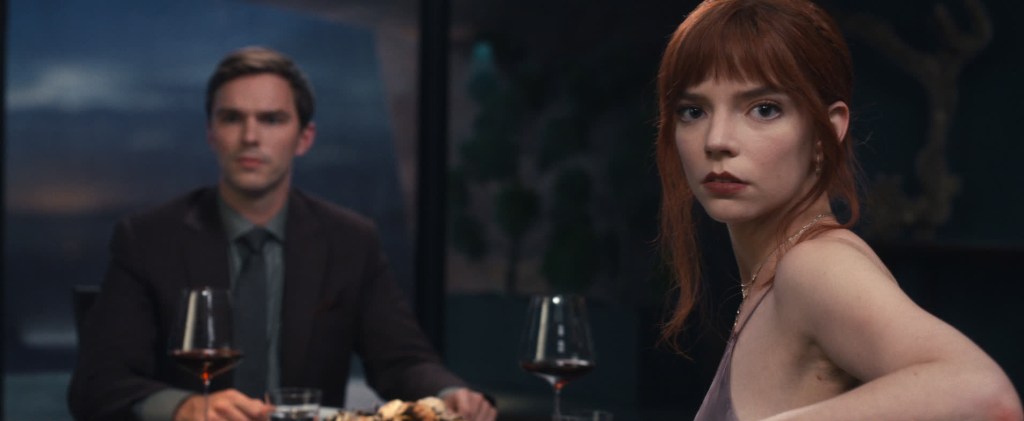
First those touches of The Most Dangerous Game. Julian Slowick (Ralph Fiennes) is a restauranteur so exclusive, his restaurant is based on a private island. Each course, of each menu is part of an overall story that forms the meal. For the story of the meal he is currently preparing, Slowick has selected an exclusive guest list of the rich and famous: businessmen, the rich, movie stars, food critics – the elite, the snobbish, the 1%. And the story he is serving up is one of increasingly grim retribution for this table-load of takers not givers. The only unexpected figure there is Margot (Anya Taylor-Joy), last-minute guest of obsessive food purist Tyler (Nicholas Hoult). How will this unexpected fly in the soup affect Slowick’s plans for the evening?

The Menu in many ways is a revenge satire. Slowick does not hold back in his increasing fury and bitterness at the people he serves without appreciation or gratitude in return. His customers are interested only in food if it costs a lot and is exclusive. They have no interest in his actual skills, in the staff (whose names they do not remember), the food itself or anything beyond their own desires. Many of the customers – most hideously a trio of “bro” investors (played with slapable smugness by Castro, Yang and St Cyr) – flash their jobs and cash expecting these to ensure their every whim is met. To them the world is like dough to be shaped into whatever bread they want it to be.

The film – with glee – exposes the hideous selfishness of the rich customers. A rich couple (Birney and Light) who have attended Slowick’s restaurants several times yet remember nothing about the food or the staff. Janet McTeer’s elite food critic, who practically scratches marks into her pen to mark the restaurants she has closed (she’s accompanied by a fawningly obsequious editor, played by Adelstein). A famous actor (John Leguizamo) who has long-since sold-out and treats his fans with contempt, joined by his spoilt rich-girl assistant/girlfriend (Aimee Carrero). Each of them is deconstructed in turns by Slowick over a series of courses parodying the snobbish bizarreness of high-class dining.

And here is where those touches of Succession make themselves known in the flavour. That series – and Mylod is a veteran (and its finest director) – also presents the ghastly shallowness and greed of the super-rich to expert comic effect. But what that show also does – and what Mylod brilliantly manages here – is make what could be two dimensional monsters sympathetic. The Menu presents these dreadful people with honesty; but, as the punishments – cruelly personal reveals, psychological torture, a finger cut off here, a man hunt there – pile up, you start to wonder if the punishment is too much?

The “bro” investors may be dreadful selfish, arrogant, dick-swinging morons: but they are also immature idiots who have never really grown up. The rich couple might treat places like this elite restaurant as a God-given right, but does that really deserve death? The food critic is harsh and arrogant, but is writing cruel words a mortal sin? The actor loathes himself for selling out his talent to make money and his girlfriend has simply been born into money and never wanted for anything. Do these people really deserve the monstrous ends Slowick has planned for them?

It’s the smartness of The Menu which could easily have invited us to just enjoy the rich and powerful being exposed, humiliated and punished. Instead, this is a smarter, more intelligent dish. The lower-class restaurant staff should be the people we are rooting for. But Slowick runs the restaurant like a cult, the staff near-robotic automatons that follow Slowick’s orders without question, intone their “Yes, Chef!” answers like a religious chant and snap to attention as one. Slowick’s number two Elsa – superbly played by Hong Chau – sums them up: all of them are desperate to become her boss and will follow Slowick to hell and back without a murmour and their heartless, personality free cruelty makes them very hard to root for.

As does Slowick himself. Here comes that sprinkling of Lector. Played with a superb, chilling intensity by Ralph Fiennes at his most coldly austere, Slowick could have been a character who swept us up in his intelligent superiority. But there is not a hint of joy in Slowick, only a vast, bubbling anger and resentment under a coldly precise exterior. Who on earth could look at this near-psychopath and think “I’d love to be him”? Slowick’s service is dryly, terrifyingly funny but you’d certainly not be left wanting to leave him a tip (unless it was your only way of getting out alive).

Instead, we gravitate towards the odd one-out. Anya Taylor-Joy is excellent as Margot, the unexpected guest who finds herself the only person unprepared for by Slowick, who is neither a member of the super-rich, but too free-spirited and independent minded to join the Slowick cult. Dragged along by Tyler – a hilarious performance of over-eagerness, snobbish elitism and stroppy self-entitlement by Nicholas Hoult – The Menu revolves more and more around the dance of death between her and Slowick. Like the audience, Margot is invited to pick a side to sympathise with.

It makes for a rich, lingering dish with an intriguing after taste, far more developed and better cooked than the sloppy revenge saga or re-heated leftovers it could have been. It left me wanting a second course.