Tag: Ian Bannen

Braveheart (1995)

Braveheart (1995)

Gibson’s Oscar-winning epic mixes great action and bad everything else – how did it win?

Director: Mel Gibson

Cast: Mel Gibson (William Wallace), Sophie Marceau (Princess Isabelle), Patrick McGoohan (Edward I), Angus MacFadyen (Robert the Bruce), Brendan Gleeson (Hamish), David O’Hara (Stephen), James Cosmo (Campbell), Peter Hanly (Prince Edward), Catherine McCormack (Murron MacClannough), Ian Bannen (Bruce’s Father), Sean McGinley (MacClannough), Brian Cox (Argyle Wallace)
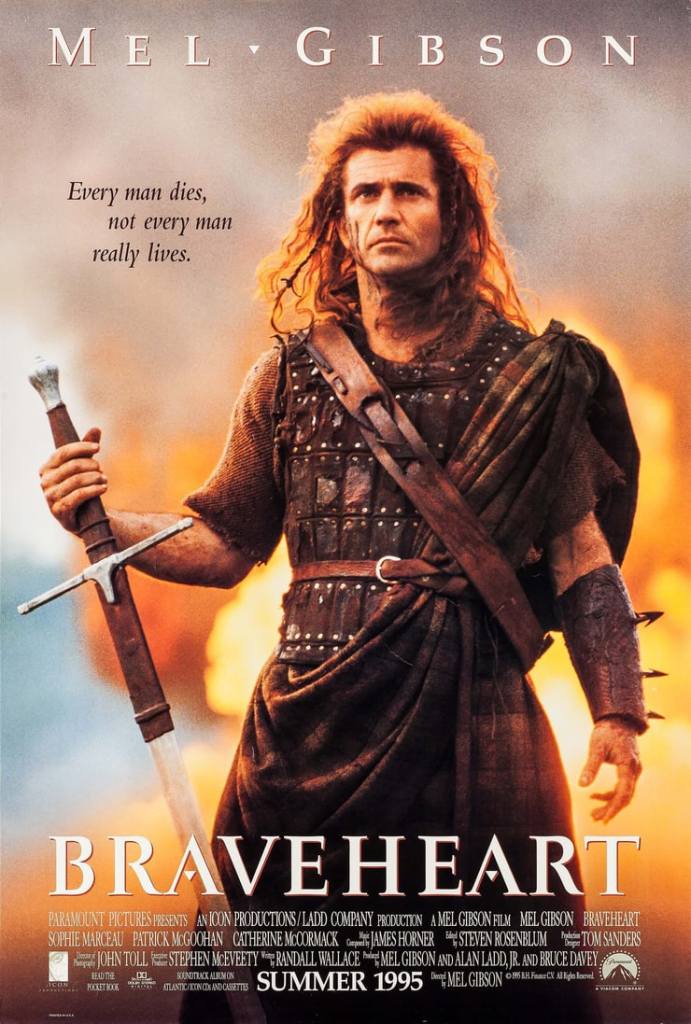
Think back to 1994 and a time when no one really knew who William Wallace was and Mel Gibson was the world’s favourite sexy bad-boy. Because by 1995, William Wallace had become the international symbol of Scottish “Freedom!” and Mel Gibson was an Oscar-winning auteur. Can you believe a film like Braveheart won no fewer than five Oscars, including the Big One? History has not always been kind to it – but then the film was hardly kind to history, so swings and roundabouts.

It’s the late 13th century and Scotland has been conquered by the cruel Edward I (Patrick McGoohan) – a pagan apparently, which just makes you think that Gibson and screenwriter Randall Wallace simply don’t know what that word means. William Wallace (Mel Gibson) saw his whole family killed, but now he’s grown and married to his sweetheart Murron (Catherine McCormack). In secret, as the wicked king has introduced Prima Nocte to Scotland, giving English landlords the right to do as they please with brides on the wedding night. When Murron is killed after a fight to avoid her rape, Wallace’s desire for revenge transforms into a crusade to win Scotland its freedom. A brilliant tactician and leader of men, battles can be won – but can Wallace win the support of the ever-shifting lords, such as the conflicted Robert the Bruce (Angus MacFadyen)? Will this end in freedom or death?

Even in 1995, Braveheart was a very old-fashioned piece of film-making. You can easily imagine exactly the same film being made (with less sex and violence) in the 1950s, with Chuck Heston in a kilt and a “Hoots Mon!” accent. In fact, watching it again, I was struck that narratively the film follows almost exactly the same tone and narrative arc as Robin Hood: Prince of Thieves – with the only difference being if that film had concluded after the Sheriff’s attack on Sherwood Forest with Robin Hood gutted alive in the streets of Nottingham.

This is a big, silly cartoon of a movie, that serves up plenty of moments of crowd-pleasing violence, low comedy, heroes we can cheer and villains we can hiss. Mel Gibson, truth be told, sticks out like a sore thumb with his chiselled Hollywood looks and defiantly modern mannerisms. The film takes a ridiculously simplistic view of the world that categorises everything and everyone into goodies (Wallace and his supporters) and the baddies (almost everyone else).

It’s also far longer than you remember it being. It takes the best part of 50 minutes to build up to Wallace going full berserker after the death of his wife. A later section of the film spends 30 minutes spinning plates between Wallace being betrayed at the Battle of Falkirk and then being betrayed again into captivity (you could have combined both events into one and lost nothing from the film). There is some lovely footage of the Scottish (largely actually Irish) countryside, lusciously shot by John Toll and an effectively Celtic-influenced romantic score by James Horner. In fact, Toll and Horner contribute almost as much to the success of the film as Gibson.

Gibson is by no means a bad director. In fact, very few directors can shoot action and energy as effectively as the controversial Australian. The best bits of Braveheart reflect this. When he’s shooting battles, or fights, or brutal executions he knows what he’s doing. Even if I’d argue that Kenneth Branagh managed to make much less than this look more impressive in Henry V. The battles have an “ain’t it cool” cheek to them, that invites the audience to delight in watching limbs hacked off, horses cut down and screaming Woad-covered warriors ripping through stuffy English soldiers. It’s probably not an accident that the film channels more than a little bit of sport-fan culture into its Scottish warriors.

Where Gibson’s film is more mundane is in almost everything else. The rest of the film is shot with a functional mundanity, mixed with the odd sweeping helicopter shot over the highlands. Its similarities to Robin Hood: Prince of Thieves are actually really strong, from the matey bonhomie of the gang at its heart, its pantomime villain, the moral certainty of its crusades and the fact that Mel Gibson is no more convincing as a 13th-century Scot than Kevin Costner was as Robin Hood. But at least Prince of Thieves knew it was a silly bit of fun. Braveheart thinks it’s got an important message about the immortality of Freedom.

Alongside that, it’s a film that focuses on giving you what you it thinks you want. Gladiator – in many ways a similar film – is a richer and more emotional film, not least because it has the courage to stick to being a film where the hero is faithful to his dead wife and whose triumph is joining her in death. In this film, there are callbacks throughout to the dead Murron – but it doesn’t stop Wallace banging Princess Isabelle, or the film using the same sweeping romantic score to backdrop this as it did for the marriage of Murron and Wallace. What on earth is it trying to say here?

It goes without saying that the real Wallace did not have sex with Princess Isabelle and father Edward III – not least because the real Isabelle was about ten when Wallace died and I’m not sure putting thatin the film would have had us rooting for Wallace. Almost nothing in the film is historically accurate. Wallace is presented as a peasant champion, when he in fact was a minor lord (the film even bizarrely keeps in Wallace travelling Europe and learning French and Latin – a big reach for a penniless medieval Scots peasant). Even the name Braveheart is taken from Robert the Bruce and given to Wallace. The Bruce himself – a decent performance by Angus MacFadyen – is turned into a weak vacillator, under the thumb of his leprous Dad (a lip-smacking Ian Bannen).

The historical messing about doesn’t stop there. Even Wallace’s finest hour, the Battle of Stirling Bridge, is transformed. The film-makers apparently felt the vital eponymous bridge “got in the way” – a sentiment shared by the English, who in reality were drawn into its bottleneck and promptly massacred. Instead we get a tactics free scrap in a field – fun as it is to watch the Scots lift their kilts, it hardly makes sense. The Scots culture in this film is a curious remix of about five hundred years of influences all thrown into one. Prima Nocte never happened. The real Edward II was a martial superstar – but here is a fey, limp-wristed sissy (the film’s attitude towards him stinks of homophobia). Almost nothing in the film actually happened.

But the romance of the film made it popular. It’s a big, crowd-pleasing, cheesy slice of Hollywood silliness. The sort of film where Wallace sneaks into someone’s room at the top of a castle riding a freaking horse and no-one notices. It tells a simple story in simple terms, using narrative tricks and rules familiar from countless adventure films since The Adventures of Robin Hood. It looks and sounds great, enough to disguise the fact that it isn’t really any good. Because it has a sad ending, scored with sad music, it tricked enough people to think it had depth and style. In fact is a very mediocre film, hellishly overlong, that turns history into a cheap comic book. It remains in the top 100 most popular films of all time on IMDB. It’s about as likely an Oscar winner as 300.
Gandhi (1982)

Ben Kingsley excels as Gandhi in Richard Attenborough’s Oscar winning epic

Director: Richard Attenborough

Cast: Ben Kingsley (Mahatma Gandhi), Rohini Hattaggadi (Kasturba Gandhi), Roshan Seth (Jawaharlal Nehru), Pradeep Kumar (VK Krishna Menon), Saeed Jaffrey (Vallabhbhai Patel), Alyque Padamsee (Muhammad Ali Jinnah), Virendra Razdan (Maulana Azad), Candice Bergen (Margaret Bourke-White), Edward Fox (Brigadier General Reginald Dyer), John Gielgud (Lord Irwin), Trevor Howard (Judge Broomfield), John Mills (Lord Chelmsford), Martin Sheen (Vince Walker), Ian Charleson (Reverend Charles Andrews), Arthul Fugard (General Jan Smuts), Geraldine James (Mirabehn), Amrish Puri (Khan), Ian Bannan (Senior Officer Fields), Richard Griffiths (Collins), Nigel Hawthorne (Kinnoch), Michael Hordern (Sir George Hodge), Om Puri (Nahari)

In 1962, Richard Attenborough was approached by Motilal Kothari, an Indian civil servant, who believed Attenborough was the man to bring the life of Mahatma Gandhi to film. All this despite Attenborough having never directed a film. But the life of one of history’s greatest men, and passionate advocate of peace and non-violence, spoke deeply to the socially-engaged Attenborough who dedicated 20 years of his life to bringing the film to the screen, immersing himself in Indian culture along the way and winning the support of Nehru (until his death delayed the project again) and Gandhi’s family. The eventual film was a huge success, cementing the public perception of Gandhi and beautifully capturing both the importance of the story, and its emotional heart.

Opening with Gandhi’s assassination in 1948, the film covers in flashback his life from combatting anti-Indian prejudice in South Africa as a young, British-trained, lawyer to his return to India and long involvement in the campaign to win India its independence from the British Empire, stressing non-co-operation, his eventual success but also his failure to hold the Hindu and Muslim parts of the country together and his attempt as “father of the nation” to put an end to religious violence, a failure that will eventually lead to his assassination. 

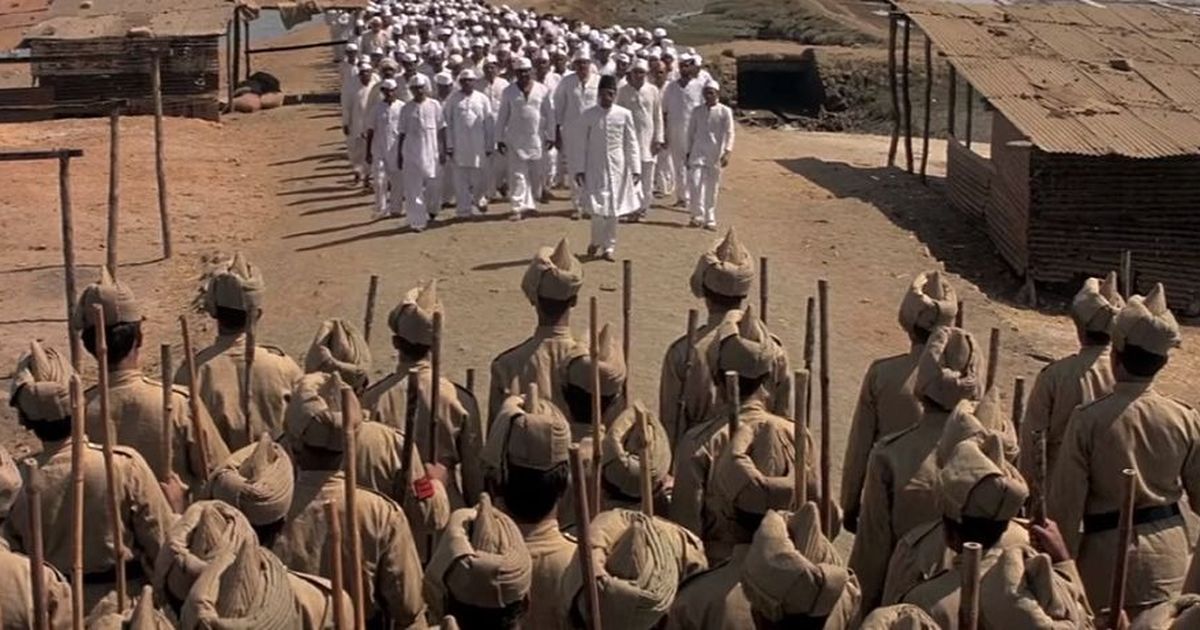
Attenborough’s grand, epic film marshals thousands of extras to bring to life pages of history. At times events fly by with speed, but Attenborough never loses sight of the emotional heart of the story – both Gandhi and the status of Indians as not being masters in their own home. Attenborough directs scenes of real power, most strikingly a heart-rending peaceful march on a salt works (the tax on salt use being a major burden on many poor Indians) that culminates in line after line of peaceful Indian protestors walking calmly forward to be beaten down by soldiers. Despite being the grandest and largest of films, it allows questions of pure morality and decency to lie at its heart and, supported by a parade of British acting greats, keeps the Indians at the heart of their own story and the masters of their own destinies.

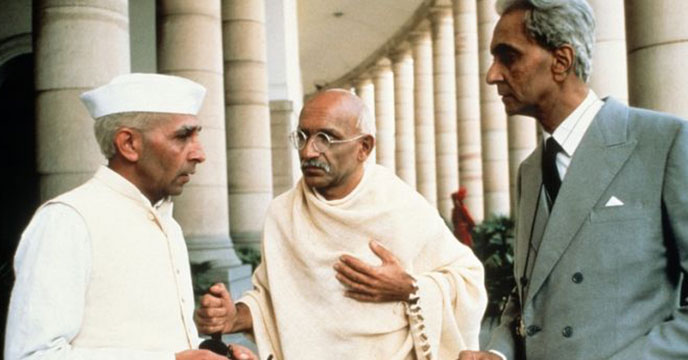
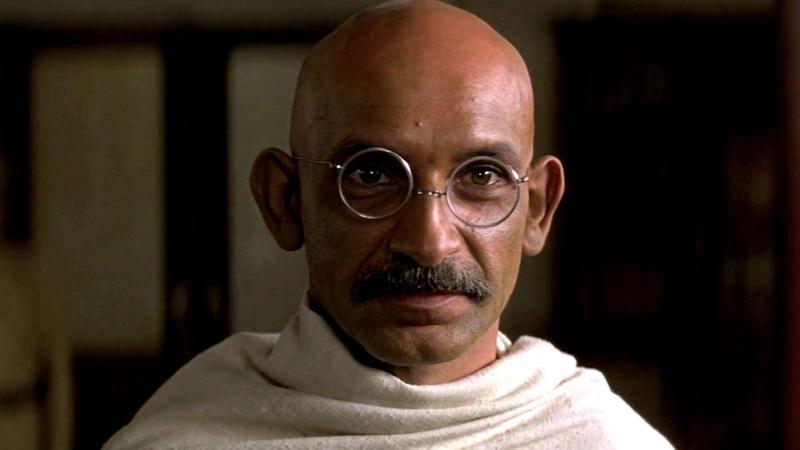
The film’s impact though may be directly connected to the gloriously transcendent performance of Ben Kingsley in the title role. For years it was believed the film could only work with a British actor in the title role – imagine how it would be received today if Gandhi had been played by (as it nearly was) a browned-up Anthony Hopkins or John Hurt (who famously told Attenborough he looked absurd). Instead half-Indian unknown RSC actor Ben Kingsley took the role. Kingsley so completely and utterly immersed himself in Gandhi – everything, the physicality, the morality, the voice, the intellectualism – that not only has he become so completely associated with the role but it’s hard to imagine anyone else playing it.

Ageing almost 50 years over the course of the film, Kingsley’s Gandhi is above-all moral, softly-spoken, observant and considerate – the very spirit of the original man seems to be up on the screen. Far from the sort of histrionics you might expect from a subject of an epic movie, Kingsley is not afraid to be quiet, gentle even underplayed. He completely understands that the charisma and power in Gandhi laid in his moral authority, not his speech-making, but his careful example-setting of even-handedness, patience and desire for peace. 

But Kingsley is also willing to show Gandhi as shrewd and stubborn, even while mixing it with both a deep pain at the loss of life. Kingsley is superbly good at the smaller quieter moments – he wrings heart-rending force from the loss of his wife (a similarly impressive and quietly authoritative performance from Rohini Hattaggadi), which partly works because the film quietly centres the truth and faith in their marriage. This is extraordinary work from Ben Kingsley, that seems to carry not just the entire film but the sense of a nation.

Attenborough though was a director who was at his best when working with actors, and his ability to coax truthful and heartfelt moments from quiet scenes are what gives the other sequences the emotional force to make them work. Attenborough seemingly called in every favour to assemble the supporting cast that backs up Kingsley, many of them juggling only a few scenes. Among the stand-outs we have a martially certain Edward Fox as General Dyer, an archly arrogant John Gielgud and a frustrated John Mills as viceroys, Trevor Howard representing decent British rule as an honest Judge and Martin Sheen as a reformist minded journalist. That’s to overlook dozens of others in small roles, all of them clearly committed to the intention of the project.

The film though allows the Indians themselves to take centre stage, even if it is easy to criticise some of the simplifications of many of the issues that would eventually culminate in partition. The film has a clear hostility towards the idea of religion, seeing it as the root of much of the violence that erupted in India in the last years of Gandhi’s life. While Roshan Seth is excellent as Nehru, the character is portrayed more as the faithful follower of Gandhi than the shrewd politician in his own right (it’s a role most of the other leading members of congress are also placed in). Alyque Padamsee carries a high level of charisma as Jinnah, founder of Pakistan – but the film can’t quite resist painting him into the corner as a semi-villain, ignoring Gandhi’s desperation to get Jinnah to invest in a united India.

It’s part of what has been seen since as the film’s more hagiographic stance towards Gandhi. Certainly later historiography has outlined a few shades of grey in Gandhi – although I would argue that seeing him as a man and not a saint only heightens (similar to Mandela) the awe at what he went on to achieve. The film’s whistle stop tour of Indian history – taking in every major event and personality, some in a matter of moments – looks particularly old-fashioned now with our current trend being biographical films that focus only on crucial moments, not the whole life. It adds a slight air of schoolboy history to the project, an unfortunate side-effect of the passionate earnestness with which the story is told.

But then even in 1982 – when it lifted 8 Oscars including Best Picture, Director and Actor and most of the technicals – it was seen as slightly old-fashioned. Attenborough has generously repeatedly said that he believed Steven Spielberg was more deserving of Best Director for ET. And it’s true that Attenborough was in many ways a producer at heart with these epics than an inspired director like Lean. His marshalling of crowds, finances and simply forcing the will together to make the picture – and to allow it to focus on Indians rather than Westerners – is a tribute to his organisational skills. His strengths as a director were more in performances, and as with many of his epic films the most memorable moments are smaller, intimate ones. The larger moments are shot with an assured professionalism rather than inspiration, but Attenborough understands how to wring emotion from moments and how to let character drive action.

Gandhi works above all because even today you can see it is a passionate labour of love, that everyone involved in clearly believed in passionately. It may well be that at times it is workmanlike or simplistic – and covers the sweep of history with an earnest completeness, even while it is unafraid to be critical certainly of the British – but it still invests it crucial moments with humanity, life and deep emotion. You can’t help but be moved by it – and you are instantly stunned by the sheer brilliance of Kingsley as Gandhi, one of those performances like George C Scott as Patton which seems more like the man than the real thing. Gandhi may be old fashioned, but that’s not a crime when the quality is still there.

Gorky Park (1983)

William Hurt investigates murder in Soviet Russia in ace adaptation Gorky Park

Director: Michael Apted

Cast: William Hurt (Arkady Renko), Lee Marvin (Jack Osborne), Brian Dennehy (William Kirwill), Ian Bannen (Prosecutor Iamskoy), Joanna Pacula (Irina Asanova), Michael Elphick (Pasha), Richard Griffiths (Anton), Rikki Fulton (Major Pabluda), Alexander Knox (The General), Alexei Sayle (Golodkin), Ian McDiarmid (Professor Andreev), Niall O’Brien (KGB Agent Rurik)

Martin Cruz Smith’s novel Gorky Park was a bestseller in the early 1980s. It looked at grim goings-on behind the Iron Curtain, a trio of grisly murders in Moscow’s Gorky Park (the bodies are faceless, toothless and fingerless to avoid identification). The murders are investigated by Arkady Renko (wonderfully played in this film by William Hurt), a chief investigator for the Moscow militia who feels out of place in the corruption of Soviet Russia, but is equally scornful of the consumerism of the West. The investigation delves into a complex web of Soviet relationships with American business and the dissident community, not least an American millionaire fur trader Jack Osborne (Lee Marvin), and a would-be defector and possible friend of the victims, Irina Asabova (Joanna Pacula).

What I loved about this film is the novel is a rather overwhelming 500+ pages, but this film is a brisk and pacey two hours – and I literally couldn’t think of a single thing missing. But then that’s what you get when you have a master writer adapting your screenplay. Gorky Park has Dennis Potter, perhaps the greatest British TV writer of all time – and this is a sublime script, which keeps the pace up, covers all the tense greedy wrangling of the villains, and also makes subtle and telling points about the Soviet system, all in a punchier and clearer way than the books. The dialogue is also absolutely cracking, ringing with a brusque, icy poetry, with a brilliant ear for a turn of phrase.

Filmed on location around Helsinki and Glasgow among other places, what the film misses in actual Russian locations (needless to say the Soviets were not keen to host the production of a film that showcased murder and corruption at the heart of their capital city), it makes up for with Apted’s taut direction and eye for the general crappiness of Soviet life. Everything is run down, everything is dirty, everything looks cold and unappealing, even the houses and luxury bathhouses of the party leaders look a bit middle-class and uninspiring. By the time (late in the film) that you find yourself in one of Osborne’s houses you are immediately struck by the quality of the furnishings – it’s literally a different world.

This atmosphere not only creates something a bit more unique, it also allows us to relax and enjoy the quality of Smith’s story. I found it overstretched in the book, but the film gives it an urgency and a sinister creepiness that grips your attention. Apted has a brilliant eye for the little tricks to survive living in a police state, from watching what you say, to carefully placing a pencil in a dialled telephone wheel to prevent bugs from activting. Every moment is well paced and nothing outstays its welcome. Characters are introduced with skillful brushstrokes, and the relationships feel real and lived in. With such strong dialogue, it’s also great they got such good actors to do it.

William Hurt takes on the lead, and he is perfect, affecting a rather clipped English accent (all the Russians speak with various regional or RP accents). With his unconventional looks (part boyish, part stone-like), he looks the part and he totally captures the yearning unconventionality of a character who deep down probably would be a true believer in a good society, but can’t believe in the corruption around him. Far from the stereotypical would-be dissident, Hurt makes him a man who loves his homeland, but not always the people running it. He’s exactly as you would picture Renko in the book – a guy who will go for justice with the bit between his teeth, a semi-romantic hero, no superman (he frequently is bested in combat), who is looking for something to love and believe in.

The rest of the cast are equally fine. Lee Marvin is cast against type as a suave, hyper-intelligent, manipulatively greedy businessman – although his reputation for playing heavies comes in handy when the gloves come off. Joanna Pacula mixes sultry Euro-siren with an urgent yearning for freedom. Ian Bannen is wonderfully avuncular as Renko’s supportive boss (extra points for Tinker Tailor fans that Bannen is reunited here with Alexander Knox, in a dark reflection of their Control-Prideaux working relationship from that series). Michael Elphick seizes on the part of the down-to-earth Pasha, Renko’s friend and comrade, a role greatly improved from the book (largely to give Renko someone to bounce ideas off).

Apted’s film has a great sense of tension and a wonderful feeling for Soviet Moscow’s dark underbelly. The mystery is increasingly gripping and involving as the film goes on – and, in a nice rug-pull, turns out to be about something totally different than what you might expect. Even the final shootout is assembled and shot with an unexpected vibe. It avoids any Cold War pandering – the main villain is a sadistic American allied with Russians, our hero a noble Russian who partners up with a salt-of-the-earth but decent American cop (Brian Dennehy, also very good). For a late night mystery thriller, with a touch of everything thrown in, you can do a lot worse than this. I enjoyed it far more than I expected. I’d almost call it an overlooked B-movie gem.

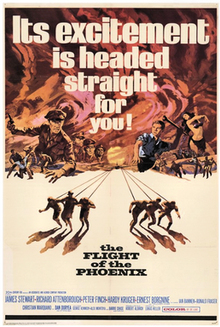
The Flight of the Phoenix (1965)

Fury and despair are never far away in brilliant survivalist film The Flight of the Phoenix

Director: Robert Aldrich

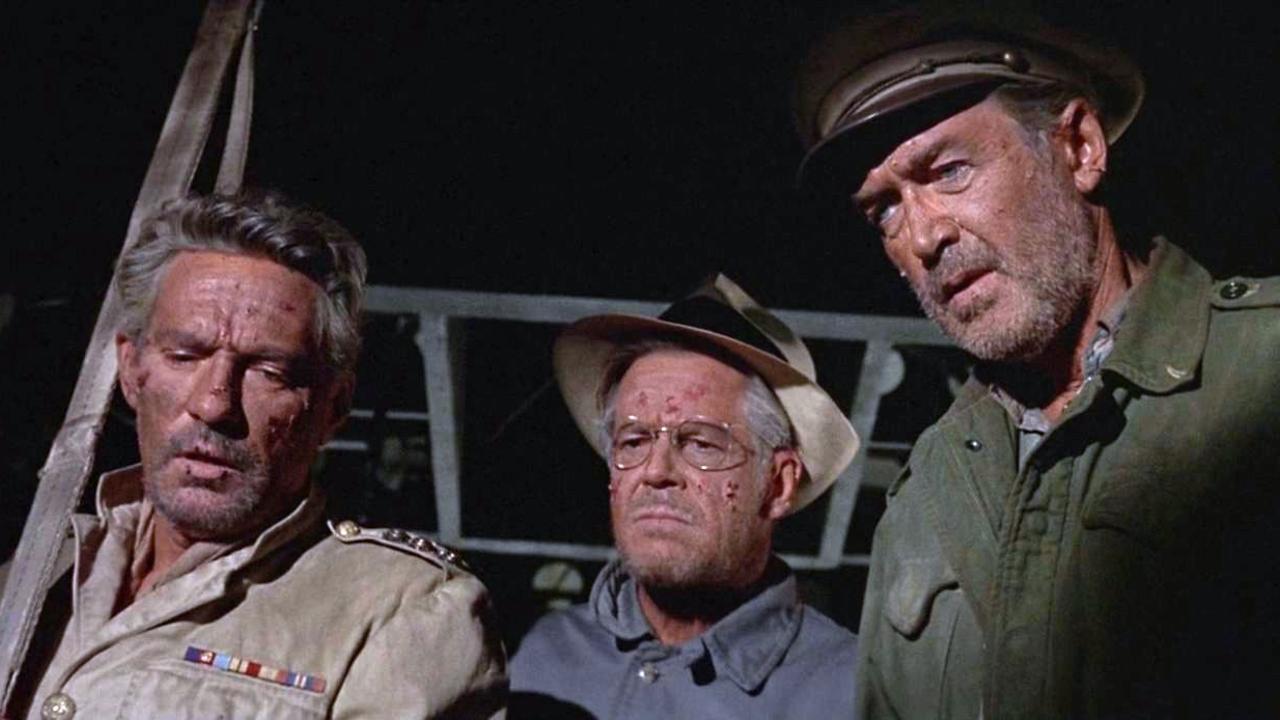
Cast: James Stewart (Captain Frank Towns), Richard Attenborough (Lew Moran), Hardy Krüger (Henrich Dorfmann), Peter Finch (Captain Harris), Ernest Borgnine (Trucker Cobb), Ian Bannen (“Ratbags” Crow), Ronald Fraser (Sergeant Watson), Christian Marquand (Dr Renaud), Dan Duryea (Standish), George Kennedy (Mike Bellamy)

Every so often you watch a film and say “where have you been my whole life!”. That’s the case with The Flight of the Phoenix– I can’t even imagine how much I would have loved this film if I had seen it when I was younger. This one has got it all for fans of anything from disaster movies to personality clashes. Aldrich’s film is a Sunday afternoon classic with bite, a brilliantly constructed actors’ piece set in the claustrophobic confines of the only shelter for miles around in the Gobi Desert.

Frank Towns (James Stewart) and Lew Moran (Richard Attenborough) are the pilot and navigator on a cargo plane flying to Benghazi, with several passengers. Caught in a sandstorm, the plane crashes in the desert over 100 miles off course. The chances of being located are small and the survivors have only enough water for a little under a fortnight, so long as they avoid exertion. While Towns quietly struggles with the guilt, and different (hopeless) solutions are suggested, German aeronautical engineer Heinrich Dorfman (Hardy Krüger) believes that they can build a new airplane from the wreckage to fly themselves to safety. Towns and Dorfman are incompatible people, leaving Moran to play peacemaker and to support the building of the new aeroplane which may be (as Towns believes) a forlorn hope in any case.

Amazingly the film was a box-office flop on release – but time rewards skill, because you watch the film and marvel at the economy of its storytelling, its expert direction, wonderful acting and fantastically drawn characters. It’s a film of immense tension, with nearly all of this coming from the bubbling potential for deadly clashes between the trapped men. The rest is supplied by the ever-present threat of diminishing resources – none more so than the limited supply of cartridges needed to start the new plane’s engine (they’ve got seven and, best case, need at least five). 

It’s this grim awareness of the knife-edge everyone is living on that powers the film. Every single resource is precious, and the pressure and fatigue show in every scene. As the film progresses, each of the men slowly disintegrates, growing increasingly scruffy, unshaven, dry skinned and weak and more and more susceptible to anger. Aldrich charts all this with professional excellence, the editing skilfully cutting away at several points to reaction shots from the actors as feuds come to a head, helped by some gloriously subtle and intelligent acting. 

And it’s not surprising really – few films capture the grim pressure of the desert better than this. Sand dries out skin and throats, reflecting the beating heat of the sun everywhere. The clear sky and burning sun turn every surface into smouldering heat – even the shade offers little respite. The viewer is left with no doubt about the insanity of spending time out of the shade in these conditions. You know immediately Captain Harris’ plan to walk 500 miles over the desert with a single canteen of water is absurd (it doesn’t end well of course). It’s a beautifully shot film that makes the mystical glamour of the desert beautiful and terrifying.

One of the things I like best about the film is that it is almost impossible to predict who will come out alive and who won’t. Unlike most Hollywood films, characters are not punished for deviating from goodness and purity – some of the most noble characters don’t come out alive, while some of the most self-serving, selfish and cowardly ones do. Even the central heroes are flawed: Towns is struggling with depression and a near crippling guilt that almost leave him fatalistically accepting death; Moran is a drunk possibly to blame for the whole disaster; Dorfman is arrogant, difficult, prickly and in many ways flat out unlikeable. 

Ah yes, Dorfmann. What a superb performance from Krüger (the first actor cast). In a masterstroke of invention, the character was changed from British (in the novel) to German. This opens up a whole world of additional prejudice between Dorfmann and the other passengers. “What did you do during the war?” antagonistic joker Ratbags asks Dorfman pointedly. It’s a tension that underlies most of the clashes. Dorfmann doesn’t help with his almost complete lack of awareness of social etiquette and his Germanic insistence on probabilities of survival: he sees no problem with treating the rest of the survivors like staff, openly debates the wisdom of helping the critically wounded, refuses to explain his thinking until absolutely pressed and has no empathy for their flagging strength and morale. But he also has a strange naivety which plays into a late plot reveal hinging on Dorfmann’s inability to read the reactions of the people sitting next to him. The film and Krüger flirt brilliantly with Germanic stereotypes – is there a more “German” character in film than Dorfmann? He’s about as far from a white knight as you can get.

But then so is James Stewart’s Towns. One of the things I like most about the film is the difficult psychology of survival. Towns is clearly struck with a barely understood guilt about the people killed in the crash, and seems ready to fatalistically accept death. His clash with Dorfmann is powered by numerous factors, not least a sense Towns has of his generation being replaced by a younger, technically minded one and a sense of losing control of his destiny. Nevertheless, Towns almost fanatically opposes the project at one point – and basically only accepts it when Moran and Dr Renard (an immensely noble Christian Marquand) tell him it’s better to have a chance of something to live for than to sit around dying. Stewart brilliantly taps into the ambiguity in his screen persona – a decency beneath the surface, but also a psychological weakness, a need for control under the nice-guy persona, a man struggling to accept he is out of his depth. It’s a brilliantly low-key psychological performance of a man struggling to button up guilt, pressure and unease.

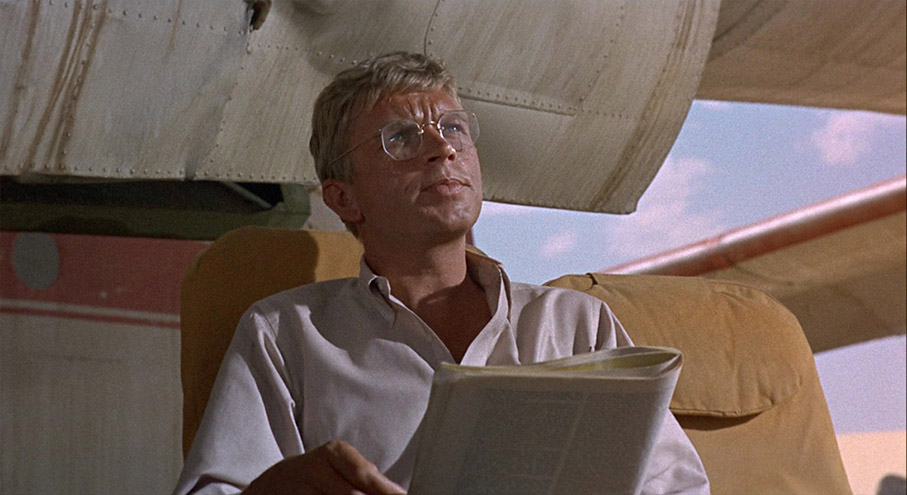
The whole cast is superb. Attenborough plays the closest to type as a loyal number 2, but even he is clearly struggling to hold acres of despair while constantly playing peace-maker. Ronald Fraser is exceptional as a career army sergeant tottering on the edge of open-rebellion throughout the film, who betrays his commander’s trust no less than three times and is the most unknown wildcard in the pack. Ian Bannen was Oscar-nominated for his electric performance as a bitter, sarcastic Scots oil-worker who surprises everyone with his hard work while never letting up for a moment his bitter commentary on events. Peter Finch gives an excellent, ram-rod straight, almost naively decent stiff-upper lip performance as Captain Harris, a man a few degrees away from a noble idiot. Ernest Borgnine is touching as an oil foreman suffering from exhaustion and stress.

All this comes together in a superior package of film making, expertly made and superbly directed, with the actors embracing their well-developed characters with glee, making this in many ways part disaster movie, part chamber piece play. I love the little surprises it throws at you – just as you think you know a character there is a moment that surprises you or makes you reassess them. The tensions and dangers of survival in extreme conditions are brilliantly captured. There isn’t a weak moment in the film, and plot twists and surprises throw curveballs at the audience, some of which bring terrifying consequences. For any lovers of survival stories, acting or tense movies this is an absolute must.