Tag: Irene Papas

Z (1969)

Z (1969)

Costa-Gravas thrilling conspiracy thriller is possibly one of the finest political films ever made

Director: Costa-Gravas

Cast: Jean-Louis Trintignant (Examining Magistrate), Yves Montand (Deputy), Irene Papas (Helene, the Deputy’s wife), Pierre Dux (General), Jacques Perrin (Photojournalist), Charles Denner (Manuel), François Périer (Public Prosecutor), Georges Géret (Nick), Bernard Fresson (Matt), Marcel Bozzuffi (Vago), Julian Guiomar (The Colonel), Gérard Darrieu (Barone), Jean Bouise (Georges Pirou), Jean-Pierre Miquel (Pierre)
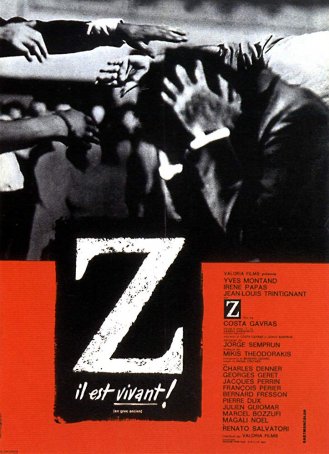
Costa-Gravas Z is an explosive political thriller, ripping a lightly fictionalised story from the Greek headlines (the opening credits playfully state ‘any resemblance to real people is ‘purely intentional!’) and turning it into a compellingly angry, cold-eyed look at political repression. It was based on the state-backed murder of Greek politician Grigoris Lambrakis in 1963 and the investigation by magistrate Christos Sartzetakis which briefly looked like it might expose repressive military forces but actually kick-started a 1967 military junta counter coup in Greece. Z takes this as inspiration for a truly universal story that continues to feel like ‘it could happen here’.

Lambrakis becomes The Deputy, played with great charm and determined charisma by Yves Montand. After death threats, he is murdered after a political rally by two thugs in a hit-and-run, in a public square, surrounded by police officers and a legion of witnesses. The police, represented by the virulent anti-communist General (Pierre Dux) declare it a tragic accident. They firmly expect our Sartzetakis-figure (Jean-Louis Trintignant, putting his enigmatic unreadability to extraordinarily good-use), son of a war hero, to back-up their bullshit. But he didn’t get the memo, conducting a genuine investigation which reveals the extensive links between the military and police and far-right organisations, how they planned the hit and did everything to ensure its success. But will this investigation lead to real change?

Costa-Gravas’ film is a hard-boiled conspiracy thriller with echoes of The Battle of Algiers’ primal urgency and immediacy. It’s committed to throwing you into the middle of the turmoil, with fast-cutting, hand-held camerawork, tracking shots through crowds and shots which zero in on the faces of victims and perpetrators alike. The film’s influence on directors like Oliver Stone is palpable. But, unlike Stone’s work, Z wears its moral outrage carefully: it presents events with a journalistic matter-of-factness, trusting us to recognise the corrupt horror of over-mighty governments. The resolute professionalism of Trintignant’s magistrate helps enormously here – heroism in this world is being honest and doing your job.

What Costa-Gravas film reveals is that these authorities believe they can act with utter impunity, convinced they will never be questioned by anyone, other than their liberal targets. Z opens with a darkly comic scene that outlines this thinking: during a lecture, the pompous General outlines (to a military audience shown impassively watching in a series of quick reaction cuts) his theory of ‘ideological mildew’ attacking the ‘tree of liberty’, using a tortured pesticide metaphor to suggest it is their duty to kill the mildew (liberals and socialists). This tyrannical view is parroted by people who are neither lip-smacking villains or fiendishly clever – they just have absolute, fixed certainty.

Z makes clear that such men, placed in position of authority, will attempt to shape events with a breath-taking arrogance. The assassination plot is shockingly clumsy and obvious and cover-up so full of transparent bare-faced lies, you’d need to be impossibly arrogant to even consider you could get away with it. Copious evidence shows meetings between senior officers and members of the right-wing CROC group. It’s claimed the Deputy’s fatal head-wound came from hitting the pavement, even though this is ruled impossible by both an autopsy and hundreds of witnesses. The General claims not to know the driver who ‘rushed’ the wounded Deputy to hospital (stopping at every opportunity), even though the man is his personal chauffeur. Everyone repeats the same tortured, unusual phrases – from the head of police to the thugs themselves.

It doesn’t stop there. Once it becomes clear Trintignant’s magistrate is genuinely investigating – that he has his own mind and opinions – the clumsy cover up turns aggressive. Blame is put on the Deputies own supporters (the word ‘false-flag operation’ didn’t exist then, but the idea is seized on); his lawyer is almost killed in a park hit-and-run in front of dozens of witnesses; a witness who can testify to the plans of the hitmen is pressured, told he has epilepsy, framed as a radical (he’s clearly not) and then nearly assassinated by one of the hit-men (put up in the same military hospital with a pretend broken leg), who flees the scene and in front of his doctors, while giggling at his cheek.

Some of this is in fact blackly funny. It perhaps almost would be, if it wasn’t for Z’s moral indignation. Even without murder, this is a repressive, corrupt regime: the Deputy’s team have innumerable petty obstacles placed in their way for their rally, their supporters are openly attacked by bused in protestors mixed with baton-wielding under-cover officers. Costa-Gravas doesn’t show the Deputy as a saint – flashbacks reveal he is an adulterer – but it does make clear his bravery (confronting and cowing crowds of anti-liberal rioters, utterly unrestrained by the police), leadership and the fear he overcomes. It also shows, especially in Irene Papas’ emotionally underplayed but quietly devastating performance, the raw grief of those who love him. His closest colleagues weep at news of his death, the post-death slandering of him all-the-more disgusting.

Z presents its evidence with an increasingly overwhelming force. The magistrate corrects (for a long time) any use of the word murder for ‘accident’ – by the time he himself says ‘murder’ it’s almost easy for us to miss it, so natural has the conclusion become. Pressure is, of course, applied to him: senior officers bluster about metaphorical eggs and omelettes; his bosses suggest he charge only the hit-men and (for good measure) charge the Deputy’s people for disrupting the peace by holding the rally in the first place. Plenty of ordinary people know exactly what’s going on, but don’t want to take risks: a newspaper editor reports what he’s told to, the Deputy’s doctor regrets not joining his lonely ‘march for peace’ but, well, you know how it is…
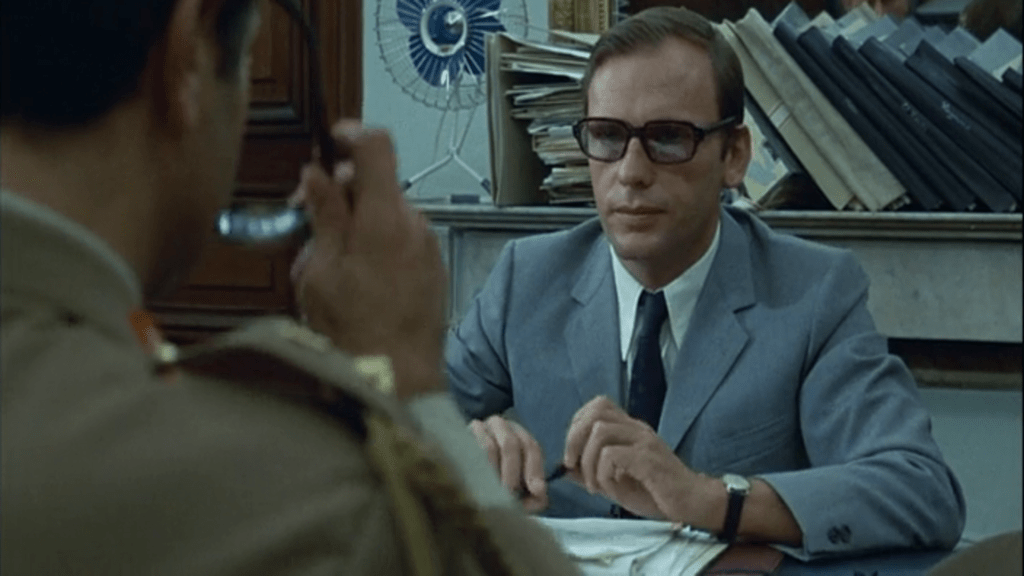
Given the blatant criminality of the police and the army – and the sadistic arrogance of hit-man Vago (an uncomfortable beat in Z is the whiff of homophobia in the depiction of Vago as a predatory homosexual and pederast) – it’s truly triumphant to see them bought to book. Despite their bombast (each officer states he will have no choice but to take his life to avoid the shame, something of course none of them do), each flees the building railing at the press. (The General, an antisemite among everything else, even roars ‘Dreyfus was guilty!’ when a journalist compares the affair to that).

But it’s short-lived. Perhaps Irene Papas’ Helene knows it will be when she responds to news of the arrest with a quiet middle-distance stare. Z closes with a dark coda that could almost be funny if it wasn’t horrifying. A photojournalist (played by producer Jacques Perrin) who we have followed uncovering the plot, reports the aftermath: initial resignations followed by slap-on-the-wrist sentences for the hit-men, charges dropped for the officers and a coup d’etat (at this point a cut removes Perrin) which sees the arrest or ‘accidental’ death of all the Deputy’s supporters, a junta government and bans of everything from authors, mini-skirts, modern mathematics and, above all, the letter Z, as zi has been taken by protestors as the badge ‘He Lives’.

It would be funny. It almost is funny. If it wasn’t part of a system that crushes freedom with violence and murder. Costa-Gravas’ brilliant, engrossing and perfectly judged film shows how terrifyingly swiftly it can happen, how freedoms and justice can be strangled before our very eyes. Watching it today, you can’t imagine a time when it won’t be coldly, chillingly, terrifyingly relevant.
Zorba the Greek (1964)

Zorba the Greek (1964)

The popular image of Greece gets largely defined, for better and worse, in this flawed, over-long, tonally confused film

Director: Michael Cacoyannis

Cast: Anthony Quinn (Alexis Zorba), Alan Bates (Basil), Irene Papas (The Widow), Lila Kedrova (Madame Hortense), Sotiris Moustakas (Mimithos), Anna Kyriakou (Soul), Eleni Anousaki (Lola), George Voyagjis (Pavlo), Takis Emmanuel (Manolakas), George Foundas (Mavrandoni)

Basil (Alan Bates) a Greek-British writer, returns to Crete to try and make a success of his late father’s lignite mine and rediscover his roots. Joining him is Zorba (Anthony Quinn), a gregarious peasant, who believes in confronting the world’s pain with a defiant joie de vivre. In the Cretan village, their friendship grows and they become involved (with unhappy results) with two women: Basil with the Widow (Irene Papas), lusted after by half the village, and Zorba with ageing French former-courtesan Madame Hortense (Lila Kedrova).

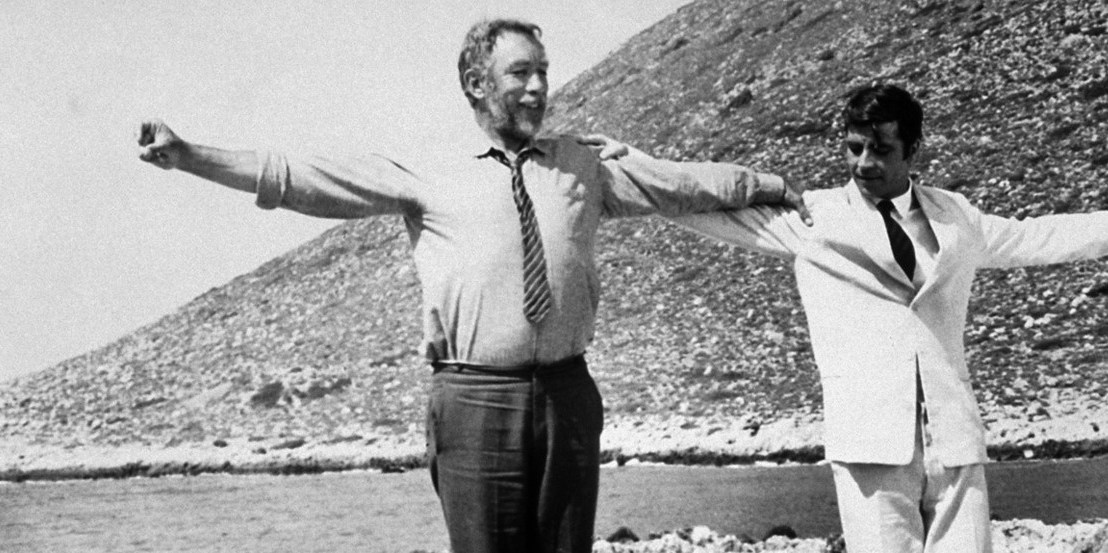
Zorba the Greek was based on a best-seller by Nikos Kazantzakis, directed by Greece’s leading film director Michael Cacoyannis. Matched with Anthony Quinn’s exuberant performance, it pretty much cemented in people’s mind what “being Greek” means. So much so the actual film has been slightly air-brushed in the cultural memory. Think about it and you picture Quinn dancing on luscious Greek beaches. There is a lot of that: but it’s married up with a darker, more critical view of Greek culture that sits awkwardly with the picture-postcard tourist-attracting lens used for Crete.

Nominally it’s a familiar structure: the stuffed-shirt, emotionally reserved, timid and sheltered, is encouraged into a bit of carpe diem by a larger-than-life maverick. As is often the case, he needs t build the courage for romance and work on an impossible dream. Zorba the Greek however inverts this structure: the main lessons Zorba teaches is that you have to meet disaster just as you would meet triumph: with a shrug, a smile and a dance. It’s decently explored – and it lands largely due to Quinn’s barnstorming iconic performance – but also slight message. And Cacoyannis never quite marries it up successfully with the tragic consequences in the film.

Shocking and cruel events happen to the two female characters. The Widow – never named in the film – is loathed and loved by the men of the village, because (how dare she!) she’s not interested in sleeping with them. Played with an imperial distance by Irene Papas, she is condemned as a slut the second she does make a choice about who she welcomes into her bed (Basil, once). Madame Hortense (played with a grandstanding vulnerability by Oscar-winner Lila Kedrova) enters into a one-sided relationship with Zorba. Led to believe (by Basil) Zorba intends marriage, she becomes a joke in the village. Both women’s plot end with shocking, even savage, results.

A braver and more challenging film than Zorba the Greek would have used these events to counter-balance the light comedy and romance of the Greek vistas and Mikis Theodorakis’ brilliantly evocative score, by more clearly commenting on the darkness and prejudice at the heart of the village. In this Cretan backwater, lynching is perfectly legit, women are public property and even our heroes powerlessly accept what happens as the way of things. A smarter film would have pointed out that, in a savage land, Zorba’s ideology is essential or had Basil question his romantic view of Greece once confronted with the barbarism it’s capable of. Neither happens. Instead, the fate of these women is just another of life’s curveballs – the very thing that Zorba has been trying to train Basil to look past. They become learning points on our heroes journey.

Cacoyannis’ rambling script makes a decent fist at trying to capture the mix of Greek life and philosophical reflection that filled Kazantzakis novel. But he fails to bring events into focus or make any real point other than a series of picaresque anecdotes. Tonally the film shifts widely: a boat journey to Crete is played as slapstick, the eventual fate of the Widow chilling horror, the relationship between Zorba and Basil a buddy-movie tinged with the homoerotic. It’s a film that tries to cover everything and ends up not quite exploring any of its successfully.

It’s most interesting note today is homoeroticism. Helped by the casting of Bates, an actor whose screen presence was always sexually fluid (and who is excellent here), it’s hard not to think that Basil and Zorba are most interested in each other. Basil gets jealous, moody and lonely when Zorba leaves for weeks to fetch “supplies” from a local town. Zorba is equally fascinated by the twitchy and shy Basil, coming alive with him in a way completely different to the gruffness he shows to the other characters. Most happy in each other’s companies, there’s a fascinating homoerotic pull here that the film skirts around (not least by making sure both men have female love interests).

Basil is a curious character, strangely undefined and ineffective who listens a lot to Zorba’s messages but seems to learn very little. When the village turns on the Widow he watches like a lost boy. Zorba effectively takes over his home. The one time he tries to live life to the full, it leads to disaster. He remains strangely unchanged by events, which I am sure is not the films intention.

This misbalance is because the film really should be about him and the changes made to his life. It isn’t, because Quinn dominates the screen. A Latin American who most people thought was Italian or Arabic, here becomes the definitive screen Greek. Quinn’s performance here is his signature, grand, performative but also sensitive and strangely noble under the surface, a bon vivant just the right side of ham. He makes Zorba magnetic and hugely engaging and it says a lot that the Greeks effectively claimed him as one of their own. But he does seize control of the film and tips its balance away from its central figure.

Zorba the Greek is a crowd-pleaser, show-casing Greece, that skims on making a more profound impact on how beauty and savagery can live so close together. It doesn’t want to sacrifice the romance too much by staring too hard at the brutality. Tonally, Cacoyannis doesn’t successfully balance the film and its overextended runtime stretches its slight message. But, with its marvellous iconic score and wonderful performances, it’s got its moments.

The Guns of Navarone (1961)


Gregory Peck leads one of the first men-on-a-mission films in The Guns of Nararone

Director: J. Lee Thompson

Cast: Gregory Peck (Captain Keith Mallory), David Niven (Corporal Miller), Anthony Quinn (Colonel Andrea Stavrou), Stanley Baker (Private “Butcher” Brown), Anthony Quayle (Major Roy Franklin), Irene Papas (Maria Pappadimos), Gia Scala (Anna), James Darren (Private Spyro Pappadimos), James Robertson Justice (Commodore Jensen), Richard Harris (Squadron Leader Barnsby), Bryan Forbes (Cohn), Allan Cuthbertson (Major Baker), Walter Gotell (Oberleutnant Meusel), George Mikell (Hauptstaumführer Sessler)

The Guns of Navarone is the archetypical “men on a mission” classic – it was the first major film to feature a team of specialists, all played by famous actors, going behind the lines to carry out some impossible task, leaving a trail of explosions and dead Nazis in their wake. Guns of Navarone was lavished with box-office success – and Oscar nominations, surprisingly – and although it’s a little too long, and a little weakly paced at times (as Thompson himself has admitted) it’s still got a cracking, bank holiday afternoon enjoyability about it. It’s not perfect, but honestly who could resist it?

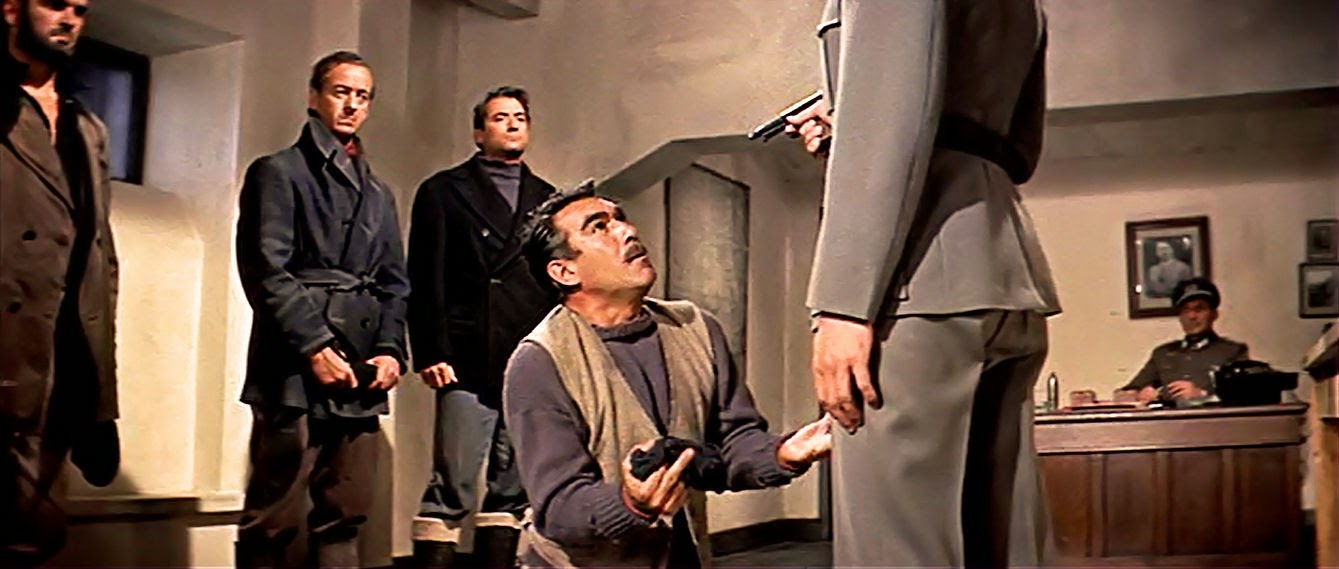
In 1943, 2,000 British soldiers are stranded on the Greek island of Kheros. The Royal Navy plans to rescue them – but the way is blocked by two massive, radar controlled guns, in an impenetrable mountain base. The air force can’t take it out: so it’s up to Commando leader Major Roy Franklin (Anthony Quayle) to put together a team to do it. Recruiting mountaineer-turned-intelligence-agent Keith Mallory (Gregory Peck), explosives expert Miller (David Niven) and Greek-resistance leader Andrea Stavrou (who else but Anthony Quinn?), Franklin leads the team in. But when he is injured, the ruthless Mallory takes command – and leads the team in a perilous behind-the-lines raid.

I’d not seen Guns of the Navarone for a few years, and I’d forgotten what a brilliantly fun, boys-own-adventure thriller it is. I’d also forgotten what a lot of time is given early on into establishing what a team of bad-asses this group are. There seems to be no limit to their ruthless, knife wielding, gun running, cold-eyed killer bravery. And they hired a hell of a cast to play it as well – so damn good that you completely forget Peck, Niven, Quayle and Quinn are all just a little bit too over-the-hill for the derring-do they are called on to carry out.

Guns of Navarone brilliantly explains the mission aims, all the stakes and introduces each of the characters and their basic backstory, before the film basically gives us a series of action set-pieces – on a boat, at the coast, on a cliff, in a village, in a German cell, in Greek ruins, in a German base. It covers everything, and each scene is directed with real verve and increasing tension, with a simplicity to camera-work and editing that really lets the action breathe. The final sequence, waiting for the booby trap to explode among the guns, is a brilliantly done “rule of three” waiting game, with the tension building up each time.

The film is also rattling good fun, and gives each of its actors’ set-piece moments. Gregory Peck grounds the film perfectly as the increasingly ruthless Mallory, willing to sacrifice a number of pawns to achieve the target, but has a war weariness that still makes him sympathetic (as a side note, Peck’s German accent was so woeful all his German was dubbed). Niven plays Miller as a mixture of louche whiner, chippy middle-class man and natural-born troublemaker – and gets some knock-out speeches on the morality of war (Niven by the way nearly died after catching pneumonia during the boat wreck sequence).

Anthony Quinn had a monopoly on playing exotic roles at the time – from Mexicans to Arabs, from Gaugain to Zorba the Greek – so no great surprise he plays the Greek colonel here. He’s terrific though, a cold-eyed ruthless killer – and the sequence where he pretends to be a cowardly awkward fisherman is wonderful (not least for Stavrou’s reaction to Miller’s praise for his performance – a half shrug and a “so-so” hand gesture, one of my favourite ever “character” touches in the movies). Irene Papas is perfect as his female equivalent, while Anthony Quayle puts together another of his “decent army officer chaps” as boys-own adventurer Franklin. Baker and Darren don’t get huge amounts to do, but Baker does well with a “lost my taste for this killing malarkey” sub-plot.

Many of the character beats were so well-done they basically became archetypes for every “group on a mission” film since (the austere leader, the difficult whiner, the old-school traditionalist, the ruthless warrior, the maverick, the one who’s lost his nerve – and, uh, I guess James Darren is the “sexy” one). The actors play off each other superbly. There are also some great cameos – Robertson Justice is great as “the man in charge”, Walter Gotell very good as an archetypical “worthy adversary” German – there is even a slightly bizarre cameo from Richard Harris as an Aussie pilot (yup you read that right). 

Navarone’s pace doesn’t always quite work – the gaps between the action sequences do lag. It takes nearly 45 minutes for our heroes to even get to Navarone. The film also can’t quite decide its stance on warfare. We get Miller’s passionate speeches on the pointlessness of missions when wars are always going to happen anyway. The unmasking of a traitor leads to a long debate on the morality of killing them or not. Several of the characters question the point and morality of war. But then, the film spends plenty of time on Alistair MacLean thriller beats: there is killing-a-plenty of German soldiers, gunned down with ruthless efficiency (not quite as many as Where Eagles Dare but pretty close!). There are small references to Greek villages paying a heavy price in retribution for the gang’s action – but these considerations never even slow them down, or make them stop to think.

Not that it really matters – this is a boy’s own action film, full of hard-as-nails actors grimly “doing what a man’s gotta do” throughout. And, despite being a little too long and aiming for a depth it doesn’t always follow through on, it’s brilliantly assembled, the action sequences are tightly directed, and the acting has a square-jawed confidence to it. Niven is pretty much perfect as the slightly dishevelled Miller, and the clashing relationship between him and Peck growing into respect, has fine bromance to it. Navarone is the first of its kind, and it’s still (and always will be) one of the best – really exciting, really thrilling, really damn good fun.

Anne of the Thousand Days (1969)


Henry won’t be happy with that girl: stagy adaptation of the Anne Boleyn story Anne of the Thousand Days

Director: Charles Jarrott

Cast: Richard Burton (King Henry VIII), Geneviève Bujold (Anne Boleyn), Irene Papas (Queen Catherine of Aragon), Anthony Quayle (Cardinal Wolsey), John Colicos (Thomas Cromwell), Michael Hordern (Thomas Boleyn), Katharine Blake (Elizabeth Boleyn), Valerie Gearon (Mary Boleyn), Peter Jeffrey (Duke of Norfolk), Joseph O’Conor (Bishop Fisher), William Squire (Sir Thomas More)

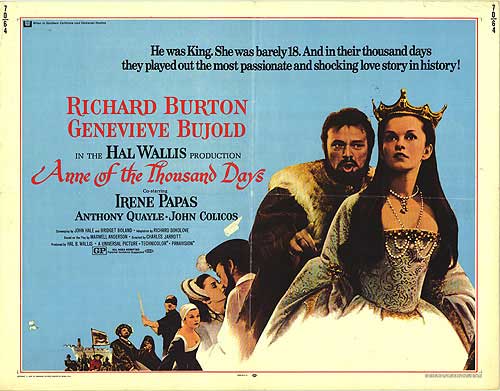
Anne of the Thousand Days fits neatly into Hollywood’s obsession of the 1960s: the grand British historical epic, crammed with costumes, old locations and leading Brit actors in beards mouthing “olde English” style dialogue. Some of these films are of course marvellous – A Man For All Seasons being clearly the best – some are merely competent. AotTD falls very much in the latter category. It’s a solid but dry and rather self-important piece of entertainment, more interested in wowing you with its pageantry than moving you with its emotion.

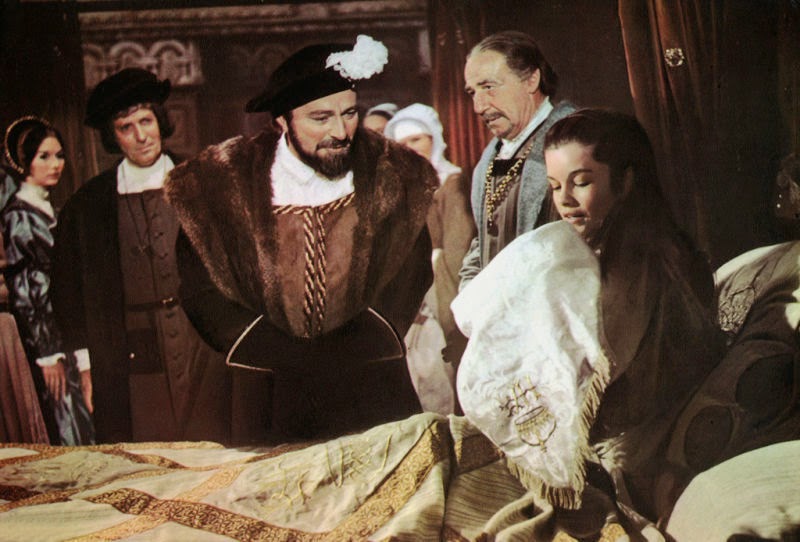
As the film opens, Henry VIII (Richard Burton) considers whether or not to sign Anne Boleyn’s (Genevieve Bujold) death warrant. The film then flashes back to tell us the story of Anne’s rise and fall. Along the way, the usual figures from Tudor history are wheeled out: Wolsey, Catherine, More, Cromwell and assorted Boleyns.  And of course, the whole thing ends with Anne proudly proclaiming her daughter will one day be the greatest queen of England, with quite exceptional clairvoyance given how unlikely that would’ve actually looked at the time.

The main problem is it isn’t sure what it wants to say about its central character. It wants to simultaneously position her as a strong, “modern” woman with her own ambitions but as a woman succumbing to passion. Essentially, it wants to have its cake and eat it: for Anne to understand Henry is far from love’s ideal vision, while not wanting to lose their “Great Romance”. So we have scenes where Anne questions why anyone would want to marry Henry or talks of her desire for peace, and later scenes where she demands the judicial murder of all who refuse to accept the marriage.

And it may want to show Anne as a modern woman, but – frustratingly – it’s only actually interested in her as a romance object. Her modernity is solely expressed in defying her family to try and marry someone other than Henry, and having spirited “I hate you/I love you” sparring matches so beloved of Hollywood. But the film has no interest in her intelligence, her involvement in the Reformation, or how this led into dangerous conflict with the increasingly powerful Thomas Cromwell (here her downfall is solely down to her inability to produce a son, and being jealous of love rival Jane Seymour, here playing the sort of minxy temptress Anne is often accused of being).

And even this simplified, Mills-and-Boon Anne is inconsistent– one minute she’s a sweet young girl bravely resisting her unwanted royal suitor. Then, she’s delighted with the power that comes with allowing the King to court her. Equally suddenly, she falls in love with him (though that scene is so confusingly written it’s initially unclear whether this is genuine or simply a ploy to win back the attention of Henry). Even away from the central “romantic” relationship, her character oscillates – she schemes revenge against Wolsey, but then is too nice to take Hampton Court from him.

Despite this, Genevieve Bujold delivers an excellent performance. The film successfully plays up her youth early on, and she brings the role a lot of passion, fire and intelligence. Her French-Canadian accent also makes perfect sense considering Anne was largely brought up at the French court. Bujold does her best to hold together an inconsistent character and delivers a real sense of Anne’s independence and intellectual strength. Not even she can completely sell the competing visions of Anne the film has, but she does a very good job with what she is given.

Richard Burton was allegedly fairly scornful of his performance, but he is terrific. One area where the film does succeed is repositioning Henry as a proto-tyrant, who literally cannot conceive he is wrong. In a memorable scene, Henry explains that, ruling as he does through God, any thoughts in his head must have been placed there by God, ergo he can never be wrong. If that isn’t a tyrant, I’m not sure what is. Burton’s charisma is perfect for a man who can flip on a sixpence from bonhomie to fury. While Anne’s intellectualism is overlooked, the film does a great job of demonstrating Henry’s intellectual fakery, via his bland and overbearing musical compositions (met with a rapturous response from the court). Lords literally breathe sighs of relief after they leave his presence. Burton may not be an ideal physical match, but embodies Henry’s ruthless selfishness and towering ego.

It’s a shame that, despite having strong performances, the film is not only so confused, but also so flat and dry. Charles Jarrott frames the film with a dull conventionality, carefully letting costumes and production design fill the screen like a dutiful workman. Has he got any really interesting ideas for shooting this stuff, or presenting a routine plot with any freshness? Not really. Instead we get spectacle, and inevitable rundown of events, but no real sense of novelty. It turns the whole thing into a rather slow, reverent slice of British history, dry and stodgy, ticking off events as it goes.

Those events come and go with a confused focus. The foundation of the Church of England is under explained. The fates of several characters are left unresolved – in particular Cardinal Wolsey (an otherwise excellent Anthony Quayle) simply disappears. The final condemnation of Anne is rushed and confused (you would be forgiven for not really understanding who she has been accused of sleeping with, and the alleged incest between her and brother is almost thrown away). Other characters are simplified (despite good performances from their actors):  so William Squire’s More is upstanding and honest, while John Colicos’ Cromwell is dastardly and scheming.

Anne of the Thousand Days is rather old fashioned and probably best watched now as a Sunday afternoon film. It tells a very, very familiar story (how many times have we seen Henry/Anne’s romance on screen before and since) without too much originality, and largely fudges putting together a clear sympathetic portrait of its central character. Having said that, it is well acted and looks wonderful. It’s just also rather dry and far too aware of having an “important” story to tell.