Tag: James Purefoy

Ironclad (2011)

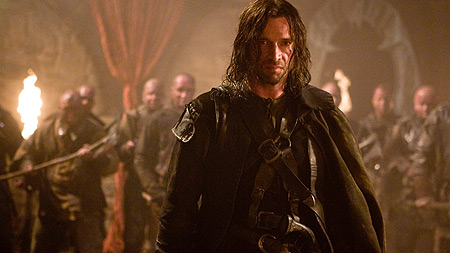
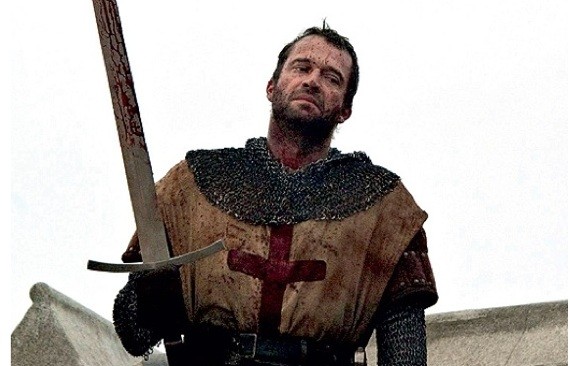
James Purefoy carries a big sword in nonsense medieval blood bath Ironclad

Director: Jonathan English

Cast: James Purefoy (Thomas Marshall), Brian Cox (William d’Aubigny), Derek Jacobi (Reginald de Cornhill), Kate Mara (Lady Isabel), Paul Giamatti (King John), Charles Dance (Archbishop Stephen Langton), Jason Flemyng (Becket), Jamie Foreman (Jedediah Coteral), Mackenzie Crook (Daniel Marks), Rhys Parry Jones (Wulfstan), Aneurin Barnard (Guy), Vladimir Kulich (Tiberius)

Let’s just take a moment to enjoy the fact that the most expensive film ever made entirely in Wales was directed by a guy called English. After that, you can enjoy the guilty-pleasure hack and blood nonsense of this sort of proto-Game of Thrones,which bears almost as much resemblance to British history as George RR Martin’s souped up re-tread with extra dragons.

Anyway, King John (Paul Giamatti) has signed Magna Carta – as always that document which gave the barons some say in the government is here reimagined as some sort of manifesto for a socialist revolution – but now Rome has told John that he doesn’t need to stick to it after all. So John hires (honestly) a load of Viking warriors to take out his enemies. Yes that is just as silly as it sounds. Before we know it, the barons need to take control of Rochester Castle, a stronghold which is apparently the key to the south of England. So Baron William d’Aubigny (Brian Cox) puts together a “Dirty Dozen” (well Dirty Half Dozen, it’s a British budget after all) to defend the castle, led by Templar knight Thomas Marshall (James Purefoy). Let the siege begin!

If that doesn’t give you an idea of the way the film mixes and matches parts of British history into some sort of heady brew, I don’t know what will. We got King John! We got Magna Carta! We got Templar knights! We got Vikings! All of this is frozen into a hyperviolent mixture of historical epic and “men on a mission” war film, with added limbs flying off left, right and centre. Most of it is delivered at an absurdly energised pace. At least all involved seem aware that they are making a stoopid B movie, rather than some sort of genuine historical epic.

Criticising the history of the supposed historical epic seems completely superfluous, so instead sit back and enjoy the skill with which Jonathan English apes Neil Marshall in his blood letting and imaginative slaughter. Sure, he hasn’t got Marshall’s narrative skill or his ability to carve human interest out of even the most basic cardboard characters. But he still manages to present what we see with enough sense of action and adventure. Ridiculous as it might feel that a tiny group of men holds off an entire legion of King John’s troops, you sort of go with it as the film is shot with enough sense of ragged viciousness that you don’t notice the gaps in the tiny budget (less than a single episode of Game of Thrones). 

The actors all know they are in something rather silly as well. It’s a bizarre mixture of people, from Hollywood star character actors to B-movie stalwarts to Brit TV stars to slumming classical actors. James Purefoy grounds the stuff with his usual commitment and charisma. Just as well he does as Paul Giamatti clearly rocks up in the spirit of a lark, hammily overacting to such a ludicrous degree that he sounds like John Adams on a bad acid trip. It’s a surprise they don’t turn him on the walls of Rochester Castle and let him chew through the defences. Between these two hardly anyone else gets a look in, although Brian Cox does well as the brave leader of the castle who suffers a particularly brutal death involving mutilation and imaginative use of a catapult. 
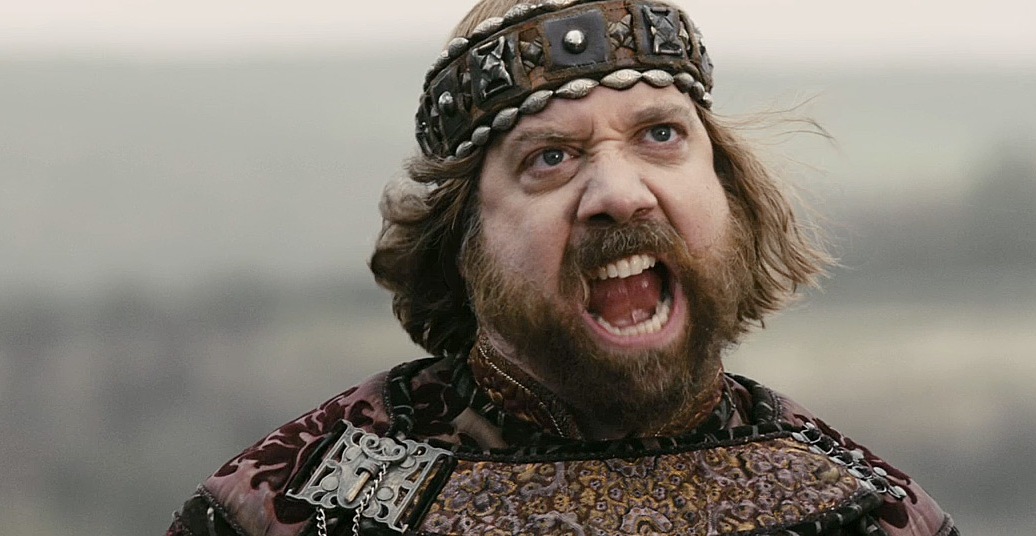
Some typically subtle restrained work from Paul Giamatti

There are some impressive set pieces and some very stirring bits of head mashing, limb slicing violence but the overall plot is completely bog standard, as if with all that investment they either didn’t have time to put a story together or felt that they needed to make something that would appeal as much as possible to the lowest common denominator in order to recoup the costs. But at least there is a nice sense of growing comradeship between this hardy gang fighting against the odds and the film gets some sense of honour and duty being causes worth dying for against tyrants. I mean, it’s not there in spades, but it’s there.

And if you like this sort of B movie hack and dash stuff you’ll probably actually rather like this. Heck I’ve seen it twice, and I found the second viewing actually rather good fun in particular, especially as I knew going into it the entire film was an absolutely absurd pile of nonsense designed to just let you watch blood spray across the screen and heads depart bodies. Roll with it – put your critical facilities on hold and forget the history – and you will rather enjoy its earnest B movie antics.

Churchill (2017)


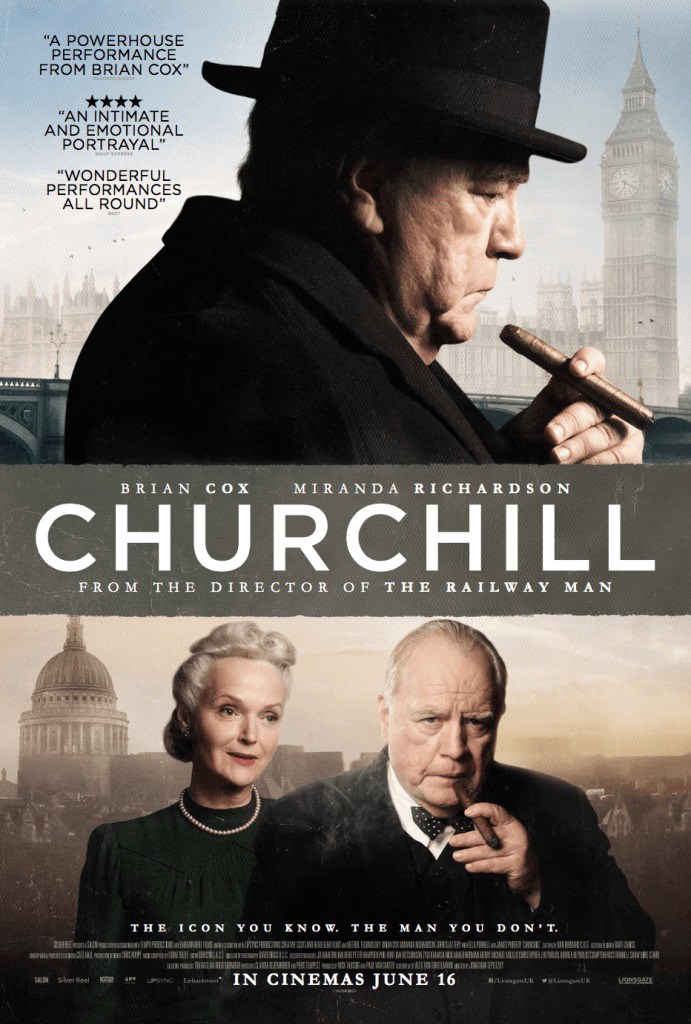
Brian Cox does his very best Greatest Britain as Churchill

Director: Jonathan Teplitzky

Cast: Brian Cox (Winston Churchill), Miranda Richardson (Clementine Churchill), John Slattery (General Dwight D. Eisenhower), James Purefoy (King George VI), Ella Purnell (Helen Garrett), Richard Durden (Jan Smuts), Julian Wadham (Field Marshall Bernard Montgomery), Danny Webb (Field Marshall Alan Brooke), Jonathan Aris (Air Field Marshall Trafford Leigh-Mallory)

Someone should open a club: The Churchill Club. Every actor who’s played the Great Man gets instant membership. President the late Robert Hardy (seven times!). Other members? You name it: Finney, Gambon, Burton, Spall, Gleeson, Russell Beale, West, Hoskins… Think of a shorter, slightly rotund British character actor and inevitably they’ve had a go. Even the decidedly non-rotund, non-short, non-British John Lithgow aced the role in Netflix’s The Crown. With Gary Oldman also making his pitch this year in Darkest Hour, this film sees renowned character actor Brian Cox join the club. 

1944. Its three days before D-Day and Winston Churchill (Brian Cox) is getting cold feet. Haunted by memories of Gallipoli, he fears that the attack on Northern France will lead to disaster and oceans of blood. Against the advice of his Generals Montgomery (Julian Wadham) and Brooke (Danny Webb), he attempts to push General Eisenhower (John Slattery) to change the plans. As depression takes its grip on him, only his wife Clementine (Miranda Richardson) can get through to him. 

Churchill is a bit of a mess. It’s pretty well acted but highly televisual, shot with a self-conscious flourish that only emphasises its micro-budget. Teplitzky is in love with the cross-fade (or even worse the half fade) – constantly cutting from place to place for brief moments in the middle of scenes, often for lingering shots of actors staring out to sea or walking through fields. The action is often framed oddly, in long shot with full bodies in shot framed between ground and sky. Other scenes are filmed flatly – when Montgomery addresses his army, no amount of slow pans can hide that it consists of about 20 men.

On top of that, every single scene is scored within an inch of its bloody life. Now I love the power of film music, but this goes too far. The score is bland, predictable and unimaginative and just not that interesting to listen to. When it’s dropped heavy-handedly on top of every single scene it makes you want to scream. It’s also often completely misjudged or inappropriate – as gentle romantic piano swells during a key discussion between Churchill and the King, you almost expect them to kiss. 

That’s before we get started on the script, which is instantly forgettable. Alex von Tunkleman wrote a long running column in the Guardian on historical accuracy (or not) in films. Talk about a hostage to fortune, when you try to write your own film… I’ll go into historical issues in a bit, but there are lots of little things that feel wrong from Smuts (Deputy PM Of South Africa!) following Churchill around like some sort of valet too Montgomery addressing the Prime Minister to his face as “Churchill”. Stuff that just doesn’t feel quite right. The script also relies on a fictional “young secretary” who eventually speaks truth to the great man and wins his respect. Von Tunkleman is no writer of snappy dialogue, the film too often feeling like a wonky history lesson than a drama.

Historically the film does explore a different side of Churchill – enough to ruffle the feathers of the millions of Churchill fans out there. It focuses on his depression and self-doubt, within the framework of a period when he was starting to become sidelined by America. It also focuses on his little known opposition (certainly initially) to D-Day (he favoured a second front opened in Europe’s “soft underbelly” of Italy) – although it certainly expands this last-minute opposition for dramatic effect. I’m pretty sure he was on board by this point (however initially reluctant)!

What the film looks like it might do (but never quite does) is really explore some of Churchill’s laws and vulnerabilities – to look at the negatives and see how overcoming (or dealing with these) made him a great man. It touches heavily on Churchill’s depression – the “black dog” – with a desperately worried Churchill retiring to his bed to despair, praying for bad weather to prevent the landing and bawling out his secretary. Churchill is frequently wrong or mistaken, and the film captures much of the frustration his generals had with this talented amateur. It also isn’t afraid to show that, with American muscle driving the war, Churchill was becoming more of a mascot than a major orchestrator of allied strategy.

It’s a shaded portrait, but the film is eventually seduced by Churchill’s magnestism – a King’s Speech style final radio broadcast is all swelling regard, and a coda of Churchill waving his hat on a beach towards France hammers home his legendary status – miles away from its careful look at his growing irrelevance (and his concerns about this) early in the film. For all we have characters constantly stressing to Churchill his time is passing, the film can’t help finishing with a flourish that hammers home his centrality.

Churchill is flat and unimaginative but it does have an energetic, engaging performance from Brian Cox. While not in the first rank of Churchills, he captures the charisma, without slavishly imitating the famous voice. His Churchill, with his depression and doubt, also feels different: a slightly counter-establishment actor like Cox fits nicely with this. It’s an assured, charismatic performance hampered by the material. The rest of the cast feed off scraps though Miranda Richardson is assured as a twinkly level-headed Clementine. Richard Durden also deserves mention as gruffly supportive Smuts, as does James Purefoy as a gentle George VI.

Churchill means well – but fails. It’s aiming to question some of the reverence we have for the past, but ends up falling between stools, in the end too in love with the myth, but too critical to please the die hards. Flatly filmed and woodenly written, too many scenes fade from memory too quickly. Brian Cox (and Winston) deserved better.

Solomon Kane (2009)


James Purefoy excels in cult-classic in the making Solomon Kane

Director: Michael J Bassett

Cast: James Purefoy (Solomon Kane), Max von Sydow (Josiah Kane), Pete Postlethwaite (William Crowthorn), Alice Krige (Katherine Crowthorn), Rachel Hurd-Wood (Meredith Crowthorn), Jason Flemyng (Malachi), Mackenzie Crook (Father Michael)

Solomon Kane was a pulp-magazine character from the 1920s. I’d never heard of him before – I imagine many others haven’t either – so bringing a film about him to the screen was always going to be a labour of love. That’s certainly what this film is. 

In 1600, Solomon Kane (James Purefoy) is a ruthless mercenary, but is confronted by a demon who tells him his soul is forfeit to the Devil. Horrified, Kane flees to sanctuary in a monastery, forsaking violence and devoting himself to God. After being expelled because the abbot has a dream, he encounters a Puritan family, the Crowthorns, and travels with them. Kane is deeply drawn to the Crowthorns – and when they are ambushed, the family killed, and daughter Meredith (Rachael Hurd-Wood) kidnapped by the servants of the sorcerer Malachi (Jason Flemyng), Kane swears to revenge the Crowthorns and rescue Meredith.

There’s something quite sweet and charming about Solomon Kane. It’s an old fashioned B-movie with a winning style. Is it going to rock any worlds? Probably not, but it’s got plenty of swagger and it makes a small budget go a long way. Bassett’s influences are pretty clear – everything from Witchfinder General to Lord of the Rings – but he shoots the film with a commendable energy. The visual flair is impressive, and successfully creates the feel of an England halfway between civilisation and the middle ages. Bassett also knows how to shoot an action scene, and the film is stuffed with fantastic sword fights that hit the right balance between brutality and dynamism.

Bassett also finds a fair amount of emotional heft in the story. The decision to focus a large chunk of the opening 45 minutes on Kane’s guilt and his attempts to make amends, make him a character we end up caring about. The “good family that wins our hero’s heart” cliché is exactly that, but it works very well here as Bassett takes his time and lets Kane’s bond with the Crowthorn family grow organically. All this patient establishment of Kane’s personality really pays off during the action of the second half.

It’s also helped a great deal by James Purefoy’s committed performance in the lead role. Purefoy has long since been a favourite of mine, who never really got the breaks to become a bigger star. His performance has the physicality and charisma, but Purefoy also adds in a Shakespearean depth to create a man desperate for redemption, carrying a pained heart very close to the surface. He dominates the whole film, setting the tone; and I suspect his dedicated performance encouraged fine work from the actors around him, despite almost all the other roles being little more than cameos. There are blockbusters whose leading actors are incapable of holding the screen as well as Purefoy does here.

Bassett’s B-movie spectacle is not perfect. The eventual explanation of why the Devil wants Kane’s soul is inexcusably garbled. Jason Flemyng is miscast as the demonic sorcerer Malachi, and his final confrontation with Kane lacks real impact (largely because Malachi has so little presence throughout the film) and devolves into a face-off with a dull special effects monster that looks rather like Megatron in the live-action Transformers films. There is a smaller-scale, personal ending in this film, but it gets crushed under the foot of the special effects. It’s a shame that a large portion of this film’s budget probably went on this.

Solomon Kane is structured, and plays, like a B-movie – but it’s proud of that. Its low budget demanded inventiveness and dedication from the cast and crew, all of whom delivered. The grimy design of the world is perfect, the story creates a good combination of action and emotion. Its story may be pretty clichéd, but it’s presented with great gusto – and has a terrific leading performance from a heavily under-rated actor in James Purefoy. More people deserve to see this – if this isn’t a cult classic in the making, I’m not sure what is.