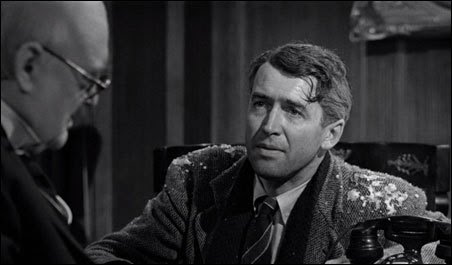
Tag: James Stewart

Winchester ’73 (1950)

Winchester ’73 (1950)

Psychological darkness underpins this dark and exciting Western from Mann and Stewart

Director: Anthony Mann

Cast: James Stewart (Lin McAdam), Shelley Winters (Lola Manners), Dan Duryea (‘Waco’ Johnny Dean), Stephen McNally (‘Dutch’ Henry Brown), Millard Mitchell (Frankie ‘High Spade’ Wilson), Charles Drake (Steve Miller), John McIntire (Joe Lamont), Will Geer (Wyatt Earp), Jay C Flippen (Sergeant Wilkes), Rock Hudson (Young Bull), Tony Curtis (Private)

“The Gun That Won the West” was the proud boast of the Winchester Repeating Arms Company of its rifle ((it can fire several shots before reloading unlike normal rifles). As Winchester 73 puts it, such guns built the West and any Indian would give his soul for one. In Anthony Mann’s complex psychological western, it’s also an instrument of death defining a whole era. Winchester 73 follows the path of one ‘perfect’ repeating rifle, won in a shooting competition by Lin McAdam (James Stewart) but stolen from him and passed from hand-to-hand, seeming to curse everyone who touches it to death.

McAdam has his own mission, searching for the man who killed his father, ruthless criminal ‘Dutch’ Henry Brown (Stephen McNally). These two compete for the rifle, in a Tombstone shooting content refereed by legendary Wyatt Earp (Will Geer) whose orders to keep the peace in this town stop the two of them turning guns on each other from the off. Defeated, Dutch steals the rifle (after getting the jump on McAdam), but he doesn’t keep it long as it moves from owner-to-owner. Meanwhile, McAdam purses Dutch, with faithful friend High Space (Millard Mitchell) in tow, encountering war bands, cavalry troops and Lola Manners (Shelley Winters), a luckless woman tied to a string of undeserving men.

Winchester 73 unspools across 90 lean, pacey minutes and gives you all the action you could desire, directed with taut, masterful tension by Mann. It opens with a cracking Hawkesian shooting contest, with the equally matched McAdam and Dutch moving from shooting bullseyes, to dimes out of the sky to through the hoops of tossed rings. Among what follows is a tense face-off between cavalry and Indians, a burning house siege of Dutch’s ruthless ally ‘Waco’ Johnny Dean (Dan Duryea), a high noon shoot-out and a final, deadly, rifle shooting wilderness cat-and-mouse shoot-out between McAdam and Dutch. It’s all pulled together superbly, mixing little touches of humour with genuine excitement.

However, what makes Winchester 73 really stand out is the psychological depth it finds. Audiences were sceptical of James Stewart – George Bailey himself – as a hard-bitten sharp-shooter out for revenge. But Stewart – deeply affected by his war service – wanted a change and Mann knew there was darkness bubbling just under the surface. McAdam is frequently surly, moody and struggles to express warmth and kindness. He can only confess his fondness for High Spade while glancing down at the rifle he’s cleaning and the most romantic gesture he can give Lola is a gun when they are caught up in a cavalry siege, wordlessly suggesting she save the final bullet for herself. McAdam is driven and obsessively focused, stopping for nothing and no-one on his manhunt, a manhunt High Spade worries he is starting to enjoy too much.

And he’s right to worry. In hand-to-hand combat, Stewart lets wildness and savagery cross his face, his teeth gritted, eyes wild. Scuffling for the rifle with Dutch, there is a mania in his eyes that tells us he is capable of killing with his own hands, a look that returns when he later savagely beats the cocky Waco (it’s even more shocking, as Waco’s ruthless skill is well established, before McAdam whoops him like an errant child). Stewart plays a man deeply scarred by the loss of his father, his emotional hinterland laid waste by a burning need for revenge to fill his soul.

This is the West Winchester 73 sees, one of anger, self-obsession and lies. Seemingly charming trader Joe Lamont (John McIntire, very good) is a shameless card sharp who cheats everyone left-right-and-centre. Waco is perfectly happy to sacrifice his own gang so that he can escape the law – just as he’s perfectly happy to use women and children as human shields and provoke a hapless Steve Miller (Charles Drake), Lola’s luckless lover, into out-matched violence. Steve is hard to sympathise for, having left Lola in the lurch without a second thought when they are caught in the open by a war band (he rides off shouting ‘I’ll get help’ and only returns after finding it by complete fluke).

In this West, a gun is the ultimate symbol. Mann opens every section of the film with a close-up shot of the gun itself, this most prized of possessions, each time in the hands of a new owner. Earp keeps his town strictly gun-free, and both McAdam and Dutch instinctively reach for their holster-less waists when they first meet. (Will Geer does a fine line in avuncular authority as Earp, treated with affectionate patience which becomes quiet fear when he smilingly reveals who he is). The cursed rifle, like Sauron’s ring, seems to tempt everyone and then betray anyone who touches it. Of all its owners, only Dutch and McAdam seem to understand how to use it: and of course, McAdam is the only man with the determination to truly master it.

There isn’t much room for women in all this. Much like the rifle, Lola herself is passed from man-to-man. Played with a gutsy determination by Shelley Winters, she’s first seen thrown out of Tombstone on suspicion of being a shameless floozy, before passing from the useless Steve (who Winters wonderfully balances both affection and a feeling of contempt for) to the psychopathic Waco (few people did grinning black hats better than Dan Duryea). It’s been argued that Lola fills all the traditional female Western roles in one go – hooker, faithful wife, independent women, damsel-in-distress, redemptive girlfriend – and there’s a lot to be said for that. So masculine and violent is this world, women constantly need to re-shape and re-form themselves for new situations.

Fascinating ideas around violence, obsession and sexuality underpin a frontier world where, it’s made clear repeatedly, life is cheap make Winchester 73 really stand out. Led by a bravura performance by James Stewart (who negotiated the first ever ‘points deal’ for this film and made a fortune), with striking early appearances from Rock Hudson (awkwardly as a native chief) and Tony Curtis (as a possibly too pretty cavalry private), it’s both exciting and thought-provoking in its dark Western under-currents

Destry Rides Again (1939)

Destry Rides Again (1939)

A gun-shy sheriff needs to clean up this town in this delightfully funny semi-comedy Western

Director: George Marshall

Cast: Marlene Dietrich (Frenchy), James Stewart (Tom Destry Jnr), Mischa Auer (Boris), Charles Winninger (Washington Dimsdale), Brian Donlevy (Kent), Allen Jenkins (Gyp Watson), Warren Hymer (Bugs Watson), Irene Hervey (Janice Tyndall), Una Merkel (Lily Belle), Billy Gilbert (Loupgerou), Samuel S Hinds (Mayor Hiram J Slade), Jack Carson (Jack Tyndall)

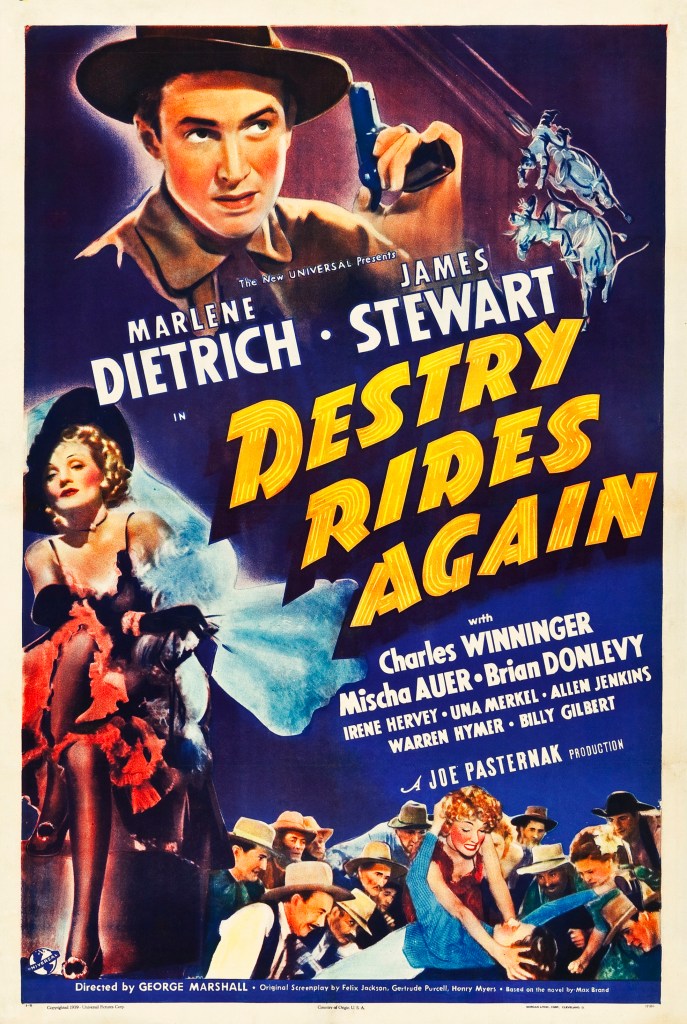
There’s a new deputy sheriff in town! Son of a wild-shooting, hard-as-nails lawman, Tom Destry Jnr (James Stewart) is surely the man to bring justice to Bottleneck. Or at least that’s what everyone thinks until his carriage arrives and out steps an aw shucks slouching drawler, carrying a parasol, who loves a homespun yarn and – worst of all! – doesn’t see the point of carrying guns. Surely, he’ll be a push-over for Kent (Brian Donlevy), the corrupt saloon owner who runs the town? Guess again. Tom will soon change all sorts of minds, not least Kent’s gal, glamourous singer (and card sharp) the improbably accented Frenchy (Marlene Dietrich).

George Marshall’s Destry Rides Again is pretty much a delight from start to finish. It combines rich comedy and Western satire, with genuine sharp-shooting thrills, and showcases a host of actors at the top of their game. It’s crammed with excellent jokes, shrewd observations and some moments of truly affecting tragedy. It’s the finest film Marshall, otherwise a journeyman, directed with confidently handled, crowd-filled set pieces and a wonderful sense of pace.

It’s hard not to fall in love with a man who doesn’t care what people think of him but, when push comes to shove, could beat them all in a game of quick draw. It helps abundantly when he’s played by James Stewart at his most boyish and lovable. Tom is determined to prove the law can be done another way: that escalating things by pulling a firearm only leads to trouble (“You see if I have had a gun there, why, one of us might have got hurt – and it might have been me”). Tom is quick-witted and confident enough to face down crises without a gun – putting him years ahead of the townsfolk who judge everyone by their ability to hit a target.

In fact, Destry Rides Again in its opening hour really commits to the idea of Tom as an ahead-of-his-time pacifist, who thinks through events with the grace of a chess-master. We’re constantly encouraged to delight not only in his smarts – the incriminating traps he lays for all around him, the skilful way he defuses situations – but also respect for his cool and guts (you need to be damn sure of yourself to order a glass of milk in Kent’s no-holds-barred saloon).

Tom eventually of course has to give them a show – his pin-point accuracy with a pistol leaves the town gasping, and a group of would-be trouble-makers lamely muttering how sorry they are to have disturbed the peace – but he’s far too brave to need to prove himself. Real courage is not caring what people think of you, and real smartness is being happy for others to call you a knabby-pabby yellow-belly. After all, they’ll only underestimate you – and make it even more likely Tom’s methodical, law-following approach will yield the right results.

Marshall mines gallons of fish-out-of-water comedy from Tom’s willingness to look the fool. From his arrival at the town clutching the parasol of a fellow passenger – his shoot-first-and-second-think-third fellow passenger Tyndall (Jack Carson) is mistaken for him because he matches the bill of what the town expects – to his passion for whittling napkin rings and his calm aw shucks good humour when handed a mop and told to use that to “clean up this town”. But we are never left with a doubt that Tom is the bravest, smartest, toughest guy in the town – and that he doesn’t need to constantly proof it to himself and others.

It eventually sinks in as well to glamour madam, Frenchy. Marlene Dietrich had not only never appeared in a Western before, she’d been declared “box office poison” just a few months earlier. In the public mind she was associated with glamour, distance and von Sternberg majesty. All that was to change with Destry Rides Again, where she was lusty, earthy but still with a touch of class. Who would have imagined Sternberg’s muse engaging in a no-holds barred cat fight with Una Merkel’s domineering housewife (a brawl that trashes most of the bar)?

Dietrich is quite superb in the role of this enigmatic madam. Her distinctive singing is used liberally throughout the film. Which fits nicely with Frenchy’s role in the town as the glamourous distracting agent for the crimes of Kent (a smugly grinning Brian Donlevy). Not that she’s an innocent: she swipes cards from punters in crooked card games and knows full well Kent sends “out of town” anyone who crosses him. But there is something in Tom she finds intriguing, perhaps because he’s smarter, more interesting and different from any other an in this benighted outlaw stop-off.

It helps as well that there is a clear magnetic attraction between the two. Not to mention between Stewart and Dietrich – it’s no surprise, watching the film, to hear they had a passionate affair during its making. Stewart has never really felt sexier than here with Dietrich, while Stewart helps Dietrich feel warmer and more approachable than she ever did with Sternberg. The dance (literally at one point) between these two, captures in microcosm the struggle for the town’s soul: will Tom win them over, or will the gun-totting baddies?

Marshall doesn’t quite cap the film off as well as you might hope. Eventually, Tom is left no choice but to pick up his guns. The film does present a final shoot out quite unlike anything you’ve ever seen before – ending in a battle-of-the-sexes brawl in the saloon, shot with an immersive comedy. But it doesn’t change the fact that Destry Rides Again can’t in the end square its circle: Tom may preach stern words over violence, but when push comes to shove only guns solve problems.

But you forgive it because this film is a hugely entertaining delight. There are a multitude of delightful supporting roles. Best of all are Mischa Auer is extremely funny as a Russian would-be-deputy who (literally) doesn’t wear the trousers in his marriage and Charles Winninger as the town drunk turned sheriff, who has a secret heart of gold even if he can’t tuck his shirt in (there is a lovely, late, call-back to this mannerism in the film from Tom that is genuinely moving). Destry Rides Again manages to be both a sort of spoof, but also a very real genuine Western, with a near perfect mix of jokes and action. It doesn’t quite manage to deliver on its concept, but it does more than enough.

Vertigo (1958)

Vertigo (1958)

Obsession and grief come dangerously into play in one of the greatest films ever made

Director: Alfred Hitchcock

Cast: James Stewart (John “Scottie” Ferguson), Kim Novak (Madeline Elster/Judy Barton), Barbara Bel Geddes (Midge Wood), Tom Helmore (Gavin Elster), Henry John (Coroner), Raymond Bailey (Doctor), Ellen Corby (Hotel manager), Konstantin Shayne (Pop Leibel), Lee Patrick (Car owner)

Spoilers: Vertigo was controversial at the time for revealing its twist, three quarters of the way through the film. I might well do the same in the review – although this is possibly a richer film if you know the twist going in

In 2012 Vertigo dislodged Citizen Kane at the top of Sight and Sound’s decadal “Greatest Film” poll, after 50 uninterrupted years for Welles’ classic. It’s an astonishing turn-around for a film which was a box-office disappointment and first met with reviews that called it “long and slow” and complained that Hitchcock had “indulged in such farfetched nonsense”. (Welles also hated the film – bet he’s even more pissed off at it now.) This is partly because Vertigo is a fiercely, almost defiantly, complex and cold film that defies easy characterisation and flies in the face of the fast-paced watchability of most of Hitchcock’s popular films. But it’s still a haunting and fascinating masterpiece, which has its greatest impact when you reflect on it days after it has finished.

Its plot is both complex and slight. John “Scottie” Ferguson (James Stewart) is an ex-police detective, his career ended by crippling acrophobia bought on by powerlessly watching a fellow officer fall to his death. He’s hired by old college friend Gavin Elster (Tom Helmore) to follow Elster’s wife Madeline (Kim Novak). Madeline is in the grip of an idée fix that she is an incarnation of Carlotta Valdes, a woman who committed suicide in 1857. Scottie follows her – and develops an idée fix of his own for the beautiful Madeline. When his acrophobia prevents Scottie from saving Madeline from jumping to her death from a bell tower, he suffers a near-breakdown. Then he catches sight of Judy Barton (Kim Novak again) who has a chilling resemblance to Madeline. And Scottie tries to turn her into just that.

Vertigo is a dizzying film of monomania and obsession, something you are immediately plugged into with its beautiful Saul Bass opening (swirling spirals, reflecting the circular nature of the obsessive) and its hauntingly mesmeric and off-beat romantic theme from Bernard Herrmann (possibly his greatest work – and he also scored Kane!). More than any other Hitchcock film, Vertigo places us firmly into the POV of its lead character, who is in all but three scenes and whose perceptions and observations we not only share but which totally guide our understanding of everything we see in the film (until that twist, when suddenly we shift to knowing more than he does).

Hitchcock’s technique is truly masterful here. There isn’t the flash of something like North by Northwest, but the sort of chilling control that builds tension and unease that also marks out films like The Birds or, to a degree, Psycho (although that’s much more of a black joke, where Vertigo is terrifyingly serious). Hitchcock uses a huge number of POV shots, alternating with shots of Stewart’s reactions (at times these are disturbing in their fixed intensity) building a subtle momentum that reflects the character’s obsession and further filters everything we experience from his perspective.

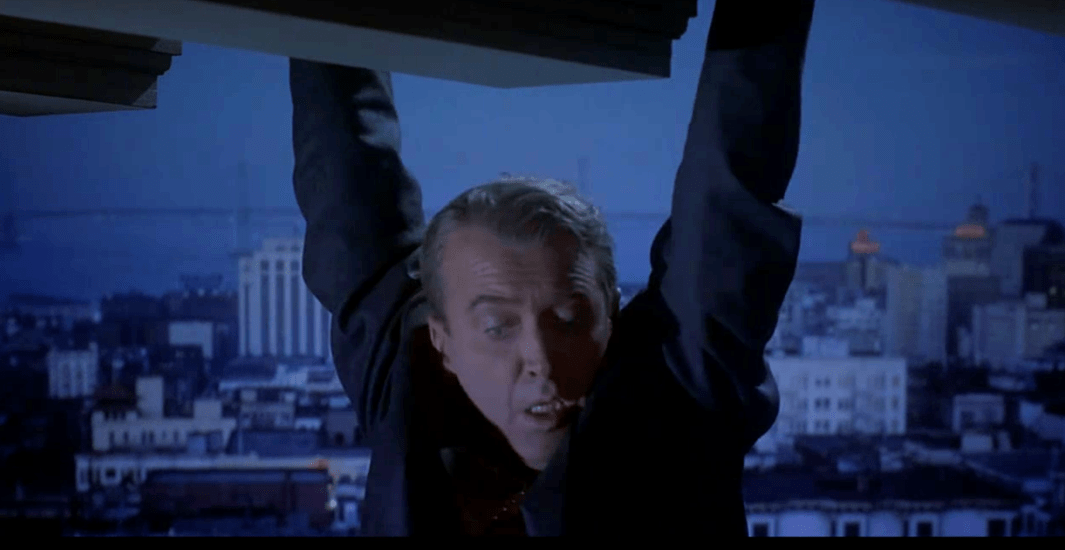
That would be the perspective of an ever-more obsessed man tipping steadily into stalkerish territory. Few films have so clearly drawn the link between the private eye and the voyeur. As Scottie silently prowls the streets of San Francisco, observing every inch of Madeline’s actions – and Vertigo has long, worldless stretches of what Hitchcock called “pure cinema” – the disturbing pleasure and control that following brings you becomes more and more clear. It’s certainly giving a sense of masculinity back to Scottie, introduced to us hanging helplessly from a ledge and then so hamstrung by his condition he can’t even climb a step ladder without collapsing.

Judged from this perspective, Scottie is one of the most darkly disturbing characters in film. Rescuing Madeline from the Golden Gate (where she has jumped in) he takes her home, undresses her and puts her in his bed – hardly normal behaviour. It’s not long from there before he surrenders to his romantic obsession (feelings Madeline perhaps returns), that eventually leads him again to be a powerless witness as Madeline plunges to her death right in front of him.

Catatonia and mental collapse follow – but really it’s perhaps just a continuation of the same obsession in another form. Because after a stay in a sanatorium, Scottie is back on the streets again, prowling for something – anything – that could make him feel closer to Madeline again. Which is how he spots Judy, the woman who reminds him of the woman he’s lost. Scottie doesn’t so much woo Judy as seemingly browbeat her into a bizarre (joyless and sexless) relationship and undertake a terrifyingly grotesque remodelling exercise, designed to make her into a carbon copy of Madeline.

This sequence is probably partly at the heart of the film’s fascination for critics and film historians – even more so since we’ve learned about Hitchcock’s manipulative, controlling relationship with his blonde female stars. Here we have Scottie instructing his love interest how to dress, walk and cut her hair – all while telling her it’s for her own good and she’ll like it – his voice with the breathless longing of a closeted pervert (that is when Scottie manages any sexual yearning to Judy, who he treats more like a treasured exhibit). This is Hitchcock dramatizing his own hang-ups, presenting them as creepy and dangerous, making Vertigo partly as well a fascinating psychological study of its director. Did Hitchcock know that his controlling relationship with women was wrong? And, in real life, could he not help himself or did he not care?

Vertigo is a perfect exploration of obsession. But it also pulls the rug out from us – and rewards constant reviewing as a result – because the film reveals there was a whole other level going on. Scottie may seem the Hitchcock substitute, but the in-film Hitch figure is actually the amiable Gavin Elster. Because the entire action of the film is carefully stage-managed by Elster to manipulate Scottie (and us!): Judy and Madeline (as Scottie has met her) are in fact the same woman, a doppelgänger for Elster’s wife. The real Madeline – who Scottie never sees or meets – is murdered by Elster at the top of that tower, and Judy/Madeline was helping build a backstory to have this murder written off as suicide, with Scottie’s acrophobia perfect to make him a powerless witness.

Here comes that pleasure for rewatching: because now when Scottie rescues “Madeline” from the river, then spends the next day with her, we thought at first he knew more than she. Now however, we understand he’s always been a patsy who knew less than anyone else. We’ve been manipulated by Elster, the master director, pulling the strings and building horrors for us. That’s Hitchcock.

The film reveals this in one of the few scenes told from Judy/Madeline’s perspective – and means we then watch Scottie actually craft a woman who actually is the woman he’s obsessed with into his memory of that very same woman. (Get your head around that!) And she allows it, because she seems as desperate as he to recapture the passion of those brief days together – but cannot tell him the thing that would help to do that. It all leads, of course, to Scottie’s destructive obsession leaving him once again to being a helpless witness as another victim plummets to their death.

Vertigo is effectively a two-hander, and most of the focus usually lands on Stewart. He is chillingly dead-eyed in this, his crazed hunting after something he doesn’t even understand capturing the controlling horror behind some romance. In many ways though, Kim Novak has the more complex part. She doesn’t speak for almost 45 minutes – she spends it mostly in long shot performing Elster’s play for Scottie (and us) of the mentally disturbed wife. But when Novak does take centre stage, this is a complex multi-layered performance, carefully modulated throughout to communicate (in advance) Judy’s vulnerability and love for Scottie, without ever letting us realise she is anything but the death-fixated “Madeline”. Novak marries two contradictory characters into one with a simple and convincing aplomb. Equally good is Barbara bel Geddes, in almost the only other named role, as Scottie’s one-time fiancée now best friend, all too aware that her feelings are not returned.

Vertigo will never match the likes of Casablanca or North By Northwest – on a list of films truly popular with audiences. It’s been described as the ultimate critic’s film: a cool, chilling, brilliantly filmed, psychological thriller that quietly exposes the mechanics of film, the manipulation of story-telling and the dark psyche of its director. In many ways initial reviews were right: on first impression, the film is cold and slow, with characters it’s hard to relate to. But it has a truly haunting quality few others can match. And it constantly presents us with a clear image, while never allowing us to guess we are seeing only part of the overall picture. It can leave us as dizzy as Scottie is, hanging from that ledge and staring down at doom, the camera zooming inside his head and showing us his terrifying POV. You need to work at it, but this is a film to value.

Anatomy of a Murder (1959)

Anatomy of a Murder (1959)

The mechanics of courtroom showmanship is ruthlessly exposed in this gripping drama

Director: Otto Preminger

Cast: James Stewart (Paul Biegler), Lee Remick (Laura Mannion), Ben Gazzara (Lt Frederick Manion), Arthur O’Connell (Parnell McCarthy), Eve Arden (Maida Rutledge), Kathryn Grant (Mary Pilant), George C. Scott (Claude Dancer), Orson Bean (Dr Matthew Smith), Russ Brown (George Lemon), Murray Hamilton (Alphonse Paquette), Brooks West (Mitch Lodwick), Joseph N Welch (Judge Weaver)

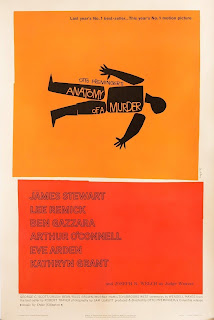
Winston Churchill once said Democracy was the worst form of government, except for all the others. You could say something similar about trial by jury: it ain’t perfect, but it’s better than any other justice system we’ve given a spin to in human history. Trials aren’t always forums for discovering truths: they are stages to present arguments (or stories), and they are won by whoever has the best one. Maybe cold, hard facts and evidence make up your story, maybe perceptions. Maybe it’s about how you tell the story. Elements of all three are found in Otto Preminger’s brilliant courtroom drama, Anatomy of a Murder.

In a small town in Michigan, a US army lieutenant, Frederick Manion (Ben Gazzara) is arrested for the murder of innkeeper Barney Quill. Manion says he did the deed only because Quill raped Manion’s wife Laura (Lee Remick). Representing him is lawyer Paul Biegler (James Stewart), a former district attorney looking to start-up a new practise. On the opposite side is new DA Mitch Lodwick (Brooks West) and, far more of a worry, hot-shot lawyer Claude Dancer (George C. Scott) all the way from the Attorney General’s office. They say there was no rape – only a jealous murder after a consensual affair. It’s he-said-she-said, only “he” is dead. How will the trial clear that one up?

Otto Preminger was the son of a noted Austrian jurist, and Anatomy of a Murder can be seen as a tribute to his father, and to the process of the law itself. Not that it’s a hagiography. The film recognises the virtues as well as the faults of the system. Above all, that the system is not perfect, it can’t base every decision on firm facts and often requires people to take leaps of faith based on their gut instinct about who may, or may not, be telling the truth.

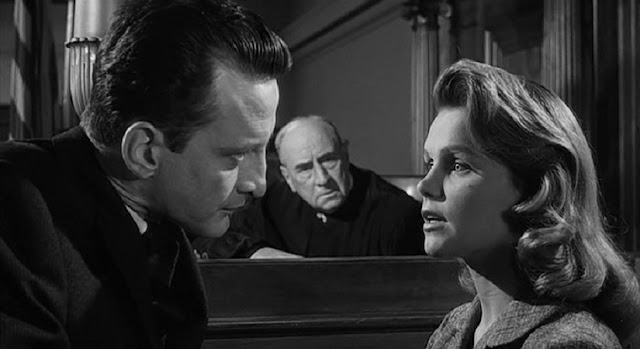
Preminger’s film does its very best to put us in the position the jury is in. We get no real evidence about what happened beyond what they get, and very few bits of additional information (except, perhaps, for seeing what many of the characters are like outside of the courtroom). Instead, the viewer is asked to make their mind-up on whether events fell-out as Manion claims (or not) based on our own judgement of the probabilities and of his (and Laura’s) character. The film opens with the crime committed and closes shortly after the verdict: there are no flashbacks or pre-murder scenes to help nudge us towards one view or another. The murder victim appears only as a photo. Like the jury we have to call it on what we see in front of us.

Anatomy of a Murder also makes clear there are plenty of shades of grey in the process of justice. During his first consultation with Manion, Biegler carefully suggests he consider whether he was in fact insane when he committed the deed – as that sort of defence will be much easier, since he doesn’t deny the killing. Sure enough, on their second meeting, Manion is now deeply unsure about his state of mind. Biegler then works backwards to establish precedent for the plea (a finds a single, over 75 years old one) to pull together a defence of irresistible impulse and to peddle hard a picture of the victim as an unrepentant rapist practically asking for a wronged husband to do the deed.

Biegler’s case is flimsy – but the key thing is to present it with pizzazz. And that’s what he’s got. Stewart’s performances in Hitchcock classics are highly regarded, but this might well be his finest dramatic performance. This is a brilliantly sly deconstruction of Stewart’s aw shucks charm: Biegler promotes an image of himself as a down-on-his-heels, bumpkin-like country lawyer, punching above his weight against the big city lawyers, Stewart dialling up the famous drawl. But it’s miles from the truth: Biegler is a former DA, an experienced trial lawyer and a formidable advocate. Stewart flicks the switch constantly, visibly putting on his persona like a skin, shedding it when no longer needed.

There is a constant suggestion that everything Biegler does is for effect. From fiddling with fishing tackle during the prosecution’s opening statements, to furious court-room theatricals as he thuds tables at slights and injustices. All of it is carefully prepared, rehearsed and delivered to make an impact on the jury. The constant parade of effect, manufactured outrage and appeals to an “us against them” mentality provokes exasperation from his opponents and a weary toleration from the Judge (played by real-life McCarthy confronting attorney Joseph N Welch). Stewart uses his Mr Smith Goes to Washington nobility, but punctures it at every point with Biegler’s cynicism and opportunism. Biegler, at best, persuades himself his client is innocent – but I would guess he doesn’t really care either way. He immediately perceives the personalities of his clients and then does his best to shield their less flattering qualities from the jury.

The one advantage we have over the jury is the additional insight we get into this strange couple, living a possibly unhappy, and certainly love-hate, marriage. Manion plays wronged fury in the court – but Gazzara gives him a lot of self-satisfied smarm and bland indifference to his crime in real life, meeting every event with a smirk that suggests he’s sure he can get away with anything. Equally good, Lee Remick’s Laura presents such a front of decency and pain in court, you’ll find it hard to balance that with the promiscuous, blousy woman we see outside of it, who provocatively flirts with intent with anything that moves. But it’s all about the show: present them right, and these unsympathetic people can be successfully shown as a conventional loving couple.

The prosecution is playing the same game. George C. Scott is superb as a coolly professional lawyer, who will use any number of tricks – from angry confrontation, to seductive reasonableness – to cajole a witness to say anything he wishes them to say. He will turn on a sixpence from being your friend, to berating you as a liar. And he’s not averse to his own morally questionable plays in court. Like Biegler, he knows presenting a good story is what is needed to win: the truth (or otherwise) isn’t enough.

Anatomy of a Murder still feels like a hugely insightful look at the legal process. Most of its runtime takes place in court, which Preminger shoots with a calmly controlled series of long-takes and two-shot set-ups, that help turn the film into something of a play (as well as a showpiece for fine acting). Along with its very daring (for the time) exploration of rape, it has a very cool soundtrack from Duke Ellington, that drips with allure and gives the film a lot of edge. The acting is all brilliant – along with those mentioned, Eve Arden is first-class as Biegler’s loyal secretary and Arthur O’Connell sweetly seedy as his heavy-drinking fellow lawyer. Anatomy of a Murder gives a first rate, at times cynical, look at the flaws and strengths of trial by jury – and is an outstanding courtroom drama.

The Philadelphia Story (1940)

The Philadelphia Story (1940)

Three stars are at the top of their game in this classic screwball-style comedy

Director: George Cukor

Cast: Katharine Hepburn (Tracy Lord), Cary Grant (C.K. Dexter Haven), James Stewart (Mike Connor), Ruth Hussey (Elizabeth Imbrie), John Howard (George Kittredge), Roland Young (Uncle Willie), John Halliday (Seth Lord), Mary Nash (Margaret Lord), Virginia Weidler (Dinah Lord), Henry Daniell (Sidney Kidd)

In 1938 Katharine Hepburn’s career was over. After the flop of some now forgotten (wait, hang on…) screwball comedy called Bringing Up Baby, she took centre place on the Independent Theatre Owners list of “Box Office Poison”. Flops after flop hit Hepburn (all of them are classics today of course), and the studios did their damnedest to drop her. So, Hepburn returned to the stage, developing The Philadelphia Story with Philip Barry – and creating a lead role for herself that would play to all her strengths and help win back public affection. And which (with a little help from Howard Hughes) she would own the rights for: so, if and when they wanted to make a film, she could insist she starred. The rest is history.

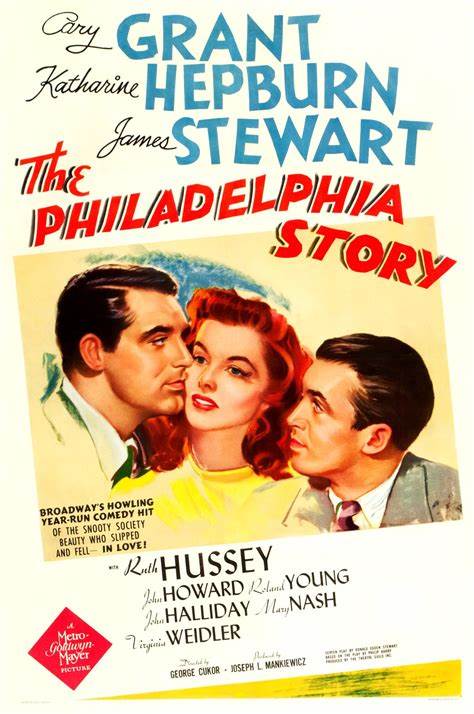
The Philadelphia Story is perhaps the best example of the Code-approved genre, the “remarriage comedy” (because the code wouldn’t countenance the idea of a couple cheating). Daughter of a rich Philadelphia family, Tracy Lord (Katharine Hepburn) is to marry her dull fiancée George Kittredge (John Howard). George’s main attraction is he’s the complete opposite of her charismatic ex-husband C.K. Dexter Haven (Cary Grant). Dexter crashes the build-up to the wedding, bringing along reluctant society journalist (he’s really a renowned short-story writer) Mike Connor (James Stewart) and press photographer Elizabeth (Ruth Hussey), promising to introduce them as distant friends of the family so they can report on the wedding. But then Tracy finds herself drawn to Dexter and Mike and George as well – who will she end-up walking down the aisle with?

Perhaps the best thing about The Philadelphia Story is that you really don’t know who it will be – and the film successfully keeps the question both up-in-the-air and deeply entertaining. There even seems a chance (unlikely as it is) that Tracy really will stick with George (a tedious nouveau riche businessman with priggish middle-class morals who can’t even mount a house – imagine!). Directed with the sort of unfussy smoothness Cukor excelled in – and helped get the best out of actors – it’s a superb comic treat, with a sparkling adaptation by Donald Ogden Stewart.

At the heart of it, Hepburn is superb in a role that riffs considerably off her own public personality. Hepburn was smart enough to know most audiences saw her as far too clever by half. Her sharpness, acidity and no-nonsense unwillingness to suffer fools had made her hard to relate to. Quite correctly, she felt she needed a role where she could “fall flat on her face”. Which , by the way, is more or less the first thing she does – a hilarious prat fall while throwing Cary Grant’s Dexter out, him responding to her snapping his golf clubs by gently putting his hand on her face and pushing her off-balance (only Grant could have got away with that by the way).

Tracy Lord is a version of the Hepburn many people felt they knew. Tracy genuinely believes she’s smarter and better than anyone else, with unquestionable judgment and superior morals. The film is a gentle exercise in pricking her balloon, showing her she is as prone to mistakes, prejudice and, above all, getting giddy and silly in love, as anyone else. This is a fiercely practical woman, who sets high standards for those around her, suddenly finding herself falling in love with three men at once. It’s the exact flighty lack of commitment she spent years condemning her estranged father for.

This is all scintillatingly played by Hepburn, at her absolute best. The rat-a-tat dialogue (with its classic, Wildean comedy of errors and mis-identification) is under her complete control. She’s delightful when, under the influence, she flirts with Mike – Hepburn showing the world (clearly they missed it in Bringing Up Baby) that she could be as silly and vulnerable as the next girl. Hepburn knew people wanted to see her personae deconstructed, and for her character to learn that (in the words of another comedy) nobody’s perfect. It works a treat – and this remained one of her greatest (and funniest) performances.

It helps she had two of the greatest to riff off. Cary Grant is at his light-comedic best here, turning Dexter – a manipulative reformed alcoholic it would be easy to dislike – into the embodiment of sophistication, charm and playful wit, who we adore as much Tracy’s family does. James Stewart won an Oscar and matches Grant gag-for-gag in a comedic masterclass. He’s a master of hilarious comedic and physical reactions – and lovable enough to turn a chippy newspaperman into a sort of hilariously droll sage. His ‘drunk’ acting is also some of the funniest you’ll see on film (even Grant can be spotted cracking up just a little as Stewart hiccups his way through a scene).

Hepburn’s chemistry with both actors is sublime. Her romancing scenes – both the worst for wear for drink, but also empowered to say things they’ve clearly been burying all day – with Stewart are not hugely romantic, but also rather sexy (Cukor’s direction here is also exquisitely spot-on). It’s a masterclass in on-screen flirtation – and you can see why George gets as pissed off as he is. Hepburn and Grant meanwhile bicker and taunt each other with all the chemistry of a match and a fire.

Each scene has a bounce that teeters between heart-felt and farcical. The set-ups are frequently silly – but they work because they hinge on characters that feel immensely real. Every performer is spot on – credit also goes to a superb Ruth Hussey, one of the few grown-ups in this weekend of flirting, feuding children. Set in a sumptuously rich Philadelphian mansion, for all of Mike’s chippy criticism it’s a celebration of the smooth upper classes over hard-working, dull prigs like George. Its sole fault might be it’s too long (at just under 2 hours, a few scenes and set-ups outstay their welcome). But, as a classic Hollywood comedy, it’s pretty much the top of the class. Box-office poison no more.

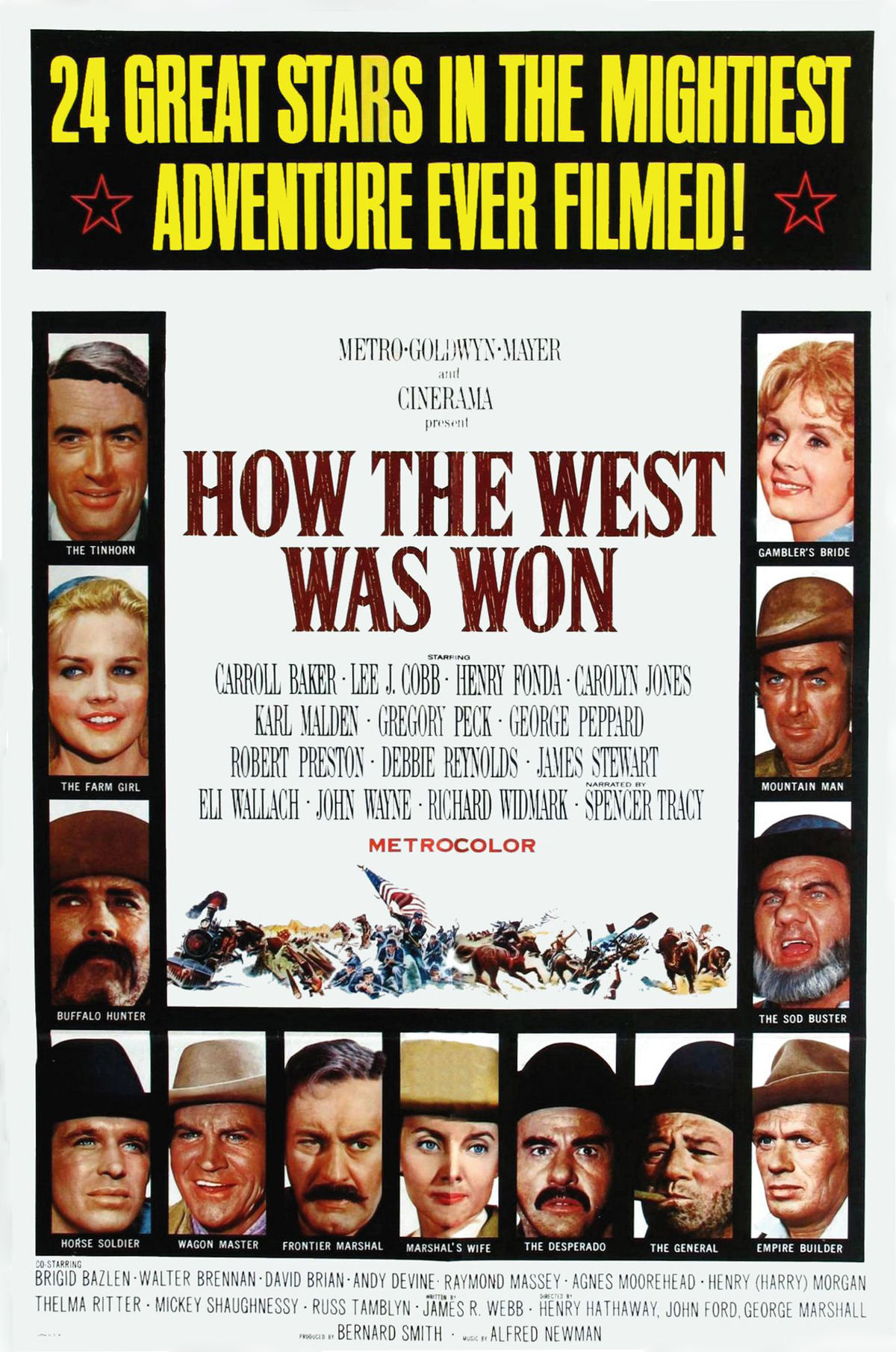
How the West Was Won (1963)

James Stewart helps us see How the West Was Won

Director: Henry Hathaway, John Ford, George Marshall

Cast: Spencer Tracy (Narrator), Carroll Baker (Eve Prescott Rawlings), Walter Brennan (Colonel Jeb Hawkins), Lee J Cobb (Marshal Lou Ramsey), Henry Fonda (Jethro Stuart), Carolyn Jones (Julie Rawlings), Karl Malden (Zebulon Prescott), Raymond Massey (Abraham Lincoln), Agnes Moorehead (Rebecca Prescott), Harry Morgan (Ulysses S Grant), Gregory Peck (Cleve van Valen), George Peppard (Zeb Rawlings), Robert Preston (Roger Morgan), Debbie Reynolds (Lilith Prescott van Valen), Thelma Ritter (Agatha Clegg), James Stewart (Linus Rawlings), Rus Tamblyn (Confederate deserter), Eli Wallach (Charlie Grant), John Wayne (William Sherman), Richard Widmark (Mike King)

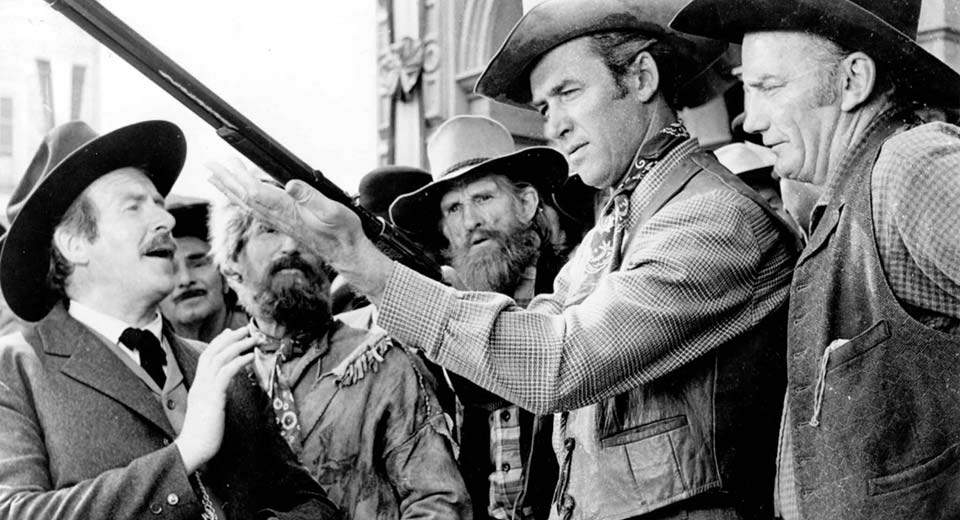
How the West Was Won was the Avengers: Endgame of its day: every star of the biggest box-office genre in America coming together for one epic adventure that would stretch over generations. Stewart! Fonda! Peck! Wayne! Together for the first time (only of course they are not, none of them appearing the in same scene). Even more than that, How the West Was Won would be filmed in Cinerama, a three-screen shooting method producing a panoramic image. All this would make How the West Was Won the biggest, grandest, largest film ever made. It was a massive box-office success, nominated for eight Oscars (including Best Picture) and wowed audiences.

Plot wise though, it’s basically a series of short films cobbled together into a single film. The stories are basically self-contained, although some actors cross over (especially George Peppard and Debbie Reynolds). The first episode The Rivers covers the migration west, down the river, of the Prescott family, taking on river pirates and allying with James Stewart (looking at least twenty years too old as a young drifter). The Plains sees Debbie Reynolds, daughter of the Prescott family, migrate further West and eventually marry gambler Gregory Peck. The Civil War sees Stewart’s son George Peppard caught up in the war. In The Railroad, Peppard reluctantly runs security for ruthless railway builder Richard Widmark. Finally, in The Outlaws an older Peppard attempts to retire, but not before one final shoot out with old enemy Eli Wallach during an attempted train heist.

All these short stories – each about 30-45 minutes in length – are entertaining. So entertaining that you won’t mind at the end that you have no idea how the west was actually won (I assume it’s something to do with progress and the law) or that the characters are basically actors riffing off their own personas rather than fully realised individuals. Despite the attempt to build the story around one  family (the Prescott-Rawlings), the stories are so disconnected and the characters so lightly sketched, with such huge time jumps, each story might as well be about completely new characters.

Not that there is anything particularly wrong with that. But it boils down to the key issue with How the West Was Won, a very flabbily constructed film that lacks any real sense of guiding narrative or vision behind it. It’s a series of set pieces, which are all about scale – the river rapids, the battles of the Civil War, the final train-set shoot out – in which some loosely defined characters live their lives. There are some decent performances – Debbie Reynolds does a very good job anchoring a couple of stories (plus we get to see her do some song-and-dance routines), while Peck (a smooth operator) and Fonda (a gruff woodsman) have the best parts among the stars. Others, like Wayne, pop up for but a few seconds.

They needed all these stars to fill the frame. How the West Was Won’s main problem is also its principle reason to exist. It was designed to showcase the wideness of Cinerama, one of only two films to use the technique. Designed to be projected into curved screens, the technique essentially used one massive camera to produce an image so large it needed three synchronised projectors to screen it. This led to an impossible wide frame to fill, with two clear joins in the middle. The challenge of shooting this was not an enjoyable one for the directors.

To cover the visible joins, nearly every scene in the film sees an object placed one-third and two-thirds of the way through the image (usually a tree or a post). The actors stand carefully on their marks in their assigned third of the image. Close ups involved flying the massive camera almost into the faces of the actors (and even then it only produced an image from the waist up). Awkward compositions abound – either with actors standing rock still in front of huge scenery, or actors standing in carefully assigned rows, standing on marks they never move from.

The sweeping shots of the American west look impressive, but in a National Geographic way – it’s simply fitting as much of the imagery of the countryside in as possible. It was a hugely difficult job for the directors. It was not helped by two of them being competent journeymen and all three of them having done their best work in 4:3. Quite frankly I don’t think any of them have a clue about how to fill a frame this mighty. Instead, the film for all its grandeur is frequently visually conservative and unimaginative to look at. It’s got huge landscapes, but no real inspiration.

How the West Was Won is an enjoyable curiosity. It is very rarely, if ever, seen as it was intended on a Cinerama screen (the version I watched on a large television, still showed the slight fish-eye effect at points of a curved image flattened). Telling five short stories, each of them entertaining enough, it keeps the interest. It has a lusciously beautiful (famous) score by Alfred Newman that captures the spirit of the West. But, for all its grandness, it’s a strangely small experience.

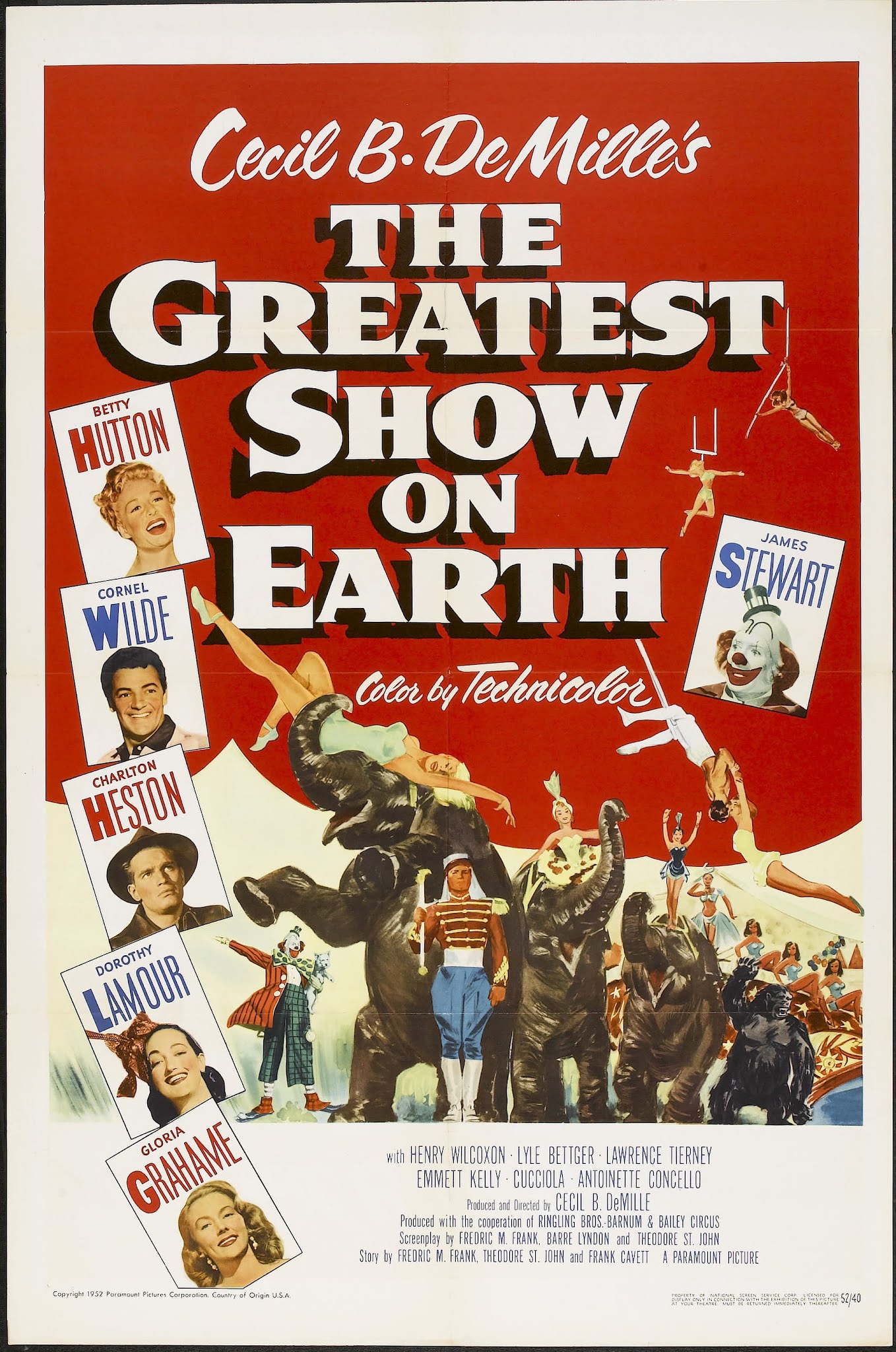
The Greatest Show on Earth (1952)

Charlton Heston and James Stewart in the infamous (and rightly so) The Greatest Show on Earth

Director: Cecil B De Mille

Cast: Betty Hutton (Holly), Cornel Wilde (The Great Sebastian), Charlton Heston (Brad Braden), James Stewart (Buttons), Dorothy Lamour (Phyllis), Gloria Grahame (Angel), Henry Wilcoxon (Agent Gregory), Lawrence Tierney (Henderson), Lyle Bettiger (Klaus)

When Crash was named Best Picture, did The Greatest Show on Earth do a backflip of celebration? Finally, when the topic “What is the worst Best Picture winner of all time?” came up, the answer would no longer immediately be “Well The Greatest Show on Earth of course”. Now, there could be an actual debate. Hard to believe but this film was the biggest hit of 1952. Its reputation has been shredded since: it’s proof that winning Best Picture can destroy a film’s reputation as much as it can raise it. Greatest Show is, of course, a pretty bad film. But it’s not catastrophically atrocious. It’s merely pretty bloody awful.

Anyway, it’s all set in a Ringwood circus. Manager Brad Braden (Charlton Heston) is so in love with the circus, he has “sawdust in his blood” (drink every time some variation of this phrase comes up, and you’ll be pissed by the hour mark – which might be the best way to watch the rest). To bring in the crowds he hires famed acrobat The Great Sebastian (Cornel Wilde) – which means shunting previous acrobat star (and Brad’s girlfriend) Holly (Betty Hutton) to support act. It’s a rivalry – but wouldn’t you know it, sparks fly and a love triangle forms. In fact, it quickly becomes a love pentagon as elephant artiste Angel (Gloria Grahame) has past with Sebastian, is in love with Brad (who’s interested) and is fending off the interests of fellow elephant artiste Klaus (Lyle Bettiger). Oh, and James Stewart plays a clown who never removes his make-up because he is actually a doctor in hiding for euthanising his wife (“He killed the thing he loved!” a newspaper headline screams).

All this is packaged together with the puffed-up self-important portentousness that DeMille bought to his Biblical epics. Cecil himself even delivers a grand voiceover at life-changing events like the raising of the big top and the loading of a train. It’s packaged together with endless stagings of assorted circus acts (this film is very slim in plot, but very long in runtime), all accompanied by continual cuts to the circus audience “oohing” and “aahing” as appropriate, or asking such inane questions as “What’s going to happen next?” (a question no one watching the film is likely to be interested in asking). It makes The Greatest Show even more of a museum piece, a recording of a certain type of grand entertainment that doesn’t really exist anymore.

Away from the big budget and long filming of circus acts, we have a dull, derivative and tedious soapy plotline where ridiculous cliches abound and barely a line of dialogue escapes clunking to the floor with the same heaviness as the Great Sebastian when he (inevitably) falls from the trapeze. No single opportunity for heavy-handed foreshadowing is missed, from that accident to the film’s big train-wreck ending, to the numerous hints dropped about Buttons’ tragic background. It’s all packed into a crude series of homages to the glories of small town America (who appreciate the delights of the circus in the way the big city suits never can) and the glorious romance of not even letting death and a train wreck get in the way of the show going on.

At the centre you get the tedious love pentagon. The central figures of this – Hutton, Heston and Wilde – seem to be involved in a private competition for who can give the worst performance. Heston (in a very early role) is wooden beyond belief, the granite self-importance that made him a perfect Moses ridiculously overbearing for the job of circus manager. He and Hutton play most of their scenes with an absurd energy, throwing themselves into poses. Hutton’s performance is bubbly, chirpy and endlessly irritating. Betty is the worst kind of simpering mess, which culminates in her holding herself responsible for Sebastian’s decision to perform without a net. Wilde is saddled with a bizarre accent (where is he meant to be from? I guess “Europe”), and acts with all the comfort and skill of a vertigo-suffering acrobat.

But then to be honest pretty much everyone in this film is awful. I’ll cut a bit of slack for Gloria Grahame, who gives Angel more charm than all three of the leads put together, and James Stewart who can play the melodramatic crap he’s saddled with standing on his head. But literally everyone else in this film is dire: hammy, over-blown, cartoonish and mugging. There is not a single moment of performance or story-telling that is remotely memorable, and everyone is introduced with a clunky, trailer-friendly line of dialogue.

Nothing will remotely surprise you about the plotline – other than that they manage to stretch something as insipid and uninspired as this out for nearly 150 minutes. Though of course most of that is circus acts, or watching circus marches, or listening to Betty Hutton or Dorothy Lamour sing. (In what passes for wit in the film, while Lamour sings the camera cuts to Crosby and Hope, her old co-stars, watching in the stands hammily chewing popcorn.) There is a certain academic interest in watching these circus acts (performed by real circus artistes – although the actors trained so they could get involved), but after a while you are only reminded that it’s not as interesting or exciting as actually being there.

Maybe that’s why the plot becomes so overblown to try and compensate. Love triangles! Falls from a great height! Gangsters muscling in on the circus! A clown on the run from the cops, meeting his mother during the show once every year! A spurned lover who decides to destroy the circus in revenge! No wonder, after the opening scenes focus on the cost of staging the show and importance of staying in profit to continue the tour, our initial set-up, never gets mentioned again. How could it compete with this bizarre parade of nonsense?

It culminates in a train wreck – and of course Buttons is given “the terrible choice” of letting a man die or revealing his medical knowledge (and identity) to save his life. The train wreck has some decent model work. DeMille certainly looks happier dealing with that than attempting to make anything among his romantic sub-plots feel light, fun or natural.

The Greatest Show on Earth is all about show – and whenever it tries to do anything intimate, it invariably falls flat on its face. There are worse films out there, but attaching the mantle of “Best Picture” to this makes it feel worse than it actually is – and its pretty bad on its own merits. When all is said and done, still possibly the worst Best Picture winner ever.

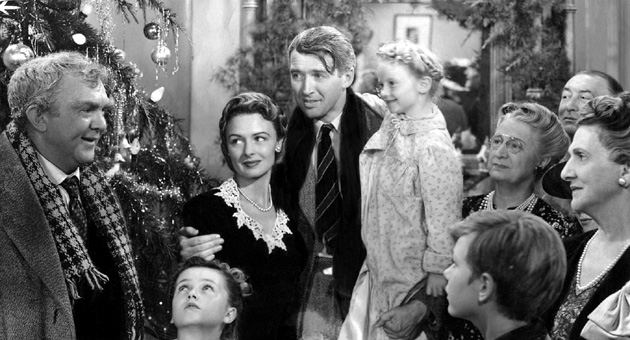
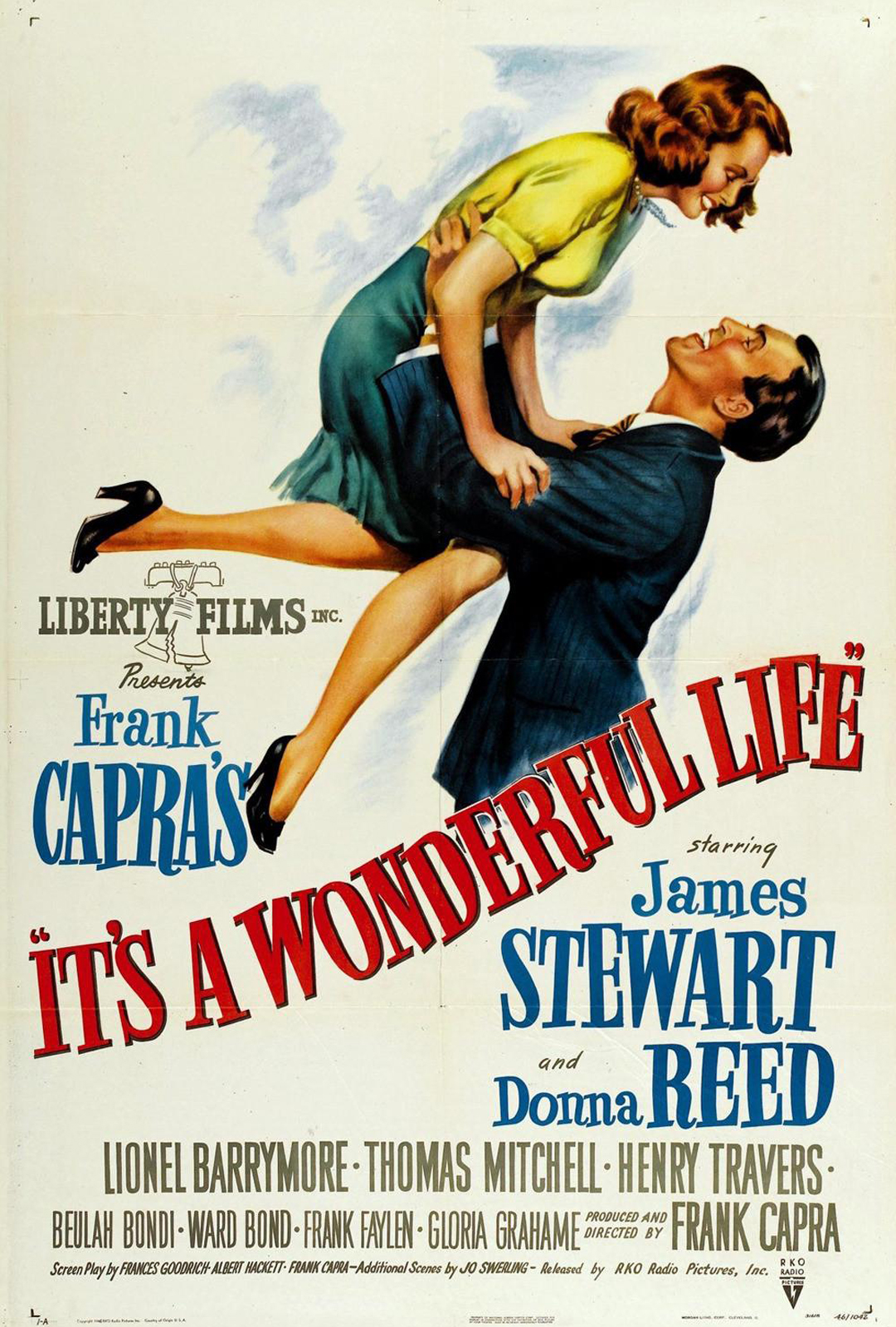
It's a Wonderful Life (1946)

James Stewart discovers he has lived a good life in It’s a Wonderful Life

Director: Frank Capra

Cast: James Stewart (George Bailey), Donna Reed (Mary Hatch), Lionel Barrymore (Henry F Potter), Thomas Mitchell (Uncle Billy Bailey), Henry Travers (Clarence Odbody), Beulah Bondi (Ma Bailey), Frank Faylen (Ernie Bishop), Ward Bond (Bert), Gloria Grahame (Violet Bick), HB Warner (Mr Gower), Frank Albertson (Sam Wainwright), Todd Karns (Harry Bailey), Samuel S Hinds (Pa Bailey)

For many people it’s as much a part of Christmas as mince pies and Santa. Any list of the greatest Christmas films of all time – in fact any list of the most beloved films of all time – isn’t complete without It’s a Wonderful Life. Capra’s emotional, heart-warming, seasonal tale encourages us to take a breath and look at the riches in our life, to look past the surface frustrations and disappointments. It seems to have something to say to everyone. There’s a reason why it has been a staple of Christmas for decades.

The small town of Bedford Falls is a place George Bailey (James Stewart) has always dreamed of leaving for a life of adventure. However, circumstances always meant he has stayed in the town, running the family savings and loans business. He’s made a success of the business, raised a family with his wife Mary (Donna Reed – extremely good in an unshowy role), helped half the town into decent affordable homes, and changed his whole community for the better. So why is George standing on a bridge on Christmas Eve, contemplating throwing himself into the river? And will his guardian angel Clarence (Henry Travers) persuade him there are things worth living for?

Capra’s film is very easy to see as a wallow in sentimentality. Certainly, the film is in love with its image of small-town America, here a nirvana of folksy lightness where everyone knows everybody’s name. In reality, America as a whole, even at the time, probably had more in common with Potter’s grasping capitalism or the nightmare vision Clarence conjures of a neon-lit Potterville of loose morals and vice. But the film would never have worked if it was just sickly sentimental – or if it had been a cynical satire for that matter. Instead it works because it is overwhelmingly human, empathy dripping from every pore. It invests us deeply in this whole community and succeeds in making the viewer relate to them at every step.

This is partly because Capra has such a masterful skill for how the little touches can make a story come to life. The loose banister cap that Bailey keeps dislodging in his home. The drawing Donna has made of George’s offer to lasso the moon. The film is full of small moments of character, that create the over-whelming richness of a whole life. It’s also a story full of charm and genuine feeling for its characters, that understands the pain little griefs and small tragedies have.

Perhaps that’s also one of the reasons for the love people have for it. Because, let’s not forget, this is a film set on the darkest day of its lead character’s life, when he considers ending it all. One of the things I find the most touching about the film is that it never stigmatises depression, guilt or feelings of inadequacy. If someone as universally loved as George can look at his own life as a disappointment, and that this feeling is treated as both reasonable but also mistaken in the best way, it reassures as all not only that we shouldn’t feel guilty for feeling this but hopefully that we are as mistaken as George is. Failure is all in the perception – and It’s a Wonderful Life reminds us that perception is often unreliable when we turn it on ourselves.

Capra’s film relies strongly on our bond with George – so the casting of James Stewart in the role plays off perfectly. Stewart is quite simply superb, completely human and deeply moving. Capra provides Stewart with several striking set-piece speeches (all of which he delivers with aplomb). The entire film is essentially a riff on Stewart’s charm and likeability – but also his everyday quality, the sense that when we watch him we are looking at someone like us. Stewart makes Bailey honest, decent and kind. You can immediately see why people like him. His principles and sense of justice drive him every day to do the right thing – and what makes him such a deeply relatable character is that this so often flies in the face of his own desires and interests.

What Capra also understands – and taps into so well here – is the darkness in Stewart. Because someone so like us is surely as likely to suffer from  depression and disappointment as the rest of us. You can never forget this is a man who has dreamed his whole life of leaving this town, of making it as an architect, of forging a broader life for himself. He never wanted to be the pillar of the community and family man he becomes. There is disappointment in Bailey at every turn, however much he treats the world around him with warmth. This isn’t what he wanted. No matter if it has won him love and respect from all around him.

And who hasn’t ever felt that? But we know that deep down – even if he doesn’t always realise it – Bailey is happy with his lot. That if he didn’t care deeply about town, friends and family he would have left years ago. We know he’s a good man: that later he will deeply regret berating his poor befuddled Uncle Billy (a gloriously cuddly Thomas Mitchell) for losing $8k and losing his temper at his wife and children on Christmas Eve. There is a pain for us to see such a good man, a loving man, who we feel we understand, angrily ask his wife why they had so many children. Everyone has lashed out like George – and everyone has, at some time, looked at where their life is and felt “I could have been more than this”. Far fewer people have taken the time to look at all the good alone in their lives and what a good mark they have made on the world.

But that’s the genius of the film. Taking its cue from Dicken’s Christmas Carol (I’d also say Lionel Barrymore’s brilliantly hissable Potter is clearly a version of Bleak House’s vile moneylender Smallweed), effectively Clarence is the Ghost of Christmas Present, showing George what the world would have been like without him. Sure some of this is overblown – Potterville for goodness sake! – but the impact is those personal stories. The brother drowned as a child. The pharmacist imprisoned for manslaughter. The affordable homes never built. The family that never even existed. The mix of science fiction and classic morality tale helps us all to reflect – so many of us have people all around who care for us, whose lives would have not been as rich as they are without us, however much we may disappoint ourselves at times.

That’s perhaps behind the love for the film. It’s about hope, while never closing its eyes to despair. It recognises that sometimes we are not happy – and it tells us that that’s okay, so long as we don’t lose hope. It encourages us to take a look at ourselves in the round and to appreciate the whole picture, not just a part of it. You can call that sentimentality if you want – but at Christmas time this message of hope and love is sometimes exactly what you need.

Mr Smith Goes to Washington (1939)

James Stewart campaigns for truth and justice in Capra’s classic Mr Smith Goes to Washington

Director: Frank Capra

Cast: James Stewart (Jefferson Smith), Jean Arthur (Clarissa Saunders), Claude Rains (Senator Joseph Harrison Paine), Edward Arnold (Jim Taylor), Guy Kibbee (Governor Hubert “Happy” Hopper”), Thomas Mitchell (“Diz” Moore), Eugene Pallette (Chick McGinn), Beulah Bondi (Ma Smith), H.B. Warner (Senate Majority Leader), Harry Carey (President of the Senate), Astrid Allwyn (Susan Paine)

Capra’s film are known, above everything, for their fundamental optimism about life, friendship and the American Way. Few films cemented that opinion more than Mr Smith Goes to Washington, the quintessential “one man in the right place can make a difference” movie. And where else would that one man need to be, but Washington? Where laws are framed and ideals come to die. It’s our hope that those at the heart of the political system are there for the good of the people. Of course, even Capra knew most of them were there to line their pockets and do their best for powerful business interests. So who can blame Capra for a little fantasy where naïve, innocent but morally decent Jefferson Smith decides enough is enough?

In an unnamed mid-Western State (the story the film is based on named it as Montana), the junior senator unexpectantly dies. The Governor (Guy Kibbee) needs a new man. Should he go for a reformer or the latest stooge put forward by political power broker in the State Jim Taylor (Edward Arnold). A tricky choice, so he splits the difference by appointing Boy Rangers leader Jefferson Smith (James Stewart) – because he’s wholesome and clean but also naïve enough to manipulate. Jeff heads to Washington, under the wing of Senator Joseph Paine (Claude Rains) – but Paine is in the pocket of Taylor.

Taylor and his cronies want an appropriation bill forced through that includes a clause to build a dam in their state. The dam will be built on land secretly bought up by Taylor and others, making them a fortune from public money. When Jeff announces in the Senate a bill to host a national boy’s summer camp on that same land, it throws a spanner in the works. Despite threats and bribes, Jeff refuses to go along with the shady deal over the dam, so they set out to destroy his reputation. With the help of his secretary Clarissa Saunders (Jean Arthur), Jeff mounts an epic filibuster in the Senate to clear his name, stop the dam and reveal the political corruption in his state.

Capra’s film is earnest, well-meaning and at times even a little bit sanctimonious and preachy – but it gets away with it because it’s also so energetic, honest and fun. It’s strange watching it today to think that the Senate at the time responded so poorly to it. Leading public figures either denounced it’s view of government and even tried to have it banned. Ironically of course, it probably inspired more people to get involved in Government than any other movie.

That was bad news for the corrupt political machines that ran so many parts of America at the time. Capra’s film is remarkably open-eyed about how these machines worked. Powerful business interests at the centre, with a raft of politicians in their pay – from Governors and senators on down. Jim Taylor – very well played with a swaggering, crude, bullying tone by Edward Arnold – only has to snap his fingers to get things done. During the film he mobilises the press, the police, the fire service and an army of heavies to enforce his will in the state and suppress free speech. The Governor (a neatly tremulous Guy Kibbee) is so firmly in his pocket, he can barely tie his shoe-laces without Taylor directing it. Senator Paine is patrician, dignified and has every inch of respectability – but he is soaking in filth up his neck from contact with Taylor.

It’s this system the film has a quiet anger about. Whatever happened to having “a little bit of plain, ordinary kindness – and a little lookin’ out for the other fella too”? Capra’s sprightly film also makes clear that we both don’t look too closely at how our government is really run and are very quick to hoover up any story we get from our political masters and accept it as gospel. An honest, decent man in the middle of all this is as unlikely a sight as you can imagine.

But that’s what these people get with Jefferson Smith – and discover someone who should be easy to manipulate, but doesn’t understand the rules of the game he’s playing. Instead Jeff thinks they are all there to help other people, not to themselves. Now you can argue, as some critics have, that law-making is the art of compromise – and that once the dam is under way, the benefits it will produce to Jeff’s home State (in terms of employment and energy) will be huge. So why shouldn’t Jeff bow down and move his boys camp in order to let the Bill go through?

Well the point is that Jeff isn’t opposed to the dam – he’s opposed to the corrupt profiteering that will spring out of it, and the way the cesspool of Washington (amongst all those fine monuments he so adoringly looks at) doesn’t care. This is a filibuster campaign to put honesty and decency back into American politics – and what’s not to like about that? It’s a film that firmly believes that one good man in the right place (that’s both Jeff and the President of the Senate, who tacitly encourages him) can change the day and save the country from itself.

There was of course no one better for such a job than Jimmy Stewart (and surely it’s this film that made him “Jimmy” to one and all). Capra had James Stewart in mind from the start – and it’s a perfect role for him, an iconic performance that stands as surely one of his greatest roles. Stewart has the skill to make Jeff endearing but not saccharine, naïve but not frustrating, innocent but not a rube, gentle but determined. Despite its corniness (and some of the film is very corny) you relate to his reverence for Lincoln’s memorial and the Capital. Stewart’s homespun charm is perfect, but it’s matched with the steel he could give characters. There is an adamant quality to his filibuster, his refusal to back down and go along with injustice. The final quarter of the film that deals with the filibuster is quite superb stuff, Stewart delivering some very-well written speeches with commitment, passion and bravura. It’s no understatement to say the film would work half as well as it does without him.

But then the entire film is also a feast of great acting, all sparked by a superb script from Sidney Buchman which mixes razor-sharp dialogue with wonderful speeches. Jean Arthur (who actually gets top billing) is very good as a cynical Washington insider who rediscovers her ideals – and finds her heart melting – under Jeff’s honest influence. Claude Rains gives one of his finest performances as the patrician Paine, a man who tries to close his eyes to his own corruption, but swallows down his own guilt and shame every day. Harry Carey gets a twinkly cameo as an amused and supportive President of the Senate. (Both actors were nominated for the Oscar, but lost to Thomas Mitchell for Stagecoach who also appears here in a fun turn as the drunken but principled reporter Diz).

Capra keeps the pace up perfectly, and his direction handles both smaller scale scenes of romance and idealism, with the larger scale fireworks of the Senate (a superb set, that looks so convincing it’s amazing to think it was built on a sound stage). His biggest trick here is to create a film that, in many ways, is a political lecture, but never makes it feel like one. Instead it delivers it’s messages on truth, justice and the American way with such lightness – but yet such pure decency – that it all works. It helps a great deal that the film doesn’t shy away from the corruption and – apart from a final turn that saves the day – resists melodrama and contrivance. Charming, funny but also thoughtful and committed, Mr Smith Goes to Washington is one of Capra’s very best.

The Flight of the Phoenix (1965)

Fury and despair are never far away in brilliant survivalist film The Flight of the Phoenix

Director: Robert Aldrich

Cast: James Stewart (Captain Frank Towns), Richard Attenborough (Lew Moran), Hardy Krüger (Henrich Dorfmann), Peter Finch (Captain Harris), Ernest Borgnine (Trucker Cobb), Ian Bannen (“Ratbags” Crow), Ronald Fraser (Sergeant Watson), Christian Marquand (Dr Renaud), Dan Duryea (Standish), George Kennedy (Mike Bellamy)

Every so often you watch a film and say “where have you been my whole life!”. That’s the case with The Flight of the Phoenix– I can’t even imagine how much I would have loved this film if I had seen it when I was younger. This one has got it all for fans of anything from disaster movies to personality clashes. Aldrich’s film is a Sunday afternoon classic with bite, a brilliantly constructed actors’ piece set in the claustrophobic confines of the only shelter for miles around in the Gobi Desert.

Frank Towns (James Stewart) and Lew Moran (Richard Attenborough) are the pilot and navigator on a cargo plane flying to Benghazi, with several passengers. Caught in a sandstorm, the plane crashes in the desert over 100 miles off course. The chances of being located are small and the survivors have only enough water for a little under a fortnight, so long as they avoid exertion. While Towns quietly struggles with the guilt, and different (hopeless) solutions are suggested, German aeronautical engineer Heinrich Dorfman (Hardy Krüger) believes that they can build a new airplane from the wreckage to fly themselves to safety. Towns and Dorfman are incompatible people, leaving Moran to play peacemaker and to support the building of the new aeroplane which may be (as Towns believes) a forlorn hope in any case.

Amazingly the film was a box-office flop on release – but time rewards skill, because you watch the film and marvel at the economy of its storytelling, its expert direction, wonderful acting and fantastically drawn characters. It’s a film of immense tension, with nearly all of this coming from the bubbling potential for deadly clashes between the trapped men. The rest is supplied by the ever-present threat of diminishing resources – none more so than the limited supply of cartridges needed to start the new plane’s engine (they’ve got seven and, best case, need at least five). 

It’s this grim awareness of the knife-edge everyone is living on that powers the film. Every single resource is precious, and the pressure and fatigue show in every scene. As the film progresses, each of the men slowly disintegrates, growing increasingly scruffy, unshaven, dry skinned and weak and more and more susceptible to anger. Aldrich charts all this with professional excellence, the editing skilfully cutting away at several points to reaction shots from the actors as feuds come to a head, helped by some gloriously subtle and intelligent acting. 

And it’s not surprising really – few films capture the grim pressure of the desert better than this. Sand dries out skin and throats, reflecting the beating heat of the sun everywhere. The clear sky and burning sun turn every surface into smouldering heat – even the shade offers little respite. The viewer is left with no doubt about the insanity of spending time out of the shade in these conditions. You know immediately Captain Harris’ plan to walk 500 miles over the desert with a single canteen of water is absurd (it doesn’t end well of course). It’s a beautifully shot film that makes the mystical glamour of the desert beautiful and terrifying.

One of the things I like best about the film is that it is almost impossible to predict who will come out alive and who won’t. Unlike most Hollywood films, characters are not punished for deviating from goodness and purity – some of the most noble characters don’t come out alive, while some of the most self-serving, selfish and cowardly ones do. Even the central heroes are flawed: Towns is struggling with depression and a near crippling guilt that almost leave him fatalistically accepting death; Moran is a drunk possibly to blame for the whole disaster; Dorfman is arrogant, difficult, prickly and in many ways flat out unlikeable. 

Ah yes, Dorfmann. What a superb performance from Krüger (the first actor cast). In a masterstroke of invention, the character was changed from British (in the novel) to German. This opens up a whole world of additional prejudice between Dorfmann and the other passengers. “What did you do during the war?” antagonistic joker Ratbags asks Dorfman pointedly. It’s a tension that underlies most of the clashes. Dorfmann doesn’t help with his almost complete lack of awareness of social etiquette and his Germanic insistence on probabilities of survival: he sees no problem with treating the rest of the survivors like staff, openly debates the wisdom of helping the critically wounded, refuses to explain his thinking until absolutely pressed and has no empathy for their flagging strength and morale. But he also has a strange naivety which plays into a late plot reveal hinging on Dorfmann’s inability to read the reactions of the people sitting next to him. The film and Krüger flirt brilliantly with Germanic stereotypes – is there a more “German” character in film than Dorfmann? He’s about as far from a white knight as you can get.

But then so is James Stewart’s Towns. One of the things I like most about the film is the difficult psychology of survival. Towns is clearly struck with a barely understood guilt about the people killed in the crash, and seems ready to fatalistically accept death. His clash with Dorfmann is powered by numerous factors, not least a sense Towns has of his generation being replaced by a younger, technically minded one and a sense of losing control of his destiny. Nevertheless, Towns almost fanatically opposes the project at one point – and basically only accepts it when Moran and Dr Renard (an immensely noble Christian Marquand) tell him it’s better to have a chance of something to live for than to sit around dying. Stewart brilliantly taps into the ambiguity in his screen persona – a decency beneath the surface, but also a psychological weakness, a need for control under the nice-guy persona, a man struggling to accept he is out of his depth. It’s a brilliantly low-key psychological performance of a man struggling to button up guilt, pressure and unease.

The whole cast is superb. Attenborough plays the closest to type as a loyal number 2, but even he is clearly struggling to hold acres of despair while constantly playing peace-maker. Ronald Fraser is exceptional as a career army sergeant tottering on the edge of open-rebellion throughout the film, who betrays his commander’s trust no less than three times and is the most unknown wildcard in the pack. Ian Bannen was Oscar-nominated for his electric performance as a bitter, sarcastic Scots oil-worker who surprises everyone with his hard work while never letting up for a moment his bitter commentary on events. Peter Finch gives an excellent, ram-rod straight, almost naively decent stiff-upper lip performance as Captain Harris, a man a few degrees away from a noble idiot. Ernest Borgnine is touching as an oil foreman suffering from exhaustion and stress.

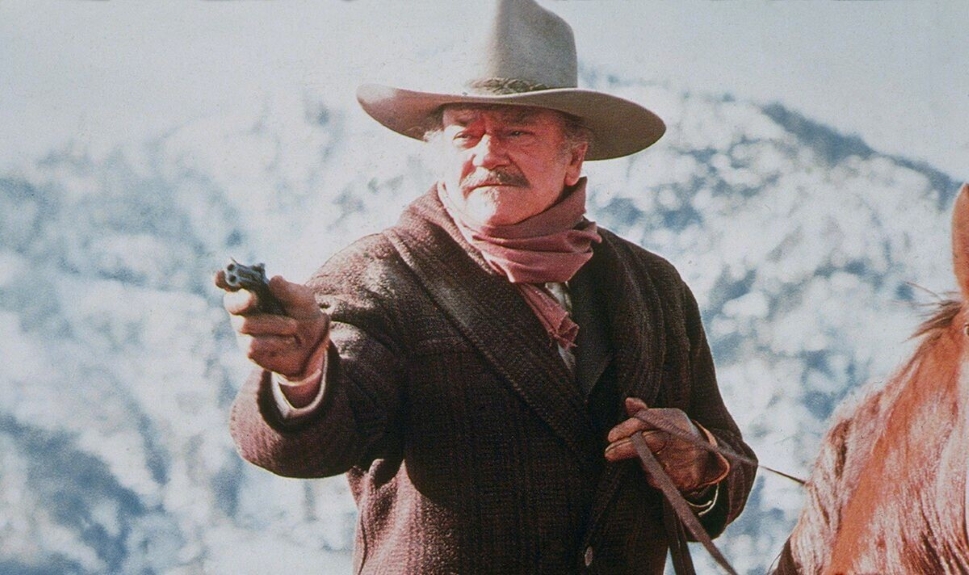
All this comes together in a superior package of film making, expertly made and superbly directed, with the actors embracing their well-developed characters with glee, making this in many ways part disaster movie, part chamber piece play. I love the little surprises it throws at you – just as you think you know a character there is a moment that surprises you or makes you reassess them. The tensions and dangers of survival in extreme conditions are brilliantly captured. There isn’t a weak moment in the film, and plot twists and surprises throw curveballs at the audience, some of which bring terrifying consequences. For any lovers of survival stories, acting or tense movies this is an absolute must.