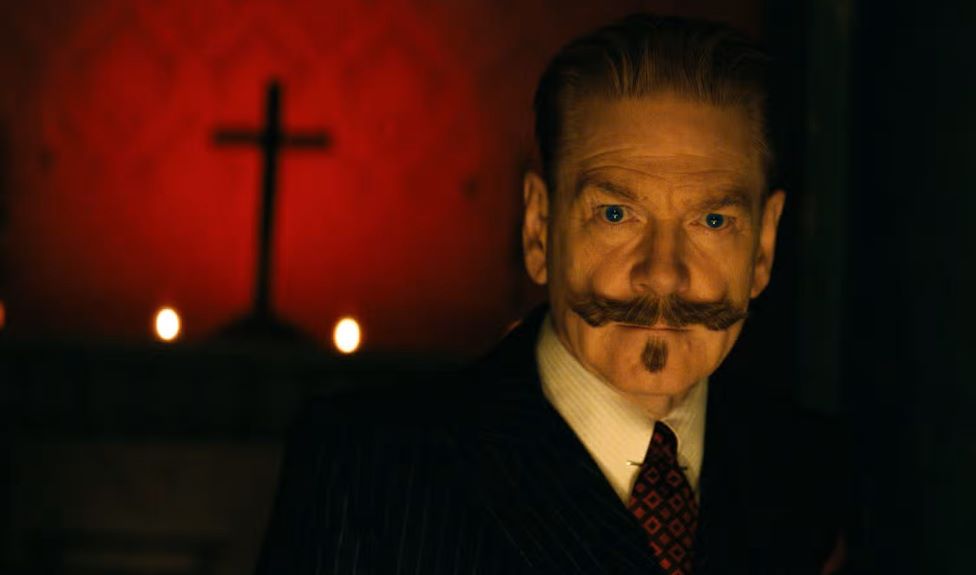
Tag: Jamie Dornan

A Haunting in Venice (2023)

A Haunting in Venice (2023)

Branagh’s third Poirot outing lowers the scale but feels more real and involving than any others

Director: Kenneth Branagh

Cast: Kenneth Branagh (Hercule Poirot), Kyle Allen (Maxime Gerard), Camille Cottin (Olga Seminoff), Jamie Dornan (Dr Leslie Ferrier), Tina Fey (Ariadne Oliver), Jude Hill (Leopold Ferrier), Ali Khan (Nicholas Holland), Emma Laird (Desdemona Holland), Kelly Reilly (Rowena Drake), Riccardo Scamarcio (Vitale Portfoglio), Michelle Yeoh (Joyce Reynolds)
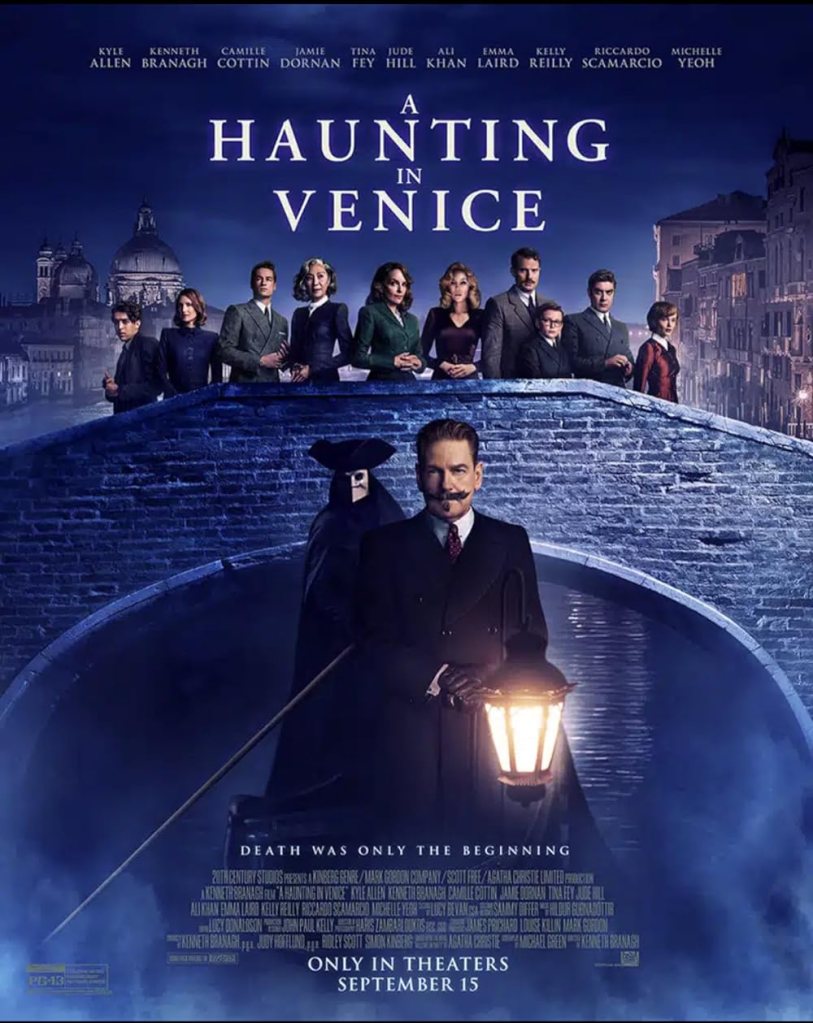
Branagh’s Poirot films have been a mixed bag. Big on starry cast and luscious locations, they’ve also succumbed too readily to bombast not to mention the sort-of tricksy directorial flourishes Branagh has such a weakness for. It’s a pleasant surprise then that A Haunting in Venice turns itself into the smallest-scale and tightest of his Poirot films and might just be the most successful of the lot.

It’s 1947 and a retired Hercule Poirot (Kenneth Branagh) lives as a recluse in Venice, studiously ignoring potential cases, his door firmly guarded by bodyguard (and retired policeman) Vitale Portfoglio (Riccardo Scamarcio). All this changes when he is visited by an old friend, crime novelist Ariadne Oliver (Tina Fey) who recruits Poirot to help debunk spiritualist Joyce Reynolds (Michelle Yeoh). Reynolds is conducting a séance for retired opera singer Rowena Drake (Kelly Reilly), still grieving the recent death of her daughter Alicia. With other guests including Alicia’s former fiancée Maxime (Kyle Allen), PTSD suffering Dr Ferrier (Jamie Dornan) and his precocious son Leopold (Jude Hill) and housekeeper Olga Seminoff (Camille Cotton), the stage is set when a storm and a murder all strike on the same night. Finally, Poirot takes up arms again.

A Haunting in Venice has a fair bit of latitude to work with since there is not an Agatha Christie Poirot mystery actually called that (or even set in Venice). Instead, this is a fast-and-loose adaptation of Hallowe’en Party (definitely one of the lesser-known books) which shifts its location, reshuffles the characters backgrounds, brings a few off-page murders very much “on page” and repackages the story to take place in a sadness-tinged, post-war misery which neatly reflects Poirot’s private grief and guilt at a life which has seen so much death.

This actually works rather well. Contrary to much of the publicity, which played up the horror elements, this is about a million miles away from The Exorcist (although Branagh clearly rewatched Don’t Look Now for Venice scares inspiration), offering instead a camp-fire spookiness and a couple of jump scares. A Haunting in Venice is actually the first Branagh Poirot that feels it would fit into the Suchet-Poirot mould: a slightly maudlin atmosphere mixed with gentle humour, a tight interview-based structure and a (thankful) reduction in gun-toting stand-offs.

A Haunting in Venice is predominantly set in one crumbling Venetian house over one night during a wild storm. The house is given a ghostly backstory of a medieval orphanage left walled-up to prevent a plague outbreak spreading – and there are suggestions of supernatural mischief (objects fall down seemingly on their own) at various points (most of which are swiftly debunked by Poirot). The film is shot and framed with a series of fish-eye lenses and some oblique angles (as per Branagh, the second shot of the film is a Dutch angle) to maximise the dimensions of the house but also at key points stress its claustrophobia, all of which works rather well. It’s moodily lit in a series of shadows (to maximise those spooky jump scares) but its horror elements are lite – a whirligig of screaming and bloodshot eyes at the séance are about as far as it goes.

Instead, it unfolds in a traditional manner, bookended by a prologue and epilogue that indulges the beauty of the location shooting (including a luscious final aerial shot over Venice). The film effectively uses its post-war setting to add emotional impact – after suffering through a war that claimed millions of lives, is it surprising that people are more susceptible to the attractions of taking to the dead? The impact of war blights several characters, from Jamie Dornan’s doctor (Dornan is very good in the role), forever scared by the sights he saw liberating Bergen Belsen to a pair of young Eastern European refugees who have fled the Nazis.

Poirot’s background as a soldier and his own traumatic familiarity with death are also rather neatly wrapped up in questions of his faith. In Branagh’s quiet, melancholic performance (where its clear moments of warmth are only covering deep regrets), it becomes clear his faith in God is as lost as his belief that the world can be improved by deduction. His rejection of spiritualism is pointedly based on a belief that there is nothing outside of the tangible.He fits in witha house awash with traumatised doctors, opera singers lost in grief, housemaids who feel their lives have no purpose and even a crime novelist who’s last three books were flops.

Tina Fey is very playful as this Agatha Christie self-portrait, bouncing effectively off Branagh’s more sombre Poirot. The cast is in fact uniformally strong – a reduced cast list from previous Branagh Poirot’s means each one feels slightly more developed. Yeoh bites into the juicy part of Joyce with movie-star confidence, Reilly is subtly fragile, Cottin and Scamarcio both effectively hiding secret depths. Jude Hill, fresh from playing the young Branagh in Belfast marks himself as a kid with a golden future with a stand-out turn as the mature, worldly-wise young Leopold, comforting and caring for his emotionally scarred Dad.

All of this is marshalled into a tight murder-mystery – we get a bit of Grand Guignal slaughter as well as an effective locked room mystery thrown on top (as well as a homage to the originals apple-bobbing murder) – with a Poirot who is unsettled and out of sorts (for reasons that I guessed but make perfect, secular sense when revealed). It even wraps up on a quietly affecting note of hope. By dialling down the flourishes, scale and action (even if Branagh can’t resist a snorricam shot of himself through the house), A Haunting in Venice actually becomes more rewarding than either of the previous films in the series – and Branagh’s Poirot remains a strong, very human interpretation of the character. Surprisingly, despite its playing with the supernatural, it feels more grounded and human and, despite effectively creating a new story, closer to Christie.

Heart of Stone (2023)

Heart of Stone (2023)

Dull franchise-starter shamelessly rips off every other successful action franchise it can think of

Director: Tom Harper

Cast: Gal Gadot (Rachel Stone “Nine of Hearts”), Jamie Dornan (Parker), Sophie Okonedo (Nomad “King of Hearts”), Matthias Schweighofer (Jack of Hearts), Paul Ready (Bailey), Jing Lusi (Yang), BD Wong (King of Clubs), Alia Bhatt (Keya Dhawan), Archie Madekwe (Ivo), Enzo Cilenti (Mulvaney), Jon Kortajarena (The Blond), Glenn Close (King of Diamonds), Mark Ivanir (King of Spades)

Heart of Stone is the first in a planned Mission: Impossible/James Bond style super-franchise for Netflix. You can’t miss this, as the entire film plays out like it’s been assembled from scenes salvaged from the cutting room floor of those series. Pretty much every single idea in Heart of Stone has been played out before (often more than once) and every single action scene has been performed, shot and edited elsewhere and better. Heart of Stone is really prime Netflix filler, the sort of brainless eye-candy that can play in the corner of a room while you scroll through your phone. Worryingly, one day, all films might be like this.

Gadot plays Rachel Stone. She’s a strictly “stay-in-the-van” tech expert for a MI6 team. Apparently set in a world where the security services aren’t predominantly made up of bland white guys from the same universities, the team consists of Parker (Jamie Dornan), Bailey (Paul Ready) and Yang (Jing Lisu). But she’s also “Nine of Hearts”, a super-agent of The Charter, a group of secret agents who use a super-computer (the Heart) to predict all outcomes and prevent disaster. When the Heart is under threat, Rachel has no choice but to reveal her identity – via a kick-ass fight scene naturally – to try and protect this super-computer which could destroy the world from falling into the wrong hands.

I’ll say one thing for Heart of Stone – it does a neat reveal of a surprise (but guessable) villain. Other than that? You’ve seen it all before. Many, many, many times – usually done better. When a battle atop a zeppelin makes you think “Hey, didn’t The Rocketeer do this a lot better almost 30 years ago?” you know your film is in trouble. Heart of Stone is like a gruesome Frankenstein’s monster, where every single stitch can be clearly seen. A Bondish opening credits sequence is stitched to a series of M:I risky stunts, with fights and car chases from Bourne and more than a dash of better TV shows like Alias and Person of Interest. It’s put together with a perfunctory box-ticking which only reminds you how many years of care goes into the franchises it’s ripping off.

Everything unfolds in Heart of Stone pretty much as you would expect it. When a character pulls out a photo of the doll’s house he’s planning to buy for his niece’s birthday, you know he’s doomed. When the Charter sends agents to infiltrate a base, but leave Gadot behind, you know you’re about to watch a “wrong door” routine. Inevitably we get a “you’re off the case” dressing down for Stone from her boss. A secondary villain is clearly an ally in waiting. Characters are defined with thinly sketched traits. Glenn Close ticks the box of “inexplicable big-name cameo”, popping up to lean on a fireplace.  It’s all drearily, depressingly unimaginative and predictable.

I ended up letting my mind wander aimlessly around the nonsense of this world. How does the Charter fund itself? How secret is it – everyone seems to know about it and after the early distress about Gadot blowing her cover it then charges about with barely a token effort at subterfuge. Why would an organisation called the Charter name some (but not all) of its agents after cards? Are there four separate branches in different places for the four “decks”? Are the numbers randomly assigned – since “Jack” seems to work for “Nine”. Why choose a codename system that takes three words to spit out (it even slows Stone down at a vital point trying to explain who she is)? Are Aces all low?

The fact I spent so much time thinking about this sort of thing kind of says it all. I would feel sorry for Gal Gadot at the centre of this except, as a producer, she must have had a say in how this derivative mess was put together. She’s woefully miscast in a role that exposes all her limitations rather than playing to her strengths. Gadot simply hasn’t got the charisma and comic timing to play a wise-cracking maverick: she’s at her best as earnest and well-meaning (see Wonder Woman where she plays a sweet innocent), but here as a sort of would-be Ethan Hunt she’s a washout. Every second she’s on screen only reminds you how good Tom Cruise is at this sort of thing.

She can do a stunt or two, to be fair. It’s unfair perhaps to say that all the big, risky stunts are all too clearly performed in front of a greenscreen or by a double, but Gadot can throw a punch. But Stone is a bland, aimless, patchwork character, whose every reaction seems like it’s guided more by what the script needs at that moment rather than any consistent logic. The entire cast more-or-less falls into the same uninspired bucket, either going through the motions (Sophie Okonedo) or not given enough to do (Paul Ready is probably best-in-show here, making a lot of a some fairly duff lines and predictable plot arcs). Perhaps, since the audience has a decent chance of finishing every line before the characters do, the actors were as disheartened as we are watching it.

The most depressing thing about Heart of Stone is it looks like a grim look into the future. As Hollywood writers strike against the threat of AI, is it possible that all films will one day be put together with the robotic predictability of Heart of Stone? Even the title sounds like a ChatBot came up with it.

Belfast (2021)

Belfast (2021)

Kenneth Branagh pays tribute to his early years in Northern Island in this autobiographical film

Director: Kenneth Branagh

Cast: Jude Hill (Buddy), Caitríona Balfe (Ma), Jamie Dornan (Pa), Judi Dench (Granny), Ciarán Hinds (Pop), Lewis McAskie (Will), Colin Morgan (Billy Clanton), Michael Maloney (Frankie West), Lara McDonnell (Moira), Gerard Horan (Mackie), Conor MacNeill (McLaury), Turlough Convery (Minister), Olive Tennant (Catherine)

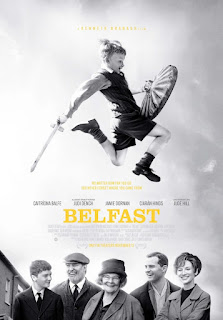
Directors making films about their childhood is a well-established sub-genre. Fellini got the ball rolling, a few years ago Alfonso Cuarón made his own black-and-white look at growing up in troubled political times in Roma and this year Pablo Sorrentino has released a film focused on his own teenage years in The Hand of God. Huge admirer of Kenneth Branagh as I am, I can’t deny he’s not a unique visionary in the vein of those filmmakers. But, Belfasthas a heartfelt, genuineness and a sweetness that verges just the right side of sentimentality and is a loving tribute not only to the city he grew up in but also to his parents, making it Branagh’s most personal project since In the Bleak Midwinter and possibly his finest non-Shakespeare film.

Branagh’s substitute is 9-year-old Buddy (Jude Hill), the child of a protestant family, living on a cross-community street in August 1969. His main concerns in life are friends, films, football and a classmate he has a crush on at school. But for his parents (Caitríona Balfe and Jamie Dornan), their worries are much more about the growing sectarian violence in the city. Pa has an offer of a job in England, which could bring them a new life. But it means the whole family leaving behind it everything it has ever known, including Buddy’s beloved grandparents (Judi Dench and Ciarán Hinds). As the city becomes more dangerous, what will the family decide to do?

If there is a memory piece Belfast reminds me of most, it’s John Boorman’s Hope and Glory. That film was true to Boorman’s memory, that growing up during the Blitz was also an exciting time, because as a child he never realised that death could be seconds away. It’s the same with Belfast. Branagh is keeps the film as much as possible from the child’s perspective. A child might be aware of the news playing on the TV, see the growing number of soldiers stopping and searching people on the streets and be wrapped up in riots, while never really understanding what exactly is going on.

The film has been unfairly attacked by some for not focusing on the accepted narratives of this era of Belfast’s history: misery, killing and brutality. What Belfast instead brings to the fore is the warm community. Streets where everyone knew your name, people sat outside their homes and chatted with neighbours, shared celebrations together and looked after each other. You can understand why it was such a wrench to leave this behind – even with soldiers patrolling the street. How scary it was for a person of any age – from Buddy to Ma, who has known nothing but Belfast her entire life – to even consider going to a place where no-one would know you and you would be an outsider.

Belfast is dedicated to those who stayed behind, those who left and all the lives who were lost. It’s a tribute to a community spirit and family, that has chimed with a great deal of people who lived in the city at the same time and place. The film is fundamentally hopeful because, under the violence and danger, it makes a plea – and demonstrates – that many people in Ireland just wanted to live their lives and didn’t care which church their neighbours went to. The opening few moments of the film is a snapshot of these halcyon days, kids from different communities playing together on the streets and their families gossiping and laughing together.

It’s shattered by the film’s first outburst of violence, as a Unionist gang attacks the street and hurl Molotov cocktails at the houses of Catholic residents – with Buddy, confused and terrified, caught in the middle and dragged into his house and safety by his frantic Ma. It’s a threat that will hang over the film for the rest of its runtime, embodied by Colin Morgan’s bullying enforcer, but only vaguely understood by Buddy – and considerably less important to him than whether he gets to sit next to the girl he has a crush on at school.

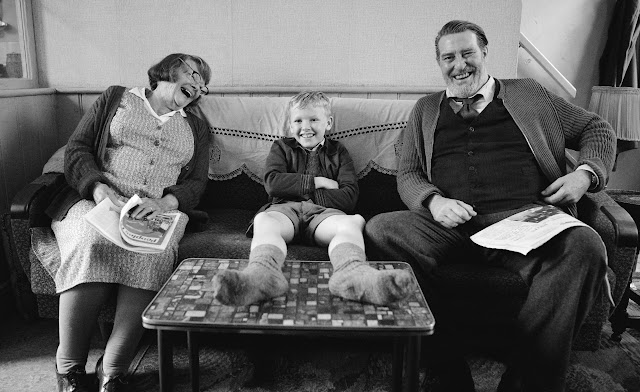
That crush is one of many things he gets advice on from his Grandad, played with a genuinely heart-warming twinkle by an Oscar-nominated Ciarán Hinds. Hinds is the picture of the perfect Grandad, wise, attentive, patient and full of homespun advice and wisdom – dialogue that Hinds brings to life with an expressive warmth. He’s paired to wonderful effect with Judi Dench (also Oscar-nominated) as Buddy’s Granny, who’s got a sharper tongue (and most of the funny lines) and has a cold-eyed realism about what it might be best for her son and his family.

You could check yourself and ask if Branagh is idealising his memories. But I think this is partly the point of the film. At several moments there is a slight air, not so much of fantasy, but of a childhood’s perception and memory being restaged. Jamie Dornan’s hard-working, caring Dad is frequently shot by Branagh in a way reminiscent of the Western heroes in the film buddy watches (High Noon in particular). A late confrontation between Dornan and Morgan plays out like a child’s romanticised memory of how something might have played out – as does a sequence where Dornan and Balfe sing and dance to Everlasting Love. I think Branagh is asking us to consider this might not be exactly what happened, but a fantasy tinged, child’s idealised memory of an event.

And Branagh’s film – shot in a luscious black-and-white – is told with a sharply edited pace and economy. It frequently allows us to see the ‘true’ situation in the background or on the edge of Buddy’s perception. Ma – beautifully played by Caitríona Balfe as grounded, moral but vulnerable and scared – has genuine worries not only about the violence but also the couple’s financial situation. There is an argument, and a later sad half-ultimatum, between Ma and Pa that we understand but Buddy is only vaguely aware is happening. Branagh’s film is full of half moments like this, where he trusts we are intelligent enough to see exactly what the child is seeing and also see more.

Branagh also draws a superb performance from Jude Hill as Buddy. This is a kid who is wide-eyed, natural, unforced and gets the balance just right between sweetness and a childish selfishness and vulnerability. There are real moments of terror and distress for Buddy, which are immensely well-done, and Branagh proves again there are few better directors of actors out there.

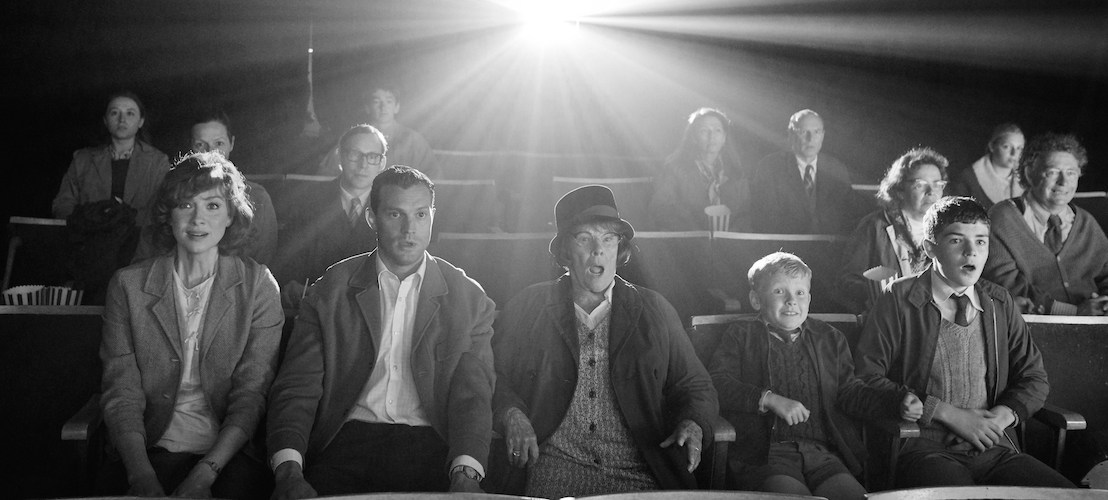
In among this there are some lovely moments where we see Branagh’s passion for the arts and film-making take hold. These are shown in splashes of pure colour: from clips of Chitty Chitty Bang Bang which an enraptured Buddy watches in the cinema, to actors performing A Christmas Carol in the Belfast theatre appearing in perfect colour. That’s not to mention touches of everything from Westerns to Star Trek to a shot of Buddy reading a Thor comic-book (sadly no Shakespeare).

Belfast is above all warm-hearted and loving tribute from a son to his parents and the impossible decisions they needed to take to give him opportunities in life they never had. Branagh’s script is crammed with some wonderful lines and plenty of hard-earned sentiment and the cast play each of these moments to perfection. It’s a passion project that really communicates its passion and shows how love, family and hope are universal. Cynics will sneer, but it’s a lovely film.

Fifty Shades of Grey (2015)


Dakota Johnson and Jamie Dornan struggle with their obvious discomfort in this ghastly, hellish, joyless film

Director: Sam Taylor-Johnson

Cast: Dakota Johnson (Anastasia Steele), Jamie Dornan (Christian Grey), Eloise Mumford (Kate Kavanagh), Jennifer Ehle (Carla Wilks), Marcia Gay Harden (Dr. Grace Trevelyan-Grey)

For some reason, about ten years ago everyone got wildly turned on by reading a series of books ripped off from Twilight, which followed the adventures of a timid student and her induction into the world of sexual spanking by a controlling billionaire. It was like tepid porn you could read in the open and talk about in the office. The entire genre of “mom porn” (now to be spotted in every supermarket book section) was born.

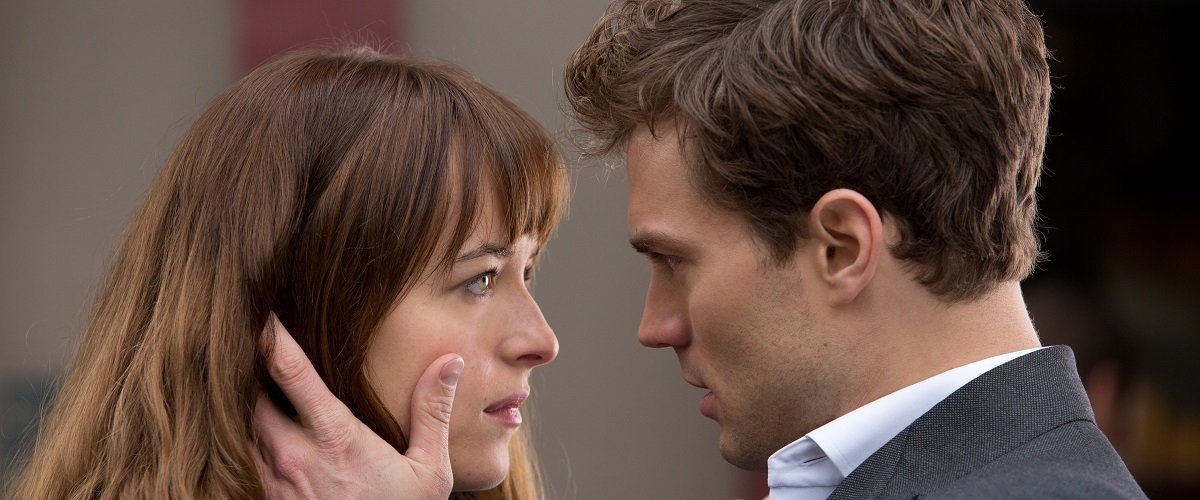
Anyway, it came at last (so to speak): the film of the book. With it came EL James’ atrocious dialogue (full disclosure here: I’ve not read the book, but I looked up some quotes and read the synopsis on Wikipedia, so I reckon that’s probably better than reading it), paper thin characters and event-less action. Along, of course, with the sex. Anastasia Steele (Dakota Johnson) is a young student who encounters Christian Grey (Jamie Dornan), a mysterious billionaire. He likes spanking. She’s never done anything down there (“You’re a virgin”, “yes”, “but you’ve done other stuff?” “no” “oh my god” – goes one classic exchange between the two). Bless, she doesn’t even know what a butt-plug is. I guess she will find out.

I’ll be blunt. This is possibly one of the worst, most offensive, horrible films I’ve ever seen. I’m actually rather angry I watched it. Nearly everything about it stinks: the acting and film-making craft are as vile, tasteless and revolting as the ideas behind it. First and foremost, Jamie Dornan honestly looks like he vomited with shame after completing every scene. Dakota Johnson does a reasonable job with a character who is as well-developed as the stains on Grey’s bedding, but since she is merely required to look alternately sad, timid or (god help us) “aroused” (expressions which bear a distinct resemblance to each other, mostly involving biting her lip and opening her eyes really wide beneath her “frumpy geek girl” fringe), she hardly needed to be much more than competent to bring this sad excuse for a protagonist to life. Ehle and Harden hopefully picked up big paycheques for selling their talents to this dreck.

As a relationship film, this is awful. Imagine Pretty Woman, but if Richard Gere could only get it up by smacking Julia Roberts in the mouth. It’s that charming. Factor in if their sex scenes had been shot with all the creativity of high-end porn, with the actors unconvincingly panting and sighing throughout and you get an idea of how sexy this film is.

The original author of the novels, EL James, had unprecedented creative control, and the tension between her demands for the film and the film-makers’ ideas is evident throughout. The film is a real hotch-potch: James had rejected one script by Patrick Marber (of Closer fame) for deviating too strongly from the book. That script presumably attracted Taylor-Johnson’s involvement as director – she wanted, it seemed, to make a serious relationship drama. EL James wanted an illustrated edition of her book. While I respect James’ insistence to get what she wrote on screen, I would also say she’s not a film-maker, and has no idea about what works on screen. What ends up here is a compromised mess – about half a Taylor-Johnson/Marber style “serious exploration of an unsuitable relationship” film, half James’ soft-porn spankathon shit.

The sex is one of the main problems with this film – there is nothing remotely enjoyable, titillating or even amusing about the joyless couplings in this film. Jamie Dornan looks like he’d rather be literally anywhere else during the sequences, a constant expression of embarrassment behind his eyes. The poor guy looks like he’s desperate to take Anastasia home to meet his mother. Both the sex and the spanking in this film are pretty tame, but he sets about both with a grim eyed determination, as if he was already thinking of getting back to his trailer and phoning his real life wife and kids. In fact, the film would make a perfect cold bath – I simply can’t imagine ever wanting to have sex again watching this film, let alone indulge in any of the “erotic” games it features, which it manages to make look as enticing as root canal.

The big thing missing from this film is any fun whatsoever. A large slice of the blame for this must go to Taylor-Johnson. I suspect she wanted to make a film that was a serious examination of relationships, and the unexpected dangers desire can lead us into. However, she was pushing against the source material (and the all-powerful author), and her efforts were always going to be doomed. This is taken from a book that is, to put it bluntly, a piece of sub-Cinderellesque shit with extra spanking. What it really needed was not an artistic approach, but more of the camp “I know this is rubbish, just enjoy it” direction – in other words, it needed an efficient (even knowing) hack director, not an artist at the helm.

By trying to look at the dynamics of power relationships in a serious way at least part of the time, Taylor-Johnson (assisted by Dornan’s fantastically awkward performance) manages to highlight what a humourless, manipulative, controlling wanker Christian Grey is. By any objective measures, he is clearly a controlling and abusive boyfriend. Filmed entirely seriously, with moody music in the background half the time and none of book-Anastasia’s laughably cheesy descriptions of the latest antics of her “inner goddess” (usually to be found dancing the hula or turning cartwheels), this film throws into sharp relief what is actually happening in this story: an experienced, controlling man finds a naïve, inexperienced younger woman and coerces her into servicing his desires. The “negotiation” talk is one of the most uncomfortable examples of this: “we can negotiate” says the man who holds all the cards, to the girl who doesn’t even know what she can or should ask for. 

Throw in the fact that he is multi-billionaire who gets his rocks off by fucking his girlfriends the same way he (presumably) fucks his business rivals, only makes him seem even more of an unredeemable asshole. His ostentatious gifts of new cars, his controlling forbidding of Anastasia to drink on her nights out with friends, his insistence on coming to remove her from one of these nights out when she’s only met him twice and has not asked for his help or his presence, his demand for her to sign a contract, his following her to her parents’, his not taking no for an answer…  Need I go on? The more the film focuses on these darker sides of the relationship, the more you look at Grey less as a messed up Prince Charming, and more like an abusive predator. 

Grey is also clearly purchasing his new part-time live-in mistress like a piece of meat, and he treats her like a piece of property throughout. Tragically (and I’m not sure the film realises this) Anastasia is so sweet and vulnerable she seems to think that she just has to accept all this spanking and rope game malarkey as just part and parcel of having a boyfriend (“Do we still get to go to the theatre” she rather sadly asks when enquiring into the new rules of their relationship). I don’t get overwhelmed with sympathy with her though: every hesitancy is overcome by a new extravagant display of Grey’s wealth. The film does build towards her walking away – but she hardly does this with any decisiveness. Despite the film’s best efforts, she in no way comes across as an equal partner or a strong character. 

So the film’s serious tone is a major problem in that sense. It’s also a major problem as Taylor-Johnson just ends up turning this into a totally dull, lifeless film. Almost nothing happens in this film. Trivial events and dull conversations are interrupted occasionally by the actors rutting with all the passion of two people eating a microwave meal. The film’s sex scenes are, incidentally, totally unbalanced: throughout his session in the red room, we see endless shots of Johnson’s assets but Dornan politely keeps his jeans on almost throughout. The camera’s perfunctory, joyless efforts to capture Johnson’s nipples in every scene it can (never miss a chance to edge them in at the corner of a shot!) just builds this feeling of no-one enjoying their work, but shovelling onto the screen what the readers might want so they can all go home.

The only way this fucking piece of garbage could ever have really worked on the screen is if someone had basically accepted it for what it was: a steaming pile of manure written to titillate those scared of searching the Internet for real porn. If it had been treated like the ghastly, campy piece of crap it was, then the film itself could have been the ultimate “bad” film. But Taylor-Johnson’s attempt to create a serious relationship drama crashes up against EL James’ dire, pig-eared prose and depthless characters, and instead creates a film both tedious in the extreme and offensive. 

Honestly, not even as a camp watch will this work – it is dull, horrible and awful. It thinks it’s a dark Cinderella tale. It’s just a dark story about a horrible man. Avoid, avoid, avoid.

Anthropoid (2016)


Jamie Dornan and Cillian Murphy plan to remove The Butcher of Prague

Director: Sean Ellis

Cast: Cillian Murphy (Jozef Gabčík), Jamie Dornan (Jan Kubiš), Anna Geislerová (Lenka Fafková), Harry Lloyd (Adolf Opálka), Toby Jones (Jan Zelenka-Hajský), Charlotte Le Bon (Marie Kovárníková), Alena Mihulová (Mrs Moravcová), Bill Milner (Ata Moravec), Vaclav Neuzil (Josef Valcik), Andrej Polak (Jaroslav Svarc), Sam Keeley (Josef Bublík)

Reinhard Heydrich, Head of the SD, Reichs-Protector of Bohemia and Bavaria (the new German name for Czechoslovakia) and the architect of the Final Solution, was the only leader of the Nazi party to be assassinated by Allied forces during the Second World War. In revenge for his death, German soldiers destroyed the town of Lodz, executing the entire adult male population and sending the rest of the population to concentration camps. The reprisals eventually numbered over 5,000 people.

This film covers the build-up and planning of the assassination (code-named Operation Anthropoid), the assassination itself and the eventual fates of the assassins. It begins with Jozef Gabčík (Cillian Murphy) and Jan Kubiš (Jamie Dornan) parachuting into Czechoslovakia, with orders to plan and execute the assassination of Heydrich. With the assassination at the half way point of the film, the second half then focuses on the immediate aftermath and the fates of those involved.

Anthropoid was a box-office disappointment when released. Personally I think a large part of this was connected to its terrible title. Anthropoidis a word that means nothing to people watching and gives you no idea what the film is about – it sounds more like a sci-fi film than anything else. It’s also a film without big-name stars, with a fantastically downer ending, and about an event many people have not heard of. It’s a shame though, as this deserved an audience.

It’s a tense, tightly structured film, sharply directed, that has events as its primary momentum over character. The characters in the film are primarily defined by their purpose within the plot. Saying that, there is scope allowed for characterisation. Cillian Murphy’s Gabčík begins the film as a man who believes himself willing to sacrifice anything for the cause. However, when the losses begin to happen, he is the man who most quickly succumbs to anger and sentiment. Conversely Jamie Dornan’s Kubiš begins as hesitant about the taking of lives, but becomes the most effective soldier among the group.

The film is actually fairly even-handed in its portrayal of the resistance members, not afraid of showing that they were not always a unified group willingly sharing a purpose. Many of the members of the resistance are hesitant about the effect the plan will have on their already decimated ranks. Others, such as Harry Lloyd’s Opálka seem almost obsessively dedicated to their duties as soldiers, at the expense of any other considerations. Even the eventual traitor is shown to be motivated at least partly by fear for the fate of his family. Similarly the film is not afraid to show the somewhat haphazard planning of the assassination, or its bungled execution (expertly reconstructed).

There is a definite mood shift after the assassination. If the first half of the film is a subdued men-on-a-mission tale, the second half is a brutal depiction of the onslaught of retribution. Ellis’ direction is crisp, taught and unflinchingly truthful, recording the actions of the police state with honesty and no sensationalism – from doors kicked in to some brutal torture scenes (the torture of one character in particular is tough to watch, without ever being graphic). The final stand of the assassins in the church is similarly brilliantly filmed and difficult to watch, a blazingly tight and bloody display of gunplay and violence, in which doomed men determine to take as many of the enemy down with them as they can.

However, as it goes on, I think the film becomes so seduced by the courage and bravery of its characters, that it stops questioning the value of their actions. From the start, many members of the Czech resistance are shown to question the worth of the plan when balanced against likely reprisals. This is an issue the film loses sight of in its second half. It is not completely surprising, considering the immense bravery of the assassins during their final stand, that the film doesn’t wish to undermine this by probing the reasoning behind their actions. But it’s a point that needs to be made and the film, in the end, dodges it: was killing Heydrich worth sacrificing 5,000 innocent Czechs in return? I’d argue probably not. The allies at the time certainly decided it wasn’t – no other attempt would be made to assassinate a leading Nazi during the war – and the question needed to be asked more in  this film. Killing Heydrich didn’t stop anything he had set in motion and had little overall impact on the outcome of the war.

Instead the film ends on a note of optimism, stressing Heydrich’s vileness and the fact that the successful assassination made the Czechs more recognised as members of the Allies. It is understandable, considering the tragic ending of the film, that its makers didn’t want to end with any doubt about the righteousness or value of their actions. And there is no doubt that Heydrich deserved his fate. But the film avoids truly addressing the collateral damage to the Czech population. It’s a single question mark over other an otherwise gripping and tense dramatisation.