Tag: Janet Gaynor

A Star is Born (1937)

A Star is Born (1937)

One of the first iterations of the tale, and with two winning performances one of the best

Director: William A Wellman

Cast: Janet Gaynor (Esther Blodgett/Vicki Lester), Fredric March (Norman Maine), Adolphe Menjou (Oliver Niles), May Robson (Lettie Blodgett), Andy Devine (Danny McGuire), Lionel Stander (Matt Libby), Owen Moore (Casey Burke), Peggy Wood (Miss Phillips), Elizabeth Jenns (Anita Regis), Edgar Kennedy (Pop Randall)

A Star is Born wasn’t the first time this story was told and it certainly wasn’t the last. Each generation in Hollywood has produced its own version of the story, not to mention a gallery of other culture creating their own unofficial and otherwise remakes. What Price Hollywood had even effectively told the same story five years earlier, and the entire concept has the air of a medieval ‘fortune’s wheel’ – two souls bound together, one goes up as the other goes down. There may in fact not be nothing new about A Star is Born at all but gave such a bright new polish to the familiar, that we’ve been inspired to come back to it again and again.

In the farmyard sticks, Esther Blodgett (Janet Gaynor) has a dream:  to become one of those stars of Hollywood’s silver screen. With grandma’s (May Robson) money in her pocket (‘What have I got to spend it on?’) she heads to Los Angeles, only to find the city is awash with similarly starry-eyed dreamers desperate for a big break. Esther gets hers in an unusual manner: serving drinks at a Hollywood party she strikes up conversation with famous star Norman Maine (Fredric March). Norman is very taken with Esther – in fact he’s almost immediately in love with her – and arranges a screen test. Soon Esther has a new career, a new name – Vicki Lester – and a new marriage to Norman. Problem is, as her star rises and she becomes the next big thing, Norman stops letting “his acting get in the way of his drinking” and his career slides into oblivion.

It’s high romance, very effectively filmed by Wellman, that requires – and gets – two very strong, highly relatable performances from its leads. Wellman’s film carefully gives both of them the space to grow a relationship that begins shyly and becomes deep and tender. Gaynor is bright, naïve and gentle with just enough ambition and determination to impress. She’s eager to please, but also firm and knows her own mind, far from a pushover in this town of press releases and media spin. Gaynor never lets us forget that under ‘Vicki Lester’ there’s that ordinary Esther Blodgett (could there be a more grounded, less starry name than Blodgett?), a woman with principles in a world of fakes.

Perhaps even better though is Fredric March (it’s the first indication, borne out by nearly all the remakes, that Norman is the better part). March is charismatic, engaging, funny, down-to-earth and everything you would want from a star – while also being a mean drunk with anger management issues. He’s introduced getting into a drunken scuffle at the Hollywood Bowl, and his love of booze makes him just as likely to laugh and flirt with Esther as it can make him take a slug at a guy who looks at him the wrong way. March’s drunk acting is very effectively restrained and he captures extremely well the self-disgust behind Norman at his weakness. March makes him a star who burns away his career through appalling choices, who fervently believes he can stay on the wagon until he can’t. In his hands it becomes a classic tragic piece, a Greek hero destroyed by his fatal flaw, his inability to escape the bottle.

This rich romantic tragedy builds wonderfully, Wellman keeping us deeply invested in this couple. The good times are really endearing: it’s hard not to grin along as they laugh and joke in a camper van after their elopement, or as they cover each other with encouragement and support for their careers. It makes the bad times unbearably painful: Norman’s drunken crashing of Esther’s Oscar win, a shambling monologue of self-pity and resentment, both heartbreaking and excruciatingly embarrassing. Norman’s fateful final decision is full of romantic imagery, as he smiling walks towards a sun-kissed beach, a beautifully staged inversion of a romantic ending.

A Star is Born’s other most interesting feature is its inside glimpse at Hollywood: or at least the version Hollywood was willing to present of itself to people. It even has a meta-theatrical element to it, the film book-marked by images of the shooting script describing the action immediately following or preceding it. Here Hollywood is a ruthless machine, chewing up the dreams of wannabes. An agent bluntly shows Esther the vast numbers of phone calls of wannabe extras they receive every day. Esther struggles just as much as assistant director Danny (Andy Devine) to find regular work. Careers are made and broken by chance, whims or the reaction of the audience to your face on screen. Names in lights one month and being pasted over the next.

Hollywood loves to be cynical about itself. A Star is Born delightedly shows its spin operation as ruthless, cut throat and controlling, planting stories about stars, covering up their misdemeanours (a regular requirement for the drunken Norman) and repackaging their lives into saleable commodities. Lionel Stander, as a heartlessly controlling press agent, is the heart of this, and the film doesn’t hold back on showing the dark powers of these studio fixers in action. But this is just a version of Hollywood: its telling that in A Star is Born while the middle management are condemned, the studio heads are absolved completely. Adolphe Menjou’s Selznick-like producer is an avuncular, uncle-like figure, endlessly caring and supportive of his stars who wouldn’t dream of any funny games to earn some money. This is a portrait of Hollywood where the top man is an affectionate saint – exposure only goes so far.

A Star is Born is also an interesting time capsule. Esther stares in admiration at a host of Hollywood Avenue stars of people must of the viewing public today would struggle to name (Norman Cantor anyone?). Seeking to impress while serving at a dinner party she’ll do impersonations of Garbo, Hepburn, Crawford and Mae West (the last even named). It’s a world where the continual production of content is even more on-going than on Netflix and the studios can start or end careers instantly. It’s a fascinating extra piece of interest in a highly effective, well-staged film. Even with its slightly murky early colour photography (it looks like a colourised black and white film), it’s a well-staged, effective romance with two very winning performances from its leads. Possibly one of the best versions of the story.

Sunrise: A Song of Two Humans (1927)

Sunrise: A Song of Two Humans (1927)

The visual language of cinema is redefined for Hollywood, with this expressionistic, fairy-tale, silent masterpiece

Director: FW Murnau

Cast: George O’Brien (The Man), Janet Gaynor (The Wife), Margaret Livingston (The City Woman), Bodil Rosing (Maid), J Farrell MacDonald (Photographer), Ralph Sipperly (Barber), Jane Winton (Manicurist), Arthur Housman (Obtrusive gentleman), Eddie Boland (Obliging gentleman)

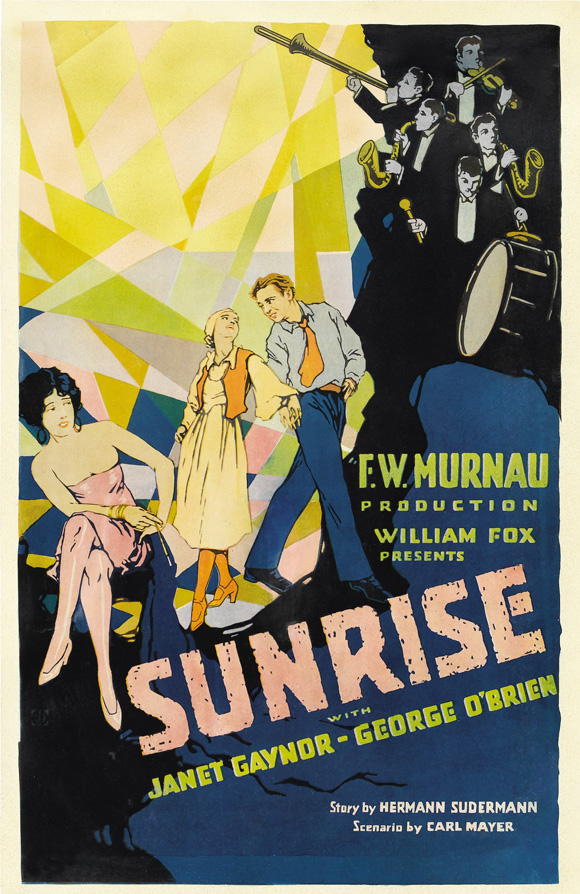
It’s 1928 and Hollywood has a neat idea. How about an annual awards ceremony toasting the best the industry has produced in the last year? But how on earth do you decide the “best” film? Isn’t comparing war films to arthouse films like comparing apples and oranges? The solution? An award for Outstanding Production and another for Best Unique and Artistic Picture. FW Murnau’s revolutionary silent movie, Sunshine: A Song of Two Humans, was the first and last winner of the latter category: a movie so technically inventive and astonishingly cinematically literate that its influence has seeped into almost every frame of footage shot by the movies ever since.

It would be fair to say Sunrise is less a narrative, more a quiet piece of expressionist art. Its plot is incredibly slim, essentially a fairy tale. In an unspecified country village (presumably in America, but it might as well be from the Brothers Grimm), a married man (George O’Brien) falls in lust with a floozy from the big city (Margaret Livingston). Before he can take the infatuation any further than canoodling by a country lake, he’s got to get rid of his wife (Janet Gaynor). He takes her out on a boat, planning to “get her drowned”, but can’t go through with it. She works out his intent though and runs. He follows her and they wind up in the big city, where a series of encounters helps them remember they actually do love each other. When they return to the village, she briefly seems lost in a genuine boating accident, before a fairy tale ending.

That’s what Sunrise is: a fairy tale. Murnau aimed at universality in his film. Namesless every people and generic, fantastic locations. A dreamlike structure and pace. It would have a monster who becomes a prince, a damsel in distress who saves the day and a wicked “crone” who wants to shatter their happiness. This is all part of turning it into a universal fable. It makes for a beautiful simplicity in narrative that is surprisingly effective if you surrender yourself to it. No one is going to mistake it for Tolstoy or Zola (for all it’s Therese Raquin remix), but you might just mistake it from something from Hans Christian Anderson.

This atmosphere benefits even more from Murnau’s artistry. One of the true founding fathers of cinema, Murnau believed in the power of images. (He died with the advent of sound – somehow that seems sadly fitting for a director whose poetic visual power would have sunk forever under the fixed rigidity of Hollywood movie cameras capturing sound.) Sunrise has fewer intertitles than almost any other silent movie. Most are concentrated in the film’s first 20 minutes, establishing plot and character. Then it relies almost entirely on the power of images.

Sunrise may be a slight story, but cinematically it’s a heavyweight. Today, transitions, flashbacks, montages, superimposed images and vivid panoramas are just part and parcel of film. But many of these techniques date from the work of Murnau, and Hollywood really woke up to them with his first American film. Sunrise is immaculately shot – photographers Charles Rosher and Karl Struss would also win one of those Oscars – a series of beautifully composed images, with a free flowing camera that looks normal today but reinvented the industry back then. Few other films, except maybe Citizen Kane, can claim to be as influential on cinematic technique.

Look at the opening montage of the big city. What seems like a straightforward fixed shot was a triumph of invention. The city was a carefully constructed set, with the shot combining forced perspective of a model train, dwarf extras and intelligent angles and camera positioning to create a vibrant, overhead shot of city life quite unlike anything anyone had seen before. (Rochus Gleis’ Oscar-winning art design is superb.) The city, when we see it in more depth, is a fascinating collection of architectural influences contrasting beautifully with the village’s homespun ruralism.

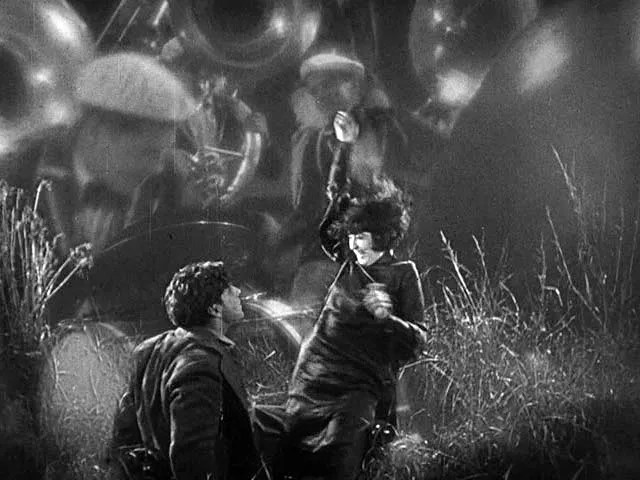
The camerawork and editing is sublime, its use of superimposed images truly extraordinary. As the man meets his fancy woman by a lake, they lie back and look at the stars. Above them, in the night sky, images of the city are imposed that stress its energy, excitement and raw sex appeal (can-can dancers and the like). It’s almost like our lovers are watching an actual movie.

Later the imposition will be reversed: after reconciling in the city, man and wife walk down a busy street – without a cut, as they walk, the street fades away and is replaced by the country fields of their home. In most cases, the imagery throws the character’s inner longings up on the screen for the viewer to digest. It doesn’t stop there. Images at various points show the city woman imposed standing behind the man as he debates killing his wife (again those inner thoughts given visual life). As the man lies back on his bed and stares at his wife, water is superimposed on top of him – it’s clear what he is thinking.

Murnau shoots with an expressionistic, early-morning brilliance, the man working home from his assignation – his slumped back and shoulders (George O’Brien joked his back did most of the work) telling us everything about his mood, in contrast with the brilliance of the surroundings, which we realise he finds as overwhelming as we do (he even gets slightly lost in the frame).

The possible drowning is a masterclass in cutting – moving swiftly from the man’s furrowed brow, as he builds up to what he must do, and the wife’s growing realisation of what he has in mind. A big part of the film’s poetic beauty is how this point of no return is an entrée to a love story. Reunited in the city, the two walk into a church and witness a wedding: the ceremony reminds them of the one they once shared, and Murnau captures the two of them emerging from the church just before the married couple, cementing the rebirth of their marriage. It’s an overwhelmingly optimistic view of love and the durability of the human spirit.

The film’s long second act of hijinks in the city can strain the patience of some. It’s effectively the couple’s second honeymoon, from having their photos taken (a candid moment of genuine love) to dancing at a Moulin Rouge style club where the man captures an escaped pig (yes seriously). It’s dreamlike (the camera work, especially in the club, reflecting this) but undoubtedly low on plot and drama. But it’s charming in its simplicity and in Murnau’s little touches of wit – the couple’s attempt to hide a damaged statue in the photographer’s studio is surprisingly funny.

It all leads us back to the narrowly averted tragedy of the final act as – irony of ironies – the newly reconciled couple are swept up in a genuine storm on the river that nearly sweeps the wife to her death. The man is distraught – so much so his homicidal rage is often overlooked him. Anyone seriously considering bumping his wife off is not well adjusted, and his reaction to the presumed loss of his wife it to attempt to strangle his lover.

This doesn’t intrude on the optimism of the tale and Murnau’s desire to present a fairy-tale like restoration of domestic bliss (after all, darker things happen in Brothers Grimm), all of which ends with an art deco sunset that kisses the frame. O’Brien’s body language may seem crude today, but it perfectly communicates the tempest at the heart of the man’s doubt. Gaynor has a beautiful innocence to her (she won an Oscar as well). Together they play enraptured love without being cloying, and are equally convincing during the rage and accusation.

Murnau, inexplicably, didn’t get an Oscar (not even a nomination), but Sunrise is a testament to his artistic brilliance with cinema. Effectively, he created a new grammar for this language, a superb use of visuals, effects, editing and production to lift a slight story into the realms of high art. Which is what Sunrise is: an arthouse poem, a visual feast that will linger with you long after its runtime has elapsed. Its influence has touched so many parts of cinema, that you might wonder today what all the fuss is about. But everything from your arthouse darling to your favourite Marvel blockbuster owes Sunrise a debt.