
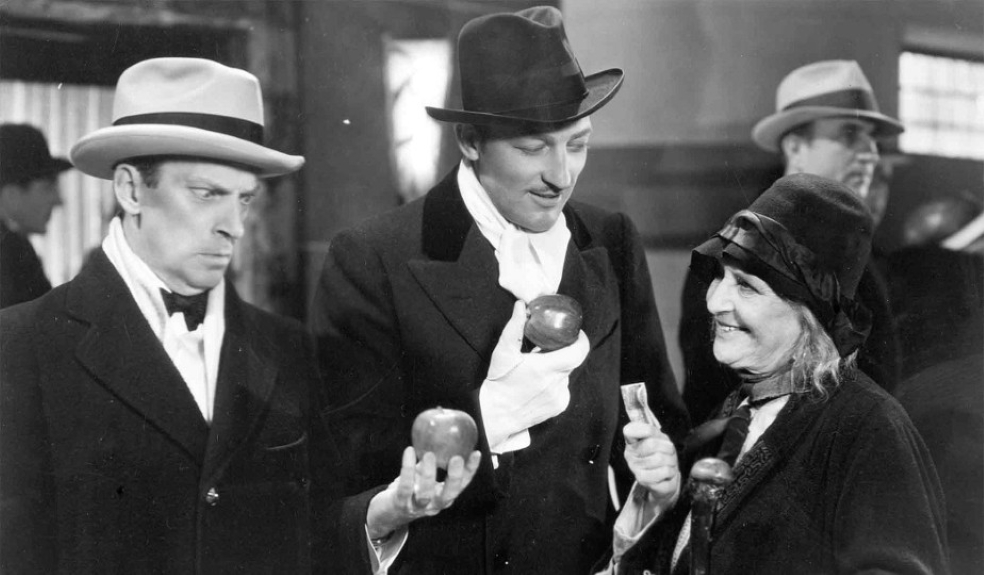
Tag: May Robson

Lady for a Day (1933)

Lady for a Day (1933)

Capra’s charming comedy is really a sort of proto-Ealing film, and certainly a lot of fun

Director: Frank Capra

Cast: Warren William (Dave the Dude), May Robson (Apple Annie), Guy Kibbee (Henry D Blake), Glenda Farrell (Missouri Martin), Ned Sparks (Happy Maguire), Jean Parker (Louise), Barry Norton (Carlos), Walter Connolly (Count Romero), Nat Pendleton (Shakespeare), Halliwell Hobbes (Butler), Hobart Bosworth (Governor)
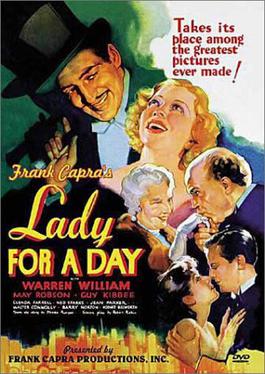
Based on a short story called Madame La Gimp (probably wise to change that title), Frank Capra’s Lady for a Day (for which he received his first Oscar nomination) fits neatly into his wheelhouse in one sense with its feel-good, comic sentimentality. But it also feels rather like an Ealing film made before the studio even existed. It’s a film where ordinary folks, some of them not exactly saints, with a mix of cunning and luck, run circles around the powers that be in the name of a good cause. It’s also a sharp, witty, fast-paced comedy with a happy ending. It’s a real crowd-pleasing comedy.

Apple Annie (May Robson) is an ageing fruit seller in New York City, who has seen better days but now lives in a rundown flat. But she’s doesn’t want the daughter, who she gave up for adoption decades ago, to know that. Using headed notepaper from a posh hotel, she has spun her a story for years that Annie is a well-to-do society figure in the Big Apple. So, it’s a disaster when daughter Louise (Jean Parker) writes back saying she’s engaged to the son of a Spanish count and is bringing him to New York to meet her mother. Apple Annie’s story seems doomed – but her salvation is that she is the lucky charm of rogueish gambler gangster Dave the Dude (Warren William) who never does a deal without buying one of her apples first. Can Dave ‘s money and his crew – with the help of a borrowed apartment – act out her fantasy for real?

Lady for a Day becomes a charming, fast-paced, semi-farce with Dave’s rough-and-tumble crew constantly trying to keep a step ahead of Louise’s prospective husband and father-in-law finding out the truth. They are helped by a large group of semi-vagrants from Apple Annie’s neighbourhood, all presented with an endearingly, non-patronising sense of supportive community. This leads to a constant parade of hustling their visitors from place-to-place, intercepting phone calls to the Spanish consulate and roping in a parade of New Yoick hustlers to play society grandees at a soiree. All of this while trying to stay one step ahead of the police and press, who are both convinced if the Dude is chucking this much money and people around, he must be planning a big score.

It’s the sort of charm you can’t imagine being allowed to fly even a year later: gangsters who don’t for a single-minute consider renouncing their life of making money from illicit deals (among other things), presented as put-upon, but-decent guys, bending over backwards to make an old woman’s dream come true. Lady for a Day doesn’t for a second suggest there should be a price to pay for their naughty day jobs. ‘Worse’ than that, in true Earling style, it presents the police chasing after them as dumb flat foots, hopelessly clueless and off-the-pace. Hard to believe the Hays Code passing that.

But it really works here, especially since Capra directs with phenomenal zip and wit. You could imagine a version of Lady for a Day weighted down in cheap sentimentality (in fact, you don’t need to – Capra made it in 1961 calling it A Pocketful of Miracles), but instead this is genuinely funny with well-drawn characters. Warren William is very good as the increasingly put-upon Duke, who can’t believe he’s been pulled into funding this good deed, but commits to it with world-weary resignation. He ‘sparks’ brilliantly off Ned Sparks’ rat-a-tat, cynical fixer flummoxed by his boss turning ‘Father Christmas’ but as determined to deliver on the deal as he would be on any other criminal enterprise.

And refreshingly Lady for a Day’s plot still has an air of criminal enterprise about it. They aren’t above threatening Halliwell Hobbes’ excellently dry butler with a bit of physical harm if he doesn’t play his part to perfection (doesn’t stop Hobbes getting in a cuttingly witty line about Sparks’ poor grammar). When a trio of journalists cause problems, they kidnap them (only for a few days they promise!). Difficult people are quietly strong-armed out of the way. Capra – working with a typically excellent Robert Riskin script – gets the tone just right, with just enough whimsical, Wildean farce.

This also plays into several set-pieces. The planning of the elaborate soiree is a particular gem. Packed with a parade of gamblers, tough guys and molls – all lacking even a drop of sophistication – they are carefully given a named role (one of them protests playing the Secretary of Defence – “a secretary is a secretary”) and a single line of high-styled dialogue, which they require hours of careful coaching to not fumble. The entire idea is excellent and superbly executed. Their dialogue is all provided by Guy Kibbee’s (quite excellent here) English gent-turned pool hustler, ‘playing’ Annie’s husband and enjoying a taste of the high life – while, in another memorable scene, discovering his pool hustling skills are more than a little helpful to the cause.

The film also works because it has a lovely, heartfelt performance by May Robson (Oscar nominated) as Annie. There is a wonderful Dickensian quality to Robson, with Apple Annie a Mrs Gamp with a tragic past (there are several references that she was once a lot more affluent than shifting apples on the street). Robson makes her sweet but sparky but never loses track of her vulnerability and fear that the truth may be discovered. She makes the character feel real and grounded, meaning the scenes with her daughter (which could have tipped into sentimentality) are genuinely quite touching.

It’s another successful beat in a fast-paced film that is entertaining, genuinely quite heart-warming and stuffed with excellent performances from a parade of studio players grabbing the sort of roles they wouldn’t normally get by the scruff of the neck. With its compassionate regard for the little guys, while not presenting either vagrants patronisingly or gangsters naively, it constantly entertains. It’s got a pre-Code daring about it (there is a neat joke about a gay hairdresser and a hint that Annie had her child out of wedlock, neither of which would have flown years later) and in its comic wit and fast-paced energy it’s one of Capra’s finest. Sure, it ends before Annie has to return to her previous life (and I’ve no idea what they would do if Louise visited again) but the film is as much about spinning a charming fantasy for us as it is for the characters.

A Star is Born (1937)

A Star is Born (1937)

One of the first iterations of the tale, and with two winning performances one of the best

Director: William A Wellman

Cast: Janet Gaynor (Esther Blodgett/Vicki Lester), Fredric March (Norman Maine), Adolphe Menjou (Oliver Niles), May Robson (Lettie Blodgett), Andy Devine (Danny McGuire), Lionel Stander (Matt Libby), Owen Moore (Casey Burke), Peggy Wood (Miss Phillips), Elizabeth Jenns (Anita Regis), Edgar Kennedy (Pop Randall)

A Star is Born wasn’t the first time this story was told and it certainly wasn’t the last. Each generation in Hollywood has produced its own version of the story, not to mention a gallery of other culture creating their own unofficial and otherwise remakes. What Price Hollywood had even effectively told the same story five years earlier, and the entire concept has the air of a medieval ‘fortune’s wheel’ – two souls bound together, one goes up as the other goes down. There may in fact not be nothing new about A Star is Born at all but gave such a bright new polish to the familiar, that we’ve been inspired to come back to it again and again.

In the farmyard sticks, Esther Blodgett (Janet Gaynor) has a dream:  to become one of those stars of Hollywood’s silver screen. With grandma’s (May Robson) money in her pocket (‘What have I got to spend it on?’) she heads to Los Angeles, only to find the city is awash with similarly starry-eyed dreamers desperate for a big break. Esther gets hers in an unusual manner: serving drinks at a Hollywood party she strikes up conversation with famous star Norman Maine (Fredric March). Norman is very taken with Esther – in fact he’s almost immediately in love with her – and arranges a screen test. Soon Esther has a new career, a new name – Vicki Lester – and a new marriage to Norman. Problem is, as her star rises and she becomes the next big thing, Norman stops letting “his acting get in the way of his drinking” and his career slides into oblivion.

It’s high romance, very effectively filmed by Wellman, that requires – and gets – two very strong, highly relatable performances from its leads. Wellman’s film carefully gives both of them the space to grow a relationship that begins shyly and becomes deep and tender. Gaynor is bright, naïve and gentle with just enough ambition and determination to impress. She’s eager to please, but also firm and knows her own mind, far from a pushover in this town of press releases and media spin. Gaynor never lets us forget that under ‘Vicki Lester’ there’s that ordinary Esther Blodgett (could there be a more grounded, less starry name than Blodgett?), a woman with principles in a world of fakes.

Perhaps even better though is Fredric March (it’s the first indication, borne out by nearly all the remakes, that Norman is the better part). March is charismatic, engaging, funny, down-to-earth and everything you would want from a star – while also being a mean drunk with anger management issues. He’s introduced getting into a drunken scuffle at the Hollywood Bowl, and his love of booze makes him just as likely to laugh and flirt with Esther as it can make him take a slug at a guy who looks at him the wrong way. March’s drunk acting is very effectively restrained and he captures extremely well the self-disgust behind Norman at his weakness. March makes him a star who burns away his career through appalling choices, who fervently believes he can stay on the wagon until he can’t. In his hands it becomes a classic tragic piece, a Greek hero destroyed by his fatal flaw, his inability to escape the bottle.

This rich romantic tragedy builds wonderfully, Wellman keeping us deeply invested in this couple. The good times are really endearing: it’s hard not to grin along as they laugh and joke in a camper van after their elopement, or as they cover each other with encouragement and support for their careers. It makes the bad times unbearably painful: Norman’s drunken crashing of Esther’s Oscar win, a shambling monologue of self-pity and resentment, both heartbreaking and excruciatingly embarrassing. Norman’s fateful final decision is full of romantic imagery, as he smiling walks towards a sun-kissed beach, a beautifully staged inversion of a romantic ending.

A Star is Born’s other most interesting feature is its inside glimpse at Hollywood: or at least the version Hollywood was willing to present of itself to people. It even has a meta-theatrical element to it, the film book-marked by images of the shooting script describing the action immediately following or preceding it. Here Hollywood is a ruthless machine, chewing up the dreams of wannabes. An agent bluntly shows Esther the vast numbers of phone calls of wannabe extras they receive every day. Esther struggles just as much as assistant director Danny (Andy Devine) to find regular work. Careers are made and broken by chance, whims or the reaction of the audience to your face on screen. Names in lights one month and being pasted over the next.

Hollywood loves to be cynical about itself. A Star is Born delightedly shows its spin operation as ruthless, cut throat and controlling, planting stories about stars, covering up their misdemeanours (a regular requirement for the drunken Norman) and repackaging their lives into saleable commodities. Lionel Stander, as a heartlessly controlling press agent, is the heart of this, and the film doesn’t hold back on showing the dark powers of these studio fixers in action. But this is just a version of Hollywood: its telling that in A Star is Born while the middle management are condemned, the studio heads are absolved completely. Adolphe Menjou’s Selznick-like producer is an avuncular, uncle-like figure, endlessly caring and supportive of his stars who wouldn’t dream of any funny games to earn some money. This is a portrait of Hollywood where the top man is an affectionate saint – exposure only goes so far.

A Star is Born is also an interesting time capsule. Esther stares in admiration at a host of Hollywood Avenue stars of people must of the viewing public today would struggle to name (Norman Cantor anyone?). Seeking to impress while serving at a dinner party she’ll do impersonations of Garbo, Hepburn, Crawford and Mae West (the last even named). It’s a world where the continual production of content is even more on-going than on Netflix and the studios can start or end careers instantly. It’s a fascinating extra piece of interest in a highly effective, well-staged film. Even with its slightly murky early colour photography (it looks like a colourised black and white film), it’s a well-staged, effective romance with two very winning performances from its leads. Possibly one of the best versions of the story.