
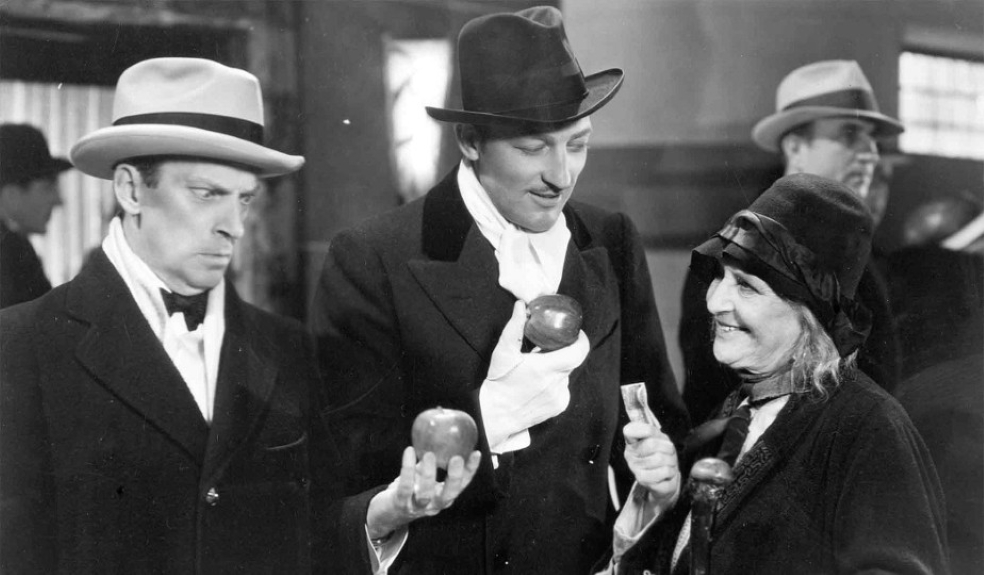
Capra’s charming comedy is really a sort of proto-Ealing film, and certainly a lot of fun
Director: Frank Capra
Cast: Warren William (Dave the Dude), May Robson (Apple Annie), Guy Kibbee (Henry D Blake), Glenda Farrell (Missouri Martin), Ned Sparks (Happy Maguire), Jean Parker (Louise), Barry Norton (Carlos), Walter Connolly (Count Romero), Nat Pendleton (Shakespeare), Halliwell Hobbes (Butler), Hobart Bosworth (Governor)
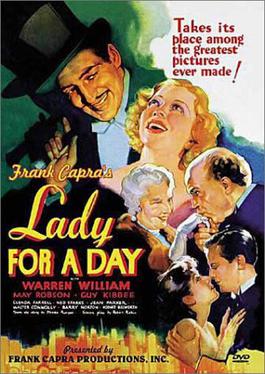
Based on a short story called Madame La Gimp (probably wise to change that title), Frank Capra’s Lady for a Day (for which he received his first Oscar nomination) fits neatly into his wheelhouse in one sense with its feel-good, comic sentimentality. But it also feels rather like an Ealing film made before the studio even existed. It’s a film where ordinary folks, some of them not exactly saints, with a mix of cunning and luck, run circles around the powers that be in the name of a good cause. It’s also a sharp, witty, fast-paced comedy with a happy ending. It’s a real crowd-pleasing comedy.
Apple Annie (May Robson) is an ageing fruit seller in New York City, who has seen better days but now lives in a rundown flat. But she’s doesn’t want the daughter, who she gave up for adoption decades ago, to know that. Using headed notepaper from a posh hotel, she has spun her a story for years that Annie is a well-to-do society figure in the Big Apple. So, it’s a disaster when daughter Louise (Jean Parker) writes back saying she’s engaged to the son of a Spanish count and is bringing him to New York to meet her mother. Apple Annie’s story seems doomed – but her salvation is that she is the lucky charm of rogueish gambler gangster Dave the Dude (Warren William) who never does a deal without buying one of her apples first. Can Dave ‘s money and his crew – with the help of a borrowed apartment – act out her fantasy for real?
Lady for a Day becomes a charming, fast-paced, semi-farce with Dave’s rough-and-tumble crew constantly trying to keep a step ahead of Louise’s prospective husband and father-in-law finding out the truth. They are helped by a large group of semi-vagrants from Apple Annie’s neighbourhood, all presented with an endearingly, non-patronising sense of supportive community. This leads to a constant parade of hustling their visitors from place-to-place, intercepting phone calls to the Spanish consulate and roping in a parade of New Yoick hustlers to play society grandees at a soiree. All of this while trying to stay one step ahead of the police and press, who are both convinced if the Dude is chucking this much money and people around, he must be planning a big score.
It’s the sort of charm you can’t imagine being allowed to fly even a year later: gangsters who don’t for a single-minute consider renouncing their life of making money from illicit deals (among other things), presented as put-upon, but-decent guys, bending over backwards to make an old woman’s dream come true. Lady for a Day doesn’t for a second suggest there should be a price to pay for their naughty day jobs. ‘Worse’ than that, in true Earling style, it presents the police chasing after them as dumb flat foots, hopelessly clueless and off-the-pace. Hard to believe the Hays Code passing that.
But it really works here, especially since Capra directs with phenomenal zip and wit. You could imagine a version of Lady for a Day weighted down in cheap sentimentality (in fact, you don’t need to – Capra made it in 1961 calling it A Pocketful of Miracles), but instead this is genuinely funny with well-drawn characters. Warren William is very good as the increasingly put-upon Duke, who can’t believe he’s been pulled into funding this good deed, but commits to it with world-weary resignation. He ‘sparks’ brilliantly off Ned Sparks’ rat-a-tat, cynical fixer flummoxed by his boss turning ‘Father Christmas’ but as determined to deliver on the deal as he would be on any other criminal enterprise.
And refreshingly Lady for a Day’s plot still has an air of criminal enterprise about it. They aren’t above threatening Halliwell Hobbes’ excellently dry butler with a bit of physical harm if he doesn’t play his part to perfection (doesn’t stop Hobbes getting in a cuttingly witty line about Sparks’ poor grammar). When a trio of journalists cause problems, they kidnap them (only for a few days they promise!). Difficult people are quietly strong-armed out of the way. Capra – working with a typically excellent Robert Riskin script – gets the tone just right, with just enough whimsical, Wildean farce.
This also plays into several set-pieces. The planning of the elaborate soiree is a particular gem. Packed with a parade of gamblers, tough guys and molls – all lacking even a drop of sophistication – they are carefully given a named role (one of them protests playing the Secretary of Defence – “a secretary is a secretary”) and a single line of high-styled dialogue, which they require hours of careful coaching to not fumble. The entire idea is excellent and superbly executed. Their dialogue is all provided by Guy Kibbee’s (quite excellent here) English gent-turned pool hustler, ‘playing’ Annie’s husband and enjoying a taste of the high life – while, in another memorable scene, discovering his pool hustling skills are more than a little helpful to the cause.
The film also works because it has a lovely, heartfelt performance by May Robson (Oscar nominated) as Annie. There is a wonderful Dickensian quality to Robson, with Apple Annie a Mrs Gamp with a tragic past (there are several references that she was once a lot more affluent than shifting apples on the street). Robson makes her sweet but sparky but never loses track of her vulnerability and fear that the truth may be discovered. She makes the character feel real and grounded, meaning the scenes with her daughter (which could have tipped into sentimentality) are genuinely quite touching.
It’s another successful beat in a fast-paced film that is entertaining, genuinely quite heart-warming and stuffed with excellent performances from a parade of studio players grabbing the sort of roles they wouldn’t normally get by the scruff of the neck. With its compassionate regard for the little guys, while not presenting either vagrants patronisingly or gangsters naively, it constantly entertains. It’s got a pre-Code daring about it (there is a neat joke about a gay hairdresser and a hint that Annie had her child out of wedlock, neither of which would have flown years later) and in its comic wit and fast-paced energy it’s one of Capra’s finest. Sure, it ends before Annie has to return to her previous life (and I’ve no idea what they would do if Louise visited again) but the film is as much about spinning a charming fantasy for us as it is for the characters.

