Iconic version of the original novel, probably too sentimental, but with a great Hepburn performance
Director: George Cukor
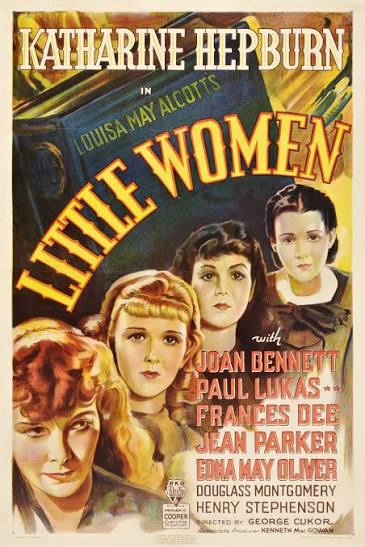
Cast: Katharine Hepburn (Jo March), Joan Bennett (Amy March), Frances Dee (Meg March), Jean Parker (Beth March), Spring Byrington (Marmee March), Douglass Montgomery (Laurie), Paul Lukas (Professor Bhaer), Edna May Oliver (Aunt March), Henry Stephenson (Mr Laurence), John Davis Lodge (Brooke), Samuel S Hinds (Mr March)
Cukor’s Little Women was actually the third cinematic version of Louisa May Alcott’s beloved novel. But it’s the one that caught the public imagination and, for generations, was cemented as the definitive version. For my generation (and others) I would say today that’s Gillian Armstrong’s superlative 1994 Winona Ryder starring version. But you can see the DNA of that here and, while it can seem both overlong and episodic, while also sacrificing some of the richness of the novel in favour of its more sentimental elements, Little Women remains a charmingly warm viewing experience.
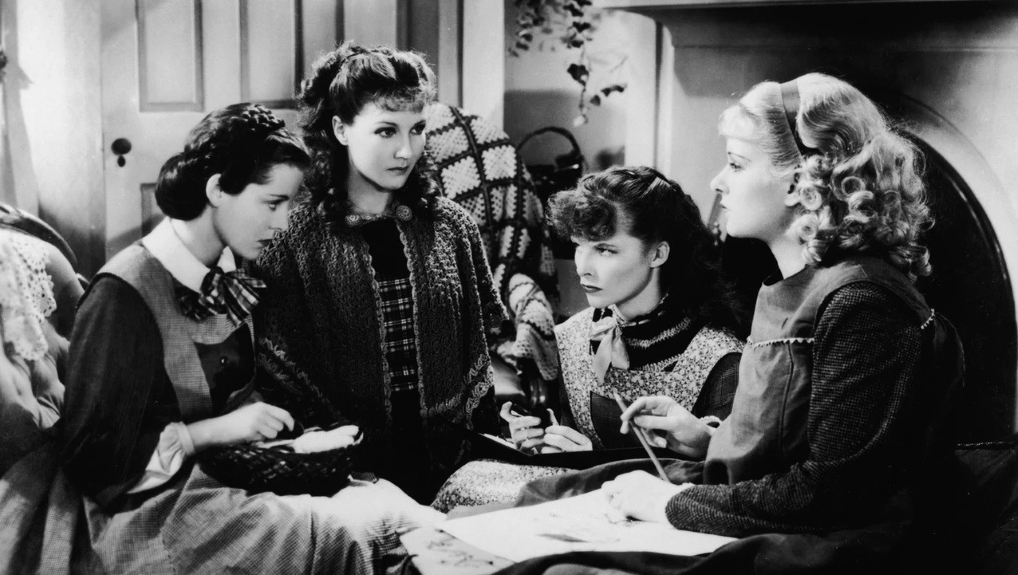
The plot is changed little. In the final days of the Civil War, the March family wait for the return of their father from the war. Under the care of Marmee (Spring Byrington), tomboyish would-be-writer Jo (Katharine Hepburn), dutiful Meg (Frances Dee), sensitive Beth (Jean Parker) and flirtatiously unruly Amy (Joan Bennett) spend their days enjoying the delights of home and the early stirrings of romance: for Jo with wealthy neighbour, the carefree Laurie (Douglass Montgomery), and for Meg his straight-backed tutor Brooke (John Davis Lodge). But, over the years, illness and the sisters stretching their wings to the Big City and beyond will change all their lives.
Amazingly, for a “woman’s director” George Cukor had never read Little Women – convinced the novel was just a treacly coming-of-age take that wouldn’t interest him (which ironically makes him sound rather like that guardian of good literature, Professor Bhaer). It was much to Hepburn’s amusement when, mid filming, Cukor finally started reading the thing and pronounced it far better than he expected. Even with his doubts, Cukor was certain it should be filmed as faithfully as possible – thankfully helping permanently shove a pin in wild ideas of updating it to the present day – with the support of original producer David O Selznick (who then effectively did the updating idea with his film Since You Went Away, made almost ten years later).
Little Women sticks closely to the events of the novel, even if it smooths out some of the novel’s edges. Most notably, any sense of feuding and unrest between the sisters is pretty much benched. It must be the only version of the novel ever made that excises the moment a young Amy, in a fit of pique, chucks Jo’s entire teenage literary output onto the fire. Instead, the film focuses very much on stressing the easy-going joy of the household. Any arguments shown between the sisters is short, instead the film zeroing in on their delighted staging of plays, sewing of blankets, gallivanting in the snow and general merriment. It even gives us a scene where Jo gets a heads-up Amy has married Laurie, just to avoid the risk of the viewer worrying how Jo might react when they meet.
Cukor’s film tightens the focus considerably. Not entirely surprisingly, the two least colourful sisters are given very little to do: Frances Dee makes very little impression as Meg and if Jean Parker didn’t have her narrative-essential death scenes (which strain under a very 1930s stiff-upper-lipness) she’d similarly easily disappear into the margins. But then that’s partly because the film is completely dominated by Katharine Hepburn, appearing in only her third film, but in a part so well-suited to her Alcott might as well have written it with her in mind (Hepburn stated she used her own artistically liberal family upbringing when she played the role).
Introduced sliding down the bannister of Aunt March’s home, Hepburn’s Jo is a superb mixture of tomboyish enthusiasm, bossy forthrightness, forceful independence, arch wit and warm humane love: so a fair bit of Hepburn in there. Hepburn dominates the film, a burst of energy in every scene, over-flowing with open emotion. From her impulsive decency in sharing food with the poor to slicing off her hair to raise money, to the tears that drop quietly from her eyes as she confesses she can’t love Laurie as she should, it’s a performance of real emotional force and intelligence.
Like few other actors, Hepburn can allow her face to run across a gamut of emotions, from stricken to accepting to disguised enthusiasm that collapses into tears when she’s alone (witness the scene when she discovers Aunt March is to take Amy to Europe rather than her). Or the touch of regret that then flourishes into warm acceptance when she learns Amy has married Laurie. She manages to smoothly distinguish between the exuberant crush Jo has with Laurie (born from duelling with pokers in the Laurence home) and the genuine, emotional connection she feels with Bhaer, a genuine intellectual equal, over the soundtrack of Bhear’s Tchaikovsky playing.
The other sister that gets focus is Joan Bennett’s Amy. Cukor had to film cunningly to hide Bennett’s pregnancy (witness the large, shapeless dresses Bennett wears – and the number of scenes where she is sitting down or clutching something in front of her chest). Bennett gives Amy a streak of naughtiness and selfishness. But to be honest, the character is weakened by the decision to dramatically tone down any sense of rivalry between her Jo. Similarly, Douglass Montgomery’s Laurie is shorn of much of his depth and interest, not helped by Montgomery’s flatter, matinee-idol performance.
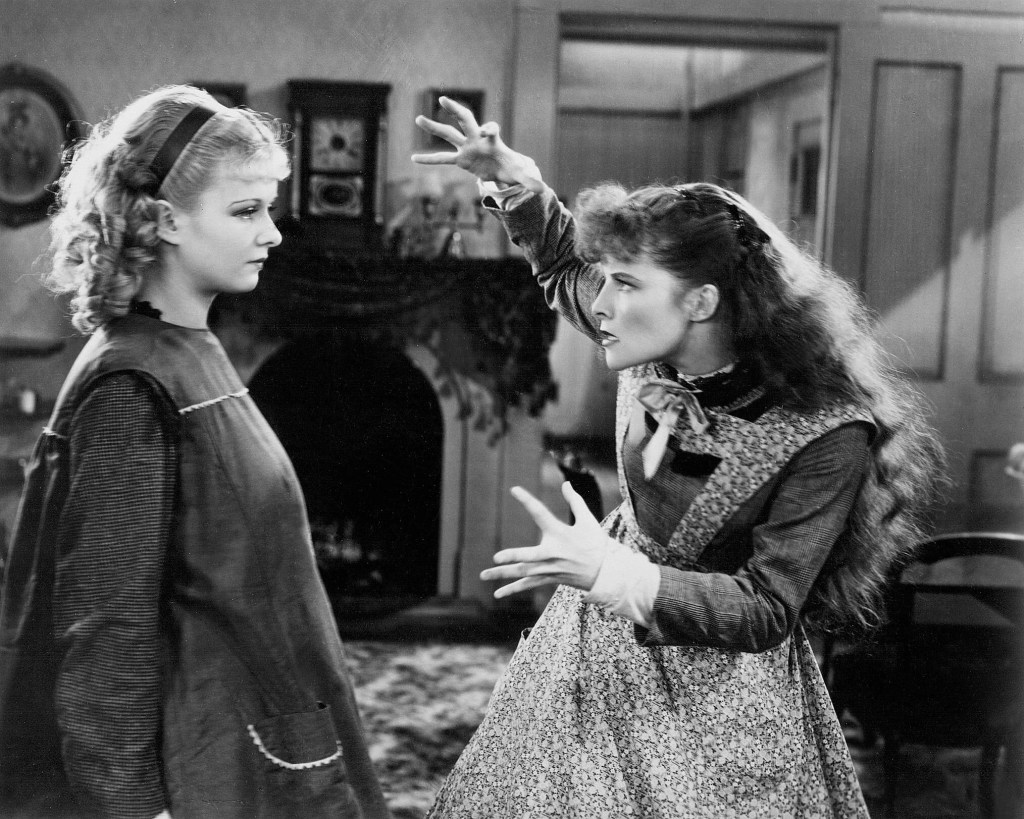
Cukor films much of this with an unfussy professionalism, that gives a focus to the acting. He and Hepburn clearly have fun with the scenes showing the recreation of Jo’s plays – Jo’s over-enthusiastic playing smacks of a parody of silent cinema. There are strikingly shot scenes, such as Jo weeping in a shadow coated attic, but visually much of Little Women is subservient to the story. And Cukor’s work with actors helped draw such excellent work from Hepburn. Hepburn didn’t win an Oscar for this – but her win that year for Morning Glory was surely partially linked to her brilliance here.
Little Women, with its lack of conflict and its reassuring cosiness, can feel incredibly sentimental. You could argue its decision to stress only the positive in the relationship between the sisters – rather than acknowledging the personality conflict between Amy and Jo that has spoken so clearly to so many people with siblings they love, but don’t necessarily have much in common with – does, ironically, reduce the film at times to exactly the sort of sentimental feel-good story Cukor believed the novel to be. Does that do Alcott a disservice? Yes it probably does – but it didn’t stop this film from stealing a place in many people’s hearts for decades.