
Smoothly professional and largely surprise-free courtroom thriller that gives you everything you expect
Director: Rob Reiner
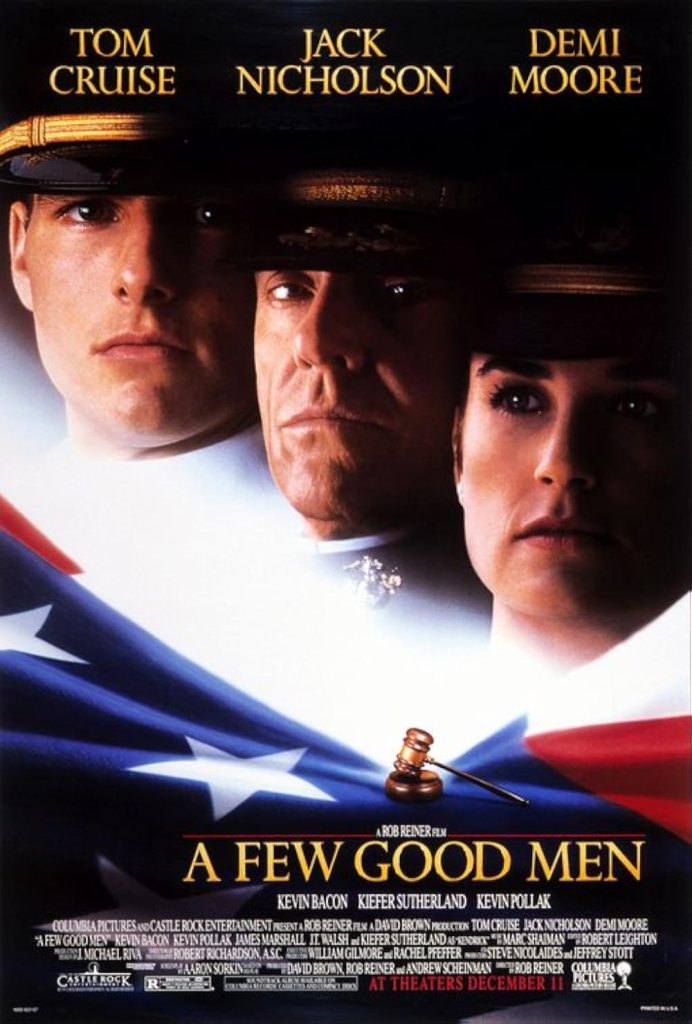
Cast: Tom Cruise (Lt Daniel Kaffee), Jack Nicholson (Colonel Nathan R Jessup), Demi Moore (Lt Com Joanne Galloway), Kevin Bacon (Captain Jack Ross), Kiefer Sutherland (Lt Kendrick), Kevin Pollak (Lt Sam Weinberg), Wolfgang Bodison (Lc Corp Harold Dawson), James Marshall (Pvt Louden Downey), JT Walsh (Lt Col Markinson), JA Preston (Judge Randolph), Noah Wyle (Corp Barnes), Cuba Gooding Jnr (Corp Hammaker)
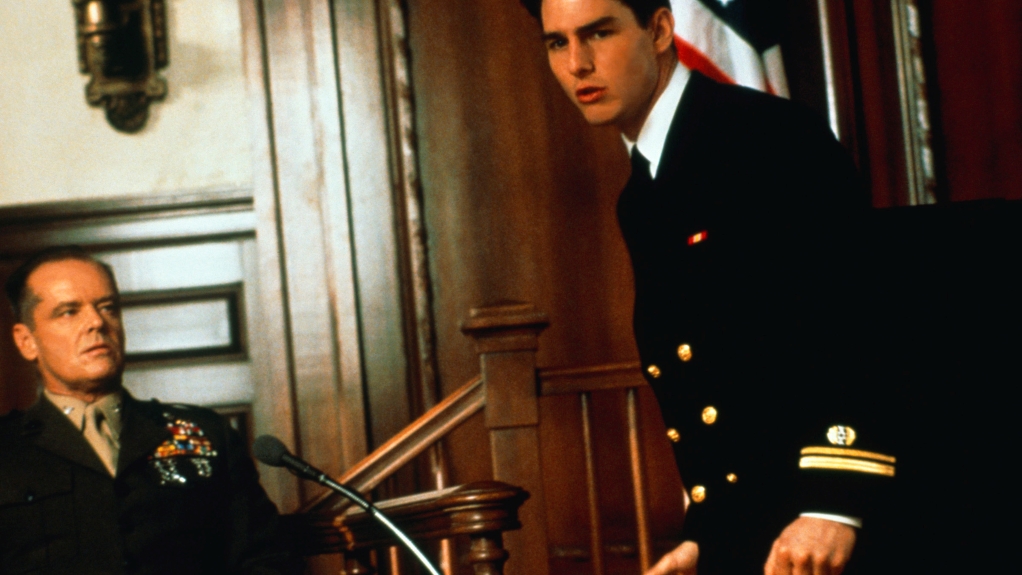
“You can’t handle the truth!” barks Colonel Jessup (Jack Nicholson) in A Few Good Men’s dramatic crescendo, an explosion the film has been signposting ever since Nicholson first cast his devilish grin at the camera. It’s not exactly a spoiler since Nicholson’s iconically quotable delivery of the line is the most famous moment in the film. And, A Few Good Men is such a well-oiled machine, that nothing in it is particularly a surprise anyway. This is a prestige, courtroom drama, a smoothly entertaining airport novel of a film packaged as a Oscar-contender. Hollywood firing on all cylinders.
Jessup is the commander of the Guantanamo Bay, holding the American line against the Cubans. On the base, a private dies after being tied up and beaten in the middle of the night. Lance Corporal Dawson (Wolfgang Bodison) and Private Downey (James Marshall) find themselves arrested for murder. But were they rogue killers or were they carrying out a ‘code red’ regimental punishment of an outsider? Their lawyers, arrogant hotshot Daniel Kaffee (Tom Cruise) and austere professional Joanne Galloway (Demi Moore) start to suspect it is. Can Kaffee get over his cocky assurance and comfort with plea bargains, and fight for justice in the courtroom? You bet he can.
To be honest you can pretty much see everywhere A Few Good Men is going practically from the start. There is, in fact, almost nothing surprising about the film what-so-ever. Every character development feels carefully modulated, every plot point calculated, every emotional beat finetuned. Adapted by Aaron Sorkin from his play, it’s full of punchy, witty dialogue (as you’d expect), but this feels like a well-oiled machine almost designed to get a green light and entertain the audiences. This feels like an early piece of writing from Sorkin, designed to get picked up.
Reiner’s direction is similarly smooth, professional, assured and designed to illicit all the expected responses from every scene. Not for one second is the viewer in any doubt at all about where the plot is going. Of course, the marines on trial are the fall guys for a twisted set of orders. Of course, the rot is going to go to the very top. Of course, Galloway and Kaffee will journey from butting heads to respecting each other (arguably, the only real surprise in the film is that they don’t end up in a romance). Of course, Kaffee will grow a conscience and become ‘personally involved’.
This sort of predictability is very reassuring and it’s no wonder the film was a popular, big hit. It presents a mystery that’s not really a mystery, character developments that are as familiar as a comfy pair of slippers and villains who practically play their scenes with a “I am a wrong ’un” post-it note stuck to their foreheads. A Few Good Men passes itself off as film with something serious to say – extrajudicial hazing in the military is a dangerous reality – but balances this with a very reassuring message – don’t worry the system works and will always weeds out the bad apples, so no need for major changes.
The professionalism extends to the cast, who have all very much been assembled to type and plugged in to ‘do their thing’. By this point in his career, Cruise was practically the poster boy for cocky hotshots who need to grow a sense of moral responsibility. He lets his charisma rip and channels his growing frustration and panic when he worries he is a more shallow man than he likes to think. Cruise can play this arc of a gum-chewing, sunglasses wearing grin turning into Clarence Darrow standing on his head (he never gets the credit he deserves for his comfort with actorly histrionics), and he provides the sort of hero who you are certain from Day One will prove himself to be more than worthy of the late father whose shadow he lives under.
Even more cast to type is Jack Nicholson. Paid a then stonking $5million for only a few days work, Nicholson channels all his reptilian charm and bombastic arrogance into a character who is, in effect, a ticking timebomb. From his very first appearance, swaggeringly holding court at his base, drawling patronising insults, any viewer who has ever seen a film is expecting a ‘Here’s Johnny!’ style explosion by the end. Nicholson, and the script, of course doesn’t disappoint, Nicholson relishing the closing courtroom confrontation so thoroughly he took home an Oscar nomination. But, like the film, this is Nicholson by-the-numbers giving the people what they want.
The rest of the cast also pull out all their charismatic stops to breathe life into what are really paper-thin characters. Demi Moore gives a decent performance as a professional who has to present as ‘icey’ in order to gain respect in a man’s world. (The casual sexism fired at her throughout – and the way the script largely avoids commenting on or criticising this – is shocking today). Kevin Pollak gives a lot of wit to the ‘best friend’ role, whose main function is frequently to explain military talk to Kaffee (or rather to the viewer). The finest performances are arguably from Kevin Bacon as a quietly assured, smoothly accomplished lawyer and JT Walsh as Jessup’s guilt-plagued number two.
These performers greedily wolf down the richly written scenes Sorkin provides for them, punchily put together to deliver their fireworks by Reiner’s direction. A Few Good Men is, without doubt, very entertaining. It’s got every single piece of interpersonal and judicial highlight that you could expect. It gives you heroes to watch grow, and villains you can boo. It gives you a happy ending, with justice triumphant and plenty of lessons learned. It’s a film that doesn’t go wrong at all – and never surprises you for an instant. Ironically, it makes sure it only offers truths you can handle.

