Tag: Jason Robards

All the President’s Men (1976)

All the President’s Men (1976)

The greatest film about journalism ever made? This dense, detailed conspiracy thriller is a marvel.

Director: Alan J Pakula

Cast: Robert Redford (Bob Woodward), Dustin Hoffman (Carl Bernstein), Jason Robards (Ben Bradlee), Jack Warden (Harry M Rosenfeld), Martin Balsam (Howard Simons), Hal Holbrook (“Deep Throat”), Jane Alexander (The Bookkeeper), Stephen Collins (Hugh W Sloan Jnr), Ned Beatty (Martin Dardis), Meredith Baxter (Deborah Murrah Sloan), Penny Fuller (Sally Aiken)

If anything, even remotely, dodgy happens in politics than, quick as a flash, you can bet the suffix “gate” is added to it. It all stems from Watergate, the Washington building that was the location of the most disastrous attempted burglary in political history. Agents from the Committee to Re-Elect the President (CREEP to you and me) broke into the Democratic office on a dirty tricks mission. They got caught, Nixon and his cronies decided to cover it up and obstruct justice – and when the story broke, it broke Nixon and his Presidency as well.

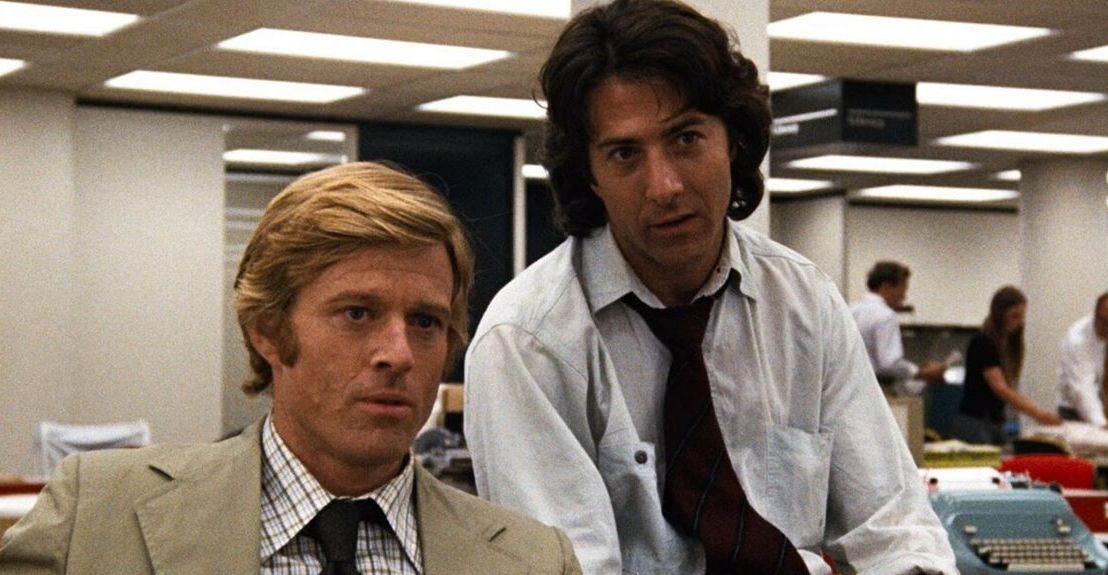
All the President’s Men covers the early days of how that story was broken by two junior reporters on the Washington Post: Bob Woodward (Robert Redford) and Carl Bernstein (Dustin Hoffman). Involved in the case from the night of the break-in, the film (adapted from the book by ‘Wood-stein’) covers their pain-staking investigation to work out what lies behind this burglary and, if there is a conspiracy of silence, how far up the chain of the Presidency it reaches. As well as winning the trust of sources, they must also persuade editor Ben Bradlee (Jason Robards) their reporting is rigorous and worth placing the full might of the paper behind them.

Produced by Redford, All the President’s Men is grounded in realism and the painstaking, methodical series of telephone calls, knocked doors, flicked reference books and sleepless sorting of facts and theories that lies behind investigative reporting. While never once slacking on the patience-defying, unglamourous, exhausting work, All the President’s Men may just have inspired more journalists to choose their career than any other film. This is journalism in all its freedom-of-speech, speaking-truth-to-power might and with Woodward and Bernstein already the most famous journalists alive, their glamour could only be doubled by being played by Redford and Hoffman.

The main obstacle All the President’s Men faced during its development was, how do you make the most famous political scandal in history suspenseful? After all (particularly in 1976) everyone watching the film knew more than the characters at every single step. The solution was fascinating. Not only does the film only focus on the second half of Woodward and Bernstein’s book – culminating in one of their biggest blunders – but the film would try and match the same confusion the journalists felt. All the President’s Men takes an already dense conspiracy – with a plethora of names and uncertain links – and works hard to make it more obtuse and obscure at every turn. Just like the journalists, mist surrounds us. Leads peter out. The focus shifts from scene-to-scene, from people to money. Nothing has been simplified or stream-lined. Instead, the film brilliantly captures the confusion the reports felt, making each revelation a beam of light.

It should, therefore, make the film disengaging and alienating. It’s quite the opposite. Alan J Pakula was already a master of 1970s American paranoia noir, and All the President’s Men is awash of the tension of questions answered and threats and dangers left hanging. There are shadowy implications throughout of dark forces at work, blocking our heroes. Potential witnesses seem terrified – in particular a CREEP book-keeper (a superb, Oscar-nominated, cameo of suppressed fear and nervy strength of purpose by Jane Alexander) who sits rigidly still, willing herself to share revelations.

Pakula’s film is tightly paced and frequently jumps over what could be otherwise clumsy narrative structures – the journalists frequently jump from A to C with the film avoiding functional scenes showing how they passed through B. With its quiet air of looming, indefinable menace – Gordon Willis’ photography makes for a superb mix of light and shade – All the President’s Men makes the unspooling of this conspiracy into pre-tension filled cinema.

It’s also a triumph of sound-mixing and editing. Sound levels drop in and out on key conversations – sometimes phrases are deliberately missed, at other times background sound drops out to sharply narrow our focus. The office of the Washington Post is a hive of background noise. Bernstein talks to a source and literally has to shout over a passing plane. The film sets its sound stall out with an opening eighteen seconds of grayish silent screen – until a crash like a gunshot reveals we have been starring at paper in a typewriter, the keys hammering letters in with earth-shattering impact.

It’s attention to journalistic detail is stunning. The offices of the Washington Post were recreated in detail, shot by Gordon Willis with a low-ceilinged brightness that contrasts completely with almost every other location in the film (in particular the car park, laid out with pillars that echo the office, where Woodward meets with shady informer “Deep Throat” it’s darkness where secrets are hid the polar opposite of a newsroom where secrets are revealed). In gripping single-takes, we watch Woodward conduct phone calls juggling sources (Redford even flubs a line at one point but works it seamlessly into the take) or Bernstein desperately track down sources for last-minute confirmations.
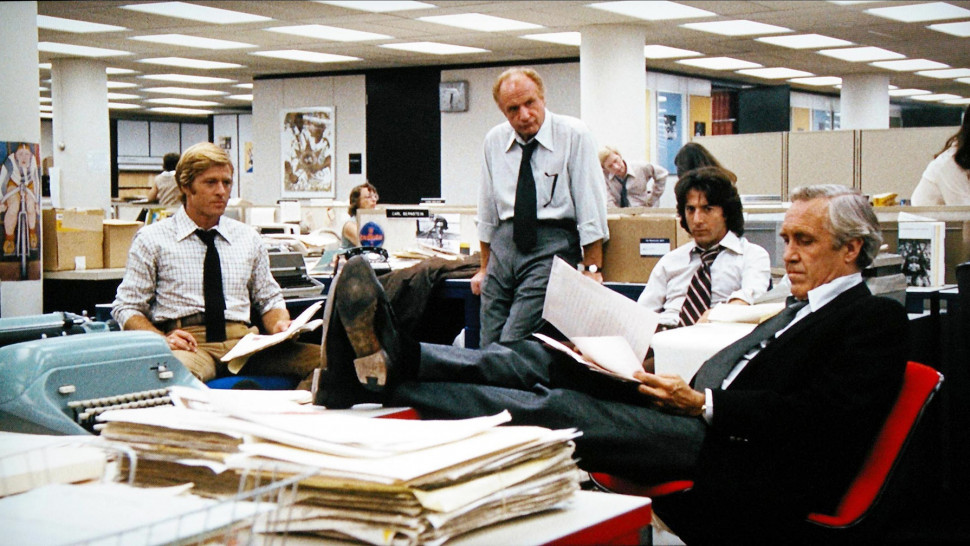
Willis uses a split dopter to brilliant effect. Effectively, this splits the lens in two – one half becomes a close-up, the other long-distance focus. It makes the screen a deeply unsettling mix of blur and crystal-clear clarity. So, while Woodward sits at his desk, we see blurred distance immediately around him – but on the other side of the screen far away other journalists clearly. Not only does this brilliantly create a sense of the endless bustle of the newsroom (also helped by the sound designs superb mix of typewriters and office noise) but also adds a visual metaphor of misty confusion that literally envelops our heroes.

All the President’s Men is a resolutely unflashy film for all of this. Its brilliance is all in its mastery of small details. It means more attention-grabbing shots – like the aerial shot of a circular library – carry even greater impact. The lack of flash also carries across to its stars, who have arguably never been better. Initially presented in two-shot exchanges (particularly in their first encounter over Bernstein rewriting Woodward’s text without his agreement), the two increasingly share the frame. Redford and Hoffman even learned each other’s lines so they could complete each other’s sentences – they almost become one character (‘Woodstein’).

The two actors were also wonderful contrasts, reflecting the two men they played. Redford, who worked hard to keep the project grounded, has a WASPY boy-scout decency and a relaxed unfussy star delivery, Hoffman the twitchy fiddling of the working-class reporter made good. Both actors have rarely been better. Equally good is the Oscar winning Robards who perfectly captures Bradlee’s avuncular professionalism while Holbrook is superbly enigmatic as the shadowy ‘Deep Throat’.

All the President’s Men demands attention like few other films – but it’s deliberately dense plot exactly matches the mystifying journey of the journalists themselves. It also turns journalism itself into a cause for typewriter knights (you could argue the downside of its legacy is journalism focused on ‘gotcha’ rather than informing). Pakula’s marvel is crammed with stunning sound and visual design and a lingering sense of paranoic fear. The film wants us to be as uncertain about what is happening as the characters – but in doing so it makes the greatest argument in favour of the power of journalism ever made by cinema.

Julia (1977)

Julia header
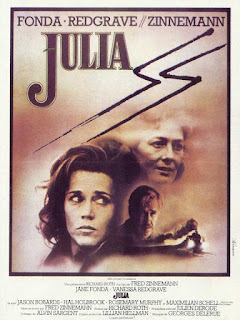
Jane Fonda and Vanessa Redgrave play friends separated by time in Fred Zinnemann’s award-bait Julia

Director: Fred Zinnemann

Cast: Jane Fonda (Lilian Hellman), Vanessa Redgrave (Julia), Jason Robards (Dashiell Hammett), Maximilian Schell (Mr Johann), Hal Holbrook (Alan), Rosemary Murphy (Dorothy Parker), Dora Dull (Woman passenger), Elizabeth Mortensen (Girl passenger), Meryl Streep (Anne Marie), John Glover (Sammy)

Playwright Lilian Hellman (Jane Fonda) remembers her close childhood friendship with Julia (Vanessa Redgrave), the daughter of wealthy Jewish parents being bought up by her grandparents. As young women, their lives take dramatically different routes: Lilian finds eventual success with The Children’s Hour, with the support of her mentor and lover Dashiell Hammett (Jason Robards); Julia travels to Vienna and then Germany where she becomes involved in anti-Nazi activity. Eventually, the need for money leads to Julia asking Lilian to smuggle funds over the German border.

That’s the meat of Fred Zinnemann’s old-fashioned, highly-genteel memory piece that also manages to make it sound far more exciting and interesting than the dry, worthy, middle-brow story that actually ends up on screen. What’s missing from the film almost completely is passion. This is a story that required fire: a sympathy for radicalism, or anger at the targeted cruelty and injustice of fascism. It gets none of this, instead offering a handsome reconstruction of period details, all filmed with a Golden Age glow, and a narrative focus that feels like it’s aimed at the wrong character.

It’s part of why this awards-bait drama hasn’t lasted in the public perception (it’s very hard to find a copy to watch – really striking for a film nominated for 11 Oscars and winning three, including two acting Oscars). There is very little really rewarding either emotionally or narratively here. The film lacks a real sense of danger or foreboding – even a scene showing fascist thugs throwing Jewish students off a balcony in Vienna is shot with a striking lack of edge or horror. And it unbalances itself by giving more time and priority to Hellman’s struggles to come up with a play “worthy of her” than it does to the title character and the real drama of her struggles. Redgrave is on screen for about 14 minutes. It’s effectively like watching The Pianist but entirely from the perspective of Emilia Fox’s character rather than Adrien Brody’s.

What we end up with is a film that feels old-fashioned, dry and respectable. It offers everything that will impress you, and reassure you that it is important film-making: a big subject, famous names, actors giving emotional performances, period detail, a tragic ending. But it lines these factors up in a way that never ever comes to life dramatically. There is a story buried in here about friendship – and Fonda and Redgrave are very good at selling a strong personal bond, especially considering their limited time on screen together – but what should be the heart of the story gets lost in a biography of Hellman, a digression into her relationship with Dashiell Hammett, and the lack of insight the film seems to have into the fate of Jews and outsiders in an increasingly fascist Europe.

The film’s only real sequence of interest is Hellman’s dash with money across the border and illicit meeting with Julia, a sequence involving coded messages, switching of hats and double-meaning conversation which fits with a spy novel. Zinnemann films this with a fine air of tension and intrigue – but it’s the only time the film stumbles to life.

I think Zinnemann struggled to find what really compelled him to tell this story. Which is a shame as a Julia-focused story – a woman struggling against a system – would have been meat and drink to the director of High Noon, From Here to Eternity and A Man For All Seasons. Instead, his skill from those films of empathising with characters trapped in a desperate situation and forced to take a stand on principle, is lost. In the end he and the film find little to interest them in Hellman, the successful novelist who feels a middle-class intellectual’s guilt at not doing more to help, who is fundamentally a footnote in a far larger story of rising Nazi terror in Europe.

The film has also perhaps faded from public attention because subsequent controversy revealed that a large part of this true story was almost certainly self-aggrandising bull-shit by Hellman. A New York psychiatrist, Muriel Gardiner, claimed in 1983 that Julia’s story was her story and that she had never met Hellman (but they did share a lawyer). No trace of a “Julia” has been found in Hellman’s life, and no evidence at all that she ever undertook this dangerous dash into Germany. Zinnemann also fell out with Hellman, privately coming to believe she was “an extremely talented, brilliant woman, but she was a phony character” and said his “relations with her were very guarded and ended in pure hatred”. Knowing that, it’s hard not to see the same distance on the screen.

Saying that, Jane Fonda is very good in the film, surprisingly fragile, uncertain and scared, and plagued with guilt that she cannot do enough to help her friend. Redgrave won an Oscar for her committed and passionate performance, which tapped into her radicalism and gives a slight character a great deal of depth (in her speech, the pro-Palestinian Redgrave made a famously controversial political speech denouncing “Zionist hoodlums”). Robards won the film’s other acting Oscar, for a professional turn as Hammett. In a very weak year for American film, Schell also landed an Oscar nomination for a brief cameo as a go-between Hellman meets in a Parisian park.

The performances are fine and the style and manner of the film is reassuringly middle-of-the-road. There is everything here to convince you this is an important film, apart from drama, purpose or conviction. Perhaps it’s so hard to find, because so few people have looked for it since 1977?

Enemy of the State (1998)

Will Smith and Gene Hackman dodge the surveillance state in Enemy of the State

Director: Tony Scott

Cast: Will Smith (Robert Clayton Dean), Gene Hackman (Brill), Jon Voight (NSA Director Thomas Reynolds), Regina King (Carla Dean), Jason Lee (Daniel Leon Zavitz), Lisa Bonet (Rachel Banks), Barry Pepper (Agent Pratt), Loren Dean (Agent Loren Hicks), Jake Busey (Agent Krug), Lisa Bonet (Rachel Banks), Jack Black (Agent Fiedler), Jamie Kennedy (Agent Williams), Seth Green (Agent Selby), Ian Hart (Agent Bingham), Stuart Wilson (Congressman Sam Albert), Jason Robards (Congressman Philip Hammersley), Tom Sizemore (Paulie Pintero)

A congressman (a cameoing Jason Robards) is murdered for refusing to support intrusive new counter-terrorism legislation championed by NSA director Thomas Reynolds (Jon Voight). Unfortunately, someone caught the killing on camera. When the NSA come hunting, he plants the recording on an unwitting lawyer friend, Robert Clayton Dean (Will Smith). Dean has no idea he has evidence that could blow the conspiracy – and is nonplussed when they set about destroying his life. The only person who can help is mysterious surveillance expert Brill (Gene Hackman), who has spent decades living off the grid. Can the clear Dean’s name and stop the bad apples in the NSA?

Enemy of the State is a fun chase movie, that enjoys the technical possibilities of the surveillance state, packaged with the fast-pace, bright colour-filtered style of Tony Scott (this is one of his best films). There is more than enough wit and enjoyment about it – not to mention watching a host of very good actors, many of them unknowns at the time, bring a lot of sparkle to the film (you’ve got to give kudos to the casting director). Everything of course gets tied up in a neat, pretty bow but it’s a damn lovely bow so that’s fine.

In its detailed look at the power of the surveillance state, Enemy of the State was, in a way, ahead of its time. The ability for the intelligence agencies here to look into literally everything in your life is pretty unsettling, from bank details to computer accounts. Every camera is an eye and satellites are tasked at will to watch anything. In fact, it’s quite something to remember that the state is only more powerful today – the internet and mobile phones would making tracking Dean even easier than the bugs they secrete about his person, which causes him to flee our baddies stripped to his undies. (Also, if only Reynolds had waited a few years, congress would wave through legislation such as he is requesting here, without batting an eyelid).

The film also dares to shade a little bit of naughtiness into Will Smith’s character. Sure, he’s a crusading labour lawyer (we’ve got to know he’s on the right side!) but he’s also an adulterer with trust problems in his marriage. Smith’s still at his charming best here, and his frazzled desperation as he struggles to understand why on earth the NSA is destroying his life is well-handled. Regina King gets a thankless role as Dean’s shrill wife, whose trust in her husband oscillates according to the requirements of the script, rather than any internal character logic.

Enemy of the State sometimes teeters on the edge of making a point about the dangers of the surveillance state. How easy could it be to abuse this power? Unfortunately it puts most of these arguments into the mouth of Regina King’s holier-than-thou wife, which rather undermines them. It’s also made abundantly clear that we’re witnessing rogue agents. This allows the film to focus more on the cool things surveillance can do, rather than clearer moral statements about whether that’s right or not, other than it being a dangerous tool in the hands of the wrong men.

Scott’s film is more of an entertainment than a treatise though (and thank God for that). It also has a nice little touch of 1970s’ conspiracy thriller to it, something the film leans into with the casting of Gene Hackman in a role reminiscent of Harry Caul in The Conversation. Sure, I can’t remember Caul driving a car while it was on fire or blowing up a building, but Hackman still gives the film some class and a touch of old-school espionage and cynicism. Truth-be-told, other than profession, Caul and Brill have very little in common (Brill is far more confrontational and confident, and much less likely to rip his apartment apart) but it’s still a nice call-back. I also rather enjoy Gabriel Byrne’s smart, playful little cameo as ‘fake’ Brill (hardly a spoiler as you can’t move without knowing Hackman is in the picture).

Scott’s high-energy fun culminates in a smart little trap laid by Dean for all his enemies, that plays nicely off the fact that the NSA agents and the Mafia are definitely paranoid and stubborn enough to not realise they are all talking at cross-purposes. The end of the film sees everything back to normal (it’s unclear how, or if, Dean got his job back considering his unceremonious firing), but I wouldn’t worry about it. It would be nice if it had said more, but as a rollercoaster ride it’s short, sharp and sweet.

Once Upon a Time in the West (1968)

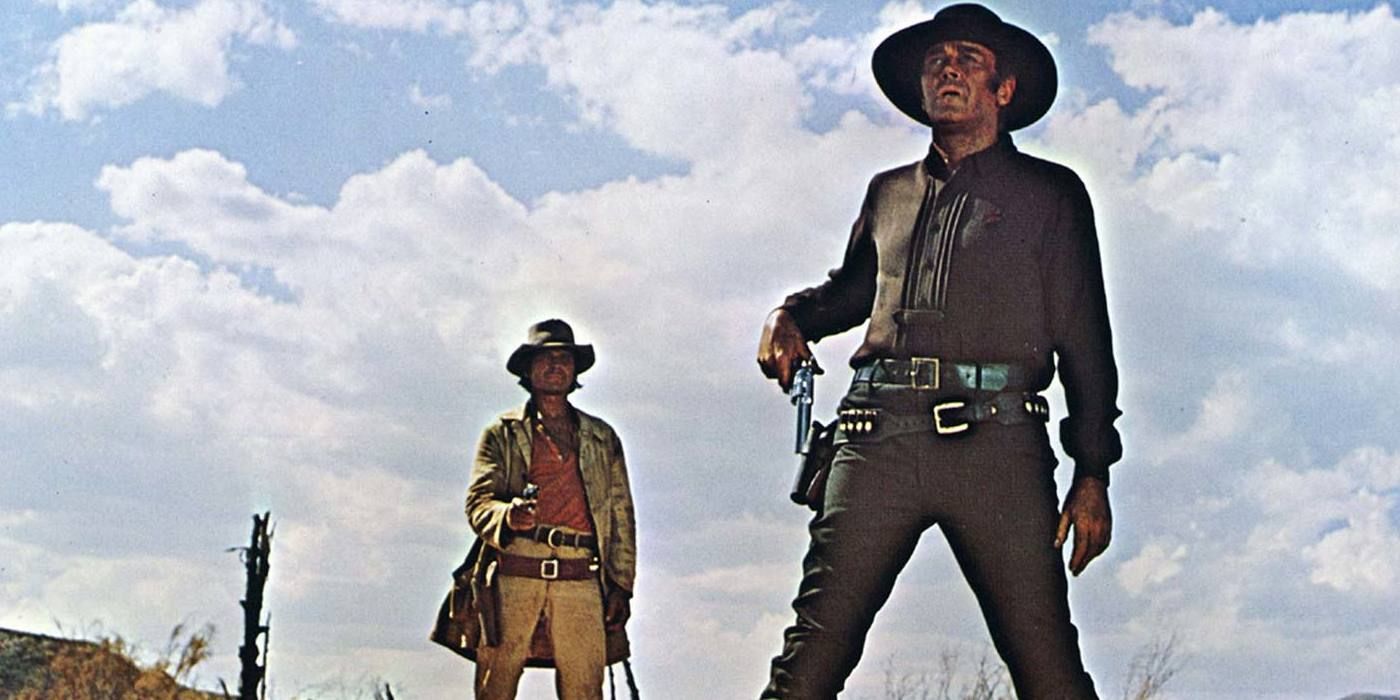
Fonda and Bronson prepare to face off in Leone’s epic Once Upon a Time in the West

Director: Sergio Leone

Cast: Henry Fonda (Frank), Claudia Cardinale (Jill McBain), Charles Bronson (“Harmonica”), Jason Robards (“Cheyenne”), Gabrielle Ferzetti (Morton), Paolo Stoppa (Sam), Marco Zuanelli (Wobbles), Keenan Wynn (Sheriff), Frank Wolff (Brett McBain), Lionel Stander (Barman), Woody Strode (First Gunman), Jack Elam (Second Gunman), Al Mulock (Third Gunman

Sergio Leone’s Westerns were always based, first and foremost, on his own love for the genre – and the great filmmakers, from John Ford onwards, who made them. Returning to the genre for the final time – putting on hold (for what turned out to be nearly fifteen years) his plans for a New York gangster film – Leone wanted to make his final, and ultimate, tribute to the Hollywood western. Collaborating with Bernardo Bertoloucci and Dario Argento (now there is an odd trio!) on the scripting, Leone’s final Western is a sweeping, grandiose, operatic Western littered with visual quotations from films he loved.

The story rather takes second fiddle to the general ambiance and visuals, but it never bothered Leone to have only the sketchiest of plots stretched across the many hours of his movies. The railroad is being built across America – changing the face of the West as it goes. Frank (Henry Fonda), hired gun of crippled railway tycoon Morton (Gabrielle Ferzetti), guns down farmer Brett McBain and his children. He had been sent to threaten them to clear off the land of Sweetwater. But why? And how will the return of McBain’s new wife Jill (Claudia Cardinale) – now heir to all of Frank’s holdings – affect their plans? And why does the mysterious “Harmonica” (Charles Bronson) – a shadowy gunman with no name have such an interest in events, and in Frank in particular? And will criminal gunman Cheyenne (Jason Robards) and his gang – blamed for the McCain killings – be able to establish their innocence?

The answers to all these questions come slowly – and often confusingly – in this long, slow but – as with many Leone films – engrossing Western, which features 3-5 minutes of Morricone build-up and extreme close-up before even the slightest action. This makes it very easy to mock, and perhaps by this point Leone had started to believe too heavily that he was an artist daubing in genre, rather than a purveyor of entertainments. Certainly, Once Upon a Time in the West is consciously weighted down with its own importance, it’s ominous sense of events heading to a pre-ordained conclusion and its half-hearted attempt to depict itself as sitting at a crossroads in American history, as technology squeezed out the old West.

But somehow you give Leone’s film a pass for all its many faults because it’s assembled with such unrivalled skill and breathtaking pizzazz. Sure the film is only half as smart as it thinks it is, but when at its strongest it offers unrivalled entertainment. Leone also mastered here his balance between the slow, tense, agonising build-up to violence – followed by its sudden and brutal enactment. 

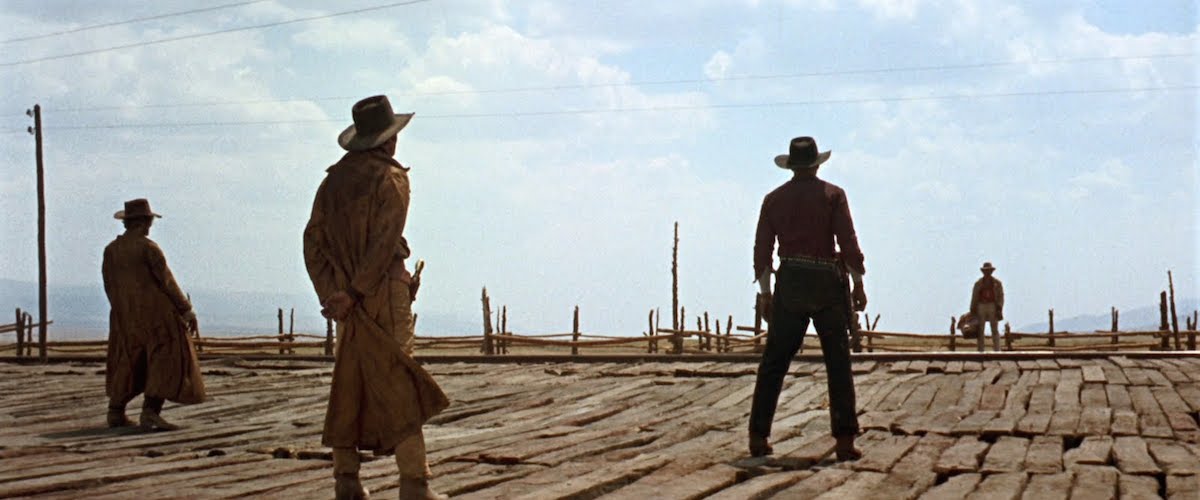
Never is that more clear than in the film’s opening ten minutes which features three gunmen (among them Ford favourite Woody Strode and reliable minor bad-guy Jack Elam) waiting at a train station for what turns-out to be the arrival of Charles Bronson’s “Harmonica”. The three gunmen sit, waiting, in silence. Around them the everyday sounds of windmills, buzzing flies and dripping water builds and relapses with all the dread of distant thunder. Leone’s camera crashes in for long, intense close-ups, as if drilling down into the souls of these bored men, the camera studying every detail of their faces. After almost ten minutes – during which the credits roll – “Harmonica” arrives. And promptly shoots all three men dead in seconds. You know it’s coming, but the tension and expectation of this confrontation makes the entire sequence compelling. 

It’s a trick that Leone repeats time and time again. Effectively the whole film is only prolonged extension of this sequence – the inconsequential back-and-forth of the lacklustre plot all really about giving us a chance to drill down into the character of Henry Fonda’s bad-to-the-bone Frank, while we wait for the inevitable gunfight between him and “Harmonica”. Leone’s film is a triumph of mood, filled with sweeping beautiful camera shot and luxiously paced editing, all mixed down with some stunning scoring from Ennio Morricone.

Once Upon a Time echoes a fairy tale in its title, and that’s what it is. For all that Leone attempts to throw in plotlines around progress, the influence of big money and the new order leaving gunmen behind, really everything it knows about America is taken from movies. Leone litters the film with visual quotes from High Noon, Shane and dozens of others, most especially Ford (he even insisted in transplanting some of the scenes to be shot at Monument Valley, which led to merry hell trying to get the other Spanish-shot locations to visually match). The entire film unfolds like a dream. At about the half way mark in particular – this might be due to cuts to be fair – the narrative suddenly becomes almost deliberately unconnected, key events seemingly skipped over and sudden character reversals taking place. There is a rumbling sense of everything in the film being artificial and the characters themselves being manipulated by something larger than them (like a film director!).

This is further heightened by “Harmonica” himself. Played with an empty blankness by Charles Bronson – the camera zooms into his expressionlessly craggy face endlessly as if searching for meaning – “Harmonica” is an almost mystical presence. He’s always in the right place at the right time, seems to be the only person in the film who knows what’s going on and Leone even shoots him regularly sliding into frame, as if the camera has stumbled upon him at the least expected times. Perhaps Bronson’s lack of real character helped make him perfect for this near-mystical presence. It also fits in with the shamanic feeling of a film where frequently not much happens at great length, but the inconsequential moments of events are filmed with a pregnant importance.

Compared to him the other principles are painted in earthy tones. Robards makes his bandit – who switches allegiances and escapes from undefined imprisonment several times in the movie – a jovial, grimy figure with a rogueish temperament. Claudia Cardinale – in what passes for a strong female character at the time – is a whore with a heart of gold who may, or may not be willing to do anything to ensure her own survival (the film is unclear). Is she a ruthless woman using sex as a weapon? Or is she the sort of radiant Earth-mother that the new West needs? Or is she a bit of both? The film isn’t really sure.

What it is sure about is that Fonda’s Frank is the meanest of the mean. Looking lean and tough, Fonda revels in the chance to play a villain – and not just any villain, this grinning sadist is so mean the first thing he does is gun down a child on screen. Leone loved Fonda – and above all he wanted those “baby blue” eyes to be the thing the viewers see as unspeakable deeds take place, expecting the cry of “Jesus Christ, that’s Henry Fonda!” Frank is a bully and tirelessly ambitious, and if we never get a real sense of what motivates him, it’s balanced by Fonda’s charismatic viciousness in the role.

It’s a pointer though to the fact that this is not a film about the West – as always the strange mixture of accents, faces and locations never makes the film feel for one moment like a real slice of America – but rather a film that is aiming to reflect the romance of movies. It’s a piece of Americana, that is really a love letter to other films. Perhaps it’s one of the first post-modern films ever made? But really your appreciation of the film can only really be complete if you have seen a lot of Westerns. Then it’s fairy tale like logic, and Leone’s operatic style and languid pace suddenly make sense. It’s not a film deep in meaning, other than perhaps our own love for cinema and the story it tells.

Magnolia (1999)

Family dramas come together in Paul Thomas Anderson’s beloved Magnolia

Director: Paul Thomas Anderson

Cast: Jeremy Blackman (Stanley Spector), Tom Cruise (Frank TJ Mackey), Melinda Dillon (Rose Gator), April Grace (Gwenovier), Luiz Guzman (Luiz), Philip Baker Hall (Jimmy Gator), Philip Seymour Hoffman (Phil Parma), Ricky Jay (Burt Ramsey), William H Macy (“Quiz Kid” Donnie Smith), Alfred Molina (Solomon Solomon), Julianne Moore (Linda Partridge), Michael Murphy (Alan Kligman), John C. Reilly (Officer Jim Kurring), Jason Robards (Earl Patridge), Melora Walters (Claudia Wilson Gator), Felicity Huffman (Cynthia), Eileen Ryan (Mary), Michael Bowen (Rick Spector)

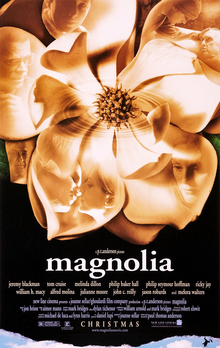
After the success of Boogie Nights, Paul Thomas Anderson landed a terrific deal: he could make what he wanted, about anything at all, at any length he liked. “I was in a position I will never ever be in again” is how Anderson remembers it. And thus was born Magnolia, a beautifully assembled labour of love, an imaginative remix of Robert Altman’s Short Cuts with biblical imagery. A sprawling collection of short stories, which leans into high tragedy and melodrama, Anderson’s Magnolia is the sort of film that is always going to find a special place on a film buff’s list of favourite films.

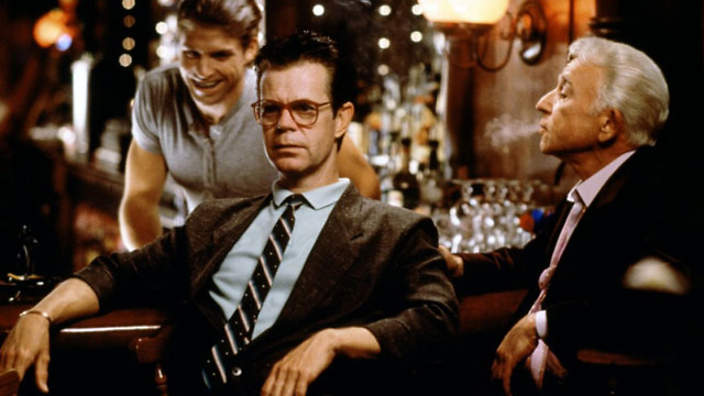
The film follows the lives of several people over a single day in LA. Legendary host of long running quiz show What Do Kids Know? Jimmy Gator (Philip Baker Hall) is dying of cancer and desperate to reconcile with his traumatised daughter Claudia (Melora Walters). Claudia is tentatively starting a relationship with devout and kindly police officer Jim Kurring (John C Reilly). Former champion of Gator’s show, “Quiz Kid” Donnie Smith’s (William H Macy) life is a disaster after his parents stole his winnings, and he’s struggling to hold down even the most basic of jobs. Former producer of the show Earl Partridge (Jason Robards) is also dying  of cancer, cared for by his dedicated nurse Phil (Philip Seymour Hoffman). Earl’s wife Linda (Julianne Moore) is wracked with guilt, while Earl himself is desperate to reconcile with his estranged son Frank Mackey (Tom Cruise), now a self-help guru who coaches men on how to pick up women. 

If you can’t see the links between the works of Robert Altman here, then you clearly need to look again. But it’s well worth it, as Anderson is a worthy successor to the master. He directs with a fluid confidence that comes from a director making a picture to please himself. Magnolia is frequently self-indulgent in its style and quirks, but it doesn’t matter when the effect of watching the film is so rewarding. From long takes to having the characters (all of them in different locations) sing along with Aimee Mann’s “Wise Up” at a key moment in the film, there are flourishes here that will annoy some but will be precisely what others fall in love with the film for.

And that love is deserved as this is a thoughtful and intelligent film about the impact the past (and specifically our parents) can have on us. As the man said, “they fuck you up, your Mum and Dad”. Certainly the case here. From “Quiz Kid” Donnie Smith to Claudia Gator, the film is crammed at every level with children (young and old) who have had their lives negatively affected by their upbringings. The past is a heavy burden, and it’s near impossible to shake-off – and in the cases of Donnie and Claudia brings with it a heavy dose of self-loathing. 

But what’s striking is that problems with the past don’t result in the same outcomes for people. Who would have thought that seemingly misogynistic motivational speaker Mackey’s beef with his dad is that Earl walked out on him and his dying mother when Mackey was a teenager? Part of the fascinating psychology of the film is how a son who loved and cared for his mother grew up to encourage men to treat women just as his father treated his mother. Is this some sort of perverse way to feel closer to the father who abandoned him? Perhaps Mackey has defined his life around hatred for his father, along with a deep longing for love – and perhaps his inability to deal with these feelings led to a professional career espousing the exact opposite? One of the neat things about Anderson’s film is that it largely avoids pat answers to this sort of thing. It’s left up to us to decide for ourselves – and perhaps reflect on how every person is an unanswerable riddle.

Whatever the answers are, it’s clear that parental problems are being paid-forward. The new Quiz Kid champion Stanley Spencer is a precocious child genius, being treated as an ATM by his father, who brags about his son while passive-aggressively demanding Stanley keep winning to continue funding his failing acting career. Stanley is a desperately unhappy child, more than smart enough to realise he is a performing monkey but unable to escape. And how can you get out of knots like that? After all, the film shows us one possible future for Stanley with Donnie – but walks a deft tightrope on whether the same life of loneliness and disappointment is inevitable for Stanley or not.

These familial clashes are introduced in the first hour and then simmer with exquisite timing during the film’s second hour. Anderson’s brilliant decision to build the film around a live recording of Gator’s quiz show means we are constantly reminded (as the show plays in the background throughout other scenes) that everything we are seeing is happening at the same time. The second hour of the film is a superbly deft cross-cutting from storyline to storyline, each building in tension. The desperation and entrapment in each scene beautifully spark off and contrast with each other. The sequence is at times marginally undermined by a slightly oppressive music score, but it’s beautifully assembled and shot and carries a real power – a superb balancing act of almost real time action that plays out for a nearly the whole of the second act. 

And Anderson knows skilfully to balance the gloom with real sparks of humanity and decency. Two characters in the film – Reilly’s cop and Hoffman’s nurse – are decent, kind and generous souls who have an overwhelmingly positive impact on every character they encounter. Both characters – and both actors are superb in these roles – are quiet, low-key but humane people who offer a quiet absolution to a host of characters, and opportunities to move on from the burdens of the past. Hoffman’s Phil is a genuinely kind person, who puts others before himself while Reilly’s Jim (surely the best performance of the actor’s career) is such a sweet, well-meaning, honest guy, that you understand why so many people feel bound to unburden themselves to him.

There is a lot to unburden in this film, and some of these moments tip over into melodrama at points. There are tear stained deathbed confessions, and angry, tearful moments of resentment and guilt bursting to the surface. At times, Magnolia is a little in love with these big moments, and indulges them too much, but it offers so many moments of quiet pain that you forgive it.

Not that the film is perfect. Today, even Anderson says it’s too long – and it really is. Unlike Altman, Anderson is less deft at pulling together all the threads in an overlapping story. This is effectively a series of short films intercut into one – the plot lines don’t overlap nearly as much as you might expect, with only Jim moving clearly from one plotline to another. It’s also a film that is driven largely by men. Of the few female characters, all are defined by their relationship to a man (and an older dying man at that), and not one of the female characters isn’t some form of victim. 

Anderson’s failure to really wrap the stories together means you can imagine unpicking the threads and reducing the runtime. Julianne Moore’s role as Earl’s guilty, unfaithful trophy wife (is she unaware of Earl’s own past of infidelity?) could have been easily shed from the film. Moore, much as I like her, gives a rather hysterical, mannered performance that feels out of touch with some of the more naturalistic work happening elsewhere in the film. The most melodramatic of the plots (every scene features Moore shouting, weeping, shrieking or all three), it also ends with the most contrived pat “hopeful ending”. It’s a weaker story that lags whenever it appears on screen.

Magnolia starts with a discussion of coincidence, but it’s not really about that – and the coincidence of all these people seems largely in the film to be reduced to the fact that they are all living in the same city with similar problems. It’s a slightly odd note to hit, as if Anderson slightly shifted the focus away from lives moving into and out of each other, in favour of a series of more self-contained linear stories. (That opening montage discussion of three (fictional) moments of fate and chance, while beautifully done, could also easily be trimmed from the film).

But then, these tweaks wouldn’t change the fact that Magnolia is a superbly made film, or that Anderson is a great filmmaker, even if he doesn’t quite manage to create the sprawling, interweaving, state of the nation piece he’s aiming for here. But as a collection of beautifully done short stories, it’s great. And the acting is superb. Tom Cruise drew most of the plaudits for an electric performance of egotism and triumphalism hiding pain and vulnerability near the surface, Anderson using Cruise’s physicality and intelligence as a performer better than perhaps any other director. Among the rest of the cast, Hall is superb as the guilt ridden Gator, Macy very moving as the desperate Donnie and Melora Walters heartrending as the film’s emotional centre, who ends the film breaking the fourth wall with a tender smile, that is perhaps one of the most beautiful final shots of modern cinema.

All this and it rains frogs at the end as well. But that introduction of biblical bizarreness is both strangely profound and fitting for Anderson’s stirring and inspiring film.

Parenthood (1989)

Steve Martin struggles with the demands of fatherhood, in the rather sweet Parenthood

Director: Ron Howard

Cast: Steve Martin (Gil Buckman), Tom Hulce (Larry Buckman), Harley Kozak (Susan Huffner), Jason Robards (Frank Buckman), Rick Moranis (Nathan Huffner), Martha Plimpton (Julie Buckman), Keanu Reeves (Tod Higgins), Eileen Ryan (Marilyn Buckman), Helen Shaw (Grandma), Mary Steenburgen (Karen Buckman), Dianne Wiest (Helen Buckman), Joaquin Phoenix (Garry Buckman-Lampkin)

If there is one thing everyone knows, it’s that families can be complex. That’s why good films about family life resonate so well – everyone (and I mean everyone) can find something in it that echoes with their own experiences. Parenthood is very good at this sort of thing, an entertaining but also tender and rather sweet comedy-drama about an expansive family and their many triumphs and problems.

Frank Buckman (Jason Robards) is the patriarch, a distant father with four children all now raising families of their own. Gil (Steve Martin), married to Karen (Mary Steenburgen), desperately wants to be the perfect dad he feels his own never was, but is struggling with the increasingly apparent emotional problems in his oldest son, 12-year-old Kevin. Helen (Dianne Wiest) is divorced, her ex-husband wants nothing to do with their children. Her son Garry (Joaquin Phoenix) is a socially withdrawn teenager, while her elder daughter Julie (Martha Plimpton) isn’t interested in education only in her relationship with gentle but useless Tod (Keanu Reeves). Susan (Harley Kozak) is married to Nathan (Rick Moranis) who is obsessed with turning their young daughter into a child prodigy. Frank’s favourite son is the feckless Larry (Tom Hulce), a wastrel sponger who turns up after years with an unexpected young son, Cool, in tow, in whom he shows little interest.

You can see just in that quick summary you’ve got a huge array of issues for the film to tackle, all of which it manages to do with sweetness, humour and also a certain amount of emotional truth. The film manages the ups and downs, the flat-out comedy and the heartbreak with real confidence, meaning you are moved smoothly from broad laughs to genuine “ahs” of sweetness. 

With the exception of the shallow and selfish Larry (every family has that black sheep), each of the characters has moments to demonstrate their depth and truth, showing sides of themselves you wouldn’t expect. In a large-cast film that delivers in a tight, well-structured two hours, that’s quite an accomplishment to be honest.

Ron Howard directs all this with fabulous control, a reminder that he’s actually quite a skilled director of comedy, with a good sense of timing and pacing. He’s also a superb director of actors, and there isn’t a weak link in the whole cast, from the youngest child actor to the most experienced Broadway veteran. 

Steve Martin is fabulous as the centre of the family saga, the dad desperate to be the best dad he can be, but who overly worries and obsesses about every detail to try and be as perfect as possible. Martin is ace at this sort of stuff, this gentle comedy grounded in reality, and totally understands how to make a character feel real and grounded. Combine that with his natural comic chops and willingness to embrace the absurd at moments – showcased here in a sequence where he desperately has to cover for a missing entertainer at his son’s birthday party – and he supplies many of the film’s stand out moments. 

Dianne Wiest (Oscar nominated) also manages a difficult balancing act in perhaps the film’s most interesting set of plotlines. Helen’s family covers the full range of teenage trauma, from a loving son who seems to turn overnight into a monosyllabic stranger to a daughter who rejects all her mother’s hopes for the future in order to spend time with a boy she doesn’t approve of. Wiest is not only extremely funny in some of her responses to these problems, but also heartrendingly real in her pain, confusion and frustration at not being able to help her children (or herself) as much as she wants, as well as the clear feeling that her life is somehow a failure compared to her two elder siblings. 

What’s also beautiful about the film is that none of these events or storylines work themselves out quite as you might expect. Young Garry (played excellently by an impossibly young Joaquin Phoenix, here billed as Leaf) has clear reasons for his feelings and is dealing with complete lack of interest his father shows in his life. Julie (Martha Plimpton, very good) isn’t the layabout teen you might expect, and has genuine feelings for Tod – who, under Keanu Reeves’ sweet, slacker style, is a man of far greater emotional depth than might be expected.

The other plotlines of the film are secondary to these, but are still wonderfully played and put together. The Moranis/Kozak plotline of “I’m an ignored wife who wants another baby” v “I’m trying to turn our daughter into a genius” is a bit more played for laughs, but the two actors know their stuff and deliver. Tom Hulce channels Mozart as the irredeemable Larry, but works very well with Jason Robards, who expertly portrays a man aware he was not the perfect dad. Again these scenes develop in ways you might not expect – particularly as regards Robard’s character.

The final sequence of the film, showing how the events and lessons of the film have changed the family but brought them together in different ways, and how they have changed and learned, should feel manipulative and pat, but because the whole film is done with generosity and warmth it actually brings a small tear to the eye with its sweetness and warmth. Parenthood isn’t perhaps remembered quite as well as it should be – but it’s a film that never fails to deliver and always leaves you feeling better about yourself. And you can’t ask more than that.