
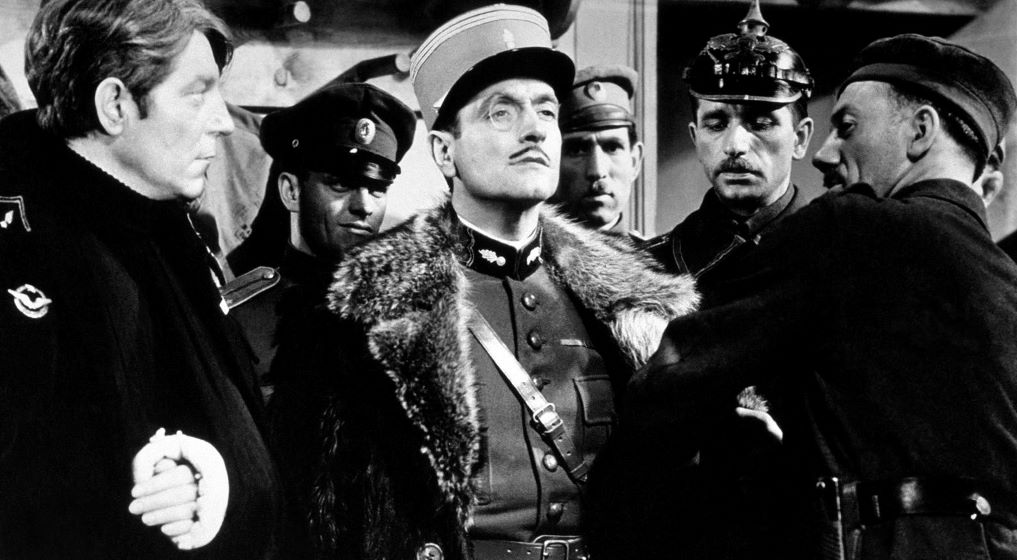
Friendship, class, warfare and change are explored superbly in Jean Renoir’s masterful war film
Director: Jean Renoir
Cast: Jean Gabin (Lt Maréchal), Marcel Dalio (Lt Rosenthal), Pierre Fresnay (Captain de Boëldieu), Erich von Stroheim (Major von Rauffenstein), Dita Parlo (Elsa), Julie Carette (Cartier), Gaston Modot (Engineer), Georges Péclet (Officer), Werner Florian (Sgt Arthur), Jean Dasté (Teacher)

“Cinematic Public Enemy Number 1”. That’s what Joseph Goebbels called Renoir’s La Grande Illusion on its release in 1937. It’s easy to think it’s because of its pacifist stance – the idea that war itself is the Grande Illusion – but perhaps it’s because Renoir’s masterpiece isn’t easy to dismiss as polemic. It’s intelligent enough to present soldiers who believe in fighting a war on different levels, but don’t see that as a reason to hate the enemy. La Grande Illusion is as much about the passing of an era and the important links that bring us closer together rather than tear us apart. And that of course was anathema to a Nazi regime, intent on crushing freedom of any sort in Europe.
Renoir’s film is one of the foundational war films, the first great POW drama. Two French officers are shot down while flying a reconnaissance mission over enemy lines. One is working class pilot Lt Maréchal (Jean Gabin), the other aristocratic Captain de Boëldieu (Pierre Fresnay). Moving from camp to camp, the two finally find themselves in a camp run by the German officer who shot them down, aristocratic Major von Rauffenstein (Erich von Stroheim). Von Rauffenstein and de Boëldieu have more in common with each other than the soldiers on their own side – though von Rauffenstein’s Victorian, romantic view of the world differs from de Boëldieu pragmatic awareness of the advance of change. When Maréchal and fellow prisoner, Jewish officer Rosenthal (Marcel Dalio) plan an escape, will de Boëldieu help them?
La Grande Illusion is a beautifully thought-provoking and gorgeous piece of film-making, a wonderful and hugely influential film. (It inspired, among others, The Great Escape with its tunnel digging escape exploits and Casablanca’s famous La Marseillaise scene). It’s a pacifist film, masquerading as a war film – but one where we never see any fighting. A polemic would have shown us the horrors and slaughter of the trenches. La Grande Illusion shows us men proud to be soldiers, praises their bravery, centres the cavalry-style dignity of the air-force and features just one death. What makes it more pacifist is the lack of anger or rage of its characters, their lack of rancid nationalism.
This is partly because the film explores a war at the cusp of societal change. The nineteenth century era of ‘gentleman’s war’ is passing away, as are the old societal hierarchies. Maréchal and de Boëldieu are on the same side, but when they are shot down it’s striking that they have more in common with their supposed enemies. Invited to a commiseration dinner by the victorious German pilots, the aristocratic de Boëldieu bonds with flying ace von Rauffenstein (they speak in English together, something that immediately separates them from the others, about horse racing) while Maréchal is delighted to find a German working-class pilot was, just like him, a car mechanic in Marseilles. There is no hatred here, just mutual respect.
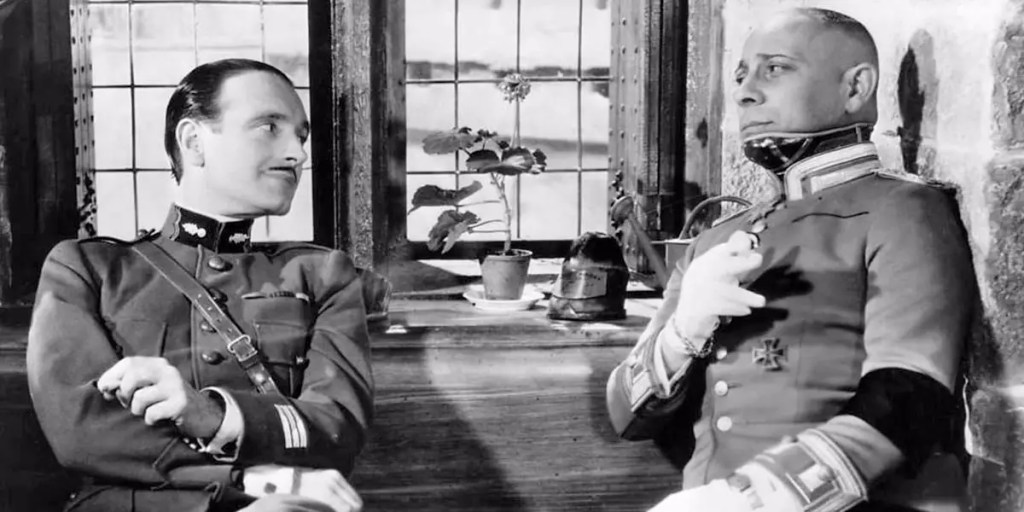
On arrival in the camp these class differences are magnified. Maréchal (the magnificently charismatic Jean Gabin) fits in far easier with the other French prisoners, all of them either professionals (engineers, teachers and the like) or outsiders, like Jewish officer Rosenthal (a heartfelt Marcel Dalio). Maréchal is inducted, enthusiastically, into their escape attempts (including the tunnel digging) as well as the social events, like the cabaret shows. de Boëldieu is a different case: there is a faint air of distrust (one prisoner even questions whether he should be told about the tunnel), and he gently refuses to take part in any cabaret and indulges the escape attempt through a sense of fair play.
But de Boëldieu is aware his world is moving on. Superbly played by Pierre Fresnay, with a wry, breezy upper-class distance that masks an acute insight, de Boëldieu knows the future belongs to commoners like Maréchal. His world – and his counterpart von Rauffenstein – is one of horse-racing, society dinners and grand houses, where a gentleman never lets a person’s nation affect his perception of them. He takes part in the war as a final grand gentleman’s sport, but also knowing that a glorious death is “a way out” of the difficult social changes that will follow.
It’s an understanding not shared by von Rauffenstein, played by an iconic preciseness by Erich von Stroheim. Von Rauffenstein respects the word of a gentleman (during a search, he tears apart the beds of every prisoner but de Boëldieu, taking his word for it that he has no contraband), sees war as a glorious expression of masculinity but never something that should come between friends. Locked within a neck brace, his posture stiff and his hands forever in trapped in tight white gloves, there is more than a hint of the closet to von Rauffenstein – and his faintly homoerotic attraction to de Boëldieu, who he sees as a natural brother-in-arms is both sad and slightly touching.

Where do de Boëldieu’s loyalties lie though? To his social equal and contemporary with whom he shares a lifetime of upperclass pursuits, or his fellow countrymen with whom he shares nothing? It’s the core of the second act of the film, as Maréchal and Rosenthal plan their escape and ask for de Boëldieu’s help. Goebbels was no doubt also unhappy with the presentation of Rosenthal. Sure, he fits many of the Jewish stereotypes: he’s a rich foreigner whose family has bought up French land. But he’s also decent, kind, shares his food and sheds a tear when Maréchal is released from solitary confinement. Maréchal and the others aren’t above befriending him despite his Jewishness, but here Rosenthal is a hero.
He’s also part of the melting pot of characters who, though they have moments of prejudice, are fundamentally all in it together. A black French prisoner goes more or less uncommented on. In solitary confinement, a distraught Maréchal is bought a harmonica by a friendly German guard, which he then delightedly plays. The French officers join in a mutually teasing relationship with an officious German guard. The various nationalities in the prison camp all muck in on their cabaret show (and escapes – a blackly comic language barrier prevents a departing Maréchal from informing a newly arrived British officer there is an escape tunnel finished and ready to go in the camp). Despite the world is tearing itself apart, but that’s not a reason for people to hate each other.
Indeed, on the run from the prison camp, Rosenthal and Maréchal find refuge on the farm of a German mother, Elsa, and her daughter, her husband having been killed in the war. (War victories get remarkably little airtime in La Grande Illusion – the famous singing of Les Marseillaise after Maréchal announces a French victory is followed in the next scene by the Germans winning it back. In the camp the soldiers grow increasingly cynical about the shortage of promised easy victories). Maréchal and this woman form a romantic bond – with Rosenthal as translator – that again transcends national boundaries. Can you imagine Goebbels being thrilled at that paragon of Aryan maidenhood, falling in love with a lunking Frenchman whose fellows killed her husband?
Neither would he be thrilled by von Rauffenstein’s desperation to save the life of de Boëldieu, the man abetting an escape. Dancing through the POW castle, pipe in hand, literally leading the guards a merry dance, de Boëldieu stage-manages his own death to leave a legacy and avoid facing the future he knows he has no place in. There is a fatalism about de Boëldieu not present in any other character: and certainly not von Rauffenstein who can’t imagine his world is ending.
But life will go on for others. Every character has a longing for life outside of the demands of war. During the cabaret, a French officer dresses (convincingly) in drag: there is something touching about the stunned, longing silence that falls across these men as they stare upon the closest thing to a woman any of them have seen in years. Maréchal plans for a future with Elsa, Rosenthal one of acceptance in his French home. War is an encumbrance, but one people understand is a burden on all regular people.
The film is beautifully made by Renoir, who uses a series of striking long-takes and intricate camera moves to create a feeling of time and place that is completely convincing, but also hugely engaging and immersive. Characters constantly stare out of windows, stressing their isolation, or are framed seemingly encased by their surroundings. Leaving aside the technical achievements and artistry, La Grande Illusion is a heartfelt, complex and moving film that challenges and questions as much as it feels regret for a time being left behind. By avoiding polemic, and stressing simple humanity and the madness of hate, it’s one of the most powerful anti-war films ever made.


 Movie Musings