
Charismatic stars and a well-oiled Hollywood plot lead into an highly effective disaster movie
Director: W.S. Van Dyke
Cast: Clark Gable (“Blackie” Norton) Jeanette MacDonald (Mary Blake), Spencer Tracy (Father Tim Mullin), Jack Holt (Jack Burley), Jessie Ralph (Mrs Burley), Ted Healy (Mat), Shirley Ross (Trixie), Margaret Irving (Della Bailey), Harold Huber (Babe)
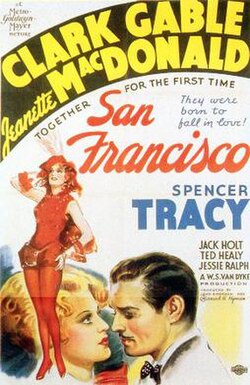
With San Francisco, Hollywood stumbled on a formula that was a sure-fire success: a romantic triangle comes to head in the face of a natural disaster with buildings tumbling. Love and disasters – who doesn’t love that? San Francisco is set in the build up to the 1906 earthquake that left over two thirds of the city in ruins and over 3,000 people dead. How’s that for focusing minds onto what really matters: who you really love and, of course, faith in a higher power.
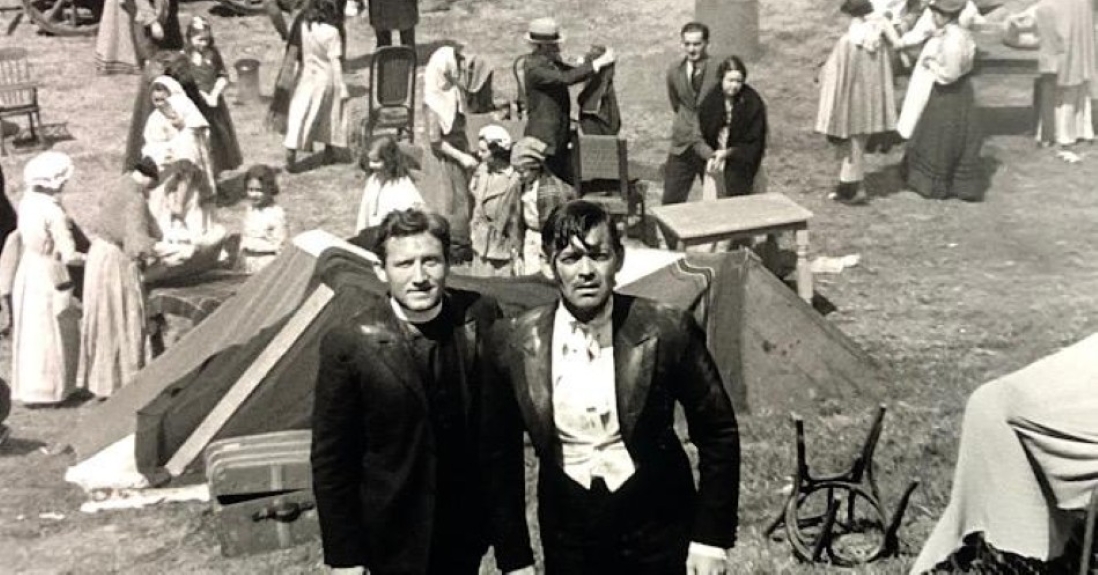
“Blackie” Norton (Clark Gable) is a lovable rogue, a saloon owner on San Francisco’s rough-and-ready Barbary Coast. His love for a good time doesn’t stop him being best friends with Father Tim Mullin (Spencer Tracy), a man’s man whose heart is with the Church. Blackie hires knock-out soprano singer Mary Blake (Jeanette MacDonald) for his saloon, but can’t wrap his head around the fact that she’s meant for classier things (like San Francisco’s opera house) than a life singing for his rowdy crowds. Of course they fall in love. Blackie is holding Mary back (without fully realising it) and she finds a new patron (and suitor) in stuffed-shirt rich-man Jack Burley (Jack Holt). All these romantic problems are suddenly dwarfed by that earthquake.
Like all disaster films, San Francisco starts with a high-blown melodrama before becoming a special effects laden epic. Much of the first 90 minutes revolves around an engagingly played familiar pair of formulas. We have a story of two old rough-and-tumble childhood friends – inevitably one who chose a life of the cloth, the other of rowdy pleasure – whose friendship struggles under the weight of conflicting principles. And we also get a love triangle where a woman is torn between two suitors – one a rogueish chancer who doesn’t understand her dreams, the other a selfish dull rich guy who offers her those dreams at a price. This is classic Hollywood stuff.
To deliver it, three popular stars go through their paces to audience pleasing effect. Clark Gable brings his customary suave charm and naughty grin to make Blackie (who in other hands could come across as a myopic, selfish sleazeball) into someone fairly endearing. Of course, it’s helped that the plot makes clear Blackie may appear to be a boozy saloon owner, but actually he has a heart of pure gold: he buys an organ for the local church, gives money to orphans and is running for office to improve the city’s fire safety. He’s easily the most polite, decent and upstanding bad boy you’ll see – and he’s even completely faithful to the woman he loves. He may say God is for ‘suckers’, but it’s not going to be a long journey to reform him into someone worthy of a good woman.
And he’s also honest in his love for Jeanette MacDonald’s Mary, trying to give her what he thinks she wants. Blinded by his three ‘Chicken Ball’ trophies for ‘artistic achievement’, he genuinely can’t see the difference between Mary performing Faust and dressing her up in the shortest skirt imaginable (as he tells her, good legs sell) to sing for hundreds of drunken punters. Poor Mary feels obliged to give up her dream to return for this nonsense, until good old Father Tim points out Blackie is accidentally behaving like a cad. Enter Jack Burley as alternative: just to make sure we know it’s the wrong choice, he’s played as un-charismatically as possible by Jack Holt and uses his money to get everyone to follow his orders, exactly the sort of ‘Nob Hill’ crook Blackie rails against.
With Jeanette MacDonald – who is perhaps a little too coy and bashful for today’s taste – we also get an awful lot of singing, from opera to hymns to several renditions of ‘San Francisco’. This went down like a storm at the time, but is probably a bit too much to take now. MacDonald actually has the duller, less engaging role, constantly changing her mind between her various career and romantic options, although she does a nice line in awkward uncomfortableness when accommodating herself to Blackie’s wishes rather than her own (not least in her body language when dressed up in that slutty showgirl costume that Blackie thinks is a compliment).
Surprisingly Spencer Tracy then landed an Oscar nomination (the shortest ever leading performance nominated), but he nails the muscular Christianity of Tim, the boxing priest. Tracy’s main role is dispensing advice and guidance to Gable and MacDonald, full of shrewd wisdom mixed with firm stares of moral judgement. Tracy plays the role very lightly, never making Tim priggish even at his most righteous. A confrontation which sees a frustrated Gable smack him in the mouth, is a classic Tracy moment: a steely eyed glare dripping with disappointment, but still he refuses to react (the film throws in an early boxing scene between the two, where Tracy easily bests Gable, to confirm he certainly ain’t scared of his co-lead!)
The various smoothly handled formula leads perfectly into the earthquake. You can’t deny this is hugely impressive sequence. The scale, using super-imposition and enormous sets, is truly stunning: buildings topple in flames, fires rip through houses, crowds run in panic through debris-packed streets. A ballroom crumbles before our eyes: the roof cracking, the wall falling down (Gable is nearly crushed by a wall), a staircase balcony collapsing.
Clearly someone on the MGM lot spent a bit of time watching Battleship Potemkin. The first wave takes Soviet cinematic montage inspiration to the max. Tight reaction cuts to horrified faces are intermixed with tumbling walls and buildings. A statue is seen, seemingly starring down in horror, before a cut to it cracking and then a shot of the head roiling downwards on the floor. A carriage wheel spins in the streets in close-up as debris falls around it. This sequence feels visceral and intense, a real stand-out moment. A second wave picks up the baton with a street literally tearing itself in two, flames licking up from a burst gas main. Buildings are dynamited as fire breaks. And through the aftermath, Gable stumbles blooded and torn and genuinely looking lost and afraid, terrified that he has lost the woman he loves in the conflagration.
It brings a real energy and punch to an entertaining plot-boiler relying on the chemistry and charisma of its stars. San Francisco ends with a tribute to the endurance of the American Spirit (not to mention, of course, Gable completing his reformation into a man of God), as all races and creeds are bought together with the ‘Battle Hymn of the Republic’ as they march towards a city reborn in superimposed imagery. With all that is it any wonder it was a box office smash?

 Movie Musings