Tag: Jeff Goldblum

Invasion of the Body Snatchers (1978)


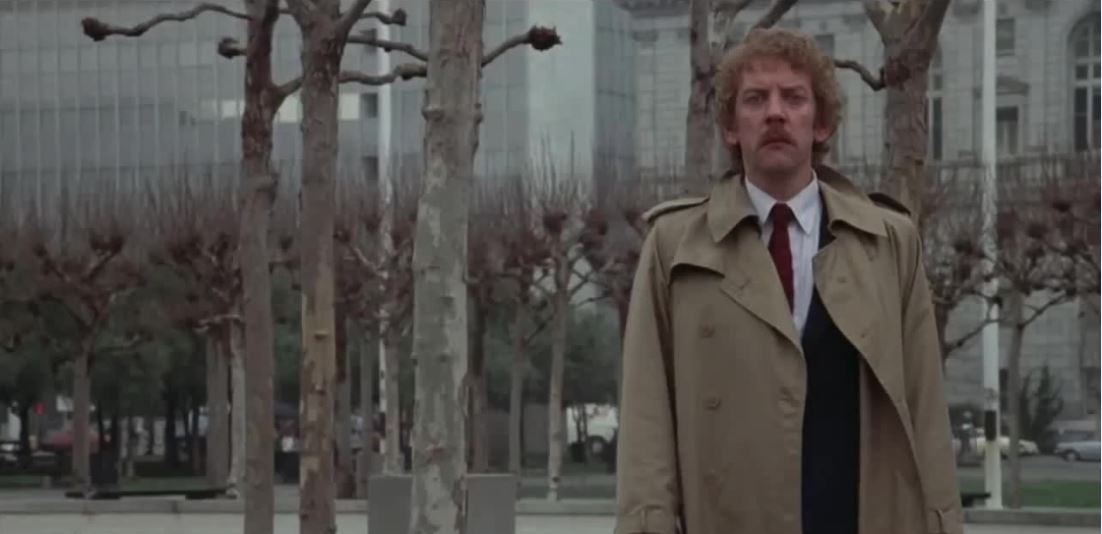
Donald Sutherland is lost in the soulless world of Invasion of the Body Snatchers

Director: Philip Kaufman

Cast: Donald Sutherland (Matthew Bennell), Brooke Adams (Elizabeth Driscoll), Leonard Nimoy (Dr David Kibner), Jeff Goldblum (Jack Bellicec), Veronica Cartwright (Nancy Bellicec), Art Hindle (Dr Geoffrey Howell), Don Siegel (Taxicab Driver), Kevin McCarthy (Running Man)
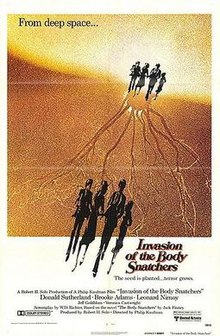
Sometimes, as we look around our office-based world, it’s hard not feel that most of it is taking place on a weary treadmill. That we are going through the motions with no engagement or feeling, that we are all cogs in the same machine. Invasion of the Body Snatchers, like all great science fiction films, taps into this sense of individuality being lost in our modern age, and mixes it with a brilliant dose of Cold-War paranoia. Like much brilliant science-fiction, it offers a window on our world that makes us pause and reflect on our own lives.

Matthew Bennell (Donald Sutherland) is a health inspector (has there been a less sexy job for a hero?) in San Francisco. One day his colleague Elizabeth Driscoll (Brooke Adams) confesses to him that her boyfriend, dentist Geoffrey (Art Hindle), has changed so much that he feels like a completely different person. Turns out she’s not alone in the city – many people are reporting their loved ones have become distant and changed. While Matthew’s friend, celebrity psychiatrist Dr David Kibney (Leonard Nimoy), laughs off their concerns, Jack (Jeff Goldblum) and Nancy (Veronica Cartwright) Bellicec are keen to listen – especially when they find a copy of Jack growing in their home. Can the people of San Francisco really be being replaced by copies in an alien invasion?

Invasion of the Body Snatchers is not just a great remake, it’s a great piece of film-making in its own right. It takes the ideas of the original and ramps them up into a Nixon-era paranoia fest, to create a creepy and unsettling film. It’s a film that perfectly understands the one thing all people value, perhaps more than any other, is their individuality and ability to feel and experience emotions. These are the two things the Pods take from you – in all other respects, the people are unchanged, they’re just unfeeling drones. 

What Philip Kaufman does really well is fill the film from the start with unsettling moments, and hints that things are wrong. The film opens with eerie visuals as the Pods arrive from space and slowly infect the vegetation of the planet. Unusual camera angles and lingering shots pick out people in the frame, behaving suspiciously robotically. Robert Duvall has a wordless (uncredited) cameo as a priest on a creaking swing in a playground – the sound and visuals both insanely unnerving, especially considering Duvall’s wordless intense stare. 

Pod people go about their work of taking over the earth with a relentless, eerie silence. Do they cling to silence so much, so that their piercing screams when they detect a rogue human can be heard? Late in the film, we see several instances of Pod people, freeze, point rigidly at an unconverted human, and then let out an inhuman shriek (it’s unsettling beyond belief). When pursuing humans, the run with a wild pack abandon. Throughout the film, the camera hovers on moments or scenes, asking us to wonder what’s going on. A floor cleaner mindlessly moves his cleaner across the floor and the camera lingers on him for what feels like ages – is he a pod person? Or is he just an ordinary Joe going about his work? Kaufman sprinkles moments like this throughout the film.

He and screenwriter WD Richter also tap into a sadness of the late 1970s – the world of the hippie, where it felt the world might change, is passing. Matthew, David and Jack all feel like old college buddies – you can imagine the three of them hanging out at Woodstock. Jack and Nancy have clung to their hippie lifestyle, but are reduced to running a mud-bath and trying to peddle Jack’s poetry to the bored and uninterested. David has repackaged himself into a soulless, impossibly vain and self-important TV psychiatrist, dishing out cod-advice and lapping up praise at swanky book launches. Matthew is a slightly grubby civil servant. Kaufman and Richter do a great job of suggesting the younger, more idealistic roots of these characters with minimal dialogue and action. It adds a rich theme to the film – are the Pod people and their mechanical, soulless routine just where the human race is going anyway? Is it any coincidence that the invasion takes places in hip San Francisco?

Kaufman shoots the film with an eerie off-kilterness, helped a lot by Michael Chapman’s excellent cinematography. Ben Burtt’s soundscape is also brilliant – from the creak of the swing at the start and the shriek of the Pod people, to the deafening silence late in the film of the almost completely converted San Francisco, as the Pod People go through the motions of their old lives, devoid of emotion. The design of the pods, and the growing replacement humans, is horribly eerie. This creepiness helps hammer home the sense of paranoia as more and more people are replaced by Pod people – leaving us, like the characters, constantly questioning who is “real” and who isn’t? Who can we trust?

Donald Sutherland is the perfect lead for this – he has both a slightly ground-down world-weariness but also a strong sense of maverick individuality. He’s an interesting, challenging actor and he’s very easy to empathise with. A lot of the film’s emotional force comes from the deep friendship (which could perhaps be more) between him and Brooke Adams (also very good). Leonard Nimoy offers a subtle inversion of his Spock persona, taking elements of Spock’s logical coldness and inverting them for both maximum smarm and creep. Goldblum and Cartwright are just about perfectly cast, with Cartwright especially good (and reaffirming her scream-queen skills) as a woman with a surprisingly sharp survival instinct.

Kaufman’s Invasion of the Body Snatchers is easy to overlook in the list of great American 1970s thrillers due to being both (a) a remake and (b) a science-fiction film. But this is an unsettling investigation of an America on the verge of changing from one type of generation to another. It’s unsettling, intriguing and gripping – wonderfully made and very well acted. It’s a film that understands paranoia, isolation and our love of our own individuality more than many others I can think of. It’s one of the great American 1970s films.
Thor: Ragnarok (2017)


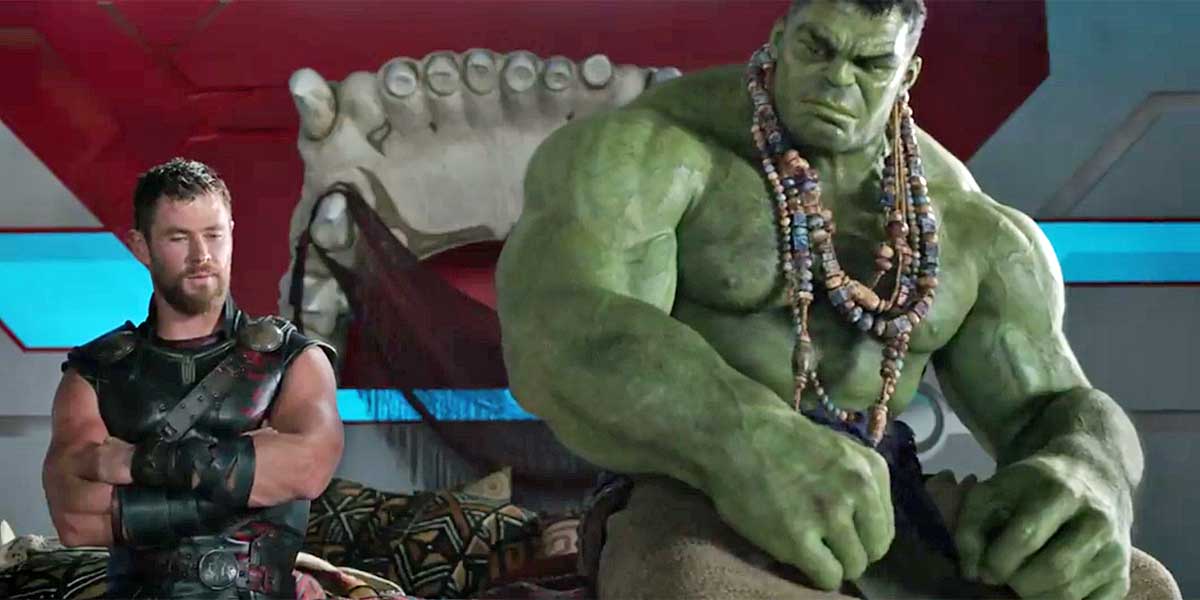
Thor and Hulk: It’s the buddy movie you’ve been waiting for

Director: Taika Waititi

Cast: Chris Hemsworth (Thor), Tom Hiddleston (Loki), Cate Blanchett (Hela), Idris Elba (Heimdall), Jeff Goldblum (Grandmaster), Tessa Thompson (Valkyrie), Karl Urban (Skurge), Mark Ruffalo (Bruce Banner/Hulk), Anthony Hopkins (Odin), Benedict Cumberbatch (Doctor Strange), Rachel House (Topaz), Taika Waititi (Korg)

The Marvel franchise is now on to 17 films. That’s 17 films all in the same universe, with at least three more to come in the next year or so. The weight of franchise backstory has started to feel overbearing, with so many other films to tie into and characters to set up that the individual film itself is left with barely any identity or purpose. How refreshing then to have a film that cuts loose and takes a slightly different tone: a genuine action comedy. Thor: Ragnarok is so tonally different from the other Thor films (let alone the other films in the series) it actually manages to feel like its own beast – it’s as close to a director-led vision as the franchise has got.

Thor (Chris Hemsworth) has been all over the universe, working to stop Ragnarok (the prophesised end of Asgard). Returning to Asgard, he unmasks his troublesome step-brother Loki (Tom Hiddleston) who has been disguised as Odin (Anthony Hopkins). Travelling to Earth to rescue their dying father, they arrive in time to see his death. Unfortunately, this releases their elder sister Hela, Goddess of Death (Cate Blanchett). While Hela ruthlessly conquers Asgard, Thor is trapped on the planet Sakaar and forced to enter a deadly gladiatorial contest – against his Avenger ally the Hulk (Mark Ruffalo) – all while trying to escape back to Asgard to stop Hela.

Thor: Ragnarok has a plot that ambles at points rather than sprints. But this hardly matters, as its main focus is on entertaining the audience. Waititi creates a sort of punk 1980s wildness, mixed with a fun-loving wit. The result is a film with action, and high stakes – but never takes itself too seriously. It perfectly understands how to puncture grandeur or pomposity of the Asgardian gods with a neat one-liner or a bit of everyday conversational inanity (a lot of the latter comes from Waititi himself, hilariously playing chilled out rock gladiator Korg).

Waititi also allows Hemsworth to let rip with his comic timing rip in a way he’s scarcely been allowed to do since Branagh’s original. It drops the faux-Shakespearean seriousness of Thor: The Dark World, and Hemsworth repositions the character in a more relaxed and charming style. From his opening introduction, undercutting the monologing of a fire demon with a dry series of puns while dangling from a ceiling in chains, he finds a neat balance between seriousness and charisma. Waititi is also (like Branagh) not afraid to let Asgard’s mightiest warrior be the butt of a few sight gags – one laugh out loud moment involving a very strong window is a stand out. Hemsworth demonstrates here he’s a far more accomplished comedian (physically and verbally) than he gets credit for.

This more relaxed Thor is perfect for the rock-and-roll feel of the film. Expertly scored (there is particularly fine use of Led Zeppelin’s Immigrant Song) it has a groovy, 1980s feel. The planet Sakaar is a primary-coloured, odd-alien filled, campy explosion of energy and vibrant punky fun. Said planet is run by the Grandmaster, played by Jeff Goldblum at his most Jeff Goldblumiest ever – if you can picture that you’ve got the tone of the whole planet. This neon lit style is reminiscent of everything from Flash Gordon to The Last Starfighter

The film’s loose comic style also allows a series of fun match-ups, from Thor and Loki (a wonderfully weaselly, fun Tom Hiddleston – still one of the best things in this whole franchise), to Thor and Strange (a lovely cameo from Cumberbatch), Thor and Valkyrie (a neat mixture of drunken self-loathing and female Thor-ness from Tessa Thompson) and lastly Thor and Hulk. The latter provides a lot of the film’s comic gold, the Hulk finally turned into some sort of character with achildish vulnerability and swagger (though the film still finds time for a Hulk penis gag). Waititi also throws in some nice call-backs to previous films – the bunch here set themselves up as the Revengers, while there are multiple references to the mantra used to calm the Hulk in Avengers: Age of Ultron – without making it feel in-jokey. 

There is so much fun in the film, you almost forget the main plot of the film is fairly heavy-going, end-of-the-world stuff. For a Marvel film there is a large body count of recurring characters (at least four bite the bullet here), while Hela’s plot encompasses mass slaughter and destruction. Scenes with Hela are kept short (structurally the film effectively strands her on Asgard to contain her invincibility), so it’s just as well the part is played with such charismatic dryness and imperious arrogance by Cate Blanchett (easily the best Marvel villain since Loki). She’s ably backed up by Karl Urban, adding a lot of complexity to reluctant cowardly turncoat Skurge. Waititi shoots Hela’s rampage of destruction with an exciting dynamism – it’s an action scene that feels different, no mean feat in a franchise that has had so many fights.

In fact most of the action feels very fresh, the fights never out-stay their welcome, and there are some brilliant visual flourishes – the final battle in particular throws in some almost painterly images as Thor and his allies take on Hela’s zombie army. The arena fight between Hulk and Thor is about a million times more interesting than the dull Hulkbuster battle between Iron Man and Hulk in the past Avengers film as Watiti keeps the focus on character rather than pummelling. The film also manages to keep the stakes high – there are always innocent people our heroes fight to protect.

Thor: Ragnarok might well be the most entertaining, fun film Marvel has produced. It’s almost certainly the best Thor film. While The Dark World failed dismally to build on the mixture of earnestness and comedy in Branagh’s original, this one feels like a natural progression of the first, amping everything up into a vibrant, 1980s styled cocktail of action and fun. It’s terrifically entertaining, well paced, anchored in characters we care about, and it just wants to entertain the viewer. You’d have to be pretty cold for it not to succeed.

Independence Day: Resurgence (2016)


Independence Day 2: Not a Resurgence but a wake.

Director: Roland Emmerich

Cast: Liam Hemsworth (Jake Morrison), Jeff Goldblum (David Levinson), Jessie Usher (Dylan Hiller), Bill Pullman (President Tom Whitmore), Maika Monroe (Patricia Whitmore), Sela Ward (President Elizabeth Lanford), William Fichtner (General Joshua Adams), Judd Hirsch (Julius Levinson), Brent Spiner (Dr Brakish Okun), Charlotte Gainsbourg (Dr Catherine Marceaux)

Sometimes your first instincts in films are great. They help you to try new things and unearth new favourites that can find a place in your heart. And sometimes your first instincts are bollocks. You see a film and, for whatever reason, you were in the right mood and you think “well that was great!” Then you come back to watch it a few months later and your second reaction is “What the hell was I thinking?”. Such a film was Independence Day: Resurgence for me.

The plot is alarmingly simple. Probably because it’s essentially the same plot as the first film. Twenty years after the events of Independence Day, mankind lives in peace and prosperity and has rebuilt the world, with a new global military armed with alien technology ready to repel any future attacks. Of course the attack comes… Soon mankind is on a ticking clock (“We were wrong. We only have 1 hour left to save the world!”)…

Okay. I did enjoy this in the cinema. I confess. Then I watched it again and released it was complete bollocks. Totally pointless sequel that adds literally nothing to the first film.

First off this film is essentially a remake rather than a sequel. A first alien ship (different species) arrives and there is panic. An attempt at communication rebuffed (theirs not ours this time). Warnings about an imminent attack are ignored. The aliens destroys several cities (mankind has been busy, as many of the landmarks destroyed in the first film have been reconstructed in perfect detail to get mashed again). A human counterattack ends in dismal failure. Even the goddamn ending of the film is once again a final battle at the salt flats, with the clock ticking. One of our heroes sacrifices themselves. It’s the Fourth of July – need I go on?

The only things that they haven’t carried across are the charm and thrills of the original. In fact there is nothing here to interest anyone who doesn’t have fond memories of the first film: the new characters are largely forgettable, most of the sequences are commentaries on the first film. Resurgence captures none of the twisted sense of awe and wonder of the original Independence Day – the shock of seeing aliens arrive, the terror they unleash, the helplessness of mankind. The action sequences (particularly the assault on the alien spaceship) have none of the sense of danger that makes the same sequences in the original so exciting – it just makes you want to re-watch the first film but not in a good way.

Instead the film aims BIG. Everything is BIGGER. Mankind has planes that fly in space, ray guns and moon bases. The aliens have a ship that’s not the size of city, but the size of a continent! Half the world is wiped out in minutes! The alien attack all takes place in one day! We’ve only got one hour to save the world from having its core drained! It’s all pushing to make the film more EXCITING! It fails. Not only is everything familiar, but everything is so rushed that there are none of the moments for reflection the first film has. Half the world is wiped out in this film and no-one takes even a minute to think about the impact of that.

It’s not just content from the last film that is familiar. This film reveals the aliens are a sort of hive mind with – you guessed it – a Queen. Is it essential for every single bloody alien film to have a queen? Ever since Aliens the idea has been done to absolute death. Needless to say, our heroes (having seen films before) work out that if they take down the Queen, all the other aliens will shut down. Familiar? Only to everyone who has ever seen a film before.

The film’s sexual politics are also all over the shop. It proudly boasted in advance it would feature a gay relationship. But the gay couple in this are safely sexless: not a single line of dialogue hints too heavily at their homosexuality and the closest they get to showing physical affection is to hold hands briefly (the point being of course, if they were too gay it wouldn’t sell abroad).

Secondly, and even more uncomfortably, at some point it was clearly decided a cross-racial relationship wouldn’t play well either. It would make sense to me if the two children from the first film had grown into love interests for each other – and if they were both white I am certain this would have happened. But this film introduces a whole new (white) suitor for Whitmore’s daughter. Hiller’s adopted son? No love interest for him at all. In fact Dylan is relegated to the role of the charisma-free straight-shooter, with Liam Hemsworth given the coveted role of the charismatic maverick who has the courage to think outside of the box and save us all. This is even more cowardly than the film’s shyness around its gay characters.

Independence Day: Resurgence is a lifeless film. It has just enough fun about it for those who remember the first film to watch it with a sense of nostalgic glee. But it has none of that film’s wit, none of its tension, none of its sense of mankind overcoming impossible odds. Despite all the hand-waving towards the unity of the world, even more than the first film this might as well be “America Vs. Aliens”. It caught me in a good mood at the cinema, with the right nostalgic mindset. But whereas Jurassic World(for instance) mixes nostalgia with genuine wit and excitement, this is a film that never comes to life. It’s DOA. Far from a resurgence, it’s a wake.

It’s also pretty hard to forgive it for this marketing abomination. Daley Blind for starters has not won twenty league titles. As for Wayne’s acting. Jesus Christ…

The Adventures of Buckaroo Banzai Across the 8th Dimension (1984)

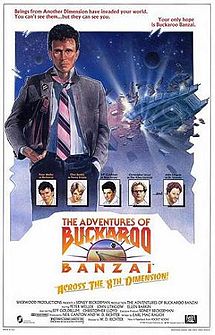
Some of the costume choices in this image probably help you to see what oddness you have in store…

Director: WD Richter

Cast: Paul Weller (Buckaroo Banzai), John Lithgow (Dr Emilio Lizardo/Lord John Whorfin), Ellen Barkin (Penny Priddy), Christopher Lloyd (John Bigbooté), Clancy Brown(Rawhide), Jeff Goldblum (New Jersey), Vincent Schiavelli (John O’Connor), Robert Ito (Professor Hikita), Carl Lumbly (John Parker)

Okay so watching that was strange. If you looked up “cult movie” in the dictionary you would probably see an embedded video of this film. It’s so cult it has literally no interest at all in appealing what so ever to anyone outside of its established sci-fi crowd. If Star Wars was sci-fi for the masses, this is camp sci-fi for the cultish elite.

The plot is almost impossible to relate but Buckaroo Banzai (Paul Weller) is a polymath genius – surgeon, rocket scientist, rockstar – who perfects a device that can travel through solid matter and dimensions. But creating the device makes him a target for a race of aliens, led by Lord John Whorfin (John Lithgow) who live in the gaps between dimensions and want to use the device to escape.

The film is part straight-laced 1940s sci-fi serial, part tongue-in-cheek romp, part comic book, part satire. In fact it’s nearly impossible to categorise, which is certainly in its favour: you’ve certainly never seen anything like it before. It’s bursting with ideas and straight faced humour and clearly had an influence on sci-fi still today (for starters there are more than a few beats of Moffat-era Doctor Who here, while Banzai himself would fit in as The Doctor). It bursts out of the screen with a frentic energy, not massively concerned with narrative logic or consistency, its solely focused on being entertaining. It throws the kitchen sink at the screen with all the passion of fan fiction.

Despite all this I think you have to have a very certain sense of humour and set of interests to really enjoy it – and I’m not sure that I did. If you don’t have an encyclopedic knowledge of comic books and sci-fi you’ll probably feel like you are missing something (and you probably are). I’m also not sure there is much there to attract the “muggle” fan – Weller plays the lead with a smoothness and a charming straightness but he’s not the most interesting of characters (to be brutally honest). Lithgow counter balances him by going utterly over the top in a performance of ridiculous Mussolini-like bombast. But it’s not completely engaging. Basically if you don’t love it within the opening 25 minutes, you aren’t going to won over by anything else that happens. Every frame of the film is setting itself up as a chance for cult fans to speak to each other.

It actually rather feels like you are being invited to a party but then are left with your nose pressed up against the window. All the actors are clearly having a whale of a time with the other-the-top setting and bizarre half-gags. But I’m not sure all that enjoyment really travels across the screen to the viewer. While it’s sorta sweet in it’s almost sexless innocence (Birkin plays the lost twin of Banzai’s wife but there’s never a hint of real sexual buzz anywhere). Characters sport guns and hang around in a nightclub, but Banzai’s gang are essentially a group of 11 year olds who have taken adult form. So it’s gentle and has an innocent chumminess, but also a bit hard to engage with it.

I think in the end I just found it a little too eager and straining to be an outlandish, deliberately cultist film – it’s like an inverted elitest piece of modern fiction, that uses narrative tricks, devices and style to make itself harder for the regular viewer (or reader) to be part of its experience. So while this is something very different and almost insanely off the wall, it’s also something that is never going to move you or appeal in the way Empire Strikes Back will do.