Tag: Jennifer Lawrence

Don’t Look Up (2021)

Don’t Look Up (2021)

A host of stars tell us the world us coming to an end in this self-satisfied film

Director: Adam McKay

Cast: Leonardo DiCaprio (Dr Randall Mindy), Jennifer Lawrence (Kate Diabiasky), Rob Morgan (Dr Teddy Oglethorpe), Meryl Streep (President Janie Orlean), Cate Blanchett (Brie Evantree), Jonah Hill (Jason Orlean), Mark Rylance (Peter Isherwell), Tyler Perry (Jack Bremmer), Timothée Chalamet (Yule), Ron Perlman (Colonel Benedict Drask), Ariana Grande (Riley Bina), Scott Mescudi (DJ Chello), Himesh Patel (Philip Kaj), Melanie Lynsky (June Mindy), Michael Chiklis (Dan Pawketty)
Climate Change. It’s the impending disaster where we stick our head in the sand and pretend it’s not incoming. Governments have been told for decades our carefree use of fossil fuels and slicing down of rainforests will have a cataclysmic impact. But it’s always easiest for governments and people to just say “nah” and not let those thoughts get in the way of our everyday lives. Adam McKay’s satire Don’t Look Now takes these trends of indifference, disbelief and denial climate scientists have faced their whole careers and reapplies them to a comet-hits-the-Earth disaster movie.

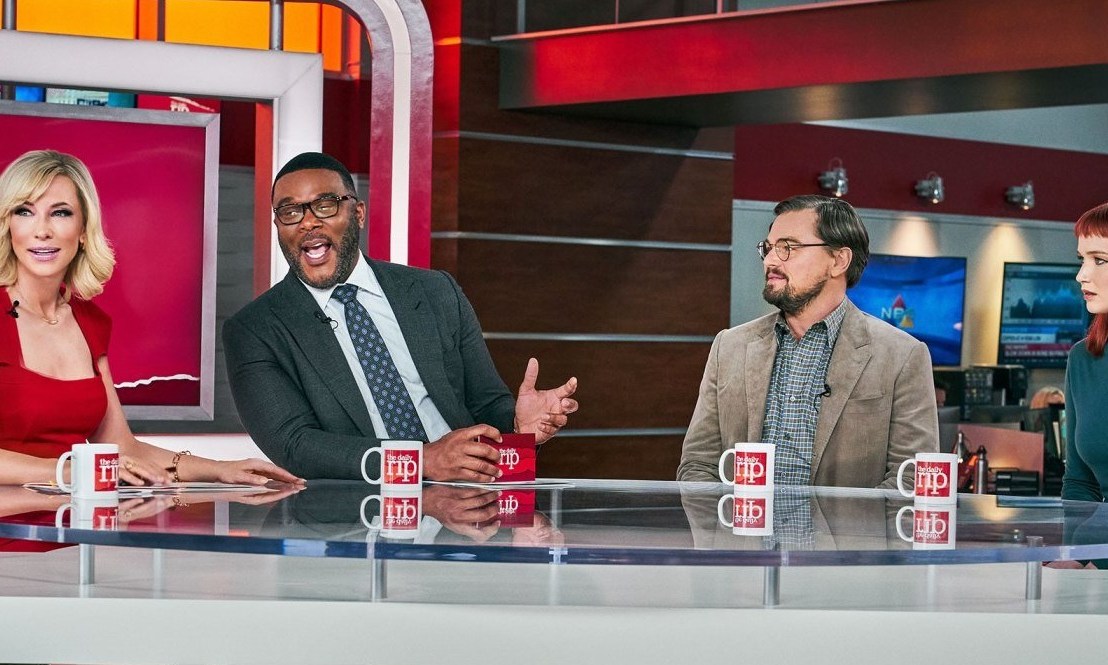
So, when Michigan State University astronomers Dr Randall Mindy (Leonardo DiCaprio) and Kate Diabiasky (Jennifer Lawrence) spot a hunk of ruck the size of Everest on a collision course with the Earth they are met with a chorus of… yawns, memes and flat-out denials. The Trumpian President (Meryl Streep) is only interested in her donors, the mid-terms and dodging the fall-out from a host of scandals. The media – represented by Fox News style anchors Brie Evantree (Cate Blanchett) and Jack Bremmer (Tyler Perry) – aren’t interested in a story they can’t process down into a feel-good social media meme. And even when people start to listen, plans to destroy the comet are benched in favour of a wildly risky scheme, dreamed up by Steve Jobs/Elon Musk style tech billionaire Peter Isherwell (Mark Rylance) to mine the rare ores it contains for money. What could go wrong?

I can see what Adam McKay is aiming for here, to create a sort of Dr Strangelove for climate change, where the great and the good we are counting on to get us through a crisis, turn out to be the blinkered morons who end up causing it. There are moments where it sort-of hits on a rich mixture of farce and genuine anger. Moments where first Kate then Mindy – thelatter with lashings of Howard Beale – melt down on National TV, apoplectic at the comet-denying indifference of millions of people stand out as both hilarious and also compelling.

But, like a lot of McKay’s would-be satirical attacks over the last year, on finance and politics, the message sometimes fails to land because of the heavy-handed, self-satisfied, smug tone of the delivery. Don’t Look Up frequently isn’t very funny – and yes I know it ends with the world being destroyed due to everyone’s indifference and incompetence – and it ladles most of the blame on obvious targets. It’s takedown of Trump – here represented by Meryl Streep – is basic, it hits open goals with the agenda-driven bias of American news reporters and takes pot-shots at messianic tech billionaires. A real punch would perhaps have focused in more on how all the mindless, unfocused greed and ambition of these people is fed by the bland, social media focused, sound-bite obsessed shallowness of the masses. But Don’t Look Up remains focused on the big people.

So focused in fact that, even in this satire, only America has the wherewithal to launch a mission against the comet. A joint Russian, Chinese and Indian mission fails to get off the ground and other world leaders are noticeable by their absence. We never really spend time with any normal people. While much of the blame does lie with governments not taking a lead, we do live in a world where normal people are radicalised by reading about nonsensical mush like QAnon through chat rooms. Imagine a satire that looked at how ordinary people can be made to believe wild theories rather than the evidence of their own eyes as a comet heads towards Earth? Instead Don’t Look Up wants to stick with something vaguely comforting – that there are big, selfish, elites running us who act out of greed and stupidity and they carry all the danger (and the blame).

Where the film is strongest is the doubt and nonsense thrown at scientists. Mindy and Diabasky are first ignored by the administration because they aren’t Ivy League. Attempting to leak their findings on the TV, they are overshadowed by an on-air-proposal of a celebrity DJ to his singer girlfriend and when they hit the news, the only takeaway is that Mindy is ‘cute’, while Diabasky is a freaky angry woman, ranting about the world ending (she’s a meme in minutes). At every point the science is questioned or put on the same level as gut feelings and political agendas. Even their campaign to encourage the world to “Just Look Up” to see the impending catastrophe is countered by the President’s “Don’t Look Up” campaign that persuades millions of people the comet isn’t real.

Really rule by social media and the dumbing down of humanity should be the main target here. A comet isn’t even a great metaphor for climate change – which is gradual, can’t be just blown up and needs to be prevented by society making changes to the way we live. In some ways, by replacing climate change with a comet, even the film is acknowledging its not sexy or exciting enough – and that it doesn’t want to turn its critical fire on millions of people who would rather turn the heating up or drive to the corner shop rather than push to make changes in their lives.

So, it’s easier and simple for McKay to create a cartoon freak show of easy targets and bash them rather than tackle the underlying causes of climate change – that our world and its population wants to have its cake and eat it, and governments for generations have been too focused on the here and now to ever worry about the years to come. So funny as it can be to see Streep Trump it up, or Rylance channel his softness into insanity, or Hill play another of his mindless frat boys turned power brokers, the film doesn’t feel like it really goes for the real causes of climate change: our own culture. It takes hits at our social media simpleness, but not at our short sightedness.

McKay does at least direct without much of the fourth-wall leaning flashiness of his earlier works, and there are committed – if not exactly stretching – performances from Lawrence (whose characters checks out in despair at the shallowness) and DiCaprio (who is seduced by fame, power and Blanchett into becoming an apologetic mouthpiece for the administration). But Don’t Look Up is a little too pleased with itself, a little too focused on easy targets and doesn’t do enough to spread the blame wider. It stills see many of us as victims or mislead – when really we are as to blame a everyone else.

The Hunger Games: Catching Fire (2013)

Jennifer Lawrence and Josh Hutcherson head back into the area in The Hunger Games: Catching Fire

Director: Francis Lawrence

Cast: Jennifer Lawrence (Katniss Everdeen), Josh Hutcherson (Peeta Mellark), Liam Hemsworth (Gale Hawthorne), Woody Harrelson (Haymitch Abernathy), Elizabeth Banks (Effie Trinket), Lenny Kravitz (Cinna), Philip Seymour Hoffman (Plutarch Heavensbee), Jeffrey Wright (Beetee Latier), Stanley Tucci (Caesar Flickerman), Donald Sutherland (President Coriolanus Snow), Sam Claflin (Finnick Odair), Lynn Cohen (Mags), Jena Malone (Johanna Mason)

It’s a year on from Katniss (Jennifer Lawrence) and Peeta’s (Josh Hutcherson) victory at the 74th Hunger Games. They and the other victors live a life of relative luxury in the dictatorship of PanAm. Problem is Katniss’ humanity and defiance of the ‘rules’ from her victory have started to inspire whispers of discontent into open mutterings. When a “victor’s tour” fails to impact on her lustre, President Snow (Donald Sutherland) follows the suggestion of Games Maker Plutarch (Philip Seymour Hoffman) – let’s celebrate the 75th Anniversary by chucking two victors from each district back into the ring. As the only female victor from District 12, this means Katniss will either wind up dead – or be put into a position where she has to abandon her humanity to become the killer she never wanted to be. But is there another game going on inside the game?

Catching Fire is an entertaining, fast-paced, well made sequel to The Hunger Games that successfully broadens and deepens the franchise. Far from being a difficult middle chapter, it’s well structured to tell a pretty self-contained story that riffs on events from the first film without being enslaved to them. It also very sharply deepens the social and political commentary from the first film, widening our knowledge of PanAm and our understanding of its corrupt, murderous system.

Lawrence’s direction is punchy, pacey and provides plenty of emotional depth and scope. It’s a film that skilfully balances questions of trauma and the horrors of murder-for-entertainment, with poundingly exciting action sequences in the games themselves. In some ways Catching Fire is the only film in the series that ends (more-or-less) with a triumphant bang, and it’s possibly why the film is the most satisfying of the lot, with the cleanest structure. It also has the advantage of widening the outer edges of the world of the film, while still largely operating within the self-contained world of the games arena.

Within that, it also manages to keep us on our toes. Many of the same set-ups – both in the build-up to the games and the action in the arena itself – echoes or reflects what we’ve seen before. The film uses this to throw at us moments the surprise us – as allegiences are revealed – or provide opportunities for dark humour (such as the setpiece Katniss decides to use to showcase her skills this time round, markedly, darkly different from her archery display in the first film).

The film is entertaining and also thought-provoking. Within the confines of its 12A certificate, it doesn’t flinch from the oppressive horror of PanAm in the districts, where sudden executions and brutal beatings are an everyday occurrence. Similarly, it demonstrates even more the heartless opulence of the capital, a world of hedonism where no questions are asked about what props this whole system up.

And at the heart we have Katniss. Wonderful played, with a full-blooded emotional commitment from Jennifer Lawrence, Katniss is slowly become aware of her iconic status, but hasn’t changed dramatically from the at-times judgmental, prickly, abrasive loner she was at the start. She’s a reluctant figure-head for a new movement, but that’s what makes her both so effective and so moving. She’s not pretending or playing a hero – she simply does the right thing, because that’s what she believes she should do. Sure she makes a host of poor character choices, but that’s what genuine people do.

Lawrence’s grounded emotional realism in the lead, helps sets the tone for the whole franchise as something surprisingly gritty, dangerous and at times quite emotionally challenging. Hutcherson does fine work as the true heart of the film series, a decent, kind man who not only sees but also brings out the best in other people. Claflin is very good as a matinee idol victor who keeps us guessing on his motivations. Harrelson and Banks provide skilled depth to characters that could have been flamboyant cartoons. Sutherland enjoyably quietly munches some scenery as the dastardly Snow, while Hoffman coasts showily but effectively.

Catching Fire bursts along with a great deal of flair and lets us really see how despotic regimes like this operate. Katniss is manipulated into situations designed to fit a narrative that will cement the position of the regime. Ordinary people are corrupted by the wickedness around them. Humanity is seen as a dangerous quality. It’s intriguing and way more insightful than you might expect from a YA blockbuster. And its treated with a profound respect by everyone involved.

And it works because it also tells a cracking, entertaining story, revolving around richly drawn characters with fully fleshed out hinterlands and personal story arcs. For all it takes place in a dystopian future, it feels a real and grounded story. And its hard not to relate to a film where the central character, for all her flaws, is fighting for her right to not kill, maim and slaughter those around her for entertainment: who clings to her humanity despite all temptations to the contrary.

Catching Fire is also blessed with being the neatest, most straight-forward and cinematic of the stories (it’s the only film in the series that ends with anything near a triumphant bang rather than a searching question – for all that it’s a compromised triumphant bang). Told with verve, smoothness and pace it’s a very entertaining movie – and surprisingly rewarding.

The Hunger Games (2012)

Jennifer Lawrence takes aim against a corrupt system in The Hunger Games

Director: Gary Ross

Cast: Jennifer Lawrence (Katniss Everdeen), Josh Hutcherson (Peeta Mellark), Liam Hemsworth (Gale Hawthorne), Woody Harrelson (Haymitch Abernathy), Elizabeth Banks (Effie Trinket), Lenny Kravitz (Cinna), Stanley Tucci (Caesar Flickerman), Donald Sutherland (President Coriolanus Snow), Wes Bentley (Seneca Crane), Toby Jones (Claudius Templesmith), Alexander Ludwig (Cato)

“May the odds be ever in your favour”. They certainly were for The Hunger Games, the first adaptation of Suzanne Collins’ dystopian YA trilogy. It was one of many franchises trying to ride the success of the Harry Potter series – and easily the best (it’s vastly superior to, say, Twilight or the woeful Divergent). Shepherded to the screen by a confident Gary Ross, it’s a film that doesn’t shy away from book’s social politics and darkness, while also balancing that with complex and engaging characters. It stands up well to repeated viewings and never lets you forget it’s a film about teenagers involved in a brutal series of murderous blood sports.

In the future, after disasters and wars, the nation of Panem has been built. Twelve colonies are ruled from the capital. As punishment for a past rebellion, each year each district sends two tributes to the capital. These tributes will be feted, celebrated – and then pushed into an area and made to fight to the death in “The Hunger Games”, all of it transmitted on TV across Panem. To the winner, a lifetime of fame and comfort. To the losers – well, death. In the poorest district, District 12, Katniss Everdeen (Jennifer Lawrence) volunteers as tribute after her sister’s name is selected. Stubborn, surly, defiant and an expert archer, Katniss surprisingly finds herself capturing the public imagination – helped by a faked romance with her media-savvy fellow District 12 tribute (Josh Hutcherson’s Peeta). But in the ring will it be everybody for themselves? Or can Katniss keep hold of her soul?

The Hunger Games is rich material. Panem feels more and more like a mix between Gilead and Trumpian pomposity (the capital is a heavily stylised and artificial Rome-inspired centre of excess), in which life and death matters for very little. It’s a film that has astute things to say not only about how totalitarian regimes operate, but also how the oppressed often connive in their own suppression. So wrapped up is the population in the excitement of the Hunger Games, so invested in the results, that they’ve almost forgotten it is a tool of oppression. That the capital can only continue to exist if all the districts co-operate in following its orders and meekly supplying anything it asks – from food and resources, to teenagers for slaughter.

What this world needs is someone like Katniss. An individual who knows her own mind, who won’t play the game and will be herself. The film is brave in not softening the edges of this often prickly personality. Expertly played by Jennifer Lawrence, Katniss is compassionate and caring – but she’s also judgemental, untrusting, holds grudges and in person is often surly, resentful and impatient. But what makes her a hero, is her refusal to collaborate in softening the Hunger Games. She knows she is being manipulated to make a world feel better about itself – and she is repulsed by the idea of taking life needlessly and the slaughter of the weaker and more vulnerable tributes. Indeed, she will go to huge lengths to keep others alive in the games – something that helps to wake a population up to how they’ve been hoodwinked by bright lights to forget their own humanity. Her defiance is less about politics and more about simple human decency and being able to make her own choices – something a whole world has forgotten.

Even the people in the capital have forgotten that the Hunger Games exist to suppress not entertain. The film gets some delightful mileage out of its satire of blanket media coverage. The TV coverage is pure ESPN or Sky Sports, mixed with shallow chat shows. Stanley Tucci has a ball as a flamboyant anchor who lets no moral qualms even cross his mind as he banters with the tributes in interviews with the same excited ease as he will later commentate on their slaughter. Wes Bentley’s would-be Machiavel TV producer has been so drawn into the mechanics of his games, he’s stopped even seeing the combatants as human beings, just another set of ratings-tools he can use to advance his career.

It’s a neat commentary from the film on how we can be so beaten down and crushed by the everyday that we forget – or overlook – how it is both controlling our own lives and forcing us to rethink our own views on life. This is a world where people are being taught that life and death are not valuable, that murder can be entertainment and that everyday burdens are worth dealing with because you have a chance of being allowed to fight to the death for a shot at eternal comfort. It’s a deeply corrupt and savage system, and the film doesn’t flinch away from exploring it.

Alongside that, it’s an entertaining, gripping and involving film (if one that is a little overlong in places). The second half – which focuses on the games – is both exciting and terrifying in its (often implied – after all this is still a film that needs to be shown to kids) savagery. It encourages us to identify closely with Katniss, to experience the same terror she does as well as delight in her ingenuity and inventiveness to escape death and plan strikes against her brutal opponents. By the end of the film we’ve taken her to our hearts – for all we’ve seen how difficult a person she is – as much as the population of Panem have.

Ross’s film is a triumph of adaptation, and you don’t say that about many YA novels. Suzanne Collins’ adaptation of her own book captures its thematic richness, while compressing it effectively. There are a host of interesting actors giving eclectic performances, including Harrelson as Katinss and Peeta’s mentor, Banks and Kravitz as their support team, and Sutherland as the controlling dictator behind it all. The Hunger Games is prime entertainment, with some fascinating design work (the costumes and sets are spot on) and very well made. It’s a franchise to watch.

Silver Linings Playbook (2012)

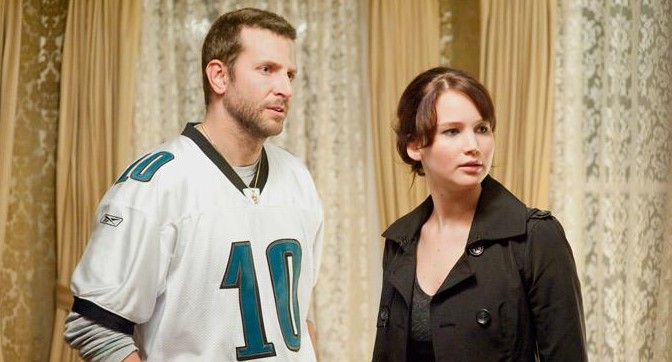
Bradley Cooper and Jennifer Lawrence in an unusual love story Silver Linings Playbook

Director: David O. Russell

Cast: Bradley Cooper (Pat Solitano Jnr), Jennifer Lawrence (Tiffany Maxwell), Robert De Niro (Pat Solitano Snr), Jacki Weaver (Dolores Solitano), Anupam Kher (Dr Cliff Patel), Chris Tucker (Danny McDaniels), Julia Stiles (Veronica), Shea Whigham (Jake Solitano), John Ortiz (Ronnie)

David O. Russell is a director it’s easier to admire than fall in love with. I can see why actors come back to work with him time and again – he’s clearly an actors’ director who crafts stories that give them chances to shine. But his films often have an archness about them, while I find too many of them settle for a sort of middle-of-the-road quirky cool. I’ve never really, truly, loved any of them – even if I have enjoyed them while watching them. The closest I think I’ve got is Silver Linings Playbook.

Pat Solitano (Bradley Cooper) is released from psychiatric hospital, after being confined for assaulting his ex-wife’s lover, into the care of his parents Pat Snr (Robert De Niro), unemployed now making a living as an underground bookmaker, and Dolores (Jacki Weaver). Suffering from a host of compulsions connected to his bipolar disorder, Pat is fixated on winning back his wife. To do so, he enlists the help of Tiffany (Jennifer Lawrence), the widow of a policeman who died in a road traffic accident, who has her own borderline personality disorder and has been dealing with her grief through a parade of casual sexual encounters. Together they enter a dance competition – Tiffany because she always wanted to, Pat because Tiffany has offered to take Pat’s letters to his wife if he says yes and because Pat wants to prove to his wife that he has changed. But is there more than mutual convenience between the two?

Silver Linings Playbook is an unusual romance, that also explores themes of mental health and compulsions and how thin the lines can be between what we consider healthy and not healthy. When does obsession tip over into something that should be treated? Pat is the sort of guy who wakes his parents up to furiously denounce the Hemingway book he has just finished reading in one sitting (a scene played exuberantly for laughs – including Pat smashing a window by throwing the book out of it) but it quickly tips into danger when in a similar mania he awakens the entire neighbourhood at 3am tearing the house apart for his wedding video, accidentally hits his mother, and ends in a tear filled scuffle with his dad. Similarly, Tiffany’s tendencies towards aggression and self-destruction frequently put her in situations both funny and dreadfully damaging.

But just as close to this, we have Pat Snr’s addiction not only to gambling, but also to a raft of superstitions designed to better his chances of winning (and which dominate large parts of his life). Dolores seems obsessed with maintaining peace and order in the family. Pat’s brother has an almost savant tendency to speak his mind, causing more harm than good. Every character in this seems to have their own psychological hang-ups, with resulting problems.

But the film marries this up with an actually quite sweet romantic story between two damaged souls, both very well played by Cooper and Lawrence. This was the film where Cooper repositioned himself as a major actor of note. His performance here is a perfect mixture of charm, pain, confusion, frustration, insight and self-destructive monomania. He’s both funny and deeply moving, sweet and also slappable, gentle but with a capacity for unpredictability. He’s a terrific performance, deeply affecting. It also helps he has fabulous chemistry with an Oscar-winning Jennifer Lawrence. Lawrence’s Tiffany is a vulnerable soul, desperate to appear as tough and impossible to harm as possible and not caring about any of the collateral damage. She’s as brittle as she seems rigid, and as desperate for affection as she pretends to be uncaring about it.

The film throws these two together with an obvious spark from the start, and brilliantly uses their preparation for a dancing contest to show them growing closer together physically and emotionally, as well as adding a purpose to their lives and giving them a common goal to work towards. There is a rather nice gentleness, amongst all the chaos of this film, that something as simple as taking up a new hobby can help to ground two people.

The film builds the romance gently, carefully showing it developing organically and leaving us to guess at what point the bond between these two enrichens and deepens from an instant connection to something more profound. It’s sure got a lot to overcome, with Pat’s obsessive focus on his wife and Tiffany’s compulsion for meaningless sex and her own desire to destroy promising relationships (she almost immediately alienates the surprisingly gentlemanly Pat with an offer of casual sex on their first meeting). With a gentle slow-burn, the film builds towards something that ends up being rather moving.

Russell’s adaptation of the original novel is well-structured and entertaining and his unfussy, stylish direction brilliantly creates an enjoyable mode. De Niro (in what many people called a joyous return to form) and Weaver are both very good as the parents (both were Oscar nominated – this is one of the few films to be nominated in each acting category) and there is hardly a weak beat in the cast. After several quirky, indie-cool, rather distant films, this is possibly the most fun and the most heart-warming Russell has ever been. It’s a career high. Heck even Chris Tucker is really good. And I’d never thought I’d say that.

X-Men: Dark Phoenix (2019)

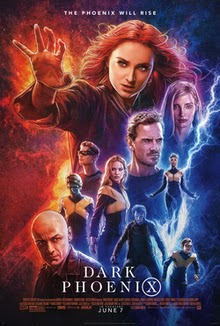
Sophie Turner does her best with a franchise that has finally seen better days in Dark Phoenix

Director: Simon Kinberg

Cast: James McAvoy (Charles Xavier), Michael Fassbender (Erik Lensherr/Magneto), Jennifer Lawrence (Raven Darkholme/Mystique), Nicholas Hoult (Hank McCoy/Beast), Sophie Turner (Jean Grey), Tye Sheridan (Scott Summers/Cyclops), Alexandra Shipp (Ororo Monroe/Storm), Kodi Smit-McPhee (Kurt Wagner/Nightcrawler), Evan Peters (Peter Maximoff/Quicksilver), Jessica Chastain (Vuk), Ato Essandoh (Jones)

As Dark Phoenix limps out of a cinema near you, losing the studio almost $100 million and finally consigning to oblivion for evermore an X-Men franchise that has lasted almost twenty years, it would be easy to think this must be one of the worst films in comic book history. It’s not. But then again it’s not the best. Dark Phoenix’s main problem is not really that it’s bad, more that it’s a bit meh. After umpteen films, I’m not sure there was anything new to show or tell about these mutant superheroes – and this film certainly failed to find it.

It’s 1992 and the X-Men are international heroes – something that may be going to the head of Charles Xavier (James McAvoy) who gets feted at major events and has a direct hotline to the President. On a mission into space to save a stranded space shuttle crew, powerful telepath Jean Grey (Sophie Turner) is hit by a strange cloud of glowing space power – and when she returns to Earth she finds herself struggling with a split personality, with a dangerous darker side of her personality taking control of her actions. It’s encouraged by a mysterious alien Vuk (Jessica Chastain) who wants the power in Jean Grey for her own ends. Can the X-men overcome conflict and tragedy to come together once again and save the world and Jean Grey herself from her demons?

Simon Kinberg finally takes the helm after producing and writing several other films in the series – although his promotion feels more like a failure to find anyone else interested in doing the job. General lack of real interest permeates the film, as if most of the stars only came on board because they felt an obligation to put a cap on the series. Jennifer Lawrence presumably came back in order to be killed off (no spoilers, it’s in all the trailers) while Michael Fassbender gives off the air of a man who’d rather be anywhere else. 

It’s not a huge surprise since the script goes through the motions, retelling a comic book storyline around Jean Grey’s “Dark Phoenix” personae that had already been done once (disastrously) already in X-Men: The Last Stand. Retreading the action here, this is certainly a better film (at least Simon Kinberg understands the characters and what makes them tick in a way Brett Ratner on that film didn’t) but it’s still a lot of the same story beats, similar types of location and brings it all together into a series of set pieces and moral conundrums that quite frankly we’ve seen before.

On top of which, Kinberg is not an imaginative enough visual stylist to make any of it look new. He’s not a bad director by any shot, but he’s a thoroughly middle brow one and he puts together a film that echoes and repeats stuff from the previous films in a way that never really feels fresh. Instead every single action beat or emotional moment feels like a quote from a previous film in the series, and never does the film really take fire and become its own thing.

This needed something special or new to bring the franchise roaring out in a blaze of glory. Instead it sort of meanders towards a resolution most people watching can probably already guess. Kinberg’s version of the story here also throws in several mistreads, most notably a plot line involving aliens and mystical clouds from space. Now I’m reliably told this fits with comic book lore. But much like in Spider Man 3 (remember that?!) when a blob of black alien space goo infected Peter Parker, introducing aliens into this series that has always seem grounded on Earth seems a bit – well – silly if I’m honest. Again it reminds you how slowly and carefully Marvel built up its universe stretching sand box. This ham-fistedly throws aliens of uncertain provenance into its world and somehow, despite this film featuring a hero who can shoot lasers out of his eyes, it feels a bit silly. 

It’s not helped that the aliens plot line is confused and their aims unclear or that Jessica Chastain looks non-plussed to be in the thing at all, as if she lost a bet or something. It does mean that we get a (reasonably) happy ending of our heroes coming together to fight an external threat – but even this feels like a tacked on reason to throw into the mix a clear antagonist, instead of dealing with the sort of shade-of-grey (no pun intended) antagonist who is also still sort of one of the good guys.

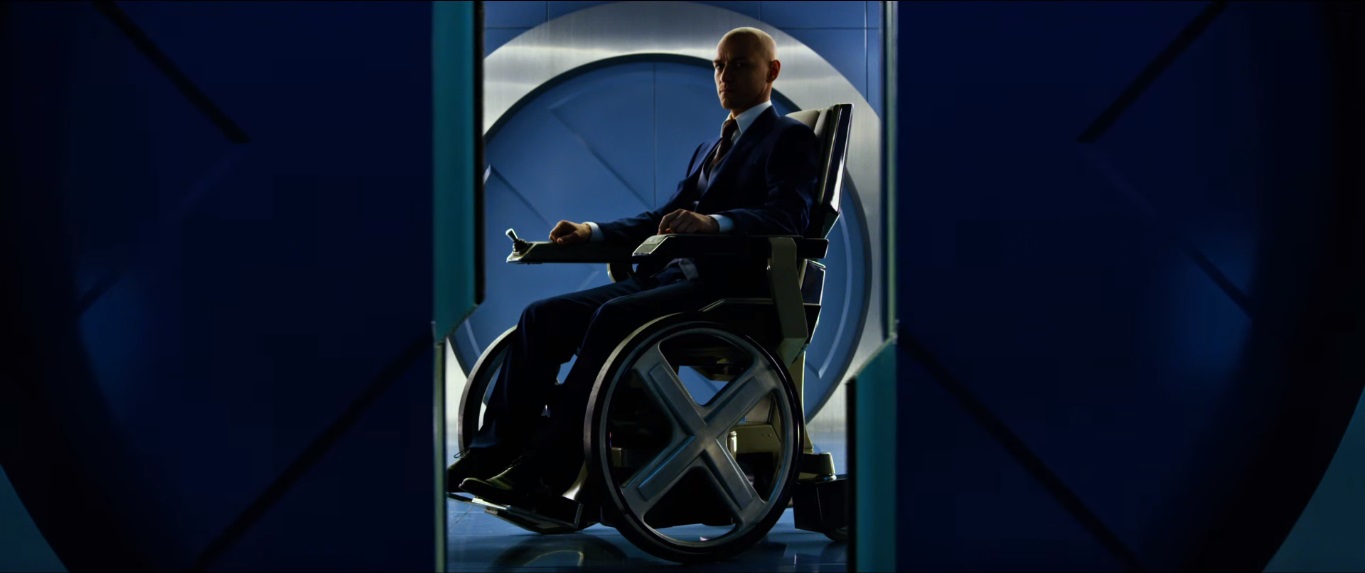
It’s telling that the film works best when it focuses more on character. Sophie Turner does a pretty decent job as Jean Grey, despite not being given masses to work with. James McAvoy enjoys the best storyline, of a Charles who has lost his way slightly and been seduced by fame – but deep down is still the humane, caring and loving character he has always been. It’s a new light to see the character in.

I think the main problem with this film is its lack of anything really original other than the odd beat like that. Everything as been seen before and, like X-Men Apocalypse despite the world-shaking events everything feels a bit rushed and lacking impact. Dark Phoenix is a decent enough entry into a long-running franchise and doesn’t short change you of the sort of thing you’d expect from an X-Men film. But that’s really it’s a problem. It’s a solid, average, okay entry into a long-running franchise but not the final hurrah the series needed to go out on an earth-shattering high.

American Hustle (2013)

Glamour and confidence tricks in David O. Russell’s flashy American Hustle

Director: David O. Russell

Cast: Christian Bale (Irving Rosenfeld), Amy Adams (Sydney Prosser), Bradley Cooper (Richie DiMaso), Jennifer Lawrence (Rosalyn Rosenfeld), Jeremy Renner (Mayor Carmine Polito), Louis CK (Stoddard Thorsen), Jack Huston (Pete Musane), Michael Peña (Paco Hernandez/Sheik), Elisabeth Röhm (Dolly Polito), Shea Whigham (Carl Elway), Alessandro Nivola (Anthony Amada), Robert De Niro (Victor Tellegio)

In 2013, American Hustle was nominated for ten Oscars and won none of them. Somehow, being invited to the big party but not receiving any prizes was strangely fitting for a film about small time grifters forced into a big game way beyond their control. Russell’s film is like a celebration of his strengths and weaknesses as a director: it’s stuffed with some very good (if rather mannered) performances, offers lots of dynamic film making, but is still basically a rather cold and arch film that’s hard to really invest in – rather like a con game in itself.

In 1978, Irving Rosenfeld (Christian Bale) is a small-time grafter, running scams with his partner and lover Sydney Prosser (Amy Adams), who uses the identity of a young English aristocrat “Lady Edith Greenslly”. Rosenfeld longs to leave his unstable, selfish wife Rosalyn (Jennifer Lawrence) for Sydney, but fears he will lose all his access to his adopted son. Rosenfeld and Prosser’s career of clever investment frauds is brought to an end when Prosser is caught red-handed by FBI agent Richie DiMaso (Bradley Cooper). DiMaso forces the pair into his entrapment operation, targeting New Jersey politicians with offers of bribes as part of a Fake Sheik investment. Initially it targets Mayor Carmine Polito (Jeremy Renner), but the operation quickly expands, as the ambitious and impulsive DiMaso constantly follows every connection and the operation expands to dangerous levels, taking in the mafia. Scared, Rosenfeld and Prosser desperately try to play both ends against the middle.

American Hustle is a decent film, which pulls together the sort of capers, turmoil and antics that you would expect from a film about a long con. It throws into the melting pot the vibes of several other films, from The Sting to Goodfellas, and asks us to admire the results. Russell encourages the actors to play it with an edgy verisimilitude that pretty much works as a metaphor for con men. Each performance is an effective display of high-wire character acting work laced with arch, studied tricks. But only rarely do you get a sense of something that’s real.

That’s part of a film that wants to have a cake and eat it as well. It’s striking in the entire story that the most sympathetic character is the initial target, Jeremy Renner’s well-meaning, passionate New Jersey politician, bamboozled into taking a bribe (money he mostly uses in the local community) because he is convinced it’s a crucial part of getting Arab investment. It’s even more striking that the most honest, subdued (and deadly) character is the Mafia kingpin Victor Tellegio, played with chilling menace by an unbilled Robert DeNiro. Nearly everyone else on the side of the entrapment operation is pretty much a selfish prick or verging on the unhinged.

But then that’s part of the point of the film, which throws two people who know what they are doing (Rosenfeld and Prosser) at the mercy of people playing with fire (Roselyn and in particular DiMaso, a permed, tightly-wound powderkeg). This is one hell of a performance from Bradley Cooper – and a sign again after Silver Linings Playbook that Russell and he have a natural understanding. Cooper is a force of nature, a bundle of terrible impulses combined with an utter lack of shame or self-control, who is quite happy to trample over everyone to get what he wants and has no regard whatsoever for the danger he puts himself and others into. Utterly unpredictable, he never sticks to a plan, veers between rage and hysterical laughter and, worst of all, is always convinced he’s right.

It’s DiMaso who spins the operation into dangerous waters with his vaulting ambition to land yet another big fish, recklessly peddling insubstantial, unprepared lies on top of each other – to the terror and horror of practised peddlar of bullshit Rosenfeld, whose whole successful schtick is based on saying “no” and having the mark do all the desperate work. DiMaso’s approach not only puts the operation at risk, it puts lives at risk – not that DiMaso cares, preoccupied as he is with his childish one-upmanship with his boss and a teenage sexual obsession with Prosser.

What chance do the (mostly) small-fish politicians and local figures have, whose lives are placed on the altar of DiMaso’s ambition? It’s no wonder that, late in the film, our conmen heroes start to feel guilt and remorse – none more so than Irving Rosenfeld. Played by Christian Bale with the sort of tricksy, Olivier-ish disguises that he so loves (in this case increased weight, a balding comb-over and a pair of tinged glasses he obsessively fiddles with), Rosenfeld is an operator happy with the level he is working at and incredibly wary of stepping up into the dangerous big leagues. Justifiably convinced of his own professionalism at fleecing money and winning trust, Rosenfeld has no problem with taking money from the selfish but every problem in the world with destroying the life of a fundamentally honest man. Bale’s performance, for all the tricks, manages to successfully build a picture of a selfish man who believes himself in his way to be honest in a way and is just trying to make his way.

That way also involves balancing between two very different women. Amy Adams does decent work as a blowsy fake-aristocrat, sporting a series of tops with neck lines that literally plunge down to her waist, although she is perhaps a little too “nice girl next door” to really convince as the love-em-to-manipulate-them Prosser. She’s not also helped by the script giving her an ill-defined arc of self-doubt linked to pretending to be someone else. Sweet as the genuine love can be her between her and Rosenfeld – and excellent as her chemistry is between Bale and Cooper – it’s the character who remains the least knowable in the film.

Also not helping is the fact that Jennifer Lawrence burns through the film as Rosalyn, the sort of electric, larger-than-life but still very real performance of arrogance, selfishness, dangerous stupidity and greed that marked her out as a major actress. Whether inadvertently putting Rosenfeld’s life at risk through blabbing details she’s half-overheard and half-understood, cleaning the kitchen while singing an aggressive rendition of Live and Let Die or nearly burning the house down because she won’t believe metal can’t go in “the science oven” (aka microwave), Lawrence is the film’s MVP.

Russell’s film showcases all these actors brilliantly, but his overall story remains a little cold and not as clever as it thinks. With a film about conmen you expect a final rugpull – and this film sort of manages one – but the story telling to take us there isn’t quite as articulate and clever as it needs to be in order to be really satisfying. Perhaps it’s the film’s ragged, hip, indie style of telling – or the air that the actors are making a lot of this stuff up as they go with edgy, semi-improvised performances – but the film never really engrosses or engages. For all that we see the inner worlds of Rosenfeld and Prosser, I can’t say I really, truly cared what happened to them. 

Instead Russell focuses on the marshalling of his resources, and cool, slick film-making. He uses expert camera work and editing, mixed with a superbly chosen soundtrack, overlaid with voiceover, sudden transitions, some narrative jumps and a vibrant sense of cool to make a story that finally feels a little too much like a style-over-substance trick – in fact a con game all of its very own, as enjoyable and entertaining as the rest of the film, but when it finishes you realise your pockets are empty.

Red Sparrow (2018)

Jennifer Lawrence tries but fails with dismal material in the dreadful Red Sparrow

Director: Francis Lawrence

Cast: Jennifer Lawrence (Dominika Egorova), Joel Edgerton (Nate Nash), Matthias Schoenaerts (Ivan Vladimirovich Egorov), Charlotte Rampling (Marton), Mary-Louise Parker (Stephane Boucher), Ciaran Hinds (Colonel Zakharov), Joely Richardson (Nina Egorova), Bill Camp (Marty Gable), Jeremy Irons (General Vladimir Andreiovich Korchnoi), Thekla Reuten (Marta Yelenova), Douglas Hodge (Colonel Maxim Volontov)

Dominika Egorova (Jennifer Lawrence) is in trouble. After an act of sabotage by her dance partner, her career in ballet is over. Out of options, she is forced into enrolling at the elite FSB Sparrow School by her uncle Ivan (Matthias Schoenaerts). There young men and women are trained, under the tutelage of its controlling Matron (Charlotte Rampling), to sacrifice all their pride and their bodies for the good of Mother Russia. Thrown into the field, Dominika finds herself entangled with the CIA Agent Nate Nash (Joel Edgerton), whom she has been ordered to seduce.

Red Sparrow is a bad film on several levels. Firstly, it’s at heart a trashy espionage movie that confuses being about intelligence with actually being intelligent. A few late twists doesn’t suddenly make this a work of genius. Secondly, its attitude of being about this damn dirty business of spying manages to make it so grim it’s not even fun to watch. Finally, it’s the sort of film that thinks constantly telling us it has a strong female lead at its heart is the same as actually having a strong female lead at its heart.

To take that final point last… Poor Jennifer Lawrence. Surely only the $20million she was paid for this film attracted her to this. I’ll start by saying she feels miscast in a role that requires a ruthlessness and capacity for viciousness that is not a natural part of her range. But this film struggles to make her feel like a character with real agency. During the course of this film, she has her leg broken, nearly gets raped (twice), strips down in front of a group of people (twice), gets smacked in the face, beaten, tortured, stabbed, shot… And a few sudden last minute gear reversals which suggest that she has been playing her own game this whole time don’t shake the impression that the film is wallowing in the torture and violence that runs through the film.

Anyway, the film is reliant on that because it’s not sharp or clever enough to really have anything else in there in its place. So we stumble from violent set piece to violent set piece, while the characters talk incessantly about macguffins and characters we care almost nothing about. The film has an almost impenetrable plot, not because it’s complex, but because it’s poorly explained and impossible to care about. Actors who are way too good for this material – and I mean the whole cast – struggle to put fire and energy into a shaggy dog story that never goes anywhere.

This all serves to make it a dull film. It really should be a guilty pleasure. All the right material is in there. Spy thrillers make for fun films. It’s interesting to have a woman at the centre of it. It’s got good actors. But too many scenes and set pieces veer towards the overly violent and sexual. For a film that is about a silly spy training school turning out honey trap agents, this film seems determined to ram the grimness of spying in our faces at every turn. This makes sense for a high brow Le Carre adaptation. It makes no sense for silly high-concept Jennifer Lawrence star vehicle.

Who really needs to watch poor Jennifer being slapped about and ill-treated for over two hours? Who has the patience for it? Who is going to enjoy it? The film struggles to get across the idea that Dominika is good at this spying game so it needs other characters to say it openly. Its rug pull towards the end lacks all signposting so gives no satisfaction whatsoever. By the time it comes round you’ll have long ceased stop caring about anything in it as well. A tedious, grimy and rather unpleasant film from start to finish that leaves a sour taste in the mouth.

X-Men Apocalypse (2016)

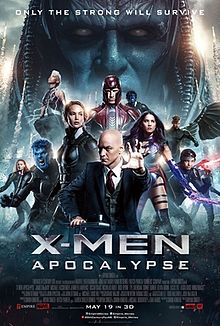
Oscar Isaac destroys something else (again) in misfire X-Men Apocalypse

Director: Bryan Singer

Cast: James McAvoy (Charles Xavier/Professor X), Michael Fassbender (Erik Lehnsherr/Magneto), Jennifer Lawrence (Raven/Mystique), Oscar Isaac (Apocalypse), Nicholas Hoult (Hank McCoy/Beast), Rose Byrne (Moira MacTaggert), Evan Peters (Peter Maximoff/Quicksilver), Tye Sheridan (Scott Summers/Cyclops), Sophie Turner (Jean Grey), Olivia Munn (Psylocke), Kodi Smit-McPhee (Kurt Wagner/Nightcrawler), Alexander Shipp (Ororo Monroe/Storm), Lucas Till (Alex Summers/Havoc), Josh Helman (Colonel William Stryker), Ben Hardy (Angel)

Where do you go with a franchise when you are on at least your second timeline (maybe more, who knows?) and earth-shattering destruction has been done so many times before? At one point in this movie, our young heroes head to the cinema to watch Return of the Jedi – with a genre savvy conversation following on whether the third film in a franchise is always the worst. You’d like to think if you were going to pop such a hostage to fortune in the third film of your franchise, then you’d be busting guts to make this film as stand-out as possible. Doesn’t happen.

It’s 1983. Charles (James McAvoy) is still running his school with Hank (Nicholas Hoult). Raven/Mystique (Jennifer Lawrence – looking for every single second as if she is only there by contractual obligation) is saving mutants left, right and centre on the underground. Magneto (Michael Fassbender) is living incognito in Germany with a wife and daughter. All that is about to be thrown into chaos when Apocalypse (Oscar Isaac, trying his very best to make an impression under piles of make-up), the very first mutant, rises from imprisonment after thousands of years. The most powerful mutant in history, he decides the world is ripe and ready for the taking.

In X-Men: Apocalypse, not only is more not more, but the film churns out emotional character and relationship beats, covered to exhaustion in other movies. One glance at Magneto’s family and anyone who has ever seen a movie is going to know they are not long for this world. Raven and Charles no sooner appear in the same frame than you know the two of them are going to struggle to reconcile their past with their different viewpoints. We’ve seen it all before – and you feel, in the slightly disengaged performances, that the cast have had enough as well. Even Apocalypse, for all his world-altering power, basically has the same agenda as every mutant villain this franchise has ever had before: Mutant Superiority. 

Around these familiar plot beats, we get action that also feels culled from before. The film culminates in such earth-shattering destruction you really feel it should be more exciting, but instead it feels tediously familiar. How many times have we seen cities devastated like this? It’s such a cliché that the millions of people who must have died in the planet-wide obliteration that consumes the final third of the film don’t even merit a mention. It’s like the world treats this global destruction with the same meh that you feel a number of the film’s viewers do. 

But then the whole film has a weary sense of inevitability about it, of going through the motions. The plot makes little or no sense. Apocalypse is awoken by a cult we never hear from again, the whole film takes place in a few days, barely enough time to build up any sense of peril – but also somehow too short a time for the vast number of comings-together of different characters to feel natural. Characters from past films are thrown in willy-nilly, often for no real reason. So from the first scene we have Moira MacTaggert and Havoc back from the first film, then Quicksilver is back to repeat his bullet-time action from Days of Future Past (saying that, this sequence, as Quicksilver rushes to save people from an exploding mansion to the tune of Sweet Dreams, is the most vibrantly enjoyable moment in the film). We even get Stryker back, a character who becomes more and more of a cartoony villainous idiot each time he appears.

In between these points, the film frequently misses its beats. Apocalypse’s assembled group of mutant followers are assembled with such casual indifference (Apocalypse basically seems to pick up the first four mutants he meets) that their characters and motivations barely register. Obviously we know Storm is destined to be a goodie, so we get a few seconds of establishment that she is basically a goodie. Magneto gets his painfully predictable backstory (Michael Fassbender is by the way totally wasted in this movie, forced to repeat the same notes over and over again from the last two films). The other two barely make an impression – other than perhaps Olivia Munn’s unbelievably fanservice costume.

But it also makes more serious errors. A hideously distasteful moment sees Magneto destroy the whole of Auschwitz in a rage. There is, quite frankly, something more than a little stomach turning about the site of a real atrocity – where millions died – being blown away on screen like any other major landmark. Even more disgusting to have it serve as a shallow, over-exploited “he feels pain because he was in the Holocaust” moment. Other times in this series this link has worked – here it manifestly doesn’t.

About the only thing that really works here is the darker interpretation of Charles – McAvoy making it clear that events have made Xavier far more willing to go to dangerous ends to protect his family – and there is a neat replay of the first conversation between Xavier and Magneto from the very first film in the franchise, with the stresses all changed to show that their positions have developed in a far different way in this new timeline. But that’s the only real moment that feels new.

But I’ve still got a certain affection for these X-Men movies, and this isn’t the worst one they’ve ever made (that’s always going to be X-Men Origins: Wolverine), but it’s up there. It somehow doesn’t feel special, more like a film that had to be made for legal and financial reasons, rather than because there seemed like a decent story to be told, or something unique to be said. The rushed plot and lack of engaging characters make more sense when you think about it like that. It’s nothing special at all, and seems to pass in front of your eyes and then just as quickly out of your memory.

Passengers (2016)


Jennifer Lawrence and Chris Pratt juggle moral dilemmas in the surprisingly dark Passengers

Director: Morten Tyldum

Cast: Jennifer Lawrence (Aurora Lane), Chris Pratt (Jim Preston), Michael Sheen (Arthur), Laurence Fishburne (Gus Mancuso)

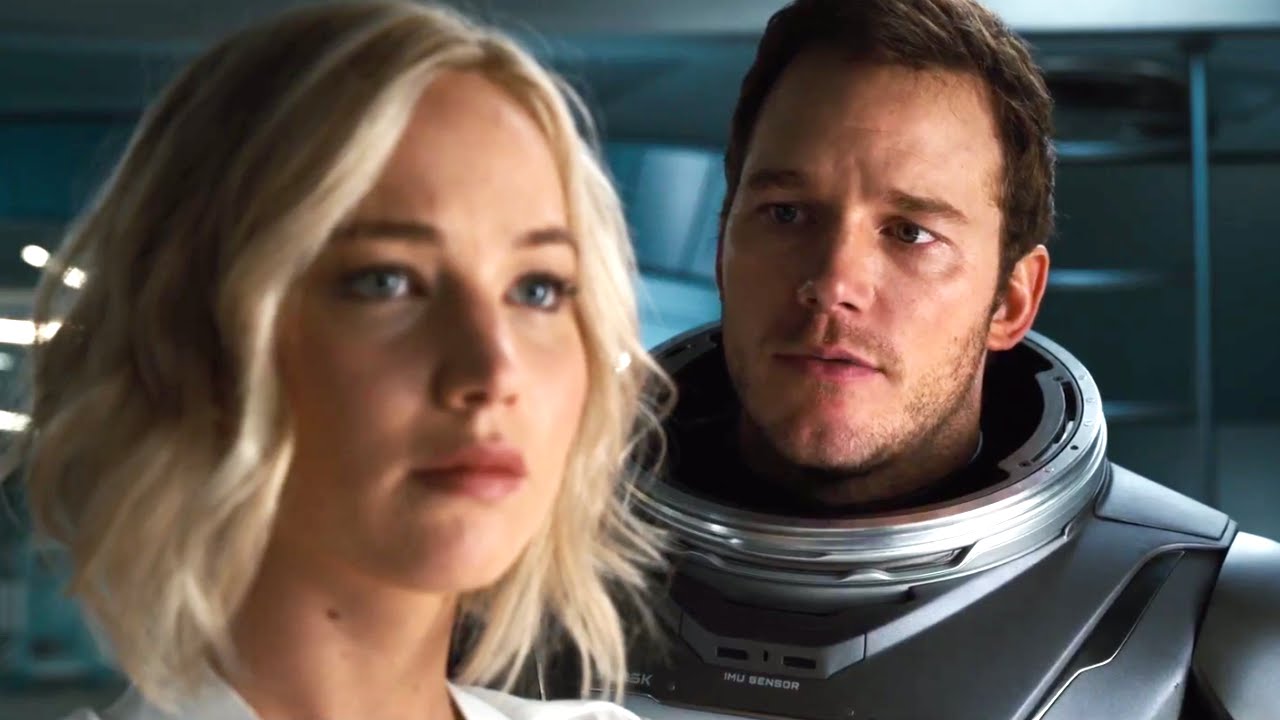
The Avalon is a spaceship carrying over 5,000 passengers and crew to a new planet for resettlement. With the flight due to last 120 years, everyone is in suspended animation. After an accident, passenger Jim Preston (Chris Pratt) is woken 90 years early. Trapped on the ship, unable to return to cyrosleep or change the direction of the ship, and with the round-trip time for messages to Earth being 76 years, Jim faces living the rest of his life alone on a spaceship. After over a year of isolation, with only android bartender Arthur (Michael Sheen) for company, Jim succumbs to temptation and wakes another passenger, Aurora (Jennifer Lawrence), for companionship. They fall in love over time – but how will Aurora react when she finds out the truth?

Passengers was a film that received a negative reaction perhaps because it managed to successfully not spoiler its plot in advance. While the trailer seemed to promise this would combine mystery and romance in a space setting, it’s actually more about the effects of isolation and the moral quandary of relieving your own despair by placing someone else in the same position. While the film is never going to win awards for its exploration of psychosis, it certainly tries to tackle this idea and explain – but not excuse – why Jim takes the decision he does.

A lot of people felt this suggested Aurora effectively falls in love with her kidnapper-cum-stalker, and that Jim’s actions are glossed over. Well I’d argue against this. Firstly, the film never shirks the repercussions of Jim’s decisions – indeed that’s really what the film is about: can you forgive the unforgiveable? A large chunk of the film is a build up to Jim taking a decision he acknowledges is wrong, and feels tremendous guilt and shame about. The later section of the film revolves around the impact of this action coming to light. Discovery of the truth destroys Aurora and Jim’s relationship, and it’s uncertain for much of the rest of the film whether there will ever be any forgiveness for Jim. If the film had shelved the issue, or Jim had been forgiven within minutes of screentime, that would be another question.

Secondly, the film works hard to show the savage psychological impact of complete isolation, and (after a year of this) the dangerous temptation of having a companion a push of a button away. Jim is clearly not in his right mind when he makes his decision – and later when Aurora faces the prospect of similar isolation, she responds with similar despair. If there is a fault with this, it is that the film shies away from defining the time progression explicitly enough – and doesn’t quite have the courage to increase its timeline (imagine if Jim had been alone for 3-5 years rather than one. Imagine if Jim and Aurora had not spoken for 2-3 years rather than one etc. Straightaway, I think the actions in this film could have been more readily understood by people).

Thirdly, these questions of isolation and morality are not as black and white as your casual internet moaner would like. Trapped alone with no human interaction, with literally zero chance of being rescued, is a psychological situation it’s just impossible to comprehend. Expecting people to behave as they would normally is simply unreasonable. Jim and Aurora do not fall in love after the truth comes out – they fall in love well before this (sure Aurora doesn’t know what Jim has done, but her feelings for him are real) – so it becomes a question of forgiving someone you love who, in extraordinary circumstances, has done something they normally would never do.

As such, Passengers is actually the sort of film where it will benefit you to discover more about what the film is going to be about before you go into it (and how often do you hear that?). Because, once you know the sort of film you are going to get, it’s not that bad a film. It’s handling of these moral issues is, I’ll readily admit, not the most effective or thought provoking (and the lack of mention of it before the film’s release, and its slight fudging through the film, suggests the “suits” weren’t happy with it either) but at least this is a film with some ideas behind it. If it had really seized the effect of isolation as its theme, and really explored the moral issues behind Jim’s actions, it might well have avoided much of the criticism. But it does enough to make some of that criticism unfair.

Away from this main plot point, Passengers is an entertaining, high-budget, character piece. Whatever your view of the character, you can’t argue against Pratt’s charisma and wit as a performer and Lawrence is also good. It’s not their best work, but they make the relationship – with all its peaks and troughs – work, and it’s endearing or tense as required. Michael Sheen is also excellent as the humanish-but-not-human-enough android bartender. The design of the ship is imaginative and the film looks gorgeous. The second half of the film delivers a fine series of tense set-ups (even if many of them are echoes of things we have seen before), and Tyldum does well to ensure that the often swiftly changing mood of the film (despair-romance-anger-tension-danger-terror etc.) seems like a smooth progression rather than a jarring one.

Passengers doesn’t have the courage of its convictions to really explore its “Ben Gunn in Space” set-up, and much of the criticism of its plot stems from its not-completely-committed exploration of the effects of isolation. But, if you know what you are going to get, it’s an entertaining film.