Tag: Joan Cusack

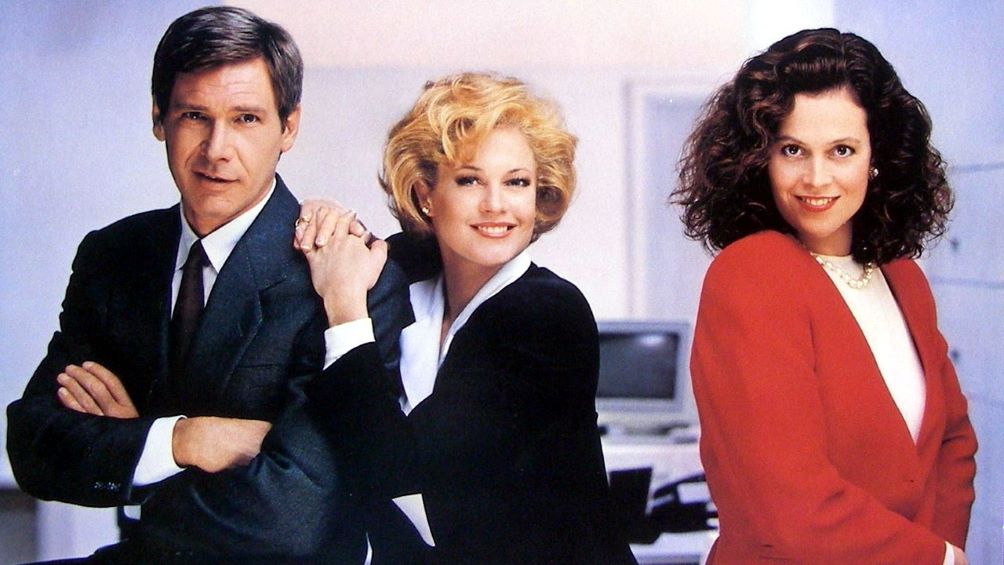
Working Girl (1988)

Working Girl (1988)

Wall Street gets the Cinderella treatment in this romantic comedy of sexual politics and mega-hair

Director: Mike Nichols

Cast: Melanie Griffith (Tess McGill), Harrison Ford (Jack Trainer), Sigourney Weaver (Katherine Parker), Alec Baldwin (Mick Dugan), Joan Cusack (Cynthia), Philip Bosco (Oren Trask), Nora Dunn (Ginny), Oliver Platt (Jack Lutz), Kevin Spacey (Bob Speck), Robert Easton (Armbrister), Olympia Dukakis (Personnel Director), Amy Aquino (Alice Baxter)
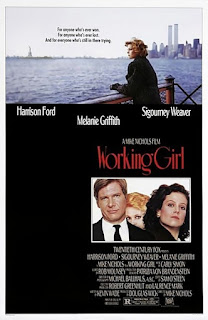
Is there a more 80s film in existence? It’s got the hair, the fashion, the attitudes, the Reagonite go-getting celebration of the guts and glory of Wall Street. Tess McGill (Melanie Griffith) looks and sounds like a dumb secretary, but she’s got the brains for business (but also, as she says, a bod for sin) – just never the opportunity to prove it. It looks like that might change under new boss Katherine Parker (Sigourney Weaver), who’s all smiles and talk of the sisterhood – but pinches Tess’ ideas and passes them off as her own. When Katherine is injured on a ski trip, Tess takes the chance to prove she’s got it by passing herself off as Katherine’s colleague and enlisting the help of mergers expert Jack Trainer (Harrison Ford) to put together a mega-bucks media merger. But what will happen when Katherine finds out?

Working Girl is really a great big Wall Street fairy tale, with Tess as the Cinderella invited to the ball only to have to run away leaving the business equivalent of her glass slipper behind. Katherine is a wicked stepmother, and Jack the handsome prince. It’s the sort of film where the heads of corporations are cuddly figures who place fair-play and honesty above making a buck and goodness, wins out in the end. Basically, it’s about as much a slice of business realism as Pretty Woman (this film could almost be a dress rehearsal for that).

Nichols directs the entire thing with confidence and pizzazz and draws some good performances from the actors, while keeping the entire thing light, frothy and entertaining. He had to fight tooth and nail to cast Melanie Griffith – but it was a battle worth winning as the role is perfect for her. Griffith always finds it hard to get good roles – her light, airy voice has condemned her to a string of airheads and bimbos – but here it’s perfect for a woman everyone assumes is dumb the second she opens her mouth. She’s even thinks of herself as not that bright, accepting her lot in life is settling for second best.

That’s personally and professionally. Her boyfriend, played with a wonderful smarm by Alec Baldwin, is a rat (she walks in to her flat to discover him mid-coitus – “This isn’t what it looks like!” he protests with an unabashed grin), who constantly reminds her that she’s punching above her weight dating him. Tess is at the bottom of an ocean of sexism on Wall Street: traders see her as little better than a perk, slapping her bum or stopping to stare at her behind when she walks past them. She barely avoids sexual assault from a coke-addled trader in the back of a limo (a piece of presciently perfect casting for Kevin Spacey). Her first boss (a puffed-up Oliver Platt) routinely humiliates her.
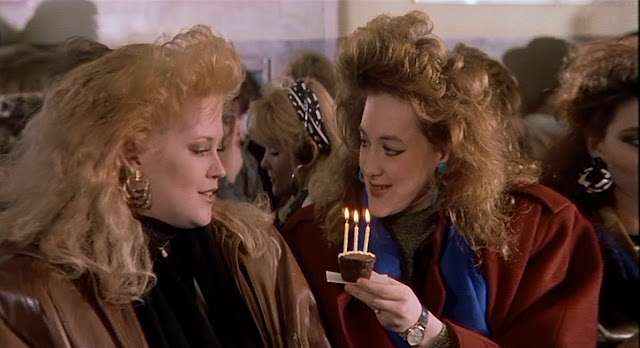
Oh my God! The Hair!

To be fair, the film makes clear that much of this is a woman’s lot in this poisonous world of Wall Street. Even her boss Katherine has to patiently remove groping hands from parts of her body, and wearily tells Tess that it doesn’t do to kick up a fuss when you never know who might become a vital contact in the future. Working Girl makes some pretty gentle points about workplace sexism – you can’t fail but notice Katherine and Tess are the only two women in the office who aren’t secretaries or HR people, and even Tess is pretending not to be – and the casual objectification of women.

Sadly, it blows a few of those points by still getting Griffith and Weaver to perform scenes in lingerie. Griffith even has a brief scene where she hoovers Weaver’s empty apartment topless. Sure, it’s a bit progressive on women’s rights in the workplace: but still, phroah, look at that.

Nichols gets one of his most relaxed and loose performances from Harrison Ford. Even if Ford at times looks a little abashed, working against such forceful performers as Griffith and Weaver (like a shy teenager in a school play), Nichols helps him feel light and funny without relying on the cool machismo that served him well as Indy or Han. Jack Trainer (such a Harrison Ford character name!), becomes giddy and playful under Tess’ influence and there is a sweet innocence about his courtship of her. It’s one of Ford’s funniest, most naturally instinctive performances.

Equally essential to the film’s success is Weaver, who plays up to perfection her glacial distance as a woman who is all smiles and “us, us, us” in person, but selfish looks and “me, me, me” in private. Weaver is very funny as a ruthless, amoral businesswoman masquerading as a campaigner for her sex and completely recognises that the role is essentially a wicked stepmother, pitching it just right between arch comedy and realism. She was Oscar-nominated, as was Griffith, and Joan Cusack who is triumphantly ditzy and warm as Tess’ best friend.

Working Girl pulls together all the tropes we expect. Tess is made up to look like the professional businesswoman she is aspiring to become, there is a neat bit of low-key farce as she passes off Katherine’s office for her own to Jack, a sweet bit of business chicanery as she Jack sneak into a wedding (the sort of thing that in real life would get you a restraining order) and it all leads into a “love and truth conquers all” resolution with a satisfying coda scene as Tess starts a new life. There is a lovely song by Carly Simon (over-used on the soundtrack – and fans should check out Michael Ball’s cover of it) and plenty of chuckles. It’s a fairy tale of New York.
Broadcast News (1987)

Broadcast News header
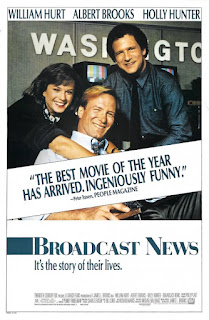
Albert Brooks, Holly Hunter and William Hurt struggle with the news and love in James L Brooks not very funny or insightful romantic media satire

Director: James L Brooks

Cast: William Hurt (Tom Grunick), Holly Hunter (Jane Craig), Albert Brooks (Aaron Altman), Robert Prosky (Ernie Merriman), Lois Chiles (Jennifer Mack), Joan Cusack (Blair Litton), Peter Hackes (Paul Moore), Christian Clemenson (Bobby), Jack Nicholson (Bill Rorish)

TV news – what is it for? To inform or entertain? It’s a debate James L Brooks tries to explore in his inconsistently toned hybrid rom-com and satire. At the end you very much intended to come out with the view that it should be about one, but is more about the other.

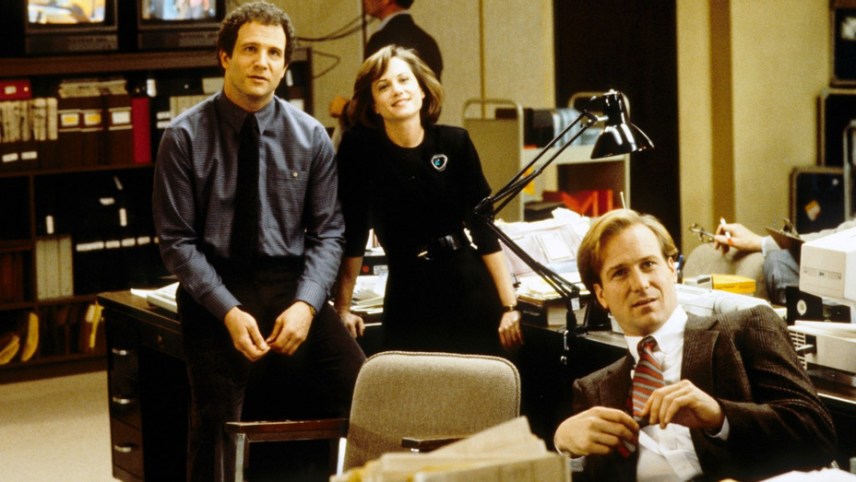
In the Washington branch of an unnamed network, Jane Craig (Holly Hunter) is a rising star producer, prone to daily emotional breakdowns. Her best friend is brilliant, committed reporter Aaron Altman (Albert Brooks), who longs to be the anchorman but lacks social skills. Arriving in their branch is Tom Grunick (William Hurt), handsome and full of TV savvy, set to become an anchor but lacking any real knowledge of either journalism or current affairs. Naturally a romantic triangle develops between these three, along with all sorts of debate about the purpose of TV news.

The film stacks the deck firmly in favour of the view that news should be a comment-free recitation of facts. Brooks’ film bemoans – often in heavy-handed ways – the intrusion of human interest, soft stories and puff pieces in place of hard-hitting questions and challenging coverage. Tom Grunick is the embodiment of this: charming, friendly, reassuring – and totally uninformed, interested in “selling” a story rather than telling it. Meanwhile, to the film’s disgust, the higher-ups at the network frequently value appearances and popularity over tough analysis, and looking good on TV counts for more than journalistic skills. Pity the film: if it feels this network is bad, imagine how it’d feel about Fox News today.

Of course what the film isn’t interested in is acknowledging a certain level of showmanship is an important tool in making the news accessible, engaging and interesting for the audience – making them more likely to pick up the important things in the content. It also overlooks that purists Aaron and Jane may avoid stage-manging their stories as overtly as others – but they’re more than happy to fill them with heart-string-tugging references and shots to get the audience reactions they want. In fact, you can see Tom’s point – what’s really wrong with him interjecting a shot of his own teary face while interviewing a rape victim (a moment he recreates)? Isn’t that basically the same?

Broadcast News tries to outline the difference, but I’m not sure it goes the full distance – or makes the debate accessible or interesting. That might be partly because the film can’t decide whether to give more attention to the satire or the romance – Jane is attracted to Tom (who returns her feelings), but is extremely close with Aaron, who carries a not-even-concealed passion for her. Both plots sit awkwardly side-by-side, getting in each other’s way and not adding insight to each other.

But then the film is fairly shrill. That partly stems from the two characters we are meant to relate to being tough to like. Holly Hunter is dynamic as the forceful, passionate Jane, but she’s also a rather tiresome character. Her purist demands are slightly holier-than-thou and while there are nice touches of humanity (on a date with Tom, she doesn’t want her handbag opened at a security check because she’s put a pack of condoms in it)  the film doesn’t manage to warm this control freak (so domineering she can’t get in a taxi without dictating the route). Jane also has a tendency to burst into tears – a suggestion of some underlying emotional problems the film instead treats as a joke.

That’s nothing compared to Albert Brooks’ Aaron Altman. This is exactly the sort of character beloved by film-makers, but who if you met in real life would come across an an unbearable creep. Like Jane, he’s an uncompromising idealist whose pious self-importance quickly grates. The film doesn’t appreciate the irony that its champion of professional reporting yearns to be the pretty-boy face of the network and resents that he’s neverbeen the popular kid.

His tantrums and rudeness are meant to be signs of his genuineness and the film leaves no doubt that his love for Jane should be requited because he knows what’s best for her. He’s the Nice Guy who doesn’t get the girls even though he really deserves them.  A scene where he furiously berates Jane when she confesses her feelings for Tom, then demands she leaves, then demands she stays so he can lecture her on his pain and why her feelings are wrong smacks of a thousand male script writers who didn’t get the girl they wanted and it was so unfair.

The film’s view of women is often questionable. Today, Aaron looks more like a Proto-Incel, one emotional snap away from strangling Jane because she won’t love him when she SHOULD. The film sees him as a relatable, principled hero. Jane may be smart and principled, but she’s hysterically over-emotional for no given reason (Women! They’re so crazy!), domineering and controlling. The film’s only other female character is Joan Cusack’s production assistant who spends her time either shrieking in shrill panic or talking with nervous incoherence.

So, it might be a fault of the film that the character I related to most was the one we were meant to condemn. William Hurt’s Tom is nice-but-dim, superficial but polite, supportive, hard-working and honest, self-aware enough to feel guilty that he’s not really qualified to do the job. He tolerates being mucked around by Jane far more than many others would and despite being constantly abused by Aaron, offers him no end of support. If Tom is the nightmare shape of TV news, you end up thinking “well heck, is it really that bad?”

Broadcast News overall is an underwhelming experience, not funny or romantic enough to be a comedy, or insightful enough about journalism to be thought-provoking. Brooks directs with his usual televisual lack of flair, but there are some decent comedic set pieces: Cusack has a mad-cap dash through a TV studio to deliver a taped report for a deadline that is a masterclass in physical comedy, while the film’s best set-piece is Aaron’s sweat-laden anchor appearance on a weekend news bulletin. But the film gives too many characters a pass and avoids asking itself the tough questions. It ends up a bit of a slog that probably has more appeal to insiders than audiences.

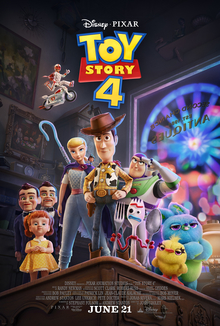
Toy Story 4 (2019)

Woody is tempted by a new life in Toy Story 4

Director: Josh Cooley

Cast: Tom Hanks (Woody), Tim Allen (Buzz Lightyear), Annie Potts (Bo Peep), Tony Hale (Forky), Keegan-Michael Key (Ducky), Jordan Peele (Bunny), Christina Hendricks (Gabby Gabby), Keanu Reeves (Duke Caboom), Ally Maki (Giggle McDimples), Joan Cusack (Jessie)

Probably the hardest thing about making the fourth film in an acclaimed, perfectly-formed trilogy (yup) is justifying its existence in the first place. That’s basically the main task that faces Toy Story 4 – does it manage to exist without ruining the other three? And was there any need to go back to a story that had already been pretty much finished perfectly.

After the third film, Woody (Tom Hanks), Buzz (Tim Allen) and friends are now settled with their new child, Bonnie (an imaginative 6 year old). But Woody is being played with less and less, and is struggling with the adjustment from being Andy’s most important toy to becoming a little-used toy in the box. Taking it upon himself to accompany Bonnie to her first day at kindergarten, he sees her use an art-class to turn a spork into a toy – a toy that quickly comes to life as Forky (Tony Hale). As Bonnie’s parents try to ease her anxiety about starting kindergarten by taking her on a road-trip, Woody obsessively tries to train the reluctant Forky – who doesn’t want to be a toy – in how to be a favourite toy.

When Toy Story 4 rapped up, I basically said I didn’t really need to see it again. That’s quite a sad statement to make considering the original trilogy of films are so damn good. But this never really feels like it does justify its existence. Toy Story 3 finalises the whole saga so well with Woody and the other toys coming full circle, having helped Andy grow up and now being passed to Bonnie to help her deal with her childhood. It’s a beautiful, heart-warming story – and there isn’t a need to see what happens next. 

Toy Story 3 ended with Woody accepting that Andy has grown up, choosing to stay with his friends as a toy rather than going to college with Andy. But here we need to hit the reset button so that Woody is now missing Andy and his previous status – but is also in denial about this. I think there is something in this that is working towards Woody working out whether he wants to continue with a life of dedicated service or whether he wants to move on and change his life completely. Of course the scales are weighted a bit by the fact Woody is no longer a favourite toy and – worse! – is gathering dust in a cupboard. But it’s all a bit unclear and gets a bit lost.

Part of this is the amount of time given over to Forky, a rather trying and faintly irritating “comic” character, whom I could certainly have done without. He exists primarily as a motivation for Woody to remain at the funfair the road-trip gets stuck at, but the long stretch of time they spend apart means the mentor-mentee relationship the film starts with trails off and disappears for a large chunk of the film. As a mirror on Woody, the part is a failure.

In fact most of the plot gets stuck at the funfair along with the road trip, as the film introduces Gabby Gabby (voiced by Christina Hendricks) a voice-box doll from the 1950s with a misfunctioning voice box who has lived her life in an antiques store and dreams of being a real toy. Gabby’s obsessive belief that gaining a working voice-box (from Woody!) will get her the love of a child drives most of the rest of the film, a slightly rambling action-adventure that features Woody, Buzz and a gang of newly-met toys breaking in, then out, then back in to the antiques store. It’s a sprawling series of adventure scenes, that seems a million miles away from the film’s original opening of Bonnie dealing with going to school for the first time.

In fact, poor Bonnie gets almost completely shelved after the first act of the film, along with the rest of the original cast who barely appear. Jessie, Rex, Slinky Dog, Hamm and co are left “guarding the base”, hardly having any impact on the film and kept separate from Woody and Buzz for ages. Since the first three films revolved so heavily around the “family” mechanism of the group of toys, to shelve most of them into background characters seems a real shame. 

Instead the film starts to focus on Woody’s fear of being “a lost toy” – something put sharply into perspective by him re-encountering Bo Peep (Annie Potts) his sometime love-interest from films 1 and 2 (not present at all in 3). With a “nine years earlier” flashback opening the film, showing Bo Peep being gifted on to a new child, the film catches up with her having escaped from Gabby’s antiques store and now leading a free life, without a child, doing what she wants, when she wants. There is some decent chemistry between the two, but more could have been made of showing Woody slowly seeing that there are positives in not having a child as well as the negatives he has always associated it with. But like so many things in the film, with so much going on and so many new characters being introduced, the thematic issues get lost.

There is just too much plot. Essentially Forky exists to give Woody a reason to remain at the funfair. Gabby exists as an obstacle to stop them leaving. The funfair is a sort of existential trap for the heroes. But everything just bogs down the film, making the storyline increasingly top heavy. Buzz seems to have taken a step or two down in intelligence. Most of the new characters don’t engage as well as the old ones, even though Keanu Reeves has great fun as a nervous stunt toy. But the film has no economy, it gets crowded over with events.

Which is a shame as there is a simple thematic story here of Woody accepting that one stage of his life has finished and he needs to move on to the next. There was, I am sure, a way of telling this story that didn’t feature all these new characters, the confusing setting and the overlong adventure sequences. There was a way of doing this in parallel with Bonnie needing to grow up a little and start going to school. Of making it harder for Woody to think about leaving, because he has the whole family of toys with him (rather than on the sidelines). But the film doesn’t do it. It’s all too often flat footed, slow and missing the emotional target. It’s Toy Story so there are good moments. But they should have stopped at three.

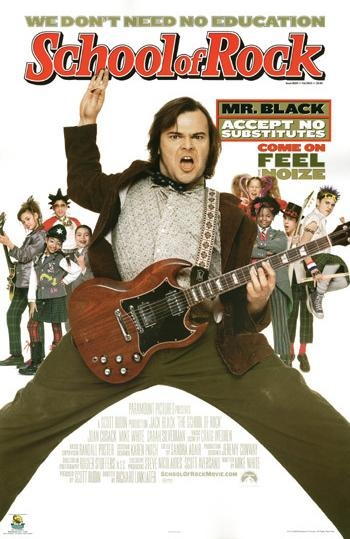
School of Rock (2003)

Jack Black triumphs in high-school comedy School of Rock

Director: Richard Linklater

Cast: Jack Black (Dewey Finn), Joan Cusack (Principle Roz Mullins), Mike White (Ned Schneebly), Sarah Silverman (Patty DiMarco), Miranda Cosgrove (Summer Hathaway), Joey Gados Jnr (Zack Mooneyham), Kevin Clark (Freddy Jones), Rebecca Brown (Katie), Robert Tsai (Lawrence), Maryam Hassan (Tomika), Caitlin Hale (Marta), Brian Falduto (Billy)

The early 2000s saw the rise of a new force in American comedy films: rotund, rock ‘n’ roll, John Belushi-light Jack Black. Following his breakout role as a music-obsessive with purist tastes in High Fidelity, School of Rock saw the legend of Jack Black hit its peak. And it deserves to, as School of Rock is the sort of perfectly-formed treat that achieves everything it sets out to do.

Dewey Finn (Jack Black) is the sort of slacker man-child beloved of indie filmmakers, who has never grown up from his dreams of being a rock star. The only thing really holding him back? Fate and his own selfishness. Dewey’s expelled from his own band, due to his penchant for extended guitar solos and distracting stage antics, and his old bandmate-turned-respectable-supply-teacher, Ned Schneebly (Mike White, also the film’s writer) is pressured into finally asking Dewey for his share of the rent by Ned’s domineering girlfriend Patty (Sarah Silverman). Desperate for money, Dewey impersonates Ned and takes a role as a supply teacher for a group of 12-year-olds at a prep school. At first Dewey just wants to leave the kids to their own devices and pick up his cheque – but when he hears his new students in their music classes, he suddenly has a brainwave: they could be his new band, and help him win The Battle of the Bands competition. 

School of Rock is an immensely heart-warming film that manages to never sell out to become sentimental or depend on its characters learning “lessons” that improve them. Sure lessons are learned, and the film is very sweet, but it manages to wear this all with a cool lightness. In fact the whole film becomes a rather touching paen to the transformative power of music, and the way it gives people confidence and a voice. 

Linklater directs with a breezy cool, drawing some fantastic performances from the whole cast (I can’t give enough praise to a director who gets such relaxed, natural and funny performances from children as Linklater does here) and totally embracing the clichés of the “inspirational teacher” genre, with a comedic bent. The kids are the expected combination – the precocious ambitious one, the shy ones who hide skill, the brash wannabe bully who finds the joy of being part of the group – but they are all portrayed with such freshness and energy that the clichés hum with joy.

Linklater’s real stroke of genius is letting Jack Black rip in the lead role. The part is so perfectly tailored to Black that it feels like almost an extension of his own personality. Black is a force of nature in the role, a perfect combination of showboating and carefully thought out character work – and he works brilliantly with the kids. He’s hilarious as well, first as a wannabe rock star layabout, later as a band leader for the kids who discovers in himself a work ethic and ability to inspire. 

The character works because, deep down, under the selfishness and laziness, Dewey is basically a pretty decent guy. He cares about people’s happiness and he has a romantic view of rock and roll as a source of self-expression and celebration of life. (Although fortunately for the film, he’s no fan of the whole drugs side of many of the musicians he worships – having no time for the “poseurs” who attempt to impress the kids with the smoking and gambling at one Battle of the Bands audition.) And he’s so passionate about this that he can actually turn himself, if not into a teacher, at least into the sort of inspiring mentor who can bring his students out of their shells.

And he does this without really changing fundamentally who he is. Sure he’s touched by the kids, just as he’s touched them (to slightly misquote the film’s cheeky paedophile misunderstanding gag, when Dewey is busted by his charges’ parents!), but the warmth under the bluster is there all the time. And Dewey doesn’t suddenly turn into a high achiever or perfect guy – he just learns to channel his enthusiasm into encouraging musical skills in others (and there is something really sweet in his genuine, warm enthusiasm for talent from the very start). The film even allows the headmistress of the school (very well played by Joan Cusack as an under-pressure uptight woman yearning to cut lose a little) to be a spiritual ally and well-meaning obstacle rather than an opponent.

It’s this good natured warmth that runs through the whole film, and which at the end finds every character contented and united. (Well nearly every character – the film can’t shake its love of wistful man-childishness sufficiently to resist turning Ned’s girlfriend into a humourless, nagging shrew, in the film’s only real misstep). Plus the film rocks really well, and seeing the band together and perform is both fun and really sweet. No one puts a foot wrong here, and a lot of its success is due to Linklater’s ease and Black’s dynamic, verging just the right side of cartooney, comic tour-de-force at the centre.

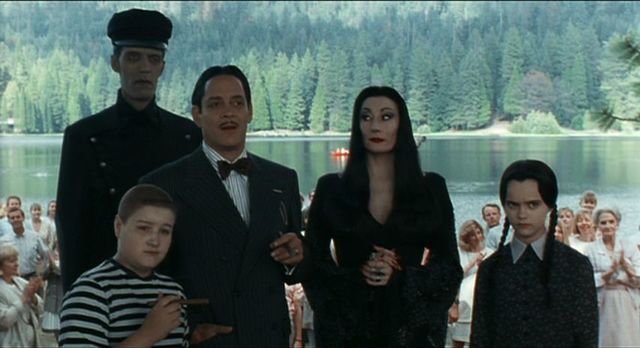
Addams Family Values (1993)


The Addams Family Values: Goth meets summer camp fun in this engaging comedy

Director: Barry Sonnenfeld

Cast: Anjelica Huston (Morticia Addams), Raúl Juliá (Gomez Addams), Christopher Lloyd (Uncle Fester), Joan Cusack (Debbie Jellinsky), Christina Ricci (Wednesday Addams), Carol Struycken (Lurch), Jimmy Workman (Pugsley Addams), Carol Kane (Grandma Addams), David Krumholtz (Joe Glicker), Peter MacNicol (Gary Granger), Christine Baranski (Becky Martin-Granger)

The Addams Family was a serviceable family comedy about a bizarre group of Halloween style characters, who delighted in leading lives of cartoony horror. It drifts along, and was a big hit, but its sequel Addams Family Values is several times smarter, more confident and funnier. As a comedy family saga mixed with cartoon creepiness, it’s hard to beat.

Celebrating the birth of their new child (“He has my father’s eyes” / “Take those out of his mouth”), Morticia (Anjelica Huston) and Gomez (Raúl Juliá) hire a new nanny, Debbie Jellinsky (Joan Cusack) to care for the baby. On her advice, they also decide to send the insanely jealous Wednesday (Christina Ricci) and Pugsley (Jimmy Workman) to a summer camp – needless to say they do not fit in with the All-American, Apple-Pie ideals championed there. Debbie meanwhile has wicked designs on becoming the widow of their rich Uncle Fester (Christopher Lloyd).

Addams Family Values gets a lot of comic juice out of some very witty set-ups. Everyone involved in the film feels more relaxed and happy to let the comedy breathe. Sonnenfeld lets the set-ups come naturally and allows the characters to come to the fore. Every joke in the film comes from watching the characters bounce off their circumstances. Of course, a lot of this comes from the fact the film doesn’t need to do any of the heavy lifting of introducing the world or the characters – it rightly assumes we know what we are getting from the start – but it still makes the film hugely entertaining.

A lot of the humour comes from the brilliant summer camp plotline, with its passive-aggressive, jolly-hockey-sticks owners (a very funny Peter MacNichol and Christine Baranski) and their naked favouritism for the popular kids. Placing the Addams children into a world of normal teenage politics and the forced jollity of adults who would rather still be one of the popular kids at school is a brilliant touch. This clash of values makes for no end of comic glory, culminating in a disastrous Thanksgiving play, which is a triumph of the sad and overlooked over the popular kids (because who watching any film favours the popular kids?).

Christina Ricci is brilliant in this – her deadpan sense of comic timing is spot-on. Every scene and every one-liner is stand-out. The film even finds time for a sweetly semi-romantic plotline between her and loser Joe Glicker (David Kumholtz, also very good as the kind of kid who likes to read A Brief History of Time). Ricci ends up carrying a lot of the film’s comic material, and she’s so perfect in the role that to a lot of us she will always be Wednesday Addams, never mind what she does.

The summer camp plotline is so drop-dead funny and memorable, it rather overshadows the film’s actual plot about Debbie’s attempts to seduce and murder Fester. Sonnenfeld struggles to make this main plot come to life – his real delight is in the sketch-based comedy of the summer camp and the Addams’ love for the grotesque and the extreme. Having said that, Joan Cusack is wickedly sexy and funny as a heartless social climber.

Anjelica Huston and Raúl Juliá remain divinely perfect as a couple so besotted they can barely look at each other without bursting into a steamy tango, or an avalanche of flirtatious foreign language banter. Juliá rips into the dialogue with a flamboyant gusto, and he’s a perfect foil for Huston’s supercool, arch one-liners. Sonnenfeld never lets the introduction of a baby affect their comic darkness in any way, which is a perfect set-up for comedy.

Addams Family Values is terrific good fun and always keeps you laughing. It’s a load better than the original, and has some terrific comic set-pieces in. Sure it’s got a pretty basic plot, but it’s directed with a wicked dryness by Barry Sonnenfeld and its cast are now completely comfortable in their eccentric characters. The tone always seems spot-on between the surrealist darkness and the childish, cartooney horror. It’s a very entertaining film.