Tag: Joe Wright

Cyrano (2021)

Cyrano (2021)

Slight but enjoyable musical, with the flaws of the original but some virtues of its own

Director: Joe Wright

Cast: Peter Dinklage (Cyrano de Bergerac), Haley Bennett (Roxanne), Kelvin Harrison Jr. (Christian de Neuvillette), Ben Mendelsohn (De Guiche), Monica Dolan (Marie), Bashir Salahuddin (Le Bret), Joshua James (Valvert), Anjana Vasan (Sister Claire), Ruth Sheen (Mother Marthe), Mark Benton (Montfleury), Richard McCabe (Priest), Peter Wight (Ragueneau)

Edmond Rostand’s play has been reinvented time-and-time again. After all, who can’t relate to a man convinced he’s unlovable and uses his poetic heart to write the words to help his rival woo the woman they both love. Erica Schmidt’s stage musical with songs by Aaron and Bryce Dessner from The National, pretty much keeps everything but kicks out the famous oversize nose in favour of making Cyrano a man with dwarfism. Bringing him to life – both here and on stage – is Schmidt’s husband Peter Dinklage, with his stage and screen love Roxanne portrayed by Haley Bennett, wife of Cyrano’s director Joe Wright.

It all helps create an easy-going feeling to Cyrano, a decent, at times impressive musical, that never quite turns into something really lasting but presents several fine songs in its middle act. It’s unfortunate that it’s opening section – and largely forgettable initial number – set the scene less than compellingly, dutifully repeating Rostand via a show-boating Cyrano easily besting a preening actor in a battle of wits, all while casting faintly longing looks at impressed Roxanne. What it doesn’t really do is seize the attention. In fact, what it does is really remind you what a slight story Cyrano de Bergerac really is: and that it only really starts with the Act Two introduction of Christian.

It’s certainly, it feels, where Wright’s interest begins. The romantic triangle between the three – Cyrano and Christian both in love with Roxanne, Roxanne in love with Christian and (perhaps) sub-consciously with Cyrano – introduces drama and stakes into a film that until then largely lacks either. Contrasts are drawn between Cyrano and Christian who share honour and decency, but are polar opposites in terms of confidence. Christian is physically and socially assured but crippled with inarticulate shyness when asked to speak; Cyrano can turn his feelings into poetry, but is convinced he is an unlovable imp, his confidence forever crushed by his appearance.

The concept of exchanging oversize nose for Dinklage’s dwarfism works rather well, when every single camera angle constantly reminds us of Cyrano’s otherness. It also gives a wonderful showpiece for the excellent Dinklage, who brings an intense, grungy charisma to the role. He can do the Cyrano’s performative showmanship, but also expertly demonstrates this is a front to protect his true self from being seen and potentially rejected. It becomes clear Cyrano partly embraces his titanic ghost-writing (hundreds and hundreds of pages), without Christian’s knowledge, because he genuinely feels it is the closest he can come to experiencing a relationship, just as he believes should he ever speak his true feelings they would inevitably be rejected. Dinklage does a wonderful job of balancing inner vulnerability with a mask of cocksure, arrogant confidence.

Cyrano certainly misses the subtle indicators, from the start, that Haley Bennett’s Roxanne might well have feelings for him. Aware that Cyrano de Bergerac often presents not the most flattering picture of Roxanne’s intelligence (she is a woman, after all, fooled for years into believing all those romantic words came from her husband not her lifelong friend). Bennett however let’s a – again perhaps subconscious – suspicion play just around the corner of her eyes, not to mention that her feelings for Cyrano feel a lot closer to romantic from the start. Is she as scared of rejection as Cyrano, put off by his independent front? After all she values honest feelings – and Christian, even if his words come from someone else, is clear about the way he feels in a way Cyrano never is. Kelvin Harrison Jr. is rather charming as this sweet, kind, strangely shy young man, tongue-tied and bemused by long words but with a strong sense of right and wrong.

The film – and the musical – is at its strongest when these three are interacting. Wright’s filmmaking also comes to life, with his more staid and traditional visual set-ups for the theatre-set prologue giving way (via a dynamic one-shot full of ducking and diving camerawork as Cyrano takes out ten assassins single-handed) to a series of balletic scenes. Large-scale musical numbers are accompanied by people going about every-day tasks with a wonderfully choreographed grace: be that bakers rhythmically kneading dough and stocking ovens, to a mass of soldiers fencing in perfect harmony. The songs also pick up considerably in both power and humability, culminating in the affecting Wherever I Fall, an eve-before-battle group number that sees Cyrano’s regiment preparing themselves for what could-be their final night, beautifully shot with a mist-filled coolness.

Cyrano’s slight story remains its weakness and the film can’t quite decide how to expand organically the deception plot at its heart. It’s almost a shame it bravely closes the door on the film’s most obvious protagonist, with Ben Mendelsohn’s De Guiche getting a scowling ‘villainy’ number but proving himself a man of honour. Fundamentally the long introduction to the set-up and the five-year-later coda the film wraps up with end-up feeling unsatisfying. It’s actually too faithful to Rostand, carrying across the original’s flaws. Cyrano embraces the mix of romance, comedy and sadness in its wooing-by-proxy and the odd-couple friendship between Cyrano and Christian, but feels more perfunctory as soon as it has to move beyond this section of the film.

It’s a shame as that central section is actually rather effective with Wright bringing the musical numbers in particular to life with a real delicate beauty. There are some very good performances, especially the heart-felt work from Dinklage, but it eventually strains towards an epic scale its story isn’t quite strong or engaging enough to support.

Atonement (2007)

Atonement (2007)

Moderately successful literary drama, that succumbs to tricksy showboating

Director: Joe Wright

Cast: James McAvoy (Robbie Turner), Keira Knightley (Cecilia Tallis), Saoirse Ronan (Briony Tallis, aged 13), Romola Garai (Briony Tallis, aged 18), Vanessa Redgrave (Older Briony Tallis), Brenda Blethyn (Grace Turner), Juno Temple (Lola Quincey), Benedict Cumberbatch (Paul Marshall), Patrick Kennedy (Leon Tallis), Harriet Walter (Emily Tallis), Peter Wight (Inspector), Daniel Mays (Tommy Nettle), Nonso Anozie (Frank Mace), Gina McKee (Sister Drummond), Michelle Duncan (Fiona)

The past is a foreign country. Sadly, it’s not always the case that they do things differently there. Instead, it can be a land of regrets and mistakes that we can never undo. Events that once seemed so certain, end up twisting our lives and shaping our destinies. A single mistake can mean a lifetime of never being able to atone. These are ideas thrillingly explored in Ian McEwan’s novel Atonement, one of the finest in his career. The same ideas carry across to this handsomely mounted adaptation, which looks gorgeous but often tries too hard to impress.

In 1935, the Tallis family owns a grand country house. Precocious Briony Tallis (Saoirse Ronan) is on the cusp of her teenage years, and believes she understands the world perfectly. A budding writer, her imagination, curiosity and romanticism overflow. But her youthful mis-interpretation of the romantic interactions between her sister Cecilia (Keira Knightley) and the housekeeper’s son Robbie Turner (James McAvoy)ends in a tragically mistaken accusation that destroys Robbie’s life. Five years later, Robbie serves as a private during the British retreat from Dunkirk, Cecilia is a nurse in London and Briony is training to become the same – their lives still shaped by those misunderstandings on that fateful night.

Atonement is a film I’m not sure time has been kind to. Released in 2007 to waves of praise (including Oscar nominations and a BAFTA and Golden Globe for Best Film), it has the classic combination of literary adaptation, period beauty and big themes. But re-watching it (and it’s the third time for me), the film rewards less and less. Instead, my overwhelming feeling this time was it was a tricksy, show-off film that – despite some strong performances, in particular from McAvoy and Ronan – strained every second to demonstrate to the viewer that Joe Wright belonged with the big boys as a cinema director.

Constantly, the emotional impact of the film is undermined because nearly every scene has an overwhelming feeling of being ”Directed”. Wright pours buckets of cinematic tricksiness and flair into the film – so much so that it overwhelms the story and drowns out the emotion. With repeat viewings this overt flashiness becomes ever more wearing. Scenes very rarely escape having some directorial invention slathered on them. Direct-to-camera addresses where the background fades to back (giving the air of a confessional). Events unspooling (and at one tiresome moment played in reverse) to illustrate time reversing to allow us to see events from a different perspective. Other visual images seem cliched beyond belief: a divine flash of light behind McAvoy while he struggles against death in Dunkirk or, worst of all, Nurse Briony talking about never being able to shed the guilt from her childhood actions while vigorously washing her hands.

Perhaps most grinding of all is the (Oscar winning) score from Dario Marinelli which hammers home the questionably reality of some of the scenes we are watching (or at least the creative filter that Briony is placing over them) by building in excessive typewriter whirs and clicks into its structure. It hammers home one of the film’s key themes: that at least part of what we are watching is based solely (it is revealed) on the recollections of the much older Briony, now a respected novelist. That perhaps, some of the events are her creative interpretation, wishes or even flat-out invention. This is a neat device, but perhaps one that could have worked better with a framing device to place it into context. Instead the reveal feels tacked on at the end – for all that this is the same approach McEwan takes in the novel (with greater effect).

But then, for all the film faithfully follows the structure of the novel (in a respectful adaptation by Christopher Hampton), too often its warmth and feeling get lost in the showy staging. Although part of the tragedy is that Robbie and Cecilia’s relationship is destroyed before they even get a chance to explore it fully, the chemistry between the two of them isn’t quite there and the film doesn’t quite communicate the bond between them being as deep as it would need to be. So much of this in the book was communicated through interior monologue – and the film refuses to take a second away from its flashiness to compensate for this by allowing the relationship between the two to breathe.

Instead Joe Wright prioritises his directorial effects. For all that his over five-minute tracking shot through the beach of Dunkirk is hugely impressive and dynamic – and it really captures a sense of the madness, despair, fear and confusion of the evacuation – this isn’t a film about Dunkirk. It is a film about a relationship – and using the same flair to make us fully buy into, and invest in, this relationship would perhaps have served the film better. It’s striking that, in the long-term, the most impressive scenes are the quieter ones: Benedict Cumberbatch’s chilling house guest’s subtly ambiguous conversation with Briony’s young cousins, or Robbie and Cecilia meeting in a crowded café after years and struggling to find both the words and body language to communicate feelings they themselves barely understand. In the long term, scenes like this are worth a dozen tracking shots – and demonstrate Wright has real talent behind all the showing off.

But the film is striking, looks wonderful – as a mix of both The Go Between and a war film – and in James McAvoy’s performance has a striking lead. McAvoy’s career was transformed by his work here – boyish charm with a slight air of cockiness under his decency, turned by events into fragility, vulnerability, fear and an anger he can’t quite place into words. Knightley gives one of her best performances – although, as always, even at her best she hasn’t the skill and depth of a Kate Winslet. Or a Saoirse Ronan for that matter, who is outstanding as the young Briony – convinced that she is right and that she understands the world perfectly, but as confused and vulnerable as any child thrown into a world that in fact she doesn’t comprehend.

Atonement has its virtues. But too often these are buried underneath showing off, ambition and tricksiness. Sadly this reduces its effect and leaves it not as successful a film as it should be.

Pride and Prejudice (2005)


Keira Knightley and Matthew Macfadyen are drowned in the shadow of the BBC adaptation of Pride and Prejudice

Director: Joe Wright

Cast: Keira Knightley (Elizabeth Bennet), Matthew Macfadyen (Mr Darcy), Brenda Blethyn (Mrs Bennet), Donald Sutherland (Mr Bennet), Tom Hollander (Mr Collins), Rosamund Pike (Jane Bennet), Carey Mulligan (Kitty Bennet), Jena Malone (Lydia Bennet), Talulah Riley (Mary Bennet), Judi Dench (Lady Catherine de Bourgh), Simon Woods (Mr Bingley), Tamzin Merchant (Georgiana Darcy), Claudie Blakely (Charlotte Lucas), Kelly Reilly (Caroline Bingley), Rupert Friend (Mr Wickham), Penelope Wilton (Mrs Gardner), Peter Wight (Mr Gardiner)

I’ve written before about certain books having been adapted so successfully there feels very little point rolling out another. If ever an adaptation set this principle, it’s the 1995 BBC adaptation of Pride and Prejudice. Not only did it perfectly capture the spirit and style of the book, with perfect scripting and direction, but the two lead actors – Jennifer Ehle and especially Colin Firth – were simply perfect (for all his achievements, the first line of Firth’s obituary will forever be “Darcy Dies”.)

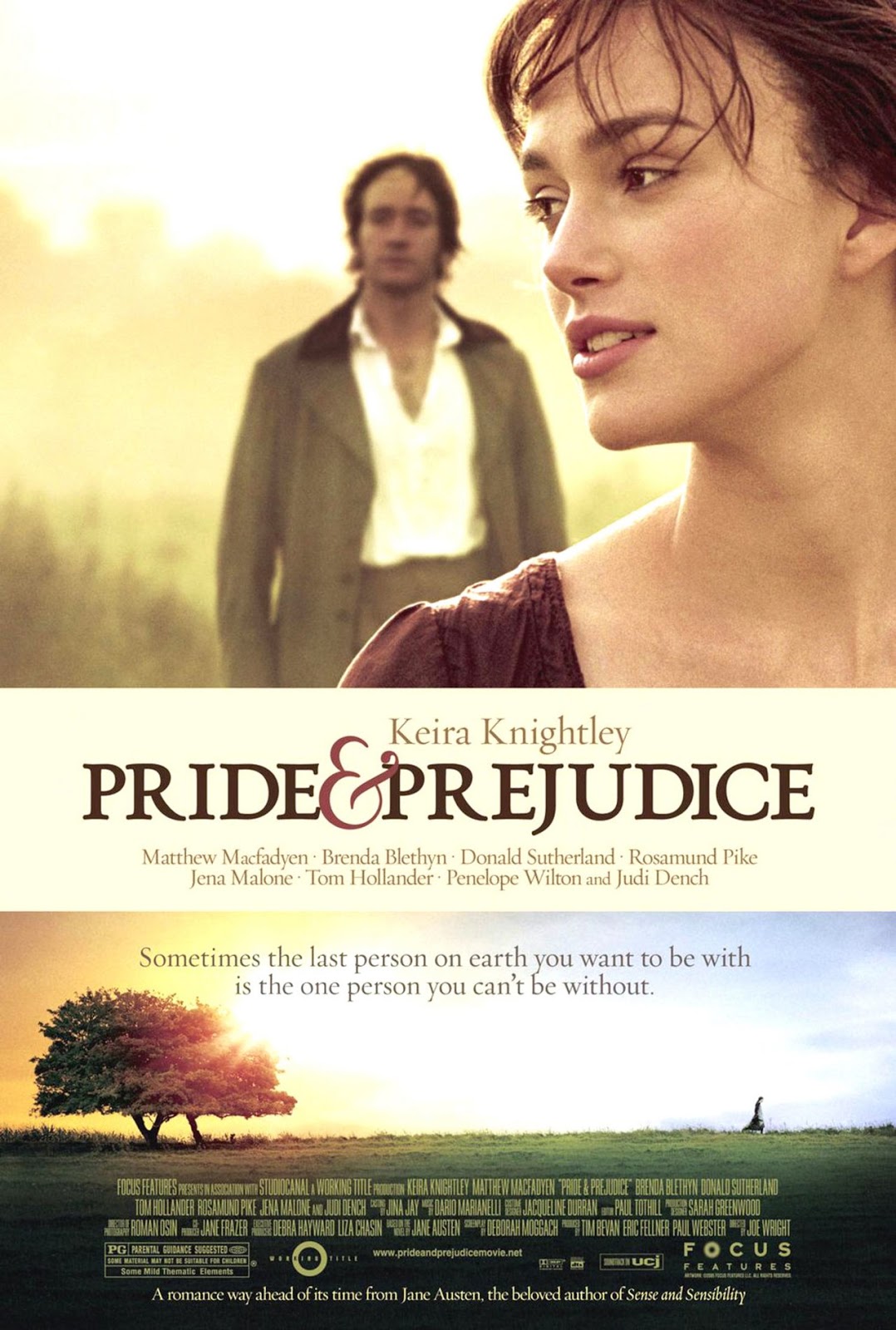
So Joe Wright and his team were already climbing a mountain when they announced plans to make a new adaptation of Jane Austen’s most beloved novel. What they’ve produced in the end is a well-made, handsomely mounted film full of visual invention – that has been pretty much rejected by nearly everyone I know who loves Austen. It’s a film that, in attempting to plough its own furlough, has ended up not really pleasing anyone: for the casual viewer it’s an entertaining but forgettable watch. For the Austen fan it’s just plain not right.

Structurally the film places Elizabeth’s relationship with Darcy slap bang at the centre, and has little to no interest in anything else. This leads to major themes and relationships being neglected or outright abandoned in some bizarre cut choices. The film wants to front-and-centre Lizzy’s increasing isolation – so Jane is dispatched from the film for almost over an hour. Even more oddly, Wickham is cut down to a few spare scenes – which makes her passionate sympathy for him and anger against Darcy make very little sense. All this isolation also means we never really understand the social implications and importance of marriage – in fact the whole thing is basically turned into a Cinderella romance: Rich Man Meets Poor Girl (And No One Else Matters). 

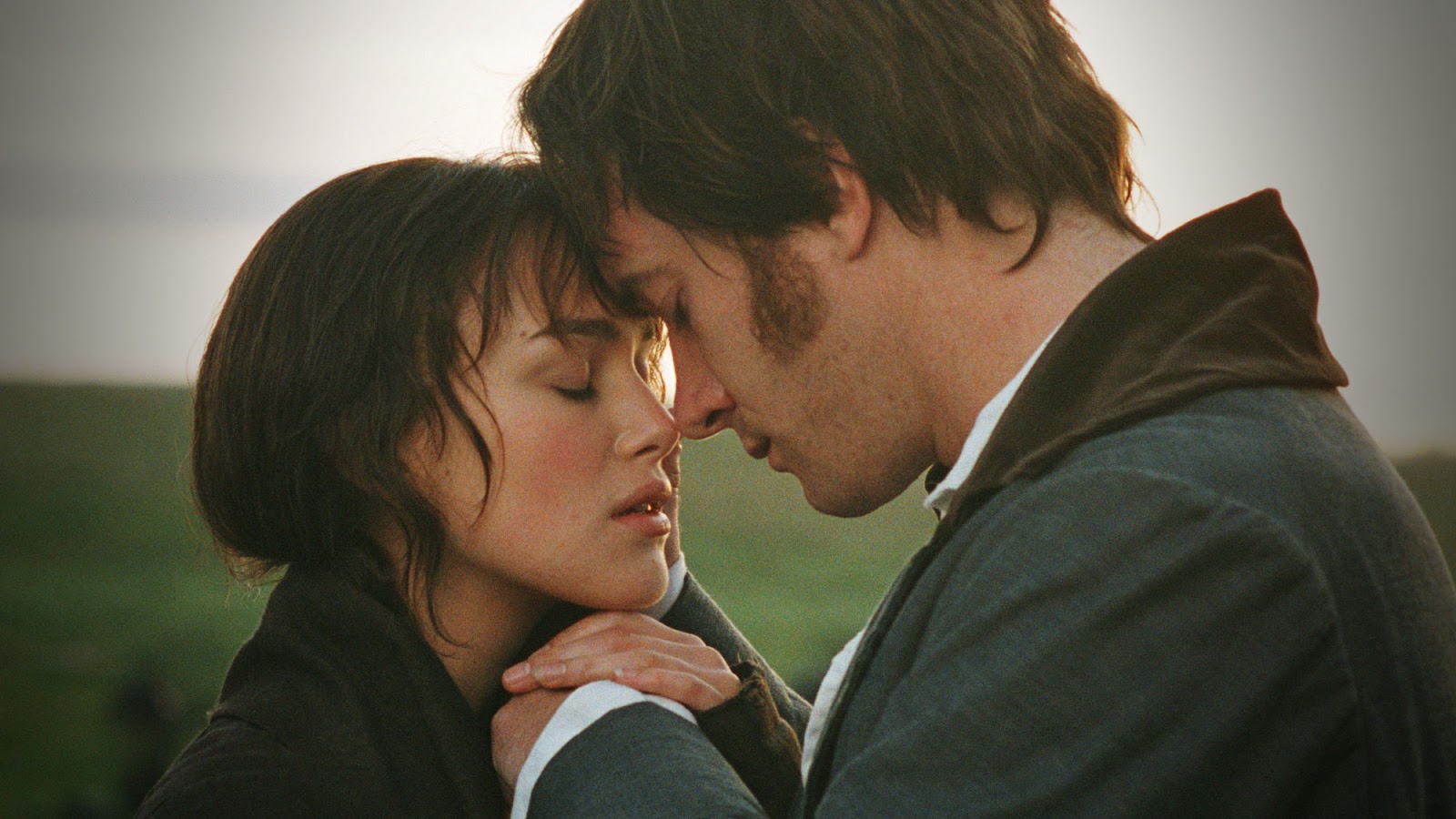
Which means a lot of the focus for the film lands on Keira Knightley. Is there a more controversial actor in film than Knightley? Oscar-nominated for the role, among my Austen-loving friends I have found only revulsion against her performance. She plays it with spirit but too much of a modern sensibility. She’s fine, but she’s just not convincing: she doesn’t look like her, she doesn’t have her warmth and wit and seems more like she’s wandered in from some sort of “flirty girls” comedy. Nothing really communicates the character’s intelligence and wit – and Knightley probably looks a little too modern for the whole thing to work. 

On top of that the film doesn’t want her to be too unsympathetic at any point, so dials down her judgemental nature, and also reduces any possibility of us judging her partiality for Wickham by mostly removing him from the film. However, this also removes many of the obstacles from the plot that stand in the way of romance.

Matthew MacFadyen does a decent job as “Nice Guy In A Period Drama”, but the character is just wrong for Darcy. Like Lizzy’s tendency to rush to judgement, Darcy’s apparent coldness and snobbery have been watered down to almost invisibility. His first announcement of love is so genuine, so gentle, so loving that you are amazed that Elizabeth dismisses him out of hand. It’s no surprise this Darcy turns out to be a decent bloke, the edges of the character have been completely shaved off. This puts a big old dent in the plot, reduces his character development, and ruins the impact of sweet later moments like Darcy’s uncertainty when the two meet at Pemberley. 

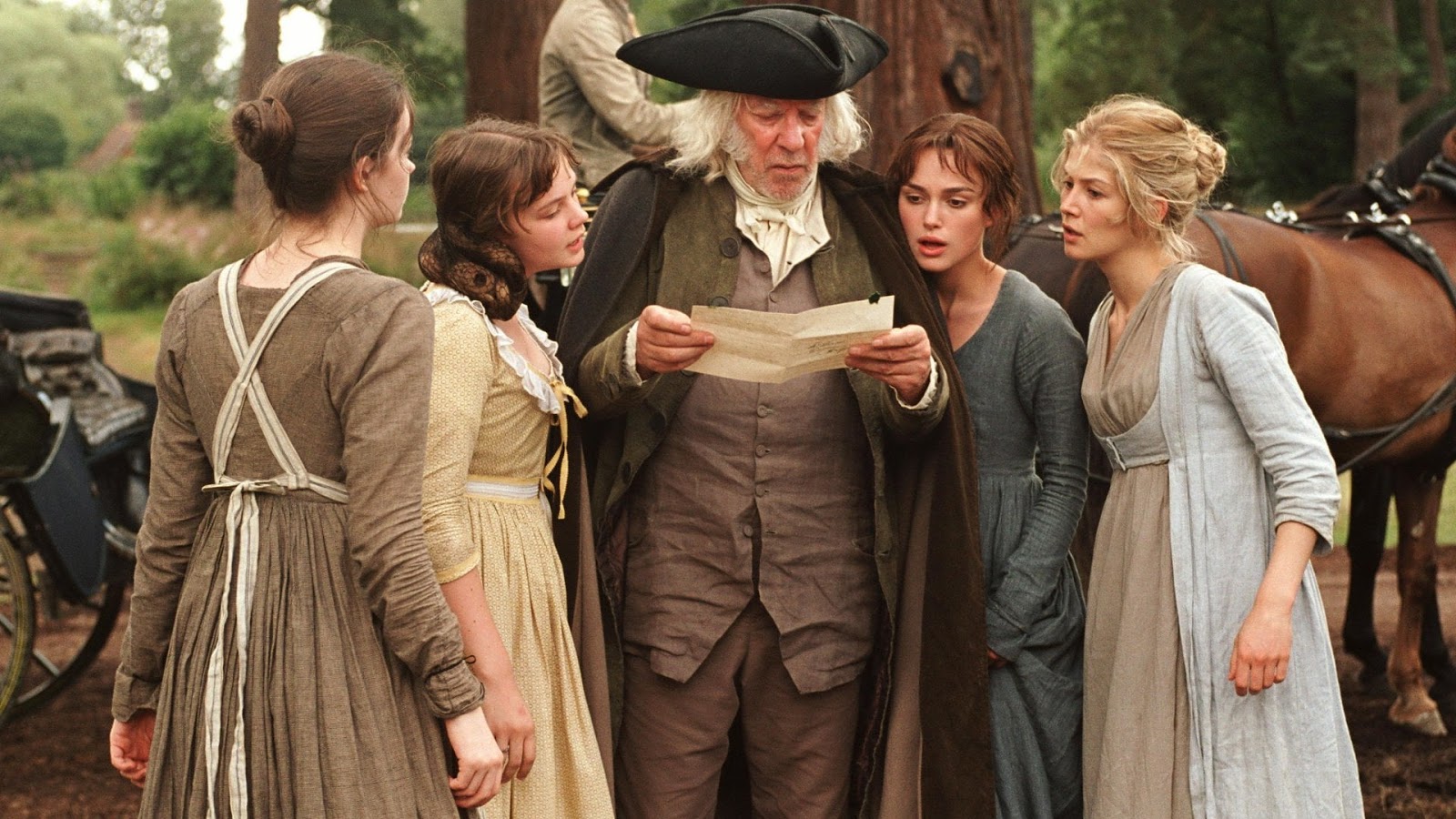
There are some good performances though. Tom Hollander is very funny as a social-climbing Mr Collins. Donald Sutherland gets so much warmth and twinkly good humour out of Mr Bennet that Wright even ends the film on him (another odd choice, but never mind). Judi Dench could play Lady Catherine standing on her head. Rosamund Pike is rather good as Jane – she totally feels right for the period. Brenda Blethyn largely manages to avoid turning Mrs Bennet into a complete stereotype. Saying that, Simon Woods portrays a version of Bingley so bumbling, tittering and awkward you are amazed either Jane or Darcy could be interested in him, let alone bear to spend time with him.

But then large chunks of the film feel odd. The screenplay works overtime to turn the film into a straight-forward star-crossed lovers story: so it’s Darcy and Elizabeth all the way, and the film is desperate to make them both likeable from the off. And if that means that, in a film called Pride and Prejudice, both the pride and the prejudice have to be junked to make sure even the stupidest audience member will like the hero and heroine, well that’s apparently a price worth paying. Lowering the Bennets’ social status as far as the film does, also turns the story into a full-on Cinderella territory. Darcy and Bingley are so posh an entire room falls silent when they walk in – in comparison the Bennets are so poor they share their house with pigs.

Ah yes the pigs. Why? The Bennets aren’t paupers. If they were, why would Collins want the place? Why would they be invited to the ball? Why would Bingley and Darcy even consider them as partners? Why would a family so aware of impressions have a home that is literallyfull of shit all the time? Why is Mr Bennet scruffy and unshaven – and why doesn’t anyone care? Who designed this? If the Bennets are so fixated on getting good marriages why do they literally live in a pig sty? It’s a visual idea that undermines the whole story.

I’m not joking. Here is a pig walking through the Bennet house.

It’s full of things like this that don’t feel right. The film junks most of the language of the original book, which makes it sound jarring (it even re-works Darcy’s first proposal: “in vain I have struggled, it will not do…” – large numbers of Austen lovers I know can recite those lines verbatim. This film apparently thought it could create a better version. It couldn’t). Large chunks of the film happen in the rain like some sort of version of Wuthering Heights. Why is that? Is it because professions of love in the rain are romantic in a Mills and Boonish sort of way? Or is it an echo back to Firth’s wet shirt?

Emma Thompson’s sublime adaptation of Sense and Sensibility demonstrated that it is completely possible to adapt an Austen novel into a two-hour film and still preserve the characters, relationships, major events and themes of the book, while also making a story that stands on its own two feet for non-Austen-ites. This film bungles its attempt to do the same. 

But there are things Wright gets right. The camera work and transitions are lovely. A long tracking shot that weaves in and around the ball early in the film, taking in every single character is not only a technical marvel but really gets across a feeling of what these hectic and bustling social events are like. There is a beautiful time transition at Longbourn, as Elizabeth rotates on a screen and the camera takes on a POV shot, showing the seasons changing each time the camera revolves around through 180 degrees. The cinematography is luscious and Wright – his first film – shows he was more than ready for the step-up from TV.

It’s just a shame that the film they made doesn’t quite work. It doesn’t capture the sense of the book. It doesn’t capture the sense of the characters. It makes bizarre and just plain wrong choices. It’s a decent film, but it is not a good adaptation of the novel. And that’s a major problem, because if you are going to adapt something as widely loved and revered as this, you better bloody well understand the novel – and I don’t think enough people here did. It’s told with a sweeping romantic style – but they are adapting the perception of Pride and Prejudice rather than the actual story. The chemistry and romance aren’t there: the film even ends with an odd sequence of Sutherland and Knightley, probably because there was better chemistry between these two than the two leads. It’s a film that basically doesn’t work at all.

Darkest Hour (2017)


Gary Oldman, rather surprisingly, rather is Churchill during his Darkest Hour

Director: Joe Wright

Cast: Gary Oldman (Winston Churchill), Kristin Scott Thomas (Clementine Churchill), Lily James (Elizabeth Layton), Ben Mendelsohn (George VI), Stephen Dillane (Lord Halifax), Ronald Pickup (Neville Chamberlain), Samuel West (Anthony Eden), David Schofield (Clement Atlee), Malcolm Storry (General Ironside), Richard Lumsden (General Ismay), Joe Armstrong (John Evans), Adrian Rawlins (Air Chief Marshall Dowding), David Bamber (Vice-Admiral Ramsay)

One of my favourite ever TV series is Winston Churchill: The Wilderness Years, a chronicle of Churchill’s time out of government (basically 1929-1939). It covers the political clashes between Churchill and his rivals brilliantly, as well as giving us a real feeling for Churchill’s own personality and flaws and featured a brilliant performance from Robert Hardy. Darkest Hour takes off almost where that series ends – and I think it might just be a spiritual sequel. And, for all its flaws, I might even grow too really like it.

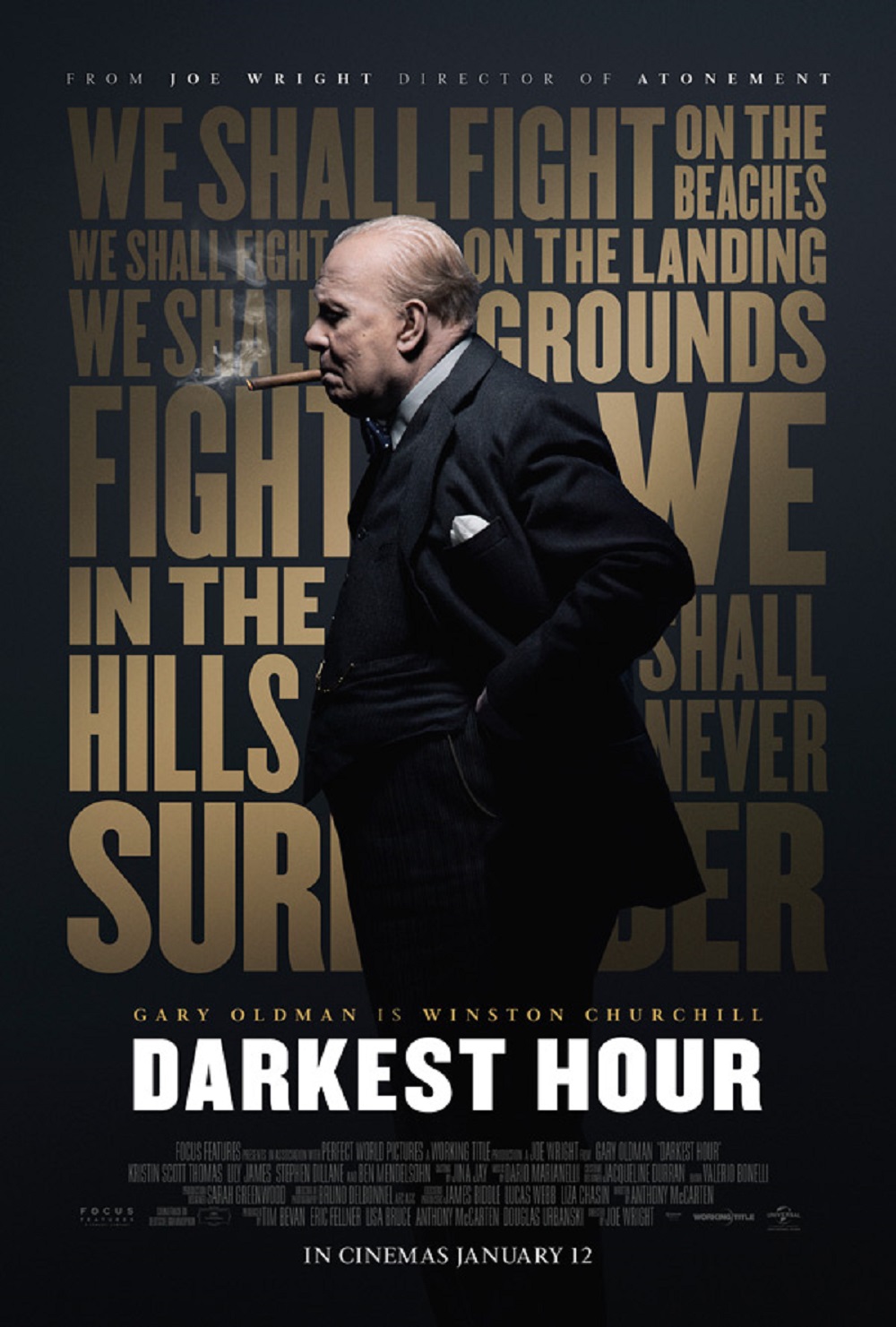
Joe Wright’s Darkest Hour is a beautifully filmed, imaginatively shot retelling of the crucial first month of Churchill’s premiership. Wright uses a great device of flashing the date up (in an imposing screen-filling font) as each day progresses. Apart from brief moments, the action rarely leaves Whitehall, with the focus kept tightly on the politics at home. Will Churchill win over the war cabinet to continue the war, or not? It revolves around dialogue shot with tension and excitement, and is structured key Churchill speeches: each carrying all the emotional impact you could expect and beautifully performed, with goose-bump effect by Gary Oldman.

Because yes, this film’s one piece of genuine excellence, and what it is really going to be remembered for, is the brilliance of Oldman’s performance. This is one of those transformative performances where the actor disappears. Of course it’s helped by the make-up, but there is more to it than that. The voice, the mannerisms, movement, emotion – as a complete recreation of the man it’s just about perfect. Whatever the film’s flaws, Oldman nails it. Sure it’s larger than life – but so was Churchill.

Oldman’s Churchill is irascible, demanding and temperamental – but he’s also warm and humane. In one beautiful moment he conducts a conversation with an un-encouraging Roosevelt, where his features seems to shrivel and shrink with despair, while his voice keeps up the optimism. Moments of gloom hit home, but there is also humour (and Oldman is actually rather funny in the lead role). There’s moments of pain, guilt and depression – it’s terrific.

However it does mean some of the other actors scarcely get a look in. Kristin Scott Thomas in particular gets a truly thankless part, no less than four times having to counsel a depressed Churchill with variations on “You’re a difficult but great man and your whole life has been leading to this moment” speeches. Lily James actually gets a more interesting part as Churchill’s admiring secretary, getting the chance to be frightened, awed, amused and frustrated with the Prime Minister – and she does it very well, even if her part is a standard audience surrogate figure.


The characters are neatly divided in the film: they are either pro- or anti-Churchill. The “pro” characters largely get saddled with standing around admiringly around the great man (Samuel West gets particularly short-changed as Eden becomes Churchill’s yes man). The “anti” characters mutter in corridors about how unpredictable and dangerous he is, how he could wreck the country etc. etc.

To be fair to the film, it does at least treat the doubts of Halifax (Stephen Dillane – all clipped repression, he’s excellent) and Chamberlain (Ronald Pickup – serpentine and tactical, although Chamberlain’s hold over the Tory party was nowhere near as great as this film suggests) as legitimate concerns. It does weight the dice in favour of Churchill, and we don’t get enough time to fully understand the reasons why peace with Hitler might have seemed reasonable in 1940 (tricky to get across to a modern audience so aware of Hitler’s status as evil incarnate). But Halifax’s stance that it was better to cut your losses than fight on to destruction is at least treated sympathetically, rather than making him a spineless weasel (as others have done).

The film really comes to life with the conflict between the Halifax-Chamberlain alliance and a (largely alone) Churchill. The cabinet war room clashes have a fire, energy and sense of drama to them that a lot of the rest of the film doesn’t always have. It sometimes drags and gets lost in filling the time with “quirky” moments with Churchill. There is a bit too much domesticity that feels irrelevant when we know the fate of the nation is at stake.

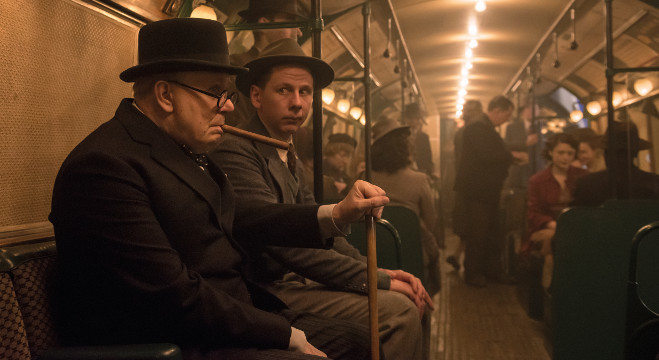
But then this is a sentimental film. Not only is it in love with Churchill (we see some blemishes, but his air of perfection goes unpunctured), but it uses devices that feelas you are watching them like sentimental film devices. None more so than Churchill bunking down on a tube train to exchange encouraging words with regular people and for them to tearfully recite poetry at each other. In fact it’s a testament to Oldman that he largely gets this hopelessly fake-feeling scene working at all.

Wright’s film makes a point later of demonstrating that – reporting back to the Tory party the results of this conversation – Churchill uses the names of the people he met, but completely replaces their words with his own. But it still gets itself bogged down in this sentimentality – including a teary end caption on Churchill being voted out of office. Every scene with Churchill and Clementine has a similar chocolate box feel, as does a late scene with George VI (who seems to flip on a sixpence between pro and anti-Churchill – although Ben Mendholsen is very good in the role).

Darkest Hour is an extremely well-made film. It’s told with a lot of energy – and it has a simply brilliant lead performance. Joe Wright finds new and interesting ways to shoot things: there are some great shots which frame Churchill in strips of light surrounded by imposing darkness. But its not brilliant. It will move you – but that is largely because it recreates actual real-life, moving events (who can listen to Churchill without goosebumps?). But it’s given us one of the greatest Churchill performances and it’s worth it for that if nothing else. And, for all its flaws, and the safeness of its storytelling, I actually quite liked it – and I think I could like it more and more as I re-watch it.