
Tag: John Agar

She Wore a Yellow Ribbon (1949)

She Wore a Yellow Ribbon header
John Wayne embodies the honour and duty of the American man in She Wore a Yellow Ribbon

Director: John Ford

Cast: John Wayne (Captain Nathan Brittles), Joanna Dru (Olivia Dandridge), John Agar (Lt Flint Cohill), Ben Johnson (Sgt Tyree), Harry Carey Jnr (Lt Ross Pennell), Victor McLaglen (Sgt Quincannon), Mildred Natwick (Mrs Abbey Allshard), George O’Brien (Major Mack Allshard), Arthur Shields (Dr O’Laughlin)
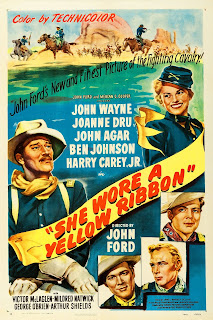
If there is a film that marks John Ford as the great American Artist of the West, it might just be She Wore a Yellow Ribbon. Shot in glorious Techicolour on location in (where else?) Monument valley by Oscar-winning cinematographer Winton C Hoch, it’s a gorgeously lit celebration of everything that made the American West a legend. Streaking red sunsets, rolling plains, lightening that slices through the sky, masculine military ruggedness beautifully bought to the screen. It’s Ford’s biggest push to become a Winslow Homer or Edward Hopper of the wide-open American space.

Nuzzling in the middle of Ford’s unofficial Cavalry trilogy (either side of Fort Apache and Rio Grande), John Wayne plays Captain Brittles (who might as well be Kirby York again, since he shares the same personality and most of the same backstory), is counting down the last few days until retirement. After Custer and his men are slaughtered at the Battle of Little Big Horn, he’s ordered to lead a cavalry patrol to fly the flag and help prevent a new war with the Indians. At the same time, he’s to escort his commander’s (George O’Brien) wife (Mildred Natwick) and niece Olivia (Joanna Dru) to an eastbound stagecoach (and safety). Olivia herself is in the middle of a love triangle with the two lieutenants eying taking on Brittle’s command, Cohill (John Agar) and Pennell (Harry Carey Jnr).

The film tells the story of that patrol and the subsequent follow-up mission to save those caught protecting the rear guard (needless to say Brittles continues the mission after his supposed retirement, bending the rules). There isn’t actually much in the way of plot in She Wore a Yellow Ribbon. Instead, Ford’s intention is to front-and-centre those particular American qualities of loyalty, honour, dedication to the cause and self-sacrifice. The men of the cavalry always put their country and fellow soldiers first, willing to sacrifice themselves to the greater good and show not one jot of hesitation in doing so. Ford shoots all this with real beauty and more than a touch of whimsical wit, coming particularly (where else?) from the Irish American contingent among the soldiers.

At the film’s heart is Wayne himself, now cemented in Ford’s films not as the traditional romantic action hero, but an elder statesman, wiser and less trigger-happy than his fellows, an unflappably experienced man who guides and inspires, shrugging off praise with an aw-shucks-just-doing-my-duty nobility. If Fort Apache and Red River were first steps towards Wayne – at this time only just past 40 – starting to act as if he was ten years older than he actually was (and in Red River’s case a little bit older than that!) – She Wore a Yellow Ribbon cemented him as the grizzled, inspiring man of action, a role he would play in variation for most of the rest of his career.

And he’s very good in She Wore a Yellow Ribbon. Ford had of course been impressed by the depth and shade of his performance in Red River. This is a simpler role – it would be a few more years before Ford used the darkness in Wayne as well as that film – but it shows Wayne slotting into place as part of What Made America Great. Wayne plays Brittles with a sadness – he’s a touching grieving husband, who takes a familiar chair out every night to talk to his wives tombstone – and a fatherly concern for his men, but tolerating no selfishness or greed. He mentors and pushes Cohill and Pennell like a second father, and has a brotherly banter with his loyal sergeant (inevitably Victor McLaglen as a hard-drinking, extremely Irish drill sergeant). He will do his duty, but he also respects Indian culture, will fight but prefers a peaceful option, will follow orders but never blindly. He’s all that’s good about the American fighting man, and this is one of his finest performances (and a personal favourite of his).

The yellow ribbon wearer is Joanna Dru as Olivia, the sort of spunky young woman Ford’s films frequently feature in key roles. Dru is just about the archetype: brave, determined, smart – much smarter than both of the rather dull men playing court to her. She’s also sensitive and understanding of Brittle’s grief and can hold her own with the men out in the field. Dru’s very good in the role, bringing it a great deal of depth and more than a touch of heart.

She Wore a Yellow Ribbon, plot wise, is more of a day-in-the-life movie. At heart not a lot actually really happens in it other than following the cavalry on two missions (one of which fails) and far from averting the war, it’s explicitly suggested they are just delaying it. The status quo is almost completely restored by the film’s end. The real focus of the film is the detail of what the men set out to do, the determination and humanity with which they go about it – not least the self-sacrificing bravery – and then the return to rest and prepare to go out again. All shot in some of the most striking and beautiful images of the West ever committed to the screen. As a visual tribute, the film is a rich feast.

It’s Ford’s celebration of America and the West and his case for the beauty and majesty of a generation and the values that they placed above all others. For this, She Wore a Yellow Ribbon may be one of the finest of its kind. It lacks the narrative thrust of Fort Apache – and like that film is, in the end, as unquestioning and uncritical of the actions and legacy of those pioneers out West, or the dangers of imperial expansionism or blind veneration of deeply flawed heroes like Custer – but it’s beautiful, very well acted (particularly by Wayne) and a fine film from a director at the top of his game.

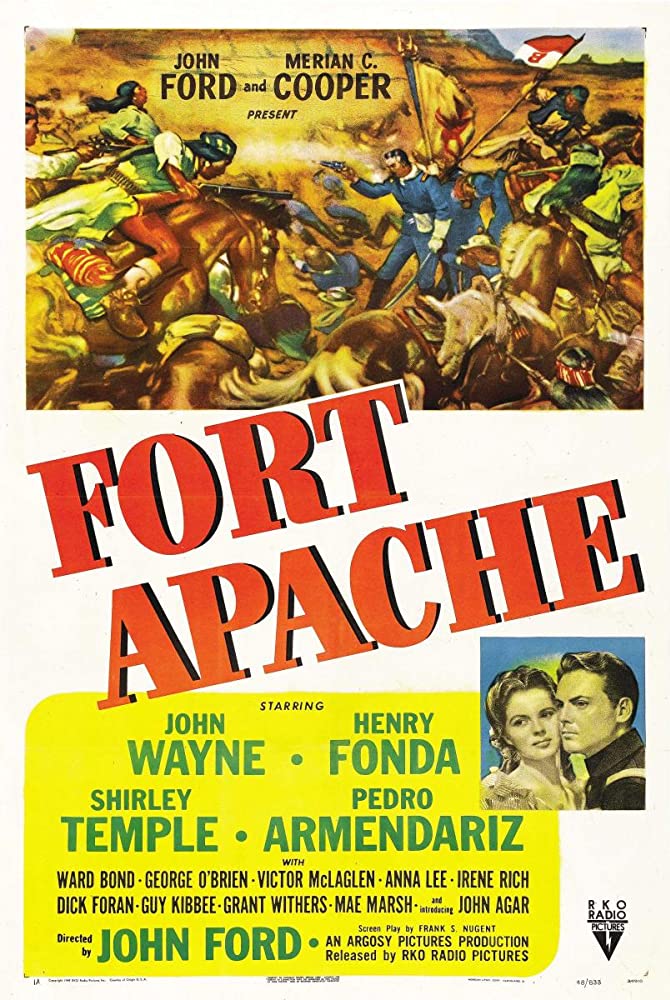
Fort Apache (1948)

Henry Fonda and John Wayne face off in John Ford’s Fort Apache

Director: John Ford

Cast: John Wayne (Captain Kirby York), Henry Fonda (Lt Colonel Owen Thursday), Ward Bond (Sgt Major Michael O’Rourke), Shirley Temple (Miss Philadelphia Thursday), John Agar (Lt Michael O’Rourke), Dick Foran (Sgt Quincannon), Pedro Armendariz (Sgt Beaufort), Miguel Inclan (Cochise), Victor McLaglen (Sgt Festus Mulcahy), Guy Kibbee (Captain Wilkens), George O’Brien (Captain Sam Collingwood), Anna Lee (Emily Collingwood)

Fort Apache was the first of Ford’s “cavalry trilogy”, exploring problems and personality clashes of remote cavalry posts in the middle of what used to Native American territory. Contrary to what you might expect, this is a complex, intriguing film that brilliantly explores tensions between very different ways of thinking and issues of class in America, which are so often overlooked. If it sells some of the tensions of clashing ideals down the river with an ending that fully endorses the myth over the reality, the fact the film makes clear that the idea of a well-meaning army all pulling together is a myth says a lot.

John Wayne is Captain Kirby York experienced, more liberal minded acting commander of Fort Apache. Aware of the difficult balance of maintaining good relations with the Apache tribe while protecting American expansionist interests, he’s perfectly suited for keeping the peace in the West. Unfortunately he’s replaced by Lt Col Owen Thursday (Henry Fonda), an arrogant, class-conscious – if polite and honourable man – who applies the letter of the law to all his dealings, so obsessed with rules (he protests “I’m not a martinet” while bemoaning the lack of proper uniform in the dust filled heat of the West) that he sees no reason to moderate even the most corrupt of the local officials who have driven the Apache to revolt, instead demanding the Apache submit. Disaster is on the cards.

Ford’s film revolves around the personality clash between York and Thursday. While both dutifully respect the chain of command, it’s clear that York has a closer bond and understanding with both the men under them and the complex considerations to balance when dealing with the Apache. Thursday, on the other hand, is an arrogant, prickly character, bemoaning his “demotion” from a field rank of General in the Civil War, to an “obscure” fort. A posting he is determined to escape from with an honour laden victory as soon as possible. 

With Ford’s romantic regard for the ordinary soldier and regular Joe, the sort of posh New-Englandish Thursday is a clear stand-out. A stiff-backed martinet, he never listens to others (he constantly needs to be reminded about names) and has a snobbish disregard for Lt O’Rourke (a callow John Agar) whose father, far from being officer class, is an Irish Sgt Major at Fort Apache. Thursday is notably uncomfortable at such Fordesque events as a NCO ball, or when talking with the men – he even looks unsettled in the desert, wearing full uniform and avoiding a hat in favour of an army cap with a dust-sheet attached at the back (no Ford hero would be seen dead wearing such a thing). 

The character works so effectively because he is played so delicately and skilfully by Henry Fonda. Cast against type – and looking older – Fonda plays Thursday as a frustrated man, terrified of failure who simply lacks the flexibility to adjust to situations. Rules instead are there to be followed in detail, regardless of his personal feeling. Corrupt government agent Meacham he treats with contempt, but he will defend his incompetent regime in Apache land to the death. With the Apache he can’t see past his own inbred ideas of superiority, treating them with a paternal disappointment, certain that they are no match for American cavalry might (spoiler, they certainly are). Fonda however keeps Thursday human, a flawed, rigid man dropped into a role he is ill-suited to and struggling to adjust.

John Wayne offers an equally careful performance as York. Unlike Thursday, York adjusts his actions and decisions based on situations and personalities, rather than enforcement of rules. Army regulations can be respected but applied with sense. Meacham to him should be hounded out of town as the root cause of all the problems. Cochise, the Apache chief, he treats with respect and honour – abiding by deals and attempting to compromise with him to find a peaceful solution (a negotiation Thursday of course torpedoes with his arrogance and intransigence). Wayne is often thought of as the action hero, but here Ford starts to explore his elder statesman quality, as well as his underlying decency and honour as an actor.

Other sub plots interweave neatly around this. John Agar’s young O’Rourke flirts with Thursday’s more liberal daughter (played brightly by Shirley Temple) – needless to say this relationship meets with no approval from Thursday. Thursday’s old colleague Sam Collingwood – now a time-serving captain at the Fort – is paralleled with him and York, as a time-server and mediocrity, a decent family man but lacking the will to do what he knows is right. Ward Bond provides both comedy and also a warm fatherly quality as Sgt Major O’Rourke, proud of his son and re-enforcing discipline on his (mostly Irish of course!) soldiers. 

And of course the action is handled extremely well. A chase sequence with Apache, cavalry and a wagon (under-manned and out-gunned, because Thursday believes a few men and rounds of ammunition should be enough to see off the Apache) is filled with excitement. And, of course, the film builds towards the inevitable disaster Thursday’s rigid mismanagement was always heading towards: a suicide charge against a well defended Apache position, fighting to defend a corrupt agent who Thursday and York both know should be replaced.

It’s a film that quite daringly shows that American’s “mission” in the West was often founded on corrupt officials, and that the military leaders were sometimes rigid, incompetent martinets who led their men to avoidable disaster. It’s shame then that the York – and the film – chooses in a flash forward at the films end to promote the idea of Thursday’s charge being a glorious defeat, rather than an avoidable disaster. And that, this printing of the legend, is important to protect the “why we fight” idea of America. It’s the downside of Ford’s love of the past, of the mythology of the West, that even in the end of a film about incompetence, it’s still seen as noble and important to protect people from the truth and promote the legend, than tell the truth. But then for Ford, protecting the memory of the ordinary soldiers who died is the key – and if that means never questioning the how or why, well then that’s a price worth paying. It’s an idea we perhaps have far less sympathy with today.