Tag: John Hurt

Ten Rillington Place (1971)


Richard Attenborough brings the killer John Reginald Christie to life in Ten Rillington Place

Director: Richard Fleischer

Cast: Richard Attenborough (John Reginald Christie), Judy Geeson (Beryl Evans), John Hurt (Timothy Evans), Pat Heywood (Ethel Christie), Isabel Black (Alice), Robert Hardy (Malcolm Morris), Geoffrey Chater (Christmas Humphreys), André Morell (Judge Lewis), Tenniel Evans (Detective Sergeant)

Films about real-life serial killers have that eternal problem: how far can they go in giving us answers? How much can we ever really understand why a killer does what they do? Is there any way of really putting ourselves in their shoes – and do we really want to? Ten Rillington Place avoids a lot of these issues by making no attempt to give understanding to Christie at all, simply presenting his actions, and by putting the focus on the tragic death of Timothy Evans.

In a miscarriage of justice Timothy Evans (John Hurt) was tried and executed for the murder of his wife Beryl (Judy Geeson) and their baby daughter in 1950. The real murderer? The man who lived downstairs, John Christie (Richard Attenborough), a socially maladjusted, softly spoken man who confessed to killing at least eight people three years later at his trial for murdering his wife. Christie had an uncanny gift for gaining the confidence of desperate women, would offer to perform illegal (and free) medical procedures (such as abortions), during the course of which he would gas them with carbon monoxide, strangle them, possibly carry out acts of necrophilia and then bury them in his garden or in the walls of his house. Evans never suspects until far too late that Christie is the killer and, scared that he will be accused, follows Christie’s advice to the letter – advice that will only make him look all the more guilty.

Richard Fleischer’s chillingly documentary-style film-making goes into forensic detail on the events of the murder of Beryl Evans and her daughter, and the wrongful conviction of Timothy Evans for the crime – largely on the basis of Christie’s testimony at Evans’ trial. Fleischer shoots the film with a deeply disciplined restraint, a calm documentary style that avoids any sensation lingering on the crimes, but still carries great emotional impact.

The film covers the period from Evans moving into the flat above Christie, Christie’s murder of Beryl, Evans panicked flight to Wales on Christie’s advice, his series of confessions to the police, his trial and execution. Book ending the film we get a scene with Christie murdering his neighbour Muriel Eady – a terrifying demonstration of Christie’s murder rituals, as well as an indicator of how easily he could gain the trust of his victims. What it strikingly doesn’t try to give us is any psychological explanation for why Christie did what he did. There are no revealing flashbanks, no cod-psychology. Instead we just see a killer, kill people. We might get an idea of what he gets out of it, but no explanation of what turned him to it. The film is all the more powerful for it. 

Instead the focus is on the victims, and the Evans story is heart-rending, partly because of Fleischer’s calm, sensitive direction, but mainly due to John Hurt’s astonishingly powerful performance. The film, and Hurt, don’t shy away from the qualities that made Evans seem like such a natural fit for a murderer at his trial. He’s a compulsive liar. He brags. He fights and argues with a fury. He’s not really that sympathetic a guy at first. But he’s certainly innocent. Hurt brilliantly demonstrates his vulnerability and simplicity – Evans was illiterate and almost unbelievably trusting, a liar who fell victim to a superb, manipulative liar.
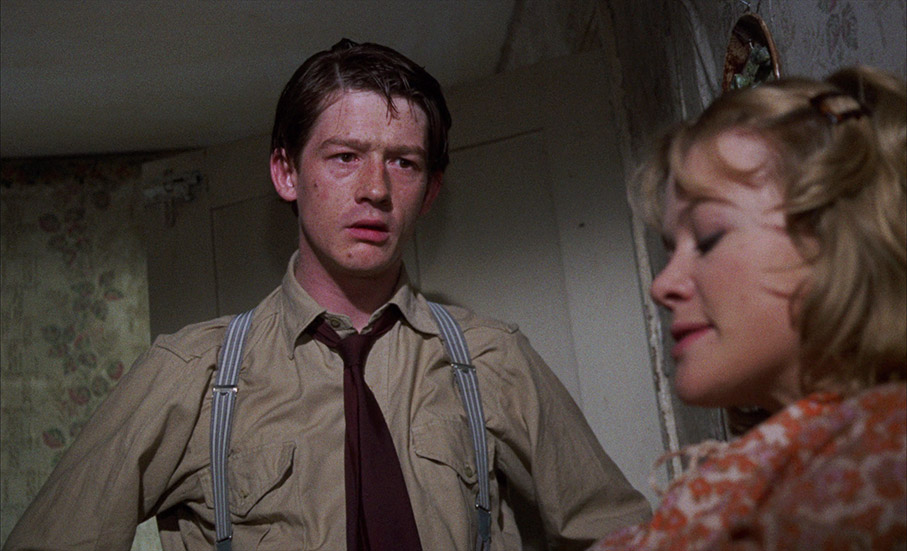
His shock and slowly growing realisation of the nightmare he is in are incredibly moving, as is his powerful grief when he finds his wife killed – and his trusting innocence when he turns (unknowingly) straight to his wife’s killer for advice on what to do. Every action Evans takes in the film makes you want to jump in and urge him to do something – anything – different.  Unsympathetic as he is at the start, by the conclusion you almost can’t bear to watch him incriminate himself with each action. Hurt is sublime, with his weak manner, his confusion, his touching faith that it will all be okay and his feeble mantra of “Christie Done It” – it’s one of the greatest performances in his career.

Judy Geeson gives a marvellously emotional performance as Beryl Evans. Geeson has the perfect look for the part, and she completely embodies a woman who has found herself in a difficult situation, in love with a weak man. You understand completely how she is drawn towards Christie as a confidant, and why she would feel the desperation to abort a child she and Evans could never afford. Her eventual murder is horrifying in its struggle and desperation, the growing horrible realisation in her eyes that she is in mortal danger – this is a particularly strong sequence, difficult to watch for the viewer, as we know what a terrible series of decisions she is making. 

Fleischer’s film was motivated by a very firm anti-death sentence stance. The scene of Evans’ execution is shocking in its brutal suddenness. Shot with a handheld camera and in a single take (in near silence other than Hurt’s deep breathing), the execution is over and done with in less than a minute – from Evans sitting in a room, to the reveal of the executioner’s noose next door and the terrible drop (with a jump cut straight to Christie stretching his back). It’s a brilliantly low-key, but resoundingly powerful scene that sticks with you for all time.
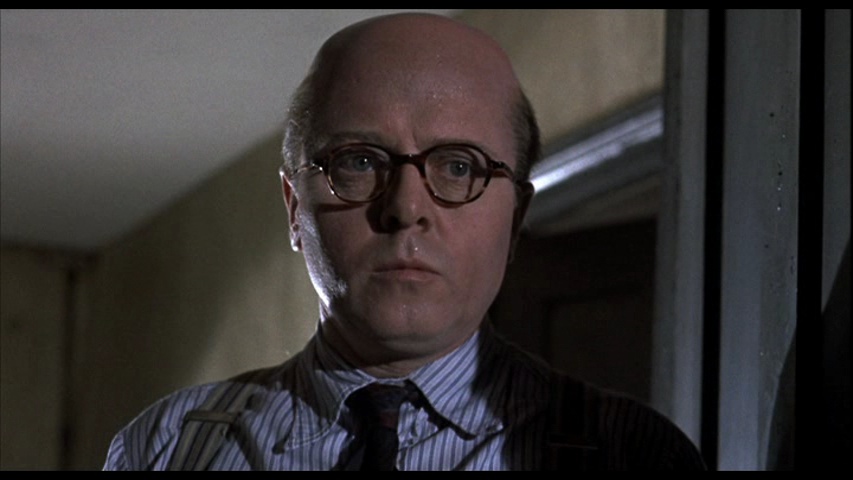
All this way and we’ve not mentioned Richard Attenborough’s transformative performance as Christie. Attenborough presents the softly spoken monster as a bland, empty non-entity, a man who has almost nothing to make him stand out from the crowd. He never makes the part into a great monster or any sort of domineering force of nature. In partnership with Fleischer, he shows Christie was a total blank canvas of a man, “evil” only in the most mundane and uninteresting way. He’s so mild-mannered, you can see why so many women trusted him. Attenborough is chillingly blank throughout, in a deeply unsettling performance of crushing mundanity. He’s brilliant in this film – Attenborough was completely committed to its anti-death penalty stance – and he avoids the temptation of trying to explain or make sense of Christie. 

That’s the trick of the film – Christie is not a special man. He performs dreadful acts, but he is a nothing of a person, devoid of motive (the lack of motive is something those at Evans’ trial use most to argue against Christie’s possible guilt), a totally forgettable man who committed crimes memorable only for their cruelty. Fleischer, and Clive Exton’s careful, thoroughly researched script, is simply superb in presenting Christie with all his filthy blankness, Rillington Place in all its crushed lack of colour, and the murders in un-flashy documentary sadness. Ten Rillington Place is an engrossing true-life story that turns a miscarriage of justice into a Greek tragedy. It’s a much overlooked classic.

Harry Potter and the Philosopher's Stone (2001)


Daniel Radcliffe gets sorted in the first of the franchise Harry Potter and the Philosopher’s Stone

Director: Chris Columbus

Cast: Daniel Radcliffe (Harry Potter), Rupert Grint (Ron Weasley), Emma Watson (Hermione Granger), John Cleese (Nearly Headless Nick), Robbie Coltrane (Rubeus Hagrid), Richard Griffiths (Vernon Dusley), Richard Harris (Albus Dumbledore), Ian Hart (Professor Quirrell), John Hurt (Mr Ollivander), Alan Rickman (Severus Snape), Fiona Shaw (Petrunia Dursley), Maggie Smith (Minerva McGonagall), Julie Walters (Molly Weasley), Tom Felton (Draco Malfoy),  Zoe Wanamaker (Madame Hooch), David Bradley (Argus Filch), Warwick Davis (Filius Flitwick)

In 2001, I was in my first year at university. I went to the cinema to watch this new, much-hyped children’s-fantasy film. I’d never heard of this Harry Potter fella going into it – so must have been one of the few people watching who was coming to it completely fresh. I was swept up in the film’s story when I first saw it. But how does it stand up watching it again decades later?

Well it’s a long bloody film. I was actually amazed this is nearly two-and-a-half hours long. Strewth. I mean this is the slightest and most childlike of Rowling’s books. Did it really need such a bum-numbing run-time to bring it to the screen?  I guess it needed a lot of that time, because there is a heck of a lot of backstory and wizarding world to introduce very early on – and the film explains this in very careful, loving detail. 

But Columbus’ world building here is excellent. I think it’s easy to forget how much pressure must have been riding on this film. How many imaginations worldwide did this need to satisfy? Not only that, but this had to cater for, and build towards, a host of sequels, some of which hadn’t even been written yet (other than in Rowling’s brilliant mind). But the film succeeded in bringing this wizarding world enchantingly to life. There is a delight in every magical sequence, or trick, produced in the film – so many that poor Daniel Radcliffe must have swiftly exhausted his repertoire of “awe-inspired” faces. But the film’s loving reconstruction of the world of the book is perfect, and the fact that it not only didn’t alienate people, but that so much of it has become integral to the popularity of the books as well, says a lot.

Later films would get more daring and imaginative in bringing book to screen – with Rowling’s full support – but this first one probably did need to hew pretty close to the original book in order to hook and secure that fan-base. So while Kloves’ screenplay may feel at time like a mixture of transcription and rewording rather than a true work of adaptation, it meets the needs of this first film.

The design elements of the film were also spot on. Much of the wizarding world would be radically overhauled design-wise in The Prisoner of Azkaban, but the foundations are all here. John Williams’ score was also pretty much perfect from the start so winningly constructed and so perfectly matched with the mood of the book that it has also become an integral part of the Harry Potter world.

But, watching the film back, it’s clear still that this is one of the weakest films in the series. Part of this is of course is that it’s also the most simple and childish of the books – Rowling would immeasurably enrichen and deepen the series with each book – but when placed in context with the rest of the franchise efforts, this does seem like a brighter, more colourful, Roald Dahlish, traditional children’s film. Again, a lot of this is faithful replication of the book – but considering how children embraced the later more emotionally mature films, it would not have been a disaster to include more of that material here.

The other main issue with the film is quite simply that it is averagely directed and rather mundanely filmed. It’s a bit of a shock to be reminded that Oscar-winning photographer John Searle shot this film, as it’s ludicrously over-bright and conventionally framed. In fact, it lacks any real visual interest at all, looking more like a child’s picture book than any form of motion picture. There is hardly a shot or visual image in the film that sticks in my head – and I am literally writing this as the credits roll on the movie. As a piece of visual storytelling, it’s pretty mundane.

Similarly, Chris Columbus is a solid but uninspired film maker. He marshals events on camera with a reliably safe pair of hands, unspectacular and undemonstrative. But he doesn’t have any real dynamism as a film maker – perhaps that’s why the material never really feels like his own. When the series did have a film maker with vision in Alfonso Cuaron (in Prisoner of Azkaban), the difference in imagination and vision was immediately striking – so much so the two directors who followed Cuaron effectively trod in his footprints.

But Columbus may well have been what this franchise needed at this stage: a safe pair of hands, who could work with the studio and the producers and shepherd to the screen a series of films that would be running for over a decade. Much as other names bandied around to direct at the time would have been better film-makers, I can’t imagine them having the “safe pair of hands” quality that Columbus did, providing the solid foundation from which the series could later grow – let’s be honest could you imagine Terry Gilliam successfully kick-starting a huge-franchise series like this?

And let’s not forget either the casting gifts Columbus left the film-makers with here. Have three child stars ever been better chosen than Radcliffe, Grint and Watson? And indeed all the other young actors, all but one of whom stayed with the series to the end? The triumph of choosing not just the talent, but the level headedness, was quite something. And the three actors here are very good. 

Grint probably wasn’t better than he was here – his natural comic timing becoming an overused tool in later films, but here he’s charming, likeable and endearing. Watson is raw but a good mix of know-it-all and vulnerable feeling. Radcliffe gets a rough ride in a hugely challenging part – and yeah he’s not yet an actor here – but he does very well, considering how often he is called on to look amazed, and how many deep feelings of isolation, loneliness and confusion he is called upon to show during the film. Not one kid in a thousand could do what he does here. Columbus got magnificent work from the entire child cast – and that alone is enough to give him a pass.

The adult cast is of course pretty much perfect. Robbie Coltrane is a stand-out as a loveable Hagrid, immensely cuddily and endearingly sweet – perfect casting. Rickman was of course similarly inspired casting, Smith was perfect, Harris an unusual choice but one that worked. Ian Hart’s twitchy nervousness gets a bit wearing, but it’s not an easy part. Griffiths and Shaw embrace the cartoonish Roald-Dahl-bullying of the Dursleys. Pretty much every casting choice is spot on.

Harry Potter and the Philosopher’s Stone is the least deep and rich of the Harry Potter films, but it had a hell of a difficult job to do. And what I have to remember is that I was one of the uninitiated who sat in the cinema to watch it and needed all that introduction. Any film that has to get Muggles like me up-to-speed while keeping the die-hard fans happy faces a very difficult task. I think you can say, for all the later films surpassed it, that Philosopher’s Stone managed that in spades.

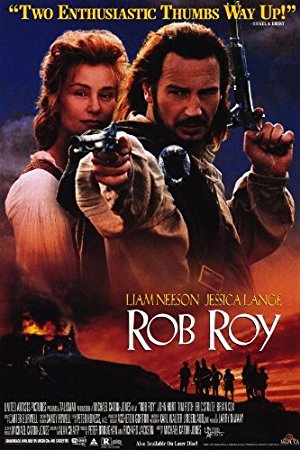
Rob Roy (1995)


Tim Roth and John Hurt are the villainous aristocrats taking advantage of Liam Neeson’s honour in Rob Roy

Director: Michael Caton-Jones

Cast: Liam Neeson (Rob Roy MacGregor), Jessica Lange (Mary MacGregor), John Hurt (Marquess of Montrose), Tim Roth (Archibald Cunningham), Eric Stoltz (Alan MacDonald), Andrew Kier (Duke of Argyll), Brian Cox (Killearn), Brian McCardie (Alasdair MacGregor), Gilbert Martin (Guthrie), Ewan Stewart (Coll), Jason Flemyng (Gregor), David Hayman (Tam Sibbalt), Shirley Henderson (Morag)

In the mid-1990s there was one of those bizarre Hollywood coincidences that saw two similarly filmed Scottish-based dramas head into production at the same time: Braveheart and Rob Roy. Braveheart stole the headlines, and the Oscars, and turned William Wallace from a footnote in history into an icon of Scottish independence. However, it’s arguable that the over-looked Rob Roy is the better, richer, more involving film.

In 1713, Rob Roy MacGregor (Liam Neeson) is the Chief of the Clan MacGregor, in a loving marriage to Mary (Jessica Lange), and supports his clan through protecting the cattle of the gentry. Knowing that this is not enough to help their poverty, Rob borrows £1,000 from the Marquess of Montrose (John Hurt) to start a cattle trading business. However, on collecting the money, his friend Alan MacDonald (Eric Stoltz) is murdered by Archibald Cunningham (Tim Roth), a foppish playboy and ruthless fencer, who is staying with Montrose and wants the money to clear his debts. Montrose demands Rob falsely testifies that his rival the Duke of Argyll (Andrew Keir) is a Jacobite in return for forgetting the debt – when he refuses, he is named an outlaw and a rebel.

Rob Roy works so damn well because it is thrillingly told, well-scripted, shot with a romantic sweep in some terrific Scottish locations and uniformly excellently acted. It’s perfectly constructed as a classic melodrama, because the heroes are pretty much completely upright, admirable and inspiring (without ever being tiresome or sanctimonious), while the villains are intriguingly shifty and vile, running the gamut from cowardly opportunist to vicious sociopath. Chuck this in with a tightly focused plot, and it works extremely well.

Liam Neeson is perfect casting as the upright Rob. Few people do nobility and decency better than Neeson, and Rob is just about the most stand-up guy you can imagine. You can totally understand why every one of his clan seems to worship the ground he walks on. Neeson’s classical physicality and stance totally sell him as the ultimate highlander, while his kindly eyes and gentle manner make him an obvious fit as an inspiring leader. 

Caton-Jones directs the action with zip, even if the film does perhaps go on a fraction too long. He sets Rob’s decency and honour at the centre of the film, and brilliantly builds the thematic story around the shifting world where old-school honour and decency is being left aside for the more ruthless realpolitik of Montrose. Rob’s old-school decency makes him the kind of hero figure you see in a traditional Western – and Caton-Jones is clearly inspired by the scope and sweep of John Ford Westerns, making excellent use of the mist and the hills. 

The Scottish highlands are our wild plains, the traditional values are those of the homestead – and the communities Rob protects are presented with a warmth and glow that is never galling. A lot of this is due to Jessica Lange’s excellent performance as Mary, a woman of warmth, tenderness but also hard-hearted realism mixed with a sharp strength of will. Lange (and her lilting accent is quite lovely to listen too) handles the events that occur to her as the wife of a rebel with a dignity, but also a fierce rage just below the surface. If Rob is defending honour, she represents it.

But the real strength the film has is its villains. It has three very different but terrific antagonists, each of them brilliantly brought to life by three very good actors. John Hurt brings Montrose a brilliant sense of slightly perverted corruption, the arrogant insouciance of a man who works out there is more going on than he is being told, but not caring so long as he can turn it to his advantage. Brian Cox is excellent as the cowardly, greedy, shallow and bullying land property manager, snivelling and timid beneath his bluster. 

The real swagger through comes from Tim Roth, who is quite superb as the flamboyant sadist and sociopath Archibald Cunningham. Roth marches off with the film, pitching it just right as a man who presents (and lives) a performance to the entire world: a foppish playboy who seems light and disposable, but is in fact a ruthless, dangerous man with no principles and a horrifying capacity for violence. The character has enough humanity to prevent him from becoming a caricature – he’s bitter at being a bastard, he has a strange affection for his mother. He’s aware that he’s the baddie – he just doesn’t care. In fact he loves it. He invites people to underestimate him – and takes a sadistic delight in proving them wrong. He’s a perfect dark reflection to Rob.

The film introduces him demonstrating his terrifying skill with a sword in a sporting duel: and you don’t need a PhD in storytelling to guess that the film is heading towards a second, closing sword duel between our noble hero and his sadistic opposite. When it comes, it’s a belter of a sword fight, brilliantly choreographed, that sums up the whole movie: Rob fights with a broadsword (and the film demonstrates how exhausting swinging one of those can be) and depends on directness and fairness. Cunningham fights with a rapier, is quick, indirect and gleefully delights in inflicting a number of glancing wounds. It’s one of the best sword fights (and uses of combat to communicate character) on film – and it’s engrossing.

Rob Roy is easily overlooked – but it’s a fine film, full of memorable moments and above all stuffed with terrific performances. Caton-Jones shoots the film very well, and works brilliantly with the actors. You’ll remember them all – and you’ll invest in their stories. Yes it is a little too long, and yes sometimes it’s a little too in love with the romance of the highlands – but it’s a smashing, exciting and engrossing film and you’ll certainly find plenty in it to enjoy: not least Roth’s showboating menace.

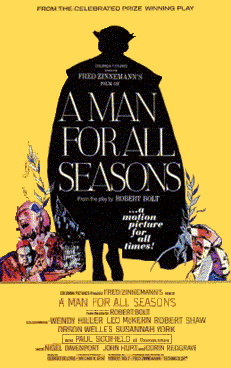
A Man For All Seasons (1966)


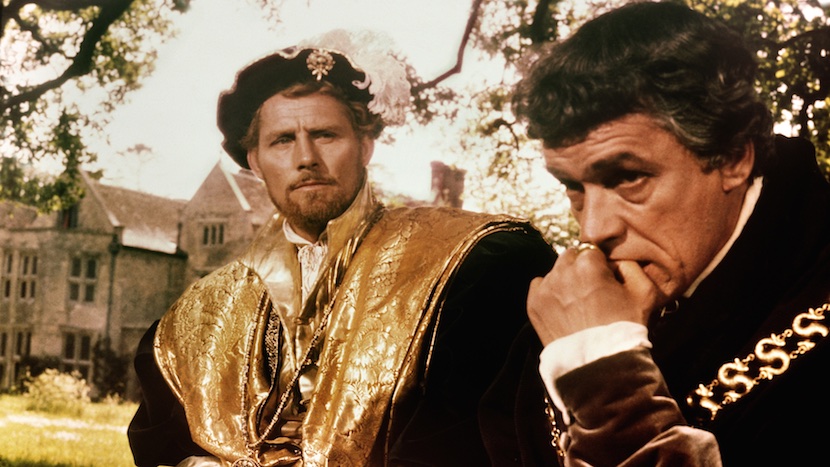
Paul Scofield ways up a difficult demand from a not-so merry monarch

Director: Fred Zinnemann

Cast: Paul Scofield (Sir Thomas More), Wendy Hiller (Alice More), Robert Shaw (Henry VIII), Orson Welles (Cardinal Wolsey), Leo McKern (Thomas Cromwell), Susannah York (Margaret More), Nigel Davenport (Duke of Norfolk), John Hurt (Richard Rich), Corin Redgrave (William Roper), Colin Blakely (Matthew)

Writing these film reviews is sometimes harder when it’s a film you know so well. I was probably in my very early teens when I first saw this and I’ve seen it dozens of times since. I know all the scenes, all the beats, and I love it. This is a brilliant film, and its depth, richness and intelligence are ingrained. It’s a wonderfully written, played and directed piece that transforms a historical event from a history lesson into an endlessly relevant and affecting parable.

Paul Scofield (simply becoming the man) is Sir Thomas More. With Queen Catherine unable to bear Henry VIII (Robert Shaw) a son, wheels are in motion to ditch the Queen and marry the king to Anne Boleyn (a split second cameo from an unpaid Vanessa Redgrave, making you believe in a moment Anne could split a kingdom). More, however, can’t agree to the divorce – his faith in the Catholic church is non-negotiable, and the church won’t recognise the marriage. So while the rest of the kingdom falls in line, More is arrested and takes refuge in his complete silence – having never spoken of his reasons, he can never be tried for them.

Re-watching this masterful film for the first time in a few years on a newly released, fully restored Blu-ray, I was immediately reminded what a thoughtful, interesting and enjoyable film it is. Having read the play again, I genuinely think (and I’m not alone) Bolt’s script is superior to the original. Several changes have been made, most notably the removal of the “Common Man”, a theatrical device whereby one actor played all the smaller working class roles, while delivering a commentary on the action. It’s a very theatrical device, which Bolt believed wouldn’t work on screen, but its removal also purifies the story, tightens the focus and allows us to focus on More. The commentary on More’s conflicted character is instead provided by Paul Scofield’s superlative performance in close-up. Bolt also removed much of the political background, making the film more of a parable of conscience rather than a “history play”.

The film is a beautiful celebration of old-fashioned Hollywood film making. Fred Zinnemann is sometimes forgotten today, extremely unfairly for a man with a hugely impressive back catalogue. A Man for All Seasons was perfect for a director whose best work saw one man stand alone against a system – be that at Pearl Harbour or the Wild West. Zinnemann was an “actor’s director”, and draws out a series of impressive performances. But his often simple set-ups never feel staged.

He and John Box (production designer) understand the power of claustrophobia, of life and death conversations in small rooms – from Wolsey’s imposing red office that seems an extension of his personality, to Cromwell’s poky office and More’s cell, the sense of being trapped builds throughout the film. By contrast, the final courtroom’s spaciousness only underlines the fact that it’s a fix. Throughout the film looks wonderful and its spare score is a beautiful Tudor-style series of compositions that carry a perfect pitched of awe and doom. It’s so beautiful (and often overlooked) I’ve put a link to the opening here.

 In fact, Zinnermann constructs the film throughout with wonderful beats and telling shots. The first appearance of Henry VIII, his head obstructing the sun, More blinking looking up, is one of the best visual impressions you’ll see of the Icarus nature of the Tudor court. A beautiful cut takes us from More (in a windswept garden, a lovely commentary on the turbulence of his life) wondering if he can find a way to sign the oath, to a shot of the view from behind his prison bars – pages and pages of story told to us in one simple cut. Later, from the same position, we’ll see a whole year pass by in a few moments – simple, unfussy, very effective. The film is packed with small, subtle moments like this that never intrude by themselves, but build to create the effect of the film wonderfully.

And this is a great film, there’s no doubt about that. The story is surprisingly simple, but Bolt and Zinnermann make it feel truly universal: the man against the state, the individual standing for what he believes is right despite all the pressure bought to bear against him. It’s a timeless parable and could be applied to virtually any time or place you could name. It’s also extremely well written: nearly every other line is memorable, the speeches are extraordinary. Every moment of reflection and observation sounds (and is) universal in its application. Its straightforwardness also helps make the story very moving, and it successfully carries out the trick of telling a movie about a saint while making him a living, breathing man we can relate to.

Of course, a large part of its success is due to Paul Scofield’s performance in the lead role. Honed after years of performing the role, it’s again almost hard to talk about individually as Scofield is so central to the film; talking about its success is in many ways to talk about Scofield’s success. Scofield’s performance is one where the actor disappears and the character remains: his More is totally real. You feel throughout not only his dignity and wisdom and his sharply defined sense of private and public morality – but also his warmness, his wit, his benevolent regard for people and those around him. He’s a caring master and friend – but not a push-over; and is adamantine in his decisions. Scofield is also able to show the contradictions of the man: a private man who cannot give up the lure of the limelight. Every beat of the performance is brilliantly observed, a list of highlights would fill a book. He carries the entire film from start to finish and never lets it slip for a second.

He’s helped by some wonderful support (and it’s a testimony to his generosity as an actor that he cedes the screen several times). Robert Shaw’s Henry VIII is a scene stealing tour-de-force. It’s up there with Robert Duvall’s Kilgore as cameos that wrench control of the movie. He’s on-screen for about 12 minutes, but he perfectly captures Henry’s charisma and his childish temper and fury. He’s intelligent (but not that intelligent – I love his sulky response when he is quickly bested by Margaret More in knowledge of Latin) and friendly but not that friendly – the sort of man who literally rips flowers from a tree to show someone how beautiful they are: destruction and excitement combined in one moment. You totally believe that this is a man who could shatter a country in a fit of pique.

Wendy Hillier also deserves notice for what might be the trickiest role in the film as Lady Alice, a woman who lives happily in the shadow of her husband. Ill-educated and lacking any understanding of her husband, it’s a part that could be almost yokel like. But Hillier brings it a world of dignity and fiery defiance, and she brings a completely convincing fury to Alice as she rails against  injustice. The final scene between her and More is a masterclass from both of simple, uncomplicated love that has held two people with very little in common together for a lifetime.

There is literally not a bad performance in this film. Every actor is perfectly cast and completely understands their roles. Nigel Davenport masterfully portrays the pride and dimness that lies under Norfolk’s bluff domineering persona. John Hurt nails Rich’s weakness, selfishness and greed and layers it with a convincing note of underlying self-loathing: a star marking performance. Orson Welles seems to have prepared his whole life for the bloated, corrupt Wolsey. Leo McKern (the only other cast member from the original production) invests Cromwell with a low viciousness and a deadly political savvy that is based exclusively on realpolitik and devoid of decency. Susannah York, Corin Redgrave and Colin Blakely all also excel.

Historically, the character of More has faced far more criticism and scepticism recently. Several historians have bought attention to More’s rigid Inquisition-like Catholicism and his willingness to execute heretics; Hilary Mantel’s equally brilliant Wolf Hall was partly written as a response to Bolt’s presentations of More and Cromwell, lauding the latter at the expense of the former.

But these controversies are not what this film is about – and it’s never trying to be a history lesson. It presents its version of the story on its own terms (very little is ever leaned about the “King’s Great Matter” or the reasons for it) – instead, like The Crucible, it turns a historical event into a deeply moving and profound parable. In doing this it transcends being a simple recounting of events, and instead becomes an independent work of art. Historical accuracy is of no relevance to the audience when viewing Henry IV Part 1: it is of no matter here either, and is something the film never claims. And it’s all the better for it. Still one of my all-time favourites.

Jackie (2016)


Jackie Kennedy patrols a White House she will soon be forced to leave behind

Director: Pablo Larrain

Cast: Natalie Portman (Jackie Kennedy), Peter Sarsgaard (Bobby Kennedy), Greta Gerwig (Nancy Tuckerman), Billy Crudup (The Journalist), John Hurt (Father Richard McSorley), Max Casella (Jack Valenti), Richard E. Grant (William Walton), John Carroll Lynch (Lyndon B. Johnson), Beth Grant (Ladybird Johnson), Caspar Phillipson (John F. Kennedy)

“Ask ev’ry person if he’s heard the story

And tell it strong and clear if he has not,

That once there was a fleeting wisp of glory

Called Camelot.”

Or so sang King Arthur in Alan Jay Lerner’s musical Camelot. It’s apt as it’s a musical cue Jackie returns to several times in this thought-provoking, if rather stately, film that with one eye looks to sharply critique the legend building of American political history, while with the other staring with adoration at the very legacy at its centre.

The film follows, in a slightly non-linear fashion, the period of time from Kennedy’s assassination through to his state funeral and Jackie Kennedy’s departure from the White House (although other scenes feature Jackie during the presidency, most notably her filming of A Tour of the White House in 1962, a TV special the film lovingly recreates with a mixture of existing and newly-created footage and audio). The framing device is an interview Jackie gives with an unnamed journalist, set after the events of the film, in which she alternates between frank honesty and careful legacy building – all the time stressing she will decide what is, and is not, printed.

The film is a both a careful deconstruction of legacy building and a celebration of it, with Jackie Kennedy portrayed as a contradictory figure – keen to give her husband a place in history and, at times, resentful of the impact of public interest in her life. In a neat scene, Jackie Kennedy asks the driver of her husband’s hearse if he has heard of the last two Presidential victims of assassination, William T. McKinley or James Garfield. He knows neither. When asked if he has heard of the first, Abraham Lincoln, he of course is able to name check victory in the civil war and the abolition of slavery. It’s a sharp reminder of the work she must do for her husband’s legacy, with his achievements ranking nowhere near Lincoln’s.

The films suggests throughout that the planning of the funeral was focused on giving Kennedy (and by extension Jackie and her children) a permanent place in American folk-lore. It’s why the reprise of Camelot works in the film – it’s sums up the attitudes of America an administration that has indeed lived on as a short time of hope, with Kennedy as the lost Golden Boy. The appropriateness of the song is something the film manages to both use and comment upon – and which it also manages to make feel fresh, despite the fact the “Camelot” has been a nickname for the Kennedy White House ever since the 1960s.

Simultaneously, though, it is a film that lingers with wide-eyed wonder on JFK himself, and which presents LBJ as a far more corrupted and overtly political figure compared to the reverence the film feels for his predecessor (his serial womanising is given only a brief mention by Jackie during her conversation with her priest). Kennedy (played by an actor with a remarkable physical and vocal similarity) is always a romantic figure, his motivations or his achievements very rarely questioned. He’s filmed like the very romantic hero, which the film is half encouraging us to question that he was – and I’m not sure this is deliberate.

The film is acute and quietly non-judgemental throughout the scenes covering the assassination, reaction and funeral plans. So much so, that the framing device of the journalist (Billy Crudup in a thankless part, scruffily dressed, alternately arch and adoring) seems like it belongs in another, dumber, movie – as if we needed Jackie to give voice to her feelings, to actually speak words stressing her power and determination in shaping what is printed about her husband, in order to understand it. It’s an obvious, TV-movie framing device that really adds very little.

This is largely because Natalie Portman gives such a sensational performance in the lead role. As to be expected, it is a brilliant capturing both of Kennedy’s vocal and physical mannerisms. But more than that, it is also a sharp performance of deeply confused grief and guilt over her husband’s fate, mixed with a public strength (at times bordering on furious anger) in her determination to plan a funeral she felt befitted her husband’s status. Weak as the journalist scenes are, she dominates them with her skilful portrayal of a woman split between a need for intimate confession and determination to maintain control over the story.

Portman’s performance also provides the emotional anchor to scenes that could otherwise be careful reconstructions. The assassination itself (filmed within the car) has rarely seemed so immediate – and the camera largely sticks with Portman’s stunned, terrified face throughout the long drive to the hospital. Her combination of lost alienation, bewilderment and shock equally dominates the rushed inauguration of Johnson, while scenes of her returning to the White House to finally remove her blood-stained clothing shimmer with emotional intensity. It’s a film that captures the stunned sense of alienation from reality that comes after undergoing any major, life-changing event.

The film has a ghostly, elegiac mood. Larrain uses rather murky photography effectively throughout the film. The slightly grainy focus given to the general world of the film allows sharper primary colours to stand out at key moments. The Oscar-nominated score for me was, however, far too insistent – a series of sharp notes and discordant sounds mixed with mournful refrains. It draws too much attention to itself and makes the same point too many times to be effective. I suspect its a score that might work better in isolation. Far better are the quiet and controlled shots of Jackie walking listlessly through a deserted White House, or the careful mixing of the tragic and the mundane (when selecting a positon in Arlington for her husband, she has to ask a companion to slow down as her shoes keep getting stuck in the mud).

It’s an intelligent, thought-provoking and adult piece of film-making, that carefully avoids passing judgement or making pronouncements. I can’t decide if it’s a film that can’t make up its mind about events, or if it challenges us to make up our mind for ourselves. Either way, Portman gives an extraordinary performance and is well supported by the rest of the cast, in particular John Hurt who gives a charming, witty performance as the Priest who Jackie allows herself (for a moment) to be completely honest with. A dynamic and interesting addition to JFK films, that manages to find a new angle and even some new ideas from well-worn ground.