Tag: John Ireland

All the King's Men (1949)

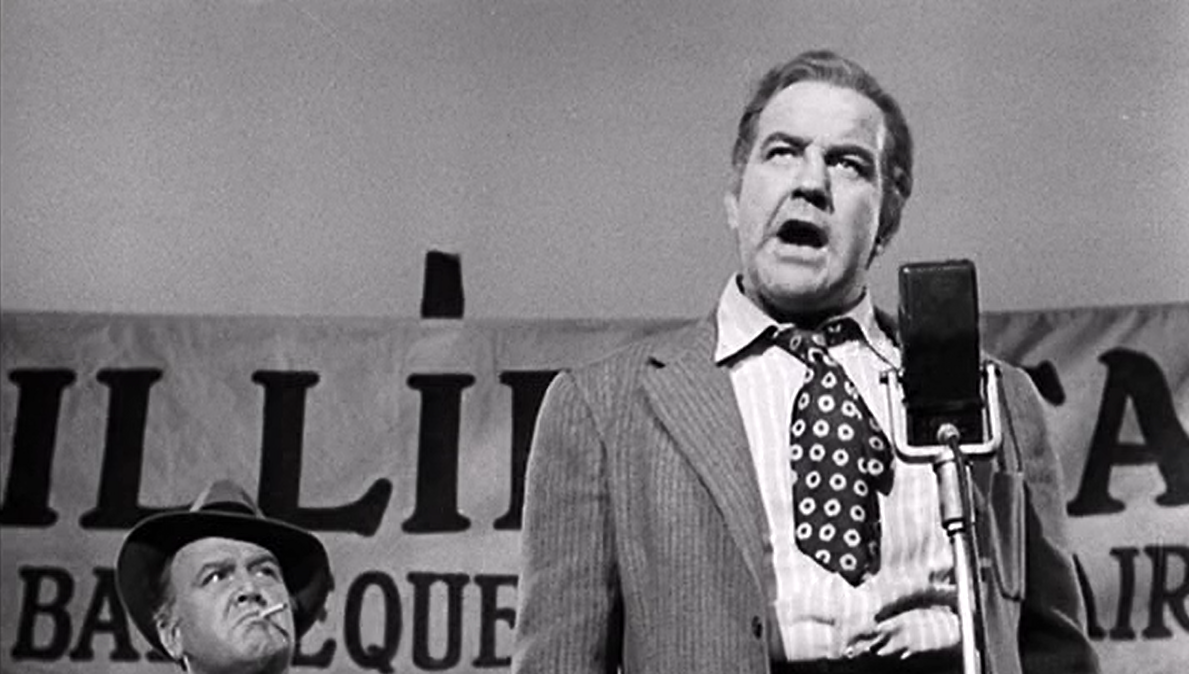
Broderick Crawford is a corrupt politician in All the King’s Men

Director: Robert Rossen

Cast: Broderick Crawford (Willie Stark), John Ireland (Jack Burden), Joanna Dru (Anne Stanton), John Derek (Tom Stark), Mercedes McCambridge (Sadie Burke), Shepperd Strudwick (Adam Stanton), Ralph Dumke (Tiny Duffy), Anne Seymour (Lucy Stark), Katherine Warren (Mrs Burden), Raymond Greenleaf (Judge Monte Stanton), Walter Burke (Sugar Boy)

We only need to look at recent elections to see populist demagogues are far from being consigned to history. So, there will always be a touch of relevance to Robert Rossen’s Oscar-winning film All the King’s Men. Based on Robert Penn Warren’s Pulitzer-Prize-winning novel, which was itself a fictionalised version of the life of Huey P Long, the Louisiana Governor who championed the working man but also turned the State into his own personal fiefdom, until his assassination. Rossen’s film looks at the dangers of populist politicians, but at times it’s a blunted, simplistic look and is too quick to colour shades of grey into more digestible black and white.

Willie Stark (Broderick Crawford) is a hick with a dream of running from office. His first campaign for county treasurer is impassioned but naïve, and he stands no chance against the ruthless (Democratic – although it’s not named) party system ranged against him. He loses but gains the attention of idealistic journalist Jack Burden (John Ireland), dissatisfied scion of a rich family. Stark teaches himself law and runs for Governor – but is manipulated by the party machine to split the ‘hick’ vote and allow their own candidate in. However, Stark rediscovers his fire and later runs again and wins. Stark promises a state run for the little people: but his pockets are lined by big-business and the man who started as a sober Christian becomes a drinker juggling two mistresses: his secretary and advisor Sadie (Mercedes McCambridge) and (proving power is an aphrodisiac) Jack’s girlfriend Anne Stanton (Joanna Dru). But can proof of his growing corruption bring him down?

All the King’s Men is a film that would be far more effective if it allowed more scope to seeing the good in Stark, not just the bad. This is after all, a self-made man (teaching himself law at home), who builds roads, hospitals and schools. He’s not a Trump, interested only in himself and damn the consequences. Many of his policies are solid Roosevelt New Deal fare. Sure, he becomes grasping, lascivious and a terrible father – but how did this happen? Was it that Stark realised that corruption was the game and he needed to play it if he wanted to win? Were there deep lying flaws already in his character? We just don’t really know.

Instead this film sets out its stall very cleanly: populist working-class politicians are much worse than tortured wealthy liberals. The characters the film admires all hail from the same gated island community of the rich. Any hypocrisy or corruption on their part is a tragic character flaw. Stark comes from poor farm land – but any corruption makes him a monster. Really is Stark all that bad? The film stresses its moral disgust at his drinking and womanising, but in office he produces the sort of modern infrastructure the State will need. Sure a newsreel questions if the state needs a modern highway (in a patronising “they are just country folk” way) and maybe it didn’t immediately – but ask how they feel ten or fifteen years down the line.

The real problem with politics in this era is not demagogues like Stark. It’s the corrupt machine style politics that settles the elections in advance, shuts the doors against anyone they don’t like and uses muscle (metaphorical and literal) to enforce its will. This is an institutional fault line in American politics of the era: and you could argue Stark’s tragedy is not that he’s corrupt, but rather that he has to fashion himself into exactly the sort of corrupt, machine-style politics boss that the system can accept in order to win. The film isn’t really astute enough to recognise this. Instead it settles for the standard “Great Man” approach, where we can point at a single man and say “yup, he’s the problem. Get rid of him and problem solved”.

Rossen’s film takes an easy soft-left approach. The poor people love Stark, because the media tell them to (although the film has its cake and eats it by only really showing the liberal press attacking him). Stark raising campaign contributions to run from office is an unpardonable sign of tar coating his hand – never mind that we’ve seen his personally funded campaign for a minor office didn’t stand a chance. Working for the people, its argued, doesn’t cancel out the evils of trousering some cash for yourself – never mind that the wealthy liberals Rossen sympathises with, living in their large country houses, have clearly been doing so for decades.
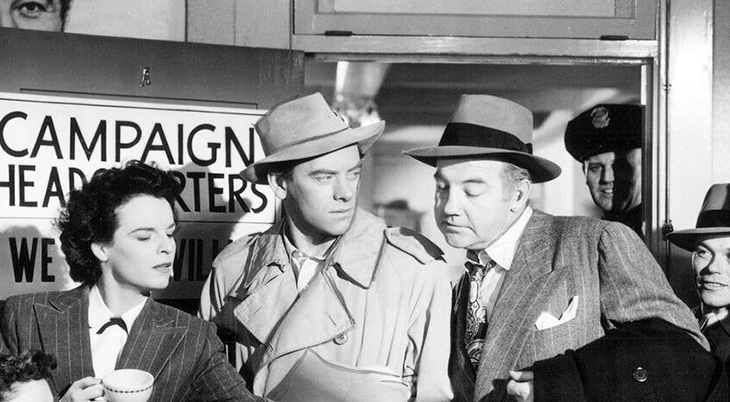
Instead All the King’s Men is a simple film that only scratches the surface of demagoguery. Stark makes great speeches, but we never find how far it’s a show and how far it’s empty rhetoric. We never find out enough either about what he has done or hasn’t done in office to make our own minds up. Rossen’s film fixes the tables and places all the blame not on the system but on a single man – and even suggests that getting rid of that man by violence and murder is in fact justified if the liberal elite decide it is. It’s not a good look for a film.

It bungles it’s politically and personally commentary, but you can’t argue that it’s not a well-made film. Inspired by neo-Realism, much of the film was shot on location (including effectively running a mock Governor campaign in parts of California) and its shot with an edgy immediacy, in places using non-professional actors. That’s a feeling helped by its sharp, jagged editing. Rumour has it that, with the first cut running long, Rossen asked the editor to find the narrative centre of every scene and then cut a hundred feet of film either side of it. The cleaned-up result of this is a edgy film that has the air of genuine reportage and effectively uses montage.

Broderick Crawford won the Oscar as Stark, and he plays the role with a sweetness that turns into brilliant bombastic swagger. The film uses his hulking physicality to marvellous effect, and while his character often feels simplistic, Crawford nails the speeches and Stark’s Lyndon B. Johnson like powers of physical intimidation. John Ireland (Oscar-nominated) does a decent if uninspired job as the weak-willed Burden, and Joanna Dru is a little too theatrical as Anne Stanton.

The most fascinating character though might well be political fixer/secretary Sadie Burke, played by fellow Oscar-winner Mercedes McCambridge. A radio actress making her film debut, McCambridge’s performance frequently avoids the obvious choices. Sadie is a hard-edged woman, unreadable, who has sharpened her personality to survive in a man’s world. Rossen’s film subtly codes that she is Stark’s mistress, but her relationship with him seems conflicted. She’s both vulnerable, but also bitter and cold to him – moments when you expect her voice to break, she’s hard, where you expect her to be sharp she’s brittle. She’s a bitterly cynical character who has given up hope. It’s a fascinating performance.

Rossen’s film is well made and is always going to have some relevance. But you feel it could have delved far deeper into its themes. But bluntly as a portrait of corruption, it’s not a patch on Citizen Kane and in Stark it sets up a monster we can have uncomplicated fun knocking over and then patting ourselves on the back once it’s done. For all its edgy, reportive feel, it’s a fantasy film.

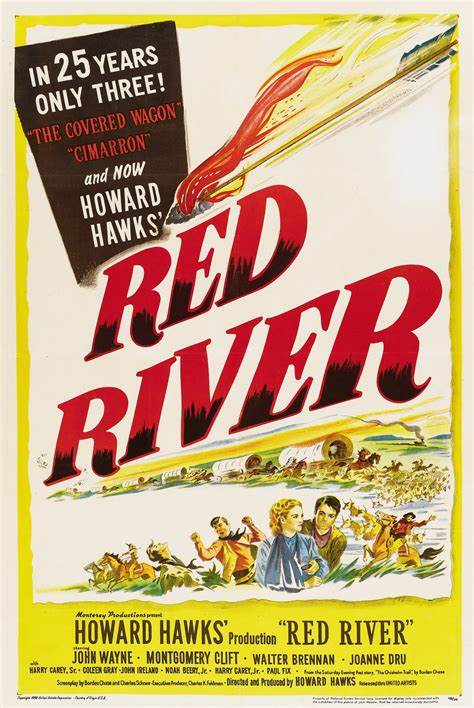
Red River (1948)

John Wayne and Montgomery Clift as duelling surrogate father and son in Red River

Director: Howard Hawks

Cast: John Wayne (Thomas Dunson), Montgomery Clift (Matt Garth), Joanna Dru (Tess Millay), Walter Brennan (Groot), Coleen Gray (Fen), Harry Carey (Melville), John Ireland (Cherry Valance), Noah Beery Jnr (Buster McGee), Harry Carey Jnr (Dan Latimer), Chief Yowlachie (Quo)

Some say Red River is, even more than Citizen Kane, the masterpiece in American film. That’s pushing it. But Red Rivercertainly is a prime slice of beefy entertainment. Hawks’ first Western (and how odd a director so associated with them didn’t turn his hand to them until late in his career – and then only made six), there is no greater compliment to make than to say you could mistake it for John Ford.

In fact, Ford was beyond impressed, famously observing of Wayne “I didn’t know the big son of a bitch could act”. Act he certainly does here as monolithic obsessive Thomas Dunson (surely a forerunner to the equally troubled – and troubling – Ethan Edwards in The Searchers). Dunson has spent almost two decades building his Texan cattle empire. Unfortunately, the Civil War means the bottom has dropped out of the Texas beef market. To make good his investment, Dunson needs to take the cattle (all 9,000 of them!) up north to Missouri (over a thousand miles) to sell at a good price. Along the way, Dunson’s ruthlessly focused ambition tips into tyranny, with Dunson (literally) judge, jury and executioner among his team. Can his more liberal adopted son, Matt Garth (Montgomery Clift), stop Dunson from destroying everything around him?

Red River covers the movement of cattle up the Chisholm Trail, a huge economic migration that saw millions of cattle moved from Texas to where their price was increased by a factor of ten. But the film has only a passing interest in the history – and the romantic, nostalgic look at it here, as a sort of boys-own adventure that goes wrong, is far more about the movies than social history. What the film is really focused on is the personal clash between two generations of men: one a relic of the first years of the new frontier, the other younger, more modern in his thinking, with a streak of humanity the other has beaten down.

Hawks’ film mixes this up with some terrific location footage. How did they wrangle all those cattle? The film is very strong in capturing the sense of excitement in the Frontier – the setting off on the trail, with its quick shot cacophony of horse-backed men whooping with joy, is full of a sense of adventure. The film is a triumph of quick-quick-slow story-telling. The 15 years of Dunson’s empire-building passes by with montage and Wayne voiceover which begins and ends with Wayne in the same position, but the actor considerably aged. Context is skilfully and swiftly given to us, but the tensions between Dunson and Matt are grow and develop naturally, simmering for a good hour-plus before erupting. Transition text between sequences bridges us from scene to scene, and is especially effective in charting Dunson’s descent into tyranny.

Tyranny is what it is all about. This is one of Wayne’s darkest – but also greatest – roles. Hawks taps into the despotic rigidity in this slab of Americana. Dunson is a man utterly and completely convinced not only of his invulnerability, but his rightness, embodying American manifest destiny. Claiming swathes of land as his own, Dunson is a man on the move, constantly striding forward (Hawks often shoots him in progressive, shark-like motion). He’ll leave behind him everything from the woman he loves (with a shocking toughness, as he looks back on the burning remains of the wagon train he left her in) to the land he claimed, to anyone who lets him down.

Dunson is also a ruthless embodiment of a time before law. No one seems to question the way he executes those who cross him. Practically the first thing he does on arrival in Texas is out-draw and kill the man sent to question his arrival. His farmstead has a full graveyard. A dark comic touch is added with his insistence in “reading the words” over graves of men he’s killed. On the trail he has those who back out, run away or question his leadership whipped or shot. Wayne’s certainty as an actor tips into a (literally) black-hatted despotism. His manly focus and ability to outdraw anyone turns him in the end into a nightmare avenger, a Western Terminator.

Opposite him is Clift (equally superb) as a more modern minded kid. Matt is the sort of man who knows that at times a bit of bend and a sympathetic ear gets better results than a beating. Hawks brilliantly builds the love-hate relationship between these two men who have very little in common, other than mutual affection. (Clift and Wayne themselves were polar opposites in acting style, social views and personalities.) There is a real love there – which makes it all the more inevitable Dunson will view Matt’s questioning of him as a betrayal nothing less than blood will redeem. The two of them, and their clash (like the clash between two sides of America) dominate the film, not letting too many other characters have a look-in.

Of the rest, Walter Brennan is a very good as Dunson’s loyal number 2, who may not always agree with the chief but largely (if reluctantly) sticks by him (for all he mutters to him “You’re wrong Mr Dunson”). John Ireland’s cocky gunslinger, who joins the trail because he admires Dunson’s no bullshit attitude, promises much at first but fails to deliver on much-hyped clashes. (Possibly because Ireland fell out with Hawks over a competition for the affections of his future wife Joanna Dru, his role later cut to ribbons in revenge.) There is however a strange, almost homoerotic, link between Clift and Ireland – mutual respect leading to an admiration love-in and much fondling of each other’s firearms during competitive rock shootings.

Red River’s ending has gained some criticism – largely because the film builds its sense of violence between the two leads so well that it feels a bit of a disappointment that they are effectively told to pull themselves together (by a woman of all things!). But, for all the film mines the clashes between two different outlooks, it never loses track of their very real affection. Sure Dunson may talk about killing Matt – but he certainly won’t in cold blood (even if he happily guns down anyone who gets in the way) and at the end of the day, he’s still the closest thing he’ll ever know as a son. Matt is emotionally mature enough to know Dunson is to-all-intents-and-purposes his father, even if he’s not above throwing a few punches at him. The clash is effectively a narrative dead-end – for all it would be exciting to see them take shots at each other, this is a family. And most families fight and make-up, not plug each other with bullets.

And it distracts from the grand entertainment of Red River, its excited love for the open country (the late act scenes inside are as disconcerting for us as they are the characters). This is a western of psychological depth successfully mixed with grand adventure. It’s hugely entertaining but also feels very true. It has two wonderful performances from Wayne and Clift. It’s not the Great American Film, but it’s directed by a superb understander of cinematic narrative and a hard film not to love.

Joan of Arc (1948)

Joan of Arc header
Ingrid Bergman shows France the way in po-faced epic Joan of Arc

Director: Victor Fleming

Cast: Ingrid Bergman (Joan of Arc), José Ferrer (Dauphin Charles), Francis L Sullivan (Bishop Cauchon), Roman Bohnen (Durand Laxart), Geoge Coulouris (Sir Robert de Baudricourt), George Zucco (Constable of Clervaux), Gene Lockhart (Georges de la Trémoille), John Emery (Duke d’Alençon), Richard Ney (Charles de Bourbon), Lief Erickson (Dunois of Orleans), John Ireland (Jan de la Boussac), Hurd Hatfield (Father Pasquerel), Ward Bond (La Hire), J. Carrol Naish (Count of Luxembourg), Frederick Worlock (Duke of Bedford), Shepperd Strudwick (Father Jean Massieu), Alan Napier (Earl of Warwick), Cecil Kellaway (Jean Le Maistre)

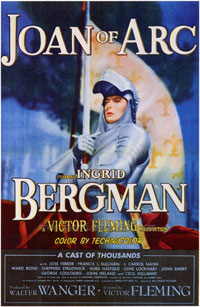
A light descends from heaven, and a young girl is seized with a sense of purpose. Joan of Arc (Ingrid Bergman) believes – as do her countrymen – that she received a message from heaven to help deliver fifteenth-century France back to the French, and out from under English occupation. For three years, this young woman strikes fear into the hearts of the English, inspiring the French into a series of victories (most of all at Orleans) and improving the French position such that the ambitious Dauphin (José Ferrer) is crowned Charles VII. But Joan is a target for the English, and she’s eventually  captured and burned for heresy after a trial notably free of justice at Rouen.

A huge investment at the time, with its colossal cast and loving recreation of medieval France, Joan of Arc is historically a luckless film. Despite its box-office winnings, it failed to cover its immense cost. It gained seven Oscar nominations (and four wins!) with no nomination for Best Picture. Its director, its cinematographer and actor Roman Bohnen (playing Joan’s uncle) all died prematurely after its release. Ingrid Bergman was caught up in scandal – and effectively exiled from Hollywood – shortly after when her affair with director Roberto Rossellini became public knowledge. Producer Walter Wagner was imprisoned three years later for shooting his wife’s lover. The film itself had 20 minutes sliced from it and, for decades, was only available in its truncated version.

Aside from these historic curiosities, Joan of Arc is a well-made, handsomely mounted but fundamentally rather dry and at points rather dull historical drama, mixed with more than enough touches of Biblical worthiness. Victor Fleming himself felt the film was a disappointment, that a trick had been missed – perhaps  aware that his own old-fashioned, rather flat direction fails to bring any inspiration out of the drama.

If drama is quite the right word for what, all too often, are too many scenes made up almost solely of a group of men sitting around a table in medieval garb talking at length of current affairs. Too many of these scenes lack in pace or urgency and many end up feeling forced, with too much of the dialogue reduced to recounting events rather than driving the story.

The structure of the story feels off as well: it can be split into three rough acts: Joan’s search for her purpose, Joan’s time as the inspiration of the French, and Joan’s imprisonment and trial. The trial, in particular, takes up almost the final 45 minutes of the film. The play the film is based on used a troupe of actors performing the life of Joan as a framing device for further insight into the life and impact of the saint. Without this framing device, the actual film becomes a rather dry history lesson.

It’s not helped by Bergman’s performance, which serves to capture in capsule the film’s po-faced piousness. It was a dream of Bergman’s to bring her Broadway performance of Joan to film. Sadly, the script’s lack of wit (or insight into the personality of Joan), means the majority of her scenes fall into a stock pattern: her lines are delivered with a breathless intensity with her hands are clasped across her chest. Aside from a few brief scenes where Joan questions why her voices have fallen silent, there are very few moments where either Bergman or the film seek to delve down into the motivations and inspirations of Joan. Like the film, her performance is bereft of any wit or warmth – instead it is almost devotional in its careful respect.

It’s part of the film’s seriousness. It makes some excellent points on the lasting impact of Joan, the horrific unfairness of her trial and the fact that, by burning her, the English merely cemented her hold on the French people rather than ending it. But too many other issues are pushed to the wayside, along with Joan’s character and motivations. No questions are raised around Joan’s interpretation of her visions. The conflict between faith and war is unexplored. The film sets its store out clearly: this is a devotional work and we should take it as that, and any questions around faith, legitimacy or what drove a fanatical teenager to embrace a life of military campaigning goes unexplored. In truth, we know as little about Joan at the end as we did at the beginning.

Which isn’t to say the film doesn’t have its plusses. As a piece of devotional film-making, it has a lovely score from Hugo Friedhofer, with just the right uses of heavenly choirs singing through the most devout sections. The design of the film is beautifully done, heavily inspired by medieval manuscripts, with the same striking primary colours and framing. It has in fact a beautifully old-fashioned look to it, a wonderfully designed artificiality. The siege of Orleans is a dramatically staged sequence, with a particularly striking orange-drenched sky. Visually you can imagine this as an incredibly stuffed-shirt Adventures of Robin Hood, but still glorious to look at.

Bergman is also wisely surrounded by a strong cast of character actors, all providing the sort of colour and corruption that Bergman’s stiffly written Joan can’t provide. José Ferrer landed an Oscar nomination for his film debut as the ambitious, weak-willed and envious Dauphin, more interested in realpolitik than doing the right thing. Francis L Sullivan connives and blusters wonderfully as corrupt Bishop Cauchon, fixing the trial. George Coulouris gives his usual hurried authority to de Baudricourt, while Cecil Kellaway inverts his Irish kindness as Joan’s Inquisitor. Off-the-wall casting choices like Ward Bond as a French captain surprisingly tend to pay-off. Shepperd Strudwick makes the biggest impression though as Joan’s sympathetic bailiff (he also speaks the prologue).

The overall film though is one more for history buffs than for movie goers. With its seriousness, odd pace (some events take forever, while others – such as Joan’s capture – either rush past in seconds of happen off-screen) and general lack of any humour or warmth, it’s not always an engrossing watch. Well-made as it is, it’s also directed with a certain flat professionalism rather than inspiration and Bergman seems constricted by the script and the part. A curiosity, but not a complete success.

Spartacus (1960)

Kirk Douglas leads the campaign for freedom in Spartacus

Director: Stanley Kubrick

Cast: Kirk Douglas (Spartacus), Laurence Olivier (Crassus), Jean Simmons (Varinia), Charles Laughton (Gracchus), Peter Ustinov (Batiatus), Tony Curtis (Antoninus), John Gavin (Julius Caesar), John Dall (Marcus Glabrus), Nina Foch (Helena Glabrus), John Ireland (Crixus), Herbert Lom (Tigranes Levantus), Charles McGraw (Marcellus), Joanna Barnes (Claudia Marius), Woody Strode (Draba), Paul Lambert (Gannicus)

You can’t talk about Spartacus without saying it can you? Did the team working on the film realise that, for all the big names, spectacles and sweeping that the film’s definitive contribution to popular culture would be the sound of a hundred men all claiming to be the slave leader? But it’s the moment you think of more than any other when the film comes up – and there’s not many films that can claim to have contributed such an instantly recognisable moment to our cultural heritage. It’s not the film’s only merit though: this is grand, entertaining, old-school Hollywood epic-film making.

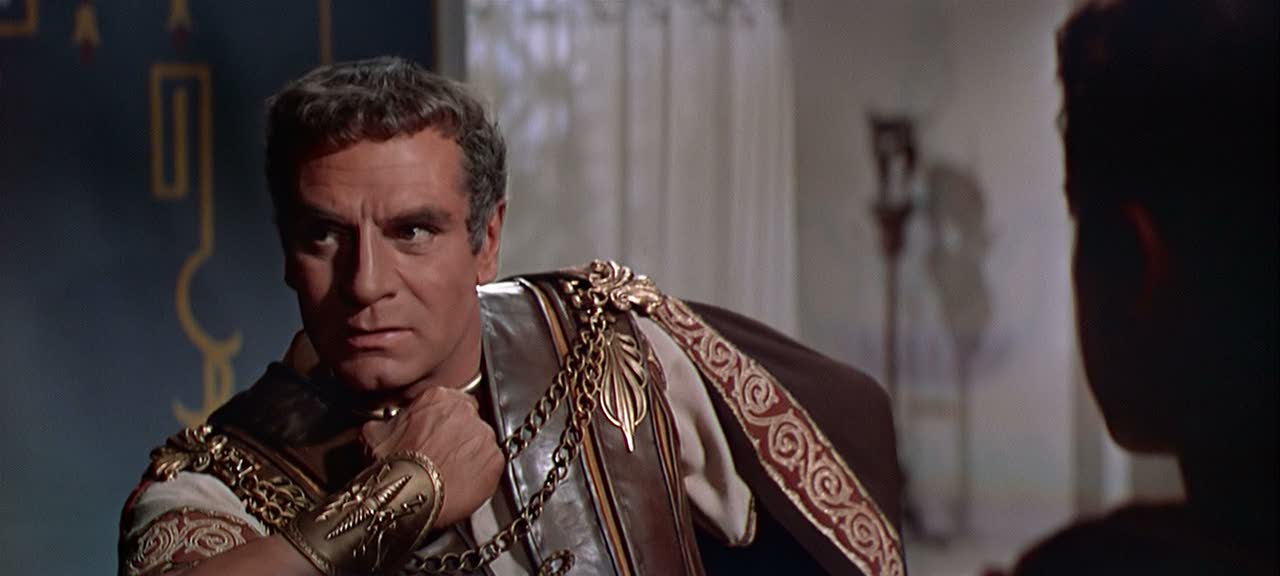
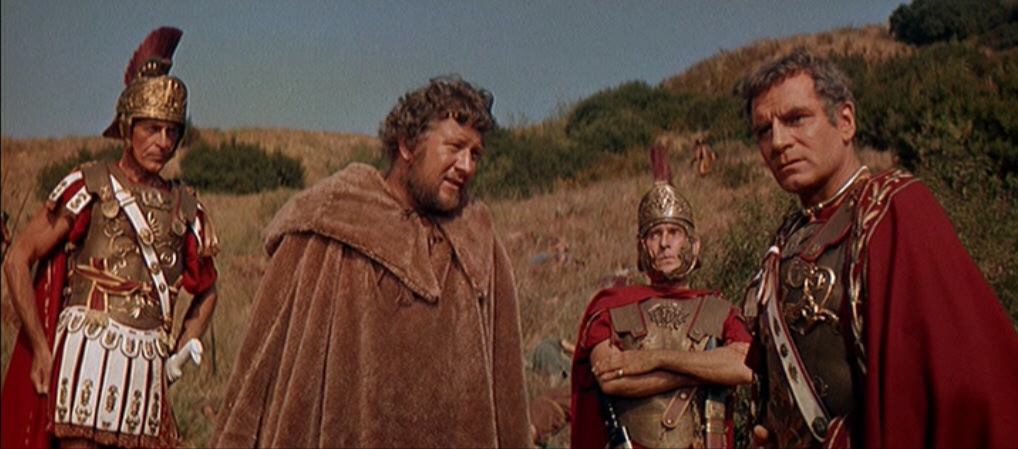
In the last decades of the Roman Republic, Spartacus (Kirk Douglas) is a young man born a slave, purchased by gladiator trainer Batiatus (Peter Ustinov) to learn how to thrill the crowds and kill his opponents. There he falls in love with slave-girl Varinia (Jean Simmons) and clashes with the regime of the training school. Revolt however stirs when rich nobleman Crassus (Laurence Olivier) arrives at the school and demands a fight to the death of his entertainment – as well as purchasing Varinia. In the aftermath, Spartacus leads a revolt – which grows into a huge army that soons puts all of Rome at risk. But a risk is also an opportunity: certainly it is for Crassus, who sees this as his chance to bring the Republic under his control.

Spartacus is a grand piece of film-making, shot on a huge scale, a labour of love for Kirk Douglas as producer. Upset at being denied the lead role in Ben-Hur, Douglas decided to make his own Roman epic – and to make something even grander than that Oscar-winning epic. Everything was thrown at the screen: grand locations, huge sets, star actors and a sweeping epic score. Alex North’s classically tinged score – with it’s distinctive employment of Roman instruments and echoing of both the intimidating splendour of Rome and the bucolic happiness of the liberated slaves – is proper old-school Hollywood score-making, that helps set the scene for the film’s epic sweep.

And Spartacus is epic – and epic entertainment. While it’s possibly a little too long, it knows when to spice up events with a battle, love scene or bit of political skulduggery. There are multiple story lines going on in this film, and interestingly they don’t all intersect. It’s easy to see Spartacus – and his struggle for freedom – as the real story of the film. But for most of the Roman characters, this is an embarrassment or sub-plot. There is a whole other story happening around the struggle to preserve Roman Republicanism – with Crassus as the face of oppression and his opponent Gracchus the slightly soiled but still vaguely democratic face of the old system. Both plots only rarely come together, and while that of Spartacus captures the heart strings, a lot of the film’s narrative drive is in the Roman conspiracies.

Perhaps this is because in the entire rebellion only Spartacus and Varinia qualify as really having personalities. And those personalities are basically flawless. Spartacus is almost saint-like in his nobility, a guy who never does anything wrong and whose only mistake is trusting others in a shifting world. Douglas does a great job of performing a character who is practically a living legend – and he completely convinces as the sort of leader his people would follow to the end. His relationship with Jean Simmons is also touchingly sweet and innocent – the film is very good at capturing the sense of how stunted the emotional lives of slaves have been, and the powerful joy they can find in the freedom of simple intimacies so many of us take for granted.

But the slaves themselves are frequently (whisper it) rather dull. Many of them might as well be sitting around the camp fires singing Kumbaya. Bar a brief moment at the start, no suggestion of taking vengeance raises its head. The liberated slaves sing, clap hands and gaze with joy. Children play and people frolic in the fields. Tony Curtis – good value as Crassus’ ex-bodyman, a learned man and entertainer of children – stages a magic show, with patter that could have come straight out of a Brooklyn street. Other than him, none of the slaves register as personalities. A tint of darkness, or moments of fury or even dangerous rage against their oppressors would have made a world of difference. But this is a simple film, where the slaves are building a utopia.

That’s probably why the film is more interested in the politics of the Romans. It’s certainly where the big name actors end up. Olivier is at his prowling, imperialist best – a heartless slice of ambition determined to bend events to his will. Against him, Charles Laughton with an impish cheek, a slightly corrupted air, as the man-of-the-people. These two conduct their own political battle of cut-and-thrust that Spartacus barely realises is happening. This manoeuvring is the real dramatic heart of the film, powered by these actors strengths (John Gavin and John Dall as their lieutenants look and sound very plodding against the playful archness of Olivier and Laughton).

That’s partly the point of Dalton Trumbo’s script (Douglas famously broke the Hollywood Blacklist by crediting Trumbo for his work on the film). While Rome plays politics, real people are fighting and dying for liberty – and will eventually find themselves crucified with nothing left but their pride and sense of freedom. It’s that feeling that probably lies behind the enduring love for this film.

It is perhaps Kubrick’s most universally beloved film. Interestingly though, it’s also the one Kubrick was least proud of. It’s true the film lacks much of his personal touch. While directed with flair and skill, parts of it could really have been made by any number of directors (not something you could say, for example, about The Shining or Barry Lyndon). Kubrick often quietly, albeit gently, disowned the film (he said he never knew what to say when people asked him about it). It’s the only Kubrick film where he was a “gun for hire”, subservient to the vision of the producer. His interest you feel is in the smaller moments – moments such as Woody Strode’s excellent cameo as a Gladiator (many of the strongest moments with the slaves in the tyranny of the Gladiator school, where life is meaningless and cheap). Really, it’s Douglas’ film – it’s similarities to The Vikings for example is striking – and while a poor advert for auteurism, it’s still a great advert for entertainment.

Kubrick’s greater interest in human failings and shades of grey perhaps explains why the Romans emerge as the more interesting characters. Spartacus’ lack of flaws were an intense frustration to him. Perhaps that’s why Peter Ustinov (who won an Oscar) is the films stand-out character. As gladiator owner Batiatus, Ustinov is devious, playful, amoral, ambitious, without principle, dryly witty but somehow still has touches of decency. The most colourful character in the piece is also the one most coated with shades of grey.

*It’s an advert for what makes Spartacus lastingly engaging and interesting whenever you watch it – even if the cry of “I’m Spartacus!” and the decency and honour of the slaves is always going to be what stirs the emotions and tugs the heartstrings. Douglas set out to make one of the greatest “sword and sandal” epics. He succeeded.

My Darling Clementine (1946)

Henry Fonda is here to enforce justice in My Darling Clementine

Director: John Ford

Cast: Henry Fonda (Wyatt Earp), Linda Darnell (Chihuahua), Victor Mature (“Doc” Holliday), Cathy Downs (Clementine Carter), Walter Brennan (Newman Haynes Clanton), Tim Holt (Virgil Earp), Ward Bond (Morgan Earp), Don Garner (James Earp), Grant Withers (Ike Claton), John Ireland (Billy Clanton), Alan Mowbray (Granville Thorndyke), Roy Roberts (Mayor), Jane Darwell (Kate Nelson)

In John Ford’s The Man Who Shot Liberty Valance, a journalist says “When legend becomes fact, print the legend”. It could almost be a commentary on My Darling Clementine, a lusciously romantic retelling of the story of Wyatt Earp and his Gunfight at the OK Corrall between the Earps and local cowboy gang the Clantons. John Ford’s film is a perfect slice of Americana, in which the West is seen at its glorious best, and almost no fact in it is true.

In 1882 retired Marshal turned ranger Wyatt Earp’s (Henry Fonda) brother James is killed outside the town of Tombstone, shortly after Earp had turned down an offer to buy his cattle from Old Man Clanton (Walter Brennan), the family patriarch. Earp suspects foul play, but decides to stay in Tombstone as its new Marshal, with his brothers Virgil (Tim Holt) and Morgan (Ward Bond) as his deputies to reinforce the law. In town he meets local gambling man “Doc” Holliday (Victor Mature) and falls for Holliday’s former girlfriend Clementine (Cathy Downs), in town searching for Doc. Will Wyatt find out who killed his brother and find contentment?

My Darling Clementine is almost entirely invented. Virtually nothing in it is true, from the year it’s set (the actual gunfight happened in 1881) to what happens in the actual gun battle. The fates of nearly all the characters have been changed (James, whose death kicks the film off, actually died in 1926) and a host of characters have been invented, not least Clementine herself. The action has been moved to Monument valley from Arizona. Its comprehensive myth-making on screen, with Earp himself changed from an unhappily married man probably “carrying on” with an Irish actress into the pillar of moral decency that is Henry Fonda. 

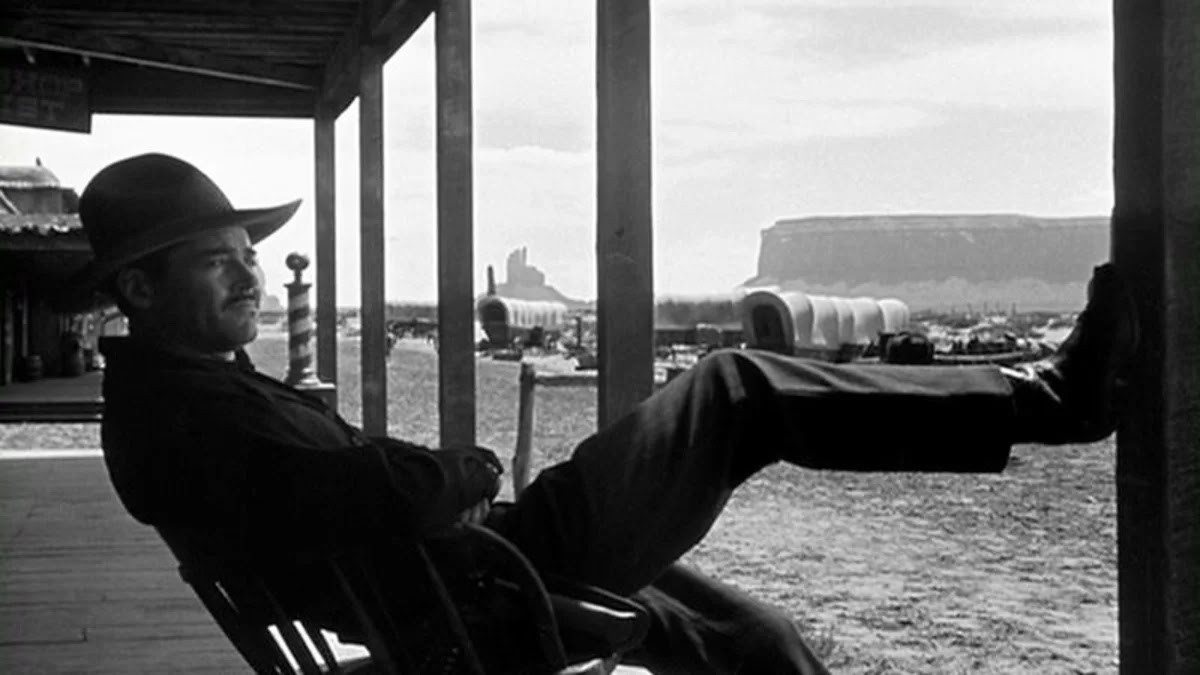
But does it really matter? Not really. If you run with the film has being part of Ford’s tradition of reworking the past of America into a grand origins myth for the United States, the film works perfectly. It’s directed with great visual skill by John Ford, who creates some luscious shots of Monument valley and some glorious skylines that dwarf the actors into the machinery of myth. His visual storytelling is perfect at communicating character, from the boyish leaning back on his chair from the boy scoutish Earp to carefully building the tentative, ]barrier filled relationship between Earp and Clementine. 

My Darling Clementine features a romance plot line, but it’s played in parallel with a story of feuding that leaves large numbers of the cast dead. Aside from Earp and Holliday there is virtually no overlap between the romance plot and the events leading to the gunfire. Clementine never refers to it, and you can almost imagine this as two films skilfully and gracefully cut together. Perhaps this is Ford’s intent: this is a film about community in the West, about the building and creation of a town and the shaping of relationships and friendships around it – that just happens to have as well a gang of murderers that Fonda needs to take down.

Tombstone is emerging from the Wild West – at a key moment half way through the film, Earp and Clementine dance (Earp with a surprising grace) at an outside ball to celebrate the opening of a church. It’s just one sign of civilisation arriving in the town, with theatre on the way and even Holliday’s gambling den slowly becoming something a little bit less violent. Earp himself is a reluctant but honest lawman, repeatedly asking at the start “what kind of town is this?” and seemingly deciding to stay to sort the place out as well as find out who killed his brother. 

It’s telling in any case that Earp’s reaction to his brother being killed is to pick up a badge not a gun, but then you would expect nothing less from Henry Fonda. Fonda is at his most decent, and bashful, his most just and moral, the embodiment of law and justice. Fonda pitches the performance perfectly, a shy man who knows what’s right, but has the guts to go the extra mile to get it. Fonda also gets some wonderful chemistry from his interactions with Cathy Downs’ Clementine, each scene between them dripping with longing but a sad knowledge that nothing can come of it.

There are a whole host of reasons for that, not least her past relationship with Doc. If there is a second heart to the film, it’s the uneasy semi-friendship that grows between Holliday and Earp. It’s a beautifully judged, wordlessly expressed mixture of regard, respect and suspicion, of two men who have taken very different paths in life but recognise in each other a common world view, a yearning for peace and poetry under the guns. Holliday – dying although you wouldn’t think it considering the hale and hearty look of Victor Mature – is a dangerous man but a fair one, not like the arrogant destructiveness of the Clantons. He’s even able to juggle respectful relations, not least with Linda Darnell’s showgirl. Mature gives a decent performance, hampered by his essential earnest woodenness from really exploring the depths of a TB suffering physician turned gunslinger, but able to express a basic decency and touch of poetry.

It’s a film about small moments between these characters that culminates in parallel with a gun fight that burns out of the clash between the Earps and Clantons. The Earps are of course all thoroughly decent, upright sorts while the Clantons are unclean, unshaven (first thing Wyatt does in the film is get shaved!) types, led by a bullying Walter Brennan. The gunfight is spectacular, but it’s part of one of two films, followed as it is with Earp’s sad departure from the town and the culmination of the unspoken love between him and Clementine. But isn’t that part of the myth? And with its romance, its heroic stand against injustice and its epic sweep and brilliance, My Darling Clementine is a celebration of the myth and power of the West.