Tag: John Slattery

Nuremberg (2025)

Nuremberg (2025)

Terribly handled drama that accidentally deals a favourable hand to a leading Nazi

Director: James Vanderbilt

Cast: Rami Malek (Dr Douglas Kelley), Russell Crowe (Herman Göring), Leo Woodall (Sgt Howie Triest), Michael Shannon (Justice Robert Jackson), Richard E Grant (David Maxwell Fyfe), John Slattery (Colonel Burton C Andrus), Mark O’Brien (Colonel John Amen), Colin Hanks (Dr Gustave Gilbert), Wrenn Schmidt (Elsie Douglas), Lydia Peckham (Lila), Lotte Verbeek (Emmy Göring)

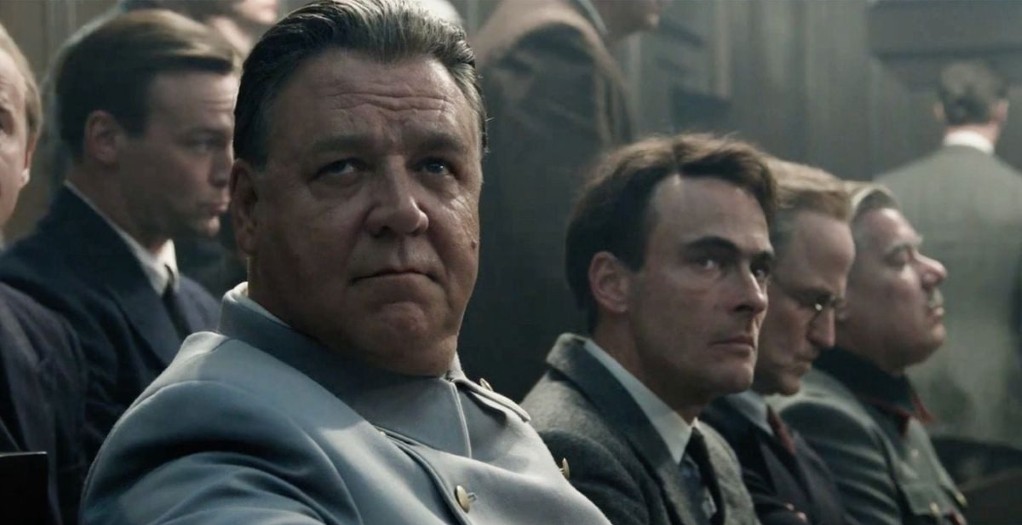
If one thing captures what a miserable failure James Vanderbilt’s Nuremberg is it’s this: if Herman Göring rose from the bowels of whatever Hell he currently resides in and saw it, he’d probably freaking love it. The misguided history lesson has a political and moral message that is obscured and fudged, its points either lost or delivered with thudding obviousness. But the one thing it’s consistent in doing is presenting the most infamous Nuremberg defendant as a fiendishly clever Hannibal Lecter, multiple steps ahead of everyone, whom the film allows to fudge (without sufficient correction) his responsibility for the Holocaust and who goes down due to his loyalty to his lost leader. Ye Gods.

Vanderbilt’s film is an old-fashioned film that simultaneously gives a spotlight to the relationship between Göring (Russell Crowe) and psychiatrist Douglas Kelley (Rami Malek) and attempts to tell the entire history of the set-up, planning, prosecution and judgement of one of the longest trials in history. It succeeds at neither of these things, and does so while cramming dry, exposition-heavy dialogue into its actors’ lips (the sort of speeches where people launch into lists of the Nuremberg Laws or the trial’s legal framework). Much of it is dramatically inert – at least those parts you’ll be able to see through the film’s impossibly murky camerawork (I expected the lights to shoot up in the courtroom in a standard ‘truth-bought-to-the-light’ cliché, but even here it’s hard to see).

The material around the trial set-up essentially takes a fascinating subject – the wrangling of four allies (three of whom didn’t really trust the fourth) to create a legal framework for an international tribunal never attempted before – and makes it dull as ditchwater. Michael Shannon does his best as Justice Jackson, architect of the trial, but the vast majority of his scenes are little more than exposition (his best is a meeting with Pius XII, whom he effectively blackmails into supporting the trial, in recompense for Pius’ lack of action against the Nazis). Richard E Grant adds a little flavour, even though this film’s whisky-from-a-teacup Maxwell Fyfe (in reality, a stern man in his 40s) feels more like Grant-101 than a real person.

While the trial is a drag, the rest is a farce. Rami Malek flails as Douglas Kelley, in a poorly written role. I suspect, based on the film’s final ham-fisted scene, the intention was to suggest Kelley got too close to Göring and bought a little of what he was selling until the scales fell from his eyes during the trial (and the Holocaust evidence). That Kelley would serve as a dark warning that even the brightest can get seduced by charismatic Nazis. This would have added real fire to the film’s closing vision of Kelley as a drunken Cassandra, desperately railing on US public radio that it could happen here. But clearly someone was worried positioning our hero as someone who admired Göring for a while was going to be hard for regular viewers to sympathise with.

Instead, we get a clumsy dance, where its repeatedly stressed Kelley is only getting close to Göring because he wants to exploit him for a best-selling book. That his sticking up for Göring (including giving credence to Göring’s argument that he couldn’t possibly know about the Holocaust, because that was Himmler’s department) and being nice to his wife and child was all part of this.

It then awkwardly tries to have this cake and eat it, by suggesting Kelley also realising the trial is about real people not just turning a buck. It spectacularly lacks the skill to pull this off. Even worse, it hilariously keeps providing evidence that Kelley is a terrible psychiatrist. Göring manipulates him with ease and, in the real low-point, we cut from Kelley blithely saying he spoke to previously-depressed prisoner Robert Ley and he seemed calm – straight to the aftermath of Ley’s grisly suicide.

This is as nothing to the film’s strange admiration for Göring. Not helped by Russell Crowe giving the film’s best performance, it feels like Vanderbilt never realises how quietly favourable the cards he gives Göring are. (It even actively absolves Göring of antisemitism, arguing he was just an opportunist supporting it for advancement.) He has all the best lines and dominates his scenes. The film draws attention to his fiendish cunning (allowing himself to be captured so he can manipulate the trial, hiding his ability to speak English etc.), shows him effortlessly running rings around everyone he talks to, weaning himself off a pills addiction through will alone… It wants the sort of Hans Gruber like villain who controls the whole trial from his cell.

It undersells small moments, such as Göring’s nervous reaction before, and complete denial after, the Holocaust film played in the trial. Even worse it gives Göring wiggle-room, unquestioned, to deny his responsibility for the Holocaust. Let’s not beat about the bush: Göring signed the order authorising it. In the real trial, his charisma butted up against the damning facts of his involvement from everything from petty art thefts, to murder of allied airmen, setting up the Gestapo and ordering the Holocaust. Nuremberg is brave enough to show Jackson’s real-life poor cross-examination of Göring – but allows Göring’s weasel words on a debatable mistranslation of his order on the Final Solution to go unexposed for the bollocks it was.

The film’s ‘gotcha’ moment in the trial is feeble, reduced down to Fyfe getting Göring to say he continued to support Hitler. This is played as the key moment that would turn Germany away from the Nazis, but surely was hardly off-putting to many in a country that had almost literally fought to the death for Hitler less than year earlier. Göring would call it loyalty – another thing he’d be thrilled the film showed him displaying.

It gets worse. A final shot of the executed Nazis’ bodies is in such staggeringly poor taste I almost can’t believe I saw it: laid out exactly like Holocaust victims, they are driven in the back of a van to be incinerated in a concentration camp. I can see Vanderbilt was going for “poetic justice” – but it’s awful. After that gut-punch, watching a drunken Kelley in a coda all-but-say ‘Watch out Trump’s-a-comin’ and he’s a Nazi!’ almost feels okay (except of course it’s awful in a different way, as subtle as every other point in the film).

Nuremberg is terrible. It’s at its best when it’s merely slow and boring. At its worst when it borderline admires Göring. If you want to watch this story, search out the 2000 mini-series Nuremberg with Alec Baldwin as Jackson and a (possibly) career-best Brian Cox as Göring (Cox, and the series, succeed in showing him with surface charm, smart, but full of vicious cruelty and staggering bombastic overconfidence). Don’t watch this.
Charlie Wilson's War (2007)

Charlie Wilsons war
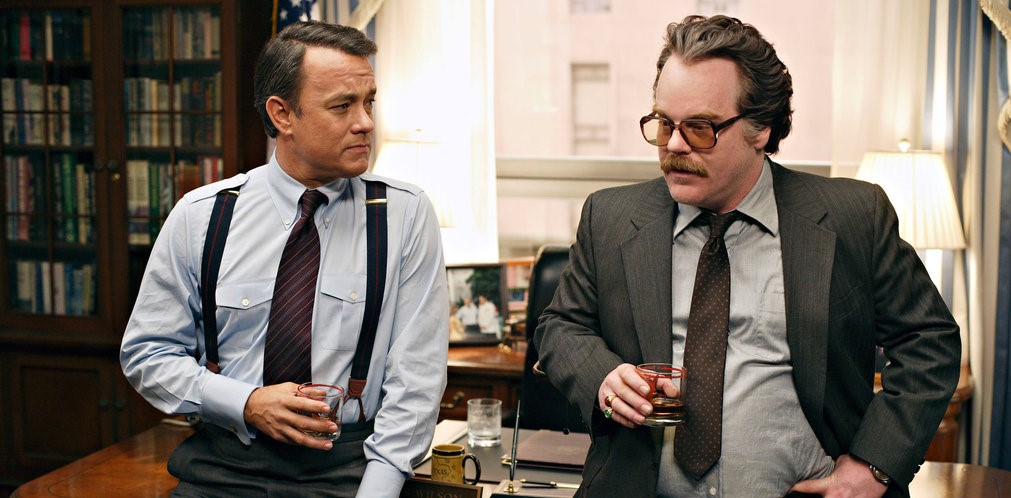
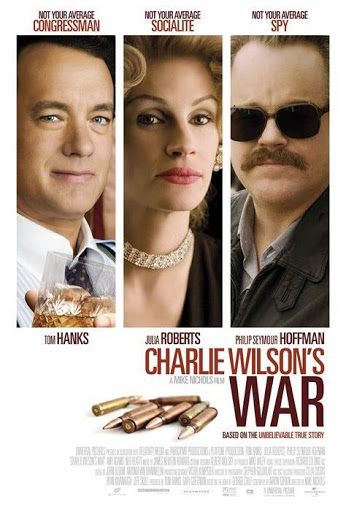
Tom Hanks and Philip Seymour Hoffman plot to bring down communism in the misfiring satire Charlie Wilson’s War

Director: Mike Nichols

Cast: Tom Hanks (Congressman Charlie Wilson), Julia Roberts (Joanne Herring), Philip Seymour Hoffman (Gust Avrakotos), Amy Adams (Bonnie Bach), Ned Beatty (Congressman Doc Long), Christopher Denham (Michael G Vickers), Emily Blunt (Jane Liddle), Om Puri (President Zia-ul-Haq), Faran Tahir (Brigadier Rashid), Ken Stott (Zvi Rafiah), John Slattery (Henry Cravely)

Did Congressman Charlie Wilson (Tom Hanks) end the Cold War? Well no, of course he didn’t. But he might just have managed to make the US notice that Afghanistan had the potential to be the USSR’s very own Vietnam. Despite his reputation as a playboy, Wilson had a shrewd understanding of geopolitics and – encouraged by millionaire backer Joanne Herring (Julia Roberts) and helped by firey CIA agent Gust Avrakotos (Philip Seymour Hoffman) – arranges for money and arms to be pumped into the Afghan Mujahideen throughout the 1980s. Shame that funding stopped just as the Taliban emerged into the power vacuum.

There is a compelling film to be made here around how the US’s short-sighted policies in Afghanistan during the 1980s led to catastrophic implications in the 2000s. This isn’t that film. Instead Nichols – with some playful rat-a-tat dialogue from Aaron Sorkin – settles for a political caper, which only nods vaguely at the future disaster of 9/11 in favour of a feel-good, against-the-odds triumph. It’s a massive shame, as a third act which really embraced how policy failures in Afghanistan contributed to the rise of the Taliban and Al-Queda could have been compelling and thought provoking.

Watching this film you could come away with no real idea why the fighters the Wilson works so desperately to get defensive anti-aircraft missiles to, would end up recruiting young men to fly planes into buildings. The film nods at this, with Wilson failing to raise even a paltry million for investment in education and healthcare in Afghanistan post-Soviet occupation (after raising billions for weapons to fight the Soviets). But we don’t get a sense of the bigger picture here. How did hatred for the Russians, with the Americans as allies, flip into fury at the West? The film doesn’t want to think about it.

Instead this is a light bit-of-fluff. It’s a comic drama of the sort Hollywood loves: the playboy with immense depth. The hero whose heart melts at a refugee camp and dedicates himself to helping people. The film uses as a framing device a medal ceremony, with Wilson being praised for his vital role in bringing about the defeat of the USSR. It’s all feel-good – and for all we see at the end a brief moment of Wilson in tears at his failure to ‘finish the job’ by offering real hope to the Afghans – and that doesn’t feel like the whole story.

There is plenty of comedy though, even if the political awareness is light. Gust and Charlie’s first meeting is a well-staged farce of Wilson juggling geopolitics with heading off oncoming scandal, that requires Gust to frequently step in and out of his office as two different conversations take place. Comic material is mined from Wilson’s handpicked office staff of attractive women who, contrary to expectation, turn out to be brilliantly insightful and hyper-competent. CIA agent Gust is a gift of a role for Philip Seymour Hoffman (who is great fun) as a foul-mouthed, just-this-side-of-OTT maverick who genuinely cares about his job.

Hoffman fares better than the other two leads, both of whom feel miscast. The casting of Hanks and Roberts seems designed to keep a film that could have been a sharp attack on America’s world policy feeling as cosy as possible. After all, this is America’s uncle and America’s sweetheart: they couldn’t be part of geopolitical shenanigans! Sadly, Hanks doesn’t have the touch of smarm and cocksure lightness with depth the part needs (Tom Cruise would have been better). Julia Roberts seems too wholesome for a sexual femme fatale (Michelle Pfeiffer would have been better).

Nichols does keep the pace up and his direction is assured and professional. But this is a strange and toothless film which, after the initial energy of Wilson managing to get the funding the Afghans need, has no idea where to go. So instead it slowly drains out to nothingness. A late scene as Gust explains the dangers of abandoning Afghanistan to the Taliban to Charlie (with the accompaniment of plane sounds on the soundtrack) hints at the film this could have been. But instead, this sticks for being a romp about how an unexpected hero changed the world. The fact it was partly for the worse doesn’t fit this narrative.

Spotlight (2015)

SPotlight header
Ruffalo, McAdams, Keaton and James head up the investigation into the church in Spotlight

Director: Tom McCarthy

Cast: Michael Keaton (Walter “Robby” Robinson), Mark Ruffalo (Michael Rezendes), Rachel McAdams (Sacha Pfeiffer), Brian d’Arcy James (Matt Carroll), Liev Schreiber (Marty Baron), John Slattery (Ben Bradlee Jnr), Stanley Tucci (Mitchell Garabedian), Billy Crudup (Eric MacLeish), Jamey Sheridan (Jim Sullivan), Paul Guilfoyle (Peter Conley), Len Cariou (Cardinal Bernard Law), Neal Huff (Phil Saviano)

True villains are hard to spot: those clothed in good deeds are particularly well hidden. Few clothe themselves in good deeds more effectively than priests – and the small minority who use their positions of trust and power to abuse vulnerable children. It’s an unforgiveable, abominable betrayal that has ruined the lives of thousands of victims around the world. This century, the Catholic Church was rocked by a scandal: many in the church hierarchy were all too aware of these appalling acts, but protected priests from exposure rather than submitting them to well-deserved punishment. It took the work of crusading journalists to lift this veil and force the Church to begin to change its policy from protecting priests to protecting children.

The story was bought to wider attention by the dedicated work of the Boston Globe’s Spotlight team – the US’s finest investigative journalist team, a small team of reporters who work for months at one story. Boston is a firmly Catholic city, where the Church still holds a huge influence over the lives of its population. For years, faint suspicions of misconduct from any of the nearly 1,500 priests in the city was hushed up. It takes the arrival of an outsider at the Boston Globe – the paper’s unassuming new Jewish, Floridian editor Marty Baron (Liev Schreiber) – to push the Spotlight team to delve deeper into this story. He finds plenty of support from the team – respected editor “Robby” Robinson (Michael Keaton), the passionate Michael Rezendes (Mark Ruffalo), dedicated and empathetic Sacha Pfeiffer (Rachel McAdams) and increasingly disgusted Matt Caroll (Brian d’Arcy James). Using tried-and-trusted journalistic methods, passionate investigation, archival work and winning the confidence of survivors, the team piece together a systematic cover-up by the Catholic Church that extends all the way to the Vatican.

Spotlight scooped the Oscar for Best Picture (along with an Oscar for its brilliantly researched screenplay). It feels like a late Oscar partly awarded in memory of All the President’s Men, the film that Spotlight bears the most relation to. But, even more so than Pakula’s film, this is a low-key, reserved but strikingly effective and engrossing film that takes an almost documentary approach to the patient work required to uncover a story (no Deep Throat here) and the grinding shoe leather needed to get there. Fittingly, given the tragic story the team were reporting on, Spotlight is almost totally devoid of histrionics (there is at best one scene where a member of the team gets angry – only to be met with a quiet “are you done?”), instead being a tribute to the professionalism and integrity of journalists powered, but never overwhelmed by, their anger.

McCarthy’s film is refreshingly free of flourish or over-emphasis. It’s brave enough to let the story speak for itself, and trusts the viewer to understand both the emotional weight of abuse and the feelings of those involved without resorting to dramatic speeches or tearful dialogue. The details dominate – searching through archives for old newspaper clippings, waiting for access to court papers, days spent reading over a decade of parish records. Nothing is earned cheaply: every revelation the result of patient leg-work and following where the story leads without agenda or bias.

Agenda is something these journalists are deeply aware of. All of the team were raised in the faith to one degree or another, with strong roots in a community. The team’s leader, Robby, is an esteemed alumnus of a Catholic school one of the guilty priests worked at when he was a child – a revelation that quietly leads him to question both his implicit turning of a blind eye, but also how only a single man’s choices prevented him from becoming a victim. There is discomfort throughout the Boston Globe at the story – assistant Editor Ben Bradlee Jnr (a fine performance from John Slattery), while supportive of the team, is prickly at revelations that the Globe had previously not followed up reports of abuse and is deeply unhappy at the thought of accusing the Church itself.

The power of the Church in communities like this is subtly, but brilliantly, depicted. The film opens in the 70s with a paedophile priest having his actions being quietly hushed up by the police after the intervention of an ADA. Virtually every important person in the city is a Catholic and, like Robby, has been bought up and schooled in the Church. In exterior shots, McCarthy’s camera constantly frames churches on the edges of shot, their spires visible over residential blocks. The scale of the power of this institution – its reach and influence – is constantly demonstrated. It’s a big challenge for the team to take on – and one which they are not even sure their readers are ready to read about.

But McCarthy’s film isn’t crude. It’s made clear that these priests are a minority – 6% – and the anger is not with faith itself, but with the flawed and wrong decisions taken by men (the psychologist the team consults, an ex-priest, makes clear his faith is not shaken by his discoveries, only his trust in the institution). Equal care is given to the victims themselves. Their stories are reported by two characters in the film, each time with a careful lack of over-emphasis and a quiet, yet emotional, honesty. No attempt is made to sensationalise any of this.

And the film also makes clear that everyone is in some way complicit in this. The Globe has failed to report it. The police and government have covered it up. People might whisper about it – or say a particular priest is “dodgy” – but no one has made an effort to rock the boat and find out about it. Instead, victims are paid off, priests are moved to new parishes and everyone tries to carry on as normal. It’s a grimy and quiet conspiracy – miles away from the Grisham-esque danger the film’s trailer suggested – rather a collective failure of moral responsibility.

The film’s low-key approach, professionalism and absorption in how people do their jobs is deeply engrossing. Few things, after all, are as involving as watching highly professional people execute their jobs flawlessly. The performances are superb. Michael Keaton gives possibly the finest performance of his career – surely connected to it being his most restrained – as the team’s leader, whose sense of personal guilt and regret quietly build along with determination. Ruffalo (Oscar-nominated) is fantastic as his passionate, committed colleague (he gets the one shouting scene). McAdams delivers quiet empathy and powerful intelligence. Schreiber confounds expectations as the numbers man who emerges as a dedicated searcher for the truth.

The truth is exposed – but it’s just a tip of the iceberg. The story might be out there, but as the film shows in its coda, the struggle goes on. Crusading maverick lawyer Mitchell Garabedian (Stanley Tucci, very good) can’t celebrate the story’s publication – he’s got two child victims he needs to talk to. Cardinal Law (a fine performance of assured, misguided, certainty from Len Cariou) is promoted to the Vatican. Similar scandals emerge across the world. But the problem doesn’t go away. Just as the story needs time and work, the same qualities are needed to reform the Church.

Spotlight is quiet, engrossing and finely moving and triumphant film-making. It focuses brilliantly on professionalism and dedication producing results and shows that hyperbole and embellishment are not needed for outstanding drama. Told with documentary realism, acted with reserved grace and skill, McCarthy’s film is a call-back to 1970s film-making in the best possible way. A deserved winner and a small triumph.

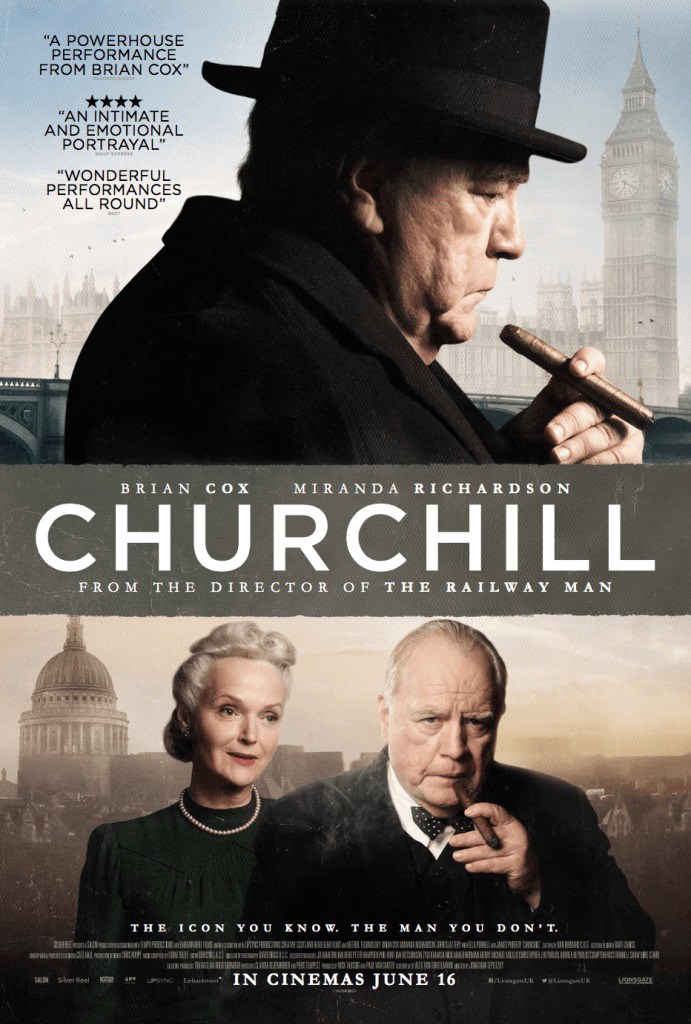
Churchill (2017)


Brian Cox does his very best Greatest Britain as Churchill

Director: Jonathan Teplitzky

Cast: Brian Cox (Winston Churchill), Miranda Richardson (Clementine Churchill), John Slattery (General Dwight D. Eisenhower), James Purefoy (King George VI), Ella Purnell (Helen Garrett), Richard Durden (Jan Smuts), Julian Wadham (Field Marshall Bernard Montgomery), Danny Webb (Field Marshall Alan Brooke), Jonathan Aris (Air Field Marshall Trafford Leigh-Mallory)

Someone should open a club: The Churchill Club. Every actor who’s played the Great Man gets instant membership. President the late Robert Hardy (seven times!). Other members? You name it: Finney, Gambon, Burton, Spall, Gleeson, Russell Beale, West, Hoskins… Think of a shorter, slightly rotund British character actor and inevitably they’ve had a go. Even the decidedly non-rotund, non-short, non-British John Lithgow aced the role in Netflix’s The Crown. With Gary Oldman also making his pitch this year in Darkest Hour, this film sees renowned character actor Brian Cox join the club. 

1944. Its three days before D-Day and Winston Churchill (Brian Cox) is getting cold feet. Haunted by memories of Gallipoli, he fears that the attack on Northern France will lead to disaster and oceans of blood. Against the advice of his Generals Montgomery (Julian Wadham) and Brooke (Danny Webb), he attempts to push General Eisenhower (John Slattery) to change the plans. As depression takes its grip on him, only his wife Clementine (Miranda Richardson) can get through to him. 

Churchill is a bit of a mess. It’s pretty well acted but highly televisual, shot with a self-conscious flourish that only emphasises its micro-budget. Teplitzky is in love with the cross-fade (or even worse the half fade) – constantly cutting from place to place for brief moments in the middle of scenes, often for lingering shots of actors staring out to sea or walking through fields. The action is often framed oddly, in long shot with full bodies in shot framed between ground and sky. Other scenes are filmed flatly – when Montgomery addresses his army, no amount of slow pans can hide that it consists of about 20 men.

On top of that, every single scene is scored within an inch of its bloody life. Now I love the power of film music, but this goes too far. The score is bland, predictable and unimaginative and just not that interesting to listen to. When it’s dropped heavy-handedly on top of every single scene it makes you want to scream. It’s also often completely misjudged or inappropriate – as gentle romantic piano swells during a key discussion between Churchill and the King, you almost expect them to kiss. 

That’s before we get started on the script, which is instantly forgettable. Alex von Tunkleman wrote a long running column in the Guardian on historical accuracy (or not) in films. Talk about a hostage to fortune, when you try to write your own film… I’ll go into historical issues in a bit, but there are lots of little things that feel wrong from Smuts (Deputy PM Of South Africa!) following Churchill around like some sort of valet too Montgomery addressing the Prime Minister to his face as “Churchill”. Stuff that just doesn’t feel quite right. The script also relies on a fictional “young secretary” who eventually speaks truth to the great man and wins his respect. Von Tunkleman is no writer of snappy dialogue, the film too often feeling like a wonky history lesson than a drama.

Historically the film does explore a different side of Churchill – enough to ruffle the feathers of the millions of Churchill fans out there. It focuses on his depression and self-doubt, within the framework of a period when he was starting to become sidelined by America. It also focuses on his little known opposition (certainly initially) to D-Day (he favoured a second front opened in Europe’s “soft underbelly” of Italy) – although it certainly expands this last-minute opposition for dramatic effect. I’m pretty sure he was on board by this point (however initially reluctant)!

What the film looks like it might do (but never quite does) is really explore some of Churchill’s laws and vulnerabilities – to look at the negatives and see how overcoming (or dealing with these) made him a great man. It touches heavily on Churchill’s depression – the “black dog” – with a desperately worried Churchill retiring to his bed to despair, praying for bad weather to prevent the landing and bawling out his secretary. Churchill is frequently wrong or mistaken, and the film captures much of the frustration his generals had with this talented amateur. It also isn’t afraid to show that, with American muscle driving the war, Churchill was becoming more of a mascot than a major orchestrator of allied strategy.

It’s a shaded portrait, but the film is eventually seduced by Churchill’s magnestism – a King’s Speech style final radio broadcast is all swelling regard, and a coda of Churchill waving his hat on a beach towards France hammers home his legendary status – miles away from its careful look at his growing irrelevance (and his concerns about this) early in the film. For all we have characters constantly stressing to Churchill his time is passing, the film can’t help finishing with a flourish that hammers home his centrality.

Churchill is flat and unimaginative but it does have an energetic, engaging performance from Brian Cox. While not in the first rank of Churchills, he captures the charisma, without slavishly imitating the famous voice. His Churchill, with his depression and doubt, also feels different: a slightly counter-establishment actor like Cox fits nicely with this. It’s an assured, charismatic performance hampered by the material. The rest of the cast feed off scraps though Miranda Richardson is assured as a twinkly level-headed Clementine. Richard Durden also deserves mention as gruffly supportive Smuts, as does James Purefoy as a gentle George VI.

Churchill means well – but fails. It’s aiming to question some of the reverence we have for the past, but ends up falling between stools, in the end too in love with the myth, but too critical to please the die hards. Flatly filmed and woodenly written, too many scenes fade from memory too quickly. Brian Cox (and Winston) deserved better.