Tag: Karen Allen

Indiana Jones and the Dial of Destiny (2023)

Indiana Jones and the Dial of Destiny (2023)

Is there a place for Indy in the 2020s? The nostalgia-tinged would-be epic doesn’t provide an easy answer

Director: James Mangold

Cast: Harrison Ford (Indiana Jones), Phoebe Waller-Bridge (Helena Shaw), Mads Mikkelsen (Jurgen Voller), Antonio Banderas (Renaldo), John Rhys-Davies (Sallah), Toby Jones (Basil Shaw), Boyd Holbrook (Klaber), Ethann Isidore (Teddy Kumar), Karen Allen (Marion Ravenwood), Shaunette Renée Wilson (Mason), Thomas Kretschmann (Oberst Weber), Olivier Richters (Hauke)

Okay let’s get the elephant out of the room: It’s better than The Kingdom of the Crystal Skull. Yes folks, we have a new fourth-best Indiana Jones film. Is that something to celebrate? Indiana Jones and the Dial of Destiny makes some of the same errors as the previous valedictory effort, but at least it learned a few things and it’s been made by people who clearly love Indy. But they loved it too much, creating an often overblown, hellishly overlong, everything-but-the-kitchen-sink film which never just jump when it can flip, spring, bounce then explode at the end of it.

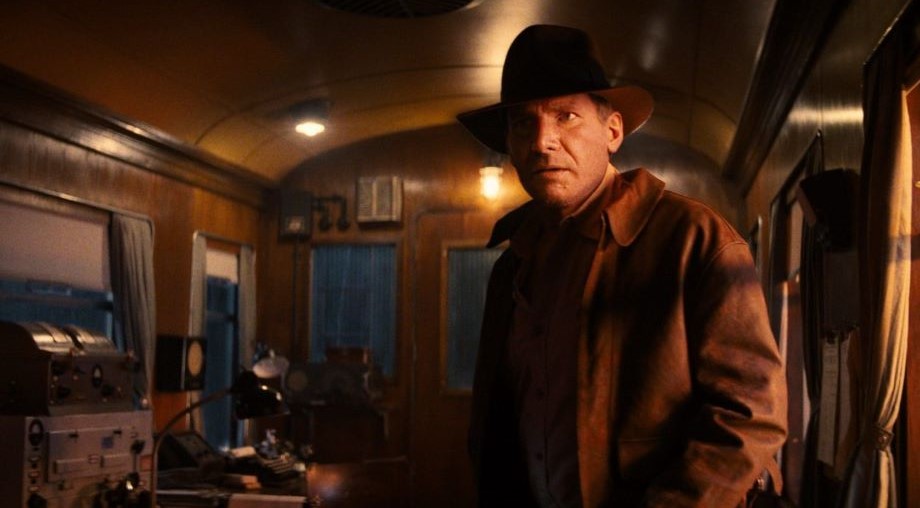
It opens with a (younger) Indy (Harrison Ford) battling Nazis in the dying days of the Second World War, trying to save a train full of precious artefacts. After defeating them, we flash forward to 1969 with Indy now a retiring archaeology professor to disinterested students in New York’s Public University, out of a place in an era where man has stepped on the moon. Grouchy, separated and fed-up, Indy’s life gets disrupted one more time when his god-daughter Helena Shaw (Phoebe Waller-Bridge) turns up on the hunt for Archimedes’ Dial. Indy knows about this dial as it was also the obsession of Nazi physicist Jurgen Voller (Mads Mikkelsen), last seen on that train in 1945 and now the brains behind the NASA moon landings. Indy and the unscrupulous Helena end up in a duel with Voller to find the dial – the prize being what Voller believes is a chance to change history.

Back in the day, Raiders of the Lost Ark was largely made so Spielberg and Lucas could show they could make an action-packed, crowd-pleaser quick and cheap. Today The Dial of Destiny is one of the most expensive films ever made (lagging only behind assorted Avengers films, the recent Star Wars trilogy and various other franchise entries). So much mony to make something less than half as good.

What this has allowed is Mangold and co to act like kids given the keys to their parents’ car. The Dial of Destiny is an explosion of Indy ideas, all rammed into the film willy-nilly. It’s made by people who feel this is their only chance to make an Indy film and don’t want to miss the opportunity to include every idea they’ve ever had.

We end up with a film that feels both far too long and yet strangely rushed. The Dial of Destiny would be immeasurably improved if about twenty minutes (at least) had been cut from its run-time and its poorly sketched thematic ideas condensed down. Its narrative structure has one too many quests, with Indy and Helena forever searching for a thing that leads to a thing that leads to yet another thing. An entire sequence, involving a pointless cameo from Banderas as a one-legged diver, would have been better slashed to ribbons or cut altogether. Every single one of the mega-budget chase sequences go on at least 2-3 minutes too long, straining the interest.

At the same time, the film manages to feel rushed. Ideas are presented and then taken nowhere at all. We see Indy tipping most of a bottle of whisky into his coffee in the morning – this suggested alcoholism never rears its head again. Voller is working in partnership (it seems) with the CIA, but their motives for this are never explained and Voller calmly ditches them part way through the film. Indy is framed for murder, but this plot thread is judicially abandoned by the time we get to the end. John Rhys-Davies literally pops up to drive Indy to an airport and make a trailer-friendly speech.
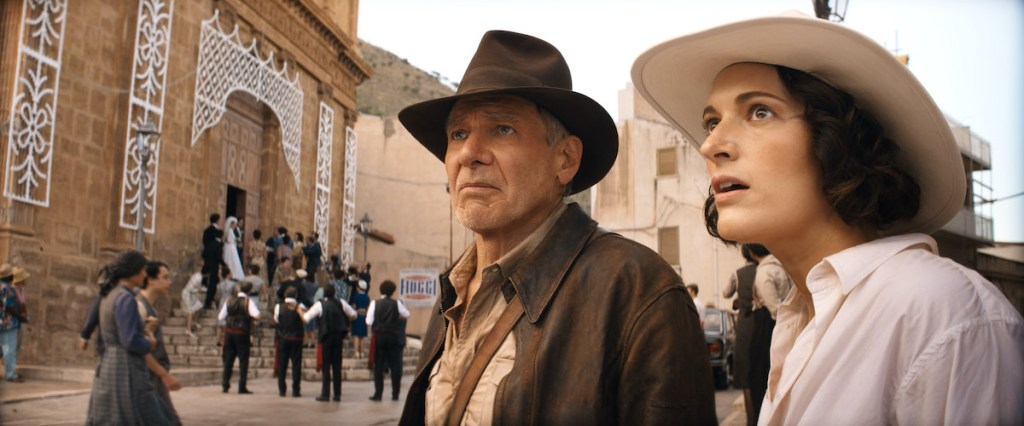
Most strikingly, all the films blaring action and endless bangijg stuff buries the most interesting plot thread of a tired, depressed Indy who no longer knows his place is in the world. The film solves Shia LaBeouf’s toxic unpopularity by having Mutt die in Vietnam, giving Indy a burden of guilt and grief. This is an Indy who has fallen from his Princeton heights, as ancient to his students as the artefacts he lectures about. It’s a thread though that the film only intermittently remembers, so crowded out is it by overlong chases, so that when the film’s conclusion returns to it as a major motivator for Indy it feels forced.

In any case, the film’s action set-pieces peak with the 1945 opening section with a digitally de-aged Ford and Mikkelsen facing off on a speeding train. I think the de-aging effect is very well done (though Indy speaks with Ford’s current 80-year-old voice), and this sequence has a sort of nostalgic charm to it and at least it feels of a piece with the originals. Not that its perfect: it’s overlong and overblown of course – a castle explodes, Indy runs over the top of a speeding train – and looks like something created with blue-screens and digital effects rather than in reality. (It’s also clear a digitally de-aged Ford head has been placed on a stunt double at key points.)

But it’s a bright-spot. There are others: Harrison Ford, again, is perfect for the role – crusty, resigned but still with the glamour of excitement in his eyes. He and the film don’t back away from his advanced age – Indy looks more vulnerable than ever – and Ford sells the moments he’s allowed in the film’s breakneck speed to reveal Indy’s emotional turmoil. He also has a great chemistry with Phoebe Waller-Bridge, who effectively channels Han Solo as an immoral adventurer who learns about decency. Mikkelsen’s mastery makes him an impressive villain.

I’ve been really hard on this film. It is fun I promise. I laughed and at times I was thrilled. But it is too much. Even the settings of the chases offer a sensory and time overload: a chase around a ticker-tape parade in New York onto a subway (with Indy on a horse) has an overload of visual details. A chase through the streets of Marrakesh goes on forever – and is over-built with our heroes chasing Voller while also being chased by Helena’s gangster-former-fiancee. film culminates in a final sequence which is just about not as silly as aliens – but by any other score is incredibly silly.

Essentially The Dial of Destiny is undermined by fan love. Mangold is a good director but doesn’t know where to stop. The film leans into nostalgia too hard but, above all, it offers far too much bang for your buck. The film is frequently at its most effective in its quieter, character-driven moments. Like Crystal Skull, it mistakes bigger for better. It’s still a more entertaining and a better film than Crystal Skull – but, somehow, its excessive overindulgence makes you feel strangely disappointed.

Indiana Jones and the Kingdom of the Crystal Skull (2008)

Indiana Jones and the Kingdom of the Crystal Skull (2008)

Indy is back. Hunting aliens. What could go wrong? Grab a fridge and let’s work it out.

Director: Steven Spielberg

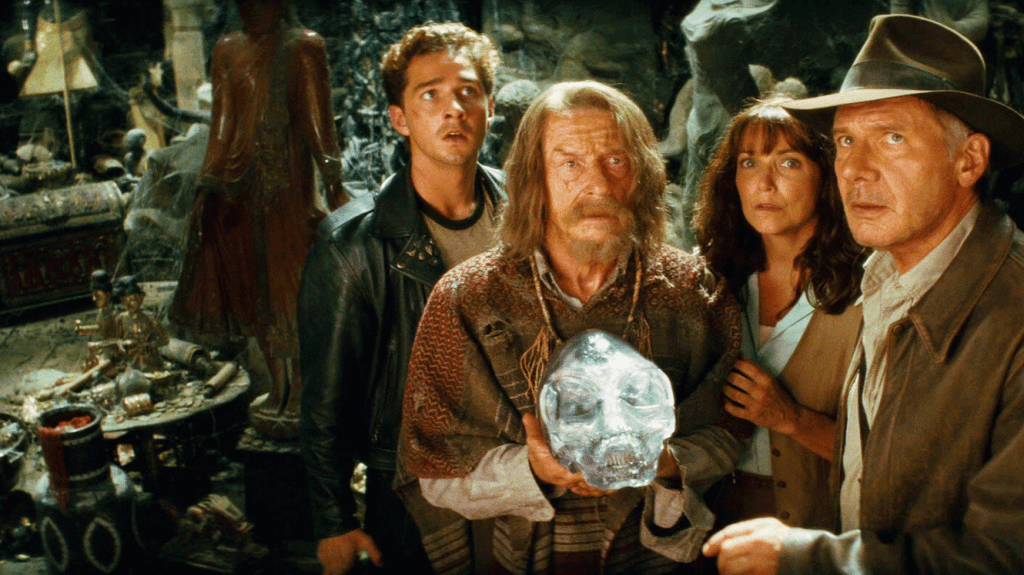
Cast: Harrison Ford (Indiana Jones), Shia LeBeouf (Mutt Williams), Cate Blanchett (Colonel Irina Spalko), Karen Allen (Marion Ravenwood), Ray Winstone (George “Mac” McHale), John Hurt (Harold Oxley), Jim Broadbent (Dean Charles Stanforth)

Flying into ignominy faster than a tumbling fridge, you’d be hard-pressed to find anyone who lists Kingdom of the Crystal Skull as their favourite Indy film. I’ll confess I enjoyed it in an affectionate escapist way when I first saw it. But lord, doesn’t it just get worse after every viewing?

It’s the 1950s and Indiana Jones (Harrison Ford) is still hunting for archaeological gems. Just as he’s still getting into trouble. This time with the Russians. A secret group in America, led by Colonel Irina Spalko (Cate Blanchett) is on the hunt for a mysterious artefact – a secret mummified alien corpse. Spalko wants to trace the aliens to find the fountain of all knowledge. Indy is suspected of being a Commie agent – not least after his old ally Mac (Ray Winstone) is revealed as a double agent – but soon finds himself roped into searching for the secret aliens and their buried crystal skulls by Mutt Williams (Shia LaBeouf), a greaser and school drop-out and son of Marion Ravenwood (Karen Allen) (wonder who the father could be?). Soon they are racing to a secret alien tomb in the Amazon.

You can spend ages scooting around what doesn’t work here. But the heart of it might be this: this is a sequel trying to pass as a young man’s film, made by two older directors who had long since fallen out of touch with the passions that filled their lives 30 years earlier. Truth be told, I suspect both Spielberg and Lucas always saw Indiana Jones as a fun diversion from other passions and never really cared about it the way generations that grew up quoting it did. Perhaps that was the biggest disappointment of all about Indiana Jones and the Kingdom of the Crystal Skull, a film that has potential but always feels like it’s being put together by obligation (and to make money).

Still, the good stuff. Harrison Ford is, of course, still Indy and there is a great deal of pleasure in seeing him inhabit this gruff mix of brains, fists and reluctant, cynical decency. The film also does a good spin on the father-son relation of Last Crusade by casting Indy as the exasperated father who finds a bond with his wild-card son (well played by Shia LaBeouf). The two have a lovely run of banter, and some neat comedy – not least a great little moment in a bar where Mutt steals a drink from a waitress’ tray, only for Indy to smoothly put it back all the same motion.

There is an exciting chase through the streets of New Haven, with Indy and Mutt on a bike escaping the Russians, including a great sight gag of Indy being pulled into a chasing car passenger window, fighting through the car and emerging the other side back onto Mutt’s bike. The opening extended fight and chase sequence (before we hit that fridge) in an Area-51 storage site is equally well done, fast paced, witty and crammed with tonnes of Spielberg flourishes. Cate Blanchett is intriguingly off-the-wall as the villain. The film even leans into Ford’s age as Indy swings over a gap and misses (“Damn I thought that was closer”) and gives Indy much of his Dad’s grouchiness.

But too much doesn’t work. And all those beats that fall on their face eventually bury the moments that do work. For starters, the original films felt real. They are shot with a grainy realism and featured practical effects. Spielberg stressed in the build-up he wanted to keep that look. So naturally the first thing we see in the film is a CGI gopher. The film is shot with a glossy, lens-smeared shininess. After a while loads of stuff looks unreal. From the fake CGI sky in the opening scene to the hideously unreal looking jungle chase, culminating in the bizarre sight of Mutt swinging, Tarzan-like, leading an army of monkeys. Like the Star Wars prequels, it feels like Lucas and Spielberg mistook making things bigger, glitzy and more exotic for making them better. Truth is nothing in this film is as exciting as Indy climbing over a real van in Raiders or riding a real horse alongside a real tank in Last Crusade. These are real and gripping. Everything here looks like it’s been built in a computer, nothing feels real or possible, and everything is bigger and heartless.

That heartlessness carries into the plot. The earlier films had clear and emotionally engaging stakes. Indy had to save his soul (Raiders and Doom), a village of children (Doom) and his relationship with his father (Last Crusade) while chasing clearly defined artifacts. Here he’s sort of incidentally building a father-son relationship with a kid he doesn’t realise is his son until over halfway through and heading into the Amazon to return a glass skull because it told him to do it. These are not well-defined stakes. That’s before we even touch on the aliens.

I can’t quite put my finger on it, but where artefacts based on the Bible or Hindu religion make perfect sense, an alien skull chase that culminates in a parallel dimensions and flying saucers feels silly. It feels as awkwardly out-of-place as midichlorians in Phantom Menace. It makes the film jar as much as those special effects filled set pieces. I know it’s supposed to mirror the 50s setting by playing with the classic 50s B-movie set-up. But it doesn’t fit with the rest of the franchise.

And you are made even more aware of this by how cynically the film has been filled with fan-bait call-backs: the opening sequence in the Grail storage warehouse, the music cues, Karen Allen, a repeat of the father-son set-up (this time flipped), a car chase through a hostile environment, horrible small animals, Commies standing in for Nazis. Killer ants standing in for snakes, horrible insects and rats. Travel and map montages. All this does is remind you of better films.

It’s not helped by how many performances fall flat. Winstone and Hurt both insisted on reading the script before they signed up. Perhaps they also read their pay offers at the same time, because that’s surely the only reason they said yes to these roles. Winstone is painfully unfunny as the ever-betraying Mac whose geezerish cries of “Jonsey!” quickly gets on your nerves. Hurt is saddled with a sort of Ben Gunnish eccentric, babbling nonsense (you won’t believe by the way he and Ford are similar ages). Karen Allen, bar the sweetness of seeing her again, is not great.

The feeling you are watching the runt of the littler is impossible to escape. Indy was a hero people loved because you could see him bleed. When he was punched it hurt. When he fell, he struggled to get back up. The Indy from Raiders would never have been hurled miles in a fridge from a nuclear blast and been absolutely fine. Christ, he was too knackered to stand up after running from that rock. That’s why the fridge moment doesn’t work: no one watching it can believe for a moment that either (a) a fridge would be hurled away like that rather than melt (b) that anyone would be utterly unharmed by it or (c) that its lead lining would save anyone from being irradiated. A mystic box that melts people’s faces when open we can buy because its “power of God” is carefully established with just enough mysterious power. Something grounded in reality like a nuclear blast can’t work. We know what that does – the fridge stretches our willingness to disbelieve too far.

But then you feel Spielberg and Lucas didn’t mind. To them these were fun home movies, a chance to indulge some childish gags. They weren’t invested in it the way we were. They had moved on and I don’t think really either of them wanted to make it. When they did, they showed they didn’t really know what people really liked about the films in the first place. They assumed it was the action. Maybe they thought they needed that with the blockbusters they were going up against. But people loved the heart and the reality. When the fridge was nuked, they knew they won’t going to get that here. That Kingdom of the Crystal Skull would have none of what made us fall in love in the first place. It was an adventure we wouldn’t want to follow Indy on ever again.

Raiders of the Lost Ark (1981)

Raiders of the lost ark header
Harrison Ford goes in search for treasure in Raiders of the Lost Ark

Director: Steven Spielberg

Cast: Harrison Ford (Indiana Jones), Karen Allen (Marion Ravenwood), Paul Freeman (René Belloq), Ronald Lacey (Major Arnold Toht), John Rhys-Davies (Sallah), Denholm Elliott (Dr Marcus Brody), Wolf Kahler (Colonel Dietrich), Anthony Higgins (Major Gobler), Alfred Molina (Satipo)

Indiana Jones is now one of the most beloved – and instantly recognisable – film characters ever created. So, it’s strange to think that Raiders of the Lost Ark was released to such little fanfare. That soon changed when the film came out. In some cinemas it was so popular it played for the whole year. It became a box-office smash, turned Harrison Ford into Hollywood’s leading movie star for the next 20 years, and made Steven Spielberg Hollywood’s leading director. And it did all that because I’m not sure there is a more entertaining, tightly made, funny, thrilling and (at times) scary adventure film out there. Spielberg and producer George Lucas may have wanted to make a film that aped B-movie adventure serials – but they ended up reinventing an entire genre.

It’s 1936 and the Nazis are in search of occult relics. Their latest target is the Ark of the Covenant, which Hitler believes will make his armies invincible. What chance is there of stopping him finding it? Well obviously the US government must put its trust in Professor Indiana Jones (Harrison Ford), one of the world’s leading archaeologists who also (fortunately) is pretty handy in a fight. Not only that, but his ex-girlfriend Marian Ravenwood (Karen Allen), daughter of his former mentor, holds one of the keys to finding the Ark. Indy and Marian end up on an adventure that crosses continents, taking on the ruthless Nazis and mixing with profound mysteries that man is not meant to know.

Hollywood wasn’t happy about Spielberg making the film. His previous film – the war comedy 1941 – had bombed, losing millions. The studio was insistent with producer George Lucas: if he wanted to see his dream of making an old-fashioned B-movie with his friend Spielberg come true, then he would need to stick tightly to a budget. After all, Spielberg had a reputation for delivering films overtime and overbudget. Our heroes stuck to this deal – and Spielberg has said it was a blessing, as it forced him to keep the film lean, tight and, above all, free of indulgence. Spielberg’s direction is perfect, so good in fact that he set the template for nearly all big-budget directing (in terms of tone, pace, mood and tempo) to come. Every action film since owes something in its DNA to Raiders.

Raiders is far more entertaining – and brilliant – than it has any right to be. It’s effectively a series of set-pieces, threaded together by screenwriter Lawrence Kasdan into a plot. Kasdan’s dialogue though was spot-on – like the film, lean, tight and perfectly focused. With exceptional brevity and focus it brilliantly creates a small core of characters, and then gives them room to bounce off each other. Its dialogue is quotable, fun and punchy. He – with Lucas and Spielberg – also crafts a central character who is flawed but deeply likeable, and a heroine who is independent and dynamic. The script is a big part of the reason why the film is a success – it makes us care deeply for the characters as they get involved in the death-defying stunts and action set pieces that make up a lot of the film.

And we don’t follow any character more than Indy himself. Thank God Tom Selleck had to withdraw at the last minute. George Lucas had resisted casting Harrison Ford as he was worried about the overlap with Han Solo. But the part fits Ford like a glove. Sure, it comes from the same wheel-house as Solo – although Indy is more taciturn, intellectual and a degree less cocksure than Solo, more a man reluctantly forced into danger than a swaggering pirate – but Ford’s skill is faultless. Ford has an everyday quality to him, and he brings a world-weary tiredness to Indiana. He has the confident grin, but he’s just as likely to see that switch to concerned desperation (there is a perfect moment of this in the opening sequence, when the vine he is grasping on a cliff top suddenly works loose). He may be a bit of a rogue (not averse to shooting a swordsman) but he’s also a good man, with the street smarts of a ruffian, who is frequently exasperated by the errors of his sidekicks. This is the sort of man that men want to be and women want to be with – an impossibly difficult trick to pull off.

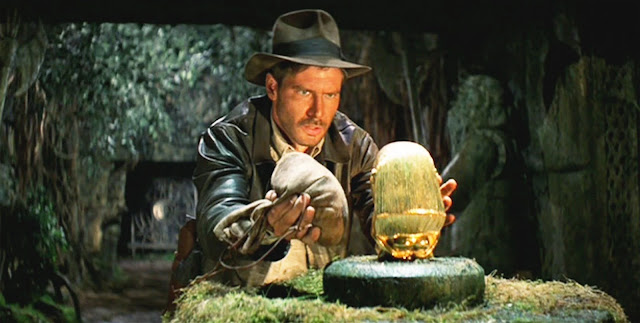
We relate to Indy because he’s vulnerable. He’s an underdog. The outstanding opening sequence – basically a little mini-movie in itself – showcases this. As Indy heads into a hidden temple for an idol (dodging spiders, bottomless pits, arrows from walls and most famously a huge boulder – a stunt Ford did for real) we get his entire character showcased. He’s astute, resourceful, trusting (sometimes too trusting) and ingenious. But he also takes a hell of a physical pounding, gets scared and above all goes through huge danger only to end up empty-handed. And of course, we find out he can cope with all this, but definitely not snakes (is there a better action set-piece punch line than “Grow a little backbone, will ya!”). It sets the tone for the rest of the film – in fact with the first five minutes alone, Raiders is already better than 99% of all other adventure films.

But then this is a director working at the top of his game. All the elements come together perfectly here: Spielberg always knows when to keep the tempo up, cuts the action superbly and also presents us with a brilliant mixture of tension, excitement and awe. He and Lucas brilliantly understand the power of images – there is a reason why a rolling boulder has become part of cinema’s language. The design of Raiders (one of its five Oscars) is absolutely perfect. Nothing like these temples could really have existed in real life – but as an evocation of 1930s adventure serials they are perfect. Mix that in with that brilliant sound design (those whip cracks for staters) and John Williams’ majestic score (from the classic Indy march to the haunting strains that tie in with the Ark) and this film is a masterclass for affecting the senses.

Then those set-pieces are told with just the right balance between thrills and wit. Again, Harrison Ford is a big part of this: he’s never smug, his trademark furrowed brow suggesting stress as much as his grin communicates relief at surviving. The truck chase – which sees Indy move from horse to truck, to under a speeding truck to back in the driving seat, half the time with a bullet in his arm – is a masterclass in thrills and superb editing. It’s such damn good fun that the film even gets away with a nonsensical beat where a car-load of Nazis is pushed off a huge cliff (the first and last indication that we are anywhere near a cliff in the whole scene!). Just like the opening sequence our hero’s combination of ingenuity, never-say-die determination and vulnerability is what makes it compelling (the Williams score also plays a huge part in building both the excitement and the triumph).

The whole film is a series of triumphant set-pieces. Spielberg also tinges the film with just enough darkness as well. The Nepal gun battle carries a real sense of danger, Indy’s fight with a tough Nazi air mechanic culminates in a quite gruesome death (although the fight beforehand has plenty of wit to it, as Indy is hopelessly outmatched physically by this giant). That’s all before the film’s famous closing sequence as the Ark finally opens up to reveal the power of God – bad news for the assembled Nazis crowded around it. The face-melting horror (and it’s hard to imagine any action adventure film doing something this horrific today) is impossible to forget, brilliantly executed and carries just the right amount of dread.

The darkness though is counter-balanced throughout by sly wit and a sense of fun. Wonderful jokes – from Major Toht’s nunchucks that become a coat hanger to an exhausted Indy responding to Marian’s kisses by falling asleep – pepper the script. The cast are fabulously chosen. Karen Allen is perfect as the independent Marian. Paul Freeman is chillingly austere and charmingly amoral as Indy’s rival Belloq. Denholm Elliott’s Marcus Brody is excellent as an older, wiser version of Indy very different from the comic buffoon he would become. The same can also be said for John Rhys-Davies Falstaffian but shrewd and loyal Sallah.

Raiders of the Lost Ark sees every element come together perfectly. Spielberg’s direction – the film did come in on time and on budget, going on to be the biggest success of its year – is completely perfect. Ford creates a character who from his first appearance is iconic (the zoom to introduce him is a wonderful tip of the hat to John Wayne’s classic entrance in Stagecoach – continuing the homages, the final shot is also a lovely nod to Citizen Kane). Every action set piece is a brilliant mix of thrills, danger, triumph and even a touch of horror (be it gruesome deaths or dreadful beasts). It’s a film that can not fail to entertain, raise a smile – and still have you hiding behind the sofa at points. Lucas and Spielberg wanted to make a film that would remind them of the adventures of our childhood. They were so successful that their film ended up defining the childhoods of millions of us.