Tag: Karl Malden

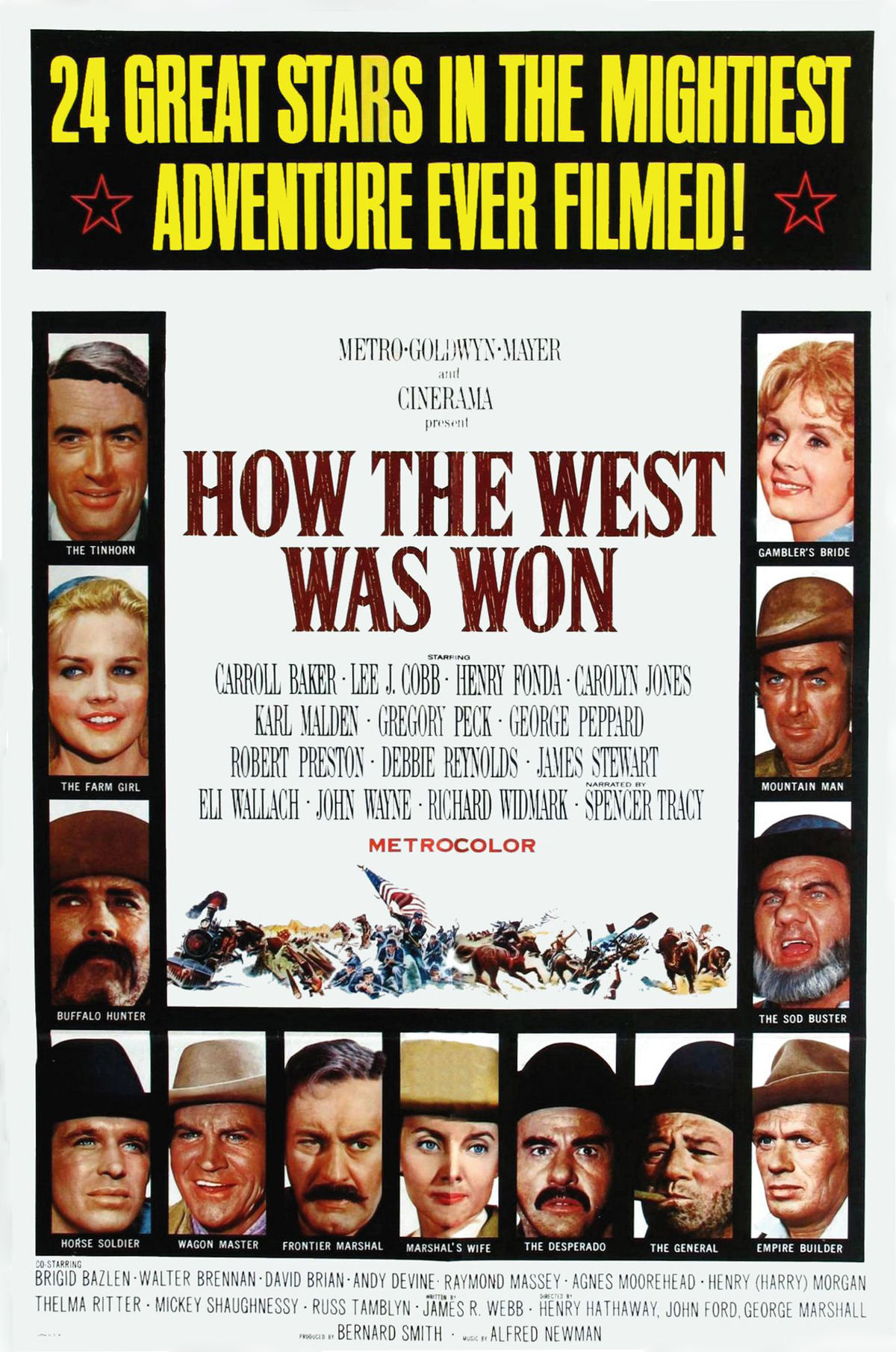
How the West Was Won (1963)

James Stewart helps us see How the West Was Won

Director: Henry Hathaway, John Ford, George Marshall

Cast: Spencer Tracy (Narrator), Carroll Baker (Eve Prescott Rawlings), Walter Brennan (Colonel Jeb Hawkins), Lee J Cobb (Marshal Lou Ramsey), Henry Fonda (Jethro Stuart), Carolyn Jones (Julie Rawlings), Karl Malden (Zebulon Prescott), Raymond Massey (Abraham Lincoln), Agnes Moorehead (Rebecca Prescott), Harry Morgan (Ulysses S Grant), Gregory Peck (Cleve van Valen), George Peppard (Zeb Rawlings), Robert Preston (Roger Morgan), Debbie Reynolds (Lilith Prescott van Valen), Thelma Ritter (Agatha Clegg), James Stewart (Linus Rawlings), Rus Tamblyn (Confederate deserter), Eli Wallach (Charlie Grant), John Wayne (William Sherman), Richard Widmark (Mike King)

How the West Was Won was the Avengers: Endgame of its day: every star of the biggest box-office genre in America coming together for one epic adventure that would stretch over generations. Stewart! Fonda! Peck! Wayne! Together for the first time (only of course they are not, none of them appearing the in same scene). Even more than that, How the West Was Won would be filmed in Cinerama, a three-screen shooting method producing a panoramic image. All this would make How the West Was Won the biggest, grandest, largest film ever made. It was a massive box-office success, nominated for eight Oscars (including Best Picture) and wowed audiences.

Plot wise though, it’s basically a series of short films cobbled together into a single film. The stories are basically self-contained, although some actors cross over (especially George Peppard and Debbie Reynolds). The first episode The Rivers covers the migration west, down the river, of the Prescott family, taking on river pirates and allying with James Stewart (looking at least twenty years too old as a young drifter). The Plains sees Debbie Reynolds, daughter of the Prescott family, migrate further West and eventually marry gambler Gregory Peck. The Civil War sees Stewart’s son George Peppard caught up in the war. In The Railroad, Peppard reluctantly runs security for ruthless railway builder Richard Widmark. Finally, in The Outlaws an older Peppard attempts to retire, but not before one final shoot out with old enemy Eli Wallach during an attempted train heist.

All these short stories – each about 30-45 minutes in length – are entertaining. So entertaining that you won’t mind at the end that you have no idea how the west was actually won (I assume it’s something to do with progress and the law) or that the characters are basically actors riffing off their own personas rather than fully realised individuals. Despite the attempt to build the story around one  family (the Prescott-Rawlings), the stories are so disconnected and the characters so lightly sketched, with such huge time jumps, each story might as well be about completely new characters.

Not that there is anything particularly wrong with that. But it boils down to the key issue with How the West Was Won, a very flabbily constructed film that lacks any real sense of guiding narrative or vision behind it. It’s a series of set pieces, which are all about scale – the river rapids, the battles of the Civil War, the final train-set shoot out – in which some loosely defined characters live their lives. There are some decent performances – Debbie Reynolds does a very good job anchoring a couple of stories (plus we get to see her do some song-and-dance routines), while Peck (a smooth operator) and Fonda (a gruff woodsman) have the best parts among the stars. Others, like Wayne, pop up for but a few seconds.

They needed all these stars to fill the frame. How the West Was Won’s main problem is also its principle reason to exist. It was designed to showcase the wideness of Cinerama, one of only two films to use the technique. Designed to be projected into curved screens, the technique essentially used one massive camera to produce an image so large it needed three synchronised projectors to screen it. This led to an impossible wide frame to fill, with two clear joins in the middle. The challenge of shooting this was not an enjoyable one for the directors.

To cover the visible joins, nearly every scene in the film sees an object placed one-third and two-thirds of the way through the image (usually a tree or a post). The actors stand carefully on their marks in their assigned third of the image. Close ups involved flying the massive camera almost into the faces of the actors (and even then it only produced an image from the waist up). Awkward compositions abound – either with actors standing rock still in front of huge scenery, or actors standing in carefully assigned rows, standing on marks they never move from.

The sweeping shots of the American west look impressive, but in a National Geographic way – it’s simply fitting as much of the imagery of the countryside in as possible. It was a hugely difficult job for the directors. It was not helped by two of them being competent journeymen and all three of them having done their best work in 4:3. Quite frankly I don’t think any of them have a clue about how to fill a frame this mighty. Instead, the film for all its grandeur is frequently visually conservative and unimaginative to look at. It’s got huge landscapes, but no real inspiration.

How the West Was Won is an enjoyable curiosity. It is very rarely, if ever, seen as it was intended on a Cinerama screen (the version I watched on a large television, still showed the slight fish-eye effect at points of a curved image flattened). Telling five short stories, each of them entertaining enough, it keeps the interest. It has a lusciously beautiful (famous) score by Alfred Newman that captures the spirit of the West. But, for all its grandness, it’s a strangely small experience.

Birdman of Alcatraz (1962)

Burt Lancaster excels in prison drama Birdman of Alcatraz

Director: John Frankenheimer

Cast: Burt Lancaster (Robert Stroud), Karl Malden (Harvey Shoemaker), Thelma Ritter (Elizabeth Stroud), Neville Brand (Bull Ransom), Betty Field (Stella Johnson), Telly Savalas (Feto Gomez), Edmond O’Brien (Thomas E Gaddis)

What is prison for? Is it just a cage – or should it offer reform and self-improvement? Debates like this have existed from the moment the first mass-prison opened. Birdman of Alcatraz taps into this, presenting a romanticised image of the life serving time of Robert Stroud (Burt Lancaster), a double convicted murderer (including killing a guard in prison) who narrowly escapes a death sentence, sentenced to a lifetime in solitary confinement. Stroud develops a passion for ornithology, eventually becoming one of the world’s experts on avian disease – all while confined to his cell.

Front and centre in Birdman of Alcatraz is Burt Lancaster. Made by his production company, and hand-picked director (after firing Charles Chrichton), Lancaster’s prickly persona and patrician distance is wonderfully re-directed as a man who, for much of the film, carries a strong whiff of danger and violence. Surly, bitter and unrepentant, Lancaster brilliantly captures Stroud’s monomania which blossoms into a realisation his own life has been wasted. Oscar-nominated, Lancaster makes Stroud hard-to-like, but one who we slowly relate to as his brutality into a sort of recognisable humanity, however sharp-edged and un-appealing he can be.

Frankenheimer’s well-made film – it’s strikingly less flashy than much of his early work, instead using a restrained sense of documentary realism – is one I found both entertaining and involving, but also strangely troubling. But first the positive: there is no doubt this is a great “prison” movie, perfectly capturing the monotony and boredom long-term solitary confinement brings. It reduces the world into something small and oppressive – Stroud has a cell, a corridor and an exercise yard – and Frankenheimer pours on the sympathy for prisoners who are caged in a system that removes any individuality from them to turn them into docile drones.

Stroud faces a permanent struggle to win the right to keep and study his birds – including going into business selling his bird illness remedies – in the face of a system that wants him to sit in his silently in his cell. It’s hard not to be engaged with Stroud, and the lengths he must go to sustain the new hobby that has given him a reason for living. A birdcage is fashioned out of a crate after months of work. Endless variations on cures are attempted to deal with an outbreak of disease. There is even a bureaucrat warden – well played by Karl Malden as a functionary who is all duty and no imagination – who strongly believes indulging this nonsense is letting him off lightly. And maybe he’s right.

And it’s that issue which I find troubling at a film. This is a conscious attempt to turn Stroud into a sort of Mandela of Ornithology. But, scratch the surface of researching the film, and you discover Stroud was a man repeatedly diagnosed as a psychopath, who committed acts of brutal murder. This is a film that asks us to look at a man and sympathise with him, based on his passion for his hobby – like a Herman Goering biopic that focuses on his love for art. Reflecting real life, in the film Stroud never expresses a jot of regret or remorse for his crimes. The film argues his work with birds shows he has been rehabilitated – but I would argue his utter inability to recognise any moral responsibility for his actions, shows he is in no-way suitable for release.

Let this idea trip into your head and then, no matter how well made the film is made – or how well acted or engaging the story is – you suddenly twig this is a film about a man who forms stronger relationships with birds than he does with other human beings. Stroud will slave for months to save his bird – but barely bat an eyelid at the death of a man. His closest bond seems to be his antagonistic relationship with Malden’s warden, while even his closest prisoner companion (an Oscar-nominated Telly Savalas) is someone who passes out of his life for years at a time with no reaction from Stroud, and who seems capable of more regret and reflection than Stroud.

Fitting his sociopathic profile, Stroud’s only real human contact is formed with his mother. And, like White Heat’s Cody Jarrett, they have the same all-encompassing (and damagingly facilitating) relationship. His mother – played with a skilful sense of control and emotional manipulation by Thelma Ritter – constantly excuses her son’s sins, while demanding she remain his principle (ideally only) personal contact. To her, all other people – especially women – are a dangerous corrupting influence. This is not a healthy relationship, but the film doesn’t explore it, other than positioning the mother as a beast, who furiously drops her son when he decides to marry (for convenience so she can visit him) a fellow ornithologist, played by Betty Field.

In real life, Stroud was a brutal killer – not the rogueish old man he becomes by the film’s end, charming journalists – but his personality is re-positioned to take a stance on the ethics of prison reform. The film has, not surprisingly, an optimistic 1960s feeling that free-will and independence should be prioritised and that the system only crushes those feelings. Life isn’t as simple as that, however much Birdman of Alcatraz wants it to be. However, it shows you can still hugely enjoy a film that you disagree with. I guess that’s the sort of oddity that makes us human.

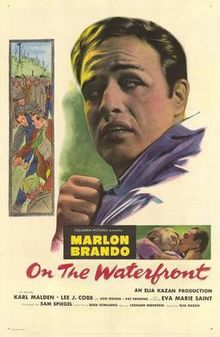
On the Waterfront (1954)

Marlon Brando reinvents film acting in On the Waterfront

Director: Elia Kazan

Cast: Marlon Brando (Terry Malloy), Karl Malden (Father Barry), Lee J. Cobb (Johnny Friendly), Rod Steiger (Charley “The Gent” Malloy), Eva Marie Saint (Edie Doyle), Pat Henning (Timothy Dugan), John F Hamilton (“Pop” Doyle), Ben Wagner (Joey Doyle), James Westerfield (Big Mac)

When’s the right time to speak out for what you know is right? It’s a question we’ve all faced at some point, and it’s the question that changes the life of Terry Malloy (Marlon Brando) after he is indirectly, and unwittingly, involved in the murder of a fellow dock worker. The killing was ordered by the corrupt, mob-connected union boss Johnny Friendly (Lee J. Cobb), who rules the workers of the shipyards of Hoboken, New Jersey with an iron fist. The victim was going to talk to the cops, and suddenly Terry finds himself in the middle of a major ethical bind: should he give evidence or play “D and D” (deaf and dumb) like the rest of the workers.

His bind grows ever tighter as the local priest Father Barry (Karl Malden) takes up breaking the power of the union as his own personal mission. Not to mention Terry’s growing closeness to the victim’s sister Edie (Eva Marie Saint), with whom he finds himself slowly falling in love. On the other side is his brother Charley (Rod Steiger), a lawyer and right-hand man of Johnny Friendly, who has been running his brother’s life forever, ruining Terry’s boxing career by ordering him to take a dive so Friendly could make a killing on the betting circuit. What will Terry do?

Elia Kazan’s multiple Oscar winner is a powerful, beautifully made, engrossing and uplifting modern morality drama that still packs a wallop today. Shot largely on location in New Jersey, with lashings of Kazan’s brilliant realism and ability to bring poetic beauty and emotional force to the most everyday of settings, On the Waterfront is sublime, a film to make you rail against the injustice of corruption and the unthinking cruelty of everyday folk when given a chance to stigmatise someone.

Kazan and screenwriter Budd Schulberg (whose script is a beautifully judged mixture of soulful dialogue and the rhythms of every day conversation) were both drawn towards the story after their engagement with McCarthyism in Hollywood. In this hunt for reds under the Hollywood bed, both Kazan and Schulberg named names. Both of them felt that they had been lied to and exploited by the communist movement in Hollywood – and also that Stalinist Russia was not a cause worth defending – but that didn’t stop many people rejecting them for breaking the rule of silence (the same rule that runs through this film). On the Waterfront is a heartfelt defence of the whistleblower (or the informer), and why that can sometimes be the only option open.

Based on a true story, Kazan’s film is a masterclass in carefully controlled, intelligent direction bringing out brilliant acting performances (always one of Kazan’s major strengths as director). Leading the way here is Marlon Brando, giving possibly the most famous, most influential acting performance in film history in the lead role. It’s not really an understatement to say it changed the face of movie acting. Brando here performs with a low-key, casual, almost tender naturalism that stands completely at odds with the more exhibitionist performers of the late 40s. And he funnels all this beautifully into Terry Malloy, a tough guy whom he inhabits with a vulnerability and gentleness that never once feels out of place with his temper and pride. There is instead an awe-inspiring transformation here, of the actor becoming the mumbling, uncertain character – not afraid for words to be lost, not worried about making eccentric or unexpected choices as a performer.

Two scenes stand out. In the first, Brando has his first long conversation with Edie Doyle, having rescued her from being set on by union men. In a single take – a carefully orchestrated willingness to let the actors explore the emotional truth of the scene from Kazan – Brando’s Terry shyly, gently, haltingly asks about her life and tries to explain his own. At one point, Edie drops her glove and Brando picks up the glove, fiddles with it and then puts it on – the sort of inspired naturalism that feels like nothing on paper, but on film carries a strange emotional force, a physical representation of the bond between them (and don’t underestimate the way Saint pulls the glove gently from his hand). The entire scene has the air of reality to it, Brando chewing gum, Saint wondering how much of herself to show to a man she isn’t sure she can trust. It’s masterful.

The other scene is of course possibly one of the most famous scenes in movies ever: I coulda been a contender. For films, this is like the To Be or Not To Be speech, a speech that has been quoted and riffed on ever since. But again, Brando resists the temptation throughout for histrionics – when Charley pulls a gun, Brando reacts not with shock or anger but sadness, almost tenderly pushing the gun aside and letting his voice fill with a world of regret for what has become of their relationship. Steiger is superb in this scene, but you can’t look at anyone except Brando here, awkward, sad, struggling to work out what to do with his life and finally confronting the broken past between the brothers with pointed regret and calm realisation rather than the anger and rage that other actors would have chosen. This is an actor who redefined his profession, at the top of his game.

The film is crammed with excellent performances. Eva Marie Saint (Oscar winning) has just the right measure of gutsy determination, fear and tender sweetness as the woman who opens Terry’s eyes to right and wrong. The film gained three Supporting Actor nominations (they all lost). Steiger is cocksure but self-loathing as Terry’s ambitious brother. Lee J. Cobb rages as only he can as the blowhard bully Friendly, demanding absolute loyalty. But on this rewatch, I loved Karl Malden’s moral certainty, courage and stubbornness as Father Barry. In any other film Barry’s speech railing against the dockers for being part of the system that oppresses them, all the time being pelted by food, would be the highlight of the film: here it’s just one of several stand-out moments.

Kazan was a superb visual stylist, this black-and-white masterpiece brilliantly shot by Boris Kaufman to create a world that feels the perfect mixture between the documentary realism and the theatrical. And working with a superb script that he felt such investment in helps to create a story that carries real emotional force, carefully investing you right from the start in Terry’s fundamental goodness and naivety, inviting you to feel rage on his behalf as he is sent to Coventry by his workmates. Topped off with a beautiful score by Leonard Bernstein – part jazzy, part wonderful orchestral stylings – this has barely aged a day in it’s over 60 years.

Patton (1970)

George C Scott triumphs as Patton in this excellent World War Two biopic

Director: Franklin J Schaffner

Cast: George C Scott (General George S Patton), Karl Malden (General Omar Bradley), Michael Bates (General Bernard Montgomery), Edward Binns (Lt General Walter Bedell Smith), Lawrence Dobkin (Colonel Gaston Bell), John Doucette (General Lucian Truscott), James Edwards (Sgt William Meeks), Frank Latimore (Lt Colonel Henry Davenport), Richard Münch (General Alfred Jodl), Morgan Paull (Captain Richard Jenson), Siegfriend Rauch (Captain Oskar Steiger), Paul Stevens (Lt Colonel Charles Codman), Karl Michael Vogler (Field Marshall Erwin Rommel), Peter Barkworth (Colonel John Welkin)

Patton was garlanded with eight Academy Awards in 1970, but rarely seems to get a mention when people list landmark best pictures. This is unfair, as Patton is a marvellous, intelligent, professional piece of film-making that rewards re-viewing: not least because, in George C Scott, it has one of those performances you simply must see, an extraordinary melding of actor and real man to such a great extent many people can’t believe they are seeing the real thing when watching newsreel footage of the actual Patton.

Patton is nominally a war film, but it’s actually an intriguing character piece. It follows the career of General George S Patton (George C Scott) during the course of the Second World War. Patton was a soldier’s soldier, a dyed-in-the-wool military man with a warrior’s instinct and a poet’s soul. The sort of man who berated men for not wearing proper uniform, then astounded them with thoughtful reflections on classical history. The film charts his command in Africa against Rommel, the invasion with Sicily (and feud with British counterpart Bernard Montgomery), his benching after striking a soldier suffering from shellshock in a military hospital, and his command of the Third Army during the Normandy invasion, including his pivotal role in the Battle of the Bulge.

With a script co-written by Francis Ford Coppola and Edmund North (later president of the Screenwriter’s Guild), Patton was a warts-and-all portrait of one of America’s most famous generals that came out amidst the country’s growing disillusionment with Vietnam. It was embraced by both sides of the argument because it very skilfully walks a tight-rope: for the hawks, there is enough of the “if we had more like him …” stance. For the doves, the film doesn’t shy away from Patton’s egomania, lack of tact and love of war (he even strongly advocates immediately turning on Russia – ‘cos they’ve already got all the men in Europe anyway – which you can interpret as visionary or insane depending on which side of the fence you are on).

At the centre of everything, George C Scott is quite simply a force of nature as Patton – I don’t think it’s an exaggeration to say this is surely one of the greatest Best Actor winning performances ever. Patton is in nearly every scene, and even the one’s he’s not in he’s the subject of every conversation, and Scott totally dominates the movie. You can’t put your finger on it, but he quite simply becomes Patton. It’s extraordinary, but the actor totally disappears and you feel you are watching some remarkable act of resurrection (fitting since Patton had a profound belief in reincarnation).

Scott’s Patton rages, he shouts, he goes into fits of childish egomania – but he’s also sensitive, intelligent and poetic. He can write a touching letter to the bereaved mother of his adjutant, expressing his sorrow, but also write how tragic it is that he will miss the wars to come. Scott is ramrod in his posture, and more than embraces the theatricality of Patton himself – when an adjutant tells the General sometimes his soldiers don’t know if he’s joking or not, the General softly replies “It’s not important for them to know. It’s important for me to know”.

It’s easy to eulogise over Scott at the expense of all else – but the film is so focused on Patton that he is intrinsically linked with the film’s success. The film is episodic, but every scene tells us something different about the man. Although since the film starts with one of the greatest opening scenes in movie history, we feel like we pretty much know him from the start.

It opens with an enormous American flag, in front of which Patton emerges in full dress uniform to encourage new soldiers to do their duty and, most of all, to “remember that no bastard ever won a war by dying for his country. He won it by making the other poor dumb bastard die for his country.” Scott famously refused to do this scene when told it would open the picture, as he felt nothing else in his performance could emerge from its shadow (they eventually told him it would go later in the film – no word on how he responded when he first saw the film!).

In a nut shell you get the whole movie. Is the giant American flag ironic or does the film really mean it? Patton is both strangely terrifying and also awe-inspiring, charisma, determination and force seeping from every pore of his body. Scott nails every detail of this speech, just as he nails every other part of the performance, while the camera work reinforces his mythic status (or his hubris depending on where you stand) as a symbol of Americana.

Schaffner’s direction of the film is easy to overlook, largely because it is refreshingly unflashy. It’s superbly professional –not a single scene falls flat. He marshals each scene with extraordinary effect, and manages the film’s difficult balancing act of sly satire and hagiography brilliantly. He also, within an epic canvas, works very well with actors – there are a host of great cameos in here, not least from Michael Bates as a preening Montgomery and Edward Binns as an exasperated Bedell Smith. Karl Malden is the only other really major character as Patton’s junior (later commanding) officer and he is perfect as the honest professionalism in contrast to Patton’s flash.

And the film gives us plenty of Patton’s flash. The man who loved war and combat, also loved performing – and does so with abundant skill. But the film isn’t afraid to show his warts: in Sicily he threatens to sack a general who refuses to risk his men’s lives on a risky operation, primarily motivated by Patton wanting to reach Messina before Montgomery. Later, when striking the scared soldier, his actions are tough to watch even as part of you sees his point about other men having been wounded in the line of duty (the playing of the soldier as a teary whiner probably doesn’t help). The film never fails to show that Patton’s worst enemy is his own arrogant lack of thought – he constantly shoots his mouth off with no thought for the impact.

The film is brilliantly constructed. The photography is excellent, the editing superbly marshals a long film of many individual scenes into a story that seems a lot tighter and forward moving than it probably is. Schaffner makes us feel we go on a clear journey with this character – helped as well by Jerry Goldsmith’s excellent score that conveys a great deal with ancient mythic weight, playing off Patton’s own belief in resurrection.

Patton is often forgotten a bit – but it is a great film, well made, brilliantly balanced, wonderfully written and directed. And at its centre: what a performance. George C Scott is simply astoundingly brilliant, completely transformed into the old general. His Oscar (which Scott declined, thinking awards phony) was as well-deserved as these things get. A wonderful film, a true epic, and a marvellous character study of an enigma – it deserves to sit near Lawrence of Arabia in the personal epic stakes (to which it has more than a few similarities).