Tag: Klaus Maria Brandauer

Mephisto (1981)

Mephisto (1981)

Brilliant exploration of the Faust story, a superb portrait of a man who sells what passes for his soul

Director: István Szabó

Cast: Klaus Maria Brandauer (Hendrik Hoefgen), Krystyna Janda (Barbara Bruckner), Ildikó Bánsági (Nicoletta von Niebuhr), Rolf Hoppe (The General), György Cserhalmi (Hans Miklas), Karin Boyd (Juliette Martens), Péter Andorai (Otto Ulrichs), Christine Harbort (Lotte Lindenthal), Martin Hellberg (Professor Reinhardt), Tamás Major (Oskar Kroge), Ildikó Kishonti (Dora Martin)
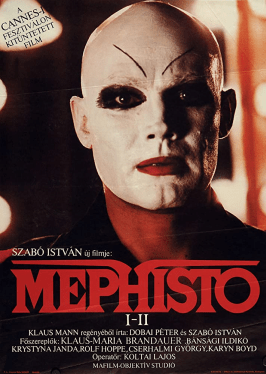
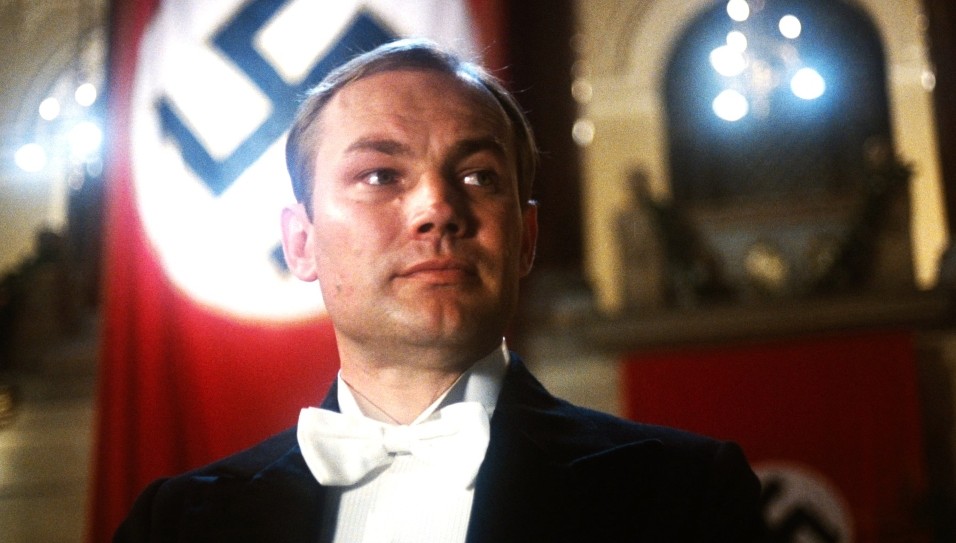
Dictatorships are also times of opportunity for those who can seize their chance. You just need the willingness to craft yourself into exactly what those in power want, learning your lines and putting on the ultimate show of unwavering commitment and devotion. In other words, helps to be an actor. Mephisto is a brilliant portrait of an actor in 1930s Germany who climbs to immense success by playing Mephistopheles on stage while playing Faust in real life, selling his soul for glory.

Hendrik Hoefgen (Klaus Maria Brandauer) is a fiercely ambitious actor, willing to adapt his views and opinions to match whatever the prevailing mood. As he tries to make his name, he throws himself into the Marxist theatre views of his colleagues, scorning the right-wingers among them. He marries Barbara (Krystyna Janda) the stage designer daughter of a liberal Mann-ish author and looks set to become the leading light of left-wing theatre. But that changes when Hitler comes to power and Hoefgen heads for Berlin and the patronage of the powerful Reichs General (Rolf Hoppe), transforming himself into the ultimate ambassador of the Reich’s vision of art.

Mephisto is not only a superbly well-judged film about the dangerous dance between art and politics, its also a brilliant character study of a man with almost no real personality at all. Superbly directed by Szabó (his masterpiece) it’s shot on a rich scale, dripping with the quiet menace of a deadly regime that cares nothing for anyone. All of which only briefly intrudes itself into the self-justifying mind of a man who becomes its willing propaganda mouthpiece, while constantly reassuring himself he’s only an actor.

The beating heart of Mephisto is the astonishing turn from Klaus Maria Brandauer, one of the greatest tour de force performances of the decade. Brandauer’s energy and surface charm is hypnotic. He throws himself into the theatricality, on and off stage, of Hoefgen as well as his boundless enthusiasm. Hoefgen will dance himself to exhaustion to entertain his lover or build grand theatrical castles in the sky with a flurried burst of exuberant passion. But he’s just as likely to erupt in carpet-chewing outbursts of childish rage at actors who don’t match his standards or roles denied him.

In those temper tantrums, you see the child in him. There is something very vulnerable and boyish in Brandauer: his lover, the cynical Black actor Juliette (a superbly whipper-sharp and perceptive Karin Boyd) comments he has the eyes of a child, and you can see that in his understanding of the world. He has a superb ability to divorce himself for the impact of his actions, absorbed entirely in his own theatrical concerns. To Hoefgen, whether or not he plays the lead in Faust or a Moliere farce really is the most important thing in the world. As Brandauer makes clear, it’s not that he’s naïve, more that he’s self-centred and myopic enough not to care.

Hoefgen is a man who needs love like oxygen, and he’ll gush it up from the biggest supply he can find. And, frankly, a one-on-one relationship isn’t going to satisfy him. He soaks up audience acclaim – and what we see of his performance as Mephistopheles it’s deserved, it’s a triumph of physicality and insinuating creepiness – but in his private life he oscillates between needy, demanding and distant. He implores his wife Barbara for her love, pawing at her like a teenager and claiming he needs her to save him; then happily leaves her in a heartbeat to seek out new opportunities in Berlin.

His personality seems half-empty. Is he even aware of the homosexual feelings he has for his old friend Otto (a charismatic Péter Andorai), the only person he takes any risks to protect as the head of the National Theatre? Brandauer finds both a childish hero-worship in Hoefgen’s devotion to this left-wing firebrand, and an unspoken romantic yearning (there is a beautiful moment when they stand together at a window and Brandauer rests his head on Andorai’s shoulder like a love-struck puppy). But really Hoefgen is a mass of opinions and views recrafted from the roles he has played (there is a hilarious montage of Brandauer in a parade of different on-stage costumes) and from those around him. He is a blank canvas, ready for the next scene.

Really, he has no principles at all, making him the perfect Nazi actor. Is that what Rolf Hoppe’s General sees in him? The character goes un-named, but Hoppe’s build and manner alerts us to the fact this is Herman Goering. Imposing and terrifying, indulgent of his mistress the mediocre (but now hugely successful) Lotte Lindenthal (a wonderful Christine Harbot, in many ways a female version of Hoefgen), he’s a terrifyingly controlling presence, jovial one moment and irate the next. He also resembles Hoefgen’s Mephisto, making their Faustian pact all the more intriguing. He can give Hoefgen everything he wants, in return for Hoefgen’s absolute devotion and every fragment of his soul. And, of course, Hoefgen gives it without hesitation.
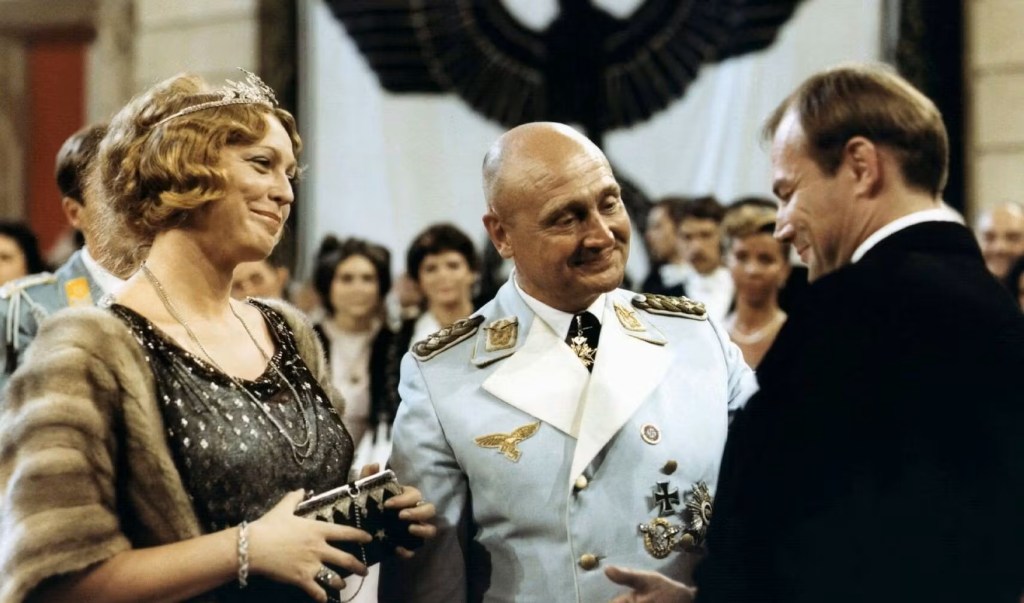
His soul is what changes. Over the course of the regime, he will report or betray fellow actors and turn away friends. Szabó establishes the ruthless vileness of the regime through fellow actor Miklas (György Cserhalmi, very good) who joins the party early, only to become disillusioned at the lack of advancement his mediocre talent gets compared to Hoefgen’s opportunism. His flirtation with Fascism ends in being marched from the theatre by the Gestapo to “die in a car crash” (in cold reality we are shown his fatal shooting, everyone pretends they don’t know he’s been murdered).

Hoefgen recrafts himself into a Fascist ubermensch. His revival as Mephistopheles is praised as “stronger” and more “fierce” than the original. He practices strengthening his handshake after the General points out its limpness. He culminates the film with re-presenting all his compelling “theatre of the people” staging ideas which he’d outlined at the start of the film (for a social realist piece in a working club), into a newly minted Aryan-Hamlet in which he and Lotte play the lead roles.

But it leaves him totally alone. Everyone who sees through his bullshit – from Juliette to his wife Barbara, wonderfully played by Krystyna Janda full of expressive honesty – is betrayed by him. Szabó has Brandauer increasingly turn his self-justifying pleas to the camera, as if we are the only people left listening to him. At the height of his success, Hoefgen becomes more pathetic than ever: frantically collecting socialist flyers from the theatre toilet and burning them in his office and finally terrorised by the General in Nuremberg’s floodlights, the spotlight he’s spent the whole film searching for only confirming to him what a plaything he is to his masters.

Szabó’s film is a brilliant musing on Faust, a wonderfully complex look at how a man can willingly be contorted and changed by ambition. And it demands repeated viewing to appreciate the towering performance by Brandauer, who burns through the screen with a charisma and power that actually heightens our awareness of his character’s blankness behind the show.

Out of Africa (1985)

Robert Redford and Meryl Streep in this sweepingly empty romance Out of Africa

Director: Sydney Pollack

Cast: Robert Redford (Denys Finch Hatton), Meryl Streep (Karen von Blixen), Klaus Maria Brandauer (Bror von Blixen), Michael Kitchen (Berkeley Cole), Michael Gough (Lord Delamere), Suzanne Hamilton (Felicity Spurway), Rachel Kempson (Lady Belfield), Shane Rimmer (Belknap), Malick Bowens (Farah Aden), Joseph Thiaka (Kamante), Donal McCann (Doctor), Leslie Phillips (Sir Joseph Byrne)

In the 1980s Hollywood faced an identity crisis. Throughout the 1970s, the films the Oscars honoured and those that topped the box office were often one and the same. The industry saw itself as the purveyor of classy, intelligent, popular entertainment. But in the 1980s, people flocked to see the latest Rocky or Rambo film, instead of the likes of Kramer vs Kramer. Hollywood wanted to carry on feeling good about itself: so it honoured as “Best Picture” the sort of sumptuous, prestige products it wanted to shout from the rooftops about, even if people weren’t flocking to see them at the cinema in the same way. So something as mundane, average, tasteful and empty as Out of Africa hoovered up eight Oscars.

Based on Karen Blixen’s memoir of her 17 years (from 1913) owning and running a coffee farm among the British community in Kenya, the film reorganises a deliberately non-linear memoir (full of impressions and reflections, thematically arranged) into a simpler narrative, and throws in content from at least two biographies of Blixen (played by Meryl Streep). As such, the film charts her life, specifically her relationship with philandering and unreliable husband Bror (Klaus Maria Brandauer) and love affair with British game-hunter Denys Finch Hatton (Robert Redford).

Pollack directs this epic with a clean, smooth, professional and lifeless tastefulness that makes it a long film full of pretty things, but a fundamentally empty experience. At the film’s conclusion, Karen is invited into the Men Only club for a drink where she is toasted. It feels like it should be the culmination of plot threads running throughout the film. But instead, its under-explored and unfocused, struggling for any attention. Rather than a culmination of a nearly three-hour experience, the moment feels unearned.

That’s about par for the course for a film ticking all the boxes of “prestige” movie making, but which tells us nothing at all. It’s clear Pollack has only a limited understanding of the intricate rules of the British upper-class community. We learn nothing about Africa, or the role of Empire there or the impact this had on the Kenyan people. Instead, the Kenyan people are seen as exotics or charming superstitious eccentrics.

The film is only interested in how beautiful colonial Britain was – the lovely clothes, the sumptuous set-design, the detailed props – and the gorgeous scenery. There is some focus given to the Kenyans – particularly Karen’s relationship with her servant Farah, very well played by a stern but wise Malick Bowens – but it is always defined as Karen visiting them, encouraging their education and pleading for their rights. There is more than a touch of the white saviour, and the film fails to really give us a sense of Karen gaining an understanding of the Kenyan people on their own terms, rather than hers.

That might be because the film is determined to turn the story into a straight-forward romance, giving most of its focus to Karen’s relationship with Denys. This is the root cause of most of the film’s problems, as Pollack casts two fundamentally unconnected actors. Streep gives a performance of such technical detail, you find yourself admiring the work while never really connecting with the character. Her Danish accent is perfectly studied, she has clearly read everything on Blixen she can find, and every single beat is perfectly observed. You can’t miss she is acting in every frame: there is nothing relaxed or truly intimate in the performance. It’s the work of a master craftsman.

This detailed excellence literally feels like it is happening in a different movie to the one Redford is in. Redford looks like he just stepped off the plane and started shooting. Pollack was convinced no English actor could play Denys in the sweeping romance he had in mind (Charles Dance anyone? Michael Kitchen – very good as Denys’ best friend – is far closer to what the part actually required, and would have been excellent). Redford was parachuted in and encouraged to play the role with his natural accent (is he still meant to be British? No idea).

The two performances never click together, and Redford’s Californian approach feels totally wrong for the Houseman-quoting, Mozart-playing, Great White Hunter he is meant to be. Not for one second can you forget this is the Sundance Kid – making it nearly impossible to buy into this relationship the film is trying to sell you, as well as making Streep’s Danish accent sound out of place (I mean why is she going to so much trouble when Redford can’t be arsed?).

All the romantic hair washing in the world can’t make these two stop being a chemistry free, jarring couple. Take away the sort of epic romance the film needs – the sort of thing The English Patient would do so right 11 years later – and all you really have left are two handsome actors in a very picturesque setting. Out of Africa looks lovely – but in a National Geographic way. The African Plains look wonderful, you’d have to do a poor job to make them look bad. Really the film is visually dull.

Pollack’s limitations as a director are revealed – he can’t give this the sweep and sense of the epic it needs and he can’t find depth in this canvas. Instead, everything is painted in the broadest brush strokes and any sense of romance it gets is from John Barry’s exquisite, luscious score. The film crams in as many shots of Africa as possible – but is bored witless by the story-telling and poetry that are supposed to be at the heart of Denys and Karen’s relationship. It rips the heart out of these two characters and their romance.

Out of Africa won all those Oscars – but feels like a box-tick exercise. Like the voters just thought everything in it musthave been Oscar-worthy. 1985 was a poor year for movies – perhaps only Ran, Brazil and Back to the Future have really grown in stature – but Out of Africa feels like the emptiest, least interesting, least effective prestige picture that ever scooped the Oscar. Nothing sticks in the memory – other than the repeated “I had a farm in Africa” line in Streep’s tongue rolling accent. Kitchen, Suzanne Hamilton and Brandaurer (charming and likeable as Blixen’s husband, despite playing a complete shit) are good, but nearly nothing else really works beneath its surface impact. Middle-brow, tasteful and pointless.

The Russia House (1990)


Connery and Pfeiffer go behind the Iron Curtain

Director: Fred Schepisi

Cast: Sean Connery (Bartholomew “Barley” Scott Blair), Michelle Pfeiffer (Katya Orlova), Klaus Maria Brandauer (Dante), Roy Scheider (Russell), James Fox (Ned), John Mahoney (Brady), Michael Kitchen (Clive), J. T. Walsh (Colonel Jackson Quinn), Ken Russell (Walter), David Threlfall (Wicklow)

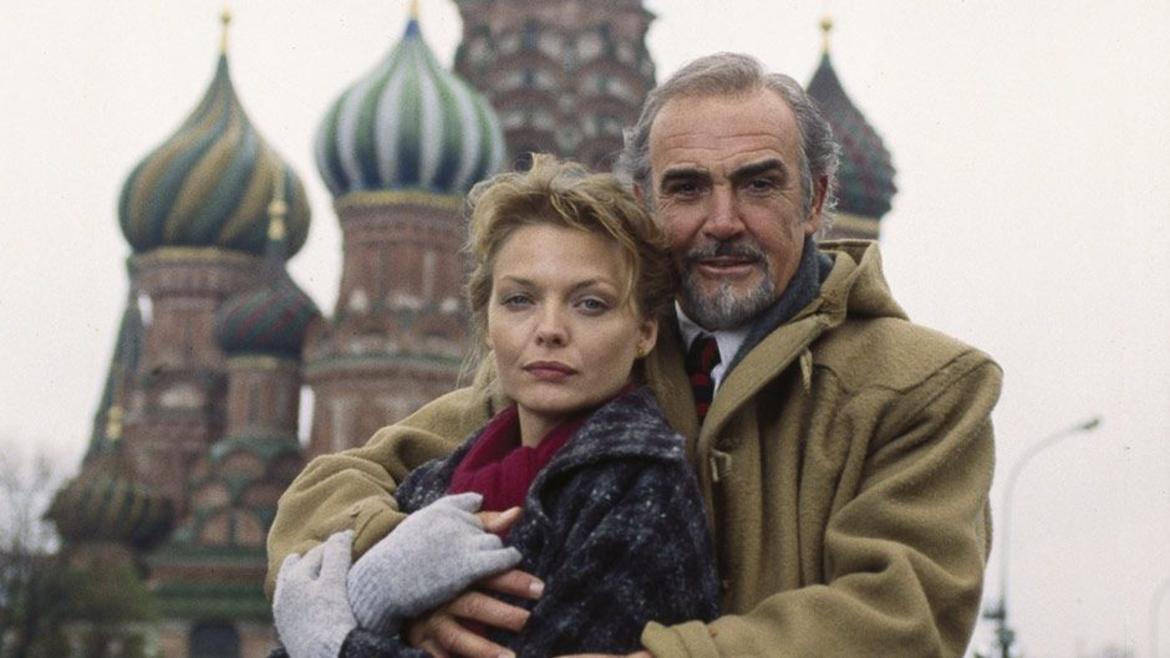
Based on John Le Carré’s novel, The Russia House was one of the first espionage thriller films released after the fall of the Soviet Union, and therefore found itself exploring the curious impact of Glasnost on the games of one-upmanship that East and West played with each other.

Barley Blair (Sean Connery) is an over-the-hill publisher with connections in Russia, who is enlisted by MI6 to recruit the mysterious “Dante” (Klaus Maria Brandauer, a little too mannered for the film and under used), whose manuscript about Russian nuclear readiness has been intercepted en route to Blair by the intelligence services. Blair’s main contact is Dante’s former lover Katya (Michelle Pfeiffer), a woman trapped in political games.

Second-tier Le Carré is brought to the screen in a film that perfectly captures the authorial voice, but missing  narrative drive. Tom Stoppard’s adaptation masterfully captures the nuances and rhythms of Le Carré’s writing – the conversations of the CIA and MI6 operatives, their lingo and phraseology, are a perfect evocation of the author’s style, while Barley comes to the screen as almost the quintessential disillusioned middle-aged romantic: scruffy with a drink problem and a public school disdain for the prefects of the intelligence service.

The film’s other major positive is the central performance of Sean Connery. The former James Bond (then in the middle of a five-year purple patch of great roles which ran from The Name of the Rose to The Hunt for Red October) brilliantly plays against type as the dishevelled Barley, a man who feels like he has spent a lifetime circling failure and unreliability. Connery tones down his athletic physicality as an actor, playing Barley as a shuffling, hunched figure, often a step behind those around him. He’s also able to capture the romantic defiance behind Blair as well as a sadness and a self-loathing, his eyes showing years of shame at his own unreliability and the disappointments he has inflicted on people. It’s one of his least “Connery-like” performances, and a real demonstration of his willingness to stretch himself as an actor.

He’s well matched by some fine supporting performances. Pfeiffer is a very good actress who balances Katya’s vulnerability with a shrewd understanding of the compromises and dangers of the world she is in. Having said that, the chemistry between her and Connery doesn’t quite click into place during the course of the film. There are also good performances from James Fox and Roy Scheider as feuding intelligence boffins, and an eye-catching “love it or loath it” one from Ken Russell playing one of Le Carré’s quintessential campy, eccentric public-school intelligence operatives.

The film’s main weakness is that the actual story just isn’t quite interesting enough. The stakes never feel as high as they should be, and the unfolding of events seems unclear rather than carefully concealed from the audience. Despite the actors’ performances, Blair and Katya aren’t quite characters we can invest in enough and the momentum of the film too often gets bogged down in a reconstruction of intelligence agent squabbles. Schepisi films the Russian locations extremely well, but too often the camera lingers lovingly on a series of locations like a travelogue, slowing down the pace of the film as the film revels in its status as only the second Hollywood production allowed to film in Russia.

It’s an intelligent and faithful adaptation, but it doesn’t quite come to life. Stoppard’s script doesn’t carry enough narrative thrust and you simply don’t care enough about the fates of many of the characters. In many ways, a less faithful adaptation – such as the BBC’s recent production of The Night Manager – might well have made for a more compelling movie. As it is, although the film feels like an immersion into the author’s universe, it also feels like a dip into one of the less engaging and memorable offerings in his back catalogue. Along with the book’s strengths, it also carries across weaknesses. It’s satisfying enough and doesn’t outstay its welcome – but it also never really seizes the attention.