Tag: Laurence Fishburne

Megalopolis (2024)

Megalopolis (2024)

Coppola’s ambitious epic commits the cardinal sins – boring, hard to follow and immensely tedious

Director: Francis Ford Coppola

Cast: Adam Driver (Cesar Catilina), Giancarlo Esposito (Mayor Franklyn Cicero), Nathalie Emmanuel (Julia Cicero), Aubrey Plaza (Wow Platinum), Shia LaBeouf (Clodio Pulcher), Jon Voight (Hamilton Crassus III), Laurence Fishburne (Fundi Romaine), Jason Schwartzman (Jason Zanderz), Kathryn Hunter (Teresa Cicero), Dustin Hoffman (Nush Berman), Talia Shire (Constance Crassus Catilina)

I wanted to like it. Honestly I did. I really respect that Coppola was so passionate about this dream project that he pumped $120 million of his own money into it to make it come true. You can’t deny the ambition about a film that remixes modern American and Ancient Roman history, within a sci-fi dystopia. But Megalopolis is a truly terrible film. Coppola wanted to return to the spirit of 1970s film-making: unfortunately what he’s produced is one of the era’s self-indulgent, overtly arty, unrestrained and pretentious auteur follies where an all-powerful director throws everything at the screen without ever thinking about whether the result is interesting or enjoyable.

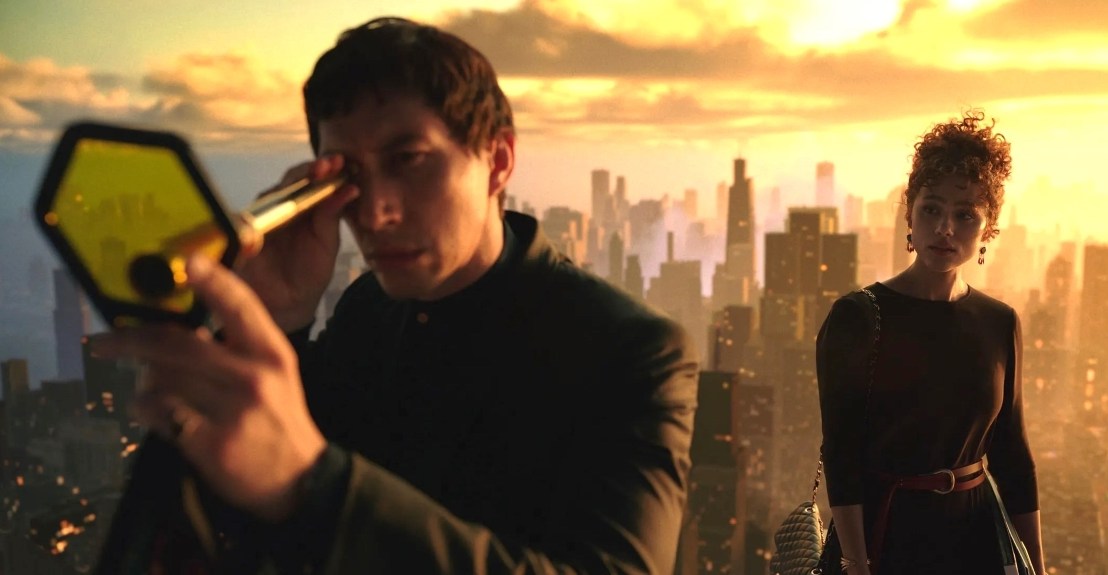
In New Rome (basically New York), Cesar Catilina (Adam Driver) is a visionary architect and inventor, who created ‘megalon’, a sort of magic liquid metal. His vision is to use it make a glorious new Rome. He’s opposed by Mayor Cicero (Giancarlo Esposito) who wants to focus spend on practicalities rather than castles-in-the-sky. This leads to a series of increasingly dirty political flights between Catilina, Cicero and Catilina’s cousin Clodio Pulcher (Shia LaBeouf) the degenerately populist nephew of super-wealthy banker Crassus (Jon Voight), who is married to TV star and ambitious social climber (and Catiline’s former girlfriend) Wow Platinum (Aubrey Plaza). Catilina is also in a tentative relationship with Cicero’s daughter Julia (Nathalie Emmanuel). Or yes and he can mysteriously stop time. Somehow. Even he doesn’t know how.

The film is a sympathetic portrait of Catiline, a powerful Roman who (probably) caused a scandal by shagging a Vestal Virgin then attempted to mount a coup with a heavily pandering populist set of promises which led to his suicide (after defeat in battle) and his followers being executed by then-consul Cicero. Megalopolis’ version mixes this with elements of Caesar’s career and remixes Cicero, Claudius Pulcher and Crassus into versions of their historical forbears. It’s a neat idea, but it’s utterly bungled in delivery. Megalopolis is a film practically drowning in pretension, bombast and self-importance, its script stuffed with faux-philosophy and clumsy political points, its Roman history crude and obvious.

It feels pretty clear Megalopolis should be three to four hours and has been sliced down to two and a quarter. The problem is it feels like it goes on for four hours and practically the last thing I could imagine wanting as the credits roll was watching yet more of this nonsense. The most striking thing about Megalopolis is how boring it is (I nearly dropped off twice – and I was in an early evening showing). It hurtles through a series of impressive-looking-but-dramatically-empty set-pieces that often make no real narrative sense and carry very little emotional force. Characters are introduced with fanfare and then abruptly disappear (Dustin Hoffman’s fixer gets a big moment then literally has a building dropped on him) and the final forty minutes is so sliced down it loses all narrative sense.

Megalopolis feels like a bizarre art project, a collage of influences, opinions, concepts and inspirations, as if Coppola had been collecting ideas in a scrapbook for forty years and then put them all in. His heavily-penned script forces clunkingly artificial lines into its character mouths, frequently feeling like a chance to show off his reading list. Marcus Aureilus, Goethe, Rousseau and Shakespeare among others showily pop-up, alongside speeches from the real Cicero. Driver even does a (to be fair pretty good) rendition of Hamlet’s ‘To be or not to be’ soliloquy, though it’s a sign of the film’s self-satisfied literariness that I can’t for the life of me work out why he launches into this at a press conference. Laurence Fishburne delivers the occasional narration with such poetic clarity, you almost forget it’s full of dull, gnomic rubbish, straining at adding depth to bland, fortune-cookie level statements.

It’s not just literary influences. The film is awash with pleased-with-itself cinematic references. Most obviously, Metropolis homages abound in its design, while Coppola’s breaking the film up with stone-carved chapter headings is a silent-film inspired touch. As well as Lang, there are clear nods-of-the-head to Abel Gance’s Napoleon (most obviously in its troika shots) while the smorgasbord of influences checks off everything from Ben-Hur to Vertigo to The Greatest Show on Earth (and damningly not as good as any of those, even DeMille’s clunker). All of this is combined with a wild mix of cross-fades, double exposures, sixties-style drug-induced fantasies and half a dozen other filmic techniques that are all very impressive but feel like a young buck looking to impress, rather than providing a coherent visual language for the film. Catiline’s time-stop abilities are some sort of clumsy stand-in for the powers of the film director – calling cut whenever he wants – but what we are supposed to make of the point of this in a film as randomly chaotic as this I have no idea.
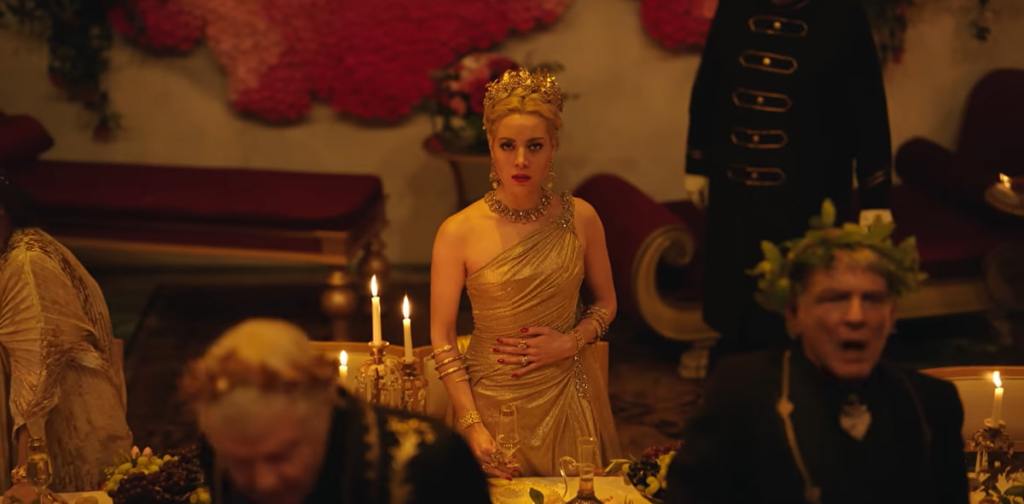
The entire tone is all over the place. A scene of tragic maudlin grief will immediately be followed by sex farce. An attempted murder by a Buster Keaton inspired pratfall. A speech so overburdened with philosophical and literary allusions it practically strangles the person speaking it will lead into a joke about boners. The cast splits into two halves: one seems to have been told this is a serious film which requires deathly sombre, middle-distance-starring pontificating; the other half that they are making a flatulent satire. The random mix of acting styles has the worst possible effect: it makes those in the first camp seem portentous and dull; and those in the second like stars of an end-of-pier adult pantomime.

Driver makes a decent fist of holding this together, even if Catiline is an enigmatic, hard-to-understand character whose aims and motivations seem as much a mystery to Coppola as they do to the poor souls watching. But he can deliver a speech with conviction and seems comfortable mixing soul-searching with goofy dancing. Nathalie Emmanuel, though, is utterly constrained by taking the whole thing so painfully seriously that the life drains out of her. On the other side, Aubrey Plaza is the most enjoyable to watch by going for out-right-comedy as a vampish, power-hungry woman who uses her body to dominate men. Shia LaBeouf also goes so ludicrously overtop as a faithful version of the seriously weird Claudius Pulcher – he engages in cross-dressing, murder, incest and drums up crowds by quoting Trump and Mussolini – that it’s either daring or just as much of an unbearably self-satisified art project as the rest of the film depending on your taste.

But the main problem with Megalopolis is that its smug, pat-on-the-back, aren’t-I-clever artistic self-indulgence makes the film painfully slow and terrifically boring. How could a film that features riots, assassination attempts, orgies, murders, an actual meteor strike and magic time-stopping be as dull as this? When everything is thrown together without no emotional coherence whatever. Characters we don’t relate to or understand, who are either po-faced ciphers or flamboyant cartoons, stand around and quote literature at each other, while the director tries a host of flashy tricks he’s liked from other movies and never gives us an honest-to-God reason to give a single, solitary fuck about anything that’s actually happening at any point to anyone in the film.

It is perhaps the ultimate auteur folly. A director creating something that only appeals to him, at huge expense (and I suppose at least he paid for it himself rather than wrecking a studio) where no one was allowed to say at any point “this makes no sense” or “this is heavy-handed” or “this scene doesn’t mesh at all with the one before it”. Instead, it throws a thousand Coppola ideas at the screen, in a film designed to appeal to pretentious lovers of art-house cinema who like to tell themselves Heaven’s Gate is the greatest film ever made or the artform peaked with Melieres and it was all down-hill from there.

To approach the film in its own overblown style: whenever an auteur crafts, Jove plays dice with the Fates to decide on the cut of the cloth for Destiny’s Loom: should it come up sixes, the Muses smile, but should it be Snake Eyes, Pluto himself shall claim his due from those who would seize Promethean fire.

That makes as much sense as chunks of the film.
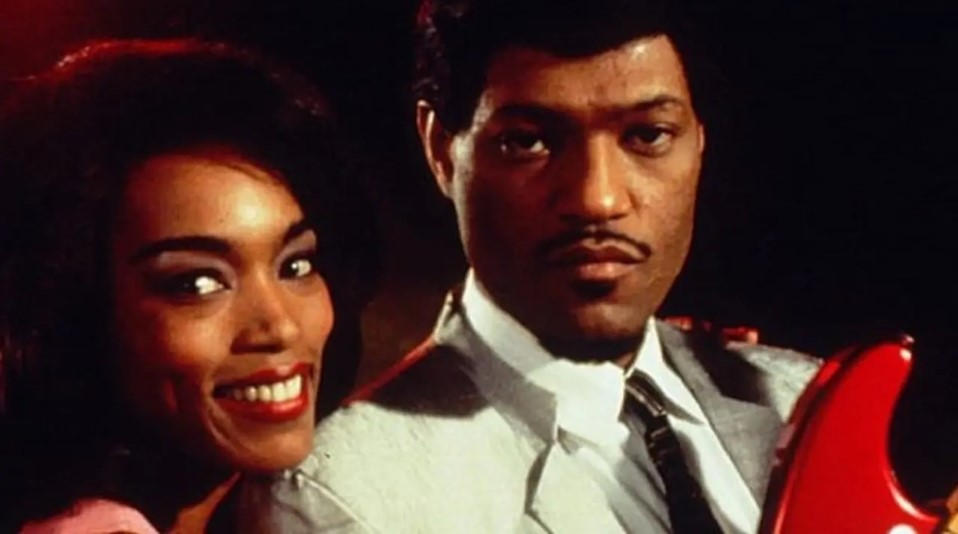
What’s Love Got to Do With It? (1993)

What’s Love Got to Do With It? (1993)

Tina Turner biopic sails into dark marital waters in a hard-hitting film

Director: Brian Gibson

Cast: Angela Bassett (Tina Turner), Laurence Fishburne (Ike Turner), Vanessa Bell Calloway (Jackie), Jenifer Lewis (Zelma Bullock), Penny Johnson Jerald (Lorraine Taylor), Phyllis Yvonne Stickney (Alline Bullock), Chi McBride (Fross), Jame Reyne (Roger Davies) Richard T Jones (Ike Turner Jnr)

How did Tina Turner become the Queen of Rock ‘n’ Roll? The hard way. Possibly the hardest. Tina Turner’s relationship (and marriage) to her initial discoverer, Ike Turner, lasted almost twenty years after their first meeting in 1956. During that time, Ike helped form her style – and viciously beat and assaulted her on a regular basis, increasingly in drug-fuelled bouts of jealousy as her talent and fame surpassed his own. What’s Love Got to Do with It? sees Angela Bassett and Laurence Fishburne bring this biopic and spousal abuse drama to the screen.

Well directed by Brian Gibson, with neat mixture of mock-documentary and home video footage carefully spliced into the film, What’s Love Got to Do with It? is practically the dictionary definition of a tough watch. It doesn’t flinch in showing the escalating violence in the Turner marriage. Bleeding noses, black eyes, furious fists and a rape scene in a recording studio that is almost unbearably visceral, What’s Love Got to Do with It? indeed: this is marriage as Dantean hell.

Tina Turner later felt the film went too far in depicting her as victim, but also not far enough in showing the violence in their marriag[AN1] e. (Ike Turner, needless to say, was equally unhappy – but who cares.) What she praised though was Angela Bassett’s performance. Cast at short notice, Bassett worked overtime to master Turner’s vocal and physical mannerisms. It’s a nailed-on performance, but Bassett also completely drills down into the heart of a woman who finds herself lost in a situation outside of her control, terrified but discovering the inner strength needed to lead her own life.

It’s a hugely emotional performance. Bassett makes Tina fiery, determined and talented – but even the strongest person can find themselves trapped in (and defending) destructive relationships. Despite the early example of Ike’s previous girlfriend Lorraine (a very good Penny Johnson), driven to a suicide attempt by Ike, despite his vanity and jealousy being clear early on, (as well as his control freak desire to dictate every inch of her life ,including changing her name to Tina Turner without her agreement), Tina is captivated by Ike.

As their relationship deteriorates, for all his vileness, Bassett’s Turner defends and excuses her husband. Whether he beats her up at home in front of the kids (and brings a dress home later as an apology) or smashes a cake into her face in a restaurant, it’s never quite his fault. He’s fragile, he’s an artist, sometimes she just makes him mad. Bassett brilliantly shows how this Orwellian double think can settle in, so that a woman like Turnerstays with her abuser for 16 years of marriage, until she realises she can break free.

Bassett’s electric performance is perfectly complemented by Laurence Fishburne’s burning, self-pitying performance of weakness and insecurity masked by anger and fury. Fishburne turned down the film five times (it was Bassett’s presence that eventually persuaded him). He felt the film didn’t do enough to show why Turner became the man he did. To be fair, he’s probably right. Turner has an early scene where he speaks of his childhood trauma (a fig leaf for his bullying) which Fishburne gives a real humanity, and he invests the early sequences with charm and charisma.

But Fishburne, like Bassett, doesn’t slack on the energy. As cocaine and envy eat Ike up, his body language becomes more bear-like, his speech ever more mumbled. His eyes cloud over with a look of hate. Only actors who trust each other completely could play these appalling scenes of domestic violence with such complete and utter commitment. Both Bassett and Fishburne give a horrible life to these shocking and sickening moments of hurt and pain.

Both actors essentially elevate material that, at heart, is standard biopic stuff, built around the usual obstacles – albeit the obstacle this time is hideous domestic violence. We see the roots of Turner’s career, the early hits, the terrible turmoil, so appalling that the final act triumph really moves. Gibson recreates Turner performances with expertise, each packing a real punch. Bassett’s capturing of Turner’s performance style is spot-on and her lip synching is flawlessly convincing.

What’s Love Got to Do with It demonstrates how hard it is to escape abusive relationships. But, the film though doesn’t quite manage to fully build the real life behind the characters. I can get why Tina Turner felt the film positioned her as too much of a victim, as it prioritises this aspect of her life before all others. While it’s made clear that Ike lived a life in which he victimised a series of women, the film’s focus on this issue diminishes the other aspects of Tina’s life and the building of her own career, making her for a large part of the film a punching bag for an abuser.

So, the survival makes for deeply affecting viewing. To see Tina return the punches and flee from a hotel in LA to find refuge in another hotel (she was granted a free room by a deeply sympathetic hotel manager who can read between the lines). Her refusal to be scared when, like all bullies, Ike comes crawling back begging forgiveness and then switches smoothly to threats when that doesn’t work. And above all the triumph of her career. The only thing she wanted from the divorce was the name “Tina Turner” – she had bled for it. And we saw it. What’s Love Got to Do with It might be, in many ways, a standard biopic but with two such forceful performances it has special moments.

John Wick: Chapter 4 (2024)

John Wick: Chapter 4 (2024)

It’s got almost no plot but what it does have is mesmeric, balletic fighting – for three hours

Director: Chad Stahelski

Cast: Keanu Reeves (John Wick), Ian McShane (Winston Scott), Donnie Yen (Caine), Bill Skarsgard (Marquis Vincent Bisset de Gramont), Laurence Fishburne (The Bowery King), Clancy Brown (The Harbinger), Hiroyuki Sanada (Shimazu Koji), Shamier Anderson (Mr Nobody), Lance Reddick (Charon), Rina Sawayama (Shimazu Akira), Marko Zaror (Chidi), Scott Adkins (Killa Harkan), Natalie Tena (Katia)

John Wick (Keanu Reeves) wants revenge against The High Table, the shadowy criminal organisation that (for various reasons) wants to punish him for various transgressions. The High Table are raising the stakes, giving the psychotic Marquis (Bill Skarsgard) carte blanche to destroy John, including levelling the Continental hotel of John’s ally Winston (Ian McShane). With destruction all around him, hunted by two deadly assassins the blind (and old friend) Caine (Donnie Yen) and the relentless dog-loving Nobody (Shamier Anderson), John’s only chance of survival is an arcane ritual duel between him and the Maquis.

John Wick: Chapter 4 is, in many ways, less a film and more an experience. Over stretched at nearly three-hours, its effectively three mammoth fights scenes (in Osaka, Berlin and Paris) loosely stitched together with a plot that doubles down on the arcane ritual of the franchise’s criminal underbelly. It was also a massive hit, the franchise’s biggest yet. Why? Because John Wick: Chapter 4 speaks a little bit to all of us who are bored with endless big-budget, special effects filled action films where nothing is real.

In John Wick: Chapter 4 you watch real people – stunt men and actors who have clearly trained for eons – set about a series of awe-inspiring action set-pieces with stunning realism. There is the same visceral thrill of watching Reeves dish out beatings as there was watching Gene Kelly dance steps: in both cases we are watching a master at work, turning his expertise into cinematic realism in front of our eyes.

So, in some ways, it doesn’t matter there is no real plot in John Wick 4 or that the characters are lightly sketched. Because we are here for elaborate, stunt filled fight scenes in the Osaka Continental. To see Donnie Yen move with the fluidic grace of a ballet dancer. To be gripped by Reeves punching his way through a brutal brawl with a fat-suit clad Scott Adkins (a martial arts superstar himself) in a neon lit Berlin nightclub. To watch Reeves fight his way up the Rue Foyatier steps, fall back down them, then fight back up again. Why these things are happening doesn’t really matter. It’s about the beautiful realism of watching actors actually do them.

That’s what powered this film to a record-breaking haul. Its why Reeves spent time in development, Steve McQueen like, ripping lines out of the script (he says little more than 500 words in the whole three hours). Who wants to see a monologue when a Reeves weary half-shrug on having to fight his way back up those stairs speaks volumes? When we need a break from the action, the script throws in some tense verbal show-pieces that Skarsgard chews up as a politely psychotic bully or McShane and Fishburne riff on with cod-Shakespearean grandeur.

It’s all thrown together with a great deal of style by Chad Stahelski, who has grown in cinematic confidence the more of these films he has directed. It takes some balls to effectively open the film with a homage to one of the most famous edits of all time from one of the greatest films ever made, as Fishburne blows out a match to cut to the desert sun rising. But then, I’m here for a film that wears its love for Laurence of Arabia on its sleeve (and even shoots a sequence on the actual location of Lean’s classic). Alongside this, Stahelski continues to find new ways to shoot this mayhem: from tracking shots, Steadicam immediacy to a sprawling birds-eye view (inspired by computer games) that tracks Wick taking out a building full of baddies.

There are a few thematic links in the film that brings the series full circuit. Wick’s two frenemies are reflections of himself. Donnie Yen – very cool – reflects Wick’s love for family, with his “doing the bare minimum” actioning to protect his daughter, while Shamier Anderson’s softly-spoken Nobody reflects Wick’s famous dog love. John Wick: Chapter 4 also hints at the existential crisis of its hero – when you are literally taking on the entire criminal world, leaving hundreds of bodies in your wake, what chance is there that this will ever end?

It’s these little grace notes that keep the film grounded enough for us to care about Wick while he slices his way through another army of thugs. But it’s not why you are there. John Wick 4 can easily – perhaps best – be watched in chunks. Soak in one action scene, have a breather, and then throw yourself into another. Because these are some of the best, coolest, most relentless action scenes you will ever see, executed with a stunning skill. And that is what differentiates John Wick at a time when everything else feels sterile. There might be far too much of it, but at least it is life.

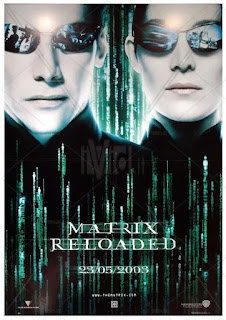
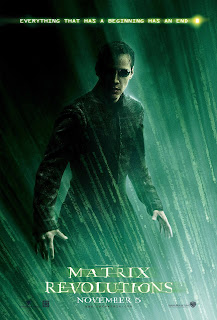
The Matrix Reloaded and The Matrix Revolutions (2003)

The Matrix Reloaded and The Matrix Revolutions (2003)

Tension, drama and thrills… all go missing in these increasingly ponderous self-important sequels

Director: The Wachowskis

Cast: Keanu Reeves (Neo), Laurence Fishburne (Morpheus), Carrie-Anne Moss (Trinity), Hugo Weaving (Agent Smith), Jada Pinkett Smith (Niobe), Monica Bellucci (Persephone), Lambert Wilson (The Merovingian), Gloria Foster/Mary Alice (The Oracle), Helmut Bakaitis (The Architect), Harold Perrineau (Link), Ian Bliss (Bane), Harry Lennix (Commander Lock), Collin Chou (Seraph), Nona Gaye (Zee), Gina Torres (Cas), Randul Duk Kim (The Keymaker), Daniel Bernhardt (Agent Johnson)

If you ever want to study a crash-course in how not to make sequels to a genre redefining film, these might be the perfect examples. I’m going to break a golden rule here and review them both together, which I’ve not done for anything else so far in this blog. The flaws in these films are so interlinked, I think you have to almost treat the whole misfire as one single, dreadfully disappointing film. And I just couldn’t bear the idea about writing two articles about each of them.

It’s six months after the events of The Matrix. Neo (Keanu Reeves) is an invulnerable phenomenon in the Matrix. He and Trinity (Carrie-Anne Moss) are in love. Morpheus (Laurence Fishburne) is being dragged over the coals by Starfleet Command (I know it isn’t called that, but it might as well be) for disobeying orders. And even worse news than that: the Machines have found the location of Zion, the secret last human city in the world. And they plan to destroy it – in 72 hours. Neo must undertake one final mission in the Matrix to find the secrets that will prevent this destruction of the human race – and he’ll have to do it with only the support of his friends, as the rest of mankind decides to batten down the hatches and wait for the uncoming storm. But is there more going on here than we think? Is there more to Neo’s existence than meets the eye? Why is he being plagued with dreams of Trinity’s death? And what is going on with Smith (Hugo Weaving) who know seems to be acting as rogue agent, working against man and machine?

The answers are all eventually revealed, with maximum pomposity and self-importance, over the nearly five hours these sequels drone on, seemingly determined to drain out everything that anyone found cool about the original movie and leave it with a stuffy, pretentious, dull shell that won’t win any new converts over. Before these films, The Matrix was a franchise that would have a life in films, video games, anime and fan fiction for decades to come. After them, it was dead in the water.

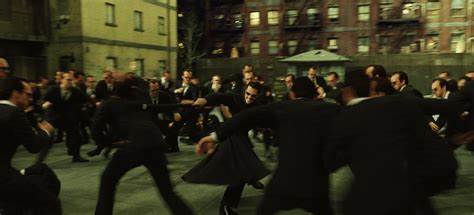
Why? What did people like about the first film? They liked the action sure, and they liked the cool action and visuals and the anti-authoritarian nose thumbing. But those all really worked because we related to the characters, we saw that they were vulnerable, outmatched and in peril. In the real world they were plucky, brave resistance fighters. In the Matrix they were desperate rebels who could do really cool things. This all gets blown away here. In the Matrix, Neo is now so invulnerable, that fights are pointless: they are little more than dull displays of choreography with inevitable outcomes. Reloaded hammers home time and again Neo can do anything he likes in the Matrix. Fighting hundreds of clones of Smith at once? No problem. Flying faster than the speed of sound? Sure thing. Reworking the reality to suit him? It’s just a shrug of the shoulders.

This is a disaster to drama in two ways. Firstly, it drains all the peril out of any moment in the Matrix world because we know that there is no way Neo can get hurt – or that he will allow any of his friends to get hurt. Secondly, it means to get any tension Neo has to be somehow depowered or separated from everyone else. This happens three times over the films: Neo gets dispatched to China, flung into an underground station purgatory and blinded in the real world. When the film becomes reliant on continuously finding a way to put its hero out of the way (a blight that also often hits Superman on film), you know you are in trouble.

Where Neo is still vulnerable, is the real world where the films spend more and more time. Sadly, the real world is a tedious, uninvolving place. Remember in the first film where Morpheus seemed like a super cool, sage-like leader of a rebellion? Well in fact he’s just a cog in a large, stuffy command structure that takes all the worst, most uncool elements of Star Trek’s Starfleet and doubles down on it. Zion is a stereotypical sci-fi city, with characters dressed in flowing robes, quasi-uniforms or urban rags (that’s when they are dressed at all – Reloaded’s early doors rave/orgy rightly draw oceans of sniggers). The real human world isn’t a gang of plucky, anti-authoritarian types but a typical sci-fi, rules-bound society. The flair of our characters is stripped from them.

All this is wrapped in a package that doubles down on the stuffy, Bluffer’s Guide to Philosophy that popped up in the first film. There it added a bit of self-regarding intellectual heft to a film about people kicking each other and dodging bullets, here it’s the be-all-and-end-all. But the films are nowhere near as clever as they think they are: various characters parrot crudely scripted stances on everything from free will to determinism to the greater good. None of it is new or intriguing, and nearly all of it feels like the directors straining to show off their reading list.

It hits its apotheosis in Reloaded as the Architect (Helmut Bakaitis), the bearded brain behind the Matrix, lays out in a long speech how Neo is in fact a part of the Matrix programme designed to help the system reboot and refresh in cycles, an interesting idea totally crushed under the weight of needlessly long, incomprehensible words, phrases and Latin quotes that don’t sound smart, only like the speech was written out in plain English and then run through a thesaurus.

And it was a neat idea that our Messiah might actually have been created by the machines to help their prison renew itself. But it gets lost in the clumsy, pleased with itself delivery, in conversations about choice and free will (will Neo choose his destiny or saving Trinity’s life? Guess!) and the generally turgid plotting. This gets worse in Revolutions which finally seeps the life out of the franchise, with a video-game shoot-out at Zion (which makes no tactical sense), a trek by Neo and Trinity to commune with the machines and Agent Smith converting every human being in the Matrix into a copy of himself, in a vague philosophical comment on the death of individuality.

The worst thing about these films is that they are self-important, hard to enjoy and often more than a little silly. Fights take place at great length with very little tension. Reloaded does have a fab freeway car chase – but again it depends on Neo being absent for any tension to exist (and as soon as he turns up it’s all solved in seconds). Almost everything in the real world is stuffy, earnest and bogged down in the sort of uncool sci-fi tropes the first film stayed away from. Nearly anything in the Matrix involves watching a God like figure hitting things (including a bizarre ten-pin bowling effect when Neo knocks over a host of Smiths).

The actors struggle to keep up the genre-redefining cool that made the first film so popular. Fishburne looks bored (and rightly so, since his dialogue is awful and he’s given almost nothing to do in Revolutions) and Weaving treats the whole thing as a joke. Reeves is earnest, but frequently restrained by the dullness of his role as an almighty God. Moss has most of the best material as Trinity makes drastic decisions for love and faith. The rest of the cast struggle with either paper-thin characters, painfully over-written dialogue or a mixture of both.

The Matrix sequels managed to drain out everything that was great about the original. Where that was nimble, these were stuffy. Where these were anti-authoritarian, these laid out a dull and stereotypical sci-fi society. Where the first was gripping, desperate and adrenalin fuelled, this sees invulnerable heroes, extended runtimes and a frequent lack of peril. Worst of all Revolutions in particular feels like hundreds of other “sci-fi war films” and about a million miles from the actual revolution of the first film. It doubles down on nearly everything that was less good in the original and strips out the things that most impacted people. How not to make a sequel.

The Matrix (1999)

Keanu Reeves and Hugo Weaving defy gravity in ground-breaking sci-fi The Matrix

Director: The Wachowskis

Cast: Keanu Reeves (Neo), Laurence Fishbourne (Morpheus), Carrie-Anne Moss (Trinity), Hugo Weaving (Agent Smith), Joe Pantoliano (Cypher), Marcus Chong (Tank), Anthony Ray Parker (Dozer), Julian Arahanga (Apoc), Matt Doran (Mouse), Gloria Foster (The Oracle), Belinda McClory (Switch)

In 1999 we all waited for the release of a science-fiction film that would change the genre forever. Problem is we all thought it would be Star Wars: The Phantom Menace, when in fact the entire world went crazy for The Matrix. It helped that The Matrix was everything The Phantom Menace wasn’t: tight, exciting, brilliantly made and above-all endlessly, effortlessly and completely cool. And it still is: not even its dreadful, dreadful sequels could dent its genius or legacy. The Matrixis a flash of counter-culture: anarchic, teenage fantasy taking over the main-stream. It’s still brilliant.

Thomas Anderson (Keanu Reeves) is an office-working drone by day, hacker Neo by night, who wishes there was more to life than this. He’s going to get more than he wished for when he’s offered a choice between the “Red Pill and the Blue Pill” (truth or fantasy) by Morpheus (Laurence Fishbourne), leader of a mysterious hacker group with super-human athleticism and strength. Choosing the Red Pill, Neo wakes up to find himself plugged into a massive machine – and that the world he knows is nothing more than a post-apocalyptic cage, a computer simulation known as The Matrix, used by the all-conquering machines to keep humanity docile while they use their bodies as batteries for their empire. Even more than that, Morpheus is convinced Neo is “The One”, a prophesied saviour who will bring an end to the Matrix. Can Neo accept his destiny?

The Matrix is a superb fusion of a whole host of questions that clearly fascinate the Wachowski siblings. Questions of identity come flying to the fore, as well as the battle for individualism in a conformist society. The Matrix has very earnest points to make about learning to embrace the people we really are, which it delivers with a host of references to philosophy and psychology. It could have become indulgent and self-important (a trap the sequels would fall into), but it delivers the story with a crowd-pleasing burst of energy, mixing in film noir, kung-fu and some rather endearing characters that we end up really caring about.

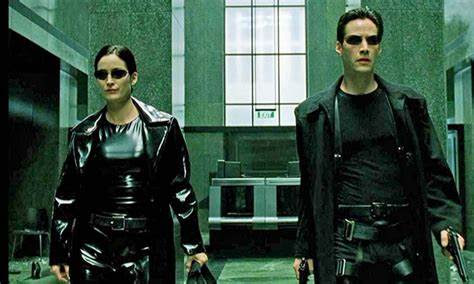
It’s also of course super, super cool. Everything about it passes the test: from the leather trench coats and shades to the high-octane action and the sense that the film is speaking directly to the alienated, authority-nose-thumbing teenager in all of us. This is a film for the people, the under-dog, with something for anyone who has ever felt trapped, bored or oppressed by their fate (i.e. nearly everyone) and reassures them that their dreams of having a special destiny might actually come true. It tapped into people’s joy and fantasy in a way The Phantom Menace totally failed to do.

This is a classic slice of mysticism. It’s not a film as clever as it thinks it is – it’s main calling card is still Alice in Wonderland the go-to for all films musing on dreamlike fantasy worlds – but it still throws a host of fun little questions and thinking points at the audience. Today, its also easier to see how the film is a celebration of counter-culture and sexual fluidity in a way that had to be snuck under the wire in the 90s. It asks (in a simple) way questions about who we are and what is it all about, in a way that really appeals to rebels. It’s the sort of film a Camus-loving teenager who is fed up with their parents, dreams they had the skill to make.

Skill is the key here. This is a superb achievement by the Wachowskis. It’s brilliantly directed, fast-paced and electric. The camera-work frequently makes use of a flurry of flashy tricks (reflections are a common theme), but which never over-whelm the narrative. It’s revolutionary use of freeze-frame camera work – an ingenious invention created “bullet time” where a series of cameras each taking one shot seem to allow us to rotate at normal speed around actors caught mid jump – introduced something we’d never seen before (and was much imitated and parodied later). The action sequences are stunning – a series of high-stakes, super-cool kung-fu-laced punches and kicks that are shot with a fluid camera that manages to seem both classic and deeply immersive.

It also works because our heroes are really underdogs. We are told again and again that they are vulnerable in the Matrix – that for all their gravity defying feats of strengths, when they come up against the “Agent” sentient programmes, they stand little or no chance of surviving. The goodies die with astonishing regularity in the film, and even the leads are shown to be extremely vulnerable in combat. Our empathy for them is so well crafted, that we even forgive the fact that they gun down countless numbers of their fellow humans during the film (it’s handwaved that anyone can become an agent at any time, so the slaughter of dozens of regular Joes is pretty much essential to prevent this).

A lot of that is also down to the excellence of the main performers. The film channels Keanu Reeves instinctive sweetness and gentleness in a way few other films managed to do as successfully before – he’s brilliantly convincing as both the kick-ass hero, but also the endearing fish-out-of-water who says “woah” as Morpheus jumps over a building. Carrie-Anne Moss is determined, assertive and very humane as Trinity while Laurence Fishbourne’s natural poise and authority are perfectly utilised as Morpheus. Opposite them we have a performance of such dastardly, lip-smacking, Rickmanesque consonant precision from Hugo Weaving, that Agent Smith becomes an iconic villain.

It all comes together into a film that delicately weaves a plucky under-dog story of a hero trying to find his purpose around a few perfectly staged, edge-of-the-seat action set-pieces, that hits a perfect balance between a wider-audience and a cool and pulpy indie vibe. It’s the sort of film that will please the masses, but many people will still feel is speaking very personally to them. Hugely influential, it remains a masterpiece of action and science fiction cinema which, while never as clever as it thinks it is, is hugely vibrant in its filming and endlessly, repeatedly exciting when watching.

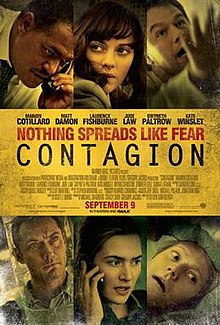
Contagion (2011)

Laurence Fishburne leads the drive to fight a pandemic in Soderbergh’s outbreak thriller Contagion

Director: Steven Soderbergh

Cast: Marion Cotillard (Dr Leonara Orantes), Matt Damon (Mitch Emhoff), Laurence Fishburne (Dr Ellis Cheever), Jude Law (Alan Krumwiede), Gwyneth Paltrow (Beth Emhoff), Kate Winslet (Dr Erin Mears), Jennifer Ehle (Dr Ally Hextall), Elliott Gould (Dr Ian Sussman), Chin Han (Sun Feng), Bryan Cranston (Rear Admiral Lyle Haggerty), John Hawkes (Roger), Enrico Colantoni (Dennis French)

It’s a fear that has gripped the world several times this century: the pandemic that will wipe us all out. It’s the theme of Steven Soderbergh’s impressively mounted epidemic drama, which mixes in an astute commentary on how the modern world is likely to respond to an event that could herald the end of times.

Beth Emhoff (Gwyneth Paltrow) is a businesswoman flying back to Minneapolis from Hong Kong (with a stopover in Chicago for a bit of rumpy-pumpy with an ex-boyfriend) who becomes Patient Zero for an outbreak of a virulent strain of swine and bat flu that proves near fatal for the immune system. While her stunned husband Mitch (Matt Damon) is immune, most of the population aren’t. Across the world, health organisations swing to action – from Dr Ellis Cheever (Laurence Fishburne) and Dr Ally Hextall (Jennifer Ehle) at the CDC, to Dr Erin Mears (Kate Winslet) running things on the ground in Minneapolis to Dr Leonara Orantes (Marion Cotillard) investigating for the WHO in Switzerland and Hong Kong. As populations panic, conspiracy-theorist blogger Alan Krumwiede (Jude Law) sees this as an opportunity for personal promotion and enrichment.

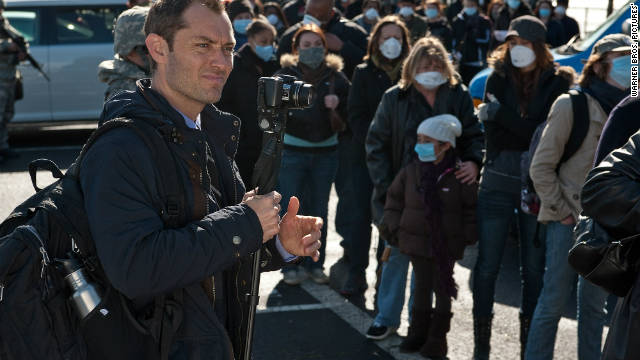
Soderbergh’s clinical filming approach makes for a chillingly realistic piece of cinema realitie, possibly one of the director’s finest films in his oddly-uneven career. Soderbergh presents events as they are, laying out the film like a giant Pandemic board. Captions regularly tell us what day we are on from initial outbreak, as well as the populations of the various cities the plot lands us in. The film is shot with a documentary lack of fussiness, and largely avoids either sensationalism or the sort of Hollywood virus clichés of films like Outbreak. It also succeeds in largely avoiding heroes or villains (even the usual baddies for this sort of film, Big Phama companies, are shown as part of a potential solution not the problem) – even the outbreak is largely an act of chance, prompted by mankind’s actions, but there is no reveal that shady suits or military types are behind it all.

Watching the film today in the light of Brexit and Trump it actually appears strikingly profound and prescient in its depiction of the knee-jerk paranoia and wilful blindness of internet and media pundits who believe every opinion is equal and valid regardless of expertise. Alan Krumwiede (a slightly pantomime performance from Jude Law, complete with bad hair, bad teeth and an Aussie accent perhaps intended to echo Julian Assange) all but denounces the views of experts as “fake news”, claims his opinions on the causes and treatment of the disease are as valid as the expert professionals (all but saying “I think we have had enough of so-called experts”), uses his unique hit count as evidence for the validity of his (bogus) conspiracy theories and makes a fortune peddling a snake-oil natural cure which he claims saved his life (and leads to millions of people ignoring the proper precautions and treatments recommended by the WHO and CDC). 

Soderbergh shows that this sort of crap is as much a dangerous pandemic as the disease itself, encouraging an atmosphere of fear and hostility. At the time it just seemed a bit snide to say “a blog is not writing, it’s graffiti with punctuation”, but today, as websites spout up presenting all sorts of horseshit as legitimate fact, this film looks more and more ahead of the curve in its analysis of a public disillusioned and untrusting of authorities can turn their attention and trust to a venal liar who claims to be a tribune of the people, but is interested only in lining his own pocket. 

But then that’s one of this film’s interesting psychological points. If there is an antagonist in this film, it’s human nature itself. The “wisdom of crowds” is continuously a dangerous thing, as areas devolve into rioting and looting. The bureaucracy of local and international governments causes as many problems as the disease: even as bodies pile up in Minneapolis, Kate Winslet’s on-site CDC crisis manager must bat away furious lackeys of the State Governor, demanding to know if the federal government will cover the extra medical precautions. Announcements of public danger are pushed back until after Thanksgiving, so as not to have a negative impact on the holiday. The decent Dr Cheever, who unwisely leaks news of a lockdown of Chicago to his fiancée, is thrown to the dogs by the government who need some sort of scapegoat they can blame the whole mess on.

If our enemies are red tape and the selfish rumour-mongering of the unqualified and the self-important, acts of heroism here are generally rogue moments of rule-benders. A scientist at a private pharmaceutical company continues his work after being ordered to destroy his samples (and then shares his crucial findings about the disease with the world, free of charge). CDC scientist Ally Hextall tests a crucial antibody on herself because there simply isn’t time to go through the lengthy trials needed (needless to say Krumwiede uses this as further evidence that the outbreak is a government stitch-up). 

Alongside all this, Soderbergh’s detailed direction and editing chillingly chart the spread of the disease. Having explained carefully how it can be spread by touch, the camera details every move of infected people, carefully lingering for half a second on every touched item, with the implication clear that everyone else who will touch these objects soon (such as door handles) will themselves become infected. The film pulls no punches in showing the grim effects of the disease (poor Gwyneth Paltrow!) and the resulting chaos as the pandemic progresses, with social structure breaking down, chaos only held in check by mobilising army forces and imposing curfews and a national lottery for cure distribution, with areas off-limits for those not carrying a wristband barcode identifying them as inoculated.

Soderbergh assembles a fine cast for this drama, helping to put human faces to characters who often have to spout reams of scientific and medicinal dialogue. Fishburne is particularly good as a noble and reasonable head of the CDC, who succumbs only once to putting his loved ones first. Matt Damon is the face of “regular joes” as a father going to any lengths to protect his last surviving child. As one reviewer said the “undercard” of the cast is particularly strong, with Jennifer Ehle perhaps the outstanding performer as the eccentrically driven CDC research scientist. Cranston, Gould, Han, Hawkes and Colantoni are also equally fine.

Soderbergh’s film was a bit overlooked at the time, but rewatching it again, the more I think it might be strikingly intelligent analysis of our modern world, ahead of its time in understanding how new media and human nature can interact with government and society, and how this can lead to a spiralling in times of crisis. One of his best.

John Wick Chapter 3: Parabellum (2019)

Keanu Reeves, Halle Berry and some very, very mean dogs in John Wick Chapter 3

Director: Chad Stahelski

Cast: Keanu Reeves (John Wick), Ian McShane (Winston), Mark Dacascos (Zero), Laurence Fishbourne (The Bowery King), Asia Kate Dillon (The Adjucator), Halle Berry (Sofia), Lance Reddick (Charon), Anjelica Huston (The Director), Saïd Taghmaoui (The Elder), Jerome Flynn (Berrada)

Early on in the film, John Wick (Keanu Reeves in a role he might have been born to play) builds a gun from scratch components of other weapons to fire some outsized ammunition, throws an axe across a room to take out an assassin, and then effectively reloads a horse, using its rear leg kicks to dispatch two more luckless assassins. It’s a dizzying 20 minutes or so of pure balls-to-the-wall action fun full of invention and black humour. The film never gets near repeating it, despite much trying.

John Wick: Chapter 3 – Parabellum doesn’t have much in the way of plot. Instead it’s effectively a two-hour series of fight sequences. What plot there is pops up around the edges of all this imaginative blood-letting. That plot doesn’t really make much sense, and can basically be summarised as John has been declared excommunicado by “The High Table”, the shady organisation that runs the criminal underworld, meaning he is a target for every assassin in the world, and he is trying to reverse that decision. That’s kind of it, and any other subplots are basically slightly confusing or narratively empty detours from that central idea.

If you cut out all the fight sequences from the film, it wouldn’t run a lot longer than 15 minutes. There isn’t really any interest in the talking stuff or the characters, which seems to be fine for the likes of Laurence Fishbourne, who is wheeled out for three scenes of badass scenery chewing, but does mean that motivations and reasons for why anyone is doing anything at all remain completely unclear. There is a key subplot involving Ian McShane’s management of the Continental, the criminal “neutral zone” hotel in the centre of New York, that involves so many changes of allegiance and intentions that it winds up making no real sense.

But then people ain’t going to this for a character study. They are there for the fights. And, as I say, these are really inventive and entertaining. The first 20 minutes – with John haring through New York, trying to stay one step ahead of a blizzard of killers – is brilliant. It’s designed to be watched with large groups of people in the same mood, encouraging you to laugh, wince and shout out with the people around you. You can’t fault the work that has gone into the filming of this or the commitment of the actors or the genius of the choreographers. All of this is pretty faultless. And, no matter what extended fight you watch, you know you will see something different in every single one.

The problem is, the vast number of fights begins to pummel the audience into submission as well. Seeing Keanu Reeves involved in a series of three-in-a-row mixed martial arts sequences, each lasting well over 5-10 minutes, you start to let the whole thing drift over you. Put bluntly, after the initial explosion of action, the film hits a level it tries to sustain for almost an hour. And it’s too much. You just can’t keep that same level of engagement. I actually nearly dropped off at one point, which is not a good sign. How much action can one film take? 

There needs to be a balance. And without any real investment in what we are seeing, John Wick 3 is another of those films designed for YouTube. I can imagine watching most of these fights as little five-minute videos on the Internet in the future. Actually broken down like this I will probably enjoy it a lot more. But as a single film, there is nothing there to link it together.

The first film had a simple, but very pure, storyline that we could all relate to. A man loses his beloved wife, who on her deathbed gifts him a dog to care for. Said dog is then killed in a senseless break-in by some arrogant criminals. John Wick’s revenge is against those who thoughtlessly took from him the last piece of the only woman he loved. Everyone can relate to that – and it grounded everything we saw and immediately put us on John’s side. This film however is a confused motivation-less mess. If the series originally presented us with a John unwillingly dragged back into this world, since then (and here) he seems like a character with no inner life. 

The film attempts vaguely to add one, suggesting that John must make a choice between being a killer or the better man. Problem is choosing to be the better man isn’t really a platform for fights. So we lose what the film really needs, which is John struggling between his good and bad demons. Instead his motivations are a confused mess and the film spends more time showing us the brutal groin attacks of Halle Berry’s dogs (those things fight with no honour let me tell you) than giving us a lead character with a coherent personality.

It makes John Wick 3 not a lot more than a YouTube compilation, and giving Ian McShane some Latin to drop to explain the film’s title, or trying to change a character in Act 4 into a personal rival for John, doesn’t suddenly give it depth or interest. It’s fun in small chunks, but this is way too long and seems to have lost at least half of what made the first film such a guilty pleasure.

John Wick 2 (2017)

Keanu tools up for my running, jumping and shooting in genial, but perfunctory, sequel John Wick 2

Director: Chad Stahelski

Cast: Keanu Reeves (John Wick), Riccardo Scamarcio (Santino D’Antonio), Ian McShane (Winston), Ruby Rose (Ares), Common (Cassian), Claudia Gerini (Gianna D’Antonio), Lance Reddick (Charon), Laurence Fishburne (The Bowery King), Franco Nero (Julius), Peter Stormare (Abram Tarasov)

It’s that age-old story: every time you think you’re out, they drag you back in. Well that’s what we get with John Wick (Keanu Reeves). Picking up where the last film stopped, Wick is approached by mafioso head Santino D’Antonio (Riccardo Scamarcio) who wants Wick to assassinate his sister, who has been promoted to head of the business over him. Eventually (after much pressure) Wick agrees – and quickly finds himself betrayed and on the run.

The first John Wick has a real charm about it, the sort of film you can really enjoy because tonally it gets itself absolutely spot on. It’s a lot of action fun, it manages not to take itself too seriously and it sets its hero up as someone very sympathetic who only goes on a rampage of violence under extreme provocation. The sequel attempts to double down on all of this and give us more of the same – but not always to the same impact.

Part of the issue is that there just isn’t the same engaging story at the heart of it. I totally understand John Wick in the first film, and completely got what it was that he was doing in the film – that essentially avenging his dog was about getting revenge on those who had taken the only thing he had left from his relationship with his wife. Here the lines are a lot more blurred – John basically saddles up under extreme provocation and blackmail and then basically spends the film killing people left, right and centre – first for someone else, then to get revenge for being betrayed back into this life (or something like that), and then finally because he’s just really pissed.

So that emotional grounding behind all the killing – and the thing that makes John Wick pretty likeable in the first film – gets lost. Instead he’s just a ruthlessly efficient killing machine – and while that is fun to watch, it’s not as immediately engaging as the first film. In fact, the second film (aiming to go bigger and better) is basically just three orgies of gunplay and violence, linked together by a few tongue-in-cheek dialogue scenes.

It’s another of those films made for YouTube clips. The action scenes can pretty much be watched and enjoyed without the burden of trawling through the nonsense plot, so you might as well hunt those down online and watch them alone. They’re really well done, extremely well shot and pretty exciting (if covered in claret). The rest of the film you can take or leave to be honest.

That’s despite all the best efforts of those involved. Keanu Reeves still brings a slacker charm to the role, even if it’s one that doesn’t stretch even his limited acting range. Ian McShane has a decent, fun turn as an influential member of a shadowy criminal organisation. We even get a rather dry Matrix reunion between Reeves and Fishburne. It’s very well directed and there are occasional good jokes.

However, it lacks a decent villain (Scamarcio as a Mafia baddie is singularly uninspiring), it goes on too long and, most of all, it’s just not quite as good as the first film. There the “world building” around the edges of the film was a fun aside from the action. Here it’s the focus – with strange councils and mystical rules all over the place – and that just doesn’t quite work as well.

John Wick 2 is fun, don’t get me wrong. But somehow it feels less charming and more bloated, something that is starting to feel itself a little too important and, in throwing more and more at the screen, means you lose the heart of some of the original.

Apocalypse Now (1979)

Martin Sheen heads into insanity in Coppola’s epic pretentious masterpiece Apocalypse Now

Director: Francis Ford Coppola

Cast: Martin Sheen (Captain Willard), Marlon Brando (Colonel Kurtz), Robert Duvall (Lt Col Kilgore), Frederic Forrest (Chef), Albert Hall (Chief), Sam Bottoms (Lance), Laurence Fishburne (Mr Clean), Dennis Hopper (Photojournalist), GD Spradlin (Lt General Corman), Harrison Ford (Colonel Lucas), Scott Glenn (Captain Colby), Christian Marquand (Hubert de Marais), Aurore Clément (Roxanna Sarrault), Jerry Ziesmer (Mysterious Man)

During the 1970s, the director was king in Hollywood. Get a reputation as a visionary director, and Tinseltown fell at your feet. You could spare no expense to put together ambitious, thought-provoking, epic films. If you wanted to shoot on location at huge cost, or reconstruct elaborate sets for single shots, for a huge runtime that catered as much to your ideas of being an artist as it did to crowd-pleasing narrative, then Hollywood would give you keys. It didn’t last: several massive bombs (combined with the huge box office take of Star Wars) shattered the mystique of the director as an ego-mad, flawless genius who had to be indulged, and persuaded Hollywood the future was in big-budget, mass-produced action films (welcome to the 1980s, Hollywood’s nadir).

Apocalypse Now wasn’t one of those flops, like (most infamously) Heaven’s Gate. But, by golly gosh, it really could have been. In fact, in many ways it should have been. It has all the hallmarks: a huge runtime, filmed over a colossal period of time in a difficult location, a plot that mixes action, war and thrills with impenetrably pretentious musings on mankind’s dark soul. A maverick director throwing his own very personal vision at the screen, and damn the consequences. It’s a miracle Apocalypse Now wasn’t a career apocalypse for everyone. It escaped because, despite everything, it more or less gets the balance right between plot and character and pretention and faux-philosophy.

The film is famously a transposing of Joseph Conrad’s Heart of Darkness into Vietnam. Captain Willard (Martin Sheen) is ordered to head down the river to “terminate with extreme prejudice” rogue Special Forces Colonel Kurtz (Marlon Brando), who is conducting his own vigilante war. On the boat trip down the river, Willard encounters a host of increasingly bizarre and surreal scenes, from war-mad Colonel Kilgore (Robert Duvall) to a seemingly leaderless battle over a bridge, a playboy bunny show and a compound of ex-French colonials. And that’s before he even arrives at Kurtz’s compound and things get really strange.

Apocalypse Now is almost impossible to separate from the bizarre, tortuous route it took to get to the screen. Originally scheduled for a few months, the film took over a year to complete. A typhoon destroyed all the sets in the first two months. Original star Harvey Keitel was dismissed after a week (as his performance wasn’t right): his replacement, Martin Sheen, had a near-fatal heart-attack partway through filming. Marlon Brando not only turned up the size of a buffalo but refused to learn (or even speak) his lines. A year into production, the film had no ending. Coppola put his entire fortune up as collateral to complete the film. It was a nightmare.

But yet somehow what emerged has a sort of force-of-nature quality to it. Even though parts are basically pretentious rubbish, despite the fact I have twice fallen asleep in this film, despite the fact it is far from being a film that trades in complex ideas and offers profound insights, it still has a hypnotic quality about it. It’s done with a real force of commitment, a genuine labour of love, a film that doesn’t leave anything in the locker room but throws it all at the screen. The quality of what lands may sometimes be questionable, but the commitment with which it is thrown is beyond doubt.

And in a world of cookie-cutter films, it’s hard to have anything but respect and regard for a film that is so defiantly its own animal, that tells its story in its unique way. It’s perhaps one of the first “experience” films: no film could of course communicate what it was like to serve in Vietnam, but this film perhaps gets close to the surreal, drug-fuelled madness in that conflict.

Because Apocalypse Now is a very surreal film. Its plot is extremely thin, and each section of its (mammoth) runtime is all about experiencing another element of the American experience. In the commentary, Coppola talks about the river trip being partly a journey from the present into the past, a journey back not only into the history of the conflict (and its different stages) but also the regressing of mankind itself into a more primitive, malleable, basic state. It’s a big lump for a film to bite off – and I’m not sure if the idea really comes across without you knowing it. The real impression you get is of rules of society being left further and further behind.

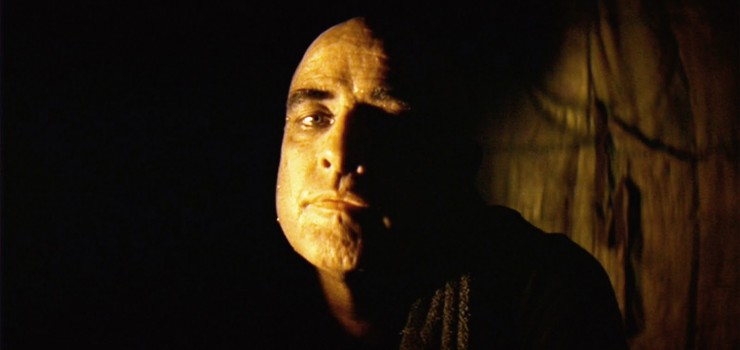
The arrival at Kurtz’s compound is the fufillment of this increasingly unnerving story. We’ve seen the madness on the journey, the pointlessness, and the bemused, carefree confusion of the crew. But at the camp we get the overblown, decadent lunacy of Kurtz. Brando dominates the final 30 minutes of the film, although his monologues are meaningless drivel, the sort of intellectual point-scoring you could hear in a sixth form debating society. To be honest, iconic as Brando’s appearance is, his performance of mumbling battiness is actually a little awful (like one big practical joke from the actor) and the film’s momentum grinds to a halt while he babbles on. 

In fact, so self-indulgent is Brando that in a way it’s a sort of tribute to Coppola’s mastery of cinema that he makes this pompous character make any sense at all – or that he makes this sort of nonsense even remotely watchable. But again it’s the hypnotic pull of the film: Coppola builds towards a chilling, haunting final sequence of Willard and Kurtz’s final confrontation intercut with The Doors’ The End and the real-life slaughtering of an ox by a crowd of real-life villagers (they were going to kill the animal anyway but offered to do it for the camera). Coppola somehow turns all this into iconic cinema, even though, viewed objectively, it’s overblown, indulgent, pretentious rubbish.

The whole film is a testament to hewing compelling filmmaking out of breathtaking insanity. After the film departs in the boat, most of reason, sense and conventional story-telling depart with it. Information only gets conveyed through rambling monologues from Willard. The crew of the boat get into scraps that reflect heightened versions of the American experience in Vietnam – from a war crime as the crew shoot-up what turns out to be an innocent boat, to an attack from unseen tribesmen with spears from the mists of the shore. Sam Bottoms, as surfer-turned-GI Lance, is our guide of a sort here – as he gets more stoned, so narrative logic departs with his senses. 

What keeps the film going throughout is the masterful film-making. Coppola shoots the bizarreness with brilliant, visionary imagination. As a social theorist he’s pretty basic – man is, by the way, a savage animal and the Americans didn’t know what they were getting themselves into in ‘Nam – but as a film-maker he’s one of the best. Who else could have made three hours of episodic boat journeys so strangely compelling? The film is crammed full of great scenes and moments which rarely feel like they tie together – in fact, they could almost be watched in any order – and there is barely a character in there, but the film feels like its throwing you into the madness of Vietnam. 

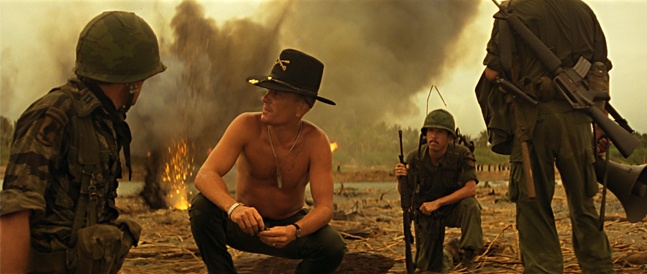
Even the sequence with a bit more narrative is still laced with absurdity. Kilgore’s helicopter assault on a village – and its use of Wagner blaring from helicopters to scare the Vietcong – is justly famous. This is a bravura film-making – and as much a tribute to the astoundingly amazing editing and sound work of Walter Murch as it is the photography of Coppola. Like most of the rest of the film it is visually outstanding, but it also has the film’s best writing (in the quotable but also strangely subtle characterisation of Kilgore) and also the film’s most iconic performance in Robert Duvall. Duvall is terrific as the war-loving, but strangely childish Kilgore, obsessed with surfing and with an ability to live totally in the moment. 

This sequence doesn’t hesitate in showing both the brutality of war – and also the insanity of our commanders. Kilgore is genuinely dreading the end of the war, and you can see why he would since he is clearly having a whale of a time bombing places. Kilgore is a lovable, quotable badass doing what needs to be done – but the film doesn’t forgot that he is also an insane soldier with no off-switch. And Apocalypse Now never really glamourises war, for all the excitement and beauty of watching those helicopters come over the horizon.

It’s the artistry in its film-making, and the genuine effort and work that helps make it a demented classic. Walter Murch’s sound design and editing is possibly flawless – this might be the best edited and sound designed movie ever – from the opening moment when the helicopter blade sounds transform into a hotel room fan you know you are seeing something special. Scenes such as Willard’s hotel-room breakdown hum with intensity as they feel genuinely real – that scene in particular feels like Martin Sheen exposing part of his tortured psyche at the time. Sheen is by the way perfect as Willard, a slightly unknowable killer with dead eyes and a dead soul, still aware of the vileness of his world.

Apocalypse Now is a sprawling batty film – and in many ways an intellectually empty one straining at a depth that ain’t there. But somehow, for all that, it still is a masterpiece. Which is in itself a bit of a miracle as it really should be a disaster. It’s pretentious. It’s overlong. It’s very full of its own importance as a work of art (the re-insertion of the long-winded political discussion at the French Plantation into the Redux version doesn’t help). Some of its performances are plain ridiculous, verging in Brando’s case on outright bad. But yet, it’s delivered with such force of conviction, it’s so wonderfully assembled, so hauntingly shot and edited, that it hammers itself into your brain. You literally can’t forget it, for all its many, many flaws. Despite yourself, you find yourself forgiving it an awful lot – a lot more than you might expect. A mess, but also a classic.

Othello (1995)

Laurence Fishburne falls foul of Kenneth Branagh’s schemes in this traditional but decent Othello adaptation

Director: Oliver Parker

Cast: Laurence Fishburne (Othello), Irène Jacob (Desdemona), Kenneth Branagh (Iago), Nathaniel Parker (Cassio), Michael Maloney (Roderigo), Anna Patrick (Emilia), Nicholas Farrell (Montano), Indra Ové (Bianca), Michael Sheen (Lodovico), Gabriele Ferzetti (Duke of Venice), Pierre Vaneck (Brabantio)

Othello is perhaps one of the most famous tales of betrayal and jealousy ever written. And yet Shakespeare’s tale of the noble general who descends into murder when convinced by his trusted ensign Iago that his wife is unfaithful, hasn’t often been made into a film. This is probably because its lead role requires a black actor and – for depressing historical reasons – most films aren’t considered good investments without a famous white actor in the lead (of course this has also been the case on stage). So we’ve had blacked-up performances from Orson Welles, Laurence Olivier and Anthony Hopkins – but this was the first proper adaptation of the play with a black actor in the lead role.

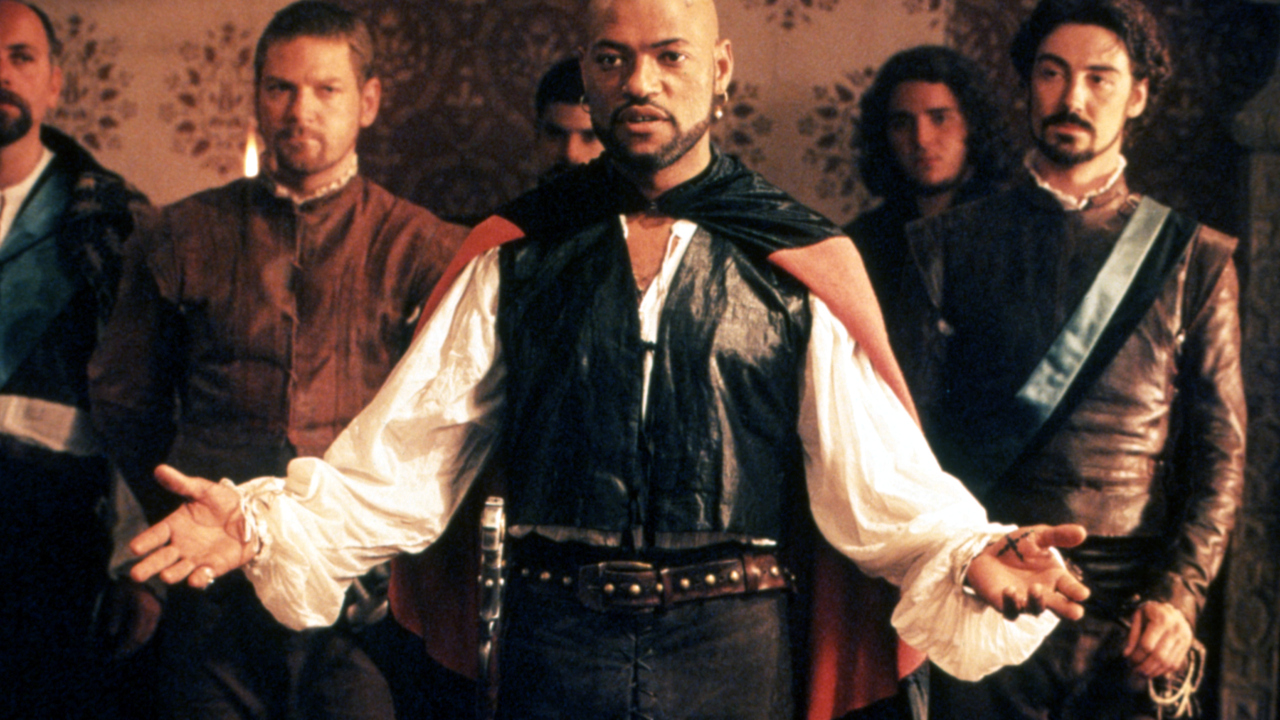
As the two leads, Laurence Fishburne and Irène Jacob are a mixed bag. Fishbourne has all the dignity and statue of the great general, and he brings a muscular physicality to the role which really works. He has a wonderful timbre to his voice and he handles the disintegration very well. He does sometimes feel a little hidebound by the language – treating the dialogue with a little too much reverence – but he’s the most believable Moorish general (for many reasons…) you’ve seen on screen so far. Jacob has greater difficulties – although many of these I think are due to this being her first film in English (talk about jumping in at the deep end) – and attempts to make Desdemona a free-spirit don’t really work that well.

Oliver Parker claimed he wanted to cast actors who weren’t associated with Shakespeare. Bizarre then that his cast is rounded out by Kenneth Branagh, the actor perhaps more associated with Shakespeare than anyone else alive. But then I guess when you can get Branagh in your movie, you aren’t going to say no. And it’s great he did, because this might just be one of Branagh’s finest Shakespearean performances: as if not also directing the thing (although many people mistakenly think he did!) freed him up to just focus on his performance. (It’s unfortunate for the other two leads that Branagh’s skill with both Shakespearean dialogue and performing it for the movies also serves to point up Fishburne’s more traditional take and Jacob’s discomfort.)

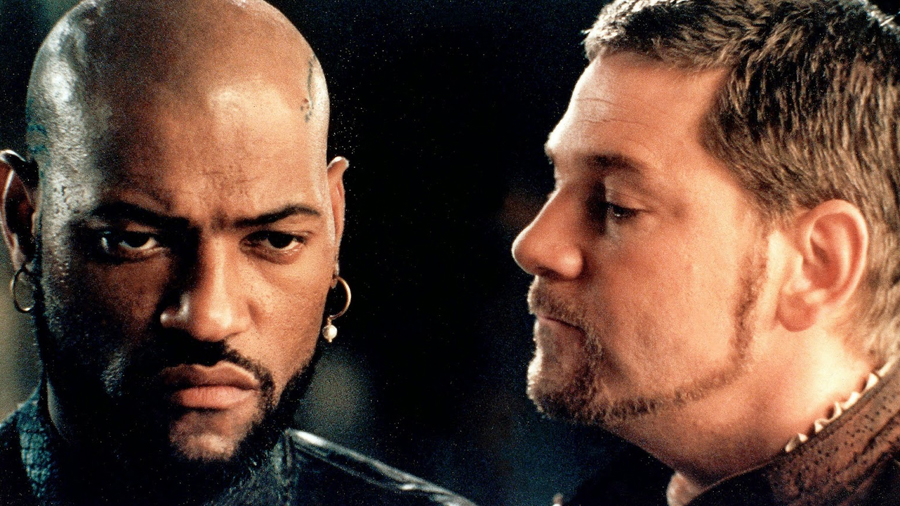
His Iago is superb, and he plays the part just right, never tipping the wink during his scenes with various characters, but playing Iago totally straight and completely genuine. He appears to be a decent, kind, lovely guy to everyone: it’s only in those asides to the camera that we see his real self, although even here he treats us with just as much charm. His Iago is the sort of guy you’d go for a drink with – and then be shocked to hear he had smilingly bad mouthed you to all your friends. Branagh also adds a homosexual undertone to the film, his Iago having incredibly mixed, repressed feelings about Othello: he seems genuinely moved when Othello makes him his lieutenant and a half twitch of regret crosses his face when the general dies.

Not that it stops him from being a bastard the rest of the time – and Parker does a very neat line in bringing the pivotal seduction of Othello to life on camera. On stage, Iago’s entrapment of Othello is a single, poison-dripping conversation – here, taking advantage of what you can do with film and editing, Parker spreads it over three locations: first a training-ground skirmish outside (where Othello bests Iago), then a sort of armoury changing room (where the outside is still visible), then finally a dungeon. As each lie gets more seductive, so Othello is literally dragged deeper and deeper into the castle. Then we get a neat flip: when he’s fully sold on Desdemona’s treachery, and begins raging and storming, we end up on huge open beaches or castle battlements, as if Othello has been reborn into a larger, refocused world.

This device smoothe out one of the problems with the original play – rather than Iago turning Othello against his supposedly beloved wife during one chat, the cuts from location to location (and different times of day) give the impression of a prolonged disintegration. Othello begins to get the first lines of each section, giving the impression that he has been dwelling on these lies in the interim, and that he is now the one bringing the subject back up, unable to stop prodding at it. It’s makes for a more convincing (and modern) psychological portrait of the corrosive triumph of jealousy than can be achieved in a traditional stage version.

The film has moments of invention – at one point Iago pours poison into Roderigo’s ear while they lie under a wagon where a couple are noisily rutting – and it does some really interesting stuff as mentioned with the “seduction” of Othello. Parker also throws in some expected cinematic tricks – so we get moments of Othello fantasising over Cassio and Desdemona together. But Parker’s not the most unique or challenging director, and he mostly shoots the film with a traditional straight forwardness, using a very traditional setting and editing style.

The film has other problems, too. Othello and Desdemona don’t have much chemistry between them, and Fishburne’s emotionally distant performance makes Othello harder to root for. Maybe this is just Branagh unbalancing the film – his Iago is so compelling, it throws off the film. Parker tries to make Desdemona a stronger character, but this doesn’t always work. Jacob’s slightly awkward tension with Shakespeare is part of this, but we also get the confusion of a Desdemona who fights for her life at the film’s conclusion and then strokes her husband’s head with affection as she dies.

Other performances don’t quite work. Michael Maloney is too overblown as Roderigo – though this Shakespearean wimp does at least get to genuinely threaten Iago and is slightly more convincing for the series of fights Iago puts him up to. Between them, the script editor and Anna Patrick turn Emilia, one of the play’s most intriguing characters, into a blank – she barely has a line in the first hour, and those she does have are delivered pretty blandly. Nathaniel Parker, though, is pretty good as Cassio (incidentally, Parker is of course the director’s brother, and Anna Patrick is the director’s sister-in-law – it’s a home movie!).

The main problem? As the play heats up to the final confrontations, the film slows right down. It’s hard to believe – as we enter Act 5 of the play – that there could still be half an hour of the film left, so snappy have the first four acts been. But the film dawdles and drags over the finishing line – and all the chase scenes of a desperately fleeing Iago can’t save it. For a film which has trimmed the play quite successfully into something sleek and fast-paced, it’s a shame that it drops all this for a wordy and over-played final half hour.

Of course Parker throws in decent moments: I like Cassio slipping Othello the knife he’ll use to kill himself. I really like Iago crawling his way on the bed loaded with dead characters, as if to try and force himself back into their story. The symbolism has been overplayed – and the image of two bodies buried at sea, water trails entwining, has been signposted far too often earlier – but these small moments work, even while the rest of the film’s conclusion drags. And maybe that’s because you don’t really care that much about Othello – he’s never seemed like a character easy to empathise with. And without that, the film can never completely work.