Tag: Lee J. Cobb

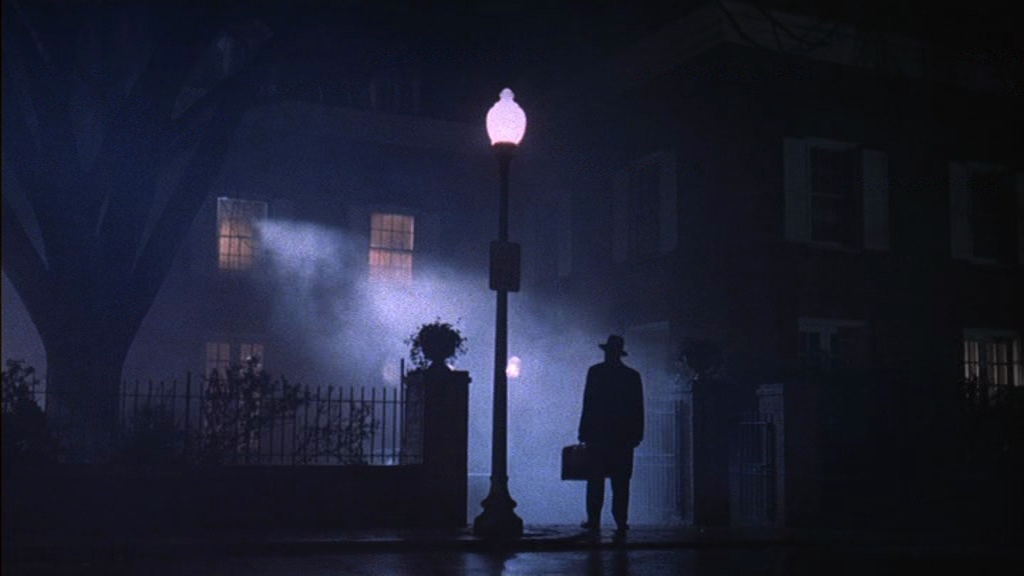
The Exorcist (1973)

The Exorcist (1973)

Unimaginable horrors seep into your mind in Friedkin’s hugely influential terrifying shocker

Director: William Friedkin

Cast: Ellen Burstyn (Chris MacNeil), Jason Miller (Father Damien Karras), Max von Sydow (Father Merrin), Linda Blair (Regan MacNeil), Lee J Cobb (Lt William F Kinderman), Kitty Wenn (Sharon Spencer), Jack MacGowran (Burke Dennings), Father William O’Malley (Father Joseph Dyer)

Growing up in the 90s in the UK it was easier to get your hands on a porno than a video copy of The Exorcist. For 12 years the film was banned because its influence was considered so insidious that it would inevitably lead to the corruption of the children who would (of course) dig out a copy to watch. Why was The Exorcist considered so powerful? After all no-one banned The Omen. Perhaps because there is something existential – unknowable, unexplained and unstoppable – at the heart of The Exorcist, while The Omen is a pulpy slasher about imaginatively bumping off Brit character actors. The Exorcist has a poetic nihilism, that reaches into your soul and takes a long-hard squeeze.

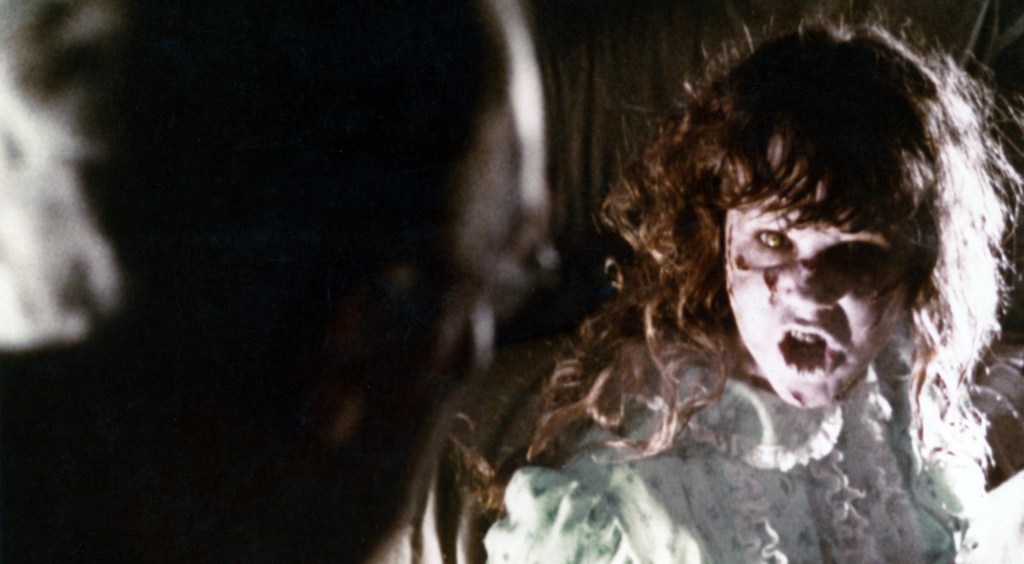
Hollywood actress Chris MacNeil (Ellen Burstyn) has problems. Her daughter Regan (Linda Blair) is growing increasingly unbalanced, suffering mood swings and saying the unsayable in grotesquely crude, sexual language. Doctors can’t find anything wrong with her. Above all they can’t explain her increased strength, contortions, the shaking of her bed and the freezing conditions in her bedroom. Could it be that Regan is possessed by a force darker than any we understand? After an unexplained death, Chris has no choice but to consult psychiatrist turned priest Father Damian Karras (Jason Miller) who reluctantly agrees that Satanic forces have taken control of Regan – and that an exorcism by himself and experienced Father Merrin (Max von Sydow) may be the only option.

Adapted from a chilling novel by William Peter Blatty (who also wrote the screenplay and produced), The Exorcist is an all-consuming experience film, directed with immersive power by William Friedkin. Everything in it is designed to unsettle, disturb and dig deep into the fears of the viewer. What could revile us more than a child, her body twisted into the features of a revolting, malign spirit, spouting revolting, bile-filled rants and revelling in a twisted, macabre sexuality? All this wrapped inside a film that makes your skin crawl with its coldness, precision and drained out colours, where sound is unpredictable, discordant and unnatural and which offers very few answers.

The Exorcist does this in spades. It’s methodical and quietly repetitive in aspects of its editing and framing, constantly using visual and audio association to build dread. Friedkin’s prowling camera glides constantly through the MacNeil’s luscious townhouse, gliding up the stairs to Regan’s bedroom to reveal new horrors. Friedkin builds the dread, his camera first studying the shock and horror on the faces of the characters, before cutting to reveal the terrors they are looking at.

We move from subtle moments – Regan’s Ouija board, through which she communicates with imaginary friend ‘Captain Howdy’, whose glider jumps unprompted from Chris’ hands. The moments of chilling flatness in Regan, such as when she tells a visiting astronaut he “will die up there”. The violent, uncontrollable, impossible shaking of her bed. Regan’s astonishing strength that can hurl people across rooms. All this builds us towards the real grotesqueness: her deformity, her sex-obsessed rantings, impossible body contortions and her revolting sexual defilement of a crucifix. It increases in immediacy, graphicness and in its breaking of social convention, until you get the feeling you watching something that can only be classed as a revolting, all-pervading, all-corrupting evil.

Evil is at the heart of The Exorcist. Friedkin superbly suggests a mystical, eternal clash between that and good at its heart. It’s opening sequence, with the discovery of the relics of the demon Pazazu in an Iraq is awash in suggestive menace: the percussive drum beat of the excavator’s tools, gusts of unexplained wind, the barking of battling dogs. A mist-filled skyline sees Merrin (and the granite faced von Sydow feels like a mythical figure) confronting a terrible statue of Pazazu. The moods –particular the audio features of this landscape – are echoed throughout the film, tying disparate locations together and subtly suggesting an age-long war that can never end.

That lies at the heart of The Exorcist’s ghastly appeal. Everything feels undefeatable, with regular streets and homes transfigured into places of inhuman dread. Little moments – a dog, a tramp, a train – take on echoes of sounds and sights associated with the demon. The brilliant repetitive use of Mike Oldfield’s Tubular Bells provides a mesmeric rhythm that always echoes the discordant tones of other sounds and sights. Friedkin plays this up with visual touches – subliminal imagery is used to flash horrors past us and the film plays with visions of suggestive unease. The demon similarly plays on underlying fears – of guilt, inadequacy and repressed desire – that it flings horrifically to the fore, through parroting the voices of others to changing its shape and appearance.

No wonder medicine is flummoxed. The Exorcist, considering its reputation, surprises for being such a slow-burn. It takes nearly two thirds of the runtime before the idea of the exorcism arises, during which we watch never-ending medical tests on Regan. Friedkin shoots these with a cold, impersonal professionalism (an angiography, with blood spurting from Regan’s neck, is almost unwatchable in its realism) which makes it feel even more powerless against the demon’s existential evil.

The Exorcist gently glides over narrative and logic gaps (not least the sudden onset of Regan’s worsening condition) because it retains a mystic power and the nightmare inducing dread of knowing exactly what is happening, but being unable to step into the film and tell the characters. It all leads perfectly into the exorcism scenes, when the film’s horror culminates in scenes of extraordinarily intensity, difficult to watch, with just the right amount of gore and suggestion.

Is The Exorcist about anything? That might be its greatest flaw. So enamoured is it with infecting us with dread, that it neglects to offer much that can give lasting spiritual or intellectual nourishment. Like a brilliantly constructed haunted house, it thrills but leaves you with little else to consider (other the costly struggle against evil). At heart, it’s a superbly well-made B-movie, a terrific horror-thrill ride where every single moment is masterfully designed to illicit an effect from the audience.

It’s helped by the superbly horrific make-up (not to mention von Sydow’s hugely convincing ageing) and effects whose practical realism increases their dread. Friedkin – at the height of his dictatorial auteurism – directed with little regard for cast and crew, focused on producing the desired effect. Guns were fired to illicit shocks. He slapped Father William O’Malley seconds before shooting a scene to make him look distressed. Burstyn and Blair both suffered lasting back injuries from being jerked around and the exorcism was shot in such refrigerator conditions, the actors couldn’t spend longer than fifteen minutes in the room.

But Friedkin’s determination to produce his vision through every means necessary worked. The Exorcist has a power few other films can dream of. The actors do their part: Burstyn’s increasingly raw pain and distress grounds it extremely well, Blair’s innocence makes her later horrors (voiced by a gravelly Mercedes McCambridge) even more disgusting, Miller is very good as the film’s eventual hero whose soul becomes a battle-ground, von Sydow invests Merrin with a rich hinterland.

They are framed with a film that is immediate, discordant and subtly grotesque. It leaves little to the imagination, but nevertheless encourages the mind to add its own horrors. It feels like the film itself can be a quiet demon, working its way inside to change you. It’s a horrific ride, and if it feels like it ends on a beat of grimness and desolation (despite Blatty’s intentions) that feels fitting for a film that may have little to truly say but affects viewers in a way few other films do. That’s why it was seen as having such power, because it invests deep, subliminal meaning and import to what could have been just (as its sequels are) an exploitation flick. That’s why it was banned.

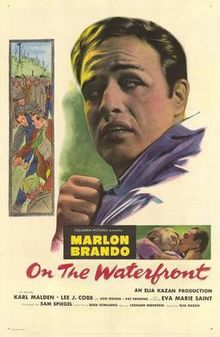
On the Waterfront (1954)

Marlon Brando reinvents film acting in On the Waterfront

Director: Elia Kazan

Cast: Marlon Brando (Terry Malloy), Karl Malden (Father Barry), Lee J. Cobb (Johnny Friendly), Rod Steiger (Charley “The Gent” Malloy), Eva Marie Saint (Edie Doyle), Pat Henning (Timothy Dugan), John F Hamilton (“Pop” Doyle), Ben Wagner (Joey Doyle), James Westerfield (Big Mac)

When’s the right time to speak out for what you know is right? It’s a question we’ve all faced at some point, and it’s the question that changes the life of Terry Malloy (Marlon Brando) after he is indirectly, and unwittingly, involved in the murder of a fellow dock worker. The killing was ordered by the corrupt, mob-connected union boss Johnny Friendly (Lee J. Cobb), who rules the workers of the shipyards of Hoboken, New Jersey with an iron fist. The victim was going to talk to the cops, and suddenly Terry finds himself in the middle of a major ethical bind: should he give evidence or play “D and D” (deaf and dumb) like the rest of the workers.

His bind grows ever tighter as the local priest Father Barry (Karl Malden) takes up breaking the power of the union as his own personal mission. Not to mention Terry’s growing closeness to the victim’s sister Edie (Eva Marie Saint), with whom he finds himself slowly falling in love. On the other side is his brother Charley (Rod Steiger), a lawyer and right-hand man of Johnny Friendly, who has been running his brother’s life forever, ruining Terry’s boxing career by ordering him to take a dive so Friendly could make a killing on the betting circuit. What will Terry do?

Elia Kazan’s multiple Oscar winner is a powerful, beautifully made, engrossing and uplifting modern morality drama that still packs a wallop today. Shot largely on location in New Jersey, with lashings of Kazan’s brilliant realism and ability to bring poetic beauty and emotional force to the most everyday of settings, On the Waterfront is sublime, a film to make you rail against the injustice of corruption and the unthinking cruelty of everyday folk when given a chance to stigmatise someone.

Kazan and screenwriter Budd Schulberg (whose script is a beautifully judged mixture of soulful dialogue and the rhythms of every day conversation) were both drawn towards the story after their engagement with McCarthyism in Hollywood. In this hunt for reds under the Hollywood bed, both Kazan and Schulberg named names. Both of them felt that they had been lied to and exploited by the communist movement in Hollywood – and also that Stalinist Russia was not a cause worth defending – but that didn’t stop many people rejecting them for breaking the rule of silence (the same rule that runs through this film). On the Waterfront is a heartfelt defence of the whistleblower (or the informer), and why that can sometimes be the only option open.

Based on a true story, Kazan’s film is a masterclass in carefully controlled, intelligent direction bringing out brilliant acting performances (always one of Kazan’s major strengths as director). Leading the way here is Marlon Brando, giving possibly the most famous, most influential acting performance in film history in the lead role. It’s not really an understatement to say it changed the face of movie acting. Brando here performs with a low-key, casual, almost tender naturalism that stands completely at odds with the more exhibitionist performers of the late 40s. And he funnels all this beautifully into Terry Malloy, a tough guy whom he inhabits with a vulnerability and gentleness that never once feels out of place with his temper and pride. There is instead an awe-inspiring transformation here, of the actor becoming the mumbling, uncertain character – not afraid for words to be lost, not worried about making eccentric or unexpected choices as a performer.

Two scenes stand out. In the first, Brando has his first long conversation with Edie Doyle, having rescued her from being set on by union men. In a single take – a carefully orchestrated willingness to let the actors explore the emotional truth of the scene from Kazan – Brando’s Terry shyly, gently, haltingly asks about her life and tries to explain his own. At one point, Edie drops her glove and Brando picks up the glove, fiddles with it and then puts it on – the sort of inspired naturalism that feels like nothing on paper, but on film carries a strange emotional force, a physical representation of the bond between them (and don’t underestimate the way Saint pulls the glove gently from his hand). The entire scene has the air of reality to it, Brando chewing gum, Saint wondering how much of herself to show to a man she isn’t sure she can trust. It’s masterful.

The other scene is of course possibly one of the most famous scenes in movies ever: I coulda been a contender. For films, this is like the To Be or Not To Be speech, a speech that has been quoted and riffed on ever since. But again, Brando resists the temptation throughout for histrionics – when Charley pulls a gun, Brando reacts not with shock or anger but sadness, almost tenderly pushing the gun aside and letting his voice fill with a world of regret for what has become of their relationship. Steiger is superb in this scene, but you can’t look at anyone except Brando here, awkward, sad, struggling to work out what to do with his life and finally confronting the broken past between the brothers with pointed regret and calm realisation rather than the anger and rage that other actors would have chosen. This is an actor who redefined his profession, at the top of his game.

The film is crammed with excellent performances. Eva Marie Saint (Oscar winning) has just the right measure of gutsy determination, fear and tender sweetness as the woman who opens Terry’s eyes to right and wrong. The film gained three Supporting Actor nominations (they all lost). Steiger is cocksure but self-loathing as Terry’s ambitious brother. Lee J. Cobb rages as only he can as the blowhard bully Friendly, demanding absolute loyalty. But on this rewatch, I loved Karl Malden’s moral certainty, courage and stubbornness as Father Barry. In any other film Barry’s speech railing against the dockers for being part of the system that oppresses them, all the time being pelted by food, would be the highlight of the film: here it’s just one of several stand-out moments.

Kazan was a superb visual stylist, this black-and-white masterpiece brilliantly shot by Boris Kaufman to create a world that feels the perfect mixture between the documentary realism and the theatrical. And working with a superb script that he felt such investment in helps to create a story that carries real emotional force, carefully investing you right from the start in Terry’s fundamental goodness and naivety, inviting you to feel rage on his behalf as he is sent to Coventry by his workmates. Topped off with a beautiful score by Leonard Bernstein – part jazzy, part wonderful orchestral stylings – this has barely aged a day in it’s over 60 years.

The Song of Bernadette (1943)

Jennifer Jones sees visions of the Virgin Mary in the moving The Song of Bernadette

Director: Henry King

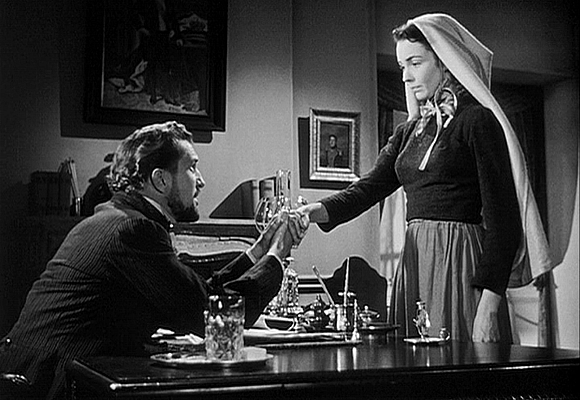
Cast: Jennifer Jones (Bernadette Soubirous), Charles Bickford (Abbé Dominique Peyramale), Williem Eythe (Antoinie Nicoleau), Gladys Cooper (Marie Theresa Vauzou), Vincent Price (Vital Dutour), Lee J. Cobb (Dr Dozous), Anne Revere (Louise Casteror Soubirious), Roman Bohnen (François Soubirous), Mary Anderson (Jeanne Abadie), Aubrey Maher (Mayor Lacade), Linda Darnell (Virgin Mary)

“For those who believe in God, no explanation is necessary. For those who do not believe, no explanation is possible.”

With these words, this worthy religious epic from the Golden Age of Hollywood kicks off its retelling of how visions of the Virgin Mary from one poorly educated peasant girl, Bernadette Soubirous, turned Lourdes from a backwater near the French-Spanish border into one of the most important Catholic pilgrimage sites in the world. It’s material that you could fairly expect to be pretty dry and sanctimonious stuff. But, surprisingly, it’s rather affecting and engaging work – and, although made with a certain workmanlike competence, carries enough touches of grace to lift it up into the second tier of the Hollywood firmament.

Bernadette Soubirous is played by Jennifer Jones – in one of her first screen roles, for which she became at 25 one of the youngest Best Actress Oscar winners ever. Until her visions begin, she is just an average peasant child, struggling with asthma, her parents (Anne Revere and Roman Bohnen) struggling with poverty, failing at religious school under the strict tutelage of Sister Marie Theresa (Gladys Cooper), and generally looking ahead to a life very much like any other. But visions of the Virgin Mary (played by an unbilled Linda Darnell) bring belief and devotion into her life, and she reports the content of the visions (and her discussions with the Virgin Mary) with an honest simplicity and consistency that wins many backers, not least local priest Abbé Peyramale (Charles Bickford). But the local officials of Lourdes, led by local prosecutor Vital Dutour (Vincent Price), concerned that these visions will impact plans for the town’s development and anxious about the hysteria they could encourage in the simple-minded, try their best to restore what they see as reason over the intoxication of faith.

Faith really is the word of the day in Henry King’s at-times stately, but also shrewdly worldly drama that mixes divine intervention and belief with a fair-hearing for the doubters and the arguments of reason. The miracles, when they come, are followed with several characters – not least Lee J Cobb’s coolly rational doctor – outlining the alternative explanations for why these people may suddenly feel they have been cured. Later Dutour complains wryly that it only takes a handful of cures among the thousands that come for everyone to continue to want – or need – to believe. 

But the film sides squarely with the truth of Bernadette’s visions, not least by stressing at every turn her honesty, guilelessness and principle. Questioned by various church officials – many of them terrified of being duped by a con, having been stung in the past – she sticks with an honest openness to the same version of the story over and over again. Peyramale – initially just as sceptical – is won over to belief by Bernadette’s sudden knowledge of such matters as the immaculate conception, when she seemed barely aware of what the Holy Trinity was while studying at school. 

King – a largely middle-of-the-road director, but who marshals his resources well here – clearly takes inspiration from Carl Dreyer’s films on similar topics of faith and visions in his shooting of Bernadette. Bright light and intense close-ups that study every inch of her rapture help convey the spirituality of her visions. When Bernadette leads groups to her visions – none of whom can see what she sees – light radiates around her and over her, but seems to barely touch those she is with. The cinematography by Arthur C Miller is beautiful, a brilliant use of light and darkness to skilfully sketch both the poverty of Bernadette’s background and the radiance of her visions.

The mood of the film is also helped be Jennifer Jones’ impressive performance. Bernadette is, in many ways, potentially one of the least interesting and dynamic characters in the film, but Jones pulls off the immensely difficult task of making someone stuffed with decency, innocence and honesty into an actually compelling and endearing character. A protégé of David O Selznick (whom she later married), Jones earned her place in the film with her ability to invest Bernadette with humanity, avoiding any hint of cynicism in her performance while never becoming grating either.

It contributes to a beautiful telling of the story, backed by a series of excellent supporting performances. Charles Bickford landed an Oscar nomination as the kindly, decent priest whose initial scepticism and concern that the crowd is being manipulated is washed away by growing belief. Lee J Cobb is very good as a stoutly rationalist doctor. Anne Revere (also nominated) has a protective warmth as Bernadette’s mother.

The film’s finest supporting roles though come from Vincent Price and Gladys Cooper. Price is superb as the man of science and reason who worries over the implications of fanaticism and the damage hysteria can cause, but is never simply prejudiced or Dawkinsish in his religious doubts. King’s film treats his concerns with a genuineness that makes both the character more interesting and the film more balanced. Cooper is brilliant as a Salieri-like nun, enraged with envy and jealousy that after years of devotion and suffering it is not she but Bernadette who gets the visions.

And why did Bernadette get those visions? The film is not crude enough to suggest why – Bernadette herself apologises for the trouble she has caused and her unworthiness – but it’s clear that it’s her very innocence and sincerity that makes her worthy of them. The design – and impressive score by Alfred Newman – helps to make the film feel as profound as it does, but it’s the balance that the film handles its characters with that makes it engrossing. There are no simple heroes or villains, just as there are no simple solutions. Like the film says at the start, it’s a question of faith. Those who do not wish to believe can marshal as many arguments in their favour as those who want nothing more than to trust in faith. It makes for a fine, balanced, engaging and well-made classic.

12 Angry Men (1957)


Henry Fonda must win over 12 good men and true in 12 Angry Men

Director: Sidney Lumet

Cast: Henry Fonda (Juror #8), Lee J Cobb (Juror #3), Ed Begley (Juror #10), E.G. Marshall (Juror #4), Jack Warden (Juror #7), Martin Balsam (Juror #1), Jack Klugman (Juror #5), Joseph Sweeney (Juror #9), John Fiedler (Juror #2), Edward Binns (Juror #6), George Voskovec (Juror #11), Robert Webber (Juror #12)

A young man is on trial for murder. The jury retires to consider. On the first vote, only one man (Henry Fonda) questions his guilt. The other jurors are convinced they are right – can Fonda turn them around?

Who hasn’t done jury service and dreamed of being Henry Fonda? 12 Angry Men is perhaps the most compelling courtroom drama ever, for that very reason: hardly any of us are judges or lawyers, but we’ve all got a decent chance of doing jury service. What would we do in this situation? How thoughtful would we be about the evidence? And, of course, that little stab of ego – could we be charismatic and persuasive enough to sway a room of people? I think this is why this film sticks with people and has become such a persuasive part of our popular culture – we all wanna be Fonda.

12 Angry Men is a film that I feel touches perfection. I thought quite heavily about whether I could identify any flaws in it at all: the closest I got at was the shot Lumet throws in of the suspect (a sweet looking kid). I suspect this shot was required so that the 50s audience could be confident that Fonda was crusading for someone who at least looked innocent (although it always makes me think, since so many of the other jurors make snap decisions, why doesn’t at least one of them look at that cute kid and think “he ain’t no killer…”). Aside from that, I don’t think there is a single mis-step in the filming, acting or writing of the film – and how many times can you say that?

Lumet is a director who doesn’t get a lot of public recognition. He subordinates his skills to the requirements of the story, rather than an auteur who imposes his style. This works perfectly for this compelling slow-burn. Lumet’s expert filming quietly lets the actors and dialogue stand front-and-centre, while cleverly using his camera language and shot choices to amp up the tension.

At first, Lumet uses wider and high angle shots, allowing us to get a sense of the room and the characters. But the real effect of this plays out over the rest of the film, as Lumet slowly moves to tighter angles at POV height, until the final sequences are played out over a series of close-ups cutting from juror to juror, at low angles. What this achieves brilliantly is to make the film feel tighter and more claustrophobic – the room feels like it’s actually shrinking in on the jurors as they argue. You can get a sense of it in the videos below, both early and later in the film.

The film also works so brilliantly because it offers a brilliant insight (and critique even?) of the legal system. The one legal professional we see is a bored judge. All references to the unseen lawyers mention either their showmanship or inadequacy. Even the jury system is subtly called into question: several of the jurors are motived more by prejudice and personal experience than by any analysis of the evidence. Others are flawed in other ways; #12 switches sides indecisively three times while #7 is so impatient and bored with the whole process, he follows the direction of the least resistance. Without #8, a decision would have been made with no discussion at all. Even the very process of taking the vote is shown to root many of the jurors down to “sides” and creates an atmosphere of competition that becomes as important as seeing justice done. And in a system of trial by your peers, only #4 in any way identifies himself as sharing the background of the man on trial. Is this a perfect system?

These ideas, though, are skilfully interwoven in the background of a gripping legal thriller. 12 Angry Men is completely objective. We never see the witnesses whose performance is the cause of such analysis. We never see the scene of the crime. We don’t have any confirmation at all that either side is right. It’s a film about the importance of reasonable doubt – and the need to be absolutely certain before sending someone to the chair. Fonda feels that doubt – and persuades the other jurors of it – but we never know if he was right or not. We never know if any of the suppositions in the jury room are true – the important thing is how high the possibility is that they might be true – and how much that affects our willingness to convict.

The film is one brilliant set-piece after another, as each piece of evidence is interrogated. I honestly can’t decide which one I like the most. What makes it work is the variation of how each case is presented. The film is as comfortable with the drama of #8 flinging a replica of the “unique” murder weapon onto the table, as it is with a careful dialogue-led dissection of the eyesight of a key witness. Who can resist Fonda limping around an approximation of the next-door neighbour’s flat to see if he can cover a certain distance within a certain time. It helps that the dialogue is incredibly rich – it has to convey a lot of information, but also manages to sketch out each of the characters so swiftly and carefully that each of them feels real.

And we’ve come all this way and not even mentioned the performances. Again, each viewing gives me a chance to appreciate a new performance: my eye was caught on this viewing by Robert Webber’s seemingly cool and collected advertising man, who has far less certainty than he projects. Needless to say each actor is brilliant. Fonda (who also produced) is the very image of moral authority – as well as a generous collaborator on the movie. Is this his best performance? It’s got to up there – #8 is a humanitarian, but he’s never smug or self-serving, just a man who feels a strong sense of his own obligation.

If Fonda is the superego, Cobb’s #3 (the primary antagonist, if there is such a thing) is the ego – raging, elemental, decisive, unshaken in his beliefs. Cobb’s performance veers the closestto a little too stagy, but it’s a character that demands it. His bluster and swaggering are vital to the character in order to make his later emotional collapse work as well as it does – and #3’s final emotional disintegration really rings true. It’s a ferociously intense performance.

Each actor gets his chance to shine. Voskovec’s sensitive immigrant has a wonderful speech on the responsibility of passing judgement. The most barnstorming speech is Begley’s racist outburst late in the film. It’s beautifully done as this loud-mouthed bully explodes with frustration, then slowly and even rather sadly collapses as he talks on and on, each sentence making him weaker and weaker, more defensive and vulnerable. But it’s never a scene about just one man – the reactions are as well judged as everything else. And I can’t tell you how much I love #4’s “I have [listened to you]. Now sit down and don’t open your mouth again” one-line response which caps the scene.

In fact just mentioning #4 brings on my love of E.G. Marshall’s performance in this film. #4 should be one of the least engaging characters in the film – coldly analytical, professional, assured and clear minded. But he’s always human, never an antagonist, but a respected citizen – the only one of the jurors who is motivated by judgement rather than prejudice. I love his calmness, his cool lack of regard for #3 and #10’s loud-mouthed berating, his patient, studied explanation of his convictions. I adore his calm puncturing and counterview of each point Fonda puts forward, until he is finally won over – and its his winning over which makes the film work. If this thoughtful, intelligent man has doubts, shouldn’t we all?

But I repeat they are all great. Jack Warden’s #7 is totally convincing as (the film’s real villain?) a man indifferent to right and wrong when compared to his own needs. Balsam’s decent but ineffectual #1 is the perfect mediocrity in above his head. Sweeney’s wry, observant and shrewd #9 is a delight (Sweeney was the only member of the original TV play to be retained). Fiedler’s #2 grows in moral force throughout, belaying his quiet appearance. Klugman’s #5 is quietly defiant and conflicted. Binn’s #6 reveals himself as a mild, humble and honourable man.

I think I could watch 12 Angry Men every week of the year. It’s brilliantly filmed (how could I not mention the oppressive rain soundtrack that accompanies the latter part of the film) and wonderfully directed. The script is simply perfect, Reginald Rose expanding and enriching his original TV adaptation. The acting is nearly flawless from all concerned. It’s, quite simply, a great movie. I simply can’t imagine anyone not reflecting on this movie when heading into jury service. It subtly comments on the legal system, but never gets bogged down in this, telling a gripping and compelling story about things we never see. It’s pretty damn near close to perfection.