Tag: Lin-Manuel Miranda

Tick…Tick…Boom! (2021)

Tick…Tick…Boom! (2021)

Joy and tragedy intermix in this extremely affectionate tribute to a musical theatre talent and his whole genre

Director: Lin-Manuel Miranda

Cast: Andrew Garfield (Jonathan Larson), Alexandra Shipp (Susan Wilson), Robin de Jesús (Michael), Joshua Henry (Roger Bart), Vanessa Hudgens (Karessa Johnson), Bradley Whitford (Stephen Sondheim), Jonathan Marc Sherman (Ira Weitzman), MJ Rodriguez (Carolyn), Ben Levi Ross (Freddy), Judith Light (Rosa Stevens)
When an artist dies young, you also mourn the loss of all the art still to come. There is an added tragedy when – like van Gogh – the artist dies on the cusp of achieving the recognition and respect they have toiled for so long to achieve. Jonathan Larsen spent over a decade struggling to get his work performed on Broadway – only to die of an undiagnosed heart condition the night before the previews for Rent (the musical that would win him a stack of posthumous awards, including a Pulitzer and a Tony) opened. Miranda’s film is a heartfelt, joyful celebration of Larsen’s life based on Larsen’s own autobiographical one-man rock musical.

Tick, Tick…Boom is all about the counting clock Larsen (Andrew Garfield) fears as his life starts to catch up with his own mapped out timetable for success. It’s 1990 and he’s turning 30, with his rock musical Superbia still only a glint in a workshop’s eye. As he keeps reminding us, at 27 Sondheim had already staged West Side Story. Is Larsen’s chance of making a success of writing musicals ticking away? Should he build a business career, like his school friend Michael (Robin de Jesús) has in advertising? Should he accept the offer of his girlfriend Susan (Alexandra Shipp) to give up on New York and start teaching in Massachusetts? Or should he keep powering away at his dream?

Lin Manuel Miranda has talked openly about how Larsen’s revolutionary work on Rent changed his understanding of what musicals could be. To him – and many others – Larsen is a key figure in the history of the American musical, paving the way to some of the great landmarks of the 21st century. Miranda’s film is soaked in a deep love for both the work of Larsen and musical theatre itself. This is a film made by a man who defines himself by his love for everything musicals – and it’s a love that echoes in every single frame of his film.

Miranda was the perfect man to direct the film – after all, perhaps only Hamilton has had as much revolutionary impact since Rent (just like Larsen, Miranda spent years toiling to get it staged). Working with screenwriter Steven Levenson, Miranda expands the original one-man musical (later versioned into a three-actor piece after Larsen’s death) into a beautifully assembled testament to a crucial few months in the life of its subject, as he subconsciously starts the inspiration that will lead (eventually) to Rent. The film takes the original score for Tick, Tick…Boom and complements it with other Larsen songs and material from Superbia to develop a rich, emotionally moving tapestry that brings Larsen storming vividly to life.

And a lot of that life comes from Andrew Garfield’s revelatory performance. Bearing a striking resemblance to Larsen, Garfield’s performance has an energy, litheness and openness to it, to a degree we’ve not seen before. His singing and dancing are graceful, dynamic and impassioned. He’s emotionally open, tender, delicate – but also, as so many artists must be, sometimes selfish, demanding and self-obsessed. It’s a performance of great joy and humour, making it even more moving to remember that ticking clock is literally counting down Larsen’s life. But this is not a tragic performance: instead it is a vibrant celebration, performed by an actor at the top of his game.

Garfield delivers wonderfully in the many songs, most of them unfamiliar. Tick, Tick…Boom is a little known musical – but Larsen’s sudden death gives it a prescient tragedy he was totally unaware of when he wrote it: he meant it was a clock counting down the end of his youth, but we know it’s actually knocking down the seconds of his life. Miranda stages the songs with all the scintillating freshness of a Broadway musical, with imaginative choreography, energetically engaged performances and at times a powerful emotional intimacy that delivers real impact.

It all works so well because of that love for musical theatre that it is dipped in. The cast is stuffed with cameos from Broadway actors – the song Sunday uses a virtual Who’s Who of the cream of Broadway – and Miranda places Larsen’s music at the very heart of the movie. It’s a film directed with a great deal of skill, but not a showy or flashy distraction. Instead, creative decisions in scenes are subordinate to the songs – so some take place in a realistic setting, some in a staged recreation of Larsen’s original performance of Tick, Tick…Boom, others in a heightened reality somewhere between a dream and a fantasy. Miranda’s trick is to make these contrasted styles all feel part of the same whole – and the joy with which all are filmed (even the sadder moments) is essential to this.

And there are some powerful moments of emotion here. Bubbling throughout the story is the AIDS crisis, which has literally destroyed the lives of several of Larsen’s friends. It is to have a very personal impact on his best friend Michael (a heartfelt Robin de Jesús). Larsen’s dwelling on this plague, where many blamed the victims, sees him scribble notes for key lines that will build Rent (Miranda has these appear on screen in hand-written text). Part of the self-criticism of Tick, Tick…Boom is Larsen acknowledging that his selfish desire for success as a protégé blinded him to the suffering of some of those closest to him. While I would have liked more direct tying of Rent into the film’s conclusion, this deconstruction of Larsen’s laser focus is well done.

Above all, Tick, Tick…Boom works because it is made so clearly by people who love musical theatre, for people who love musical theatre. The performances are sublime, especially Garfield who has never been better or more engaging, with de Jesús and Alexandra Shipp also excellent and Vanessa Hudgens standing out among the rest. Miranda’s film is a strikingly well-made and heartfelt labour of love, that will reward rewatching and uncovers the overlooked work of a major talent who died way too young.

Mary Poppins Returns (2018)

Emily Blunt is practically perfect in every way in Mary Poppins Returns

Director: Rob Marshall

Cast: Emily Blunt (Mary Poppins), Lin-Manuel Miranda (Jack), Ben Whishaw (Michael Banks), Emily Mortimer (Jane Banks), Pixie Davies (Annabel Banks), Nathanael Saleh (John Banks), Joel Dawson (Georgie Banks), Julie Walters (Ellen), Colin Firth (William Weatherall Wilkins), Meryl Streep (Topsy), Dick van Dyke (Mr Dawes Jnr), David Warner (Admiral Boom), Jim Norton (Mr Binnacle), Jeremy Swift (Hamilton Gooding), Kobna Holdbrook-Smith (Templeton Frye), Noma Dumezweni (Miss Penny Farthing)

Some sequels go into production even before the first film hits the cinemas. Others give you a good long wait – and Mary Poppins has had you waiting 54 years. Of course, part of that was down to her creator, PL Travers. Travers so hated the Disney original (I mean, she really hated it) she outright banned all other adaptations of her work – but her estate were far more open to the prospect (and let’s be honest, probably also to the money) that Disney could finally go ahead with a sequel.

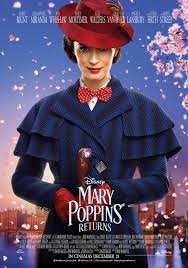
And thank goodness for that, since this delightful film is practically perfect in every way. It’s 25 years since the events of the first film, and Michael Banks (Ben Whishaw) is now a widower with three children, whose home is about to be repossessed by the bank for non-payment of loans. His sister Jane (Emily Mortimer) is trying to help, but the pressure and sadness are showing on Michael and are forcing his children Annabel, John and Georgie (Pixie Davies, Nathanael Saleh and Joel Dawson) to grow up fast. The Banks family is in trouble – so it’s the perfect time for the arrival of Mary Poppins (Emily Blunt) to save the day – with a little bit of help from gas-lighter Jack (Lin-Manuel Miranda).

Mary Poppins Returns is a triumphant mix of nostalgia and originality, that walks a very difficult tightrope between being a loving pastiche and tribute to the original film while also managing to bring its own original charm and magic touch. That’s a difficult trick to pull off – but it basically takes a slight remix of the original film’s story and adds a heft of emotional impact to create something that feels modern and fresh while also being very close tonally to the original.

This is never clearer than in Emily Blunt’s sublime performance as Mary Poppins. If there is anyone who had a more difficult job in this film than Blunt I can’t think of them. She had to take on the most iconic character of an iconic actress – and does so brilliantly, but creates a character who feels an equal mix of both Andrews and Blunt. This is clearly the same character as before, but Blunt mixes in a wonderful heart-warming care and concern under the pristine English exterior that melts the heart. She has a glowing twinkle to her, an almost bottomless charm with an endearing delight for the wonder and silliness that is part of Poppins world. And boy can she sing and dance? She carries the film with effortless grace – to such endearing effect that, just like with Julie Andrews, you miss her as she becomes less prominent in the final act.

And of course she is matched by a superb company of actors. Lin-Manuel Miranda makes the transition to the big-screen like a duck to water, hugely loveable, wonderfully charming and superb (as you would expect) at the musical sequences. The three children give exemplary performances, with never a hint of sickly sentimentalism. Emily Mortimer is radiantly giddy as Jane, while Ben Whishaw will bring a lump to the throat as a Michael who is struggling under a huge amount of grief.  That’s not the mention wonderful turns from the whole of the cast, especially from Holdbrook-Smith as a kindly lawyer.

All these actors are “marshalled” brilliantly by director Rob Marshall. With his experience of musicals – both on screen and stage – Marshall knows his stuff and brings all his experience to bear here to create a sequel that will be seen (I’m sure) as a worthy companion to the original. Marshall’s direction of the musical sequences is faultless. He knows exactly how and where to place the camera for maximum effect, and gets just the right tone and mood from these scenes. He’s also, let’s not forget, a brilliant choreographer and has put together some exquisite sequences, not least the lamplighter song Trip the Light Fantastic, a whirligig showstopper of a number that if you saw it in the West End would have the whole crowd on their feet.

The songs make for easy criticism (reviewers seem duty-bound to say they are not as good as the original) – but to these ears Marc Shaiman and Scott Whitman’s songs and scores are both catchy and engaging. Give them time and I’m sure you’ll find them as replete with impact as the Sherman brothers’ tunes from 1964. Saying that, there might be one musical number too many – but that’s a very minor criticism. 

Because this is a film that gets so much else right. The storyline is certain to leave a lump in the throat, with its delicate handling of grief and the sadness both of growing up and also children being forced to leave their childhoods behind in impossible circumstances. These are universal themes – and they certainly impacted on me, and on a cinema packed with families all of whom were engrossed. That’s part of the magic of what Marshall has achieved here – heck, even the final Big Ben set-piece starts pushing you towards the edge of your seat in tension. I also loved the bravery of the colour-blind casting. It’s a film that stands on its own feet so well, it almost takes you out of the film when Dick van Dyke appears at the end – it doesn’t need the cameo, this film is its own beast.

Mary Poppins Returns will leave a smile on your face and a glow in your heart. It’s totally lovely from start to finish. Emily Blunt is superb (with wonderful support from all) and Rob Marshall triumphs as director and choreographer in this, surely his finest movie ever. It’s got something for all ages, and a truly heart-warming story. It takes everything that works so well in the first film and builds on it. It’s a wonderful mixture of homage and originality, that you will enjoy time and time and again. Practically perfect!

Moana (2016)


Maui and Moana conquer the seas in this wonderfully fun Disney yarn

Director: Ron Clements, John Musker

Cast: Auli’i Cravalho (Moana), Dwayne Johnson (Maui), Rachel House (Tala), Temuera Morrison (Tui), Jermaine Clement (Tamatoa), Nichole Scherzinger (Sina), Alan Tudyk (Hei-Hei)

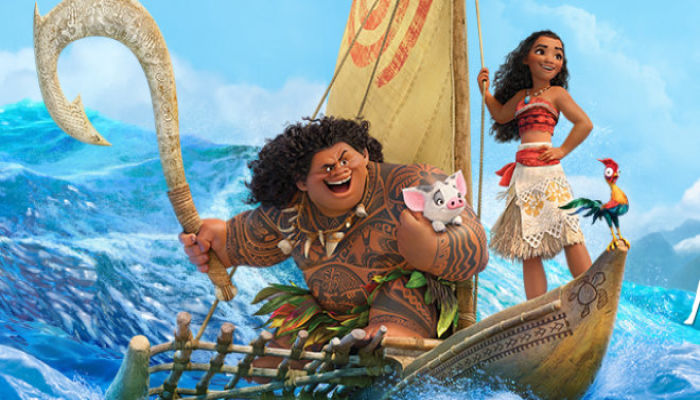
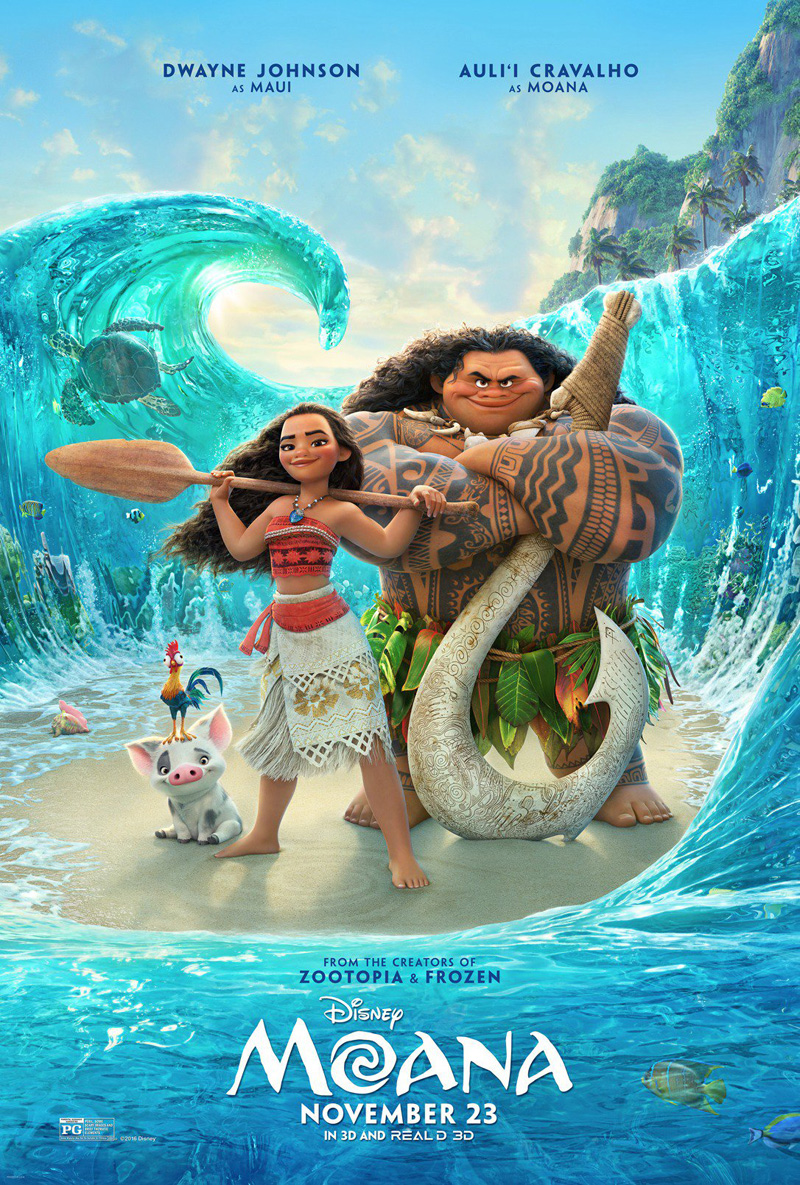
Once upon a time, the demi-God Maui (Dwayne Johnson) stole the heart of the island goddess Te Fiti, in order to give it to humanity. But he was attacked by the lava demon Te Kā and lost the heart and his magical fishhook. A thousand years later, Moana (Auli’I Cravalho), the daughter of the chief of her small island, grows to be a teenager who dreams of exploring beyond the reef. When her island’s crops start to fail, the Ocean chooses her to leave the island to find Maui and restore Te Fiti’s heart, in order to restore health to the world.

Moana is a charming, engaging and witty Disney movie, with strong, well-drawn characters, that immerses itself in its Polynesian mythology setting. What works about it – and what always puts Disney above its competitors – is that the film is interested in telling a story about characters who have real concerns and depth. Compare it to other, more stunted, “joke”-focused animations, produced by companies like Dreamworks, to see how far above those films it is. There are very few jokes here that will date (perhaps one about tweeting) – instead it’s a film that recognises its content for the adults doesn’t need to be sly film references or cheeky gags: a strong plot and engaging characters will entertain all generations.

One of the reasons the movie works so well is because Moana herself is a sympathetic, engaging heroine with dreams and aspirations, but who is still deeply respectful of her background. She’s not a rebellious teen, but someone who wants to improve the world around her, and is beautifully voiced by Cravalho. As such, she’s not only a great role model (take note parents!), but someone you end up totally rooting for. It also helps that she has a wonderful chemistry with Maui (very well voiced by a charmingly sparkling Johnson) – the film quietly subverts the expected Mentor/Pupil relationship between the two, as each teaches the other lessons both practical and spiritual.

Moana learns many of the lessons Disney picked up from Frozen. Like that film, it follows a free-spirited, independent-minded young woman not defined by a romantic interest. Its focus is on the lead overcoming a task to save her world. And it is built around an extremely catchy, very good song. How Far I’ll Go, Moana’s signature song (refrains of which are built into many of the other songs), is a sensational, powerful and tear-prickling power ballad about being yourself and following your own heart. It is remarkably easy to sing along with and carries a great message. It’s also got a brilliant popular appeal – I was stunned to see the YouTube video of it has over 141 millionhits (would that this site had so many). Many of the other songs are similarly excellent, especially the extremely hummable You’re Welcome (the songs are brilliantly composed by Lin-Manuel Miranda, Opetaia Foa’I and Mark Mancina).

Its visuals are outstanding, the animation terrific. I also really liked the way Clements and Musker embraced the strengths of silent characters, and the expressiveness animation can bring to characters. The Ocean, a clear character here who influences events, is nothing more than a shaped concentrated wave with no features, but has an expressiveness that makes it one of the wittiest characters in the film (memories of the carpet from Aladdin spring to mind). Similarly, the silent, dim-witted chicken Hei-Hei supplies many of the film’s laugh-out-loud moments. Maui’s body tattoos (wonderfully illustrated), moving and communicating silently with Maui throughout the movie, are terrifically innovative and feel unique.

Moana has a looseness and coolness to it that makes it an enjoyable, perfect viewing for a Saturday night. The storytelling is brilliantly done and the final confrontations are shot with a daring vibrancy that betters many action films. Clements and Musker have a mastery of the material that creates a gripping and involving story and characters. In many ways, it doesn’t do anything too unique or different from past Disney movies, but it tells the story with such charm and imagination that you’ll get totally wrapped up in it.