Tag: Literary adaptations

The Cider House Rules (1999)


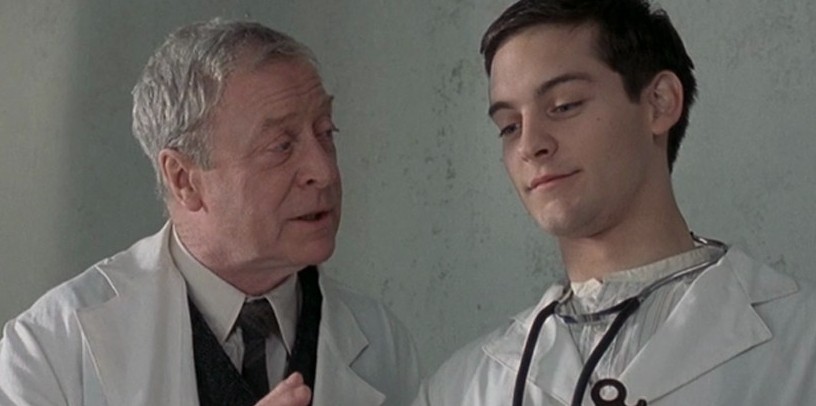
Michael Caine and Tobey Maguire deal with moral dilemmas in this handsome adaptation of John Irving’s Dickensian novel

Director: Lasse Hallström

Cast: Tobey Maguire (Homer Wells), Michael Caine (Dr. Wilbur Larch), Charlize Theron (Candy Kendall), Paul Rudd (Lt. Wally Worthington), Delroy Lindo (Arthur Rose), Erykah Badu (Rose Rose), Heavy D (Peaches), K. Todd Freeman (Muddy), Kieran Culkin (Buster), Jane Alexander (Nurse Edna), Kathy Baker (Nurse Angela), Kate Nelligan (Olive Worthington), J.K. Simmons (Ray Kendall) 

The Cider House Rules is the sort of well-constructed literary adaptation that Hollywood excels at producing: a well-crafted script (Irving adapted his own novel extremely well), juggling serious affairs without hectoring the audience, handsomely mounted, with a Dickensian style and a cast of heavyweight actors delivering performances that speak of their investment in the film.

In a Maine orphanage in the 1940s, Homer Wells (Tobey Maguire) is raised by Dr Wilbur Larch (Michael Caine) as a surrogate son. Larch is a domineering autocrat with a passionate love for his charges, whose humanitarian instincts lead him to perform illegal abortions. Troubled by this – and feeling pressured into succeeding Larch’s as director – Homer leaves with a young woman (Charlize Theron) and her fiancée (Paul Rudd) after she visits for an abortion. Working as an apple picker in their orchard, under Mr Rose (Delroy Lindo), Homer learns important lessons above love and duty.

There are many similar films that feel like dull awards-bait, and the fact that this one avoids that is a major point in its favour. It’s very easy with material like this – cute orphans and tear-jerking speeches – to feel Cider House is a manipulative film (and I guess in a way it is) but it’s put together with such commitment and sincerity I found it genuinely moving. Hallström’s warm and beautifully paced direction creates a marvellous coming-of-age tale with characters whose flaws can be as deep as their warmth is vibrant.

The film also manages to move beyond its ‘coming-of-age’ roots with intelligent (but not too heavy-handed) mulling on the nature of “rules” – both those imposed on us and those we impose on others. Dr Larch (a magnetic performance by Oscar-winner Michael Caine) is a maverick, disregarding the abortion laws as he believes it is better he does abortions rather than someone untrained; he is also perfectly willing to impose his own rules on Homer as testaments to be followed without question. Similarly the “Cider House Rules” written on the wall of the apple workers’ lodgings are rejected outright by the working gang for their own unspoken code of conduct, no more effective than the system it replaces. All the characters are forced to draft their own rules (or principles) they can live with, matching their circumstances and actions.

The film also looks gently at the conflict between our desires and our duties, with Homer and Candy both yearning for freedom from their natural inclinations to have something to serve. This is presented as a struggle without a natural “right or wrong”, even if the apple orchard is a loose Garden of Eden, into which evil is admitted with tragic (and life-changing) consequences. A small criticism would be that the charismatic warmth of Caine’s performance and the family atmosphere of the orphanage are so endearing that it does unbalance the dilemma Homer eventually faces – instead of the audience feeling as torn as Homer about whether he should stay or return, most audience members I think would want him to return to the orphanage forthwith!

Tobey Maguire is so perfectly cast as the naïve in some ways, wordly wise in others, old-boy-young-man that he effectively reprised Homer Wells as Peter Parker a few years later. His sweet face –uncomplicated innocence and charm are in every twitch of his smile – carries the film, and his easy-going desire for a simple life makes perfect sense of the character’s rebellion against Larch’s benevolent dictation. Equally good for me though is Theron as Candy. She is a wonderfully expressive performer: midway through the film she is caught off-guard by an overlong hug from Homer, and a series of conflicted emotions from shock, to guilt, to attraction play across her face.

There is hardly a weak performance in the film, with Hallström drawing excellent work from the young orphans. Amongst the sprawling, Dickensian feeling cast, Caine is marvellous as the part dictator, part humanitarian Larch making a larger-than-life character feel real and grounded. Lindo captures the pride mixed with arrogance of Mr Rose. There are plenty of other excellent performances, not least from Baker and Alexander as two contrasting nurses in the orphanage.

I almost feel slightly guilty for the impact Cider House Rules had on me. In many ways it’s exactly the sort of safe, middle-of-the-road “serious” drama that seems designed to attract the notice of Oscar voters. But it’s told with a great deal of skill and dedication, and delivers so many emotional moments with warmth and feeling, I found myself genuinely moved by it. In fact I felt a bit teary at least twice. This is closely linked to some excellent performances – and a wonderful swelling musical score by Rachel Portman – but despite being the sort of middle brow Hollywood film it’s fashionable (and easy) to attack, I thought this was engaging, moving and thought provoking from start to finish.
The Russia House (1990)


Connery and Pfeiffer go behind the Iron Curtain

Director: Fred Schepisi

Cast: Sean Connery (Bartholomew “Barley” Scott Blair), Michelle Pfeiffer (Katya Orlova), Klaus Maria Brandauer (Dante), Roy Scheider (Russell), James Fox (Ned), John Mahoney (Brady), Michael Kitchen (Clive), J. T. Walsh (Colonel Jackson Quinn), Ken Russell (Walter), David Threlfall (Wicklow)

Based on John Le Carré’s novel, The Russia House was one of the first espionage thriller films released after the fall of the Soviet Union, and therefore found itself exploring the curious impact of Glasnost on the games of one-upmanship that East and West played with each other.

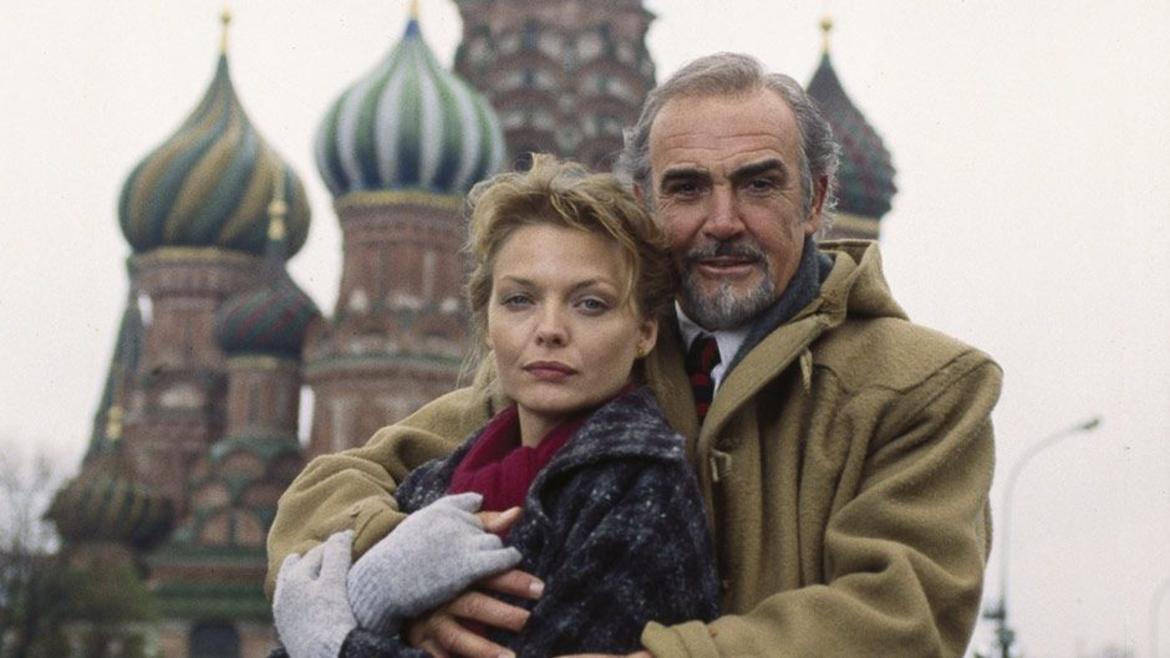
Barley Blair (Sean Connery) is an over-the-hill publisher with connections in Russia, who is enlisted by MI6 to recruit the mysterious “Dante” (Klaus Maria Brandauer, a little too mannered for the film and under used), whose manuscript about Russian nuclear readiness has been intercepted en route to Blair by the intelligence services. Blair’s main contact is Dante’s former lover Katya (Michelle Pfeiffer), a woman trapped in political games.

Second-tier Le Carré is brought to the screen in a film that perfectly captures the authorial voice, but missing  narrative drive. Tom Stoppard’s adaptation masterfully captures the nuances and rhythms of Le Carré’s writing – the conversations of the CIA and MI6 operatives, their lingo and phraseology, are a perfect evocation of the author’s style, while Barley comes to the screen as almost the quintessential disillusioned middle-aged romantic: scruffy with a drink problem and a public school disdain for the prefects of the intelligence service.

The film’s other major positive is the central performance of Sean Connery. The former James Bond (then in the middle of a five-year purple patch of great roles which ran from The Name of the Rose to The Hunt for Red October) brilliantly plays against type as the dishevelled Barley, a man who feels like he has spent a lifetime circling failure and unreliability. Connery tones down his athletic physicality as an actor, playing Barley as a shuffling, hunched figure, often a step behind those around him. He’s also able to capture the romantic defiance behind Blair as well as a sadness and a self-loathing, his eyes showing years of shame at his own unreliability and the disappointments he has inflicted on people. It’s one of his least “Connery-like” performances, and a real demonstration of his willingness to stretch himself as an actor.

He’s well matched by some fine supporting performances. Pfeiffer is a very good actress who balances Katya’s vulnerability with a shrewd understanding of the compromises and dangers of the world she is in. Having said that, the chemistry between her and Connery doesn’t quite click into place during the course of the film. There are also good performances from James Fox and Roy Scheider as feuding intelligence boffins, and an eye-catching “love it or loath it” one from Ken Russell playing one of Le Carré’s quintessential campy, eccentric public-school intelligence operatives.

The film’s main weakness is that the actual story just isn’t quite interesting enough. The stakes never feel as high as they should be, and the unfolding of events seems unclear rather than carefully concealed from the audience. Despite the actors’ performances, Blair and Katya aren’t quite characters we can invest in enough and the momentum of the film too often gets bogged down in a reconstruction of intelligence agent squabbles. Schepisi films the Russian locations extremely well, but too often the camera lingers lovingly on a series of locations like a travelogue, slowing down the pace of the film as the film revels in its status as only the second Hollywood production allowed to film in Russia.

It’s an intelligent and faithful adaptation, but it doesn’t quite come to life. Stoppard’s script doesn’t carry enough narrative thrust and you simply don’t care enough about the fates of many of the characters. In many ways, a less faithful adaptation – such as the BBC’s recent production of The Night Manager – might well have made for a more compelling movie. As it is, although the film feels like an immersion into the author’s universe, it also feels like a dip into one of the less engaging and memorable offerings in his back catalogue. Along with the book’s strengths, it also carries across weaknesses. It’s satisfying enough and doesn’t outstay its welcome – but it also never really seizes the attention.

Howards End (1992)


Emma Thompson and Anthony Hopkins discover marriage is never an easy business

Director: James Ivory

Cast: Helena Bonham Carter (Helen Schlegel), Anthony Hopkins (Henry Wilcox), Vanessa Redgrave (Ruth Wilcox), Emma Thompson (Margaret Schlegel), James Wilby (Charles Wilcox), Samuel West (Leonard Bast), Nicolas Duffett (Jacky Bast), Jemma Redgrave (Evie Wilcox), Susie Lindeman (Dolly Wilcox), Prunella Scales (Aunt Juley), Joseph Bennett (Paul Wilcox), Adrian Ross Magenty (Tibby Schlegel)

From the mid-1980s to the late-1990s, Merchant-Ivory was the by-word for a certain type of film-making: intelligent and sensitive adaptations of books, with fine British actors in wonderful costumes. It was a perfect brand. And it probably reached its peak with this masterful adaptation of EM Foster’s precise, tragi-comic analysis of class in Britain.

Set in Edwardian England, the film focuses on three very different families: the Wilcoxes, grown wealthy off the back of the Empire, who have purchased large chunks of the houses and lands of the former aristocratic elite; the Schlegels, an upper middle-class family of intellectuals; and the Basts, a lower middle class couple trying to improve their lot. Ruth Wilcox (Vanessa Redgrave) befriends Margaret Schlegel (Emma Thompson) in the last few months of her life and, on impulse, leaves Howards End, her beloved family home, to Margaret when she passes away. With the agreement of his children, her husband Henry (Anthony Hopkins) destroys the note, but later falls in love with and marries Margaret. Meanwhile, Margaret’s sister Helen (Helena Bonham Carter) struggles to help improve the lot of thoughtful, well-read insurance clerk Leonard Bast (Samuel West) – with disastrous results.

The film balances these varying plot lines with great skill. It weaves in both well-judged social commentary and a shrewd and subtle analysis of the way perceptions of morality (and the consequences of people’s actions) alter dramatically depending on the class and sex of the person perpetuating the societal offence. Helped by Ruth Prawer Jhabvala’s masterful (and Oscar winning) screenplay, Ivory’s direction balances this acute scrutiny with an emotional and deeply involving story, staffed with characters whose dignities and flaws are humanly observed. Ivory and Jhabvala demonstrate a masterful understanding of the way we build stories about our own lives and create the people we want ourselves to be – and how this can be influenced by the results of our actions.

These self-images people create of themselves in the film are invariably more noble than the people they transpire to be. Of all the characters, arguably only Leonard Bast follows up on his intentions and consistently delivers on his word. It’s a tribute to Samuel West’s wonderful performance as Bast, as well as the film’s control, that Bast is both a tragic victim and also at times an almost painfully pathetic character, a striver whose every attempt to improve his lot ends in disaster (the film also sticks to Forster’s darkly comic fate for Bast).

While the Basts constantly pay a heavy price for every action, the Wilcoxes and Schlegels largely avoid paying any price for their mistakes until the end. Indeed, Henry Wilcox seems barely able to understand that his past love affair with a young woman left him with a certain moral responsibility for her fate after he broke the affair off. In a brilliant series of short scenes (with fades to black between each section of the conversation) we see him painfully confess the story to Margaret; the fades perfectly capture the mood of a broken up and difficult emotional moment for both characters.

The film perfectly understands the hypocrisy of the upper classes. Wilcox is a man of complete certainty and off-hand confidence, making sweeping statements with complete authority, who has no empathy with the lower classes: “The poor are poor. One is sorry for them, but there it is”, he blithely tells the Schlegels. His son Charles (a smackable James Wilby) is a spoilt and selfish snob with only contempt for anyone lower than him on the social ladder. Helen’s later fall from grace (in its way a manipulation of those dependent on her) is met with a condemnation Wilcox never imagines should never attach to his own actions. The whole film is a brilliant tapestry of these contrasts and flaws.

Emma Thompson won an Oscar for her work here, and she does a wonderful job as the emotional heart and conscience of the film, essentially our eyes into the events of the story. Intelligent and with a deep sense of morality, Margaret is also a woman who is willing to make compromises when she judges there is the need. Her decisions are not always correct or justifiable, but Thompson makes her struggle between her need to do the right thing and her desire to find happiness with her husband constantly understandable. In addition to this, Thompson is a radiant and engaging presence, allowing a character verging at times on being a matronly fusspot to always be someone we care deeply about.

She’s matched by a complex and thoughtful performance by Hopkins as Henry Wilcox. Hopkins has a brilliant understanding of the essential moral emptiness of Henry, based not on any malice or cruelty but on a genuine belief that some rules can be applied differently to him because his position and his own self-image reassure him that he is a good man. One of the film’s main subplots is the journey of Henry to understanding his actions have had consequences – and that these consequences reflect on him. Hopkins handles the growing awareness of this with brilliant sensitivity – his late emotional collapse is a masterclass in low-key, elegant, but deeply moving, acting. It’s also a tribute to the film’s mastery that Wilcox (despite basically being a cold, thoughtless snob) remains a character we relate to, understand and forgive.

Sex bubbles under in this Edwardian world. Henry’s sexual history is a crucial turning point. Helen’s freer attitude to love first brings the Wilcoxes and Schlegels together and then later leads to disastrous consequences with Bast. Tied directly in with the class issues in the film, Charles (James Wilby) is determined later to defend her honour, despite Helen having no wish for him to do so. There is even a hint of sexual feeling in Ruth Wilcox’s sudden friendship with Margaret. Alongside this run themes of the slow and deliberate way relationships develop: Margaret and Henry’s relationship takes the whole course of the film to reach a proper understanding, while Helen (and Helena Bonham Carter is wonderful here as a faintly skittish well meaning do-gooder) and Bast’s friendship shifts and changes throughout the course of the film without either really understanding the other.

Howards End’s complexity is of course in large part due to EM Forster’s original source novel, and his insight as a commentator on Edwardian England and its morals. But to capture so much of the air of the novel in this film, and to bring the story so richly to life, is an enormous tribute to the mastery of Ivory and Jhabvala’s work here and to the excellent work of the cast. The production values are exceptional of course and the film is told with pace, zip and feeling. If there was a high point for the costume drama this (and their follow up picture, The Remains of the Day) was it. Merchant-Ivory would never hit these heights again.

Great Expectations (2012)


Ralph Fiennes is ‘Ungry

Director: Mike Newell

Cast: Jeremy Irvine (Pip), Holliday Grainger (Estella), Helena Bonham-Carter (Miss Havisham), Ralph Fiennes (Magwitch), Robbie Coltrane (Jaggers), Jason Flemyng (Joe Gargery), Ewen Bremner (Wemmick), Sally Hawkins (Mrs. Joe), David Walliams (Pumblechook), Tamzin Outhwaite (Molly), Ben Lloyd-Hughes (Bentley Drummle)

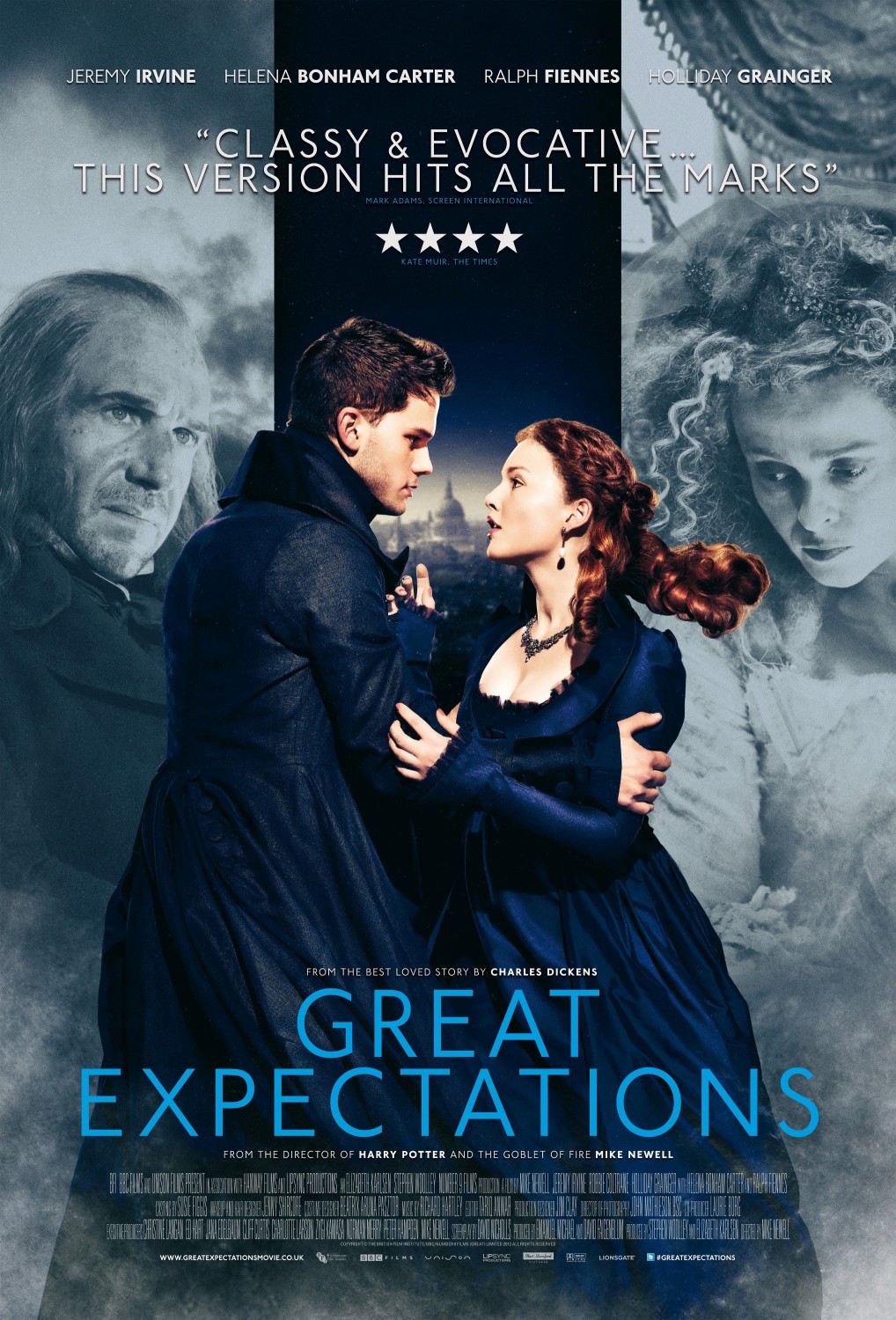
There is one major problem with Mike Newell and screenwriter David Nicholl’s faithful adaptation of Great Expectations, one of Charles Dickens’ best loved novels. It’s such a faithful adaptation that it largely fails to say or do anything unique or interesting with the actual source material itself. Thus it basically joins the parade of adaptations of this novel on film, struggling to define itself from the competition.

For those who don’t know the story: young Pip has two defining encounters in his childhood. One is with escaped convict Magwitch (Ralph Fiennes), to whom he provides some help; the other with eccentric, secluded spinster Miss Havisham (Helena Bonham-Carter), who brings him in as a playfellow for her ward, Estella. As a young man, Pip (Jeremy Irvine) finds himself coming into “great expectations” from a mysterious benefactor, and moves to London where he encounters Estella (Holliday Grainger) once more.

Nicholl’s screenplay is a careful ticking off of all the events you would expect to see from either the book or previous versions: “I’m hungry boy”? Check. Mrs Joe? Check. Boxing with young Herbert Pocket? Check. Jaggers and Molly? Check. Wemmick, the Aged P and the cannon? Check. Bentley Drummle? Check. Joe Gargery in London? Check. Fire? Check. And so on, and so on. What’s really missing from the film is any sense of identity, any sense of a story it wishes to tell, or angle it wants to take on the source material. Instead it’s a picture book accompaniment to the novel. A beautifully filmed one, I will say (John Mathieson’s photography is lavishly good, and brilliantly captures the wide-open spaciousness of Kent compared to the dank, claustrophobic confines of London) but still a picture book.

It’s also decently acted throughout, with Jason Flemyng a stand-out as a decent, kind and loveable Joe (a part I think it’s almost impossible to fail in). Robbie Coltrane makes Jaggers a creepy charmer. Helena Bonham-Carter is, as one reviewer said, “almost too perfect casting” as Miss Havisham – her performance is a bit too familiar as a remix of her parts in Tim Burton films and Bellatrix Lastrange – but she is still very good in this role.

The closest the film gets to putting a twist on the novel is to front and centre the love-story angle between Pip and Estella. Even this, though, is not completely successful, largely due to time. Irvine and Grainger are fine performers (Grainger in particular does an awful lot with what can’t be more than 10-15 minutes of screentime), but adult Pip and Estella don’t have a scene together until halfway through the film. The film also is reluctant to lose anything major from the Gargery or Magwitch plotlines, meaning these get equal weighting with the Estella scenes. It’s possibly the only area where this adaptation is weaker than the BBC adaptation of a few years later, which effectively repositioned the story with a focus on father-son relationships, adding greater prominence to the Pip-Gargery-Magwitch relationships.

Mentioning that BBC adaptation makes a key point about the lack of individuality this production has. Casting my mind back to it, I found it very hard to remember or distinguish the differences between the two – both looked very similar, took similar decisions and featured similar casts. In fact, it became very hard to remember who was in what – an internet search for images for this film throws up plenty of images of Douglas Booth from the mini-series. It’s a small point, but I think captures the lack of uniqueness about this film.

I’ve been very hard on this film, which I feel a bit bad about as it is a very watchable and loyal adaptation and a perfect entry point for Dickens. It also has, in Ralph Fiennes, one superb performance. Of all the versions of Magwitch on screen, this surely has to be the best. Fiennes has the physicality and danger the role needs, but he also has an ethereal, almost child-like quality to him. You can believe this is a dangerous man, but also understand how he can be so passive and easily led. Fiennes’ Magwich takes a delight in the seeing the pleasures of others and has a sweet dedication to his own codes of loyalty. It’s a terrific performance – and actually emerges as the one unique and defining thing the film has to offer.